New Mexico – Part 1 – Getting to 50+ Species and Wonderful Bosque del Apache

The government shutdown was in day 26.  TSA employees had already missed a 2 week paycheck and there was no way to know when the next one would be coming.  There were news stories about backlogs and potential delays at security checkpoints at the airports.  My flight was due to depart Sea-Tac Airport at 5:25 p.m.  I am always early, but this time I wanted to be sure to allow time – just in case…

I got through security in exactly two minutes.  I thanked everyone for coming to work despite the shutdown.  I was now 90 minutes ahead of departure time.   Travel last year had earned me MVP status with Alaska Airlines and I had been upgraded to Premium Class.  More leg room and more importantly to me – early boarding and sitting closer to the front, I would get off the plane early as well.  The trip was off to a good start.  Landing in Albuquerque 10 minutes early, a quick shuttle to the rental car center, an unasked for upgrade and quick processing by Alamo, and a 10 minute drive to my hotel continued the good start.  Clear skies and without wind was forecast the next day.  All good.  I was ready to bird.

In planning the trip as part of my 50/50/50 project, the key was to find a good local resource hopefully to be able to join in the field or at least to get useful input to help find my needed 50 species in a day.  As I often do, I started with the local Audubon Chapter – in this case Central New Mexico Audubon.  It turned out to be a great one stop answer to my needs.  I found a field trip to the Alameda Open Space and Bridge scheduled for January 17 led by Barbara Hussey.  Her contact information was included and I sent her an introductory e-mail. She responded positively saying I could join their group.  She shared probable species to be seen and over the course of other e-mails and a phone conversation, she helped me plan an itinerary both to get my 50 species and also to see some of the birds and places I hoped to visit.  She was terrific.

If I had done my homework a little better I would have found that Barbara was the author of “Birding Hotspots of Central New Mexico.  She and co-author Judith Liddell knew as much about birding in this area as anyone.  Both were also very active in the birding community and as it turned out Judith was also going to be on the field trip.  Sometimes it is better to be lucky than good.
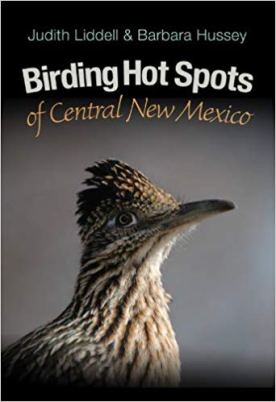
birding hotspots of central new mexico

The Audubon trip was scheduled to start at 9:00.  I wanted to arrive early figuring to do a little birding on my own, knowing that since the maximum number of species to expect was between 25 and 30, I would have to leave before the projected 12:00 p.m ending to be able to get to other places.  On the way over I was struck by the number of Rock Pigeons.  They seemed to be on every wire and flying over every road – I must have seen 200.  This theme continued during my entire visit.  I saw far more Rock Pigeons in and around Albuquerque than I have seen anywhere else – even in big cities.

Next I picked up a few species in the adjoining neighborhood including Great Tailed Grackle which had not been on my radar screen but is common in the area.  At the Alameda Open Space Park, my first birding was a small pond immediately next to the parking area.  It was full of ducks but only a couple of species – almost exclusively Wood Ducks – at least 70.  What a beautiful start to the day.

Wood Duck

wood duck1

A Black Crowned Night Heron was also in the pond.  It turned out to be a good thing that I saw it early as it was not there later and to see one would have extended my stay on the trip.  I did not know that at the time, or if they were easy to find anywhere else.

Black Crowned Night Heron

black crowned night heron

The meet up place for the trip was the parking lot and by 8:45 birders were starting to arrive.  Lots of birders.  Lots and lots of birders.  I met Barbara and saw that she was going to have her hands full leading this big group.  When the decision was made to split the group into two, with the second group led by Judy Liddell, I decided to join her group not wanting Barbara to feel she had to “hold my hand”.  Judy was great and the group was fun.  It was mostly beginning birders although a couple of them were well beyond that.  Trips like these are great for birding and are one of the important things that Audubon chapters do all over the country.  I am sure that there were at least 50 people and all seemed to enjoy the time – seeing birds and learning about them – and just having a good time.  A large group is not the best way to maximize the number of species seen, but Judy was excellent and the area along the Rio Grand River was good habitat with a mix of water birds, passerines and a few of these and a few of those.  I spent about 90 minutes with the group and ended up with 32 species – more than expected and a good start to the day.

Barbara, Judy and a couple of the local birders gave lots of suggestions for next places to go, but it was clear to me that my best chance to maximize species would be to get to Bosque del Apache NWR – high on my “I want to visit this place” list.  This had been a great start to the visit at least as much due to the people as the birds.  Birding can be a very social activity and this was such at its best.  I am sure I would greatly enjoy more time with Barbara and Judy and with many of the birders…particularly…well that would take me off topic.  😉

I have learned that often in trying to get to 50 species in a day, there are flybys on the roads between birding destinations that could prove to be a much needed sighting for the day.  On my way to Tingley Ponds I picked up an American Kestrel and a Downy Woodpecker.  I expected to see more of the former but the Woodpecker was a miss at Alameda so I was glad to see one.  I was unsure of how to cover Tingley Ponds which I was told would add several duck species plus a Neotropic Cormorant.  I never saw the Cormorant although I learned later that I had been looking in the right place.  I added only two duck species and a Pied Billed Grebe.  There were lots of people walking or fishing in the area and I probably just did not give it much of a chance.  I left after just 10 minutes with my species count at 37 for the day.

My pre-trip research had identified Valle de Oro NWR as a good place to bird and it was also highly recommended by Barbara and Judy.  It was on the way to Bosque del Apache and just off the main road.  The first four birds I saw there were new for the day:  European Starling, Say’s Phoebe, Common Raven and Chihuahuan Raven.  The latter was a challenging ID.  I saw more than 50 Ravens.  At least two of them were much smaller with relatively  small bills.  They were in flight so I could not see any white feathers on the neck a feature not always visible and which was the basis for them previously being called White Necked Ravens.  They are regular at this location, so I was good with the check mark on my list.

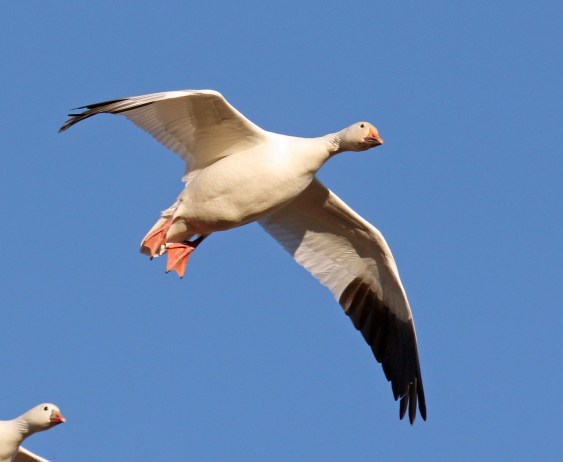
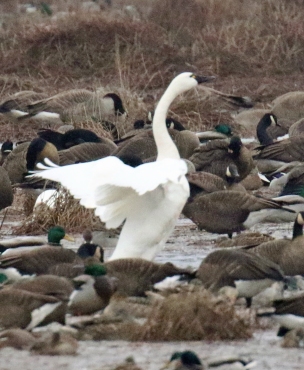
Most notable at Valle de Oro were the flocks of Sandhill Cranes and Snow  Ross’s, Canada and Cackling Geese.  All of the geese except the Canada Geese were new for the day.  I am sure there were more mixed in, but I was pleased to identify a handful of the smaller Ross’s Geese among the Snow Geese.  These are very uncommon in Washington.  I would see many more later in the day. Recent visits to the Refuge had produced Ferruginous Hawk, Greater Roadrunner, Prairie Falcon and several other good birds, but I found none of them.  More time and local birder input would likely have made a difference but I was now at 44 species and thought some of these misses might be found at Bosque del Apache and I was eager to visit this famous place.  It was 92 miles south but with the speed limit at 75 (I love you New Mexico) and a bit of a fudge factor that seemed to be used by New Mexico drivers that meant it was barely 75 minutes away – lots of time.
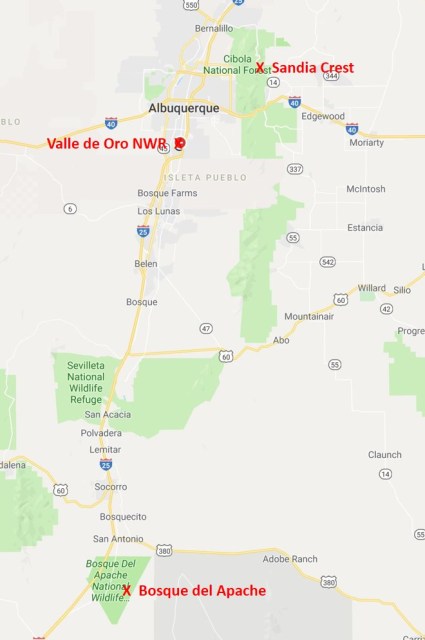
nm

There will be lots of details to follow but the bottom line is that Bosque del Apache was FANTASTIC!!  Overall the “Woods of the Apaches” is over 55,000 acres with the heart of the refuge being about 4,000 acres easily accessed by a double loop road that is about 12 miles long.  I spent about 3 hours at the Refuge which was not nearly enough – driving most of the loop road and getting to the very birdy visitor center after it closed and too late for as much birding as it justified in the fading light.  Ebird shows 366 species for the refuge – an incredible list.  However it is the number of individuals that may be more impressive as many waterfowl species are present in the thousands as are the Sandhill Cranes.  It was easily one of the favorite places I have birded.

On the road into the Refuge I had a single Prairie Falcon, a single Greater Yellowlegs (joining Killdeer as my only shorebirds for the day), several Loggerhead Shrikes and two Western Meadowlarks – surprisingly the only ones I saw.  I also added a Northern Harrier, Mourning Doves, Green Winged Teal and Northern Pintails to reach 50 species for the day.  With that mission accomplished, all pressure was off and I forgot about numbers and just enjoyed the beautiful day at an amazing place.

Western Meadowlark (Eastern Meadowlarks are also at the Refuge but have a white malar) – This was the 50th species for the day.

western meadowlark1

Loggerhead Shrike (Northern Shrikes are also found in Winter but are much rarer and have a much narrower eye stripe/patch)

loggerhead shrike

Twenty-six duck species have been reported at the Refuge – with 17 present in January.  I did not check every duck there and had 11 species with Northern Pintails seemingly the most numerous.  The biggest waterfowl show was the large numbers of both Snow Geese and Ross’s Geese in mixed flocks.

Goose Raft

mixed flock of snow and ross's geese

Snow Goose

snow goose flight1

Ross’s Geese (with Snow Geese) – Can readily see size difference

ross's geese

I saw fewer raptors than expected – only a few Red Tails, a half dozen Bald Eagles and a few American Kestrels.  The one exception was a good number of Northern Harriers.  One was feasting on a Snow Goose in shallow water.  I have never seen a Harrier kill a Snow Goose in Skagit and Snohomish Counties in my home state Washington although both species are plentiful there.  I do not know if this was a kill or scavenging but a good photo opportunity.

Northern Harrier with Snow Goose

northern harrier on snow goose

A typical scene in the many fields would be flocks of Sandhill Cranes with Snow, Canada and Ross’s Geese and some duck species.  I did not try to count the individuals or scan for different species – just enjoyed the spectacle.  Thousands of birds.

Typical Scenes

sandhill crane

typical scene

Towards the end of the loop, it was getting later and many Cranes, Geese and Ducks were on the move.  It was still four days away from the full (Wolf) moon, but the already large moon did provide an interesting photo opportunity as a backdrop for the birds in flight.

Moon Mallards

moon mallards

Another treat as dusk approached was a large flock of Wild Turkeys – over 125 in a single group.  I had hoped to see quail on the drive but to this point the Turkeys were the only gallinaceous species found.

Wild Turkey

wild turkey2

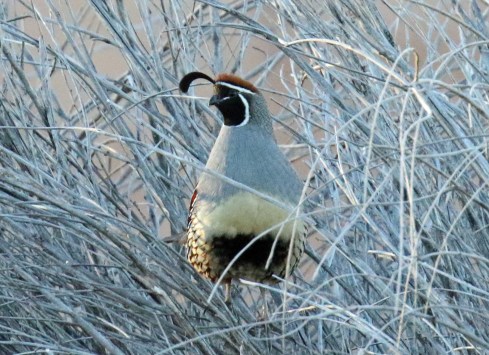
I wish I had had more time and especially wish I had processed how good the birding was at the Visitor Center.  It was almost 5 p.m. when I got there and the light was getting low.  There were lots of birds including more than 125 Gambel’s Quail,  They seemed to flush from everywhere.  Other treats there were a Curve Billed Thrasher, some Lesser Goldfinches and a couple of Pyrrhuloxias – one of my favorites.  273 species have been record at the Visitor Center with over 70 reported just this January.  I only had ten in the 20+ minutes I was there – completely alone.  There are feeders and native plants – really a great place.  I will get back.

Pyrrhuloxia
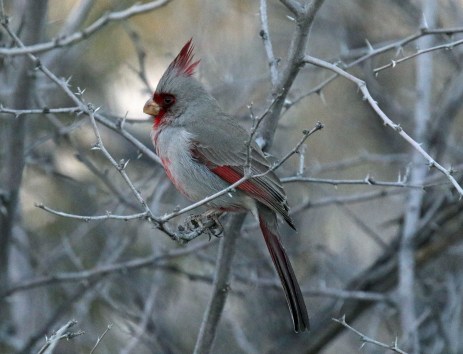
pyrrhuloxia2

Gambel’s Quail

gambel's quail1

Now the light was really low with the sun setting over the low hills to the west.  Time to go.  It had been a fabulous visit.  Without really trying to get a high species count, I had seen 38 species at the Refuge, so so but the quality of the experience was outstanding.  There would be one more species and a closing spectacle.  I headed to two ponds at the North end of the Refuge on the main road.  It was the “fly-in” spot at dusk for the Sandhill Cranes.  Just before getting there, I saw a familiar silhouette on one of the telephone poles – a Great Horned Owl.  It would turn out to be the only Owl I saw on my entire trip so I include the photo despite the poor light.

Great Horned Owl

great horned owl

The Sandhill Crane fly-in was as fitting a way to end a great day as one could hope for.  There were already many photographers and gawkers there when I arrived.  There were hundreds of Cranes already in the pool, their raucous calls filling surrounding us and they just kept coming and coming.  I did not stay until the end so I do not know the total, but there are many thousand Cranes on the refuge.  I took some videos and lots of photos.  An almost spiritual experience.

Sand Hill Crane Fly-in Spot

sandhill crane sunset

It seemed like ages ago that I had left the Audubon Group at Alameda Open Space.  The wonders of Bosque del Apache had not erased but had overshadowed the birding in the morning.  The Great Horned Owl was the 62nd species seen during this day making New Mexico the 24th state where I have now seen 50 species in a day.  All of those days have been great and this one ranks high.  There are many places I have birded that I hope to revisit.  This is definitely one of them.

Bosque del Apache
bosque del apache

New Mexico Part 2 – Foothills and Mountains – Jays and Rosy Finches

When I planned my trip to New Mexico, I had two important goals.  The first – satisfied on day one and detailed in my first New Mexico Blog Post – was to find 50 species in a single day.   I believed a visit to Bosque del Apache would play an important role in doing that.  It did but had I known how much I would enjoy that place, I would have made birding there as an essential part of my trip independently of just finding more species.  My second goal was to visit Sandia Crest to see the three species of Rosy Finches:  Gray Crowned, Brown Capped and Black.  I had seen them at the Wildernest Community location in Colorado on April 9, 2016 but the views and photos of Black Rosy Finch were limited and unsatisfactory.  Sandia Crest is THE place to go to get good looks at all three species – especially at the feeders maintained by the Sandia Crest Gift Shop and Cafe.

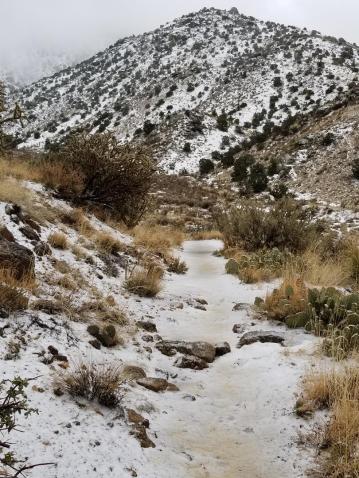
With two days still available, I debated whether to wait until my last day to go to Sandia Crest or to try it on Friday.  A heavy wind was projected for Friday afternoon – not good for birding or possible tourist activities.  Saturday was supposed to be better.  I decided to bird in the foothills outside of Albuquerque in the morning and then maybe head up to Santa Fe later – revisiting one of New Mexico’s major attractions.  I chose Embudito Canyon, northeast of Albuquerque as my birding spot.  It had rained over night and when I got to the Canyon, it was covered with a few inches of snow and it was snowing very lightly.  It was beautiful!!

The Trail at Embudito Canyon

scene 1

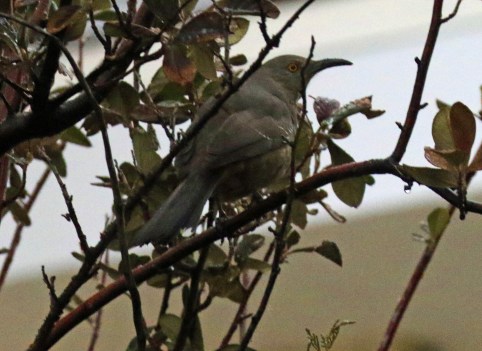
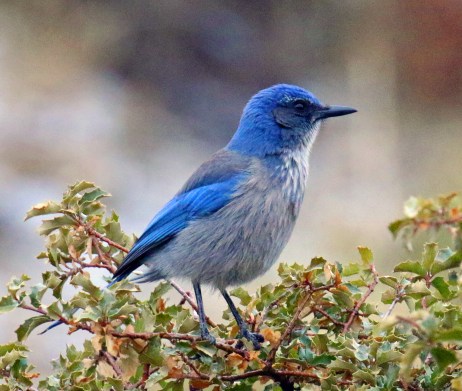
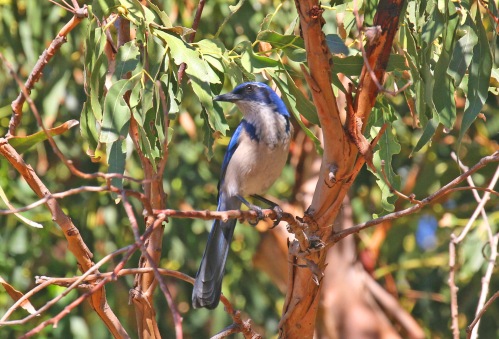
Like in Arizona, habitats here change dramatically and quickly as soon as you leave the flatlands and get into the foothills and gain elevation.  I found myself in the land of cactus and sage and low shrubs with some oaks and pines.  I also found myself immediately with birds.  The first was a Curve Billed Thrasher buried in shrubs at the last house before getting into the Park itself and the second was a Woodhouse’s Scrubjay.  I had first seen the latter in Colorado in 2016 and then later had them in Arizona in 2017 and in Texas in 2018.  I had photos from those visits, but none were great.  This one was much better.

Curve Billed Thrasher

curve billed thrasher

Woodhouse’s Scrubjay

woodhouse's scrubjay1

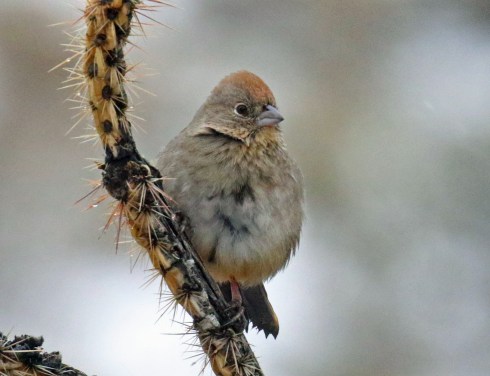
A photo that I missed was of a Cactus Wren.  It popped up about 1/4 mile up the trail and then disappeared rather than perching in the open as I have seen them do before.  Instead I got a photo of one of what seemed to be a pair of Canyon Towhees, a nondescript but attractive species.

Canyon Towhee

canyon towhee3

The most numerous birds were Dark Eyed Juncos which seemed to be everywhere.  I estimated there to be at least 70 but it well could have been over 100.  And there were some of many of the different forms – Slate Colored, Pink Sided and Red Backed.  They were extremely skittish and would disappear quickly into the brush.

Dark Eyed Junco – Red Backed

dark eyed junco

It was great fun to walk alone in the canyon.  The snow had no other footprints except for some deer and it was eerily quiet as the snow cover muffled all sounds except for a few bird calls.  The vegetation changed the further up I went and it is at times like these that I wish I knew more about plants.  I believe the photo below is of a Tree Cholla Cactus.  Some Desert Prickly Pear can be seen in the background.

Tree Cholla Cactus

ocotillo

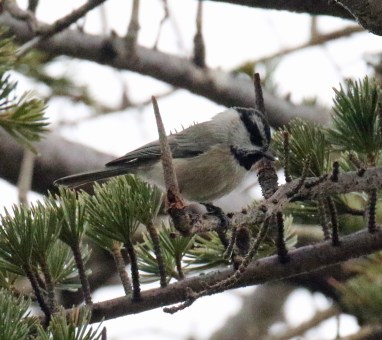
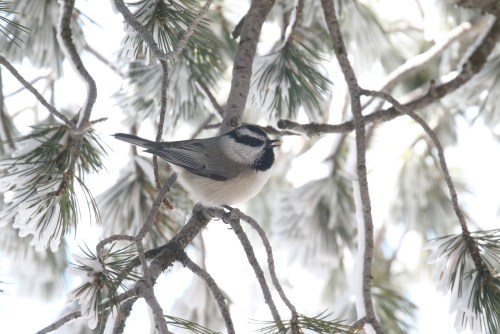
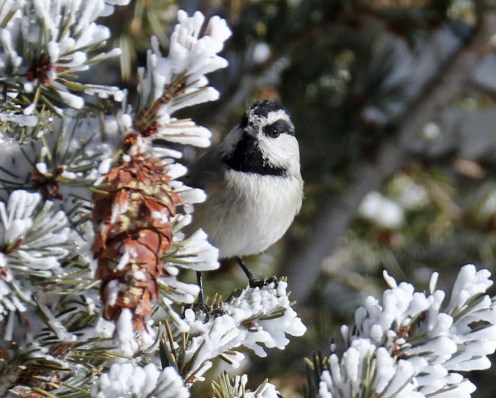
The place was so different from what I see in Washington.  It was peaceful and restful but at the same time energizing.  The lightly falling snow added to the magic of the place.  I think I was still somewhat on a high from the visit to Bosque del Apache and this place took me to a higher place – both literally and emotionally.  The last bird I saw in the canyon was a Mountain Chickadee, a species that always brings a smile as well.
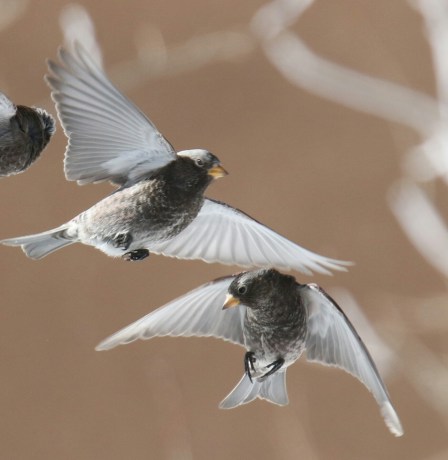
Mountain Chickadee

mountain chickadee

A good indication of just how different this habitat was from the ones I birded the previous day is that while there were only 12 species seen, 50% of them were new.  Now what?  I had so thoroughly enjoyed this visit that I abandoned plans to go to Santa Fe and decided to head to Sandia Crest which was less than 30 miles away.  It turned out to be a bad decision.
As I headed further east before going higher into the Sandia mountains and the Cibola National Forest, there was no snow on the roads although some could be seen in the hills.  The elevation of Albuquerque is just over 5,200 feet and Embudito Canyon is around 6000 feet.  Sandia Crest i is almost 11,000 feet.  My rental car was a front wheel drive which I thought would be sufficient as I expected that the road would be plowed since it was the way to a major ski area.  But I had not figured in just how much snow had fallen on the mountain the night before or that the snow plows would not have removed much of the snow past the ski area.  The last 15 miles of the trip were on a winding road with sharp turns and still some snow.  I went very slow and was doing ok until bout a mile before the ski area – which was still 6 miles before the crest.  Even though I was following right behind a working plow, I felt there was just no way I was going to make it and if I got stuck I would be in serious trouble.  So an hour into the ascent, I turned back.  It was now around 11:30 a.m.  Where to next?

When I got back to the west side of the Sandia Mountains it was almost 1 p.m. and the wind had picked up substantially.  I considered going to Sevilleta NWR – about 30 minutes north of Bosque del Apache.  I also considered going to Santa Fe about an hour and a half north.  But the wind was a deterrent.  I decided to bird a bit at Rio Grande Nature Center, a place highly recommended by one of the better birders on the field trip the previous morning.  I added a couple of duck species but the wind was now very strong and when I went into the bosque – the woods – I found almost no birds.

A friend had visited nearby Petroglyphs National Monument and said there were a few birds and  the petroglyphs were interesting.  My friend had visited before the government shutdown.  The Monument was closed to traffic and the visitor center completely shutdown.  I tried an alternative entrance which was at least open to parking but by then the wind was gusting over 40 mph.  I admitted defeat and returned to my hotel conceding that some additional sleep might be the best idea anyhow.  The weather was supposed to be crystal clear the next day, wind free and warmer.  I would try Sandia Crest again, but I was still worried about the roads as many parts of the road would not be in the sun and it was unclear how much snow would remain.  I had a plan to solve that if my rental car company would help.

alamo

My rental car was from Alamo.  From my hotel I called customer service and asked if I might be able to exchange my vehicle for an SUV.  I spoke with Renee who was very friendly, understanding and helpful.. She checked Alamo’s inventory at the airport and found that they had no SUV’s but did have 2 trucks with 4 wheel drive.  She could not reserve it for me but said all I had to do was go to the return center and work it out there being sure not to let them check me out before securing another option.  She expected an upgrade fee of not more than $30.00 or so for the one day exchange.  To me that was worth it.  The return place was barely 5 minutes from the hotel.  Bottom line is that Alamo was terrific.  Kenny, who turned out to be the manager, got me into a 4 wheel drive pickup within 2 minutes.  We modified the paper work and I drove off – without an up charge.  The whole process took less than 10 minutes.  When I got back to the hotel, I called Customer Service, expressed my gratitude and gave an outstanding review naming both individuals.  The representative I talked to was very appreciative since in general people call to complain and not to say thank you.  Thank yous are very powerful.

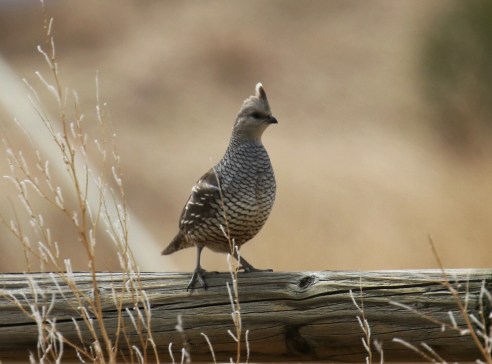
The plan for Saturday was to get to Sandia Crest after 10:00 a.m. which is when the Gift Shop opened.  I filled in the early morning with another visit to the foothills, this time to the Elena Gallegos Picnic Area – an Ebird Hotspot.  I was hoping to see a Juniper Titmouse but the main target was a Scaled Quail – possible if unlikely.  At the entrance building I paid my $3.00 fee and had a great talk with the Ranger.  He gave some birding suggestions in the park.  We also talked about Sandia Crest and Bosque del Apache.  I entered the park and headed off to a spot he said at least had a chance for Scaled Quail.  As I approached the area, another visitor came speeding by from the opposite direction.  Three birds flushed – one was a Mountain Bluebird, one a Western Bluebird and the other was — a Scaled Quail.  It had been on the side of the road and headed into the brush.  I prayed that it would land not too far away but no luck and it was gone.  It was a “want” and not a “need” as I had a good sighting and photo from Colorado but they are neat little birds.  Sigh…

Scaled Quail (from Colorado in 2016)

42-Scaled Quail


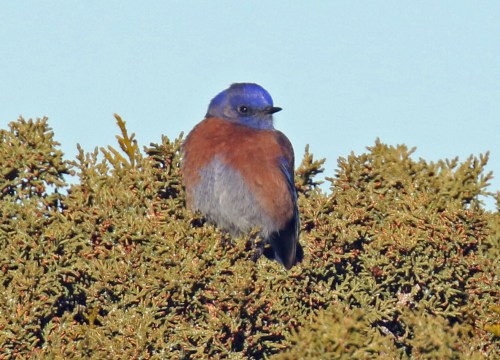
Missing the flushed Western Bluebird was no problem as they were abundant in the park.  I expected to see many Mountain Bluebirds but no more were seen. The skies were also bright blue, so maybe they just blended in too well.  Not so colorful were two other birds seen in good numbers:  Juniper Titmouse and Townsend’s Solitaire.

Western Bluebird

western bluebird1

Juniper Titmouse

juniper titmouse1

Townsend’s Solitaire

townsend's solitaire1

As had been the case at Embudito Canyon, there were also lots of Dark Eyed Juncos of several forms and many Woodhouse’s Scrubjays.  There was one more new bird, a Ladder Backed Woodpecker.  Only 9 species were seen at this spot in the 55 minutes that I was there, but 5 of them were new for my trip.  I really enjoyed the place and my first ever truck was performing great.  It was time to head to the Crest!!

Ladder Backed Woodpecker

ladder backed woodpecker1

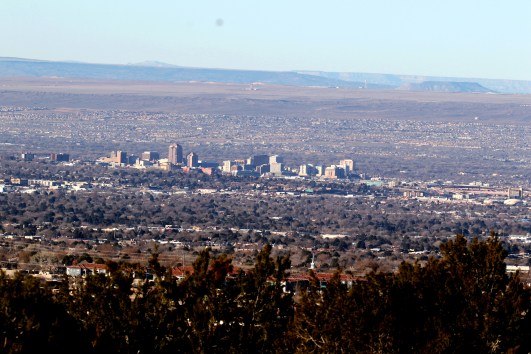
View of Albuquerque from Elena Gallegos

Albuquerque from Elena Gallego.jpg

Although it was only 35 miles to the Crest, I knew much of the road was slow going so I expected it take about an hour to get there.  The Gift Shop website said they would be open at 10:00, so timing looked good.  When I got to the winding road in the mountains it was clear that much of the snow from the previous day had melted.  I wondered if the car exchange was necessary.  It was.  As I got first to the Ski Area – which was jammed – and then beyond there were still a number of spots with some snow that the plows had missed or the sun had not melted.  I only got into 4 wheel drive in a few places but I doubt I would have made it with the other car.  It was spectacular.

trees

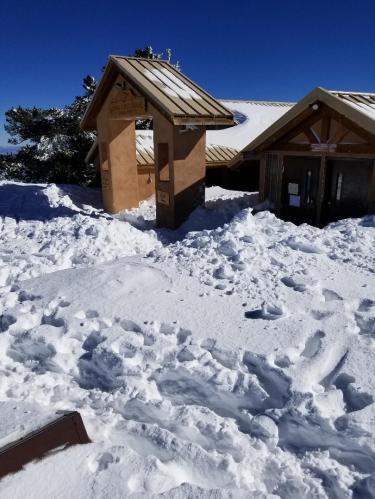
I arrived at the Crest around 10:15.  The road to the parking area for the Gift Shop was closed so I parked below.  Uh-oh…the stairs up to the Gift Shop were buried in 18″ to 24″ of snow – or more.  I trudged up them laboring in the thin air at almost 11,000 feet elevation and when I finally got to the entrance to the Shop, it was blocked by snow and seemed closed. So I trudged back down hoping to get a view of the finches as they came to a feeder that was visible from the parking area.

Sandia Crest gift Shop Entrance

gift shop

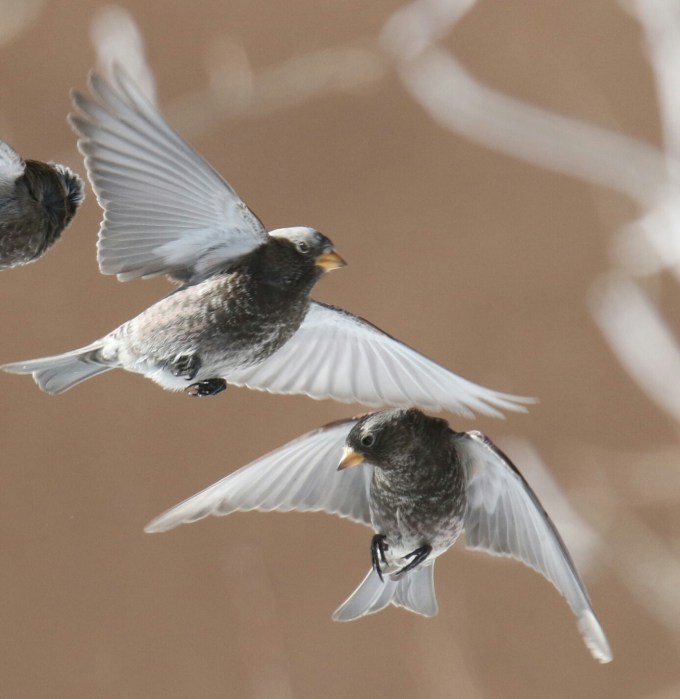
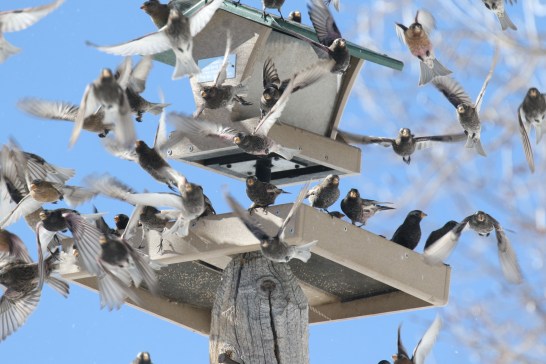
I heard them coming before I saw them.  Out of nowhere a large flock of Rosy Finches flew first into the tree next to the platform feeder and then on to the feeder itself.  It was a mad swirl of flashing wings and gorging birds.  They seemed to be entirely Black Rosy Finches but I picked out a single Gray Crowned Rosy Finch and a few Brown Capped. ones. It was impossible to single any out with the camera in their constant movement, so I just kept taking pictures.

Rosy Finches at the Lower Feeder

2p5a1522

I heard some high pitched calls coming from behind me.  They were not more Rosy Finches but I was unsure what they were.  They sounded like squeaky Jays.  Out of the corner of my eye I saw 4 blue forms fly by followed immediately by at least 10 more in a tight flock formation.  The common Jay at this location is the Steller’s Jay and I had already seen a couple of individuals on the road up.  These birds were solid blue … and had no crests and no black heads.  I had only seen them twice before but I was sure they were Pinyon Jays – uncommon but not impossible here.  Unfortunately if they stopped and perched at all, it was somewhere beyond the Gift House which was above me.  Had I not been diligently searching the Rosy Finches for Gray Crowneds I might have been able to get on them for a photo, but there was no time to switch from binoculars to camera.  Additionally disappointing because I only have two  photos from the Colorado observation.

Pinyon Jay – Colorado – April 2016

54-Pinyon Jay Flight

And…the Rosy Finches flew off as well.  A few minutes later someone came down the steps from the Gift Shop with a sign saying the shop was open but that access would be via the rear entrance.  I followed him up a second set of steps where the snow was more compacted and around to the rear entrance where he had shoveled away the snow so the door could be opened and Voila! I was in the Gift Shop where it was not only warm but where I could watch the feeders AND get some hot chocolate!!  Another thank you for his efforts.

Over the next half hour, more people came up to the Gift Shop.  Some were birders, some photographers and some were just visitors including two men from Israel.  Two of the birders were from Tucson, AZ – veteran birders a little older than me who were also there for the Rosy Finches.  We shared war (birding) stories and they liked my 50 State undertaking.  One of them, Karen Morley, was a former president of the Maryland Ornithological Society (MOS), a pretty high powered and prestigious organization in my native Maryland where I lived for the first 21 years of my life but never birded.  The small world aspect of birding came home twice with this intersection.  In 1975, I attended a conference of the Maryland Ornithological Union – predecessor to the MOS.  One of the field trips I joined at that conference was led by the legendary Chan Robbins.  In an extraordinary day of birding at the height of migration, we had well over 100 species.  It is the only 50 species day that I am including retroactively because it allows me to have Mr. Robbins as part of my story.  A second small world connection was that Karen was friends with a birding acquaintance of mine from Tacoma, Washington – indeed someone who had a connection with someone in Indiana that led to my birding companion there when I had my 50 species day there last year.  A small world indeed.

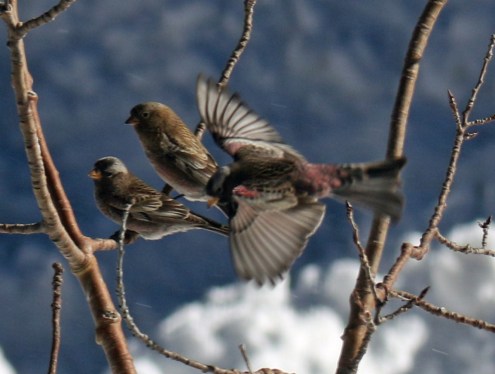
Back to the Rosy Finches.  It was not for at least 30 minutes, but they did make an appearance at the upper feeder and then made several more afterwards.  The feeder is directly on the porch behind the Gift Shop.  On days without the snow, it is possible to sit on the porch and watch the finches come in to the seed that has been placed there to attract them.  They are used to humans gawking at them and tolerate the close presence.  This day the porch was closed so the view was through large plate glass windows, but the birds were still very close and the optical distortion was slight.  I took MANY photos…many, many, many photos.

Black Rosy Finch Photos

black rosy finch with snow dust

blrf2

black rosy finch flight

black rosy finch detail

blrf trio

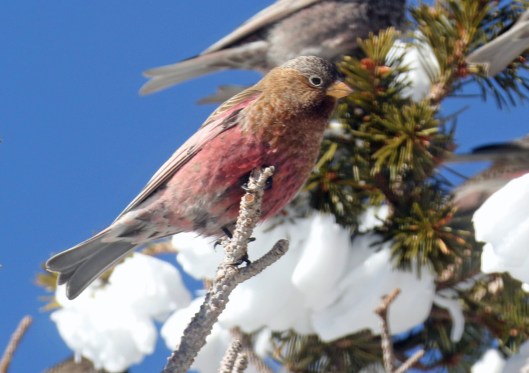
It was not so easy finding and photographing the Brown Capped Rosy Finches and I never again saw the Gray Crowned Rosy Finch that had been in the flock that visited the lower feeder earlier – or did I?

Brown Capped Rosy Finch

brown capped rosy finch 1

Brown Capped Rosy Finch with Black Rosy Finch

black and brown capped rosy finches

This is either a Variant Form of Brown Capped Rosy Finch or is a form of the Gray Crowned Rosy Finch with less than usual gray.

brown capped rosy finch2

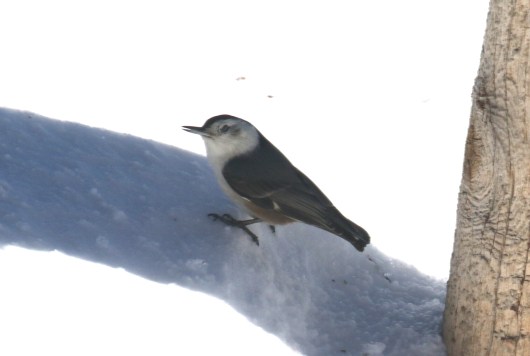
The only other species seen while at the Crest were a few Steller’s Jays, a Sharp Shinned Hawk, a White Breasted Nuthatch and some Mountain Chickadees.

White Breasted Nuthatch

white breasted nuthatch

Mountain Chickadee

mountain chickadee with seedmountain chickadee

While the highlight of this visit was without question seeing the Rosy Finches, there were so many other great parts as well.  All of the birds were superb in this beautiful setting.  Sharing stories with Karen and her friend was great fun.  The views were spectacular.  And engaging the gentlemen from Israel was one of those experiences that is a special part of birding.  They were not birders but were aware of the great birding in Israel especially during migration.  They did not know anything about the Rosy Finches or how special this place was for birders wishing to see them.  Giving them some background and sharing my binoculars was very rewarding.  One of the men called his family in Israel and he spoke to his wife and his young daughter.  I believe it was 9 hours later there – so around her bedtime.  The magic of technology allowed this conversation to be had as clear as if they were in the same room, and with his smart phone he could let her see this beautiful place and even the birds coming to the feeder.  Amazing times.  An amazing place.

View West from Sandia Crest

view

It was barely 1 p.m. and the return drive would be about 90 minutes.  I considered more birding at another location or possibly some sightseeing in Albuquerque, but it had been a full three days and as is usually the case on these trips, I had gotten less sleep than I should.  I needed to get the car back to the rental return and then get back to my hotel by shuttle.Somehow it felt right to end the birding with the high – literally and emotionally with the other world feeling of Sandia Crest.  So I called it a day and a fitting end to a wonderful visit and returned to the hotel to work on photos and do some reading.

The visits to the foothills and to Sandia Crest had brought my total species count for the visit to 82 species.  There were no new ABA Life birds or photos, but some of my earlier photos had been improved.  I had visited New Mexico twice earlier – one a non-birding trip to Santa Fe and once as a brief adjunct to a trip to Southeast Arizona in 2016.  Adding species seen on those trips, my New Mexico State List stands at a paltry 95 species.  Given that the New Mexico State list is over 550 species, I want to come back and see many more.  But regardless of the species count, this visit will be one of my favorites with memories of Barbara Hussey and Judith Liddell, of Bosque del Apache, the foothills and Sandia Crest.  I really love these trips!!

24th state


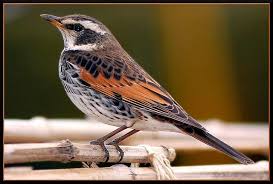
Thrush Dreams Revisited – Chasing a Dusky Thrush

The Dusky Thrush Chase

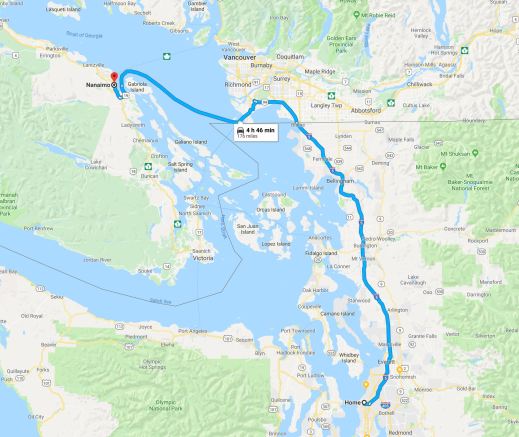
Birding is NOT a static activity either moment by moment in the field or over time as we follow our passions.  I am updating my Thrush Dreams post from barely a month ago (December 21, 2018) because yesterday (January 22, 2019) with Steve and Connie Pink, I traveled to Nanaimo, B.C.  to chase a Dusky Thrush that had been reported two days earlier.  When I first heard of this mega rarity, I was returning from a wonderful trip to New Mexico – part of my 50/50/50 project that will get at least one blog post of its own later.  I had never been to Nanaimo and had it pictured in my mind as “close to Alaska”.  Wrong!  It is a 2 hour ferry ride from the Tsawwassen Ferry terminal outside Vancouver, B.C.  When Steve contacted me late on Monday – after I had returned from a great day of birding in Kittitas County with Frank Caruso and Deb Essman (another blog post to come) and corrected my geography, I said sure let’s go.

Edmonds to Nanaimo

map to nanaimo

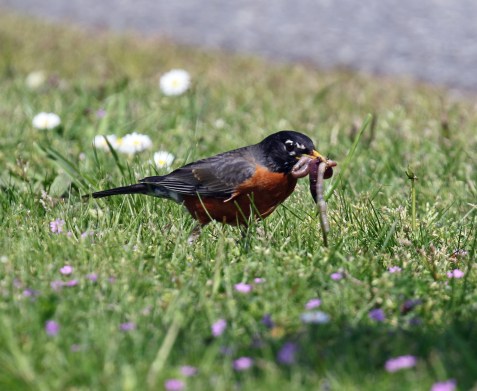
We left early Tuesday a.m.  At the border it was a repeat of some earlier experiences with Canadian Border patrol – friendly, efficient AND we learned he had actually read about the rarity when we told him the purposes for the visit.  The ferry was more like a floating resort with comfy seats, shopping and food.  No good birds on the way but an easy 2 hour ride.  We disembarked around 10:00 a.m. and were at the stakeout site around 10:15.  There was a single car there and we were able to visit with a birding couple who were not high powered birders but were very friendly and most importantly, they had seen the Dusky Thrush in the company of some American Robins 20 minutes earlier.  They seemed equally interested in a Palm Warbler that they had seen.  It is a good bird for the province BUT we were chasing the Dusky Thrush and that was our only quest. With the details of where they had seen it before it had flown off, we walked back up the road and began scanning trees near the house and barn.

There are many emotions that run through birders as we chase rarities.  The strongest of course is a strong “want/need/desire/hope” to successfully find the target.  In a case like this where we are on unfamiliar territory, have traveled a long way (although not as long as cross country chases that many birders do), are looking for a VERY rare bird, and it is the day after the last report, there is the uneasy nagging feeling that accompanies the questions: “Is it gone?”  “Are we too late?”  When our new best birding friends told us the Dusky Thrush had been seen, even though it had flown off, the odds were very, very good that it was still there and it was now just a matter of time.  So we scanned and waited.

About 19 minutes later, with only a few views of American Robins the light rain was feeling wetter, the temperature was feeling lower, and the light wind was feeling stronger.  Another minute later, our awareness of all of those changed dramatically when Steve, with our only scope, yelled “Got it!”.  The Dusky Thrush was perched on top of the large oak tree next to the house.  Protocol in such cases is for the spotter to get a “record look”, then stand back and let the next and next person get a look.  Connie got the second look and then just as I focused on the bird, it flew off.  Yeah, countable but not even close to satisfying let alone a photo opportunity.

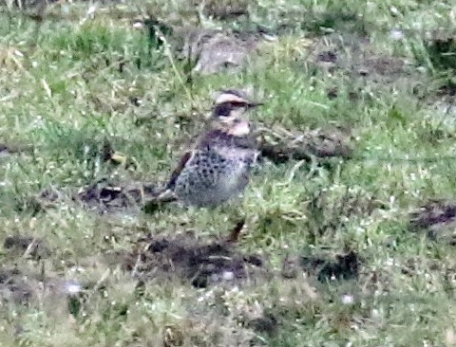
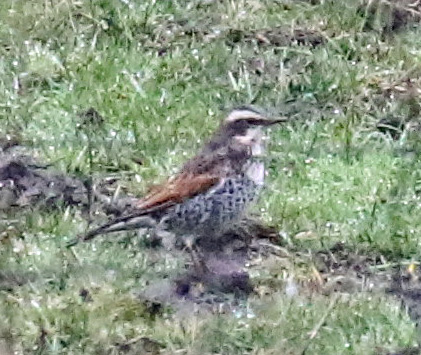
There had been other birders on the ferry who were coming to chase this bird.  As we were alone, we wondered where they were.  It turned out they had all made wrong turns, gotten lost, regrouped and arrived about 15 minutes after our peekaboo view.  But they too now knew that the Dusky Thrush was here and there were now more eyes to continue the search.  About 15 minutes later, the Dusky Thrush was re-spotted – again just brief looks and a fly off.  A short while later, it returned and now it was on the ground, still distant, difficult to see and moving around but there were some good views.  For the next 20 minutes we watched it forage on the ground and even perch up on a wood post that was flat on the ground.  I tried for photos in the difficult conditions.  Sure wish I had the 800 mm lens that one of the birders had!!!

First Photo of the Dusky Thrush – ABA Photo #697

dusky thrush1

Best Photo of the Dusky Thrush

dusky thrush3r

Final Photo Photo of the Dusky Thrush after it perched again in an even more distant tree.

dusky thrush tree1

The distance, poor light and interfering grass and gates and wires were all a challenge – so very poor photos BUT I got an OK photo, had OK looks and definitely had an ABA Life bird.  What rain?  What cold?  What wind?  It had seemed much longer, but it had only been 90 minutes since we had left the ferry and we would be able to return and catch the 12:45 ferry back to Vancouver and possibly have time to chase a Snowy Owl that had been reported in Skagit County the day before.  This was a very good chase.

We made the ferry, reveled in our good luck and then hit truly awful rain at Tsawassen which continued for the rest of the drive home.  The Snowy Owl had not been seen by anyone tht day and in the awful rain, we probably would not have tried for it anyhow.  Guess we would just have to “settle” for the Dusky Thrush.   And that was just fine!!

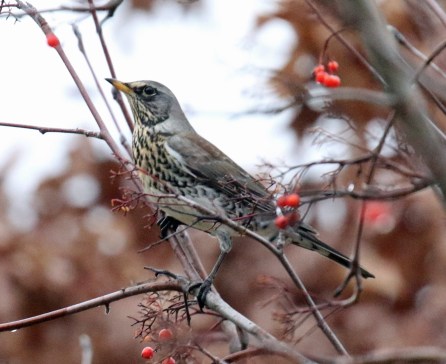
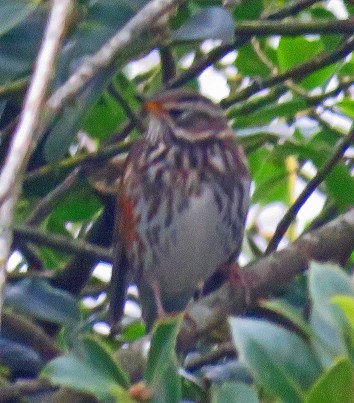
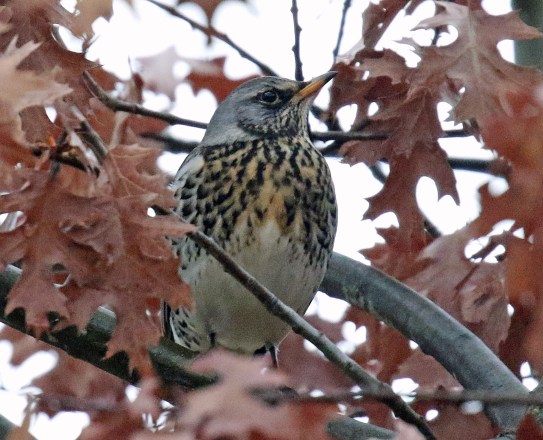
My original Thrush Dreams blog post was inspired by the successful Fieldfare chase to Salmon Arm, B.C, about 350 miles away from Nanaimo.  British Columbia is a HUGE province.  That fact plus it being somewhat closer to Alaska and there being many excellent birders has resulted in many rarities like this one.  My three rarest thrushes are from B.C. now adding Dusky Thrush to Fieldfare and Redwing.  Now we need an  Eyebrowed Thrush!!  

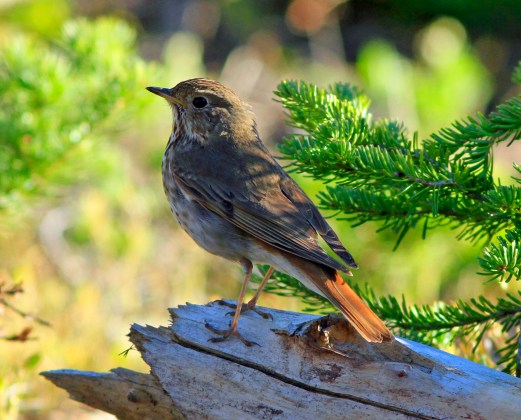
So I need to already revise my Thrush Dream  as the Dusky Thrush is thrush number 16 I have seen in the ABA Area and there now “only” 11 that I have not.

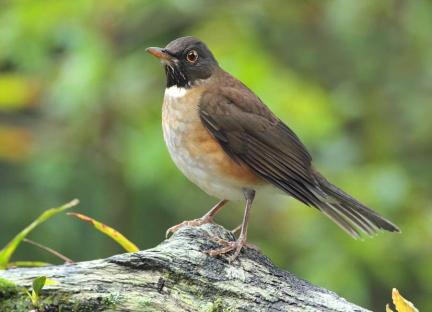
A White Throated Thrush continues to be seen in Madera Canyon in Southeastern Arizona.  If somehow it remains after I return from Hawaii the second week in February, maybe I will give in to temptation and go.  And I will definitely be waiting for an Eyebrowed Thrush sighting in B.C.  Steve and Connie Pink are ready to go as well…

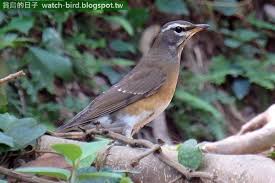
 Eyebrowed Thrush

Eyebrowed Thrush

White Throated Thrush

White Throated Thrush                               

One sad note…  Great friend Melissa Hafting who has been my fabulous source of rare bird information and assistance in B.C. and who is an extraordinary birder with a first focus on B.C. birds is currently in Ecuador.  She is having a great time but is really hoping the Dusky Thrush remains until her return.  I hope so, too.

Looking Back on 2018

With the exception of yet another romantic failure, by all measures 2018 was a great year.  Without question the highlight was the addition of Griffin Pascal Leung to the family as my first grandchild.  Although he arrived on the scene a month early, he is healthy and happy and definitely a cutie.  Parents Miya and Lester are wonderful parents.  Unfortunately, I only got to visit them and Griffin in Newton, MA twice and Miya and Griffin made the trek to Seattle once.  I am looking forward to time with them in Hawaii next month.

Grandson Griffin – Maybe a Birder in the Future – But Entirely His Choice

Griffin Birder

As best I can recall there were only two health issues in 2018, some very brief congestion after a plane ride that was chilly or worse and some bursitis in my left knee after the crowded San Diego Pelagic trip and that darn anchor chain in the bow of the boat.  At age 71 those are hardly matters to complain about.  I am 15 pounds lighter than I was when I started the year.  That’s the good news, but the bad news is that I am 10 pounds heavier than I was maybe five months ago – another casualty of that romantic failure – or at least that’s my excuse.  Many friends have had knee replacements this year and have done very well afterwards.  So far no indication that this will be my fate in my near future, but I do not take good health for granted and am grateful for my present condition and high energy.  If only I could figure out how to sleep past 4 or 5 a.m.

It was an excellent birding year.  There were many special birds, but mostly I am very happy about visits to great places and time with wonderful people.  There is way more to it than just numbers, but I am a “lister” and not only keep track, but organize much of my birding accordingly.  Some bottom lines for the year are below.

Washington

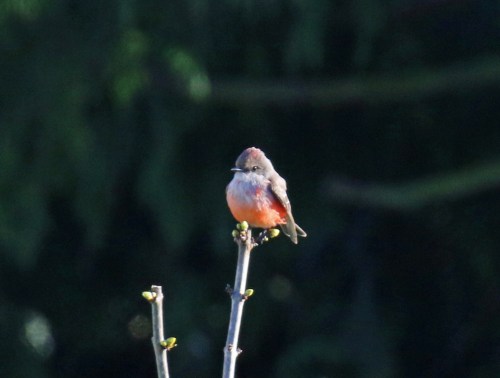
My first priority is adding birds to my Washington state life list and state life photo list. New state birds in 2018 were LeConte’s Sparrow, Painted Redstart, Phainopepla and Vermilion Flycatcher.  This brought my “countable” state total to 420 species.  I also added a photo of a White Wagtail (seen but not photographed in 1984) to bring my Washington photo total to 409.  I guess I would have to acknowledge two remaining and recurring disappointments.  I tried several times but was unable to get photos of either a Boreal Owl or a Flammulated Owl.  Maybe next year (an annual refrain).   The only unsuccessful state “lifer” chase was for the Prothonotary Warbler seen at Neah Bay.  Ann Marie Wood and I missed it by an hour or so.  Sigh…

I did not specifically try for a big year list for the state but as reported here earlier, I did a Big Month in January. The 208 species that month made it pretty easy to get a good year list.  Since I birded out of state for more than two months including some prime time in both Spring and Fall migrations, I was very happy to end the year with 349 species seen in the State.  That Prothonotary Warbler would have been a nice round 350!!

Vermilion Flycatcher – Stanwood – Last New Washington State Bird and Photo – December 4, 2018

vemillion fc

ABA Area 

My second birding priority in 2018 was adding new ABA photos.  I had reached the milestone 700 species life list in 2017.  Now I was trying to add more ABA photos hoping to get to that same level for species photographed.  If only I had been taking pictures in the early days when I had seen many of the Florida, Texas and Arizona specialty birds as well as others here and there.  I did not keep a chronological list, but believe I ended 2017 with 628 photos.  And that was a big jump from the end of 2016 thanks to trips to Arizona and Florida in 2017 where I expect I added as many as 100 ABA photos.  Of course seeing new ABA Species was important as well, especially since each of those was also a new photo opportunity.  I will discuss it separately but much of my birding as part of my 50/50/50 Project contributed to my totals in the ABA area.

2018 was a great ABA year.  I saw a total of 564 species (my best year ever).  Of those 26 were new lifers bringing me to 728 countable species.  And 68 were new ABA photos bringing me to the oh so close to 700 total of 696 species with photos.  Some of the photos were not so great, but I did get photos of all of the new lifers for the year.  I think all of them have been included in previous blogs about many of my trips.  I am often asked to pick a favorite bird or a favorite bird for the year.  In 2018, it would have to be the Whooping Crane as much for its beauty as for its symbolic importance as a conservation success story right up there with the California Condor which was a highlight of 2017.  It was not the rarest bird of the year.  That honor would probably have to go to the Fieldfare seen in British Columbia, the Nazca Booby in San Diego, the Sinaloa Wren in Arizona, or the European Storm Petrel in North Carolina.

My biggest disappointment was having my camera lens go on the blitz while at the Yellow Rails and Rice Festival in Louisiana.  Thus despite seeing several Yellow Rails, I was not able to get a photo of any.

Whooping Crane – Aransas NWR  – April 4, 2018

Whooping Crane4

New ABA Life Birds in 2018

Rosy-faced Lovebird Golden-cheeked Warbler Craveri’s Murrelet
Streak-backed Oriole Audubon’s Shearwater Ashy Storm-Petrel
Sinaloa Wren Wilson’s Storm-Petrel Least Storm-Petrel
Red-throated Pipit European Storm-Petrel LeConte’s Sparrow
Nazca Booby Band-rumped Storm-Petrel Philadelphia Vireo
Whooping Crane Fea’s Petrel Eurasian Tree Sparrow
Tropical Parula Black-capped Petrel Tundra Bean-Goose
Morelet’s Seedeater Yellow-footed Gull Fieldfare
Black-capped Vireo Black Storm-Petrel

My 50/50/50 Project/Adventure

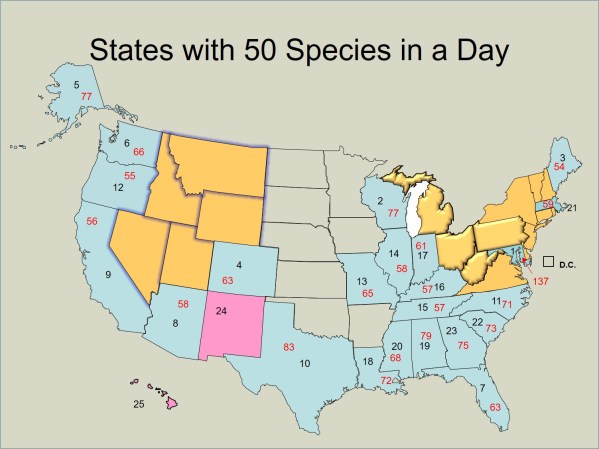
As explained in earlier posts, this project evolved during the year and was not officially put into action until October.  The goal here is in each of the 50 states on a single day to see 50 species and to intersect with local birders and folks in the process – also to see places of interest – birding or not – in each case.  I decided to grandfather in a few states where I had already accomplished that goal:  Maine, Arizona, Wisconsin, Maryland, Florida, Colorado and Alaska.  I may redo some of these states as I go, but for now, they are in the “Done” list.  I had also already done that on many occasions in Washington including many times in 2018 and in fact have already done it 5 times this year.  That still left 42 states to do. Having a lot of fun along the way, I was able to add 15 states in 2018 and have a very ambitious schedule to hopefully complete the project in 2019.

In each state the overriding requirement is to have fun and also to get those 50 species and to join local birders.  When possible, I try to include a new ABA species or a new ABA photo either as one of the birds or on an additional day of birding in the states.  I haven’t broken it down by year, but so far on this adventure I have seen 415 species on the day of the count itself and 594 species including additional time in the state on the same trip.  In 2018,  5 new ABA Life birds were added on the count days only and 11 more were added on extended days.  There were many favorite birds or favorite bird photos or stories along the way on these trips including the Whooping Crane above, but they have been included in previous posts so I won’t include them again.  More importantly there were many great places visited and even more great people that I met.

I include again this map which shows the 23 states where I have already finished the 50 species in a day goal.  The ones in pink are scheduled for the next few weeks – New Mexico and Hawaii.  The ones in raised gold will be a month long swing during the peak migration this Spring in the east and the ones in gold with blue border will be a car trip in late May into June when I return from that eastern marathon.  Those gray states in the plains plus Arkansas and Iowa are unclear.  Maybe this fall – may have to defer them until 2020.  It’s a big country.

Interactive Map as of December 31

Birds, places and people – truly a great combination and that is the overwhelming lasting feeling about this year.  Had all of them over and over again.  Looking forward to 2019.

Georgia – Great People and Great Birds – Especially a Sedge Wren FINALLY!!!

As with my previous post about South Carolina, I am going to start with Connections – a critical, challenging, essential and incredibly rewarding part of my 50/50/50 Adventure.  My goal is to bird in each of the 50 states with a meaningful local connection – hopefully a local birder or maybe someone with just local perspectives and insights – ideally both.  In a pre-trip exchange with Ken Scott – my new found birding friend in South Carolina, I asked if he might know someone to work with in Georgia.  He connected me to Buddy Campbell who was compiling some of the South Carolina Christmas counts and was “well connected”.

Through Buddy I connected with Diana Churchill – no not Diana Spencer Churchill, the eldest daughter of Sir Winston Churchill.  That Diana died in 1963.  This Diana Churchill has been writing a twice-monthly column, “Birder’s Eye View,” for the Savannah Morning News since 2001 and in 2011 published a book, Birder’s Eye View: Savannah & the Low Country.   Despite being busy with the  publication of the sequel Birder’s Eye View II: The Low Country and dealing with family health matters, she was very helpful both in suggesting places to visit and also connecting me first with Pam Smith, an avid but relatively new birder in the area and then with Steve Calver, who Pam described as “the best”.  I would very much have loved to have met Diana but those two connections were fantastic and I ended up birding two days with them.  They were both “the best”.  Steve was an incredible birder and knew every nook and cranny in the area.  Pam was a lot better than she gives herself credit for and was as nice and friendly as anyone I have met.  And Pam hooked us up with Russ Wigh – another great birder and great guy and we all joined him for a second day of birding at The Landings.  More on all of this follows.  It was a great visit.

With Pam Smith and Steve Calver

Pam and Steve

Pam was dealing with some lower back issues and the original plan was for me to bird a bit on my own the first morning with her meeting me after a doctor’s appointment.  When Steve joined the program, that changed to starting early with him and having Pam join later.  Steve had a special place in mind to start the day.  At first the location was confusing to me but when I actually mapped it out, it was literally three minutes from my hotel – something he had not been aware of.  When I got there to meet him, I wondered why he had chosen this spot – some woods next to a parking lot behind the Comfort Inn.  But the forest edge was quite birdy – especially with Yellow Rumped Warblers – a theme that would continue all day.  But then we headed off on a nondescript path that I doubt I would have noticed myself and we birded through some woods until we came to a wetland and pond.  It was a wonderful place and definitely something I would never have discovered on my own.

We spent two hours there and had 33 species with a few Wood Ducks, a single Great Egret and a single Great Blue Heron as the only “water birds”.  There was also a constant flow of Ring Billed Gulls.  American Robins, noticeably few in South Carolina, were constantly flying overhead and we estimated over 1000 Red-winged Blackbirds.  Yellow Rumped Warblers were everywhere – a nuisance distraction as we were constantly seeing them flit about forcing us to be sure they were not something else.  Steve estimated at least 60 and I think there could even have been twice that many.  There were also more Ruby Crowned Kinglets than I think I have ever seen elsewhere – at least 15.

Ruby Crowned Kinglet

Ruby Crowned Kinglet

But Steve had not brought me here for any of those birds.  This was also a great place for woodpeckers – and particularly for Red Headed Woodpeckers which I had mentioned to him in an email as a favorite.  We got to an area with many snags and sure enough two Red Headed Woodpeckers came in.  The lighting was terrible and they were distant so no great photos but still a great find.

Red Headed Woodpecker

Red Headed WP

Other woodpeckers included Northern Flicker (Yellow Shafted), Downy, Red Bellied and Pileated Woodpeckers and Yellow Bellied Sapsucker.  I got a nice photo of the latter when there was some sun.

Yellow Bellied Sapsucker

Yellow Bellied Sapsucker

I had also mentioned Winter Wren as a desired species since I do not have a photo of one.  Steve took me to a very specific spot where he had found them before.  We searched diligently and tried playback to no avail.  Just as he was when there was not a better photo op for the Red Headed Headed Woodpecker, I think Steve was more disappointed than I was that we did not get the Wren.  That’s how he was the whole visit – caring and considerate and giving.  On the way out we stopped again at the forest edge near where we parked.  I got a quick glance only at a small bird with a bright yellow belly.  It was a spectacular White Eyed Vireo.  I wish it had posed for a photo.

Our next stop was the Chatham County Wetlands Preserve, an Ebird Hotspot that I had originally planned to bird on my own before meeting up with Pam Smith.  It was another good spot with even more Yellow Rumped Warblers.  Pam did come to meet us there arriving just after I found and finally got a life photo of a Sedge Wren – making it pretty clear that the bird I had seen at Caw Caw was a Marsh Wren.  Not world class photos but they made my day.

Sedge Wren – ABA Photo #695

Sedge Wren Best

Sedge Wren4

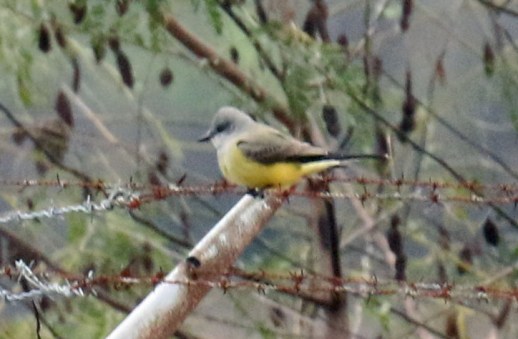
We had 24 species at this spot in a bit less than an hour and a half and I was at 43 species for the day.  Now a birding threesome, we headed off to another local Ebird Hotspot – Hutchinson Island where Steve hoped there might be a very rare Western Kingbird,  Sure enough we found two.  This was a lifer for Pam and it was super to see her excitement as she added this species to her Life List.  Being there with her was one of the best parts of my visit.

Western Kingbird (one of two) – Distant Photo

Western Kingbird

We again spent about an hour and a half finding 25 species but ten were new ones for the day and we were now over 50.  One very nice bird was a very bright Prairie Warbler.  Only a quick but good look – no photos.  Other new species were Field and Savannah Sparrows, Osprey and Red Tailed Hawk, Gray Catbird, Killdeer, Double Crested Cormorant and a Loggerhead Shrike – the only one of my entire trip.  Before a quick lunch at Subway and a visit to Steve’s home with its very productive feeders, we made a quick stop at a field where I found a Wilson’s Snipe and where we also had a lovely Red Shouldered Hawk.

Wilson’s Snipe

Wilson's Snipe

Red Shouldered Hawk

Red Shouldered Hawk

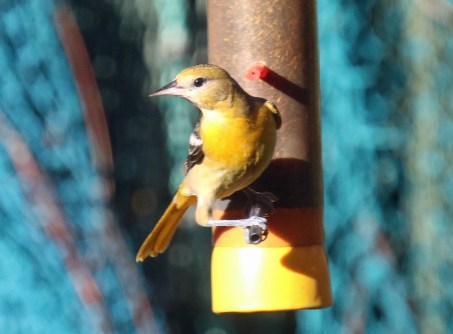
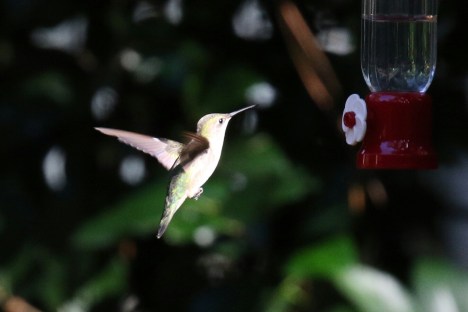
Steve was very kind inviting us to his home – clearly a birder’s home with photos of favorite birds and a very bird friendly backyard with a number of feeders.  In less than an hour we had 17 species and a number of great photo ops.  Most interesting to me were the 4 or 5 Baltimore Orioles.  Steve said he has had as many as 8!!  There was a very active Ruby Throated Hummingbird but not the quite rare Black Chinned Hummingbird that he has had on occasion.  As we prepared to leave we had two more very nice visitors – a Painted Bunting and a bright Yellow Throated Warbler made appearances.

Baltimore Oriole Female

Baltimore Oriole Female

Ruby Throated Hummingbird

Ruby Throated Hummingbird 3.jpg

Painted Bunting

Painted Bunting

Yellow Throated Warbler

Yellow Throated Warbler1

We made one more stop together – Lake Mayer where we added 4 duck species, Brown Pelican, Anhinga, American Coot and Forster’s Tern for the day bringing us to 70 species.  Anhingas are sometimes called “Snake Birds” coming from their behavior of swimming with body submerged and their long, thin snaky neck the only thing seen above the water.  We watched one catch a good sized fish and others drying their wings – quite beautiful.

Anhinga

Anhinga GA

Larry Calver bid us adieu and said he would try to join us the following day.  Pam continued as tour guide and took me to Priest Landing on Skidaway Island.  We were beginning to run out of light but she wanted me to have some targets there for our day.  In about 25 minutes we had 20 species including 7 new for the day – mostly waders including a Wood Stork and a Tricolored Heron.  For me the two best birds were our last ones we found.  Pam has a great birding ear and she picked up some Brown Headed Nuthatches feeding high in trees right next to the road.  Then the coup de grace was just after me mentioning that I was surprised that we had not had any Blue Gray Gnatcatchers, she heard two and in very little light we actually found and photographed one – species 77 for our great day together.

Blue Gray Gnatcatcher

Blue Gray Gnatcatcher1

It had been a very enjoyable time with great birds and two really wonderful people.  The photo of a Sedge Wren was of course the highlight, but it was just one of those days that flowed easily and well.  The good news was that we were going to reassemble the next day and bird a private community – “The Landings” with Russ Wigh, a resident.  But first I celebrated the day with a rare for me steak dinner.  Birding can be a lot of fun!!!

We reconvened the next morning at a “retail center” on Skidaway Island next to The Landings.  I use quotation marks because there is no way that anyone would have believed it was a retail center – designed to fit into the planned development without a hint (and barely a sign proclaiming) of what it was.  Russ Wigh is another well traveled birder who has relocated to South Carolina.  The Landings is a golf-centered community with numerous ponds, some native growth and well groomed homes and landscaping.  It is a gated community open only to members with a number of courses and an architectural consistency that works even though there is a wide range of home prices and sizes.  It was attractive but not ostentatious – a very pleasant place – and full of birds.

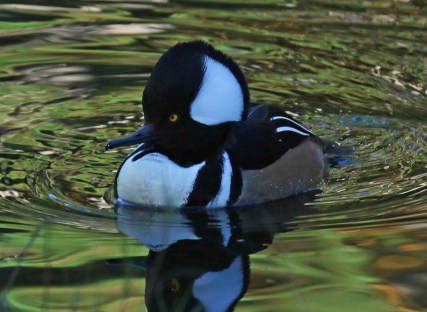
Before entering The Landings, we got 23 species in 23 minutes at the University of Georgia Aquarium including a Black Bellied Plover, a Willet and some Dunlin.  We then returned to Priest Landing and found NO waders at all.  The preliminaries over, we now entered The Landings itself.  I will not catalog observations chronologically – just some standouts – like hundreds of Hooded Mergansers.  Every little pond, and there were many of them, had scads of these gorgeous ducks and they are all tame as apparently they are fed regularly by the residents.  If you walked up to the water’s edge, the Hoodies would swim over looking for a handout.  This unnatural behavior does provide photo opportunities,

Hooded Merganser – Up Close and Personal

Hooded Merganser

Russ was familiar with every tree and lawn and pond in the area having kept a running count for many years – definitely over 170 species but I cannot recall his list total.  Knowing that I was looking for a species count, we went to a pond that had a female Lesser Scaup – the only one around.  It swam nonchalantly with more Hooded Mergansers.

Lesser Scaup

Lesser Scaup

To add another species we also visited “the best” pond for roosting Black Crowned Night Herons – and found many – adults and juveniles.  Yellow Crowns are found sometimes but not this day.

Black Crowned Night Heron

BCNH.jpg

At the next pond we had one of several Ospreys meaning of course that there are fish in the ponds.  I never followed up to get the full story, but Russ had told us that we had to be careful with our sightings because there are decoys in most of the ponds and they are there somehow related to helping the fish populations.  We came close to falling for “new” species a couple of times but plastic ducks don’t count.  By the way as you can see from the photos it was a fine and clear day with temperatures starting in the low 50’s and ending up just over 60 degrees.

Osprey

Osprey

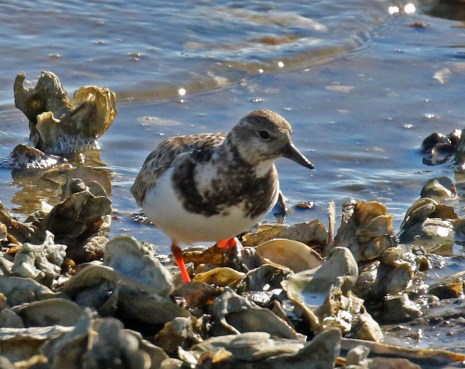
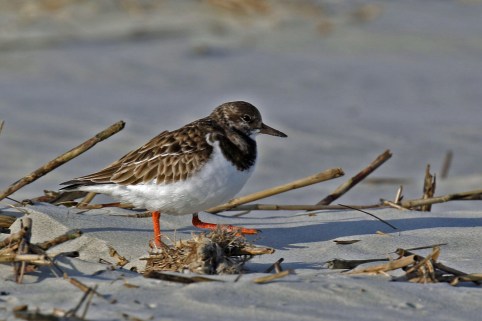
There were many habitats in The Landings including a salt water marina and beach where we had Horned Grebe, Least Sandpiper, Ruddy Turnstone, Herring and Ring Billed Gulls, and Forster’s Terns.  It was becoming easy to see how the area had such a big species list.

Ruddy Turnstone

Ruddy Turnstone Landings Marina

We also spent rewarding time at Russ’s yard and feeders.  As at Steve Calver’s this was a great opportunity not just for good birds but also good photos.  I include just a few.

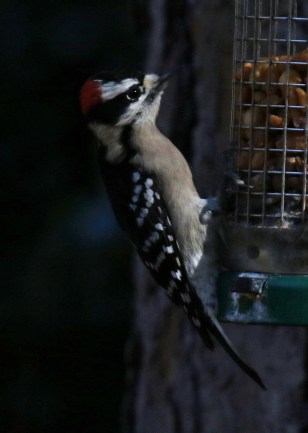
Downy Woodpecker

Downy WP at Feeder1

Brown Headed Nuthatch

Brown Headed Nuthatch GA

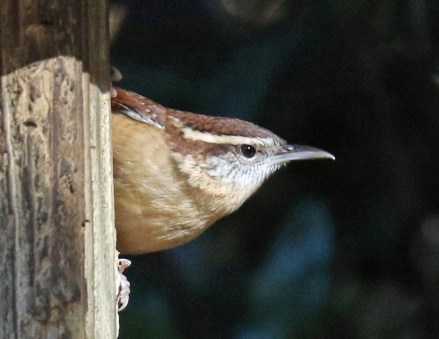
Carolina Wren

Carolina Wren

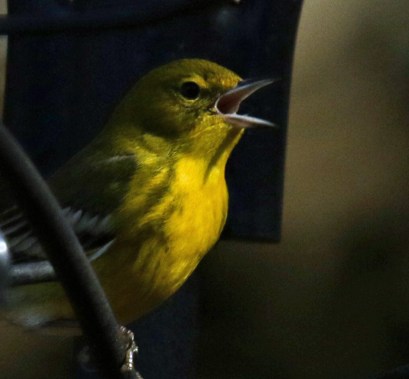
Pine Warbler

Pine Warbler Singing

About those Carolina Wrens…they were everywhere and it is amazing how such a small bird has such a loud song.  They were often the first bird heard each morning  and they continued to be heard throughout the day – welcomed every time.  Another bird that was heard frequently was the Northern Cardinal.  I was often struck though by how hard it could be to actually see such a bright red bird as they often remained buried in the branches and foliage.

We ended the day around 1:00 p.m. giving me time to visit “Historic Savannah”.  Hugs goodbye to great companions.  We had seen 55 species that morning bringing the two total up to 95 species – a fabulous visit.  I am sure I did not do it the right or best way but I was disappointed with the Historic Area in the city.  Some interesting architecture and lots of park blocks interspersed within commercial and residential areas, but it seemed helter skelter without there being a consistent interesting core.  I had not done my homework and I am sure I missed some treasures.  Around 3:00 p.m. I abandoned the city and headed out to Tybee Island to see if I could get to 100 species for Georgia.

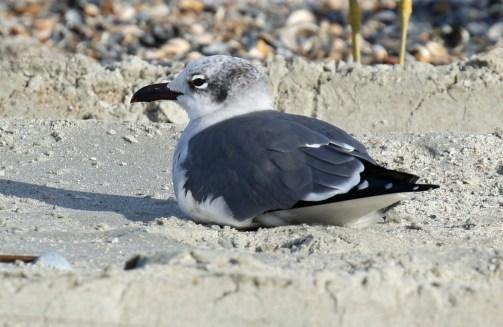
In my initial planning for the visit, it seemed that Tybee Island would be a great spot to go for 50 species in a day.  On this visit I concentrated on the beach and jetty only.  Given all the no parking or paid parking areas, I can only imagine the crowds in the summer, but on this day I essentially had it all to myself.  Although the first bird I saw was a Chipping Sparrow near where I parked, most of the birds were shorebirds or water related.  A small flock of gulls included some Laughing Gulls and Sanderlings ran along the beach next to them.  Both were new for the trip.

Laughing Gull

Laughing Gull - Copy

Sanderling

Sanderling

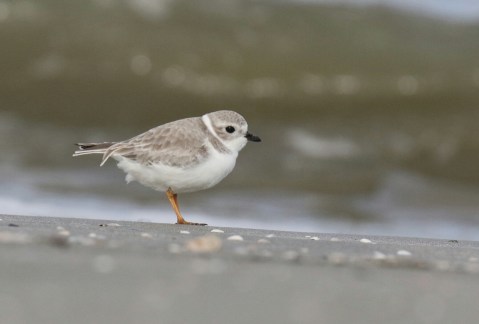
The only birds out in the ocean were a Common Loon and some Brown Pelicans and the only shorebirds continued to be Sanderlings.  I would need some help to get to 100.  Help came in the form of a nice group of shorebirds at the south end of the Island by the jetty.  There a small mixed flock had more Sanderlings, a Ruddy Turnstone,  two American Oystercatchers and three Piping Plovers, the latter two new for the day bringing the count to 99.

Ruddy Turnstone

Ruddy Turnstone Tybee

American Oystercatcher

AmericanOystercatcher

Piping Plover

Piping Plover Tybee

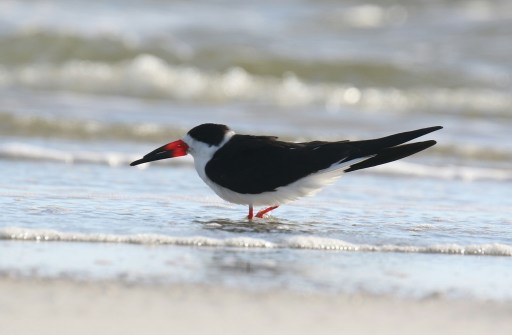
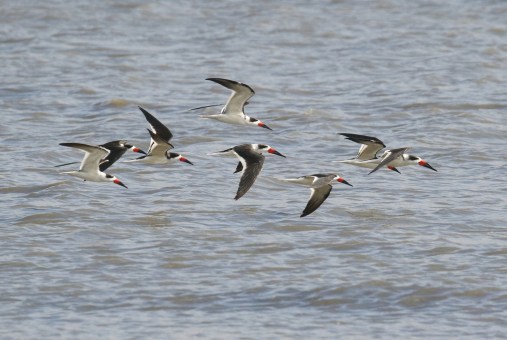
Where would 100 come from?  I would walk back along the beach and maybe something new would come in.  Nope did not have to wait, a flock of 8 Black Skimmers flew by and then landed right next to me.  Beauties…

Black Skimmer

Skimmer GA

It was getting late and I had a very early flight the next morning.  Time to leave.  I was pleased with every part of the day at least related to birds and people.  Somehow it seemed fitting that I had made it to 100 species.  Then there was a surprise.  When I got back to the car, I heard a familiar call and found a single House Sparrow.  I had expected to see them in many places including in Savannah, but I had not.  It was species number 101 and I had to chuckle when I realized that it meant one more species than the 100 I had in Alabama earlier this year.  Alabama had just beaten Georgia in a hotly contested and close SEC Football Championship Game.  This time Georgia came out on top…with me being the only one that noticed.

I arose early the next morning to get the car back to the airport and make my 6:01 a.m.flight to Dallas and then off to Seattle.  The Savannah Airport is small and very lovely – a little gem – and very easy to navigate.  I probably could have gotten there 15 minutes before departure and been ok.  It was a long flight home after a very fun week in the Lowcountry of South Carolina and Georgia.  As good as the birds were and as lovely the area, without any question it was the people that made this visit special.  Ken and Betty and John and Karen in South Carolina.  Pam and Steve and Russ in Georgia.  And Buddy and Diana behind the scenes making it all possible.  I truly regret not being able to meet those two but will be forever grateful for their support and aid and will long remember my time in the field with the others.

Having found my 50 species in a day in each state, my “completed list” now stands at 23.  I am off to New Mexico in January and Hawaii in February and then it gets really busy,  Been a blast.

Interactive Map as of December 31

The South Carolina Lowcountry and the Beaufort CBC

The Connection

The pelagic trip out of San Diego on August 19 this year has already been featured in one of my blog posts (https://wordpress.com/post/blairbirding.com/21064).  As I wrote there, I had many frustrations, but there were many great birds including 4 Lifers, but for the purposes of this post, it was the great people – one in particular – that were more important.  Among those on board were 8 birders doing Big Years of one sort or another.  They include the top 6 ABA lists for 2018 with the other 2 being within the top 11.  Another birder on the boat was Ken Scott from Beaufort, South Carolina.

We had only a brief intersection onboard that was interrupted by the appearance of a Red Footed Booby.  But I remembered that he was from South Carolina, so when I was planning my visit there as part of my 50 States adventure, I hoped we might intersect again.  I found an email address and contacted him and it worked out perfectly to be able to join him for a day of birding on the Christmas Bird Count in Beaufort County, South Carolina – midway between Charleston, S.C. and Savannah, GA the two cities I wished to visit birding near each as part of my project.  Ken felt there was a really good chance to get 50 species on his CBC especially if I birded his area in the morning and then went with a different team to a different habitat area in the afternoon.  So my plan was to fly into Charleston and combine some sightseeing with some birding before joining him.  This area stretching from just north of Charleston to the Georgia border is called the “Lowcountry or Low Country” – a geographic and cultural region along South Carolina’s coast, including the Sea Islands with many resorts and beautiful sandy beaches.

Charleston to Beaufort

Before the Count – Charleston to Beaufort

Charleston was founded in 1670 and grew as a seaport with a healthy economy from that activity and the cultivation of rice, indigo and cotton.  The wealth brought the development of many historically and architecturally significant homes and buildings. In April 1861, Confederate soldiers fired on Union-occupied Fort Sumter in Charleston Harbor, beginning the Civil War.  The War brought significant damage to the City but the preservation and reconstruction of the old homes and buildings became a foundation for a thriving tourism – the major driver in its economy today.

My plans to spend a lot of time in the Old City were dampened – literally – when torrential rains and surface flooding came on my first day.  Plan B was to do some birding in the morning and hope it would clear for tourism in the afternoon.  I headed to Fort Moultrie (pronounced “Mool – tree”) National Monument dating back to Revolutionary War days and continuing as a fort in the Civil War.  More than 3 inches of rain fell that morning and I made good use of both rain pants and parka.  I was greeted by a flock of White Ibis on the grass by the Fort and found a number of passerines as I walked the grounds.  The Fort was on the water and this produced a good mix of birds as well including a surprising Black Scoter.  Even in the poor conditions, I had 35 species including hearing a Clapper Rail and seeing a pair of American Oystercatchers.  I had picked up 5 other species before even getting to the Fort

White Ibis – Adult and Juvenile

White Ibis White-Ibis-Immature-.jpg

It was 11:00 a.m. and still pouring.  Coming onto Sullivan Island to get to the Fort I had crossed a causeway and had noticed some shorebirds.  Having found many more species than expected at the Fort,  I thought it might be possible to make a stop on the causeway and maybe one more spot and actually get to 50 species for the day and then hope it would clear for some time in the City.  I added several shorebirds on the Causeway.  Four to go.  An Ebird Hotspot called the I’On Rookery was nearby and promised some ducks and maybe a few passerines so off I went.

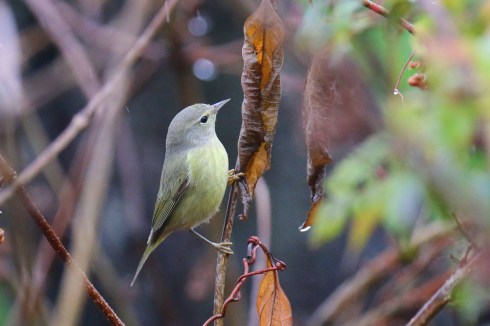
It turned out to be one of my favorite stops.  I added seven species to get over 50 for the day (removing any concern about doing so for South Carolina) including a Blue Headed Vireo, one of my favorites, and a very nice Orange Crowned Warbler.  It was good that I found them because there were only two species of waterfowl and I had expected a few more.

Blue Headed Vireo

Blue Headed Vireo 2

Orange Crowned Warbler

Orange Crowned Warbler1

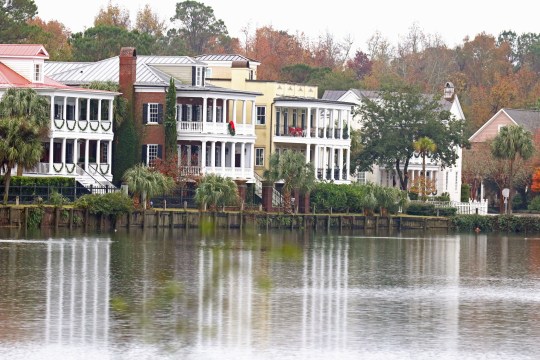
The birds were nice, but the real appeal was that the pond I visited was in the center of a beautiful planned community of lovely homes and beautiful landscaping.  It was extremely well done and as attractive as any I have seen anywhere.  I later found out that the homes were quite expensive – certainly for the area or for my preconceived notions of housing costs in South Carolina.   Even without large lots, home prices began at $1.3 million and some were substantially higher including the ones in the photo below which were located on the pond. They would have been much higher still in Seattle.

I’On Village Pond and Homes

I'On Pond

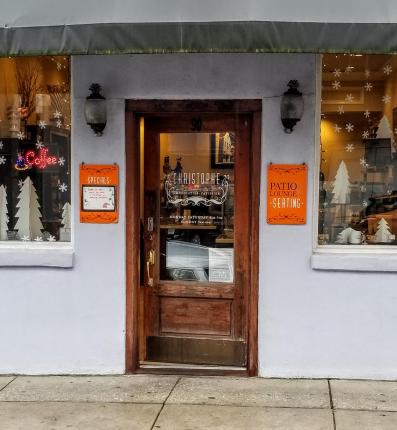
The rain had slowed and I headed into Historic Downtown Charleston.  I did not go into any of the old mansions but walked through the Historic Market and enjoyed the streetscape.  I did make sure to visit Christophe Artisan Chocolates.  Earlier I had discovered this great chocolatier when Pat Lueders took her Naturalist Journeys group to Charleston.  I arranged chocolates to be delivered to her while she was there as a thank you.  It worked very well and I wanted to personally thank the folks there for their efforts.  It also allowed me to get a wonderful almond croissant for myself, too.  The shop was amazing – beautiful pastries and chocolates – yummy, too.

Christophe Artisan Chocolates and Cafe – Truffles

Chocolate

Truffles

I did not have time to visit but wish I could have gone to Henry’s for jazz and food.  Not so great on the outside but it was highly recommended.  It seemed to me that there were restaurants everywhere.  Many downtown but also in every neighborhood and historic area.  Charleston has a reputation as a “foodie paradise”.  I believe it.  That night I did not go fancy but I went “excellent” with barbecue at Bessinger’s – basic, filling and very tasty.

Jazz.jpg

BBQ

The next day I headed to Beaufort (pronounced “Byoo-furt” in South Carolina as opposed “Bo-furt” in North Carolina with birding stops at two great places – Caw Caw Interpretive Center and Donnelly Wildlife Management Area.  Beaufort was  70 miles from Charleston and the entire area looked like great birding habitat. But there had been so much rain that many areas were flooded and when I got to Caw Caw, many of the trails and paths were impassable.  There is a terrific visitor center and an extremely friendly and helpful person there opened early and got me hooked up with a naturalist walk that was scheduled 20 minutes after I got there.

You know that you are not in Washington when the naturalist describes changes that will be made to the usual walk because of the flooded fields and explains that we cannot just go through the brush because while the probability is very slim for Coral Snakes that there is danger from Copperheads, Cottonmouths, and two or three kinds of Rattlesnakes plus Alligators.  Easy decision — I will stay on the trails…

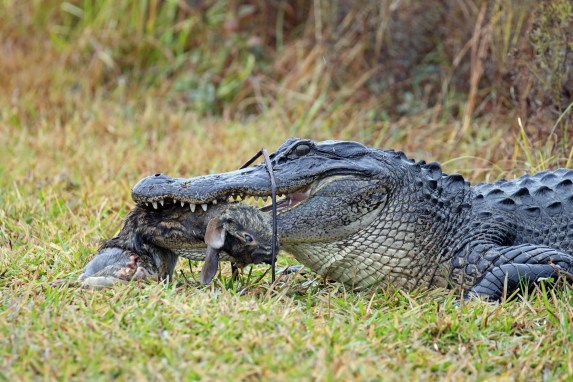
In just over two hours with an amiable group of birders, we saw or heard 39 species including some heard only Wood Ducks the only waterfowl of the trip despite habitat that looked good to me.  The highlight was unquestionably the medium sized (6 foot) Alligator that was on the trail ahead of us with what appeared to be a rabbit in its fearsome jaws. It slithered backwards into one of the canals as we approached – carefully.

Alligator

Alligator with Prey1

It was now almost 11:00 a.m. and I had another area to visit – and I also wanted to break away from the group and try to find a Sedge Wren – a species high on my photo wanted list as I did not have one for the ABA.  I thought I had thought I may have heard one as we walked but our guide was not sure and felt it was useless to try to get it to come out.  Not more than 5 minutes after separating from the group I stopped at what seemed to me to be good habitat and got an immediate clear response after a brief playback of Sedge Wren calls.  (Which by the way the guide was not averse o using.)  A small Wren came up into the reeds  and remained hidden – but noisy.  I grabbed a few miserable photos as it darted around never completely in the open.  Even though its calls were dead on for Sedge Wren I am still not sure if the photo is of a Marsh Wren or a Sedge Wren and I got differing opinions from two locals.  The supercilium and clear breast say Marsh to me despite the calls.

Wren – Sedge or Marsh?…Marsh

Marsh Wren

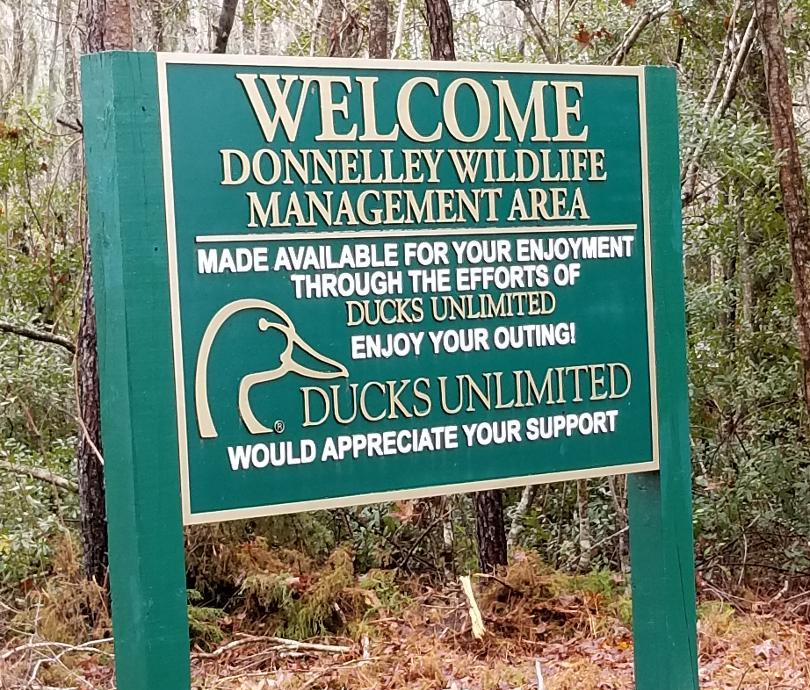
After Caw Caw, I moved on to the Donnelly Wildlife Management Area.  In my early pre-trip planning I had identified this Ebird Hotspot as a great place to either find 50 species in a day or to supplement a list from elsewhere to do so.  Since I was not sure that the Beaufort CBC would produce 50 species, I thought I needed a backup plan.  The only problem was that the Hotspot name included the seemingly limiting “(partial fall and winter restricted access)”.  What did this mean?  When I asked Buddy Campbell – the compiler for the Beaufort County and some other Lowcountry CBC’s that Ken had gotten me in touch with, he said it was related to hunting and would probably not affect me.

Donnelley.jpg

It was a GREAT area – and another example of where hunters and birders share interests in habitat creation, preservation and management and where coexistence can be very positive.  My first stop was on a dike along a wetland barely into the park.  I expected many ducks and found many – well over 100 Wood Ducks but unlike our experience with them in the open in Washington, these ducks were hidden away in the wooded marshy areas, detectable only by their constant calling and then their flights when I got anywhere close.  Buddy (and Ebird reports) said this was also a good Sedge Wren area. I heard at least one but got only brief distant glimpses.

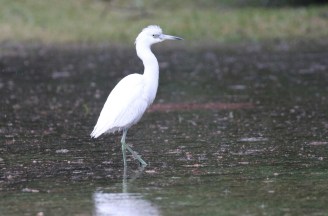
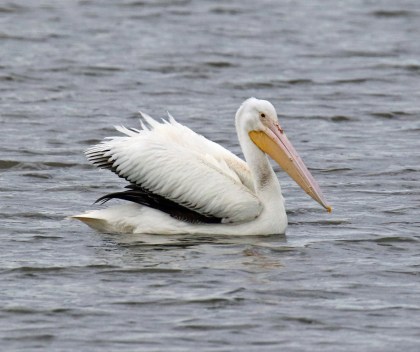
I could write many pages about this place – really fun visit of almost 3 hours.  It was mostly thin forest and wetland.  A good mix of passerines and one spot with some shorebirds (both Yellowlegs and both Dowitchers).  Ebird reports included many waders but other than a couple of Egrets, a Great Blue and a Green Heron, I had found none…until…I discovered the large pond/lake behind “the Lodge”.  What a great spot!! In addition to other species there were 53 American White Pelicans, 6 Great Blue Herons, 18 Great Egrets, 11 Snowy Egrets, 4 Little Blue Herons, 1 Tricolored Heron, 1 Green Heron, 2 Black-crowned Night-Herons, 20 White Ibis, 5 Roseate Spoonbills, Forster’s Terns, an Osprey and a Wood Stork.  A great way to pad a list.

Lesser Yellowlegs

Lesser Yellowlegs

Snowy Egret

Snowy Egret 3

Little Blue Herons (Juvenile and Adult)

Little Blue Heron  Little Blue Heron Adult

Roseate Spoonbill

Roseate-Spoonbill.jpg

White Pelican

White Pelican.jpg

When I tallied my list after this visit, it was 67 species.  Added to Caw Caw and a couple of species on the highway (American Crow and European Starling), I had 84 species for the day (and over 100 for the trip) – and the planned big Day was yet to come – the Beaufort CBC on the 16th.  I thoroughly enjoyed Donnelly.  In addition to the great birds, it was the feeling of unity with the place.  Very peaceful aided in part by the fact that for the entire time I was there, I did not see another human being – just me and the beauty and wonder of nature.

Beaufort and the CBC

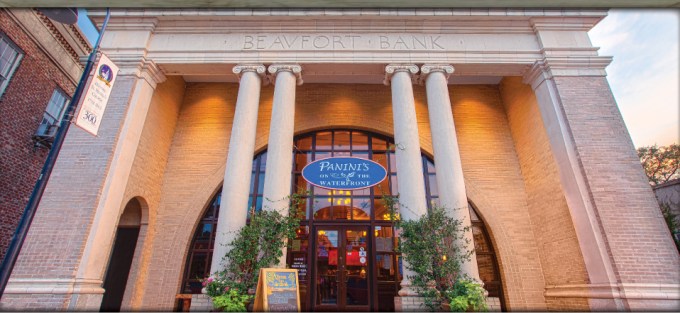
Ken and his lovely wife Betty picked me up at my hotel that evening and we went to dinner at Panini’s on the Waterfront in Beaufort.  I had been hearing about how great the oysters were in the area but Ken said we would have them at lunch the next day.  I chose a Greek Shrimp Panini.  It was exceptional.  After the very short visit on the pelagic trip it was nice to spend relaxed time with Ken and with Betty.  Both, like many people in the area, are transplants and their perspective on the area was very interesting.  Definitely gave me a different take on preconceived notions of South Carolina to some degree.  Like most places there are people of all sorts, cultures, beliefs and attitudes.  This is not the place to go into these matters but it was easy to discuss politics, race, and the culture of place.  Discussing birds was great too as Ken and Betty are well traveled and have many stories.

Panini’s on the Waterfront

Panini Beaufort

The plan for the next day was simple.  I would be meeting them at 8:00 and we would bird one habitat area on St. Helena’s Island and then I would join another group in the afternoon to bird a very different habitat on Harbor Island.  The morning was steady good birding with a mix of passerines, waterfowl, waders, shorebirds and raptors.  I particularly enjoyed a grassy field and trees that had numerous Palm Warblers, Pine Warblers and Eastern Bluebirds.

Palm Warbler

Palm Warbler

Pine Warbler

Pine-Warbler.jpg

Eastern Bluebird

Eastern Bluebird 4

Raptors included both Black Vulture and Turkey Vultures (some consider them raptors), Northern Harrier, Bald Eagle, Red-shouldered, Red-tailed and Cooper’s Hawks,  and American Kestrel and Peregrine Falcon.

We finished the morning with 59 species, so I guess I needn’t have worried about 50 species in a day.  We then met up with my “afternoon group” led by John Fisk and spouse Karen at a very unique restaurant, the Johnson Creek Tavern.  It was “oyster time”.  Tradition at the restaurant is for visitors to put dollar bills on the wall for good luck. Every inch of every wall was full. When the walls were last cleaned in May 2018 more than $17,500 was collected…and donated to charity…a veterans group.  There was no room for my dollar … but I enjoyed the oysters!!

Johnson Creek Tavern – St. Helen’s Island – South Carolina

Dollars on Wall

With Ken and Betty Outside the Restaurant

Ken and Betty

It was then goodbye to Ken and Betty and off with John and Karen and 4 others.  John Fisk is a retired orthopedic surgeon and both he and Karen were interesting, excellent and avid birders.  Our afternoon would primarily be at sand beach habitat on Harbor Island with a couple of wetland areas thrown in.  We had good shorebirds including Black-bellied,  Semipalmated and Piping Plovers, a surprise Marbled Godwit, Sanderling, Dunlin, Least Sandpiper and Willet.  Hard to beat Piping Plovers as favorites.

Piping Plover

Piping Plover

Marbled Godwit

Marbled-Godwit.jpg

I was not able to get on it fast enough for a photo, but we also had a flyby Northern Gannet and at the very end some Black Skimmers which are always a treat.

Black Skimmers

Black Skimmers

Much of the time was spent walking on a beautiful sandy beach.  What was not as beautiful was the impact of storms and erosion on the beach and the homes built there.  Many homes were damaged or destroyed by Hurricane Mathew and other storms.  Some have been torn down but there is a lawsuit underway to require removal of six severely damaged homes that are eyesores to say the least.  We walked through some of the ruins as we birded.  John had studied beach dynamics and I wish I could have recorded his discussion on how the beach was reforming.

Hurricane Destroyed Home on the Beach

Hurricane Damage

We called it a day around 4 p.m.  I made another stop on the way out of town and headed off to Savannah, Georgia where I would be birding the next day.   We had 26 species on our count and I added a couple more on my last stop.  This brought the species count for the day to 73 and for my visit to South Carolina to 116.  It had been a great day for birds, people and places (and oysters) and a wonderful visit to South Carolina.  I hope to get back sometime and spend more time in Charleston and to visit places like Kiawah Island and Hilton Head.  Time with Ken and Betty was too short.  Maybe our paths will cross again.

Thrush Dreams

As I was writing up my previous post on the successful Fieldfare chase, I had ‘thrushes” on my mind recalling some new observations or photos the past year or so.  Feeling very full of myself, I listed all of these great birds and found I had decent photos of them.  Then I made the mistake of asking the question, “I wonder what thrushes I have not seen?”  Yikes – there are a lot of thrushes that are included on the AOU/ABA list and a lot I have not seen.  Granted the ones I have not seen are very rare for sure, but that was the case for the Fieldfare too – so why not dream.  There are far more species than I was aware of.

Below are photos of the thrushes I have been fortunate to have seen in the ABA area – followed by photos of ones I have not – but hope to someday (most are highly unlikely).

15 Thrushes I Have Seen in the ABA Area

Rufous Backed Robin – California

Rufous Backed Robin 2

Fieldfare – British Columbia

Fieldfare1

Redwing – British Columbia

Redwing

American Robin – Washington

American Robin with Worms

Eastern Bluebird – Indiana

Eastern Bluebird 4

Western Bluebird – Washington

Western Bluebird

Mountain Bluebird – Washington

Mountain Bluebird1

Townsend’s Solitaire – Washington

Townsend's Solitaire

Swainson’s Thrush – Washington

Swainson's Thrush1

Wood Thrush – North Carolina

Wood Thrush

Veery – Washington

Veery

Clay Colored Thrush – Texas

Clay Colored Thrush1

Hermit Thrush – Washington

Hermit Thrush1

Varied Thrush – Washington

Varied Thrush

Gray Cheeked Thrush – Alaska

Gray Cheeked Thrush 3

I have also seen and photographed Northern Wheatear and Red Flanked Bluetail which used to be grouped with the thrushes but are now Old World Flycatchers.

12 Thrushes I Have Not Seen in the ABA Area – Yet (Photos not mine)

Bicknell’s Thrush                                                Aztec Thrush

bicknell's thrush - Copy  Aztec Thrush

Eurasian Blackbird                                       Eyebrowed Thrush

Eurasian Blackbird  Eyebrowed Thrush

Dusky Thrush                                                Mistle Thrush

Dusky Thrush    Mistle Thrush

Brown Backed Solitaire                               Orange Billed Nightingale Thrush

brown backed solitaire - Copy  orange-billed-nightingale-thrush

Black-headed Nightingale Thrush            Red-legged Thrush

Black Headed Nightingale Thrush - Copy  Red Legged Thrush

White Throated Thrush                                        Song Thrush

White Throated Thrush  Song Thrush

A Fieldfare in British Columbia

I very much enjoy my birding travels – new birds, new places, new people.  BUT…one negative is that it seems like there is always some great bird that shows up near home when I am gone.  Two distinct memories of such occurred when I was in Maine and Massachusetts in late June and early July 2015.  The first was a Great Shearwater that was found on a pelagic trip out of Westport on June 27th.  A very rare bird in Washington, it was supposed to have been a “given” on the pelagic trip I took in Maine 10 days earlier through a wonderful program at the Schoodic Institute.  Nope first time ever they had missed it on the trip.  Sigh… But I did see one later on my North Carolina pelagic trip on June 30th this year.

Great Shearwater

Great Shearwater

Earlier that month a Crested Caracara was reported in Skykomish – perhaps the first accepted Washington record.  Every day in Maine and Massachusetts I saw reports coming in for this incredible sighting.  Would it stay?  I was able to see it on July 4th after I got home – and then it was gone – possibly killed by the mad man goat farmer.  So at least that had a happy ending for me if not the Caracara.

Crested Caracara – Skykomish, WA – July 4, 2015

Crested Caracara - Copy

On December 16th, a Fieldfare was found on the Salmon Arm, B.C. Christmas Bird Count.  On that day I was doing the Low Country Christmas Bird Count in Beaufort County, South Carolina.  I learned of the Fieldfare the next day.  Fieldfares are Robin-like thrushes that are common in Europe and occasionally show up in the Northeastern U.S. and Canada.  One was seen in Idaho in 2015 and there is a possible record from B.C. in 2003.  So a VERY rare bird.  I still had three more days in Georgia ahead before flying home on December 19th.  Would it stay?  And it was a very long ways away – 350+ miles from Edmonds.  But quite a great bird…

On December 18th – Ann Marie Wood and John Puschock – Washington birding friends had made the long trek and found the bird.  Others had done so on the 19th.  It was still there.  Figuring that I was still on East Coast time and still high from my great South Carolina and Georgia visits (soon to appear on other posts) I decided if nothing else it would be an adventure and committed to go on the 20th.  Taxiing in to the gate at Seatac Airport, I posted that on Tweeters to see if anyone else was interested.  I got an almost immediate response from good friend Steve Pink that he wanted to go.  A bit later I got a message from B.C. birding bud Melissa Hafting that two of her friends desperately wanted to go but had no car.  Could I take them?  Mel had seen the bird on the 17th and was the first person to tell me about it.  Sure…I would be happy to help.  I then got inquiries from another half dozen people – but my car was full.

This would be a long trek so an early morning start was essential.  Steve came to my house at 4:30 and we headed off to the Sumas border crossing.  It took a bit longer to get there but we sailed through the crossing – “Where are you going?”  – Salmon Arm.  “Why?” – to hopefully see a rare bird.  “Really?” – Yes.  “OK”.  Five minutes later we met Joachim Bertands and Graham Sunderland at the Abbotsford Costco, loaded up and were off.  A complication was that bad weather – lots of snow – was predicted for the Coquihalla Highway (Route 5) so we had to go the even longer route of Highway 1 – the Trans Canada Highway.  This would add almost 90 minutes to the trip – but that was better than getting stuck.  It was 6:15, dark, raining and miserable driving.  Not going to go through all the details, but with a stop for bathrooms and gas, we finally pulled onto Krick Road just south of Salmon Arm around 11:20.  We had a report earlier that one of Joachim’s friends had seen the Fieldfare an hour or so earlier and there was a birder at the stakeout site as we approached.  It wasn’t sunny but it wasn’t snowing or raining…things looked good.

Fieldfare Stakeout Site – Krick and Kernaghan Roads

Intersection

He had a smile on his face – a good sign.  He had indeed seen the Fieldfare – about five minutes ago – but it had flown off to an area behind one of the houses.  He left and we searched – and searched – and searched.  We found a single American Robin, heard a Black Capped Chickadee and watched a small group of European Starlings come and go.  It was QUIET!!!

When I first conceived of this chase, I felt it was a 50/50 proposition.  When I heard that it was seen on the 19th, I raised the odds to 75% and when we hear that Joachim’s friend was successful, I was at least at 98%.  Hearing that it had been seen 5 minutes before we arrived I was now at 100% BUT as it remained quieter and quieter, I was not so sure.  We spread out and after maybe 25 minutes of searching Graham said he saw a group of Robins.  He had not seen the Fieldfare, but Joachim (definitely the sharpest – and youngest – eyes) was able to ID the Fieldfare buried in a distant tree.  We got horrible views and even worse photos but at least we had the bird.  AND then – thank you Bird Gods – the flock flew closer and then even closer as they returned to their favored Mountain Ash trees to feed on the berries right at the corner of Krick and Kernaghan roads.  Great views and great photos – and we all had a new ABA Lifer!!

Fieldfare – Salmon Arm, B.C. – June 20, 2018

Fieldfare1

Fieldfare3

Fieldfare7

We watched the Fieldfare for another 30 minutes – very happy indeed.  We knew we had a long return trip and checking the road conditions, things looked good for the shorter Coquihalla route if we left right away.  So we were off – way beyond satisfied.  It was mostly clear and beautiful as we retraced part of our steps through Kamloops and then hit the Coquihalla – beautiful multi- lane divided highway.  Conditions were great until we hit maybe the last 30 miles where we encountered snow, ice and slush.  All was good until I hit one curve a bit too fast and felt my left front wheel spin and then pull us into a dangerous condition.  Many years ago I had taken a course on driving in snow and ice and the training paid off.  I was able to steer into and through the slide and just missed an area where plowed snow had piled up and after a few seconds that probably seemed much longer top the passengers – got complete control without any harm done – just increased adrenalin and heart rates.  I went slower the remainder of the way and we made it back to Costco safe and sound just before 6:00.

Steve and I said our goodbyes and then continued on for the last 100 miles back to Edmonds.  This border crossing took a bit longer but the guard was very friendly and smiled about our bird.  I had expected to be very tired from the 750+ miles of driving but the good company in the car and then successful chase overcame that and we were back home before 8.

Joachim and Graham proved once again that my enjoyment is as much from the people as from the birds. Joachim is a graduate student from Belgium who has an amazing life list both in the ABA and in the Western Palearctic areas.  He was a fountain of knowledge and stories and taught us a lot.  Graham, like Steve Pink, is a former Brit.  Very interesting bloke who has never driven a car!!  He worked for a cruise line and has traveled the world.  He, too, had many good stories. One was about a Sedge Wren on the Falkland Islands.  Steve and I wondered if maybe this was a misidentification as we could not imagine a Sedge Wren there.  Research confirmed – there is a race of Sedge Wrens there – who knew.

A long almost 16 hours for just one bird.  Non-birders don’t understand but most birders do.  After all it was a Fieldfare!!  It was ABA bird #730 and ABA photo #696 – very nice…

Why We Chase…A Wild Goose Chase with a Happy Ending and Self Questioning

Background

On October 25, 2018 two Finnish birders reported seeing a Bean Goose at the William L. Finley NWR south of Corvallis, OR.  This undocumented sighting made it onto the American Birding Association (ABA) Rare Bird Alert (RBA) on October 28th and the Portland Audubon Society RBA on November 1st.  Then silence and no reports or observations followed…until November 25th when it was located at the McFadden Marsh at the NWR and reported by many.

The ABA and the American Ornithological Union (AOU) currently recognize two species of Bean Goose – Tundra Bean Goose and Taiga Bean Goose.  The Finley bird was believed to be a Tundra Bean Goose.  Bean Geese breed across Eurasia from Norway to Siberia, and winter south to southern Europe and China, favoring open grassland and farmland – including bean fields – hence its name.  It is a rare but regular visitor to the Aleutians and the Bering Sea region of Alaska during its northward migration in spring but has been seen only extremely rarely elsewhere in North America.  Bean Geese are common in Finland so the initial report by the two Finnish birders was credible if incomplete.

And my research is also incomplete but I found only 6 records on Ebird for Tundra Bean Goose outside of remote Alaskan Islands.  All were of single birds.

  • October 1982 – Quebec Province, Canada
  • October 1999 – Whitehorse, Yukon Province, Canada
  • October 2013 – Salton Sea, California
  • November 2013 – Nova Scotia, Canada
  • December 2014 – Nestucca Area, Oregon (continued for many months)
  • January 2018 – Bird shot by hunter in Arkansas

My focus was on other matters when the Nestucca bird was reported in 2014 and 2015.  Friends made the journey and readily found it.  I did not.

The First Chase

On the afternoon of Sunday November 26th I was on Facebook and saw a report on the ABA Rarities page there that a Tundra Bean Goose had been seen at Finley NWR in OR.  I paid it little attention at first.  Finley NWR is about 290 miles from my home, a distance I have traveled on chases before as part of a Washington Big Year or for the Red Flanked Blue Tail in Idaho.  As rare as that bird was, it was not even a life bird as I had seen one previously in British Columbia – but in miserable rainy conditions and I had no photo.  Photos of the Lewiston, ID bird were exquisite and birding friend Keith Carlson was a willing local guide, so I made the long trek (over and back in two days) and had a great time with great photos.

Red Flanked Bluetail

red-flanked-bluetail1r

Last year in addition to a constant first priority of adding birds and photos to my Washington State List, I set a goal of reaching 700 species on my ABA Life List.  The Island Scrub Jay seen on December 1st accomplished that.  At the beginning of this year I set a goal of getting as close to 700 ABA photos as I could, but knew it would be unlikely and more realistically I could maybe get sufficiently close to reach that goal in 2019.

Island Scrub Jay – Santa Cruz Island – December 1, 2017

Island Scrubjay 1

With some changes in my personal life mid year, I came up with a new “project/adventure” – observing 50 species in each of the 50 states on a single day in each – my so called 50/50/50 Project and my attention lately had primarily been on research, logistics and arrangements for that – maybe adding some of those ABA photos along the way.  The Tundra Bean Goose would be a new ABA Life bird and if photographed a new ABA photo but it was not a Washington bird (first priority) and Oregon was already in the “Done” column for 50 species in a day.  But…what if I could find it, photograph it AND find 50 species in a day?  My previous Oregon 50 was very lackluster.  Another 50 species day with this mega-rarity would be special – adding a new dimension to a chase.

Somehow within a few minutes of first giving it thought, remembering Rule 1 for any chase which is “Go Now”, I decided to give it a try.  I think the key factor was simply that it would be a rewarding thing to do.  And this is important: while in no way thinking I would not find it, my approach to birding had changed.  I had evolved.  I now valued the chase experience itself independently of the result.  Whatever the birding result, ALL of my chases had given me stories, lessons, satisfactions and rewards.  There was nothing on my agenda for the next few days — why not.

I made a couple of calls to see if friends had some interest.  It wasn’t a lot of notice, so maybe that was unlikely, but company is always great.  Several people had made the trek to see the Nestucca Tundra Bean Goose in 2014 so not this time.  I was on my own.  I had seen a comment that many geese roosted at night at the McFadden Marsh. There was no certainty that the Tundra Bean Goose would still be present but I calculated that the greatest likelihood would be that if it was, it would roost with the big flock and that getting there early was wise.  I decided to leave VERY early – around 2:00 a.m. to get there at first light.  I was out the door at 2:15 – at least there would be little traffic.

With only a single stop along the way I arrived at McFadden Marsh at 6:45 a.m. just as there was some light in the sky and some visibility.  I was greeted by thousands of birds – geese, ducks, and swans.  Reports had mentioned “the bridge”, “the blind” and “along Bruce Road”.  I tried them all scoping every bird that I could – some relatively close and many quite distant.  I got excited as I found one goose that was “different”.  But when it finally raised its head, it was a Greater White Fronted Goose – not our guy.  Mostly there were hundreds of Mallards and Cackling Geese.  Within the hour many other birders showed up – on their own “wild goose chases”.

Greater White Fronted Goose

Greater White Fronted Goose

Even with all the eyes on the search, we could have missed the target.  It could have been mixed in and behind others, or behind clumps of grass, or just too distant.  Whatever the case, no success.  Not too long ago, the feelings of disappointment would have been overwhelming and I would have been quite unhappy.  No, I was not thrilled, but somehow it had still been “fun”.  After three hours I decided to head off and explore some other areas including the Cabell Marsh where the Finnish birders had first reported it.  I tried there and visited many other places within the NWR returning to McFadden three more times hoping the Bean Goose had been found.  It was great birding – even without the Bean Goose.  Some highlights:

Red Shouldered Hawk – One of Three Seen

Red Shouldered Hawk1

Red Tailed Hawk – Bathing in Puddle on Road – Allowed me to Get within 6 Feet

Red Tailed Hawk in Puddle1

Wild Turkeys

Wild Turkeys

California Scrub Jay (seen with Acorn Woodpeckers and Western Bluebirds)

California Scrubjay1

At McFadden there were always hundreds or even thousands of waterfowl, with geese flying off and others flying in.  Nobody found the Tundra Bean Goose.  Maybe it had been a one-day wonder.  There was one really odd goose though.  Others had noted it before – either a hybrid or an oddly plumaged Cackling Goose or Emperor Goose mix. It and other waterfowl are below.

“Odd Plumaged” Goose

Odd Goose

Tundra Swan

Tundra Swan Standing

Aleutian(?) Cackling Goose

Cackling Goose

Cackling Geese in Flight

Geese in Flight

Snow Goose

Snow Goose

I hung around until 3:30 – almost 9 hours all told.  No Tundra Bean Goose, even more disappointing since I had found 55 other species that day.  But it was time to leave – fight the traffic around Portland and be home by 10.  Sigh…

And Now for the Rest of the Story…

I wish I had seen the Tundra Bean Goose.  But I also wish that my camera had not malfunctioned as I tried for a photo of a Yellow Rail at the Yellow Rails and Rice Festival in Louisiana.  And I wish that I had bought Amazon in 1998 or Microsoft in 1986.  None of those happened and I am still alive, healthy and looking forward to “next” and I continue to collect experiences, stories and enjoy the process.  That said, I definitely watched the Ebird reports to see if someone else had reported the Tundra Bean Goose from Monday.  Nobody had.  BUT a report did show up for Tuesday, and another for Wednesday and again on Thursday.  Good for them.  Happy for them.  Not competing with them.  But damn…it would have been nice.  I kept working on my trip plans for South Carolina and Georgia, finalized plans for Hawaii and began looking into a winter trip to New Mexico. I also had a couple of social engagements.  But those everyday observations by others did register.

I had dinner with my sister Saturday night.  Literally an hour before heading down to Seattle to see her, I made an executive decision to try again.  Why?  I asked myself that as I made the decision.  There is almost certainly more to it – some psychology – as will be discussed later, but the answer was simple again.  Successful or not this would be a good story, a good experience, something to look back on with a good feeling and something to write about – and something to affirm that I was “ALIVE” – doing something I loved, following a passion and just getting out there and trying.  AND I had a calm sense that I would find the goose and put an exclamation point on the week and the previous attempt.

The Second Chase

After a great dinner at 8:00 p.m. I said goodbye and told my sister I was off to Portland.  She thought I was nuts, and that is likely not the first time she has felt that.  I had thrown a sleeping bag and some pillows in the car and figured I would stop at a rest area somewhere and grab at least a few hours of sleep.  That worked perfectly as I got into Oregon, found a rest area bout 90 minutes from Finley NWR and actually got almost 4 hours of sleep before heading off again around 4:30 a.m.  It was very foggy and pitch black as I pulled into the parking area on Bruce Road near the path out to the blind which is where I planned to start my search.  It would not be light for another hour, but I could already hear geese, swans and ducks cackling, quacking and whistling at the marsh.  I was worried about the fog, but there was nothing I could do about that and I am getting better at not stressing about such things out of my control – unhappy maybe, stressed, no.  I dozed for about 45 minutes and then walked out to the blind with binoculars, camera and scope.  There were thousands of birds – barely visible.  I was  somehow confident that I would find the goose – even if not just then or right there.  But moreso, I truly was already very pleased, because I had followed through on a wish and executed it well – so far.  I was completely alone and completely engaged in my life and a passion for it.

Just after 7:00 a.m. there was enough light to be able to meaningfully start my search through the scope.  Within not more than 5 minutes among the thousands of birds in front of me I found one that raised my heartbeat as it was a goose that was NOT a Cackling Goose and NOT a Greater White Fronted Goose but it had its head turned away and I could not see the tell-tale bi-colored bill that would confirm the ID as a Tundra Bean Goose.  Turn, damn you turn!!  It must have heard me.  It turned and even at 20x magnification in the poor light, I could see the orange marking. Eureka!!!!!  The light was weak.  My ISO was high, the shutter speed slow, but I got a photo.

Tundra Bean Goose – First Photo (ABA Photo 694#)

Tundra Bean Goose First Photo

There was nobody there to share a high five.  Nobody to watch a Snoopy dance.  No congratulations.  On other chases there have often been others or if not, I still gave a shout or did a dance or a jump or a fist pump.  Not this time.  I just savored the moment as deeply as I had any moment.  There was not a need for any outward expression because it was so completely internalized.  This confirmed a really chancy decision and was like the proverbial cherry atop the sundae.  But it was going to get even better.

The goose was resting and I kept my scope on it hoping for better views as the light improved.  About 10 minutes later I heard someone approaching the blind.  When she came in with her birding gear, I asked the almost unnecessary question:  “Would you like to see the goose?”  She beamed.  I lowered the scope and she saw the bill and had a new life bird.  This was the second try for Janet Kelly also.  She had made the 3+hour trip up from Medford, OR earlier in the week on a day the Tundra Bean Goose had been seen by others but not by everyone looking.  She was one of the unlucky ones.  This made up for that.  I was almost as happy for her as I was for myself – almost.

We watched the goose for about 15 minutes and then without any warning it and maybe 2000 other birds took off in a noisy flight and were gone. We had been very fortunate.  We had been at the right place at the right time.  A little bit later and we may have missed it.  I have been in that spot before.  Not more than 5 minutes later, two more birders arrived at the blind and we delivered the words we have all heard and hate more than any others:  “You just missed it!” Our visitors were Bert Filemyr and Casey Weissburg.  To say they are both serious and accomplished birders would be an understatement.  Joining with Laura Keene –  an extremely accomplished and serious birder – they had arrived at the Refuge the day before and had missed the Tundra Bean Goose.  Casey immediately expressed her disappointment and asked which way they had flown.  All we could say was “away”.

Meanwhile Laura Keene had positioned herself at the bridge and this strategy had paid off as a few moments later she texted Casey that she “had the goose!!”.  Casey took off imploring Bert to race along with her.  Let’s just say that there is a significant age difference between the two and as I accompanied Bert running with gear on the icy boardwalk, I felt I had to comment that it was not worth a heart attack.  Bert joined Casey in their rented car and they drove the 1/4+ mile to the bridge where Laura had the Tundra Bean Goose in her scope.  Not the world’s best view but when it raised its head, there was that bi-colored bill.  This was ABA life bird 801 for Laura, and number 748 for Bert.  I don’t know about life birds, but it was ABA number 642 for Casey – this year.  As I said – serious and accomplished birders.  It was wonderful to see and feel their excitement as they found this extremely rare species – a sign of its rarity being that none of them had seen it before.

The Tundra Bean Goose was cooperative in that it remained still, but not so much as it mostly rested with its head tucked down being essentially a lump of brown feathers.  Other birders arrived and we were able to show them the mega rarity.  After more than an hour with an only occasional head lift to show its bill, it joined many other geese and flew off – eventually landing across the road in an even more distant spot.  But in flight, it gave us the best views including it bright orange feet.  It also gave me my best photos.

Tundra Bean Goose Flight Shots

Tundra Bean Goose Flight

Flight in Group

Among the birders to join our group was a father with two young boys and a couple of other young birders.  I would wager that this day will be part of their cherished memories forever.

And I can say the same for me.  A favorite day.  Anyone reading my blogs or talking to me about birding knows that for me birding is that wonderful activity that inserts me in situations where there is the chance to visit interesting places, meet interesting people and see great birds.  There is never a day of birding that does not provide one of these rewards and on days like this, I get all three.  Pretty great!!  And this day it was in spades.  The refuge is not Cascade mountains beautiful, but it is a lovely place and now had given me two days of special attachment.  All of the birds and their movement at the marsh were majestic with the Tundra Bean Goose being as good as it gets.  And how wonderful to share this time and this bird with these folks.

Knowing of her and especially her incredible Big Year in 2016, I had contacted Laura Keene earlier this year as a resource to find contacts in states I would be visiting during my 50/50/50 adventure.  She was gracious and most helpful getting me in touch with someone that I did bird with later.  It was a great treat to meet here in person.  I hope to see her again some day either on her home turf of San Antonio or in the field.

I had not had any previous contact with Bert but had seen his name on Facebook and Ebird.  He is from Philadelphia.  We exchanged “birder cards” and I will contact him for ideas when I will be visiting that area this Spring.  If life is really good, maybe I can join him in the field.

Casey Weissburg describes herself as a nomadic bird biologist living for the love of birds and the natural world.  Her youthful energy, and knowledge of birds, were abundantly clear watching the Tundra Bean Goose.  We have become Facebook friends and I am sure she knows birders out there that may be able to help me in my quest and I hope our paths cross again.

Seeing the Tundra Bean Goose was immensely satisfying.  Sharing the wonderful birding experience with Janet, Bert, Laura, Casey and the young family and others there made it magical.

Final Thoughts and Questions – Why We Chase…

What all is behind our “wild goose chases” and others?

What makes me drive 5  hours from Edmonds to look for a goose in a marsh in Oregon twice in less than a week?

What brings Bert Filemyr from Philadelphia to Seattle to join friend Laura Keene who had flown in from San Antonio and drive 4 and a half hours to to look for a goose in that same marsh, joined by Casey Weissburg who came from I don’t know where?

What moves Janet Kelly to drive 3+ hours from Medford to to look for a goose in that marsh?

What brings us and others – many, many others – to look for “special birds” with “special” defined differently by each searcher – in marshes and sewage treatment plants and forests and deserts and feeders and mudflats and mountains all over the globe.  Why do we travel miles and miles for hours and hours, give up sleep, endure heat, cold, bugs, flat tires, lost communication and miss birthdays and other important dates?

Why do we chase? Why do we chase again and again when too often our chases do not find success – at least in terms of  finding our targets?

  • “Compulsion” is variously defined as “a very strong feeling of wanting to do something repeatedly that is difficult to control” or a “strong and barely controllable emotion” or “any powerful or compelling emotion or feeling”.
  • “Obsession” is variously defined as  “a compulsive preoccupation with an idea or an unwanted feeling or emotion, often accompanied by symptoms of anxiety. – a compulsive, often unreasonable idea or emotion”; or “a persistent disturbing preoccupation with an often unreasonable idea or feeling”; or “an idea or thought that continually preoccupies or intrudes on a person’s mind”.
  • The American Psychiatric Association defines “Addiction” at least as related to substance abuse as a complex condition, a brain disease that is manifested by compulsive substance use despite harmful consequence. People with addiction (severe substance use disorder) have an intense focus on using a certain substance(s), such as alcohol or drugs, to the point that it takes over their life. They keep using alcohol or a drug even when they know it will cause problems.
  • Albert Einstein is widely credited with saying, “The definition of insanity is doing the same thing over and over again, but expecting different results.”
  • “Passion” is defined as a strong inclination toward a self-defining activity that one likes (or even loves), finds important, and in which they invest time and energy on a regular basis.  Passions are seen as existing in two types: harmonious and obsessive.
  • “Love”  – one theory developed by psychologist Robert Sternberg, says there are three components of love: intimacy, passion, and commitment where intimacy encompasses feelings of attachment, closeness, and connection.  Poets may define it differently.

To differing degrees and in different ways, I believe that chases have elements of all of the above.  The definitions I have used for compulsion, obsession and addiction are at least somewhat pejorative if not downright negative.  I think there are other takes on all of them but these potentially negative aspects cannot be ignored and if they are not outweighed, balanced and driven by the far more positive aspects of love and passion, we are possibly in dangerous territory for ourselves, others and even the natural world that we engage.  Our chases are driven by these factors and are not always successful.  It took a while, but I have come to so enjoy the attempt, the pursuit itself, the intersections with people, places and the birds so that I am now at peace with finding my target bird — or not.

And besides, there can be another chase tomorrow…


Making the Most of Massachusetts with Mike

This was a quick trip with the priority being Thanksgiving with my son Alex, daughter Miya, son-in-law Lester and most importantly my grandson Griffin.  Late November may not be the ideal time for birding in Massachusetts, but I had an extra day and I had an excellent co-conspirator.  With the superb care and guidance from Mike Resch I was able to find 59 species on a cold and windy day – and I now had met the 50/50/50 goal in my 21st state.  The species count did not include the wonderful Thanksgiving Turkey.

My first interface with Mike Resch was in October 2016.  He was coming out to Washington from Massachusetts to work on his “project” – observing at least 50% of the species recorded in each state.  So for example, the list of birds ever observed in Washington stands at 521 (including some that have only been observed once and many that have not been observed for many years).  Mike’s goal (obsession?) is thus to have observed at least 261 species in the State.  Not terribly hard if you live here, but requiring many days over more than one season at the very least.  And after Washington – there would still be ANOTHER 49 STATES!!! Yikes… Mike had reached his goal in Washington but then Neah Bay started producing several new species for the State and he was no longer over 50%.  Time to visit Neah Bay.  He had seen some of my posts about visits there and contacted me for some advice.  He had a great visit but added to and solved his problem at the same time when he found the first record of a Prothonotary Warbler for the State on November 5, 2016.  Dan and Brad Waggoner were there that day and also got looks and a gorgeous photo. (As an aside, Brad found another Prothonotary Warbler at Neah Bay at a different location this October!!)

Prothonotary Warbler – Neah Bay – November 5, 2016 – found by Mike Resch – Photo by Brad Waggoner

Prothonotary Warbler

Later that month I was in Massachusetts (again for Thanksgiving) and I joined Mike for some birding on November 26th with our two targets being a Tufted Duck and a Pink Footed Goose, the latter of which would have been an ABA Lifer.  We succeeded in finding the duck but the goose eluded us.  I was not aware of it until I did some research for this post, but we actually had 50 species that day.  The Pink Footed Goose had turned up later in the day so I returned to Artichoke Reservoir and found it with the aid of another birder the next morning.  I took no photos on that trip at all but since this post will be light on photos, I am including my ABA Pink Footed Goose photo from British Columbia last year.

Pink Footed Goose – with Melissa Hafting – March 10, 2017 – Blenkinsop–Lohbrunner Road

Hoping to “officially” add Massachusetts to my “completed list” for the 50/50/50 project, I contacted Mike and he graciously agreed to help with my quest.  Back to his “project”.  Whether it is a Big Day, a Big Year or some crazy quest like his or mine, good research, good information, good logistical planning and good luck are very important.  Working with others in our birding community is not only the best way to assure success, it is also the best way to really enjoy the experience.  My little project pales greatly compared to Mike’s – just incredibly impressive for him to have accomplished what he has.  Since a main purpose of my project is to interact with interesting people along the way, I very much wanted Massachusetts to be with him.  More details about that when I write up my 50/50/50 adventure somewhere other than just on a blog post.  Another benefit of working with him was that he did all the work – planning out where we would go and even doing a scouting trip to be sure the itinerary would work.

This being Massachusetts, rather than meeting at a Starbucks, we met at Duncan Donuts.  I saw MANY on my visit and do not recall seeing a single Starbucks although I know there are some there.  And, oh yes, as you can see there was snow on the ground.  This was to be my only “winter” trip trying for 50 species and this was the only time there was some snow.  Of bigger concern were the frozen ponds that may have hampered our success finding some ducks and shorebirds.

Dunkin Donuts

I had seen six species on the way to our rendezvous – only 44 more to go.  Our first stop was at Joppa Park in Newburyport where we had 16 species with the best being a singing Eastern Phoebe (late), a flyover flock of Snow Buntings and a flock of Long Tailed Ducks on the water.  Mike said we could not count the two Penguin statues nearby.  We moved on to Parker River NWR, a great area where Mike and I had birded two years earlier.  At several spots within the refuge over 2.5 hours we found 50 species even though ducks were relatively scarce and we had no shorebirds at all.  Some more Long Tailed Ducks and hundreds of Scoters.  We clearly identified some of all three Scoter species: White Winged, Surf and Black with the latter being the most numerous at least for closer birds.

Black Scoters

Black Scoter Flock

There was a light dusting of snow – made it prettier and did not deter ground feeders.  We had small groups of American Tree Sparrows, Dark Eyed Juncoes (Slate Colored) and Snow Buntings.  We had a single Ipswich type Savannah Sparrow and a couple of White Throated and Song Sparrows.  The Tree Sparrows were by far the most numerous.  I wasn’t taking many photos (and had only my point and shoot camera) but here are a few.

IMG_4264

American Tree Sparrow

American Tree Sparrow

Dark Eyed Junco (Slate Colored)

Junco

A photo I wish I could have gotten was of a small flock of Lapland Longspurs that flew overhead with their chirping flight calls.  With the snow on the ground, it felt like I was in the Okanogan in Washington which in the winter is where thee can be huge flocks of Horned Larks, smaller flocks of Snow Buntings and Lapland Longspurs mixed in.  It is also a good place to find Tree Sparrows.  All of these species were found this day – “Okanogan East”.  Having crossed the 50 species threshold with time to spare, we headed to Rockport hoping for some alcids.

At Andrews Point at Rockport we immediately found a flock of Common Eiders (my first for the year) and had a flyby Northern Gannet (another FOY).  We saw more Long Tailed Ducks, Harlequin Ducks and again many Black Scoters.  A single alcid appeared right below us.  We got a fleeting look before it dove and … disappeared.  The field mark that caught our attention was a line on its face curving down from and behind the eye.  We both immediately concluded it was a winter plumage Common Murre.  If so it would have been the first on the coast this year.  After further reflection later, Mike was pretty sure that it was instead a juvenile Razorbill – more likely at the time and place.  The juveniles can have a similar line behind the eye.  I changed the report but am now having second and third thoughts as I was pretty sure I had checked the bill initially hoping for a Thick Billed Murre which is an extreme rarity in Washington as opposed to the abundant Common Murres.  I did not remember it as a large bill which I associate with Razorbills.  Of course in Washington, we never have Razorbills.  I have only seen them in summer in Maine.  I wish we had photos to study.

Common Eider

Common Eider

Long Tailed Duck

Long Tailed Duck

We had both an adult and a juvenile Northern Gannet.  I got flight photos but they are terrible so I am including one from Maine in the summer of 2015.  Gannets are closely related to the Boobies and certainly look like them to me.  This has been by far my best year for this group as I have previously seen Masked, Brown, Red Footed, and Nazca Boobies and am happy to add the Gannet to the list.

Northern Gannet – Maine – June 2015

Northern Gannet

We continued on to a couple of other places in the Rockport/Gloucester area without finding any more alcids or adding new species.  We were at 57 species for the day and it was time to head home for Thanksgiving preparations.  I added a Turkey Vulture and a Western Grebe on the way home (making one more waterfront stop hoping for something new).  Birding with Mike had been great fun and very educational as he recounted stories of Massachusetts and some of his other states.

Mike also provided another great bonus.  He has created an interactive map that he uses to graphically display where he has seen various species across North America.  He kindly provided me a copy that I have adapted to keep track of my progress as I try for all 50 states.  Massachusetts is state number 21 and I have plans for 2 or 3 more in 2018 before a big push in 2019.  This map shows the progress.  Thanks Mike.

Interactive Map as of November 23

I cannot resist adding one more photo to this post.  My grandson just became 9 months old.  He and his mom have been out with me on walks near their home in Newton, MA where I have seen some nice birds.  After Thanksgiving on one such walk I added three more species for this Massachusetts trip.  I look forward to the day when Griffin will know some of the birds we see and hope he will enjoy the time together.  In the meantime, I can at least make sure he has the right “birder look”.

griffin-birder.jpg