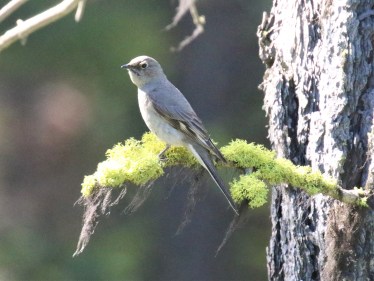
Grand Birds in the Grand Tetons – A Second Day with 50+ Species

This was another case where a glitch in pre-planned logistics worked out well.  I would be meeting Cindy at the Salt Lake City Airport on the afternoon of June 14th and from there we would drive to Jackson Hole, Wyoming.  The night of the 12th with the successful Flammulated Owl adventure meant a late night and a much later than usual start on the morning of the 13th, but there was an open day to do some exploring in Wyoming and if fortunate maybe even find 50 species.  That would take pressure off the visit with Cindy but it also would mean birding without company – a deviation from the “Grand Plan” of my 50/50/50 Quest which was to have company on each day of birding.  It worked out very well.  So the first part of this blog is before the Tetons.  For them you will just have to wait.

Prologue

Evanston, Wyoming is just over the state line from Utah.  Not a big town but sufficiently urban to give me Rock and Eurasian Collared Doves, House Sparrows and House Finches, European Starling and American Crow.  Adding a kettle of Turkey Vultures, a surprise California Gull, some American Robins, American Goldfinches and Tree Swallows and I was at 11 species in short order.  Other 50 species days had similar starts so it barely being after 9:00 a.m., I was very pleased.

That pleasure increased when a short way out of town I found some good sage habitat and easily found Brewer’s and Vesper Sparrows and Sage Thrasher and had a small flock of White Pelicans and a few Common Nighthawks fly over.  Both are always a treat and since I saw no water in the area, the Pelicans were a big surprise.


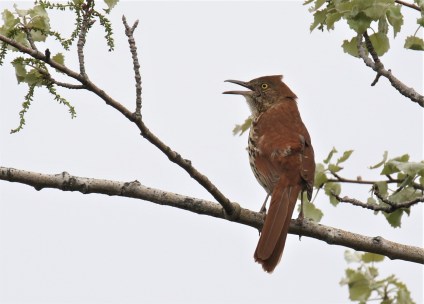
Sage Thrasher

Sage Thrasher

It was now just past 10:00 a.m. and I was at 24 species so going for 50 was definitely the goal.  Moreover, though, it was just fun and relaxed birding in beautiful open country.  As I have written before, this kind of birding energizes me – the combination of finding birds and being in such wonderful places without concerns for politics, bills to pay, even sports scores is consuming in a very positive way.  I think that even subconsciously dealing with those every day matters creates a negative energy and being away from them allows the positive energy that is available to take over.  I recognize that this is a luxury – especially being able to go on an adventure like this for  days or even weeks at a time.  Even in smaller doses, however, there is a restorative role played by following our passions and being immersed in them.  I need to remind myself of that the next time the ugliness of much of the current state of affairs in America is in the news.

Tim Avery had recommended the Woodruff Narrows Reservoir and environs as a great birding stop.  It was closer to Evanston than I had realized and even with much of the travel on a dirt/gravel road, I was there earlier than expected.  Still surrounded by sage, the Reservoir itself was a wonderful new habitat – the key to any “listing” day.  And now I understood where those White Pelicans had come from or were going as there were hundreds of them on the Lake/Reservoir.  More importantly there were both Clark’s and Western Grebes, Spotted Sandpipers, Killdeer, Willets and one of my favorites – Wilson’s Phalaropes.  

Wilson’s Phalarope

Wilson's Phalarope

Willet

Willet

Both Caspian and Forster’s Terns added to the count but the reservoir seemed almost duck-free.  I saw many Mallards but nothing else.  This was one time I wondered if my decision not to bring a spotting scope would be proven to be a poor one.  I expect that some of the distant specks may have other ducks or grebes but neither camera nor binoculars were able to show me that.  I met some locals at the reservoir whose interests were more in their two huge Black Labrador Retrievers than birds although the woman had a large telephoto lens and was taking photos of some of the birdlife.  She assured me they were “friendly” as the dogs came running to me.  I was more worried about a drenching as both had been in the water.  The visit with both the Labs and the couple was fun, with some input about hunting and birds in the area.  If need be, I could stretch this into the requisite “intersection” with locals.

Adding a single Lark Sparrow, a Belted Kingfisher and a Bald Eagle brought my species count for Reservoir to 26 with 19 new for the day.  Then it got a little weird.  I thought there was a road on the north side of the Reservoir that would take me to Cokeville, WY another spot that Tim had suggested.  Maybe there was, maybe there wasn’t but my GPS was not up to the task.  Fortunately the day was young, I did not really have a time limit and even more fortunately I found a little patch of forest where I found a House Wren, Dusky and Gray Flycatchers, a Northern Flicker and some Chipping Sparrows.

Chipping Sparrow

Chipping Sparrow

I had to backtrack and retrace my route along the Reservoir to get back onto the highway.  At least there were two new species along the way as I saw a single Gadwall and watched a small group of 5 Common Mergansers, all male and all distant fly in.  I expect I did miss other species without a scope but it was just noon and I was at 49 species for the day.  I figured it would be easy to find another one without the hour long drive to Cokeville.  It was but the problem was that I had not paid attention and realized that for half of the journey I would be back in Utah.  The weather was good, I had no obligations, so no worries.  Still it would have been nice to add the 8 new species I found along Highway 16 in Utah to my Wyoming list – especially the Sora.  In fact I had not realized I was back in Utah and thought there was something wrong with Ebird which I was using to track my progress.  It kept showing 49 species for Wyoming.  The problem of course was with me.

When I realized that I had been in Utah, I decided just to carry on to the Cokeville area and almost as soon as crossing back over to Wyoming, a lovely male Northern Harrier flew by for species number 50 for the day.  There would be 8 more new ones without having to go too far – so that goal was achieved – again money in the bank as had been the case in Utah two days earlier.  I would be back in Salt Lake City with time to spare to catch up on photo editing and able to work on blog posts for earlier trips.  Wyoming was now state number 41 with 50 species in a day.  The hope, however, was to at least equal and perhaps surpass this day with Cindy in Grand Tetons.

Northern Harrier

Northern Harrier Male

On to the Grand Tetons

It would be almost 5 hours to get from the Salt Lake airport to our “home” for the next three days – the Snake River Park KOA and Cabin Village in Jackson, Wyoming.  Cindy’s plane arrived a little early and we were on our way around 1:30 after a quick lunch.  We would be retracing much of my route from the previous day without the stops for birds or a visit to the Reservoir.  Cindy had flown out only a few days after returning from a 2 week trip to Portugal.  I don’t think her body had any idea what time zone it was in.  The last time I had seen her was at the Buffalo, NY airport after our visit to Niagara Falls which had followed biding at Magee Marsh and then in Tawas, Michigan (see   ).  That had been more than 3 weeks ago and it seemed much longer.  It was nice to take a break from birding and just “catch up” on the long drive and watch as the scenery got better and better.

I can’t say that our cabin at the KOA was an idyllic riverfront retreat, but the river was nearby and the cabin was serviceable.  I had last been in Jackson almost 50 years ago and my memories are probably flawed, but the town itself was overrun with tourists and it was hard to even find a parking place when we went out to dinner – not the quaint village I thought I remembered .  We weren’t there for the town though, and maybe it is the same flawed memory, but the Grand Tetons were even more magnificent than expected and during the almost three days we were there, we never tired of spectacular views which changed with each new perspective.

Our first birding day began on June 15th – crystal clear blue skies with a few puffy clouds.  Cold in the morning but warming as the day passed but never too hot.  We started the day as I usually do trying to find those countable “junk bird” Starlings, House Sparrows, Collared Doves, Crows and Robins.  All were in or round town, but we also found a few Trumpeter Swans, 5 Swallow species including some Bank Swallows, a Western Tanager and a Black Chinned Hummingbird.  Within 7 miles of our cabin we had 20 species in less that 30 minutes.  Our most photogenic bird was a squawking Common Raven that posed for us at coffee.

Common Raven

Common Raven

Our first official birding spot was at the Visitor Center at Flat Creek/National Elk Refuge.  In about an hour, we had 20 species with the best being Sandhill Cranes that Cindy spotted in the distant field.  It turned out that a volunteer had his scope trained on them when we got up to the observation tower.  Our conversation with him was informative…and not.  He asked if we knew what baby/young Sandhill Cranes were called.  I had always assumed they were chicks.  He told us that they were properly called “Colts”.  That turned out to be correct and was the informative part.  But he also told us that the two in the field had just “dropped” a youngster – like a mare might do with a foal.  I suggested that they laid eggs like all other birds but he would have none of it.  Not worth an argument and our later research confirmed that not only did they lay eggs, but that there was a fairly long incubation period (about 30 days) and that both parents do share in this duty.  Once hatched the young are quite precocious and leave the nest in a day or so – but are hardly “dropped”.

Sandhill Crane (Seen later in the day)

Sandhill Crane1

Just before entering the Park itself we stopped by some nice mature sage and I immediately heard the buzzy song of a Brewer’s Sparrow.  With a little coaxing it came right to us and posed nicely.  I had always thought of this species, like other Spizella sparrows, as small and slim, but I had never focused on the long tail.  It is quite apparent in the photo and will now be part of my identification process.

Brewer’s Sparrow

Brewer's Sparrow1

We also saw several Vesper Sparrows.  I will pat myself on the back here, as I finally remembered their song and found our first one as we were driving by with open windows on a road through the sage.  If I could remember other songs as well, I would find a lot more species.

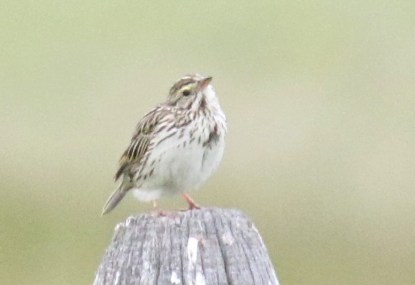
Vesper Sparrow

Vesper Sparrow Singing

Time for a pause from birding.  Have I mentioned that the Grand Tetons are SPECTACULAR!!  The scenery is truly overwhelming.  The Teton Range is part of the Rocky Mountains and extends for over 40 miles.  The Park itself was established in 1929 and is barely 10 miles south of Yellowstone National Park.  Its name came from French trappers who saw the mountains as grand teats.  I guess they were very lonely… Grand Teton Mountain is almost 14,000 feet and rises more than 7,000 feet above Jackson Hole, the valley floor along the Snake River.  Especially with one of the lakes or rivers in the foreground, we were in awe the whole time.

tetons1

In the Park itself, we first birded along Moose Wilson Road.  Our 19 species there included three of our favorite photos: a Broad Tailed Hummingbird, a Warbling Vireo and a Red Naped Sapsucker.  Finding the latter was one of those birding moments that is frustrating and rewarding at the same time.  I had heard its distinctive drumming but could not locate it.  After two moments I heard its “waah” call and looked up to find it on the backside of a tree right next to us.  I “waahed” back and it posed in great light as you can see.

Broad Tailed Hummingbird

Broad Tailed Hummingbird1

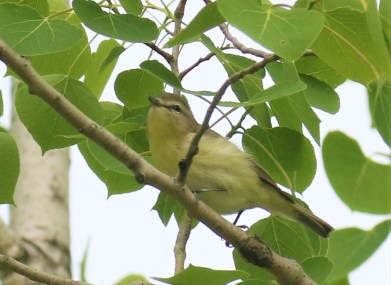
Warbling Vireo

Warbling Vireo

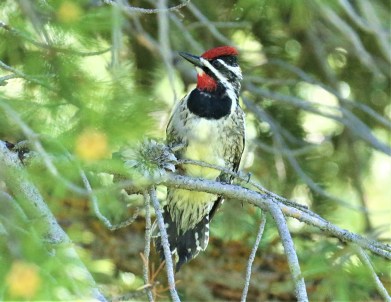
Red Naped Sapsucker

Red Naped Sapsucker1

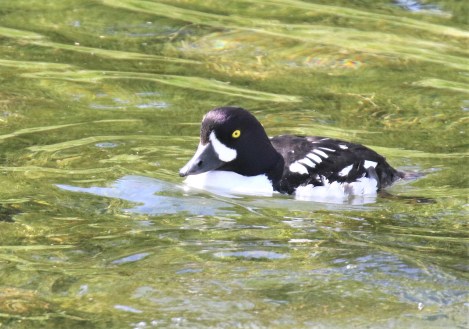
We now had 47 species for the day and had one more place to go .  At the Visitor Center, one of the Volunteers (not our Sandhill Crane guy) had recommended a visit to Schwabacher Landing.  It was great advice as it was probably our favorite place in the Park.  Of the 14 species we saw there, 11 were new for the day.  The first was heard before seen, as 4 Spotted Sandpipers along the river edge called “weet” “weet” “weet” and then flew by with their distinctive shallow wingbeats.  Next were several female Goldeneyes.  As I was trying to determine whether they were Common or Barrow’s, a beautiful male flew in and the crescent between its eye and bill left no doubt.

Spotted Sandpiper

Spotted Sandpiper

Barrow’s Goldeneye

Barrow's Goldeneye

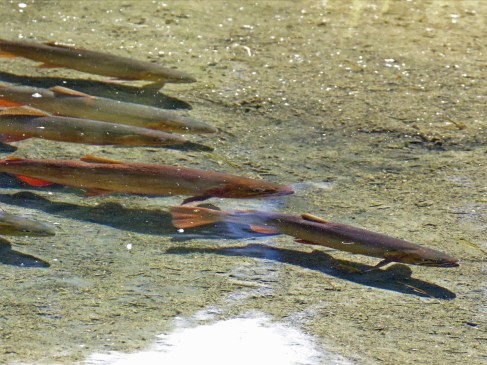
A hiker we met who was coming back to the parking lot, told us she had seen a group of Cutthroat Trout further along.  Not more than a half mile along the trail which bordered the river, we found them in a shallow pool – at least 20.  They looked like they had come from a mold as each was over 18 inches and in beautiful breeding color with the orange red of their “cut” throats tails and fins clearly visible.  We would be fishing in a few days and I could only hope to find a pool waiting for us somewhere full of “Cutts”.

Cutthroat Trout

Cutthroat.jpg

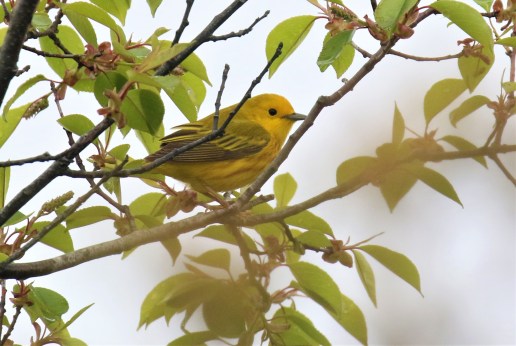
This seems as good a place to relate that among the most common birds we saw or heard – almost at every stop were Yellow Warblers.  There were many at Schwabacher, often singing, chasing each other or just posing in the sun.  Most that we saw were males so maybe the females were on eggs at their nests.  The only other warblers seen were Common Yellowthroats and Orange Crowns.

Yellow Warbler

Yellow Warbler

Our 58 species equaled the count from my day alone, but the birds, scenery and company were definitely better on this day.  We would return to Schwabacher Landing the next day just for a hike.  On the way in we came upon a fun scene as Prairie Dogs (we think) were rolling around in what could best be described as a “Monkey Pile”, even if that is mixing metaphors in a way.  Others departed but the two remaining seemed to be quite fond of each other.

squirrels

Maybe this was a precursor of things to come.  When we got to a spot that had been a favorite the previous day, a gentleman was there sitting on his lawn chair just enjoying the scenery and yet another beautiful day.  A few minutes later, we heard several voices coming towards us.  Hikers perhaps?  Not exactly; this was a wedding party with bride and groom dressed appropriately and with at least another 20 guests etc.  The gentleman vacated his spot and the very happy group commenced their ceremony.  We later learned that this is a very popular spot for outdoor weddings.

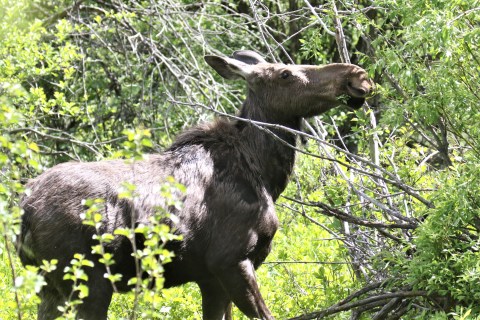
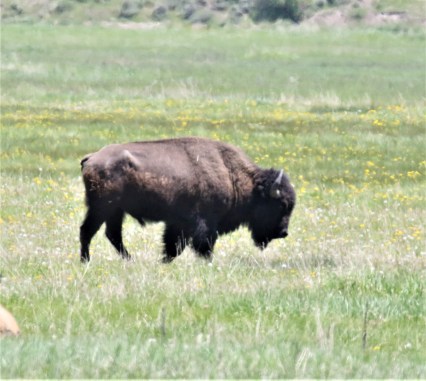
A hoped for part of any visit to Wyoming and the National Parks is the chance to view wildlife.  We had seen Pronghorns (Antelopes) and Buffalo on our birding day but had missed a Black Bear; and a Moose had been seen along Moose Wilson Road just before we drove past the pond where it had been grazing.  On our non-birding second day (well, actually our “less birding” second day), we thought we would try the area again.  When we got to the pond Park Rangers in the road directing traffic.  Not an accident – a Moose sighting,  We found a spot for the car and got a look moments before she headed off and disappeared in a thicket.

Moose

Moose1

Pronghorn Antelope

Antelope

Buffalo

Buffalo1

Wyoming was now officially state #41 with 50 species in a day.  We would be heading off to Montana to visit friends, do some birding and try our hand at flyfishing.  It had been a wonderful visit with the 50/50/50 quest being the catalyst for great times in a truly spectacular place.  I saved the best picture for last – two happy birders at our favorite spot – Schwabacher Landing.

Cindy and Blair

Epilogue – Yellowstone

In my head, I have always associated Yellowstone National Park with Montana, but the reality is that the vast majority of the Park is in Wyoming.  After our great visit to the Grand Tetons, our net stop was to be Helena, Montana where we would visit friends and try for fifty species in a day. Even though it was 90 minutes longer (not including any stopping), we elected to go through Yellowstone.  It turned out to be much longer due to slow traffic because there were lots of visitors and also a few stops to take in some of Yellowstone’s many wonders.

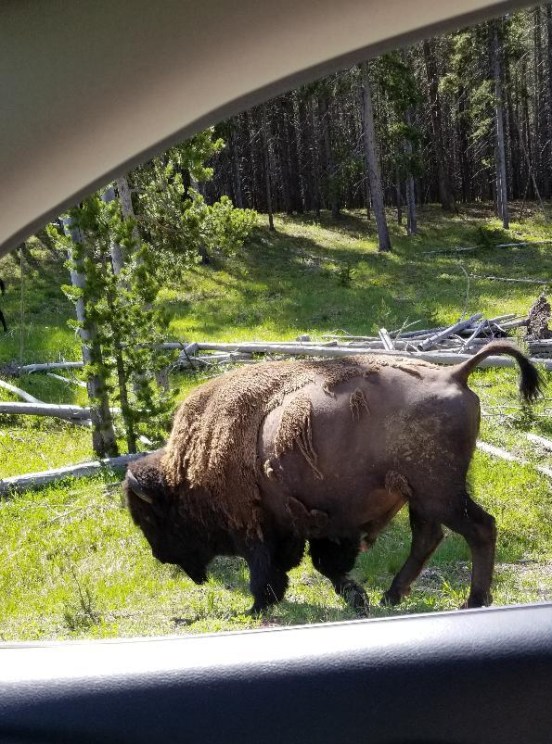
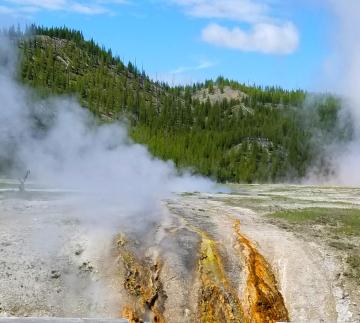
We did not visit Old Faithful or Yellowstone Falls – which had giant traffic backups.  Maybe someday we will return and do so.  I do want to include two photos from the drive, both taken from the car by phone camera.  They show how close you get to nature just being in the park.  At one point the Buffalo in the first was literally inches from the car.  If Cindy had her arm out the passenger side, I think the Buffalo may have licked it for the salt.  The second was as we neared the geyser basin and the line to Old Faithful.  Yellowstone is famed for its displays of thermal activity.  We saw steam from the geysers and the photo shows the outflow from one of the many hot springs which came within feet of the road.

Buffalo Close-up

buffalo-from-car.jpg

Hot Spring

Hotspring

I kept my eyes open for a possible Golden Eagle or Prairie Falcon as we drove through Yellowstone, but none were seen.  The only bird we added for Wyoming was a Cedar Waxwing – seen during a bathroom stop.  It was the 87th species for the trip.  I did not think about it at the time, but it would have been nice to have 13 more species to get to 100.  I have seen 100 or more species in 20 states and am very close to that in some others.  Adding states to the 100 plus list could be a fun adventure.  Maybe in a few years.

Cedar Waxwing

Cedar Waxwing


Fifty with a Flammy – Finally!!

A part of my 50/50/50 Adventure that I usually enjoy is the logistics involved in planning my schedule and the individual days of birding.  Routes, hotels, companions, hotspots are all important since my trips involve multiple states each with its own set of details.  In the East where the states are small, travel times were easy to deal with.  Quite a different story in the West.  Distances within and between states are immense and even the distance between birding spots can present challenges.  At least the speed limits are a friendly 70 to even 80 mph, a big help.

Surviving and enjoying our combined birding and vacationing time when she met me in Ohio and Michigan, Cindy was going to meet me in Salt Lake City after I had birded in Idaho and Utah and then we would vacation and bird in Wyoming and Montana.  This was a welcomed but complicating addition to my normal birding logistics.  And I screwed it up somehow putting in an extra day in Salt Lake City for me before she arrived.  I can only hope that all my inevitable miscalculations in the future end up so well.  There have been many great times in this visit and I am going to share them all.  (If your only interest in my Flammulated Owl story – just skip to the end.)

As I related in my previous post, I had gotten ahead of schedule by first finishing my Idaho 50/50/50 day in the Lewiston area thanks to great guiding by Keith Carlson and Terry O’Halloran.   That enabled me to find the Cassia Crossbills in Southern Idaho at least a half day ahead of the initial plan.  That in turn gave me at least a half day jump on my schedule for Utah.  As I was driving south into Utah I picked up some birds here and there but since I knew I had two more full days including my Flammulated Owl trip, they were an afterthought.  An immediate thought was that I had some time to be a tourist and for no particular reason I remembered another of those Landmark Books from my childhood (see the reference to Ethan Allen and the Green Mountain Boys in my Vermont post wordpress.com/post/blairbirding.com/22093).

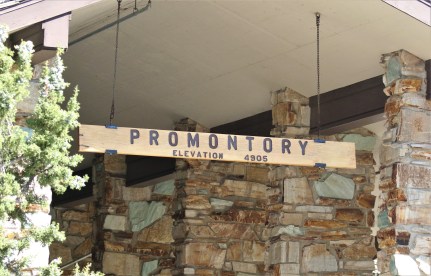
This memory was about the story of the Transcontinental Railroad.  I vaguely recalled that it had been completed at Promontory, Utah and wondered where that was.  Maybe it was a sign of good things to come, because when I googled “Promontory, UT” I found it was relatively close to where I was and – I am not making this up – driving directions said the exit was the next one on Interstate 84 – less than a half mile ahead.  At 75 mph, that was about 15 seconds.  Timing, timing, timing.

First Stop – Promontory, Utah and the Golden Spike

Promontory Utah.jpg

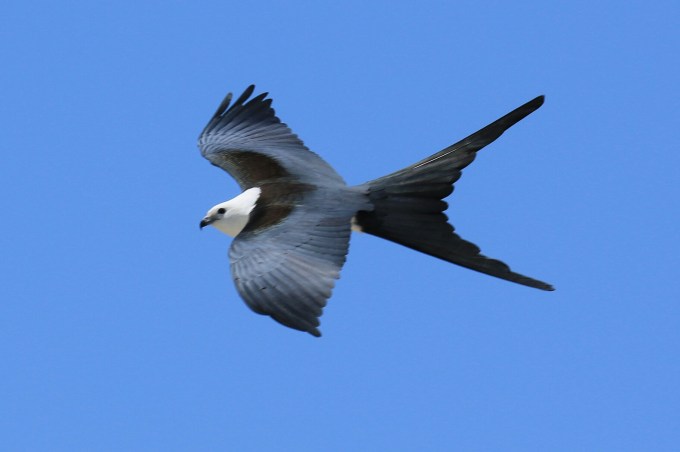
Promontory was about 25 miles west of me and the first part of the drive was through a minimally developed farming area which just happened to have some nice birds including my first of what would be many flyover flocks of White Faced Ibis.  The landscape opened up and there were more birds including a Swainson’s Hawk and a Western Kingbird.

Swainson’s Hawk

Swainson's Hawk

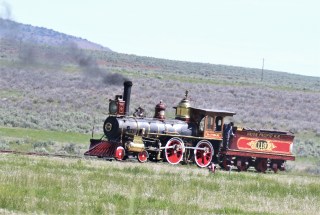
By the time I got to Promontory, my species list was at 22 – interesting but I had come because of the Transcontinental Railroad.  This is where the actual final connection was made first linking the entire continent by rail.  In May 1869, the “Golden Spike” was driven to add the final rail connecting the Union Pacific and Central Pacific Railroads – essentially connecting the East which had ended at Omaha, Nebraska with the West – Oakland and San Francisco Bay, California and changing the country forever as commerce and people settled across the prairies and the wilderness.

There is a small park and visitor center and shiny old steam engines, not all that impressive, but the historical significance is symbolically overwhelming and I was very pleased to add this experience to my 50/50/50 journey.  Doing such things was one of the objectives from the start.  And the coincidence that this was just a month after the celebration of the 150th Anniversary of the Golden Spike was very cool.

Golden Spike National Historical Park

Golden Spike National Historical Park  Golden Spike Railroad

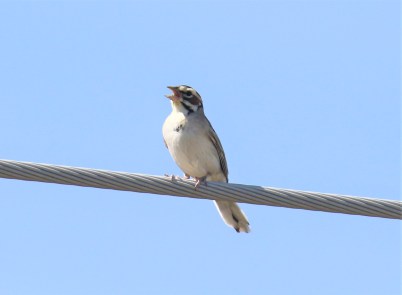
After a short visit I headed back towards the Interstate but when I found first a Long Billed Curlew and then some Sage Shrub species including Lark Sparrow, Sage Thrasher, Brewer’s and Vesper Sparrows and a Loggerhead Shrike, well it was getting very interesting from a birding perspective as well.

Long Billed Curlew

Long Billed Curlew  Long Billed Curlew Singing

Lark Sparrow

Lark Sparrow Singing

Sage Thrasher

Sage Thrasher

A few more species at a little wetland and then a sign for a Bear River Migratory Bird Refuge changed my plans dramatically.  I was at 37 species without really having thought about trying for 50 species that day.  Now I would.

Bear River Migratory Bird Refuge

I had never heard of Bear River Migratory Bird Refuge and since my 50/50/50 planning had concentrated around Salt Lake City it was simply not on my radar screen.  It should have been.  Better during earlier Spring migration or later for migration in the fall, it is a wonderful place.  Over the next several hours I drove through its various habitats and covered more than 30 miles.  And I added another 22 species for the day getting me way past 50 – money in the bank so to speak taking all pressure off the next day to find 50 species although that was still the plan so as to include a Flammulated Owl – and hopefully its photo.

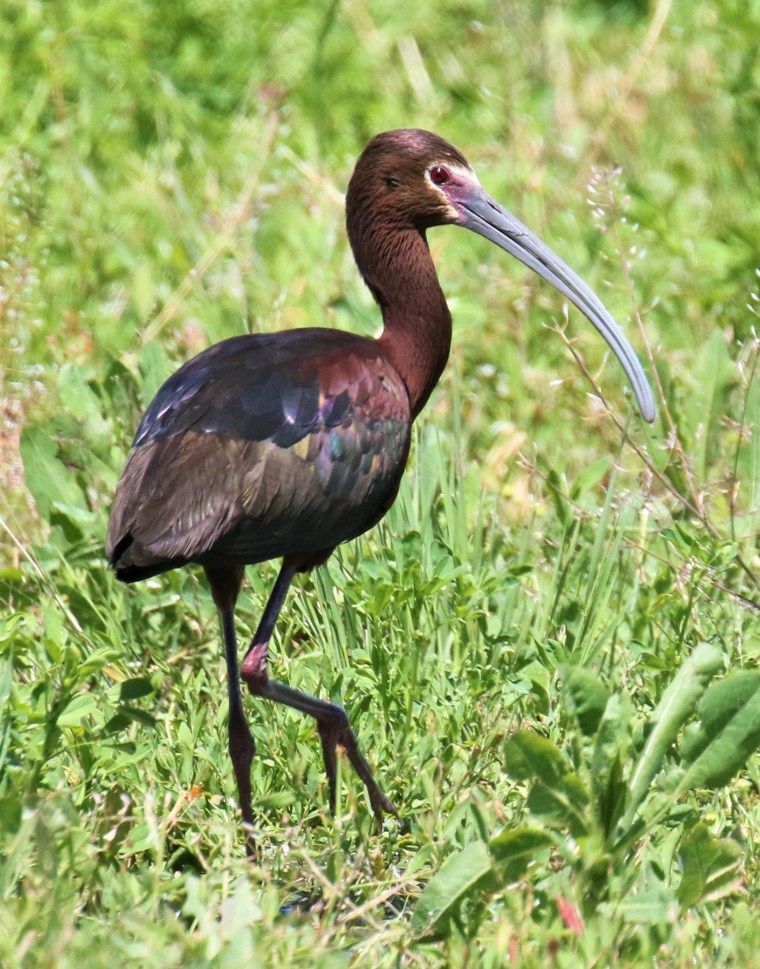
Without question the most impressive birds at the Refuge were the hundreds – make that thousands of White Faced Ibis.  They were in sloughs, fields, ponds and almost constantly overhead.  I know there were some Glossy Ibis mixed in, but especially without a scope (or the requisite patience) I did not search for any.

White Faced Ibis

white-faced-ibis-vertical.jpg

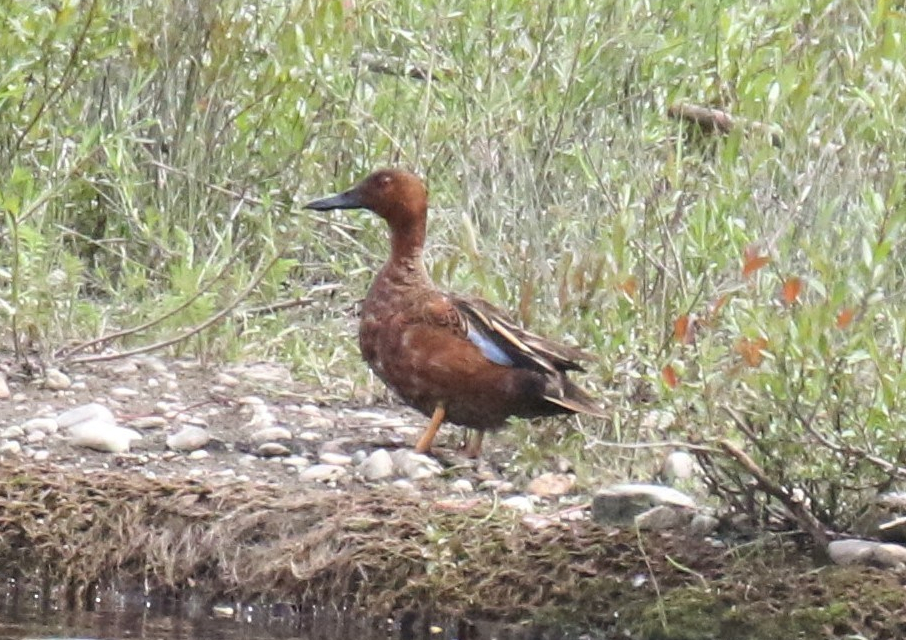
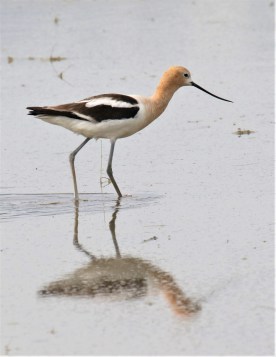
Surprisingly the most common waterfowl were Cinnamon Teal.  I saw mostly adult males.  Maybe the females were on nests.  I am sure there were over 100 in small groups or alone.  Equally impressive was the large numbers of American Avocets.  I did not scope distant ponds of which there were many so I am sure my count of over 150 was way short.

Cinnamon Teal

Cinnamon Teal

American Avocet

American Avocet 12th

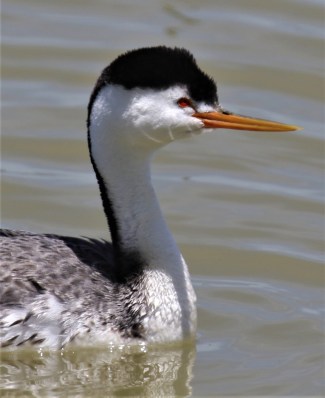
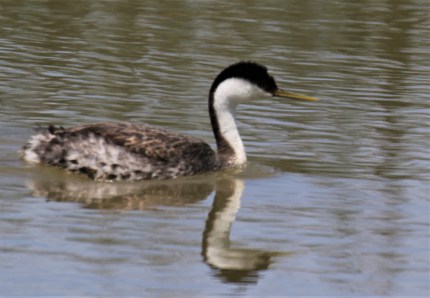
A much appreciated opportunity during my visit was the chance to see many Clark’s and Western Grebes up close making the identification much easier.  The best way to distinguish the less common Clark’s from the abundant Westerns is to see white completely surrounding the eye of the former as opposed to the black engulfing the eye of the latter.  The back of the Clark’s is also paler and its bill is orange not yellow/green.

Clark’s Grebe

Clark's Grebe

Western Grebe

Western Grebe

So my miscalculation had worked well for both history and birds, but I did not have a reservation in Salt Lake City for the night which I figured would be a simple matter of adding a night to my existing reservation.  Not so fast my friend.  I called the hotel where I had reservations for the next two nights.  They could not accommodate me.  Not because they were full – far from it.  They had a lot of empty rooms but not an uncommitted one that was clean or could be cleaned for me for that night.  It was 2:00 p.m. when I called.  There is a lot I do not know or understand about the hotel business. [Like why anyone would design bathroom light switches so that one switch turns on both the light and the NOISY fan at the same time.]  However, even when I said I would then have to cancel my reservation for the next two nights because I did not want to have to relocate, there was no solution.  OK – I cancelled and took my business elsewhere.  And oh yeah the original reservation was at a large national chain – not the same one I ended up at.

Even with the 50 plus species from the previous day, when I got up the next morning (in that new hotel room), I was still hopeful that with the aid of Tim Avery I could have my 50/50/50 day in Utah include a Flammulated Owl.  But I was not due to meet with Tim until 3:15.  Back to tourist mode.  Most definitely not my cup of tea and I have some issues…but…this is a big world with room for lots of ways to lead one’s life – as long as nobody else is hurt.  So…I visited the Mormon Temple – I was in Salt Lake City after all.  As I said in a Facebook post, SLC may well be the white shirt capital of the world – hundreds of mostly young men (and some officials as well) in suits, ties and white shirts in the 85 degree heat.  This used to be commonplace in the world of business, but standards have relaxed and changed – not for these folks.  I wonder if that will remain the case much longer with the impact of social media.  But as I said, it is a big world and if it works for a greater purpose, fine.  I did not go into the Temple itself but did hear a few minutes of an organ recital.  Had a couple of interesting conversations and departed.  Glad I went, do not think I will ever feel a need to return.

The Mormon Temple

Temple

On the way back to my hotel to work on posts etc before meeting up with Tim, I stopped by Liberty Park.  Found 16 species – a good start for what would hopefully be a very birdy remainder of the day.  Tim was at my hotel a few minutes early – that was nice.  We picked up another birder and headed off to Farmington Bay Wildlife Management Area.  It was quickly evident that getting to 50 species this day would not be a problem.  Much of it was a repeat of species I had seen the previous day at Bear River.  My only new species for the State was a Bullock’s Oriole, but altogether we had 52 species there.  I did not know it at the time but a Blue Winged Teal that I was at least the first to see was uncommon, even moreso was a Cinnamon Teal x Blue Winged Teal hybrid that Tim found.

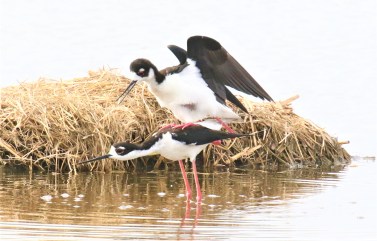
Without question the highlight of the visit at least for me was a pair of copulating Black Necked Stilts.  It was interesting to observe the pre-copulatory behavior as the female seemed to clearly communicate receptivity.  He was a little slow on the uptake but it all worked out.

Black Necked Stilts

Black Necked Stilts Copulating

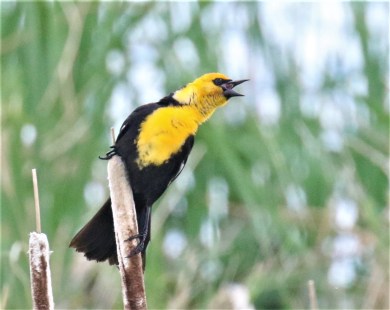
A few more stories about Farmington.  You would think that with the abundance of Yellow Headed Blackbirds, it would be easy to get a great photo.  Somehow every time we tried there was a reed in front of out subject.  This was the best I could do.

Yellow Headed Blackbird

Yellow Headed Blackbird12th

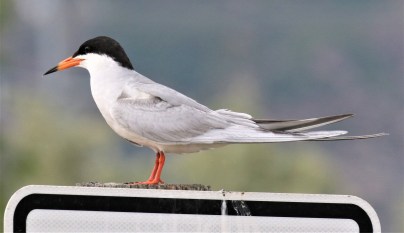
Like every other stop on our trip, Tim knew important little details like that a particular Forster’s Tern favored a particular pond and would circle around, maybe perch for a rest but always return – providing good photo ops – of most interest to Rick Folkening and me.  This one of it on a Refuge speed limit sign (15 mph) as my favorite.

Forster’s Tern

Forster's Tern 1 12th

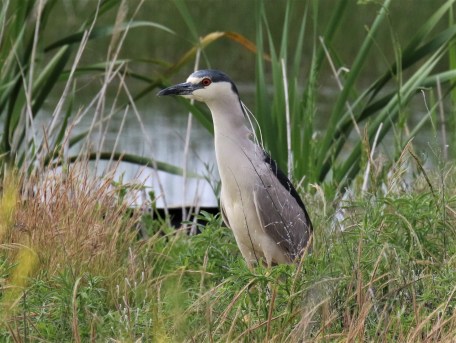
Early in our visit, a medium sized brownish bird flushed out of the reeds and flew off.  It was a juvenile Black Crowned Night Heron.  Tim told us that it was often misidentified on EBird as an American Bittern.  He said we would “probably” see another one – meaning we would for sure.  Shortly afterwards we did.  This became a running joke during our visit.  After each observation, Tim would repeat “probably another one”.  This maybe happened 6 times.  The last one was the best – an adult posing nicely.  It is a bonus when a guide has a good sense of humor – better yet when it is about getting his clients onto the birds.

Black Crowned Night Heron

Black Crowned Night Heron

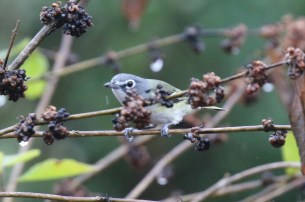
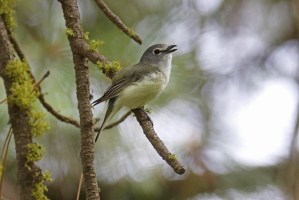
So much for the marshes.  How about some mountains?  We picked up another birder and headed East into the foothills with a first stop at Little Cottonwood Canyon hoping for a Virginia’s Warbler – a lifer for Rick.  Almost all of my birding the previous day (and continuing at Farmington) was in wetland or open field habitats.  This was new and we quickly added eight new species to my day and State list.  We may have heard a Virginia’s Warbler but no response or appearance.  We definitely got both from a Plumbeous Vireo – the first I had seen since last year in Arizona and a species I have seen only a few times.  I had seen many Cassin’s Vireos earlier in the week in both Washington and Idaho and last month had seen many Blue Headed Vireos on my Eastern swing.  These three species split from the single Solitary Vireo.  Not a lot of difference visually although the songs are very different.  My photo from Utah is below and I add ones of the other two species.

Plumbeous Vireo

Plumbeous Vireo

Blue Headed Vireo (Connecticut) and Cassin’s Vireo (Washington)

Blue Headed Vireo 2  Cassin's Vireo

We were essentially working our way to the owl spot and to darkness.  At Little Dell Reservoir we quickly heard a Green Tailed Towhee and saw it fly in and as they often do bury itself in thick brush.  It flew to more brush and then more and finally gave us a 1.5 second look in the “almost open”.  I was not able to get a photo but I think Rick got enough of a look to count it as a life bird for him.  We heard two more at Big Mountain Pass where we met Dave and Melissa from California, who joined the group and where the target was a MacGillivray’s Warbler – a lifer for one of the partyThe warbler was heard immediately and there were decent looks although never completely in the open.

One more pre-owling stop – at a creek where Tim knew there would be a nesting pair of American Dippers.  The water seemed very high and fast to me, but the Dippers were there and we saw them – in a tree – a new experience for me.  Would this be the appetizer to the new experience that really mattered – a Flammulated Owl photo?  It was now time to find out and we returned to Big Mountain Pass.  My experience with Flamms had always been that they did not start hooting until it was completely dark.  It was not yet completely dark and there was a lot of moonlight.  Nonetheless we heard hoots shortly after we arrived.  It was Showtime for Tim Avery.

Prior to this trip, I had filed 15 Ebird reports which included Flammulated Owls. That included 40 individuals. I had only actually seen a single owl. All of the rest were heard only.  It had been very frustrating – even more than missing photos of the much rarer and harder to find Boreal Owls.  As Tim explained to the group, Utah is a great place to find and see Flamms in part because their favored habitat here is mostly in Aspens which are much farther apart than the pines/firs where they are most often found elsewhere. For a long time it had been thought that Flamms were only found in pines. Not so, all they need is a nest hole – provided by Flicker cavities – and food – primarily moths. Flickers are in the Aspens and provide nesting sites there and there are plenty of moths. The lighter color of the Aspens also provides an easier background for visuals.  Tim had us at a site that had lots of Aspens.

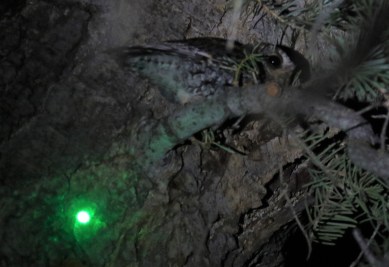
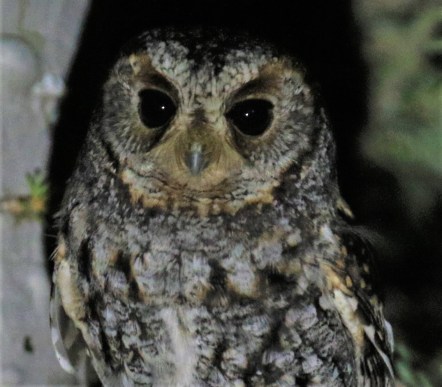
At least two owls were hooting.  Tim’s playback and his own hooting brought the owl closer.  I had had this experience many times in Washington without getting a visual.  This time we did … but then it was gone perhaps because we had made a small noise.  Another owl, more hooting, more playback, closer again, another visual.  This time it seemed to be more at ease.  Tim shined his LASER two feet below the owl.  I got a photo – a really lousy photo, but it was my first ever of this a Flammulated Owl and if that was all the night was going to provide sobeit and I would be happy.

Flammulated Owl First Photo

Laser Points the Way

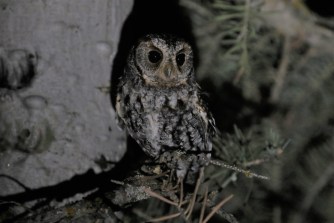
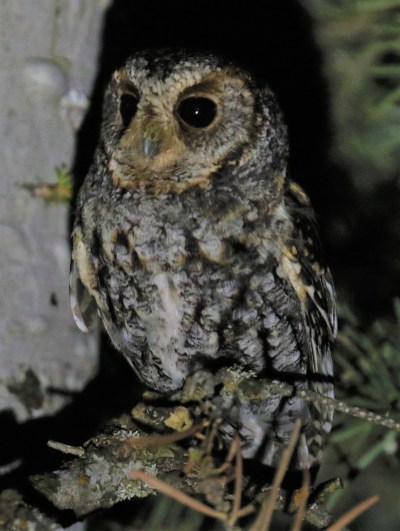
But the night indeed would have more including one Flammulated Owl that was super cooperative and super photo friendly perching in the open and remaining there for several moments even though Tim’s spotlight remained on it the whole time.  Tim said his experience was that once an owl had a comfortable perch, it would remain there as long as there wasn’t sudden movement or noise from us.  I was overjoyed with the photos but I wish I had taken a video both to include the continued hooting in sound and also to show the effort the owl made with each hoot, thrusting its chest each time.

Flammulated Owl Photos

Flammulated Owl

Flam5

Flam8

One lesson that night was that Flamms are generally much closer when they are heard than I had thought . The hoots do carry, but not as far as I had believed. We had one owl that we thought was maybe 25 to 50 feet away and was only 8 feet above us. Tim said studies show that the owls hoot approximately 45 times in a minute. It actually seemed more frequent. By that average, one of our owls hooted almost 2000 times in the less than hour that we were in its territory and could hear it.

If you really want to learn more and experience them yourselves – go to Utah – better yet – contact Tim Avery. tim@mwbirdco.com  (801) 440-3035.

We went to one more spot and heard both Flammulated and Saw Whet Owls.  We tried mostly for the Saw Whet and it never moved from a perch high in the canopy.  Sure it would have been nice, but I was already on cloud 9, so the Saw Whet’s only distinction was being the species number 75 for the day and number 95 for the State of Utah.  I would pick up 3 more species on my own the next day for 98 in the State.  Liking round numbers, I wish I had seen two more.  Maybe on another visit.

Having seen 59 species on my own the day before was gratifying but it was very special to be able to include my former nemesis Flammulated Owl for my 50/50/50 day in Utah.  It was ABA Life Photo #703 and Utah was State #40 for the 50/50/50 Adventure.  Wyoming and Montana are ahead on this trip.  Don’t think they will beat 50+ with a Flammy in Utah though.


Idaho with Keith and Terry -50/50/50 at Its Best

Whether in my blogs or in my conversations with those who are interested, I emphasize that while my 50/50/50 Adventure is definitely about birds, it is really about people – people who share my passion for birds and beautiful places and passion for being with other people who are out there enjoying these wonderful gifts from nature.  There is no better example of this than my birding in Idaho with Keith Carlson and Terry O’Halloran.  And this is especially so as it followed a similarly wonderful day of birding their beloved Walla Walla County with Mike and MerryLynn Denny.  That day also had more than 50 species in a beautiful place with great birders who are even better people.  It really is about people.

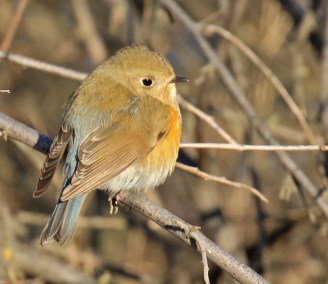
I got to know Keith Carlson as a resource for some of the great birds found in Asotin County and from a chase or two there and an extremely special bird across the Snake River in Idaho.  One was a Blue Jay in December 2015 and another was a Red Flanked Bluetail in January 2017.  Each time Keith went out of his way to make sure I saw birds he had already seen.  He was a great guide and great company then and even moreso on this occasion.

Red Flanked Bluetail

red-flanked-bluetail7

When I asked Keith if he could help with my 50/50/50 quest in Idaho, he jumped on it and not only came up with a plan for the day, he also came up with another birding companion, Terry O’Halloran and with breakfast and with lunch and then went out with Terry on a scouting trip to make sure we could find 50 species.   And then…

And then he and Terry found a Great Gray Owl.  When I got to Lewiston the day before the day of the quest, Keith said we had to get together and talk about a different option.  He told me of the Great Gray and asked if I wanted to go for it knowing it might make it harder to find 50 species since it was not part of the original logistics.  And also knowing it was not a sure thing.  My answer was easy – “Of course” and if we found it it would be a great addition and part of the story of the day.  If we didn’t find it, I was still confident we would find 50 species AND our search would still be a story for the day.  AND it is another part of this 50/50/50 adventure – the getting out and doing – trying, living fully with others and with spirit and a love, a passion for the activity itself.  Results are great, but the main result is participation itself.  Sure let’s go for the Owl.

Keith’s Great Great Gray Owl Photo (and the duplication is definitely intentional)

GGOW1

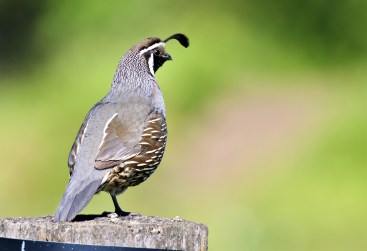
Keith picked me up at 5:30 a.m. and then we picked up Terry at his house.   It was about an hour to get to Craig Mountain where they had found the Great Gray.  I had learned from my other 50/50/50 trips that it was important to pick up some common species on the way to targeted birding hotspots – birds like House Sparrow and European Starling.  This morning was very productive in that respect.  Aided by some birds at Terry’s feeder including Lesser Goldfinch, we had 16 species within 10 miles of my hotel.  We also had a very photogenic California Quail.

Lesser Goldfinch

Lesser Goldfinch

California Quail

California Quail

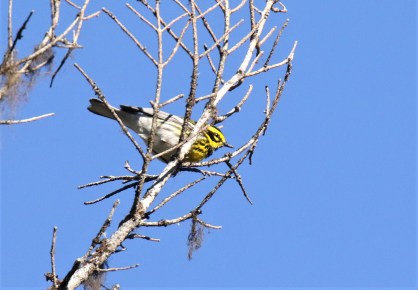
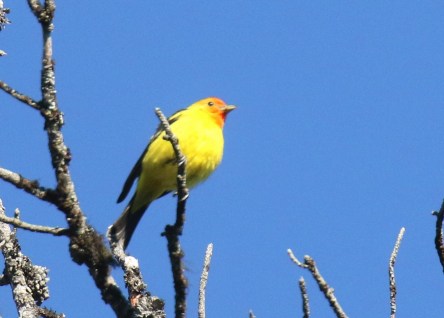
There was high anticipation when we arrived at the meadow where the Great Gray had been seen.  Not going to hold readers in suspense.   The Great Gray did not make a repeat appearance.  Keith was disappointed.  Terry was disappointed.  Sure, so was I – but not as much as they were.  They actually felt more responsibility for the success of my day than I did.  Keith was particularly worried that we had “wasted” time – taken time away from my 50 species quest on this empty pursuit.  Not wasted at all – it was terrific.  We shared the energy and excitement of the chase.  We found many other birds including a completely unexpected Wilson’s Snipe that Keith flushed.  I used the Northern Pygmy Owl tooting call to attract a small flock that included Mountain, Black Capped and Chestnut Backed Chickadees, Red Breasted Nuthatches, Ruby Crowned Kinglet, Townsend’s Warbler and Western Tanager.

Townsend’s Warbler

Townsend's Warbler

Western Tanager

Western Tanager

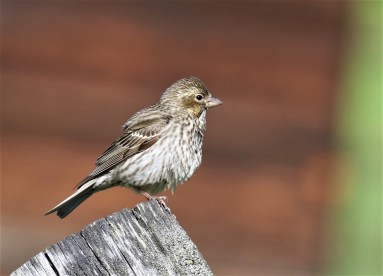
We also had other birds in the area including Mountain and Western Bluebirds, Cassin’s Finch, Red Crossbills and a rare Lincoln’s Sparrow.  On the drive out of the area, we found a Townsend’s Solitaire – always a good find.

Western Bluebird

Western Bluebird1

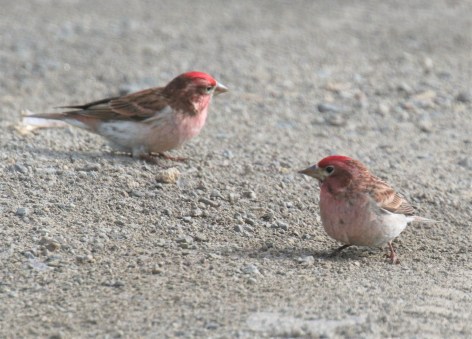
Cassin’s Finch

Cassin's Finch1

Townsend’s Solitaire

Townsend's Solitaire1

By the time we left the area, we had 33 species from there and 48 altogether.  Not a waste at all – a highly productive and very fun visit and then the local expertise of Keith and Terry took us across the finish line as we visited Red Bird Lane where we had 27 species – 8 new for the day taking us past the 50 species threshold.

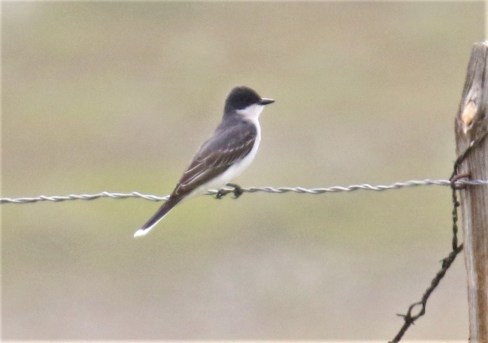
Eastern Kingbird

Eastern Kingbird1

Tree Swallow at Nest Box (I am including it here but it may have been at Craig Mountain)

Tree Swallow

Everything now would be gravy and we had lots of it.  We went to Mann Lake, a place I had heard about many times and seen in many great Ebird reports – famous for shorebirds and waterfowl and rarities.  Not its best time but we still had 7 new species including a Spotted Sandpiper that Keith knew had to be there and with diligence we found.  And then more local expertise and more caring participation because the reality was that as it has been on so many of my visits to other states, my adventure was a shared adventure, a joint activity and Keith and Terry not only wanted it to succeed by reaching some minimum but to be a full on engagement with ongoing meaning and enjoyment.

There had been a report by Carl Lundblad of a Least Flycatcher at a specific spot – with other good birds as well.  We had GPS coordinates and a description and a bird list.  There seemed to be some disconnect between the description and the GPS, but we got to what was almost certainly the right spot and we once again added new birds for the day – Lazuli Bunting, Yellow Breasted Chat, Black Headed Grosbeak, Vaux’s Swift and a Least Flycatcher – maybe…It looked mostly like one and it made all of the Least Flycatcher calls – except no che-bek.  It flew in in response to the che-bek calls but did not repeat them.  It did not respond to Willow Flycatcher calls – but a Willow Flycatcher did.  So maybe…

Our Mystery Flycatcher

Least Flycatcher1

One more stop both because it was a known Great Blue Heron roost spot and also because we needed to eat those lunches that Keith’s wife had prepared for us.  And fittingly there would be one more great bird as two Common Nighthawks flew over us with their loud and familiar “pe-ent” call.

Common Nighthawk

Common Nighthawk

It was only 2 o’clock.  Keith and Terry were game for anything.  We had observed 77 species for the day.  We could continue and probably add another dozen or so.  My earlier planning had assumed it would take all day to get our 50 species so I would be staying at a hotel in Lewiston for another night.  Keith had already vetoed that plan inviting me to spend the night at his home.  Either way, I would then have made a long 8+ hour drive the next day to Twin Falls enabling me to try for Cassia Crossbills the next morning before heading off to Salt Lake City (another 4 hours away).  Now there was another option.  I could head south and stay at McCall, ID halfway to Twin Falls.  That would make it possible the next day to get to the Crossbills spot in the afternoon, find them if I got lucky or more likely scope out the area and make another try the next day.

The choice was mine.  Keith and Terry had been so giving of their time.  It was a Sunday and I was sure there were other things they could be doing.  Splitting the 8 hour drive in half was appealing – heck, Keith had done all the driving this day, so I was fresh.  And somehow it seemed fitting to end the day with the Nighthawk – newly arrived in the area just for me/us to see.  I decided to head south and the results of that decision have already been written up in another blog post on the Cassia Crossbills (yes I found them the next day – or rather they found me).

So another successful 50/50/50 day – great birds, great places and great people.  Idaho was state #39.  Time with Keith was great.  Meeting Terry was great.  Seeing new places that I had only read about was great.  Many thanks to Keith (and his wife) and Terry.   They even provided perfect weather.

Cassia Crossbills – Luck Was With Me

This will be a short and very focused post and will be followed later by a longer one covering my wonderful 50/50/50 time with Keith Carlson and Terry O’Halloran in Northern Idaho.  The original plan had been to do the 50 species day with them in and around Lewiston, ID on Sunday June 9 spending that night afterwards in Lewiston.  Then I would do the long 8+ hour drive to Twin Falls, ID spending the night of the 10th there and try for the Cassia Crossbills the next morning at the Diamondfield Jack Campground.

Keith and Terry were such fabulous “guides” that we had over 75 species before 2 p.m.  This enabled me to hit the road and get to McCall, ID where I spent the night of the 10th.  McCall is about halfway between Lewiston and Twin Falls.  With this head start I was able to drive through Twin Falls and get to the Diamondfield Jack Campground just after noon.  Even though I had been encouraged to try for the Cassia Crossbills early in the morning, I figured I might get lucky or if nothing else, I would be more familiar with the area increasing my odds for success on a return the next morning.

The drive along Rock Creek to the Campground was spectacular in beautiful weather.  Soaring cliffs and rock formations on both sides of the road.  The temptation was to stop and bird as I went since I was hearing Yellow Warblers and Yellow Breasted Chats.  But they would be there on the return.  I wanted to get to the Campground.

Rock Creek Scenery

Rock Creek Scenery

Word was that the Crossbills could be found near the parking area for the Campground.  This was my first “surprise”.  There was a huge and frankly quite ugly parking area.  Where to start?  I parked next to a picnic table and when I got out of the car I thought I heard some Crossbills.  I followed the sound and found a Red Breasted Nuthatch putting finishing touches on its nest hole but no Crossbills.  Then I heard some chatter at the other end of the parking area.  Off I went.  Several Yellow Rumped Warblers and some Cassin’s Finches but again no Crossbills.

Red Breasted Nuthatch

Red Breasted Nuthatch at Nest

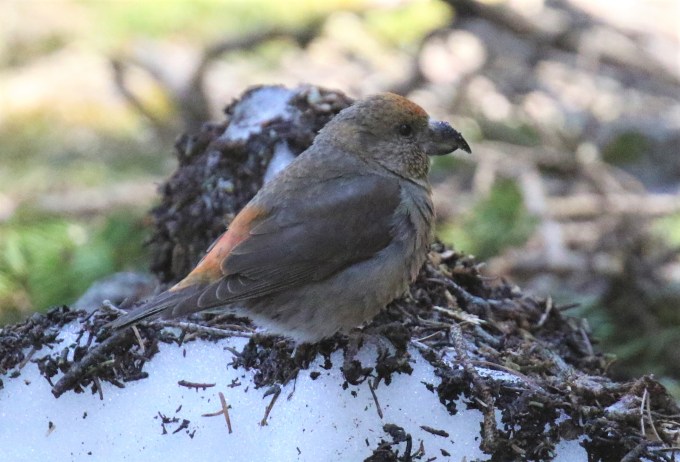
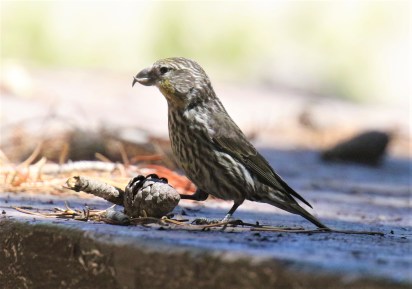
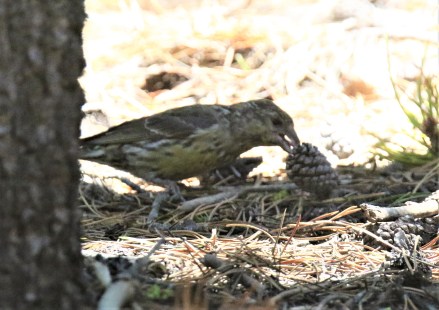
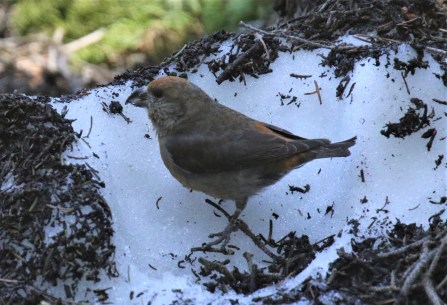
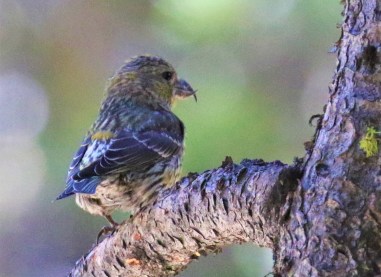
OK, time to breathe.  I returned to my car, got my lunch and sat down at the picnic table.  Some say that they would rather be lucky than good.  Nope I would rather be good than lucky…but this day I happily made an exception.  As I sat with my lunch they came in one after another after another – Cassia Crossbills – almost at my feet.  I had expected them high up in the trees but here they were down low feasting on the cones that were everywhere for the taking including on the picnic tables.  One landed on the picnic table next to mine.  Snap…an ABA Lifer and an ABA Life Photo!

Cassia Crossbill – ABA Lifer and Life Photo

Cassia Crossbill Female

Cassia Crossbill Working on a Cone

Cassia Crossbill at Work

There was a small pile of remnant snow and that seemed to be a favorite spot as at one time there were 4 Crossbills on it and they were joined by Pine Siskins.

Cassia Crossbill 4

Cassia Crossbill

All told there were at least 22 Cassia Crossbills always on the ground or on low perches over an area of maybe 100 feet by 100 feet.  They seemed to act individually except for the bit of snow, but apparently there was some magic signal and as quickly as they had appeared – poof! and they were all gone.  The fun had lasted maybe 15 minutes.  I guess I picked the right time for my lunch.

Cassia Crossbills on a Low Perch

Cassia Crossbill3

Cassia Crossbill2

Elated does not begin to describe my feelings.  A beautiful place and wonderful birds and I had them both completely to myself.  I watched several of the Crossbills use those powerful crossed bills to pry the seed kernels out of the cones.  Their bills seem significantly larger than the crossed bills of the Red Crossbills.  The birds themselves seemed bigger as well, but without them being side to side, hard to say.  In any event this was a lucky day indeed.

The Cassia Crossbill was not recognized as a separate species until 2017.  Unlike the nomadic and widespread Red Crossbills, the Cassia Crossbills remain in their very limited habitat area in Cassia County.  They feed on the cones of the Lodgepole Pines which are plentiful in the Sawtooth National Forest.  I had great looks and a special opportunity to watch a behavior that I had not expected with them feeding on the cones ground.  A very lucky time indeed.

“Sufferin Succotash” – Birding Rhode Island

At 7:00 a.m. on May 3, 2019 my State List for the State of Rhode Island was 0.  Six hours and 10 minutes later it was 84.  Not bad.  Or as I at times say when impressed, “Wowsers”!!  For this accomplishment (and yes, I know I am dating myself), I will let Daffy Duck and Sylvester the Cat voice their opinion: “Sufferin Succotash”!!  Here’s the rest of the story…

Daffy Duck

First I am cutting myself some slack on the cartoon characters reference and their well known idiom, even if you don’t.  Rhode Island was the second of 13 states birded for 50 species in my Eastern Marathon, but this is the 13th Blog Post on the trip and I am a bit tired.  Second, it may be corny – actually doubly so, since succotash is a mixture of corn and lima beans – but the phrase has special application here as 23 of those 84 species were seen at Succotash Marsh.  Granted many more were seen at Trustom Pond, but the puns I came up with for “Trustom” using “trust ’em” just didn’t do it, so “sufferin succotash” it is.

Back to being serious.  There was no sufferin or suffering on this day.  Just lots of good birding in Rhode Island – again with my expert birder friend Mike Resch.  We knew it was going to be a good day when the first bird we saw as we started birding in Westerly, Rhode Island was a Wild Turkey at a busy intersection.  It actually looked like it was waiting for the “Walk” signal to cross the road.

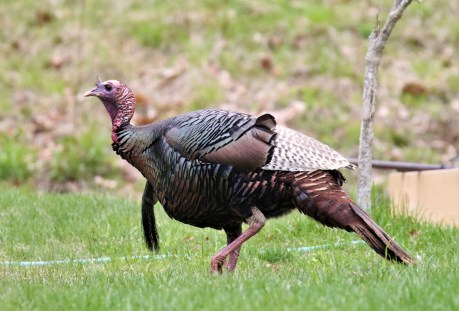
Wild Turkey

2P5A0238

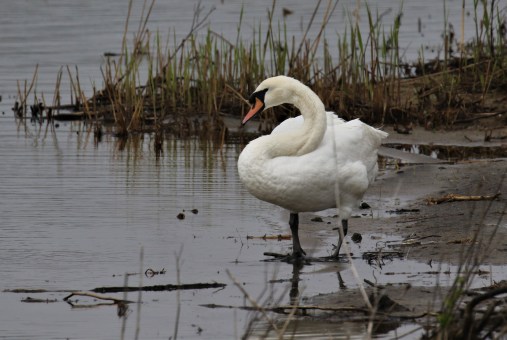
Trustom Pond National Wildlife Refuge is on Block Island Sound in Southern Rhode Island.  There is a large pond, the ocean coast and forested habitat – an excellent birding hotspot.  We would spend just over three hours there and record 64 species – chalk up another state for the 50/50/50 Adventure.  Surprisingly this included only two shorebirds, a Sanderling and a Willet.  But there was a good mix of everything including 6 duck species, 5 raptors, 5 warblers and some of these and some of those.  I got a nice photo of a Mute Swan in flight at least proving that these are not pinioned birds added as ornaments to some pond.

Mute Swan

Mute Swan Flight

The two Northern Gannets were too distant for a photo but they were the first I had seen in 2019, special treats for West Coast birders.  No Eiders but I would see some later.  Another new bird for 2019 was a Blue Winged Warbler.  I had seen one last year in Texas but had not for many years before that.  I would chase its close relative the Golden Winged Warbler later in several states hoping for a first ever photo.  Didn’t know it then but do now – it didn’t happen.

Blue Winged Warbler

Blue Winged Warbler

There were unfortunately no Eastern Bluebirds, Blue Grosbeaks or Black Throated Blue Warblers but we did see Blue Jays, Blue Gray Gnatcatchers, and Blue Headed Vireos.  A better vireo was a White Eyed Vireo.

Blue Headed Vireo

Blue Headed Vireo

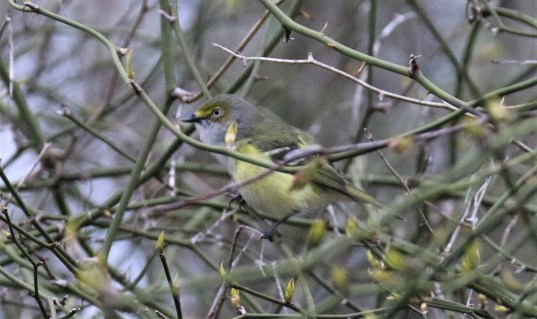
White Eyed Vireo

White Eyed Vireo

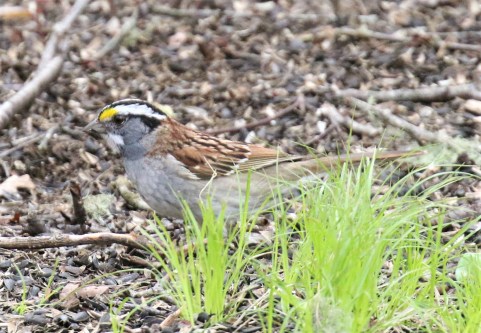
It is always an adjustment for me that White Throated Sparrows are so common in the East and often much moreso than Song Sparrows which often seem to be everywhere back home.  Certainly fine looking birds, though.  The most common sparrow or sparrow-like bird was the Eastern Towhee, its song constantly reminding us to “Drink your tea.”  I well remember this as one of the first species I was aware of when I first returned as a birder to Maryland where I grew up.  At that time it was called a Rufous Sided Towhee only later being split away from the Western form the Spotted Towhee.

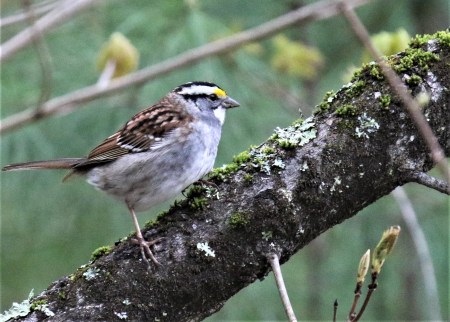
White Throated Sparrow

White Throated Sparrow1

Eastern Towhee

Eastern Towhee

Spotted Towhee (from Washington State) for Comparison

Spotted Towhee

There are many birders who think that Yellow Warblers may also be split – if not Eastern and Western forms, then at least the ones in Florida.  Until that happens, the one we saw here will continue to be the same species as ones I would see in Washington.  Even though listing is an important part of my birding, I really don’t care much about these splits.  Yellow Warblers are gorgeous – wherever found and whatever form they are.  The red chest streaks on this one were particularly bold and bright.

Yellow Warbler

Yellow Warbler

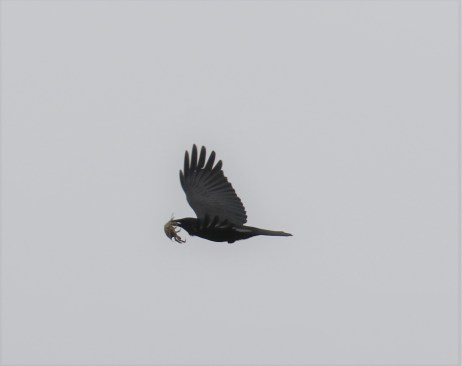
We moved on from Trustom Pond to the Succotash Marsh.  Here we had lots of shorebirds, 10 different species with the most numerous being Least Sandpipers and Dunlin.  As had been the case in Connecticut, we also had both Semipalmated and Piping Plovers with even more of the latter at this spot – at least 10.  We also had the only Black Bellied Plovers of the trip.  None of the shorebirds were up close – that’s why a scope was so nice to have.  So no photos.  And the same was true for the 3 Least Terns and the Common Loon – all in the distance.  A little closer was a Fish Crow.  I was happy to hear its distinctive call – different from an American Crow – and to count it as a new species, but as with our “Northwestern Crow” in Washington, I wonder about it being a separate species or at least would be maybe more comfortable if they were all lumped together – no disrespect to any of them.  At least this one was eating a fish – well, a crab so a shellfish by some accounts.

Fish Crow

Fish Crow with Crab

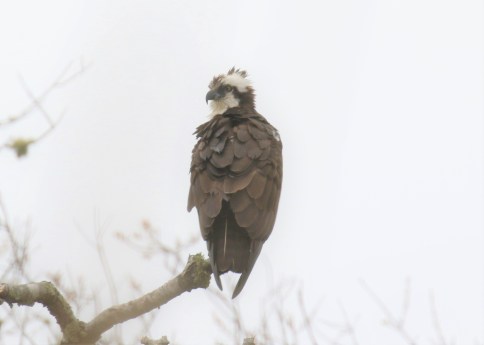
Another fish eater we observed was an Osprey.  We later saw this one pluck a fish from the water.  I believe Ospreys join Barn Owls as the only or one of only a few species that are occur regularly without being introduced on every continent – except Antarctica.  I have seen them on 4 continents (not Europe or Asia) and in 25 states and believe they have been seen in all 50 although rarely in Hawaii.  A welcomed observation anywhere.

Osprey

Osprey

Since I am writing this after the blog posts for the other states, I want to include a bird that was seen frequently in all of the Eastern States – and heard even more commonly – often the first bird I heard in the morning as I left my hotel.  It is so common that I just put it out of mind and did not include it in any of the other posts.  It is the Northern Cardinal.  It may be one of the birds most recognizable by non-birders.  Gorgeous. Loud and deserving of having its picture included.

Northern Cardinal

Northern Cardinal Male

Our final stop was at Galilee Harbor where we finally saw some Common Eiders and such “rarities” as House Sparrow and Rock Pigeon.  Our day total was 84 species.  It was just a bit after 1 p.m.  Mike had been very generous with his time and had to rendezvous with family and attend a dance competition with his daughter.  I would spend the night in Rhode Island and then be off to New York.  I did some sightseeing and then got to my hotel early and crashed as I think the travel and jet lag finally got to me.

I met a birder on the trail (elsewhere) whose special project is to get his life list in each state to 100 species.  He has been working on it for a long time.  I am pretty sure that I could have continued birding that afternoon and gotten to 100 for the day.  It would have been my 20th state with that total or more.  Sure glad that is not my project.  And I am sure glad that I was able to spend more time with Mike Resch.  I would see him again in a few weeks in New Hampshire.  He really really knows New England.

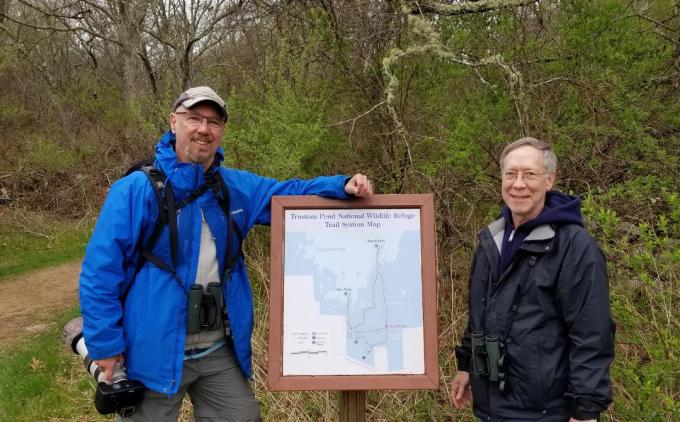
With Mike Resch at Trustom Pond

Trustom Pond with Mike


Birds – Even in Brooklyn

The original plan had been to bird upstate New York on my way back from Michigan.  Fortunately I was able to change plans to instead do my birding in Brooklyn earlier in the trip and to try to join the Brooklyn Birding Club on a walk in Prospect Park on Sunday May 5th.  The really good part of this was that it would enable me to visit my son Alex who lives in Brooklyn.  He has a hectic travel schedule but not only would he be there but he would be able to join me for at least some of the birding.  He is not a birder so this was a major deal.  Specialty coffee has been his passion and I am sure he knows more about that than I do about birds – that is he knows A LOT.  So this was great news.

Brooklyn Birding Club

The Brooklyn Birding Club is a big deal.  It was founded in 1909 and has a large and active membership.  For me the best part was its many trips and walks in Prospect Park, a 585 acre mixed used park with a big lake in the heart of Brooklyn.  It is not quite but almost as famous for city birding as Central Park in Manhattan which is 50% larger.  On a good day in spring migration it could easily give me 50+ species.   I would get to New York after birding in Rhode Island probably arriving late on the 4th and having dinner with him and then do the birding the next day.  The bad news was that some pretty heavy rain was predicted for the 5th but the good news was that Rhode Island was easier than it might have been so I could get into Brooklyn early on the 4th and do the birding then.  Alex would not be able to join me that day but we could still have dinner and if the 4th didn’t work the 5th was available as Plan B – rain or not.

More bad news was that there was rain on the morning of the 4th as well.  A surprise was that I easily found a parking spot across from the park.  I had seen a half dozen birds including a surprise Merlin on my way into the City.  It was 8:00 a.m. and I was ready to go.  My only plan was to walk around and hopefully find some birders as well as birds.  I managed to do both but the birders were less welcoming than has been my general experience.  Not entirely and not all of them, and I maybe was less gregarious than usual as well.  I managed good visits with a few but mostly with birders who were on their way out.  In the wet morning, the birds also seemed to be less active and I heard few songs – not that I would have identified most of them alone anyhow.  I definitely could have used Mike Resch or a formal Birding Club Walk.

I did manage some birds though – 39 species including 9 warblers.  The best was a very brief look at a Blue Winged Warbler without a photo.  Second was probably a Northern Waterthrush.  I was being very careful to keep my camera dry so not tons of photos, but I was happy to get what I could.

Northern Waterthrush

Northern Waterthrush

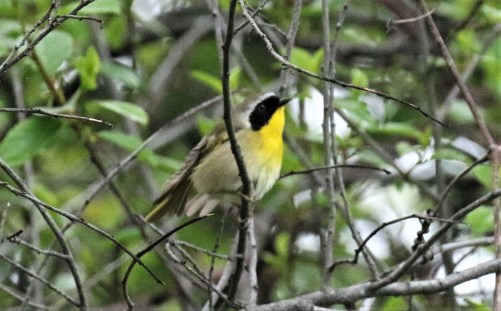
Common Yellowthroat

Common Yellowthroat

Chipping Sparrow

chipping-sparrow.jpg

White Throated Sparrow

White Throated Sparrow


I am sure I missed birds on the Lake any many more in the trees but one I was glad to get was a Mute Swan.   Unlike in Washington, they are “countable” in the East.  I heard many stories though of why they are not a welcomed bird – doing a lot of damage.  Definitely a striking bird, however,

Mute Swan

Mute Swan

I spent 4 hours at Prospect Park – including more than 30 minutes being completely disoriented and heading off in the wrong direction.  I had wisely saved the intersection where I parked the car on my phone and GPS bailed me out.  The Park is heavily used including lots of runners, power walkers, strollers and birders.  Not surprisingly given its location, the users and the birders were of many ages, races, colors and nationalities.  I heard many languages.  English was predominant but I heard a lot of Spanish, Russian, Korean, Chinese and German in addition to many Eastern European and African languages that were not identifiable to me.  There were more non-white birders there than I think I saw at all other places I visited on my Eastern birding marathon combined.  A positive thing but telling in contrast to those other places.

Including the earlier birds seen I had 42 species.  I was hungry so I left the Park and grabbed some street food, found my car and headed off to Jamaica Bay.  The weather was improving and I wondered if maybe I would return to Prospect Park tomorrow after all.  On the North Channel Bridge to the Jamaica Bay Wildlife area I added 11 new species in the totally new habitat with a mix of ducks, shorebirds, waders and gulls and terns.  And the additions continued at the Refuge itself adding another 23 species with some more ducks, a Least Tern, some more shorebirds and a Clapper Rail plus numerous passerines.

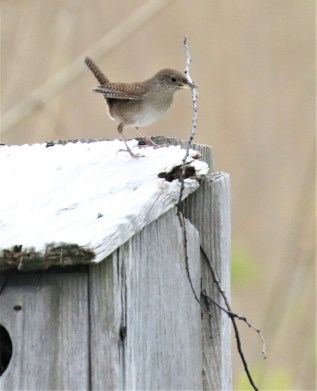
By no means a rare bird, but a fun one to watch was a House Wren that seemed to be gathering material to build a nest.  I have no idea what it intended to do with this stick which was at least twice its size.

House Building House Wren

House Building House Wren

My favorite shot was of a White Eyed Vireo – easy to see where it gets its name.  Earlier I had seen Warbling and Blue Headed Vireos but not a Red Eyed which I had expected.  And there were some warblers as well including a Prairie Warbler which was new for the day.  I had seen Yellow Rumped and Yellow Warblers at Prospect Park but no photos in the wetness.  Much better here.

White Eyed Vireo

White Eyed Vireo1

Prairie Warbler

Prairie Warbler1

Yellow Rumped Warbler – Myrtle

Yellow Rumped Warbler

Yellow Warbler

Yellow Warbler

A species I was glad to see and photograph was the Brown Thrasher looking very brown indeed.  This guy was singing almost non-stop and stayed in the open most of the time.

Brown Thrasher

Brown Thrasher3

One more photo.  Nothing unusual but I loved this Tree Swallow – good light and a nice pose with everything in place – except one contrasting white feather.  What was that all about?

Tree Swallow

Tree Swallow

As it turned out I could have skipped Prospect Park altogether and just come to Jamaica Bay as I had 56 species there in less than 2.5 hours.  Many of the birds had been seen at Prospect Park earlier and I ended the day with 76 species.  The places were great but the local intersections were less than I would have liked and it was disappointing not to be able to include Alex in at least some of the birding – although that would be more than made up by visits later.  But there was going to be a great local intersection after all – one of my favorites on the whole trip.

As I was coming back to the parking area in now beautiful weather, a young family was walking towards me – dad, with an infant in a chest carrier, a mom and a toddler who was not much older than my grandson – maybe 18 months old.  Who know why these things happen, but the toddler was looking straight at me as we got closer and closer.  Maybe it was the binoculars.  Maybe the camera, maybe just the happiness that could have been apparent on my face as I had seen my 50 species for the day.  Maybe just my boyish charm (wink).  She walked away from her parents and straight towards me…and reached out her arms.  I learned long ago that the best thing to do with small kids is to bend down – get to their level.  So I did and asked her her name.  No answer, but now she actually grabbed my hand and clearly wanted to be lifted up.  I also learned a long time ago that you just do not pick up little kids you do not know.  By now Mom was next to us and she said she was dumbfounded as her little girl had never done that before.  The little girl then said “up”.  My eyes met mom’s and I got the OK approval.  I lifted her up and she gave me a hug which I reciprocated.  I told her how pretty she was and that I loved birds and wondered if she did too.  No response except for a smile.

After probably no more than 15 seconds I returned her to the ground.  Both Mom and Dad had big smiles, so I guess everything was ok.  I told them all to have a wonderful day and continued towards the car.  The toddler started to follow me away from her parents but Mom took her hand and they were off.  Not the local intersection I expected for a birding trip but it was as good as it gets.  I am almost teary remembering it.  A truly beautiful moment.

There was still time to visit Alex in his new apartment – his first one on his own in very expensive Brooklyn.  I had been apprehensive about that – just about safety, but although not luxurious and small, it was certainly safe and comfortable.  Later we went to dinner and again somehow i found a parking place on the street near the restaurant.   My son definitely knows his food.  The dinner was superb as tasty as any I can remember – clearly the work of a serious chef and a restaurant that is all about quality.  It was a good visit.

It did indeed rain the next day and with the success of the previous day, I skipped a return to Prospect Park.  I got to extend the visit with Alex and yes there was more good food, a great lunch.  And then I was off – heading to New Jersey where I would visit Cape May for the first time.  New York was the 3rd state on this trip – 10 more to go – and the 28th with 50 species in a day.  And fond memories of kids – my fine son and that lovely little toddler.  Maybe she will enjoy birds on her own someday.

A Spicy Start for the Eastern Marathon – Connecticut – The Nutmeg State

I had flown into Boston on April 29th and had a lovely visit with my daughter, son in law and grandson.  That was a great start to what was planned to be a very long trip lasting 30 days, visiting 15 states and birding in 13 of them – hopefully adding all 13 to to the “completed list” on my 50/50/50 Adventure.  The quest was simple – observing 50 species of birds on single days in each of those 13 states – with others – visiting new and interesting places and having fun.  It was now May 2nd and I would be meeting good birding friend Mike Resch in Willington, CT to start the birding part of the adventure.

Grandson Griffin – A Birder Someday?

Griffin

Mike had already been a big part of my project and his role would expand greatly on this trip.  We had birded together getting 50+ species in Massachusetts earlier.  Now Connecticut.  Then together to Rhode Island and at the end of this Marathon we would bird together again in New Hampshire.  I could not have been in better company or with a better birder.  I had learned from my other trips to look for “common birds” around my hotel before the hotspot birding began.  Species like House Sparrow, American Crow, Common Grackle etc would probably be seen later, but just in case not, get them and count them early.  If nothing else it would create some momentum.  I had 5 species in hand before Mike arrived.  Now we were off to one of Mike’s favorite areas – the Yale Forest and Boston Hollow and Kinney Hollow Roads – classic New England Forest.  I had checked out the area the previous afternoon and found it mostly quiet but still had 25 species including a Tom and Hen Wild Turkey – a very New England species to me – think Pilgrims and Thanksgiving.

Wild Turkey

Tom Turkey

We spent over three hours in the forest and aided enormously by Mike’s great skill and especially his encyclopedic knowledge of bird songs, we had 51 species.  It wasn’t the best light for photos and many of the birds were high up or buried in dense foliage but lots of good ones including 5 woodpecker species, 5 sparrow species and 7 warbler species.

Red Bellied Woodpecker

Red Bellied WP

White Throated Sparrow

White Throated Sparrow

Eastern Towhee

Eastern Towhee

Black and White Warbler

Black and White Warbler

The best photos may have been of a White Breasted Nuthatch and we also had a Red Breasted Nuthatch, Black Capped Chickadee, Brown Creeper and Tufted Titmouse.

White Breasted Nuthatch

White Breasted Nuthatch Vertical

Only two flycatchers – Least Flycatcher and Eastern Phoebe and a single vireo – Blue Headed – lousy photo but better one laterThere would also be a better photo later of one of my favorites – Rose Breasted Grosbeak.  Two species heard and seen briefly but sadly not photographed were Northern Waterthrush (2 individuals in still water just where Mike expected them) and Louisiana Waterthrush (in moving water, again just where Mike expected them).

Least Flycatcher

Least Flycatcher1

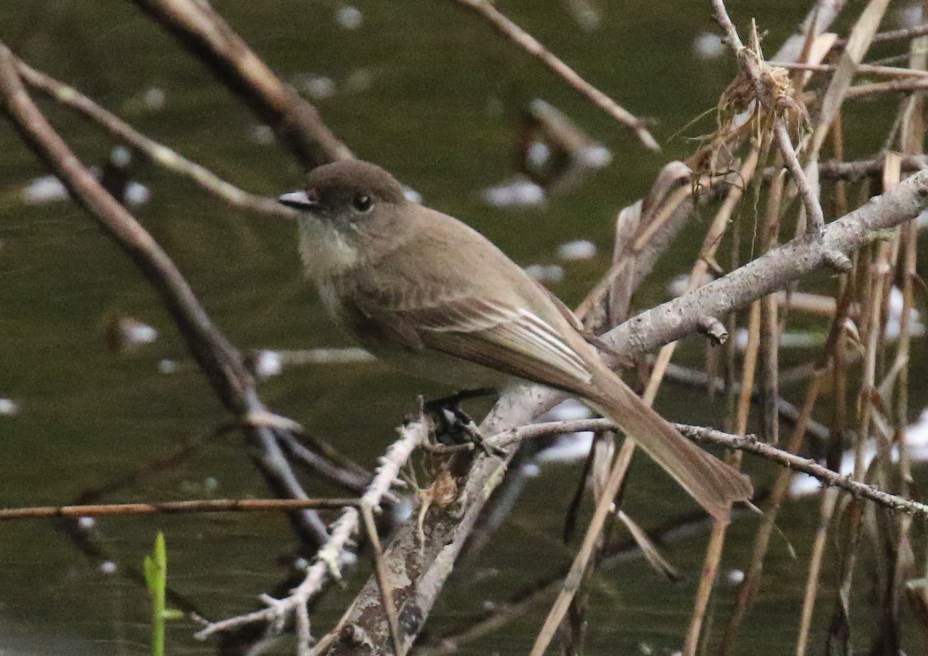
Eastern Phoebe

eastern-phoebe.jpg

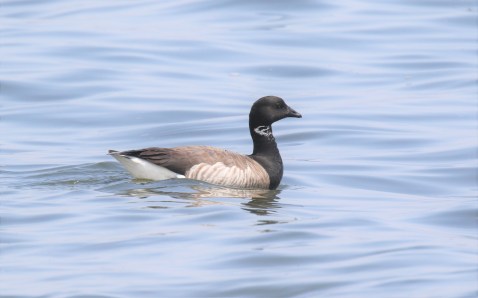
It was now about 11:00 a.m.  I had 53 species for the morning.  Quit now?  No way; we had two more great stops ahead and would be joined by two of Mike’s friends.  It was a great start but truly the best was yet to come.  We picked up a couple of incidental species along the way and arrived at Sandy Point on the coast in New Haven County.  There were lots of Brant close to shore and we had some Red Breasted Mergansers.

Brant

Brant

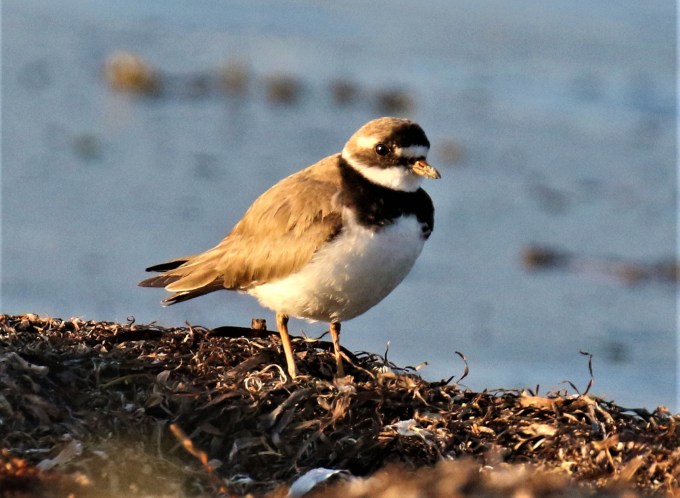
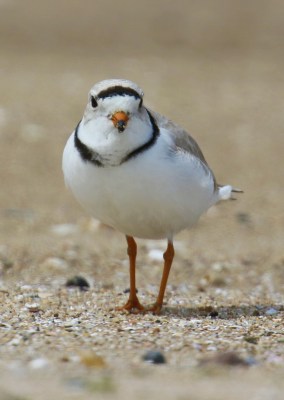
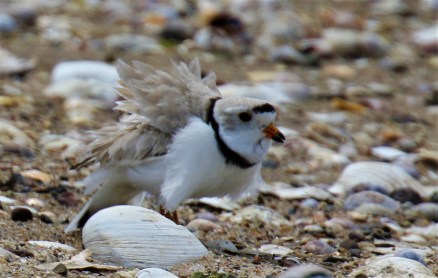
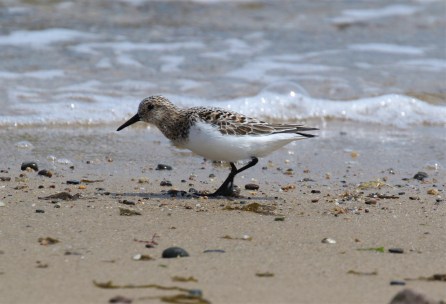
Among the six shorebird species were numerous Piping Plovers – hard not to love.  We even saw one displaying.  Another favorite was the American Oystercatcher.  We have Sanderlings in Washington as well and I had seen many scurrying along the surf on the sand before I left, but they had been dressed in winter white.  These were in their very much different breeding plumage.

Piping Plover

Piping Plover1

Piping Plover

2P5A1008 (2)

American Oystercatcher

American ystercatcher

Sanderling

Sanderling

A species we do not have in Washington is the Great Black Backed Gull.  Big and with that very black back (or mantle) it is easy to see and identify.

Great Black Backed Gull

Greater Black Backed Gull Flight

We had 28 species in a bit over an hour and a half – many of them new for the day in this totally different habitat and our species day count was now at 79.  There would be more.   We got to Hammonasset Beach State Park at around 2:45 and heard birds as soon as we parked.  Then we saw birds – lots of birds – up close and personal birds – great birds – and many different types of birds.  Shorebirds, waders, gulls, flycatchers, vireos, warblers, sparrows and particularly thrushes.  Many trees had multiple birds and/or multiple species – maybe a mini fallout.  Lots of great photo ops.

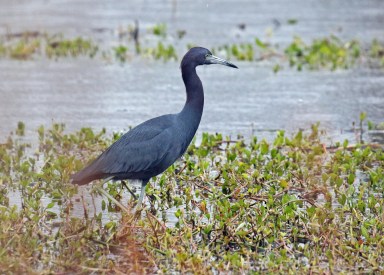
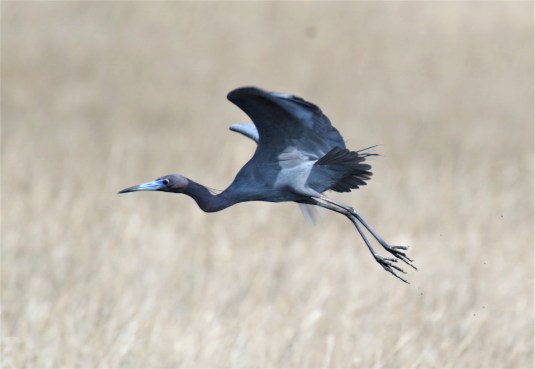
Little Blue Heron

Little Blue Heron

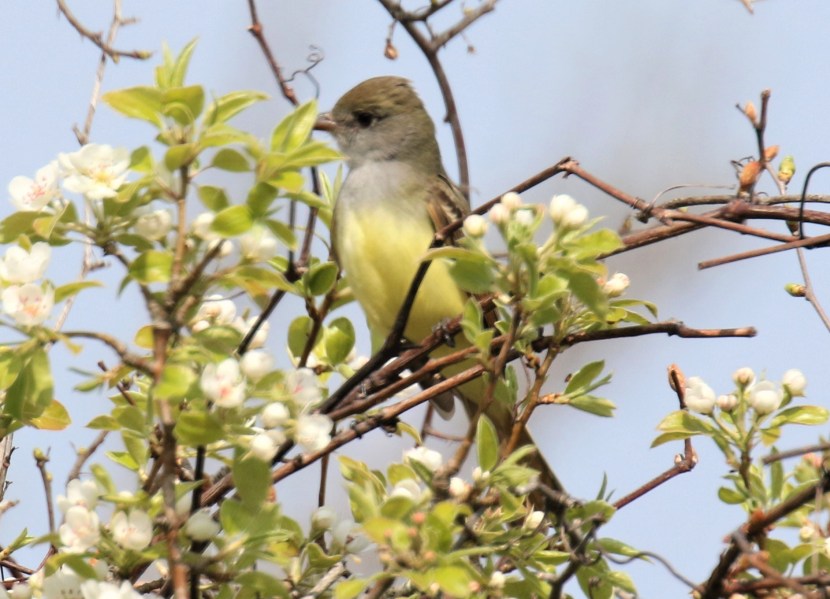
Great Crested Flycatcher

great-crested-flycatcher.jpg

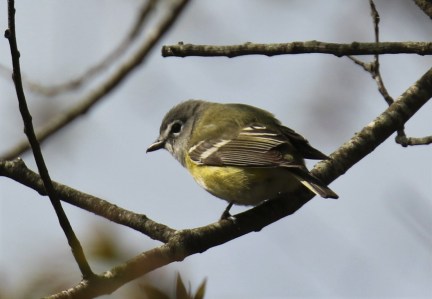
Blue Headed Vireo

Blue Headed Vireo1

Warbling Vireo (We tried to make it into a Philadelphia Vireo)

Warbling Vireo1

Yellow Throated Vireo

Yellow Throated Vireo

Baltimore Oriole

Baltimore Oriole

Scarlet Tanager

Scarlet Tanager

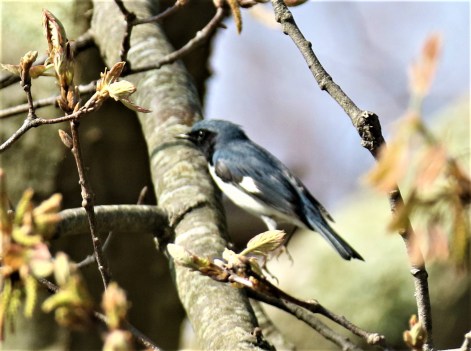
Black Throated Blue Warbler

Black Throated Blue Warbler1

Black Throated Green Warbler

Black Throated Green Warbler

Nashville Warbler

Nashville Warbler1

Particularly amazing to me were the Rose Breasted Grosbeaks.  We had at least 10 of these beauties including 6 in one tree!!  And equally special were the many thrushes – 7 species:  American Robin, Swainson’s Thrush, Veery, Gray Catbird, Eastern Bluebird, Gray Cheeked Thrush and Hermit Thrush – awesome!!

Rose Breasted Grosbeak

Rose Breasted grosbeak wtih Flowers

Rose Breasted Grosbeak1.jpg

Swainson’s Thrush

Swainson's Thrush

Veery

Veery

Gray Cheeked Thrush

Gray Cheeked Thrush

We were there transfixed on the so called low hanging fruit for just under 3 hours slowly covering almost 3 miles.  It was seriously about as good as it gets in beautiful weather as well.  Fifty species in all of which 22 were new for the day.  We later added a Chimney Swift and ended the day with 102 species.  How nice it would be if there was some kind of carryover and I could put the species above 50 into a bank and withdraw them as needed in other states.  It is my “game” so I can make the rules, but that is one rule that just doesn’t work.  One really good rule would be to include Mike Resch on all trips.  We would bird together in Rhode Island the next day so I certainly felt good about that.  BUT…

BUT…when you are out on the road, there can always be curve balls/surprises and we got a big one.  Mike and I checked into our hotel and unloaded optics and baggage into the room and went out for a quick dinner.  When we got back the card reader on our locked room door would not read our cards and let us in.  I have had this happen before where  maybe the card was next to the phone in my pocket and got de-magnetized or whatever.  Off to the front desk to get new cards.  But they did not work either.  Uh-oh.  The person behind the desk had a “master key” of sorts – another card since there was no physical actual key to gain entry.

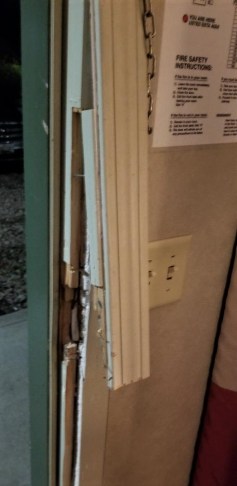
It did not work either.  Now understand – everything we had except for the clothes on our backs was in the room and we would be leaving early the next day to go to Rhode Island for the next day of birding.  An offer of “I can get you another room and will get someone to look at it tomorrow” had no value whatsoever.  I won’t go through the ensuing details but maybe 30 minutes after the initial problem was discovered, a manager arrived.  She fortunately lived nearby.  It was clear to her as it was to me that the ONLY solution was to break down the door.  She forcefully, for her, kicked the door extending her leg in front of her…nothing.  Time for action. With her consent I turned away from the door and then back kicked it open breaking the jamb of course in the process.  We gathered our stuff and then moved to that now useful other room.

The Door – After the Kick

Door

It is a little unnerving to know that there was no back up system to open the card reading lock.  If it was a bad battery, that could only be replaced if the door was open…no access from the front.  So a disaster was avoided even if we lost an hour or so and blood pressure was definitely raised.  We did receive an apology but maybe a comped room would have been in order.  Even at many chains, each hotel is individually owned by a franchisee.  Expressing displeasure on Facebook was considered…and then dropped as otherwise it had been a really good day.


Out of Sync in Virginia

I guess it had to happen – one day when it just was really difficult.  From the start I had struggled with Virginia unsure where it would fit in my schedule and thus where I would bird.  As other plans solidified I decided to bird in the Alexandria area in the suburbs of Washington, D.C.  I researched the area and made plans accordingly.  This would allow me to leave Philadelphia early and make a stop in Baltimore, Maryland where I wanted to drive by St. Frances Academy, where I had taught for a year almost 50 years ago between college and Law School.  An amazing place, it was an all girls, all Catholic, all Black school in the Baltimore ghetto, founded by free Haitians before the Civil War and run by the Oblate Sisters of Providence an order of black nuns.  Quite a year, but not a story for this post.

St. Frances Academy – and Its Neighborhood – 2019

St Frances Academy

Neighborhood

It still should have been easy but some pieces were missing.  I would arrive there on a Sunday.  No field trips were scheduled for that day but there was one the next.  Rain was predicted and it had been raining the previous day as well.  My one contact, a great source of information, had commitments that would not let him join me until late afternoon on Monday.  It was too late to rearrange my schedule so I carried on following the leads from my contact and indications from EBird that suggested 50 species should be very doable.  I would see how Sunday went and then try again Monday if necessary.

On Sunday I arrived at 9:30 a.m. much later than I would normally want to start for the 50 species day and although it wasn’t a hard rain, it was enough to make a difference.  I first went to Belle Haven Park – along the Chesapeake River.  As I got out of my car I saw another birder getting ready to get into his.  I later learned he was one of the top birders in the area who had just finished a walk with some friends.  (I believe his name is Edward Eder). Other commitments meant he could not continue with me in tow, but he had seen a Prothonotary Warbler (always a treat) earlier and he took me to the spot in the Marina, shared some stories and supported my choices of other spots to go later.  Unfortunately we did not find the Warbler.  In fact it was very slow, wet and windy.  He took off and I contemplated “next”.

Five minutes later I heard the Prothonotary Warbler and was able to get a brief view and a poor photo in poor light.  Maybe things would improve.

Prothonotary Warbler

Prothonotary Warbler.jpg

It was hard to tell where or whether Belle Haven Park turned into Dyke Marsh Wildlife Preserve – one of the areas that was part of my pre-trip planning.  I hiked on for over a mile and did find some birds – nothing of note but one of these and one of those and a couple of something else.  The rain continued lightly but I am sure it dampened the activity – literally.  Nonetheless, after a couple of hours I had 34 species.  My main birding spot was to be Huntley Meadows, where the walk would be on Monday and highly recommended by online source, my acquaintance of the morning and by Ebird.  But the former two had also recommended Monticello Park.  A Golden Winged Warbler had been seen there a few days earlier and Blackburnian Warbler was also a possibility and both were much desired by me.   Unfortunately in the continuing gloomy weather, bird activity was almost nil, visibility was poor and there was so much water on the paths that walking was a challenge.  Thirty minutes added only two new species for the day – neither a warbler.

It was now one o’clock.  I did not doubt I would eventually find the 50 species I sought, but for the first time, I really was not having fun.  I saw my first Rock Pigeons of the day – not exciting but at this point a new species was a new species.  It went on the list.  I made it to Huntley Meadows around 1:30 and spent just over an hour there.  The rain had slowed but it remained gray and gloomy, kind of like my home area just north of Seattle in March (and often in 6 or 7 other months of the year as well).  There were birds but only 11 were new for the day and I had expected twice that many.  It was still not even 3 o’clock and I had another good place to go, but were it not for the “need” to find my 50 species, I might have hung it up for the day.  It simply was not a day for photos and the best I could come up with was of an Eastern Kingbird –  at least you can see the white terminal band on the tail.

Eastern Kingbird

Eastern Kingbird1


Now I needed – just two more – Please!  This is where my local resource helped big time even if he was not physically present.  He had recommended the Occoquan Bay NWR in neighboring Prince William County.  Again nothing real exciting but in an hour I added 10 new species and then was at 58 for the day. Relief…

I was back at Huntley Meadows the next morning to join the walk at 7:00 a.m.  Maybe it was them.  Maybe it was me.  Maybe it was the rain that continued even if lightly.  Maybe I was just tired and thinking of “next” but there was no chemistry on the walk – no connection – and no local flavor.  But then there was one really good bird – a Red Headed Woodpecker – and the gloom disappeared.

Red Headed Woodpecker

Red Headed WP2

Red Headed WP

Even in the rain – visible in one of the photos, these were ok photos of a wonderful bird and were definitely the highlight of the trip.  I had 37 species in just over 2 hours but no new photos and only a handful of new species for the trip.  Since I had seen my 50 species on Sunday, I decided to forego returns to Occoquan and head to Manassas, Virginia and visit the Manassas National Battlefield Park.  I birded along the way and in the area around the Battlefield as well as at the Battlefield Park itself.  Altogether I had 52 species for the day – fewer than the day before but there had been a local intersection on the morning walk and now I would add an historical element at the Manassas National Battlefield Park.

Manassas National Battlefield Park

Manassas Visitor Center

Fence

The description of the First Battle of Manassas also known as the First Battle of Bull Run below is borrowed from History.com.  Visit that site for more information about this battle and the Second Battle of Manassas (Second Bull Run) and other battles of the American Civil War.

Prelude to the First Battle of Bull Run (Manassas)
By July 1861, two months after Confederate troops opened fire on Fort Sumter to begin the Civil War, the northern press and public were eager for the Union Army to make an advance on Richmond ahead of the planned meeting of the Confederate Congress there on July 20. Encouraged by early victories by Union troops in western Virginia, and by the war fever spreading through the North, President Abraham Lincoln ordered Brigadier General Irvin McDowell to mount an offensive that would hit quickly and decisively at the enemy and open the way to Richmond, thus bringing the war to a mercifully quick end. The offensive would begin with an attack on more than 20,000 Confederate troops under the command of General P.G.T. Beauregard camped near Manassas Junction, Virginia (25 miles from Washington, D.C.) along a little river known as Bull Run.

On July 21, 1861, Union and Confederate armies clashed near Manassas Junction, Virginia, in the first major land battle of the American Civil War. Known as the First Battle of Bull Run (or Manassas), the engagement began when about 35,000 Union troops marched from the federal capital in Washington, D.C. to strike a Confederate force of 20,000 along a small river known as Bull Run. After fighting on the defensive for most of the day, the rebels rallied and were able to break the Union right flank, sending the Federals into a chaotic retreat towards Washington. The Confederate victory gave the South a surge of confidence and shocked many in the North, who realized the war would not be won as easily as they had hoped.

The area was beautiful belying the carnage that had taken place.  Only a few buildings, some cannons and the wooden fences remain.  It felt peaceful – hardly like a place of bloodshed and war, but I guess that is how it is with all battlefields and they eventually return to nature and we forget…and make the same mistakes again.

Virginia was not the high point of my trip and I felt bad that I had not gotten more from the experience, maybe had not invested sufficiently in making it better.  I wish I had birded on the coast – maybe at Chincoteague, but that was the trade-off on my tight schedule.  I had to move on – west to West Virginia.  But in other respects this part of the trip worked well – giving me the chance to revisit St. Frances Academy and to see an important part of American history – and still find my birds.


The Birds of Harpers Ferry, West Virginia
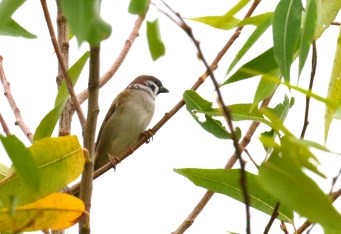
Harpers Ferry is where the Potomac and Shenandoah Rivers meet.  Harpers Ferry is where abolitionist John Brown’s raid may have actually started the Civil War.  Harpers Ferry is a beautiful place in the mountains of the Mountain State.  Harpers Ferry is where I knew I wanted to do my 50/50/50 birding in West Virginia.  And with the help of Beth Poole, that’s exactly what I did.

There have been some horrendous floods at Harpers Ferry and there had been so much rain the week before I got there that there was a lot of wet areas on a couple of roads and fields had casual water, but it was at most a nuisance and our birding day was lovely.  This photo from the town of Harpers Ferry itself shows why flooding is to be taken seriously.  That 1935 flood was more than 10′ above where I was standing and I was standing 10 feet above the river level.  Yikes!!

Flood History

Flood

The story of how I met Beth Poole is like similar stories in other states and they are the best parts of my 50/50/50 Adventure.  Through some listservs and Ebird Reports I discovered the Potomac Valley Audubon Society (PVAS).  From their web page I learned that a walk was scheduled at the Cool Spring Preserve on May 15th – the day after my schedule had me birding West Virginia.  I couldn’t really change this date because my visits to Magee Marsh and the Tawas Festival in Michigan were set in stone on subsequent days.  I contacted PVAS and had a wonderful conversation that bolstered my confidence that birding at Cool Spring would be a good idea and they gave me contact information for Beth Poole who would be leading the walk on the 15th.  They also loved my 50/50/50 project and raised my spirits about it even higher than they already were.

I contacted Beth and she suggested I join her on a scouting trip at Cool Spring on the 14th and she offered to take me other places afterwards if more species were needed.  As I said this is similar to other stories.  Time after time, members of our birding community have stepped to help with time, suggestions, and support.  I would be happy to have any of them as friends or birding companions any time and any where.

Like I had done in previous states, I checked out Cool Spring when I got to Harpers Ferry on the afternoon before the scheduled official day of birding.  In more than 90 minutes I only found 19 species, but it was mid afternoon and not many birds were singing and I did not recognize some of the songs I heard.  I figured Beth would help in the latter regard and that morning would be better – but I was a bit worried.

I got in some early morning birding before meeting Beth and had identified 14 species.  One good find was a flooded field along a road near the Preserve that had both Solitary Sandpipers and Killdeer and had a Pileated Woodpecker calling.

Solitary Sandpiper

Solitary Sandpiper1

Beth was enthusiastic and optimistic as we started out at Cool Spring Preserve.  There was more activity than there had been the previous afternoon – but it was not real birdy and some expected birds were not found.  We did have Field Sparrows, Indigo Buntings, Baltimore Orioles, Great Crested Flycatcher, an Orchard Oriole (female) and Eastern Kingbird – but only two warbler species.

Indigo Bunting

Indigo Bunting1

Baltimore Oriole

Baltimore Oriole1

Great Crested Flycatcher

Great Crested FC

Orchard Oriole (female)

Orchard Oriole Female

Eastern Kingbird

Eastern Kingbird1

Certainly not a rarity but a favorite photo from the visit was a pair of Tree Swallows at a Bluebird nesting box.  It took a while but we finally found an Eastern Bluebird at another box.

Tree Swallows

TREE sWALLOWS

Eastern Bluebird

Eastern Bluebird

After revisiting the pool I had discovered early to show Beth, we had 34 species and it was just after 10:00 a.m. – lots of time left but lots of species needed.  We drove into the Harpers Ferry National Historic Park and picked up a handful of species.  I found an unexpected Grasshopper Sparrow so at least I felt like I was contributing something.

Grasshopper Sparrow

Grasshopper Sparrow

This is where Beth came through like a champ and proved how valuable local expertise can be.  We headed down to the Shenandoah River and birded a number of different spots that mostly seemed like the same to me.  But we added a species or two here and there at each stop: Chimney Swifts and then an Eastern Phoebe, a Song Sparrow and a Blue Gray Gnatcatcher.  Now we were at 48 species.  An Acadian Flycatcher brought us to 47 and a Double Crested Cormorant was #48.  It was now past noon.  Would we get to #50?  What would it be?

Acadian Flycatcher

Acadian Flycatcher

We moved a little bit off the river and hit a magic spot – seven new species in less than 15 minutes and one was the bird of the day.  As I got out of the car to look at a Hairy Woodpecker that Beth had found, I spied a flash of yellow and then the flash perched right in front of us – a gorgeous Prothonotary Warbler.  I couldn’t have chosen a better 50th species for the day.

Prothonotary Warbler

Prothonotary Warbler1

Time to celebrate with a lunch in Harpers Ferry at a funky old place dating back more than 180 years.  It also gave us a chance to see some of the historic buildings including one where John Brown had been.  I really liked the feel of the town – probably moreso with over 50 species (and a good lunch) under my belt.  These little additions were an integral part of the positive experiences that came with my adventure.

John Brown

We picked up a couple more species and ended the day with 58.  Especially after a little worrisome start, we were thrilled.  We went back to Cool Spring Preserve and shared the news and took an acknowledging photo.

Beth Poole and Blair Acknowledging the 50 Species Success

Beth Poole

It would now be on to Ohio with an intermediary stop for the night in Somerset, PA to break up the drive.  First some more background on Cool Spring Preserve taken from the Potomac Valley Audubon Society info page:

Preserve History

In 1752, 22-year-old George Washington made his first land purchase of 1,459 acres along Bullskin Run, including the area that is the present day Cool Spring Preserve. Washington leased his land in 200-acre parcels. Each lease tenant was to build a 20’ dwelling with a good 40’ barn, plant and care for specific crops, install certain “creatures,” erect and maintain fences, plant an orchard and vineyard, and preserve the woodlots without overcutting.

In 1830, 146 acres, including most of Cool Spring Preserve, was sold to Thomas Grigg’s Jr. The rest of Cool Spring Preserve was located on a neighboring property to the east, which was owned by the Haines’, a quaker family. On February 5, 1869, siblings Edward, Alvinia and Mary sold one acre of land to a freed slave, Susan B. Thornton, for $1. Mrs. Thornton’s cottage still stands on Cool Spring Preserve.

Between this time and 1998, the property was used as a dairy farm and named Cool Spring Farm. Later it was sold to Jefferson Orchards who used the land to grow peaches and nectarines. During this time, existing buildings fell into disrepair and the fruit crops eventually failed.
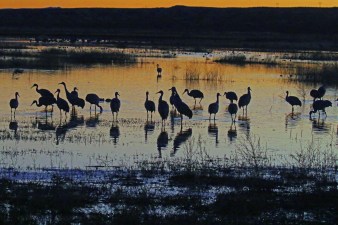
In 1998, Cool Spring Farm was purchased and underwent a three-year renovation to bring life back to the buildings and property. In 2008, the adjoining 12 acres including Mrs. Thornton’s cottage were purchased and CraftWorks at Cool Spring, a non-profit designed to connect art with nature was established.

Cool Spring Preserve is named after Cool Spring Farm. It was donated to the Potomac Valley Audubon Society by CraftWorks in 2016.

Nothing about birds in that write up but if it were not for my birding and this adventure in specific, I would know nothing about this, would not have visited Harpers Ferry or any of the many other places I had already been or would later go.  Each place has a story.  Who knows maybe I had walked in some of the same exact spots that had been walked by George Washington at Cool Spring or by John Brown at Harpers Ferry.  Birding opens doors to interesting people and places and tops them off with special birds like Prothonotary Warblers.  How fortunate we are to have such a passion.
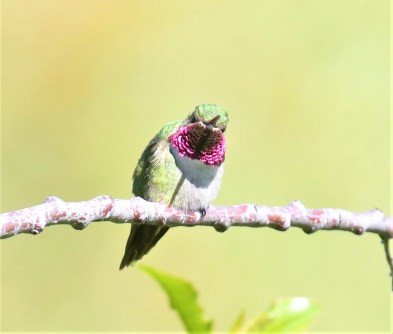
Cape May and Brigantine – New Jersey Hotspots

When first planning my East Coast Marathon, there were several places that were absolute musts and the rest of the trip would be built around visits to them.  The must bird places were Cape May in New Jersey, Magee Marsh in Ohio, Kirtland’s Warbler Country in Michigan and Bombay Hook NWR in Delaware.  As I added details some more places became essentials – Heinz NWR at Tinicum outside of Philadelphia and Prospect Park and Jamaica Bay in New York.  I had never been to any of them and visiting them was in keeping with one of the major objectives of my 50/50/50 Adventure – having my passion for birding take me to places of special interest – scenic, historical or birding.

Of all these places, Cape May, N.J. turned out to be the one that least matched my uninformed conception.  At the southeastern tip of New Jersey, Cape May does include a National Wildlife Refuge and a Wildlife Management area, but some of the best birding is in the town itself – a mostly uncommercialized resort on the coast with beaches, lovely homes, and lots of great habitat.  It is probably best known for spectacular migration in the Fall but there is great birding in the Spring as well.  A place that was more like my conception of such places and which had not been on my radar at all in the trip planning stage was Brigantine NWR about 50 miles north of Cape May and along my way from Brooklyn where I had been birding and visiting my son the previous two days.

NJ

I planned for my 50 species day to be at Cape May and had arranged to spend the morning of May 8th with Tom Reed who is a scientist/naturalist/guide out of the Cape May Bird Observatory and then do more birding on my own later in the day.  As was often the case on this trip I had underestimated the birdiness of the areas I was visiting and overly cautious in projecting my ability to find the magical species in a day.  Some of this was due to concerns about weather, but I led a charmed life for most of the trip and had few weather challenges.

My first actual birding in New Jersey was as I was coming in to Atlantic City.  I had been there once before – probably at least 60 years ago as a kid on a brief, as in one day, vacation with my family.  I remembered it as “schlocky” – also defined as “exciting” to a kid with a carnival like boardwalk.  No longer so – or at least not visibly so as I drove by mega hotels and casinos.  Or maybe schlocky in a different way.  In any event, by the time I finished the drive and headed north to Brigantine, I had 19 species including a couple hundred Brant in the ocean and even more Semipalmated Plovers on the beach.

Atlantic City

Atlantic Cit

I continued on to the Brigantine Unit of the Edwin B. Forsythe NWR arriving before 9:00 a.m.  Any concerns about a 50 species day were soon dispelled.  It was a beautiful day and birds were abundant highlighted by 13 shorebird species.  Most numerous beyond a large number of undifferentiated peeps were 150 Dunlin, 78 Whimbrels, 38 Willets, and 35 Semipalmated Plovers.  There were smaller numbers of both Greater and Lesser Yellowlegs, Black Bellied Plovers, Short Billed Dowitchers, White Rumped Sandpipers, Spotted Sandpipers and American Oystercatchers.
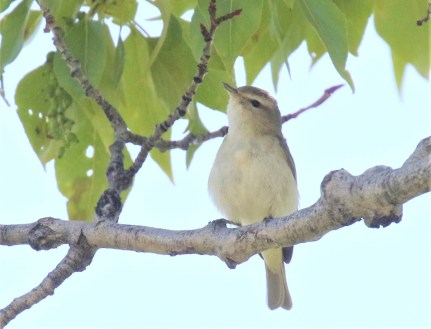
Dunlin

Dunlin

Whimbrel

Whimbrel1

Willet

Willet

Semipalmated Plover

Semipalmated Plover

American Oystercatcher

American Oystercatcher

Lots of gulls and terns as well with a large flock of Black Skimmers, numerous Forster’s Terns, a couple of Common Terns and 4 Gull Billed Terns which I had not expected.  The gulls were Bonaparte’s, Herring, Laughing and Great Black Backed.

Black Skimmers

Black Skimmers

Forster’s Tern

Forster's Tern

Gull Billed Terns

Gull Billed Terns1

Laughing Gull

Laughing Gull1

Great Black Backed Gull

Great Black Backed Gull

Altogether the “water” birds accounted for 29 species.  Thirty-three “non-water birds” brought the count to 62 species – not bad for a place I had not originally considered.  So I easily had my 50+ species after just over 3 hours of birding and it was just past noon.

Osprey

Osprey1

Fish Crow

Fish Crow

Carolina Chickadee

Carolina Chickadee

Tufted Titmouse

Tufted Titmouse

Field Sparrow

Field Sparrow2

Common Yellowthroat (1 of only 4 Warbler Species)

Common Yellowthroat

After lunch on the way to Cape May and my hotel, I saw a couple of Glossy Ibis in a field but I couldn’t stop for a better view or a try for a photo.  I had been going strong for more than a week and was tired.  I had over 70 species for the day so since my room was ready, I checked in early and got a little sleep.  A seafood dinner and then since it was still light, I made a quick trip to the Cape May Point State Park – where I would be meeting Tom Reed the next morning.  I added a few species and called it a day – an excellent one with 74 species and some nice photos.

In the 15 minutes driving from my hotel to meet Tom Reed, I picked up 11 species and in just 30 minutes at Cape May Point State Park with Tom we had 18 including 5 new ones for New Jersey:  Northern Gannet, American Bittern, Merlin, Least Tern, and Common Loon.  I also got a lovely photo of a very purple Purple Martin.

Tom Reed

Tom Reed

Northern Gannet

Northern Gannet Adult1

Purple Martin

Purple Martin

It was clear that Tom knew every nook and cranny at Cape May.  He was a wealth of information about migration, bird counts, songs and everything else avian.  He next took me to Higbee Wildlife Management Area near Cape May Point.  There we added several new passerine species including Yellow Billed Cuckoo, Eastern Kingbird, White Eyed Vireo, Great Crested Flycatcher, Blue Grosbeak and Indigo Bunting among others.

White Eyed Vireo

White Eyed Vireo

Great Crested Flycatcher

Great Crested Flycatcher1

Indigo Bunting

Indigo Bunting Singing

There were only two warbler species, but one was a lovely Black Throated Blue that flew off just as I got it in focus – so sadly no photo of this very lovely bird.  Our next stop at Cape Island was also excellent – this time with 5 warbler species including one that was essential for this trip – a Cape May Warbler at Cape May.

Cape May Warbler

Cape May Warbler3

Prairie Warbler

Prairie Warbler1

Our penultimate stop was at another Cape May Hotspot – “The Beanery/Rea Farm”.   Tom had planned the morning to sample different habitats and this one was different from the others and gave us a few new species including Prothonotary, Black and White and Northern Parula Warblers.  They brought our species total to over 50 for the morning and our warbler count to 9 species.  Fewer than I expected but consistent with Tom’s assessment that it had not been a good few days of migration.  We made a last stop at the Cape May Hawkwatch Station.  Not much going on there but definitely the place to be in Autumn for the hawk migration.  I wish I had been able to time my visit here to take in that spectacle as the stories are astounding.  In many respects my 50/50/50 trips are exploratory runs to identify places I would like to return.  There are many and this is definitely one.

I thanked Tom and headed off for some more birding on my own.  I added some new birds for the day but only two new ones for New Jersey – Gadwall and American Wigeon.  I also saw numerous Least Terns which are always special.  Look closely and you will see why I chose this photo out of the many of this species.

Least Tern

Least Tern Pooping

I ended this day with 68 species and had over 100 for the two days of birding.  I am sure I could have added at least a dozen more if I had continued to bird.  The plan had been to bird all day this day, bird less the day before and bird hard the next morning before taking the ferry to Delaware.  If there had been more migrants, I probably would have continued on that course.  But after two days of good birding I was satisfied and planned to try for an earlier ferry the next morning.  For the rest of the afternoon, I just drove around the town soaking in the architecture and flavor of Cape May – a place I think girlfriend Cindy would very much enjoy and then celebrated another state with 50 species – the 29th – with a scallops roll dinner – a favorite.

Cape May Scenes

Cape May

Cape May Homes

Scallop Roll – Yummy

scallop-roll.jpg

I had no trouble getting on the earlier ferry the next morning – but that begins another story…