The Big Month Continues – Here and There and Almost Everywhere – Prelude to the Okanogan

I had noted an Ebird report of an Osprey at the Cowlitz River Trout Hatchery.  This was not a species that I had thought possible as I believed they left in the Fall and did not return until the early Spring.  But this was apparently a hold over and it had been doing so for several years.  I planned an itinerary that would include looking at Magnuson Park for Cedar Waxwings and possibly an Iceland Gull, continuing to the Mouth of the Cedar River looking for the Gull there if missed at Magnuson (and also hoping that somehow a Palm Warbler had shown up there as it has been a good spot in the past).  Then it would be down to the Cowlitz with a stop at Nisqually NWR on the way down or back.

The plan also included the hope that Brian Pendleton would join me and that worked very well especially since Brian knows Magnuson Park much better than I do.  There were no Iceland Gulls on the bathing platform but we found at least one and possibly two Cedar Waxwings at the Hawthorn trees near Kite Hill.  I had not even taken my camera as it was wet but a sufficiently good view to know it was a Cedar and not a Bohemian Waxwing, which have been at this location in the past.

At the Mouth of the Cedar River, no Palm Warblers but there were lots of gulls and through the scope we were able to find at least one and possibly a second Iceland Gull.  These were both birds that were highly likely at other spots if missed, but getting to 182 and 183 felt like a great start to the day.  Unfortunately it went downhill from there.  We found the Cowlitz Hatchery and it definitely looked like a great spot for a hold over Osprey, but despite a long and diligent search there and at the Salmon Hatchery upriver, we found only Bald Eagles.  But we had a great visit with a couple of locals – one of whom had a great story about Phil and Chris Anderson – Captain and First Mate of the Monte Carlo which is the boat for the wonderful Westport Pelagic trips.  Not for sharing here, but it will be fun to share with Phil and Chris when we see them.

On the way home, the weather turned ugly and Nisqually was quite wet.  Even before entering, we found a large group of shorebirds – but they were only Dunlin and Greater Yellowlegs.  We found the Northern Saw Whet Owl near the parking lot but it was so wet, we did not even take the scope out to the boardwalk.  We saw a flock of shorebirds – two sizes (probably??) that likely contained the hoped for Least Sandpipers, but too distant, too wet and too dismal to make the call.  Our best find was an American Bittern that flew in and posed for a photo.  For the day we had 50 species – two new for the month and at least the traffic on return was not too bad…but that Osprey was a big miss.

American Bittern

American Bittern Nisqually

I hearkened back to my decision to cut my visit to the Okanogan short and return on December 31st last year instead of carrying over and starting the year there for 2018.  Especially since reports had come in over the past two days of two great group trips there, I knew that I had to return and indeed a successful trip was probably essential if I had a shot at 200.  But of course I never seem to do anything the easy way, so in addition to having to make another trip to the Okanogan, I front loaded it with a trip in the other direction – to Fort Simcoe in Yakima County to get the Lewis’s Woodpecker that was a certainty there but also to hope to find an Acorn Woodpecker that does not belong there but which had been seen a couple of days earlier.

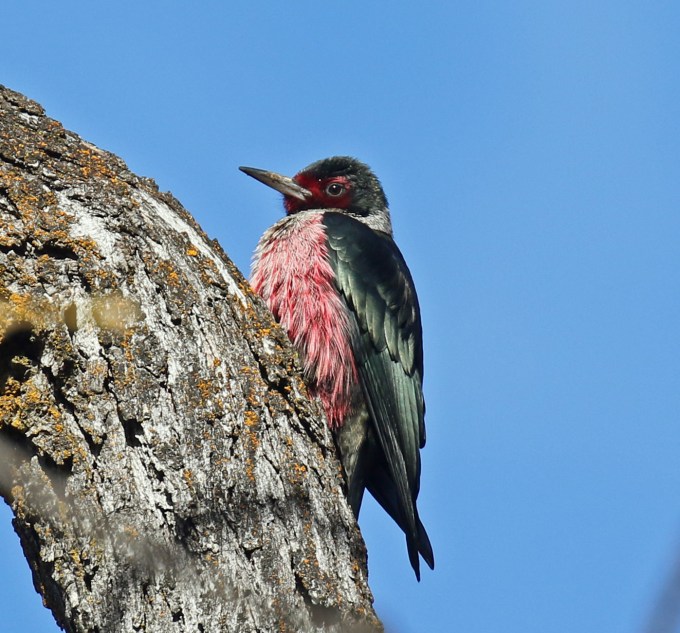
I again went the longer and slower route through the Yakima River Canyon.  No Golden Eagle this time, but in the area I had had one before I was able to get a Canyon Wren to respond to my playback.  #184  When I arrived at Fort Simcoe it was, as I knew, closed for the winter, but you could park outside and walk in.  It really is a cool spot and now, completely deserted except for me and a single Park employee, it was kind of eerie.  But it was also VERY windy.  I worried that this did not bode well for finding woodpeckers.  However, Lewis’s Woodpeckers were easy – if for the most part seen in hurried flights before landing at the tops of the many oak trees that are why they are there.  At first the light was poor and so were my photos but later there was a sun break and a nice photo of this beautiful bird resulted.

Lewis’s Woodpecker

Lewis's Woodpecker

Now where was that Acorn Woodpecker?  I spent over an hour looking – circling the property three times without success.  Earlier I had visited with the park employee.  He was doing some early maintenance work and while aware of the Lewis’s Woodpeckers being there, he was not familiar with birds at all.  I told him that I was there to get a see the Lewis’s Woodpecker and a much rarer Acorn Woodpecker.  I showed him the photo and he said he had never seen one.  But this had been a good decision as about 70 minutes into my visit as I passed him again, he said that there had been a “smaller woodpecker” near the Interpretive Center.  I checked it out and found it but unfortunately far back in an area behind an electrified wire and “off limits”.  It responded to my play back – but only vocally – it never flew in closer.  There is no way to misidentify this clown faced bird though.

Acorn Woodpecker

Acorn WP

It was nice to add these two new birds.  When I made my first plan for the assault on 200, I figured I might need to try for the Acorn Woodpecker in Lyle in Klickitat County, normally the only place in the State to find it.  This saved me many miles and many hours and I was now at 186.  Time for the long drive north towards the Okanogan.  No way to get there and do significant birding that day, so the plan was to stay in Ephrata that night after a stop at Rocky Ford Creek where a Sora was possible.

Almost on a whim as I was heading back through Yakima, I decided to stop at the Popoff Trail – very popular with and productive for Yakima area birders and just possibly a spot where there might be a Hermit Thrush.  I had never birded there before so I just picked a trail and headed off.  At the first “likely spot”, I stopped and played the call note of the Thrush.  There was an immediate response and a very inquisitive bird flew in within seconds.  The brush was dense and it was never in bright sunlight but the call was unmistakable and the photo was at least good enough for a firm ID.  I had hoped for one during the month but was not at all certain where to look so this was a real bonus bird #187.

Hermit Thrush

Hermit Thrush

I had not been to Rocky Ford Creek for at least 12 years.  I had known it as a fun fly-fishing spot and not as a place for birds, but seeing it again, the cattails and rushers were perfect for rails and the ponds for waterfowl.  Two men were fishing as I arrived and we traded “fish stories”.  One fellow was from Sequim and was familiar with the areas I had birded there recently.  The water is gin clear and large trout were visible here and there.  I almost wished I had my gear.  But I was there to find a Sora.  I went to what looked like a good spot and played several calls.  No immediate response – except from some Virginia Rails – which often happens.  Then a few minutes later I hear “keep calls” from a Sora near the platform there.  Further play back from me resulted in another Sora making a quick appearance after some whinnying calls across the creek.  This was #188 for the month.

I had hoped one would come in for a photo – but the only rails that came in close were Virginia Rails.  One was extremely active and I got a photo and I had at least partial views of at least three.  I could safely say there were at least seven there and I think there may have been 10.

Virginia Rail

Virginia Rail

Although it did not end with a photo of a Sora, it was very cool to show the fishermen my picture of the Virginia Rail.  They had wondered what bird had made the pig grunts sounds.  Now they knew.

There was still time to drive just barely onto the Waterville Plateau before returning to Ephrata for the night.  I hoped for some Snow Buntings or Gray Partridge.  I found neither but at one stop I did hear the clear “chuck chuckara” calls from some Chukars on a massive stone cliff where I had stopped to play for Rock Wren – without response.  I had hopes for actual sightings and photos but these birds can be challenging so I was pleased to have my first ones for the month – ending the day at 189.

The next day would get me to the Okanogan itself.  There had been great reports from a Tacoma ABC Club trip and from another group.  I was hopeful – and tired – so early to bed.

Half Way Through the Month – 5 More Birds of the Month Today

Today is January 16th.  Yesterday I passed my initial Big Month Goal of 175 species for the State and the total was at 176.  The original thought was that if 175 was “reasonably easy”, I would push on and go for 200.  With 176 species in just about half of the month, had it been “reasonably easy” – well sort of, but even though “only” 24 more species in the remaining half month seemed easy, I knew that all of the easy birds had already been seen and I would need many more trips and some good lucks – maybe even some unexpected birds in addition to almost all of the expected ones to reach the goal.

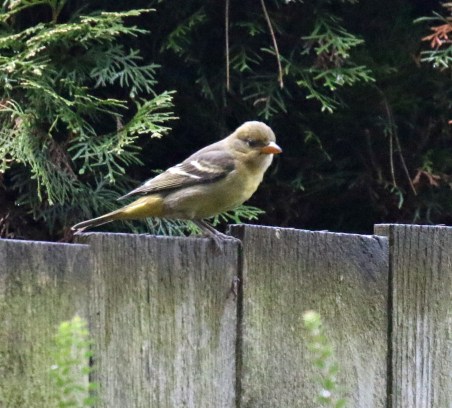
This morning the plan was to try for one of the “unexpected ones”.  A female Western Tanager was visiting Mark Tamboulian’s feeder in Shoreline, Washington and he said I was welcome to visit.  This was a great stroke of luck.  Western Tanagers are generally not here in the winter – so an unexpected add.  I had to take my car in for service that day and would get a loaner but that imposed some time constraints.  Luckily Mark’s place was only a couple of miles from my dealer and was on the way back from the dealer to my home.  How convenient.

Mark has a landscape business and it was very apparent as I drove up to his home.  The grounds were SPECTACULAR!!!  Super design and of course very well maintained.  I was invited in and we began our vigil watching his feeders in his equally beautiful back yard.  He explained that it generally came in with other birds and usually visited the suet.  As we waited we talked – about birds mostly – but a really fun free-ranging conversation.  His neighbor and birding pal was there as well.  His interests were more to photography but together they had traveled to many places in the U.S. and Latin America and had a very impressive bird list and expertise and great stories.

As I have said so many times, in birding we get the opportunity for great places, great people and great birds.  The beautiful home and grounds and wonderful people had delivered the first two of these and when the Western Tanager showed up, all three were there and it was just barely 9:00 a.m.

Western Tanager Female

Western Tanager

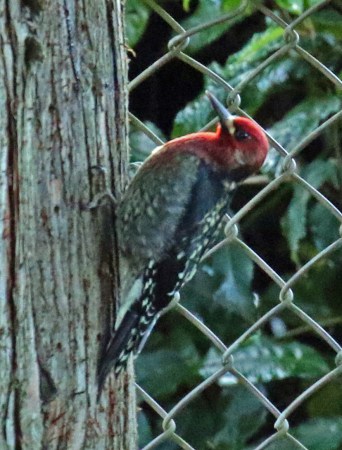
It hung around awhile and then took off.  I continued my visit and we shared stories.  Their experience at the Asa Wright Station in Trinidad was alarming – very unsanitary conditions – I was forewarned.  They had lots of good stories as well.  Time to leave but I happened to mention that one bird I was looking for was a Red Breasted Sapsucker. Bingo!!  The neighbor said there was often one in his yard.  We went out and there it was drumming away in open sight.  Hard to get any easier than that.

Red Breasted Sapsucker

Red Breasted Sapsucker

I now had 178 species for the month and the day was young and I had plans for more.  The visit with Mark had been terrific in any way.  I hope our paths cross again and after i am through with this Big Month I will be sure that happens.  But first it was time to head north to Whatcom County.

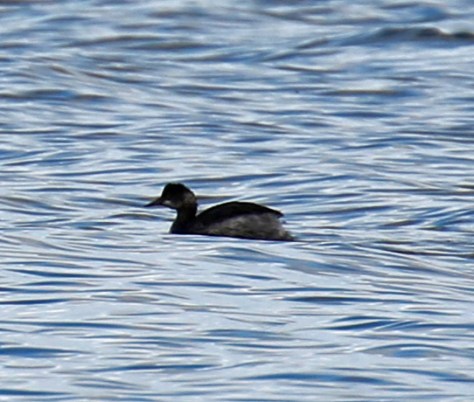
A Rock Wren had been seen regularly at Birch Bay State Park.  It was one of the birds missed on the Walla Walla trip so here was a make up opportunity.  Additionally this was a good spot to find Eared Grebes – not an easy find in the winter.  I found the Rock Wren fairly easily but off leash dogs on the beach kept it pretty leery not willing to pose in the open as it had for many others.  The Eared Grebes were not so easy but eventually I was able to find at least two out in the Bay – just close enough for some ID shots.

Eared Grebe

Eared Grebe

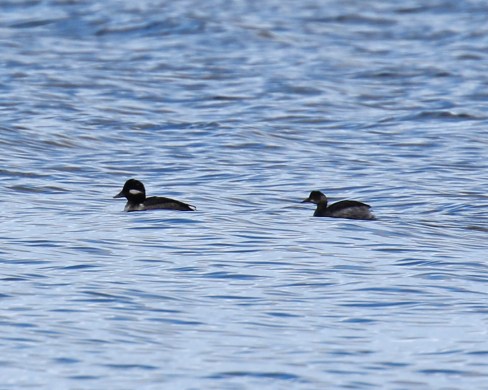
It was interesting to watch one of the Grebes.  It was almost like it was paired with a female Bufflehead.  The two moved around as a unit and I never saw the Grebe more than 25 feet away from the Bufflehead.  The photo is fun, too, as it shows just how small the Grebe is.  Buffleheads are very small ducks – but the Grebe is even smaller.

Eared Grebe and Bufflehead

Eared Grebe and Bufflehead

As pleased as I was to get a photo of the Eared Grebe, I could not fail to recall the spectacular photo of one last year not far from this spot at the Blaine Marina.  I think it has appeared in a blog before but I include it again.

Eared Grebe (March 2016 – Blaine Marina)

Eared Grebe5

My final stop for the day (I had to get back to get my car) was at Semiahmoo.  I hoped that somehow a Mountain Bluebird might reappear here -as one had been there in the winter of 2014 – but not this time.  I did however add a Northwestern Crow.  This is the only place in Washington I will count one other than the Olympic Peninsula.  I am not convinced it is a separate species but the authorities accept it…who am I to argue – especially as it was Bird of the Month #181.

Been East – Going West – The Quest Continues

It was pretty late when I got back home from my Walla Walla trip on January 14th.  There is a saying, “There is no rest for the wicked“.  Wait a minute – I am not wicked – just currently obsessed.  So after that long trip there was still unfinished business and this meant getting little rest and then back to it early on the 15th – this time heading west – specifically to Sequim and environs.

A huge flock of Black Bellied Plovers had invaded a corn field on Schmuck Road and at least one Pacific Golden Plover was being seen with them.  Dunlin were in the field as well.  I easily found the field and at first did not see any birds at all.  Then I moved a little further east and noticed birds flitting around through the corn stalks.  It was a gray day and the light was poor and the birds were mostly pretty far out.  Even through binoculars it was clear they were Plovers but a scope was going to be needed to find the Pacific Golden Plover.  There were dozens – actually many dozens of birds.  They would come into view and then disappear as they moved between the rows of stalks.  At first there were only Plovers – no Dunlin.  Then first one and then another and then another flock of Dunlin moved in.  There were probably 75 to 100 Plovers and several hundred Dunlin.  It was frenetic!!

Fortunately though I had a good scope, the Pacific Golden Plover is noticeably darker and smaller than the Black Bellied Plovers and most importantly I was lucky.  A smaller, darker Plover became very apparent still quite distant but a bit in front of the other Plovers and obviously different from the Dunlin.  It was not still though and if I took my eye off the scope I would lose it.  Back to the scope and I would find it again only to repeat the process.  I have never used digiscoping, but I think that would have been the only way to get a photo.  Pleased with finding the Pacific Golden Plover and Bird of the Month #172 it was time to try for the next target.

Actually targets.  A flock of Marbled Godwits had been showing consistently at Dungeness Landing Park and a single Willet had been seen there and/or at Three Crabs as well.  I first went to the lookout spot over Dungeness Landing Park – the vantage point from where the Emperor Goose had been seen in 2016.  No shorebirds visible.  Then it was down to the park itself with the same result.  Cline Spit looked seemed to be the likely spot for them – but there were no birds there.  Maybe luck would be better at 3 Crabs.

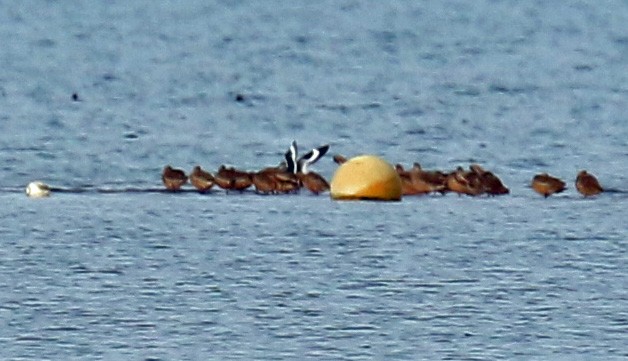
It was.  I didn’t find the birds but I did find the birder who knew about the birds.  Bob Boekelheide was on one of his census runs.  Together with Denny Van Horn, Bob is as knowledgeable about birds in and around Sequim as anyone and is also a great guy and has been very helpful on past quests.  Bob said that the Willet generally traveled with the Godwits and that Dungeness Landing Park was the best place to be.  He said, “Let’s go look.”  About four minutes later we pulled into the parking area, got out of our cars, and were exactly at the right time to see the flock of Godwits fly in with a companion – the Willet.  They landed on a mini-island just off Cline Spit – visible as shapes by the naked eye and as the targeted species with magnification.  I have a 100-400 mm lens.  A 600 mm lens with a doubler would have been necessary for good photos at that distance but I was able to get the one below that shows the Godwits with the Willet easy to ID with its black and white wing pattern.

Marbled Godwits and Willet

Willet

Bob certainly delivered as these were Birds of the Month #173 and #174.  He also delivered again as he told me of a couple of spots on the Dungeness River where I could probably find an American Dipper.  Sure enough right again.  Another distant view pretty far downstream from the bridge but I had reached #175.  One more stop to make – off to Point Wilson at Fort Worden in Jefferson County hoping for some Ancient Murrelets.

Point Wilson is a very cool spot – with great views at the intersection of the Straits of San Juan de Fuca and Puget Sound.  It can be very birdy.  In November 1986, I joined many other Washington birders to observe an extremely rare Steller’s Eider there.  No such rarity this day – although this Western Alaskan rarity was currently being seen about 200 miles south at Seaside, OR.  My hopes were simply for some Ancient Murrelets.  This was as good a place as any in Washington to see some and I intended to follow up with a trip on the Port Townsend to Keystone Ferry for closer views.

Point Wilson did not disappoint.  Again all the birds were far off and a scope was needed but there were a number of alcids – primarily Common Murres and some Pigeon Guillemots and a pair of Ancient Murrelets.  The look was good enough for a positive ID and Bird of the Month #176 but I was looking forward to the ferry ride as I have always had good looks at Ancients on the passing.  This is where trouble struck.  I got to the Port Townsend Ferry Terminal early.  I was asked if I had a reservation.  I said “No’ and then asked if it would be necessary.  I was assured I would get on the next boat.  I was the next to next last car that did NOT get on the ferry and the next one would not leave for 90 minutes by which time it would be too dark to see anything.  To say I was furious was an understatement.  And it was made worse when I learned that there was a two hour wait on the Kingston Ferry which I could have made without any delay if they had just told me that there would not be room.  AAARGH!!!

So there being no great shot from the ferry of an Ancient Murrelet I include one from another trip.

Ancient Murrelet

Ancient Murrelet (2)

I consoled myself with the fact that I had a good day birding and had passed the 175 species original goal.  But ferry disappointment aside, I was now committed to going all out for 200 species for the Big Month and waiting for the Kingston ferry gave me time to plan the next trip.

The Quest Continues – to Walla Walla and Back

Has it really only been ten days since my last post.  It feels like ages ago – definitely a very full ten days.  That last post was on January 11 as I was about to embark on a trip to Walla Walla with stops along the way.  In my quest to see as many species as I could in Washington in my Big Month of January, I had just seen some Bohemian Waxwings and Purple Finches at Harborview Park in Marysville and my total for the month was 157.  With great luck, I said that maybe 170 was possible after the trip to Walla Walla.  This post covers that trip.  Others will go from there – but just as this has been delayed, so too will they – because I am fully absorbed in the birding – collecting the stories and photos that will appear in later posts.

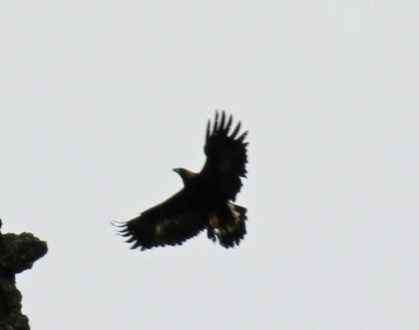
I intentionally chose the scenic route of the Yakima River Canyon rather than racing down I-82 after I cleared Ellensburg.  The Canyon is beautiful, a favorite fly fishing spot – floating the Yakima River mostly in the fall, and it can be birdy – especially in the Spring.  I stopped at a couple of spots to listen for Canyon Wrens – and heard none.  I looked for Chukars – and saw none.  But just where it was supposed to be – near Selah Butte, a Golden Eagle flew overhead and then landed on one of the rocky crags.

Golden Eagle (New for the Month)

Golden Eagle Landing

A Black Crowned Night Heron flew by at the Yakima River Delta and I saw my first American White Pelicans at the Columbia Park Marina.  Unfortunately I did not find the Lesser Lesser Black Backed Gull that had been seen there recently.  I next looked for Ferruginous Hawks first on Nine Mile Road – where I added my first Horned Lark for the Year and then on Byrnes Road.  I found the hawk at the latter spot but only a poor distant view of it in flight over one of the fields.  I visited the Tyson Ponds thinking I might look for Yellow Headed and/or Tricolored Blackbirds.  Overwhelmed by the huge numbers of Starlings, and Blackbirds there I did not try very hard, and as it was already getting a bit dark (the day was gray anyhow), I called it a day and headed to my hotel in Walla Walla.  I checked in with Mike and MerryLynn Denny and made plans for the next day.  When MerryLynn told me she had had a Western Screech Owl at Walla Walla Fort Park, I knew that would be how I would start my day.  This day had been just “OK” – some species missed but I had added 5 so I was now at 162.

I was up early and hit the Park before 5:00 a.m.  It was less than 2 miles from my motel.  Just where MerryLynn said she found it, I was able to strike up a playback conversation with this little owl.  It never came in close and I did not have a spotlight anyhow, but this was a good omen.  I returned for a shower and breakfast and then joined up with the Dennys.  Birding with them is a highlight each year.  Fun, knowledgeable, excellent birders, very giving – one could not ask for more.  And the day was beautiful.  Walla Walla had experienced some very cold and snowy weather but the snow was all gone and this day would be in the 50’s.  It was an excellent day.

We went to so many places I could not keep track.  One of the “problems” with birding with Mike and MerryLynn is that they do so much birding in their beloved county and see so many birds, that there is a constant litany of what they had seen a day ago, a week ago, or last year.  I am no longer disappointed when we don’t see everything they had seen in those past trips – but I think they are disappointed that I too don’t get those birds.  We got off to a bit of a slow start – not real birdy – until I changed my hat – putting on one that my daughter had given me a couple of years ago.  Things picked up.  The first new species I added was an Evening Grosbeak on Biscuit Ridge Road.  It had been on my theoretical list but was not expected.  In perfect light, the picture shows a stunning bird.

Evening Grosbeak (New for the Month)

Evening Grosbeak

We then moved on towards Smith Springs Road where Long Eared Owls were “guaranteed”.  We had them there last year on the Denny’s popular “Owls By Day Trip”.   I am going to cheat a bit here and not be real exact on some of the locations that were all “in the vicinity” – but we had lots of great birds and especially great views.  Some of the observations will be out of order time wise as well.  Here are the new birds for the month and “special birds” – with their photos.

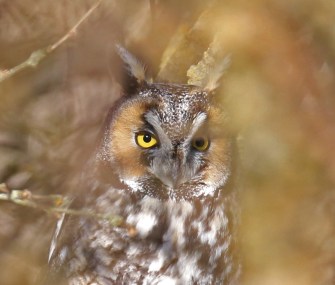
It took some time to find them buried as they were in the thicket along Smith Springs Road but we were able to find 4 Long Eared Owls.  There were probably more but other birders were around and we did not want to hog the resource.  As deeply as they were buried I was thrilled to get any photos at all.

Long Eared Owl (New for the Month)

Long Eared Owl3

Long Eared Owl

Nearby we also found some American Tree Sparrows – definitely a target for the trip.  Also buried in thick branches and hard to photograph from the car but glad to add to the list.  We had at least 4.

American Tree Sparrow (New for the Month)

American Tree Sparrow1

The previous day I had found a small flock of Common Redpolls on Nine Mile Road.  MerryLynn had not seen any in the County yet so we were all happy when three showed up with a huge flock of probably 300 American Goldfinches.

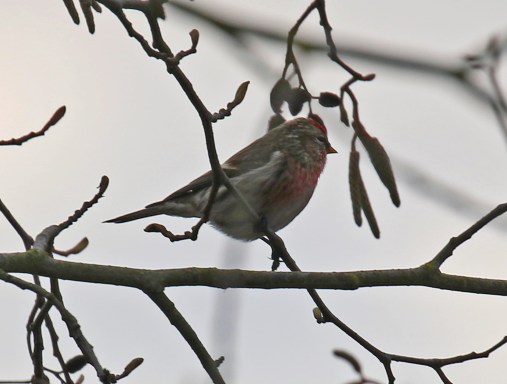
Common Redpolls


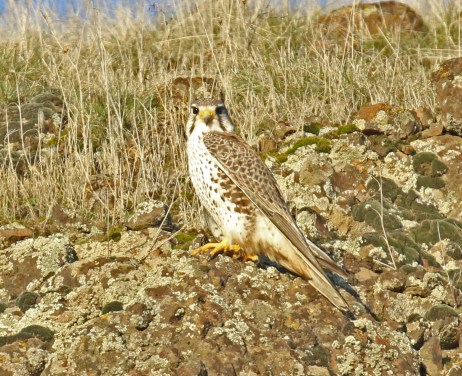
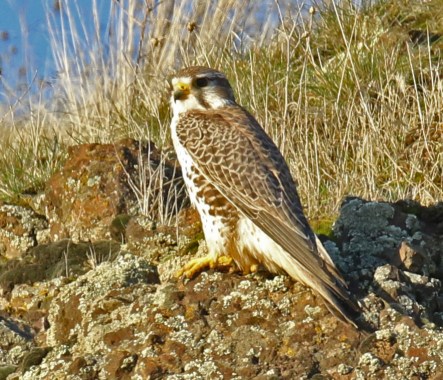
This area is really good for falcons.  We saw many American Kestrels during the day but special treats were a Merlin and a Prairie Falcon that were very photogenic.

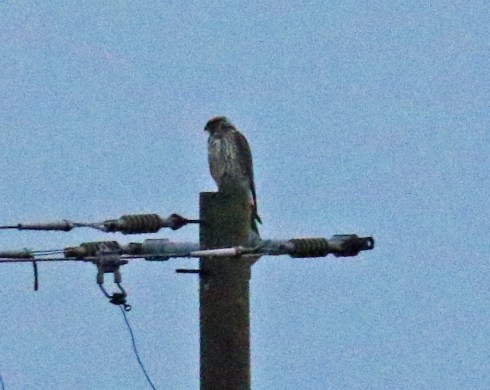
Merlin

Merlin

Prairie Falcon

Prairie Falcon

Prairie Falcon 3

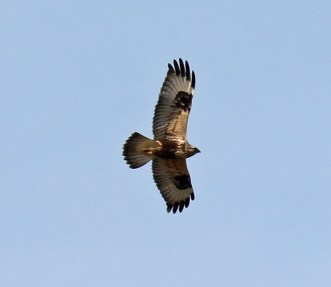
Throughout the day we had many hawks – mostly Red Tails but also a Cooper’s Hawk and both light and dark phase Rough Legged Hawks – real beauties.

Rough Legged Hawk – Light Phase

Light Phase Northern Rough Legged Hawk

Rough Legged Hawk – Dark Phase


Another new bird for the month was a Ring Necked Pheasant.

Ring Necked Pheasant (New for the Month)

Ring Necked Pheasant

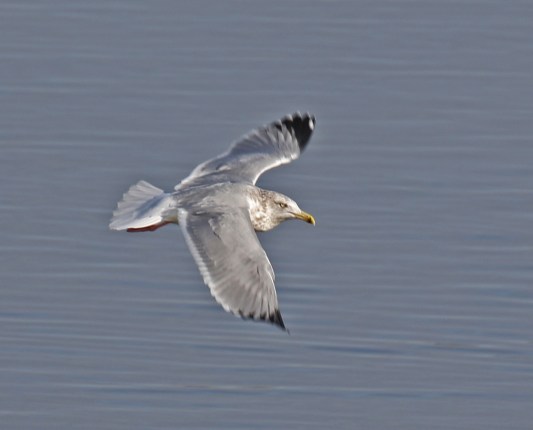
We visited Lower Monumental Dam primarily to look for “specialty gulls”.  Mike had brought many loaves of bread to “chum” for the gulls to come in closer.  It worked but I think part of the reason was just because Mike so enjoyed seeing how far he could scale the bread.  The gulls were mostly California Gulls but there were also many Herring Gulls and one adult Glaucous Winged Gull.  Here the latter are “pure” rather than the mostly hybrid Glaucous Winged/Western “Olympic Gulls” on the West side.  I liked the photos of the Glaucous Winged and Herring Gulls in flight and include them here.

Glaucous Winged Gull

Glaucous Winged Gull

Herring Gull

Herring Gull

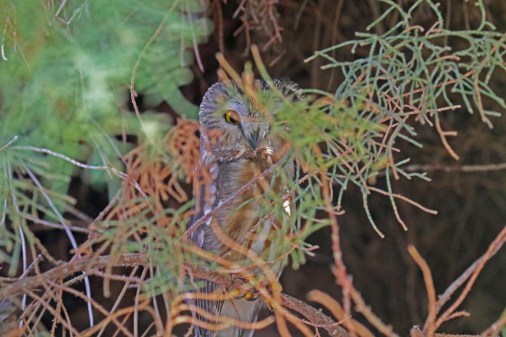
We thought one gull might have been a Glaucous Gull.  But expert review nixed our ID.  It would have been nice. In addition to the Long Eared Owls, earlier we had also found a Great Horned Owl, my third owl species for the day.  We were about to add a fourth as, per usual, the tiny Northern Saw Whet Owls at Fish Hook park were cooperatively roosting in their regular spots.  Very hard to get a photo through the thick branches.

Northern Saw Whet Owl (New for the Month)

Northern Saw Whet Owl

Two other good birds at the Park were some Purple Finches (MerryLynn’s first for the year) and a White Breasted Nuthatch.  I had seen the latter at two other spots earlier in the month but this was my first photo.

White Breasted Nuthatch

White Breasted Nuthatch1

It had been a full day bit there was to be one more stop – another try for Great Gray Owl on Lewis Peak Road.  We had just missed one at this spot on the Owls By Day Trip last year and one had been seen “at the meadow” a couple of times in the preceding week.  Within a few minutes of arriving and me playing the owl’s call, we had a response.  My heart beat quickened but sadly what we heard was a pair of Great Horned Owls.  They were in the distance and probably made it less likely that a Great Gray would appear.  And it did not.  This was also a good area for Northern Pygmy Owls but they too were uncooperative.  So not the great climactic finish that was hoped for but still a wonderful day.  I had added another 6 new species for the month and my total was now at 168 – and there was still – tomorrow.

“Tomorrow” started early again as I revisited Lewis Peak Road hoping that the Great Gray might like the morning better.  Alas no luck, but exactly where the Denny’s had seen one earlier in the month, a Northern Pygmy Owl gave a brief appearance in the early morning light.  My hoped for 170 was close and there was more ahead that day.

Northern Pygmy Owl (New for the Month) – Picture from November

NOPO

Before heading out to Walla Walla, MerryLynn told me that a Snowy Owl had been seen just off Dodd Road.  I had looked for it on my way over but did not have an exact location and knew it was iffy anyhow.  Now, however, I had specifics and I would try again. First I made a quick trip to the Barn Owl spot on Dodd Road and was able to see one owl buried deep in a burrow – Owl #2 or the day and #6 for the trip.  I was told that it liked to sit on some bee boxes visible from the road and reachable by a track into the field.  When I got to the right spot, I saw the bee boxes in the distance and there seemed to be something white on one of them – part of the box – or the Snowy Owl.  Yay!!  It was indeed a Snowy Owl – lucky #7.  How cool if the Great Gray had cooperated to make an 8 Owl trip -and there was a possibility for #9 as a Burrowing Owl had been reported at the man made burrow spot off Highway 395.  I tried for that and was unsuccessful so had to be happy – and I was very happy – with 7 owls!!

Snowy Owl – (New for the Month)

Snowy Owl

I returned to the gull spot near Bateman Island.  This is where I had missed the Lesser Black Backed Gull two days earlier.  Chris Lindsey had seen a Slaty Backed Gull there just the day before and this time I was armed with some of Mike’s chumming bread.  When I got there many gulls were on the ice where the Slaty Back had been seen.  It was not there but other gulls were in the area and I thought chumming and waiting and hoping was a good strategy.  It sort of was.  I threw the bread out and got some action – but nothing with a slaty back.  I waited and tried again – but unfortunately this was a holiday and there were visitors to the area including a family with two kids.  Also two twenty-somethings.  They all started skimming rocks on the ice and just as a number of larger gulls including the Slaty Backed came in, they changed tactics and started skimming the rocks towards the gulls.  No gulls were hit but a large number flew off including my target.  Many just circled and returned but the Slaty Backed Gull flew off towards the Island.  It remained but was now viewable only by scope.  There ought to be a law (actually there probably is).  So no photo and not the best experience but it was a new bird and the chumming was a new experience for me.

I made that unsuccessful try for the Burrowing Owl and it was time to head home.  Snow was predicted on the Pass and I wanted to beat it.  I didn’t beat it, but I did avoid problems that may been there just a little later as there was heavy snow fall when I went through but it was not yet cold enough to really stick.  The story was probably very different a couple hours later.

The trip had surpassed expectations even without the Great Gray Owl.  I was now at 171 species for the Month.  My Big Month would easily hit 175 and the two rarities of Snowy Owl and Slaty Backed Gull – both unexpected and very special – suggested that I should go for 200.  More stories on that quest will follow.

A Day Off – So Posting a Catch Up

It is January 11th.  It is raining.  I am not out birding.  I am resting … and attending to mundane necessary matters like laundry, bill paying, deciding whether to change insurance companies and cellular plans, and starting on taxes.  I would rather be birding…

And tomorrow I will be again – back at the quest for a “Big Month”, something I have never done before.  Unless the Pass is completely closed by snow, I will head east to Walla Walla with stops a long the way.  If all goes well I will be within striking distance of my Big Month goal of 175 and then think about really pressing on towards 200.  All that is for a later Blog Post.  Today is a quick summary of the past 10 days – good birds and birding in Washington.

January 1st

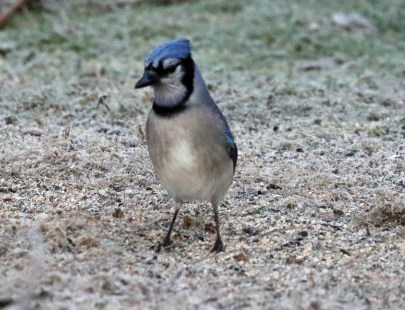
I started the day with the resident Barred Owl in nearby Yost Park – doing its “Who cooks for you” thing at 6:30 a.m.  Then it was up to Barry’s place on Bow Hill Road hoping that the Blue Jay would be there still.  I saw it almost as soon as I drove up in dim light just before 8:00 a.m.  I picked up some of the regulars along the route and found the Merlin in Edison before 9:00 – #30 for the day.  Shortly thereafter I found the Prairie Falcon that has hung around near Bayview Edison Road – a good bird – #40 for the day.  And a few minutes later I had a Kestrel – my third Falcon in less than 20 minutes.  I assumed I would quickly find a Peregrine for a fourth, but I missed it.

Blue Jay
Blue Jay

I went to the Samish Island overlook to scope for water birds hoping for some nice alcids.  The water was choppy and I found no alcids.  The best bird was a Long Tailed Duck.  I did not have an exact itinerary for the day but knew I wanted to look for the Black Phoebe that has been a regular at Wylie Slough, so I headed South and readily found the flycatcher – catching flies.  The handful of other birds I added there brought the day’s work to 60 species.

Black Phoebe

Black Phoebe

There were two more specific targets for the day – the continuing Rose Breasted Grosbeak near Green Lake and the Common Redpolls that were at Green Lake itself.  I met Jason Vassallo at the Grosbeak stakeout site.  It was a little delayed but then the Grosbeak made a very cooperative appearance feeding on the ground below the feeder.  Jason told me he had had a large group of Redpolls at the Montlake Fill, so I opted for that instead – thinking it might produce more species as well.  I only found 4 Common Redpolls there but seeing a Canvasback and some Wood Ducks were a treat and I left the Fill at 71 species for the day.

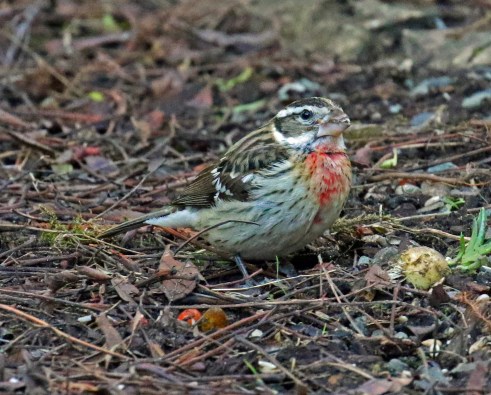
Rose Breasted Grosbeak

Rose Breasted Grosbeak

Now it was back to Edmonds.  Disappointingly few birds at the waterfront and I ended the day back at Yost Park where two Varied Thrushes ended the day with my species list at 79 for the day – the month – and the year.

January 2nd

Hoping for some better birds on the Edmonds Waterfront, I started the day there but found even fewer birds at a high tide.  Sunset Avenue was kinder, however, as I found a group of Brant and a pair of Black Scoters – both species often found scanning from this location.   I also found the usual Harlequin Ducks at Edmonds Marina Beach Park.  Next it was to Pine Ridge Park hoping for some more forest birds.  Just as I was leaving after adding a few species, I found a Pileated Woodpecker tapping away – species #89 for the year.

Pileated Woodpecker
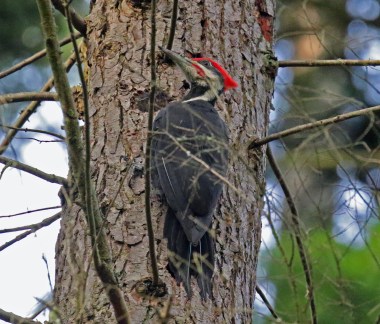
Pileated Woodpecker

At this point I had not yet decided to do a “Big Month”.  I had birded hard the day before and was still tired from a shorter than originally planned trip to the Okanogan on December 30th and 31st.  I was tired.  I knew I would be heading off the next day with Carol Riddell and Brian Pendleton for birding in Tacoma and Ocean Shores – so I called it a day  and went home.

January 3rd

A Ross’s Goose had been seen at Ocean Shores in late December.  If I had not seen one at the Salton Sea on my California trip, I might have chased it then.  But this was a new year so this rare small white goose was very appealing.  Brian, Carol and I first tried for some uncommon birds in Tacoma.  We found the Harris’s Sparrow but could not find either the Cinnamon Teal or the Glaucous Gull.  We were hindered by poor light and the press of time and moved on to Joint Base Lewis McChord where a Gyrfalcon had been seen the last week in December.  I had seen it on Christmas Day and should have returned to look for it on New Year’s Day.  We arrived just in time to learn that we had missed it by 10 minutes.   AARGGH!

Harris’s Sparrow
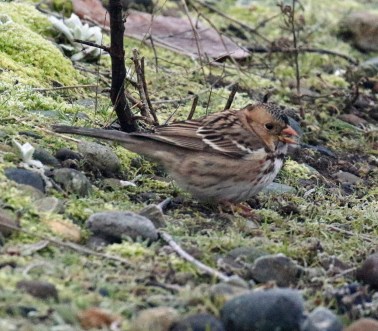
Harris's Sparrow1

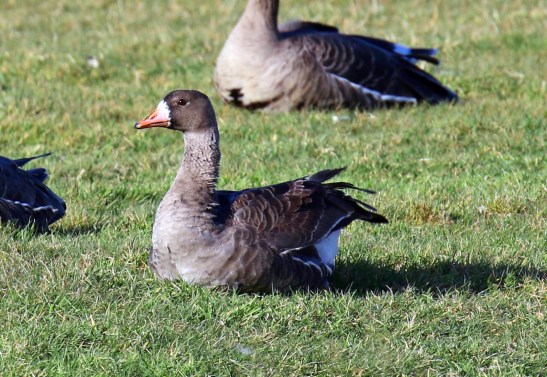
On to Ocean Shores.  It took a little sleuthing to figure out where on the Golf Course we would find the Ross’s Goose, but when we rounded the corner and a brilliant spot of white was seen against the green grass of the course, we knew we were good.  It was grazing with a small flock of Greater White Fronted Geese – bingo two new year birds!

Ross’s Goose

Ross's Goose

Greater White Fronted Goose

Greater White Fronted Goose

The other rarity that had been a draw to Ocean Shores was the White Winged Crossbill.  A flock had been hanging out in the vicinity of the Discovery Center.  We drove the area looking at the tree tops and listening.  More importantly we kept our eyes open for other birders and when we found some, they had located the Crossbills.  Not the giant flock that would be seen later in the week, but decent treetop looks in good light – good enough to see the white wing bars.

White Winged Crossbills
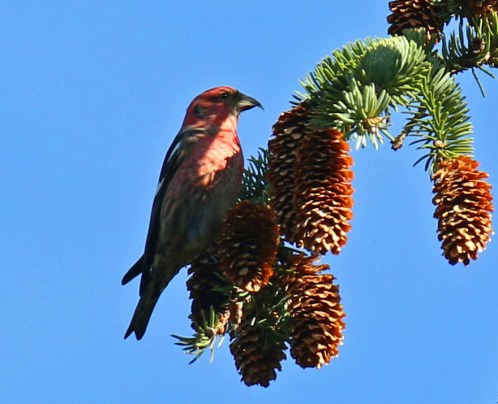
White Winged Crossbill

We next visited the Point Brown Jetty.  The tide was high and the waves were ferocious.  A spectacular sight.  I am no longer able to walk out on the jetty to get to the Rockpipers that are often far out.  Under these conditions it would have been suicidal, but more importantly it was unnecessary.  The high water and waves had concentrated the birds relatively close in and we had great views of 4 or 5 Rock Sandpipers and a dozen or more each of Black Turnstones and Surfbirds.

Rock Sandpiper

Rock Sandpiper1

Surfbird

Surfbird

Black Turnstone

Black Turnstone

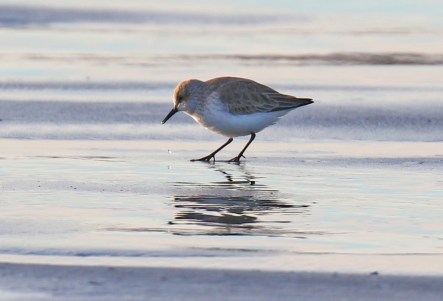
We visited the Sewage Treatment Plant where we added some ducks and looked for shorebirds at the Game Range – but the water was so high, there was no place for them to be.  As a last resort we drove the beach just south of the Casino and found thousands of shorebirds – mostly Sanderlings and Dunlin bit there were also some Black Bellied Plovers and a handful of Western Sandpipers.  All were new year birds.

Sanderling
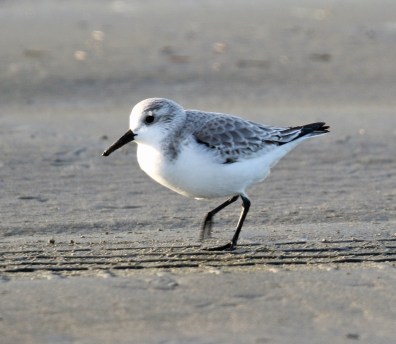
Sanderling

Dunlin

Dunlin

Western Sandpiper

Western Sandpiper

Our last bird of the day was a Barn Owl that flew over at dusk just as we approached the rest area on the way home.  It had been an excellent day – adding some rarities, some good coastal birds and ending the day with 106 species for the month.

January 4th

Today started with an unsuccessful wait for a White Throated Sparrow that had been frequenting a feeder in North Seattle.  It left 15 minutes before I got there and returned 30 minutes after I left – having waited over an hour.  I got a California Scrub Jay at Sakuma Viewpoint and then headed back up to Skagit County where I bumped into Jon Houghton at Wylie Slough.  We looked for and failed to find the Great Horned Owl that had been seen roosting in one of thickets but then joined forces and were off to the North Fork Access to the Game Range hoping for Swamp Sparrow.  We may have heard the Swamp Sparrow but definitely not well enough to count it.  Jon’s eagle eye did pick out an American Bittern, however and it was very photogenic.

American Bittern
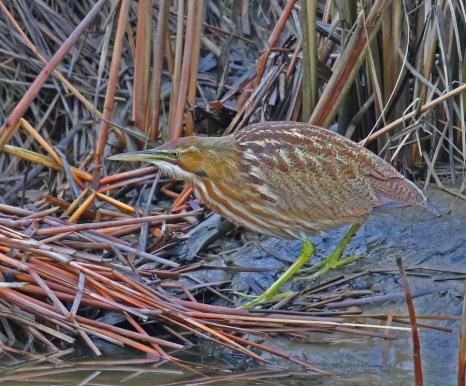
American Bittern

Jon headed home and I picked up a few more birds including a Peregrine and a Northern Shrike and ended the day with 115 species for the month.

January 5th

This started back at the Edmonds waterfront which was a bit more productive and I was able to pick up two alcids and two loons and a Western Grebe.  I returned for more feeder watching and after about 20 minutes the White Throated Sparrow made an appearance with a small group of Juncos and Golden Crowns.  Later in the neighborhood I found some Band Tailed Pigeons – a species I have seen in the area often.  I then got my oil changed (way too many miles chasing birds).  There was not time for a long search but I had time to visit the Weyerhauser Ponds for the sure thing Redheads (and some other ducks).  A stop at the Boeing Ponds returning home was disappointing as the resident Green Heron was not found.  My only new bird there was an American Goldfinch.  The total for the month was now up to 124

Redhead
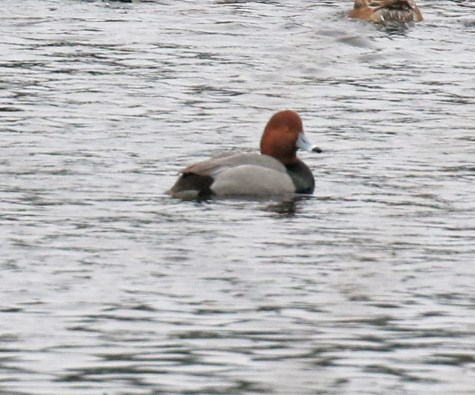
Redhead

January 6th

I had started the year with a Barred Owl but I had not yet actually seen any.  I was hoping to rectify that today and headed to Camano Island hoping for a Great Horned Owl and then to Eide Road hoping for a Short Eared Owl.  Great Horned Owls had been reported at two places on Camano – one on Hanstad Road – a go to spot for Wild Turkeys.  No owls and no turkeys.  But a Great Horned Owl did hoot back on Arrowhead Road – still no visual, however.  It was still near dusk but with enough light to see so I retraced steps and went to Eide Road.  A single Short Eared Owl has been reported there, but despite intense scoping, not one for me.  A Cooper’s Hawk was a new bird for the year.  I then went back to Camano Island to Maple Grove Beach – a new place for me.  It has been a good place for seabirds and I was able to find 10 water birds there including my first Common Murres and Marbled Murrelets of the year.

It was still relatively early so I headed again up to Skagit County – determined to find a Short Eared Owl at the West 90 and hoping for some other  good birds at other spots.  I tried again for the Great Horned Owl at Wylie Slough and was again unsuccessful.  At the North Fork Access, the water level was higher than when I had visited with Jon Houghton.  Maybe that is why I could not find the American Bittern but might also explain why I did find the Swamp Sparrow – although unlike the time I was here last month with Bruce LaBar and Ed Pullen, it would not come in for any view at all.

On to Rosario Head and Rosario Beach.  A Yellow Billed Loon had been here around this date last year – not this time.  Also no Ancient Murrelets.  The only new bird was a Black Oystercatcher – on the rocks on one of the offshore islands seen only with the scope.  Now for that Short Eared Owl.  Near Sullivan Road I ran into a group from Whidbey Island Audubon.  They had seen a Short Eared Owl hunting at the West 90 perhaps 30 minutes ago.  When I got there Grace and Ollie Oliver were leaving and they had seen one about 10 minutes earlier.  So one was there – but where.  A yell from Ollie was for a flock of Plovers across from the West 90 – a common place for them.  All were Black Bellied.

For the next 20 minutes I scoped every inch of the West 90.  Some other birders arrived and looked as well.  Finally I found a single Short Eared Owl on the ground maybe 400 yards away completely invisible with its back to us but briefly visible when it turned its head.  The highlight of the day was being able to get a family onto the bird – a thrill for the young boy who thought owls were “cool” – who would not agree!!  A small flock of Brown Headed Cowbirds had flown in while we were looking for owls – a new bird for the month.

It had been raining for much of the day and I had decided to leave my camera in the car – after having one fizzle out in light rain on my trip to Arizona last year – an expensive lesson.  It was drier at the West 90 and the Owl was too far away for any photo anyhow but then heading home the Northern Shrike was perched on exactly the same spot as when I had seen it earlier in the week – my only photo of the day – from in the car.  The month total was now at 134.

Northern Shrike (from the car)

Northern Shrike

January 7th

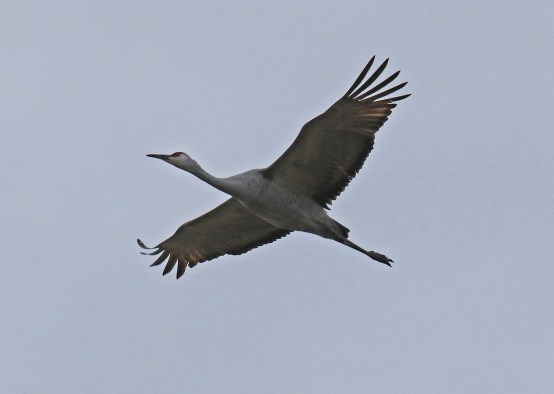
Any Big Year, Month or Day requires a lot of traveling.  I had already been to the Coast.  Now it was time to head south and find some special birds in Clark County.  Snowy Egrets are few and far between in Washington.  At least one has been seen at times the last few years in the Vancouver Lowlands along Lower River Road.  If this was the only potential new bird for the year, I would not have made the trip, but there were some other possible goodies and it proved a good trip.  I easily found the Snowy Egret along with three Great Egrets in the River Road Ponds.  I was surprised to also find both Tree and Barn Swallows there.  Flyover flocks of Sandhill Cranes meant that I added 5 new year and month birds in less than 10 minutes (well after 3 hours of driving of course).

Snowy Egret
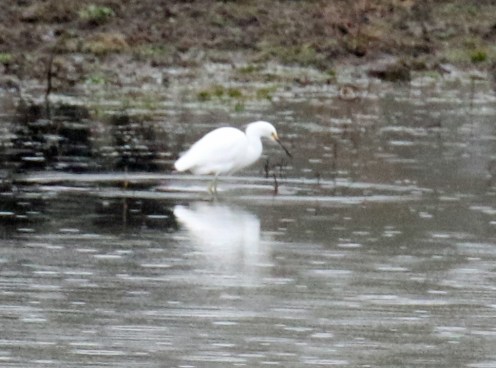
Snowy Egret

Sandhill Crane

SAndhill Crane1

I then followed up on a report of some Lesser Goldfinch at Meadowbrook Marsh Park – less than 15 miles away.  I had barely started hiking the park when a small accipiter took off after two small birds.  It was a male Sharp Shinned Hawk chasing two Lesser Goldfinches.  So quickly two more new birds for the month.

Next it was on to Ridgefield National wildlife Refuge.  It is always a good place – lots of waterfowl and raptors.  Passerines too but observation is limited as you have to remain in your car for most of the circuit through the refuge.  My targets here were Red Shouldered Hawk, Wilson’s Snipe and just maybe a White Headed Nuthatch – most likely to be heard.  I was greatly aided by a very knowledgeable volunteer at the entry and set off on the car loop at the River S unit.  Just where they always are, I found numerous Wilson’s Snipe in a muddy pond.

Wilson’s Snipe
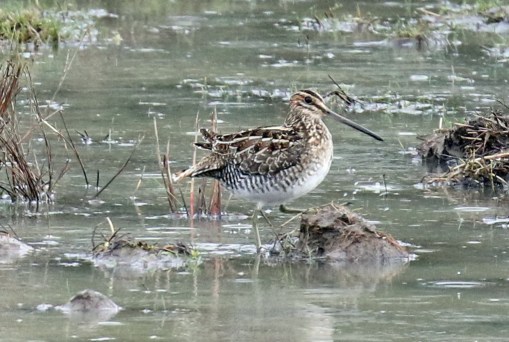
Wilson's Snipe2

On my first loop around the path I listened for Nuthatches and heard none and I searched every tree looking for a Red Shouldered Hawk – again none.  I decided to make another pass – a good decision as I heard a White Breasted Nuthatch at the Kiwi Trail pullout and then a Red Shouldered Hawk buried in dense branches just as the auto route began to turn back to the east.

Red Shouldered Hawk
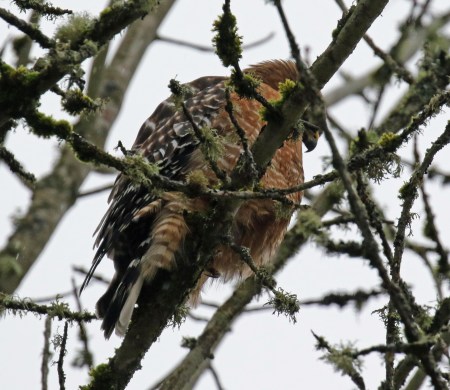
Red Shouldered Hawk

On the way home, I made yet another try for the JBLM Gyrfalcon – again no luck.  I think it may have moved on – or been hit by one of the planes.  Traffic was bad – but less bad than usual coming home – still a long day.  But a good one that ended with the month count at 145.

January 8th

It’s getting harder to find new birds.  One that I had “saved” was the Townsend’s Warbler that comes to Steve Pink’s feeder.  I think it may have flown off the feeder just as I arrived but fortunately it returned about 15 minutes later.  I then headed over to Log Boom Park.  I have had Green Herons there in the past and Carol Riddell reported one there on the 7th.  It is an easy bird to miss but this time luck held as it was again at Pier 3.

Green Heron
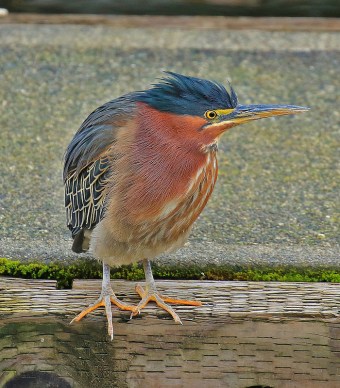
Green Heron

Then on to Everett Marine Park – a great place for gulls.  I quickly found what I thought was a Herring Gull but then wondered if it was a hybrid instead.  I found another gull that was definitely a Herring Gull – pale iris and all.  I had a couple of candidates for Iceland (Thayer’s) Gull but just wasn’t sure so I will look again.

Herring Gull

Herring Gull

The last new bird of the day was an Orange Crowned Warbler – at the Union Oil property adjacent to the Pine Street Fish Hatchery.  We had one there for the Edmonds Christmas Count.  It was less responsive this time but in the same general area.  Not a staggering list for the day but the total for the month stood at 149.

January 9th

Time to hit the road again.  Steve Pink, Brian Pendleton and I headed over the Pass to Kittitas County.  We would meet up with birder friend Deb Essman but first we birded Suncadia and Bullfrog Pond just west of Cle Elum.  We had no luck at Bullfrog Pond but at Suncadia we found all three Washington Nuthatches (Pygmy, Red Breasted and White Breasted) and a couple of Mountain Chickadees.  On the way to Deb’s we fund the first of many Black Billed Magpies – still the first of year for all of us.  A big disappointment though was failing to find a White Headed Woodpecker which we know is in the area.

At Deb’s place we quickly had more Mountain Chickadees and then off we went searching for “chickens” – looking for Gray Partridge, Wild Turkeys, California Quail and Chukars.  We were hampered by lots of fog – and the birds were not cooperating.    Our best bird was a Prairie Falcon – one of two seen.

Prairie Falcon
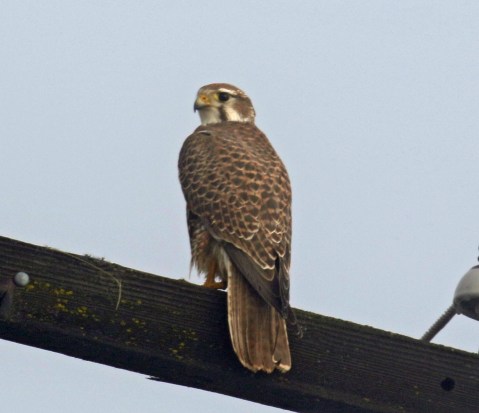
Prairie Falcon1

Deb called on some special resources to get us the best birds of the day.  We went to a ranch where the owner feeds Wild Turkeys.  He gave Deb a bucket of corn and she took it to the feeding spot and within moments after spreading it we had a great scene of at least 50 Wild Turkeys coming in to gorge themselves – very cool experience.

Wild Turkeys

Wild Turkeys1

Then Deb took us to another friend’s place – a veritable bird haven with many feeders, native trees and an avid birder owner.  There were hundreds of birds including lots of California Quail and Goldfinches.  We also got a fleeting look at another White Breasted Nuthatch and some Mountain Chickadees.  We had a Cooper’s Hawk as we approached and apparently had just missed a Barred Owl.

Mountain Chickadee

Mountain Chickadee

Not long after we left to continue our hunt for Partridge, Deb got a call from the owner saying he had relocated the Barred Owl.  We returned and found it high in some trees.  I had actually seen one at the same property with Deb two years ago but it was a new County bird for Steve and Brian – very nice find.

Barred Owl

Barred Owl

We dropped Deb back home and then went out to Vantage and Hunzinger Road hoping for Rock and/or Canyon Wrens and Chukars.  No luck on any of them – pretty birdless.  The Turkeys and the Barred Owl were clearly the stories of the day.  The trip back was a little tense as there was lots of snow falling on Snoqualmie Pass.  My Jeep handled it well but we would not have liked being there an hour later.  After the trip, the month list was at 154.

January 10th

I had looked for a Red Breasted Sapsucker at a couple of spots earlier in the week and tried a couple more in the morning – no go.  Carol Riddell had reported some Cinnamon Teal at Tambark Pond in Bothell.  I had never heard of the place but wanted the Teal so I gave it a try.  There was a pull-off on an adjoining main road.  I parked and quickly saw two ducks that I was sure were Cinnamon Teal disappear around some reeds.  Another 7 birds took flight and disappeared.  I thought I saw blue wing patches but they flew directly away from me so no ID. There appeared to be a road that was next to the pond in a housing development and I found a way to get there and when I parked I found a group of ducks all huddled together resting that included the two birds I had seen earlier together with some more Cinnamon Teal, Green Winged Teal and a Northern Pintail.  I watched for 10 minutes and the birds remained – heads down.  Could confirm as the desired Cinnamon Teal though.

Cinnamon Teal (and others)

Cinnamon Teal

I considered trying some other spots but was running out of ideas.  I have been considering switching my cellular service from Verizon to Comcast and stopped by the Alderwood Comcast store.  Afterwards, as I was heading home I got a call from Steve Pink who said that David Poortinga had located some Bohemian Waxwings in Marysville.  Odd how the world works.  Since I had been in the store, I had not checked email messages.  I had come close to making the switch while there but decided to wait until after getting back from a trip to Walla Walla.  If I had made the switch I would not have had my phone when Steve called.  I headed for Marysville right away.

Steve, David and Ann Marie Wood were on the Bohemian Waxwings as I got to Harborview Park – another new spot for me.  Sure enough there were eleven Bohemian Waxwings feeding on berries and being their gorgeous selves.

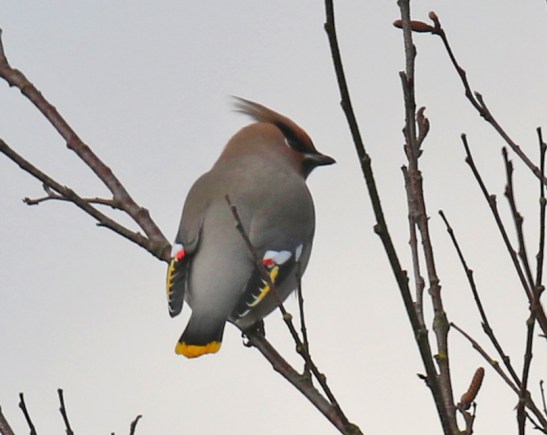
Bohemian Waxwing

Bohemian Waxwing

And as a bonus I found some Purple Finches that David said he had seen earlier – another new bird for the month.

Purple Finch

Purple Finch

When I started writing this, I had intended to only cover a few days and then return for additional reports later.  But I often find I get swept up in the writing and I enjoy it.  Hours pass and then I realize it is late and I am hungry – like now.  But I am all caught up at least.  The month count is now at 157.  I am off to Walla Walla and environs for a few days starting tomorrow.  Hopes are high.  With luck I could even get to 170 species for the month.  Stay tuned.
2017 – All Goals Reached (At Least the Birding Ones)

Quite a year – filled with wonderful birds and people and places – many filling previous blog posts in 2017.  Some repetition here is probably inevitable, but I will try to keep it to a minimum.  I just want to celebrate and summarize and then move headlong into the next year.

Somewhere along the way, I set some goals for birding as well as for personal matters.  Some of the latter did not go as well as I would have liked but this is a birding blog, so I will mostly skip those and reflect on the birding ones.  That said I do wish the others had been met and if it would have mattered, I would have given up the birding successes to achieve the others.

In one of my blogs earlier this year I think I set out the 7 goals I had set for the year – all multiples of 100 – my “double zero” goals, and later blogs have detailed reaching each of them.  Again, these were the objectives:  100 species in one day; seeing my 200th species in Kittitas County; seeing 300 birds in my home state of Washington for the year; getting a photo of my 400th species in Washington; seeing 500 species in the ABA area for the year; getting a photo of my 600th species in the ABA area; and lastly getting my ABA area life list over 700 species.

I hit the 100 goal on June 24th starting out in hometown Edmonds with a Barred Owl in Yost Park.  I added another 34 birds in Edmonds and then headed east picking up another 15 species in the Snoqualmie Pass area before moving on to one of my favorite birding areas, Kittitas County, where I added 36 species.  The 100th species for the day – a Bullock’s Oriole was found at the Wenas Campground in Yakima County.  I added 16 more species ending the day with a Common Merganser on the Tieton River.

Goal 1 – 100th Species in One Day – Bullock’s Oriole – Wenas Campground, June 24th

Bullock's Oriole

The second goal – my 200th bird in Kittitas County was almost unknowing – an Anna’s Hummingbird at feeders – just east of Snoqualmie Pass and thus in Kittitas County.  Rufous Hummingbirds are common in Kittitas County but Anna’s are not.  I had lost track of that and it was almost an afterthought to try to find one Anna’s among the many Rufous Hummingbirds at the feeders.  Greatly outnumbered by the 16 Rufous Hummers, on June 16th, I found a single Anna’s.  Later on July 12th an American Three Toed Woodpecker became species 201 in the County.

Goal 2 – 200th Species in Kittitas County – Anna’s Hummingbird – Snoqualmie Pass – June 16

Anna's Hummingbird

Although I wasn’t so sure at the time I set it, the goal of seeing 300 species in Washington for 2017 was readily reached (and surpassed).  Over the preceding 5 years I had averaged 355 species so 300 would have seemed “easy”, but in each of those years I had intentionally tried to maximize the species seen, and in 2017 much more time and energy was planned to be spent seeking birds outside of Washington in the ABA area going after some of my other goals.  The combination of some good birds showing up in Washington which led to adding both ABA birds and state birds for the year and doing more state birding than anticipated as some of my non-birding goals went astray, resulted in me hitting my 300 goal with a Solitary Sandpiper at the Redmond Retention Ponds on July 26th.

Goal 3 – 300th Species in Washington – Solitary Sandpiper – Redmond Retention Ponds – July 26

Solitary Sandpiper1


Getting photo number 400 of Washington bird species was maybe the highlight of the year.  As chronicled in my Blog Post: A Swallow Tailed Gull – Way Beyond WOW!! somehow a Swallow Tailed Gull which belongs in the Galapagos and had only been seen north of the Equator one other time, made it to Carkeek Park on the morning of August 31st just when super birder Ryan Merrill just happened to be there.  He recognized the rarity and got the word out to the birding community.  Even though I was 25 miles away in Bellevue at 6:45 a.m. when Ryan’s Tweeters post appeared, I somehow got dressed and with the miraculous absence of traffic was at Carkeek park and looking at this incredible find by 7:30 a.m.  I took a quick photo – and then many more – so this of all species turned out to be photo number 400 for Washington.

Goal 4 – 400th Washington Species Photographed – Swallow Tailed Gull – Carkeek Park – September 1, 2017

Swallow Tailed Gull 3

With goals, 5, 6 and 7 in mind, I had planned lots of travel in the U.S. for 2017 with trips to Arizona and Florida being the most important but there was also a mostly non-birding visit to San Diego in late January and a visit to the East Coast to see my kids that included a day with some birding on Cape Cod.  It was during the Cape Cod trip that I met goal #5 – seeing my 500th bird in the ABA area for the year.  It was a Mute Swan seen in a pond in Duxbury, MA on October 9th.  Mute Swans are occasionally seen in Washington but are not “countable” here as they are not considered an established species (and I disagree), however, they are well established in the East and countable as such in Massachusetts.  Given that inconsistent status, I night have preferred a “better” species for #500 for the year but it is a fine looking bird.

Goal 5 – 500th ABA Species for the Year – Mute Swans – Duxbury, MA – October 9th

Mute Swans

Goal 6 was the corresponding ABA accomplishment to Goal 4.  Instead of 400 species photographed in Washington, it was getting a photo of my 600th ABA species.  This one is a little embarrassing as I really do not know which specific bird on my Arizona trip was photo number 600.  I added MANY new photos on that trip and since I was not the one keeping the lists, some of the specificity as to exactly when each bird was seen and photographed is not clear.  I know it was one of the new birds/photos for August 3rd and my favorite bird that day was the Thick Billed Kingbird so I am going with that.

Goal 6 – 600th ABA Life Photo – Thick Billed Kingbird – Patagonia Roadside Rest Area – August 3rd

Thick Billed Kingbird1

One more to go and this was the one that I did not think I was going to make.  It used to be that someone who had an ABA Life List of 700 species had probably spent many years and many miles accumulating that number of species.  Getting to that number was like gaining admittance into a special club – rarefied company.  It is still a pretty good club but with an enormously expanded membership as modern travel, communication and data resources has made 700 a number that many have even gotten in a single year.  That said, finding 700 species in the ABA area requires extensive birding in many habitats at many times of year, multiple “chases”, some skill and some luck and definitely some perseverance and drive – and maybe a little mental instability – at least according to non-birders.  It almost certainly requires lengthy and probably repeated visits to Arizona, Texas, Florida, Alaska, California, New England, the plains, the coasts, deserts and the mountains.  It probably involves multiple pelagic trips and visits to some famous birding meccas.

I had done most of the above – many back in my first decade of birding – 1971 to 1981 – and then some more lately.  I had visited Texas and Arizona and Florida and seen many of the “specialties” in those places.  I had more recently been to Maine and Colorado and Alaska and added 30 ABA “Lifers” on those trips.   But my concentration had been more on birds in Washington, so at the end of 2016 my ABA Life List was 664.  The “magical 700” was imaginable, but it would require some travel, lots of luck and some help.  I think I made up my mind to at least try for 700 when a Falcated Duck showed up in Washington in mid-January – a first new ABA bird for the year.  I made plans to visit Florida and Arizona – states where as I said I had previously seen many of the specialties, but where many possibilities remained – especially in Florida where a number of “exotics” were now recognized and had not even been on the list when I had last visited in the 1970’s.

Falcated Duck – Padilla Bay – January 16th – The Catalyst to go for 700

falcated-duck2

As it turned out, a couple of misses in Florida and some more in Arizona left me at 690 when I got back from Arizona on August 8.  One might think that it would be easy to add “only 10 more species” but without an expensive and maybe not even possible trip to remote Alaska, there just weren’t places to go to get more than a couple of birds at a time and I did not have the time, money or energy resources to make the 5 or 6 trips that would probably be required.  I decided I would just be happy with hitting goals 1 through 6 and then work on 700 in 2018.

Then a couple of unexpected new birds.  The aforementioned Swallow Tailed Gull showed up within just a few miles from my house.  That was 691.  In October at the end of a visit to old haunts on the East Coast and a visit to my children in Brooklyn and Boston, I squeezed in a few hours of birding on Cape Cod – getting that 500th ABA Bird for the year and adding Cory’s and Greater Shearwaters bringing my total to 693.  It still looked unlikely – especially as now it was already mid October – past migration and a time when new birds are less likely to find.  California might offer a handful of species, but preliminary study suggested that I could maybe get 5 new species and with some real luck – maybe a 6th.  Figuring it would be worse to get to 698 or even 699 after yet another expenditure of time, energy and dollars.  I decided to forego the trip.

Then two things happened.  I got a reminder from Alaska Airlines that I had some credit in my account from a changed earlier trip to California – no refund but credit towards another trip that would be lost if not used during this calendar year.  And I also got a reality check that the relationship I had been trying hard to build and preserve over the past year just wasn’t going to work.  We had both known for some time that despite so many good parts, those parts just weren’t going to add up to the “be all” relationship that had been hoped for.  No ill will or blaming – just a sad and disappointing reality and definitely some pain in the process.  I acknowledge that I often use birding as a distraction from those parts of life that are not so great to deal with.  I needed to get away.  The credit from Alaska Airlines would cover a trip to California.  As a minimum I would get some new ABA Photos and some new ABA year birds and I would get closer to the 7th goal as well.  So off I went.

The details were outlined in my numerous blog posts about the California trip.  It was helpful as a distraction and with the surprise arrival of three major unexpected rarities: Red Footed Booby, Garganey and Rufous Backed Robin, I was able to reach 700.

Goal 7 – 700th ABA Life Bird – Island Scrub-Jay – Santa Cruz Island

Island Scrubjay 1

So after all the twists and turns, hits and misses, great places, great people and great birds all 7 of the goals for the year were met.  Some were met just barely and others were significantly surpassed.  Here is the scorecard:

Species in one day – Goal 100 – actual 116.

Life Birds in Kittitas County – Goal 200 – actual 201.

Year Birds in Washington – Goal 300 – Actual 333.

Photos of Washington Species (Life) – Goal 400 – Actual 402

ABA Species for the Year – Goal 500 – Actual 532

ABA Photos (Life) – Goal 600 – Actual 634

ABA Species (Life) – Goal 700 – Actual 702

And to cover all the territory – the goal of a sustained special relationship – probably the hardest and most important one – that one despite our best efforts was not met – maybe some other year…maybe…

Now what?  It is January 10, 2018.  I have set two specific goals for the year and have some others that are not defined.  The specific goals include a personal one and a birding one.
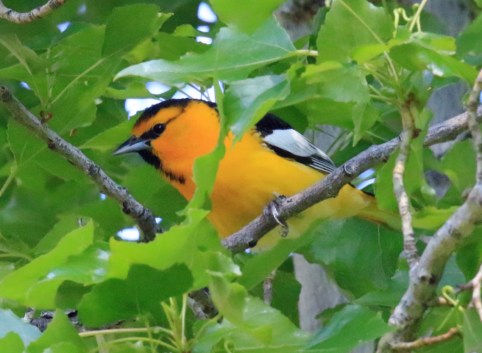
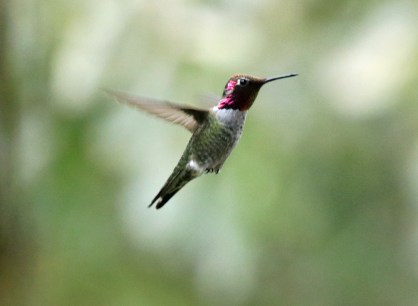
The birding goal is to do a “Big Month” – see how many birds I can see in one month in the State of Washington.  Since my undefined goals include several trips out of state during prime birding times, I have chosen the month of January and am pressing hard to maximize the number of species seen.  The most species I have ever seen in Washington in January was 154 – during a year where a goal was for a Big Year in the State so a month that had lots of birding.  I have birded every day so far this year and have been both driven and fortunate.  Earlier today I saw some Bohemian Waxwings that were found by David Poortinga in Marysville.  They were species 157 for the month.

Bohemian Waxwing – Marysville – January 10, 2018 – Species 157 for the Month

Bohemian Waxwing

I have  set the “minimally acceptable” target as 175 species.  One might think that already being at 157 makes that an easy “get”, but it gets harder to find new species each day.  I am traveling to Walla Walla later this week and we’ll see how I do.  With luck (and lots of help from Mike and MerryLynn Denny) I might be able to get to 170 or 172.  If so then 175 will be a given with some targeted additional trips elsewhere.  Research suggests that 200 species is at least a possibility – lots more travel and lots more luck.  If things go really well on the Walla Walla trip – I may press on and see if I can hit yet another goal with two zeroes.

The personal goal is far more important and when met will be far more rewarding.  At the end of last year I learned that my daughter and son-in-law are expecting their first child in late March.  All are healthy and everything looks good.  I have hoped for a grandchild for many years.  It is going to happen in 2018.  My goal is simply to hold him in my arms…

Closing Out the Year

2017 was a fun and productive birding year.  Goals I had set were somehow met and looking back on that will be the subject of my next blog post. I had expended a lot of energy in the California trip that I chronicled previously and per my previous blog post, Neah Bay delivered in December yet again with the completely unexpected Arctic Loon.  Maybe that should have been enough for the year.  In each of the previous five years, I was doing some kind of “Big Year” so December was a month of chases for “just one more”.  It was different this year, but after meeting my goals for three ABA Lists – life birds, life photos and year birds – there was still an allure to adding “more” if possible.  And while there was no chance to have a “really big” Big Year for Washington, the appearance in Washington of some rare birds like that Arctic Loon provided impetus to close strong by adding some new state birds for the year that might also add to my ABA total for the year.  Plus, any goals aside, they were cool birds.

The first “special bird” was a Blue Jay that was reported at an undisclosed private residence in Skagit County early in December.  I saw a report when I was still in California and hoped there would be a chance to look for it when I returned.  Blue Jays are pretty rare in Washington – usually one or two appear each year – usually somewhere in Eastern Washington and usually in December although I did see one at Palouse Falls State Park in October 2013.  I did not see one in 2016 and this one would be my first west of the Cascades.  It took a day after I returned to get some “inside information” that would let me give it a try and the following day I was there bright and early and found not only the Blue Jay but also a very fun property owner who it turned out welcomed birders to visit.  I gave friends some directions and in the following weeks would revisit several times with others – for most of whom the Blue Jay was a State Life bird.  As much as I enjoyed seeing this very beautiful rarity, the best part was the visit with the homeowner, Barry, and with other birders who came to see the Jay.  I would guess that more than 70 people have visited.

Blue Jay – Skagit County – December 7, 2017

Blue Jay (2)

The Arctic Loon in Neah Bay was the next special bird – no need to add more after my previous blog but I include the photo – well because it really was that special for me.

Arctic Loon – Neah Bay – December 18, 2017

Arctic Loon

On December 21 Ebird reported a Rose Breasted Grosbeak in a residential neighborhood near Greenlake in Seattle.  The report did not appear until too late to go look for it that day, but I was there very early the next morning.  Already there was Sarah Peden – who had helped me find the Arctic Loon in Neah Bay 4 days earlier.  Dave Slager soon joined us.  We met the home owner who had reported it – Max Kingsbury.  He had not seen it again that morning.  He was very engaging and very happy to have others looking for it at the feeder in his back yard.  It did not make an appearance while we were there – perhaps it would be another one-day wonder.  Max took our numbers and said he would let us know if it returned.  The only messages we got that day were that it had not returned – until a very late brief appearance – too late for us to return and try – but that was sufficient encouragement for a return the next morning – and Sarah returned as well.  Soon a few other people showed up.  We watched for maybe 45 minutes – another no show.  I volunteered to walk the neighborhood and see if was nearby.  About ten minutes after I left, it came to the feeder.  Sarah called and texted me BUT my phone had turned itself off and when I returned, everyone said – you just missed it.  AAARRGH!!!

After a while everyone left and I stayed hopeful.  Max’s wife, Melissa had come down and it was her sharp eyes that found the Grosbeak in a tree above the feeder.  Hard to see and not a great photo – but this was only the second time I had seen one in Washington.  The other last year – you guessed it – in Neah Bay.  That one was also coming to a feeder – at Butler’s Motel – but it was a less striking female.  This was a young male with some rose on its chest.  Not a gorgeous full breeding plumage male – but pretty nonetheless.

Rose Breasted Grosbeak – Greenlake Area – December 23, 2017

Rose Breasted Grosbeak

Dozens of people have visited the Kingsburys over the past 9 days to see this special visitor – a life bird or state life bird for many.  I have been back several times hoping for a better photo.  Today I got one.

Rose Breasted Grosbeak – Greenlake Area – January 1, 2018

RBGR1

There would be one more special bird to show up – a Gyrfalcon found near a runway at McChord Air Force Base south of Tacoma.  A Gyrfalcon had been reported the first week in December in the Samish/Skagit area first by Marv Breece and then at a different location later by one other birder.  I had searched for it alone and with others – unsuccessfully.  Nobody else had found it either.  Then the McChord report came and on Christmas Day in the snow, I visited the area and got a truly terrible distant view through the scope with snow falling.  I hoped it would stick around and I would have another chance – to try for a photo.  People were having mixed luck finding it but there were successes each day.  My daughter and son-in-law were visiting and when I took them to an early flight on the 28th, I had the opportunity to try again.  I waited 90 minutes until there was any light (it was a VERY early flight) and sure enough there it was perched on the northernmost telephone pole – which seems to be its favorite spot.  Very gray poor light but at least it was not snowing – so an ID quality photo.

Gyrfalcon – McChord AFB – December 28, 2017

Gyrfalcon

A trip to the Okanogan in north Central Washington is imperative for anyone doing a big year – or trying for certain species as it is the best place to find them – in winter.  Ideally a visit is in February but I had not made the pilgrimage in 2017.  It is a good area to find Gyrfalcons but I no longer “needed” that species.  It is also a great area for Snow Buntings, Snowy Owls and Common Redpolls.  I had seen the first two species at Sandy Point in Whatcom County in early November and Redpolls had shown up in many locations in King and Snohomish Counties and I had seen them at Greenlake and at the Everett Sewage Ponds.  Before those observations, I was definitely going to make a year end visit both to add some ABA Year birds – and stay over until January 1, 2018 to start the year with those species already in hand.  I planned to leave on the 29th and return on the first.  With the Gyrfalcon and Redpolls now seen, it was  less appealing,  but there were still some possibilities – Great Gray Owl, Gray Partridge, American Tree Sparrow, Gray Crowned Rosy Finch, Pine Grosbeak and Sharp Tailed Grouse.

Common Redpoll – Everett Sewage Ponds – December 22, 2017

Common Redpoll

A report from Bill Boyington on the 22nd had been pretty discouraging.  He found some Sharp Tailed Grouse but little else.  Good friends Jon and Kathleen Houghton had gone up the day before I planned to go – again not a great report although Jon Had found (finally!!) a Great Gray Owl at Havillah, some Pine Grosbeaks on Badger Mountain and some Partridge.  The problem was that there were very few birds and these were not reliable.  The feeders on Nealey Road were not active – a definite negative.

Weather for the 29th called for freezing rain.  I decided not to go.  Jon was returning on the 29th and before leaving he found a single flock of Rosy Finches at Molson.  He said the roads were ok.  So I decided to go figuring there was a decent chance of at least two new species and an outside chance at a couple more – and the Great Gray Owl was an always treasured find.  So I set off early on the 30th figuring I would stay two nights (it is a long way to go).

It was snowing on Stevens Pass but the roads were good and after that, it was actually a good bright day.  I found a few Pine Grosbeaks near where Jon had had them on Badger Mountain, but where his were close and on the road, mine were distant and in tall pines.  Still a new ABA and State species for the year.  I continued through the Waterville Plateau – usually a good area for Gray Partridge and always full of Horned Larks and Snow Buntings.  There were a couple hundred Horned Larks – far fewer than usual – and essentially nothing else.  Then on to to Bridgeport Hill Road – one of the best Sharp Tailed Grouse areas – nothing and then to the Okanogan with the first focus at Scotch Creek – where Bill had his Sharp Tailed Grouse and where I have found them often in the past – nothing.  And at the pasture area where Jon had had Partridge I had only California Quail, Ring Necked Pheasants and Black Billed Magpies.  There was snow – usually helpful – but perhaps not enough.  It also did not help that hunters with dogs were in the area and there were also numerous Rough Legged Hawks.  One was very photogenic – but I wanted the Grouse.

Rough Legged Hawk – Conconully Road – December 30, 2017

Rough Legged Hawk Wings Spread.jpg

It was then on to the Highlands and especially to Havillah looking for that Owl.  There were essentially NO birds anywhere in Highlands – possibly because it was VERY cold.  The lowest temperature was 8 degrees – snow on the ground – roads good but no birds.  I found a room at the Omak Inn but only made a reservation for a single night as it did not look promising to stay to start the new year.

Early the next morning I went back to the pasture and then to Scotch Creek.  Even more Quail and Pheasants but no Partridge.  Luck was better at Scotch Creek.  But it was very cold – 12 degrees.  A small flock of Sharp Tailed Grouse were in distant trees by the Creek between Happy Hill and Salmon Creek Roads.  It was very overcast and poor light so I elected to head into Conconully to see if there were Grosbeaks or other finches and then return hopefully to get some photos.  There were essentially NO birds in Conconully and when I got back to the Grouse spot, the Grouse had dispersed – somewhere out there – but not to be seen.  I opted to head up Happy Hill Road – another good Sharp Tailed area.  The first part of the road had been lightly plowed but in about a mile, the snow deepened.  I came around a bend and flushed a few Sharp Tailed Grouse but no time for a photo before they disappeared over a ridge.  After about 1.5 miles, the snow was a bit too deep and I turned back.  A photo would have been nice, but I was happy to have at least seen the Grouse.

Should I give the Highlands and especially Molson another try?  It was cold and despite the grouse, there just did not seem to be many birds around.  It was also a long way and I had made the decision not to stay another night – so it would add a few hours to the day.  I did not think there was sufficient reward.  I decided to try Cameron Lake Road on the way home and call it a day.  I took the Riverside Cutoff Road to get back to Omak and then head south.  A treat along the way was a Golden Eagle – often found in the area but by no means a sure thing.

Golden Eagle – Riverside Cutoff Road – December 31, 2017

Golden Eagle2

The main goal for Cameron Lake Road was a generally reliable spot for American Tree Sparrow.  Cameron Lake Road is a primitive road that parallels Highway 97 for about 15 miles.  I started at the north end and a few miles in a flock of 50+ Common Redpolls flew onto the road ahead of me.  Pretty skittish, but I got a few photos.

Common Redpolls – Cameron Lake Road – December 31, 2017

Common Redpolls.jpg

Common Redpoll1

Unfortunately the snow got too deep and I was worried about some trouble.  I had survival gear – but this road gets little or no traffic and if there was trouble it might require a long hike out.  So I back tracked and figured I would try the southern part of the road as that was closer to the Sparrow spot anyhow.

The southern section was also snowy but had some of the best birds of the trip as first there was a small mixed flock of Horned Larks and Snow Buntings and then a large flock of Snow Buntings joined them.

Snow Buntings – Cameron Lake Road – December 31, 2017

Snow Buntings

Just as the deep snow turned me back on the northern part of the Road, so it did on the southern end as well – no more than 4 miles in.  BUT – one more gift.  Another small flock flushed from the road.  I figured they were more Larks or Buntings but a decent look showed gray heads and rosy chests and butts – a small group of Gray Crowned Rosy Finches.  A quick look and then they were gone.  By far, the visit to Cameron Lake Road was the best part of the trip.  There was too much snow to reach the target zone for the Tree Sparrows but the three flocks were more than consolation prizes.

Roads were good but traffic was tough coming home and it is a long way.  I am not a New Year’s celebrant anyhow, but I crashed when I finally got home.  Not a terrific trip but still a good way to end the year – added three new State and ABA birds.  That made it seven State and six ABA year birds for the month of December (after California) – as I had had a Rose Breasted Grosbeak in Florida earlier in the year.

Goodbye 2017.  Hello 2018.  Thanks for the great experiences and memories – ready to start finding some more.


Crazy Like a Loon — or Like a Fox?

“Crazy as a Loon.” What is that all about?  The idiomatic phrase is readily found in literature (egads even in “Peyton Place”) and in general parlance.  Undoubtedly the phrase derives from the loon’s unmistakable wild call – compared to a madman’s ravings.  Which might suggest that the bird got its name from lunatic.  But the origin of that is from the Latin luna – moon – and the notion that people acted crazy under the influence of the full moon.  Actually the Loon got its name from lom – a Swedish word for someone who is clumsy – think “lummox. ”  The Loon is a brilliant swimmer and diver and in England Loons are called Divers.  Out of the water, however, it stumbles unbalanced on feet made for paddling and not for standing – a lummox for sure.

Combine stumbling behavior and eerie calls and I definitely understand “crazy”.  Maybe that adds a layer of appeal but moreso – especially in breeding plumage – their appeal to me is their striking beauty.  Yesterday, however, I was driven by a different appeal – the appeal of  getting a photo of one of only a dozen species I have seen in Washington that I had not photographed and definitely one that I never expected to remove from that list.  Pursuit of that quest was initiated by a Tweeters post by Joshua Glant, a talented young birder in the area, who was participating in his first Christmas Bird Count (“CBC”).  He was in Neah Bay, aka the “Land of Rarities” and he reported that Brad Waggoner, a VERY talented not all that young birder had found an Arctic Loon.

I had seen my first, last and only Arctic Loon at Port Gamble on October 22, 1973.  That was barely a month after I had moved to Seattle.  More than 44 years had passed and now there was a chance of seeing one.  There were three problems.  (1) Neah Bay is about 3 hours away. (2) It was not clear that there was a real photo opportunity as the bird seemed to be distant and maybe even heading further away.  (3) I was very tired – a month plus of imperfect sleep.  Was there really enough energy to even make a try.

As it turned out number (3) determined the matter.  Another troubled night and I was up before 4:00 – unable to return to sleep.  Being “crazier than a loon” I figured, what the heck – follow Rule 1 – go now.  If there was no energy to carry through, I would just pull over somewhere and … sleep?  I knew the drill – catch an early ferry in Edmonds – just over a mile from home.  Slog through the only route to get to Neah Bay.  Hope that storms had not closed roads and also hope not to get stuck behind one of those logging trucks on the very curvy roads past Port Angeles.  Get to Neah Bay and begin scanning the water.  Hope it was still there.

The bird had been seen from the Ba’adeh Village Loop – just east of town.  It was also reported later from “The Wedge” an area even further east – in the strait itself.  I had no idea how to get there.  I hit the restrooms in town (thank you, thank you for being there) and scanned the main bay/harbor.  Lots of loons but all were either Common Loons or Red Throated Loons.  They are all great birds, but I needed the one with the white flank patch – the Arctic Loon.

Red Throated Loon in the Harbor

Red Throated Loon

There are not great observation spots at Ba’adeh Village but I tried them all.  Not long after starting my scans I saw one loon in flight that seemed to fit the bill.  Smaller than a Common Loon – was it a Red Throated Loon? Especially in flight they seem to have very slender necks and this one was chunkier.  Was it a Pacific Loon or was that really a white patch on its flank – making it the prized Arctic Loon?  Although I was convinced that flank patch was real, the view was through the scope and far too brief before it disappeared heading west.  Definitely no picture – so the real objective was not met anyhow.  Just not sufficient data to be sure – so I determined not to count it.  I saw two Pacific Loons – definitely no flank patches – more Common Loons and Red Throated Loons and that was all.

Common Loon (in the Harbor)

Common Loon1

I spent the next several hours trying to figure out how to get to The Wedge (and not doing so) returning to the town and scanning the harbor and bay from numerous vantage points and then visiting other spots in the area looking for Pine Grosbeaks, which had also been reported on the CBC.  I found no Pine Grosbeaks and my best bird was a Ruffed Grouse that I flushed coming down from Bahokas Peak.  I had seen one there in years past but more often find Sooty Grouse.

I had one more card to play.  I had not yet visited the jetty and to scan the bay from there.  It was now after noon.  Somehow I was still awake.  Maybe it was the caffeine from the coffee and my Mountain Dew.  The area at the base of the jetty and along Boom Road to get there had been incredible birding spots in the past.  Rarities seen have included Rustic Bunting, Horned Puffin, Red Phalaropes, and Dusky Capped Flycatcher – an unbelievable list.  Was there one more in the offing?

As I rounded the corner onto the jetty itself I saw first a parked car and then a birder with scope – a familiar one.  As I drove past Sarah Peden, she said: “You may want to get your camera and your scope.”  “Why is that?” I asked.  “There’s an Arctic Loon here.”  Was it really going to be that easy?  YES!! YES!! YES!!  I ignored the scope but was immediately ready with the camera.  I grabbed a quick look through Sarah’s scope more to pinpoint the location than to actually get a view and then took a picture.  Now no matter what else, and as it turned out there was a lot “else”, I would have that never expected, long awaited photo of an Arctic Loon – in Washington.  If that had been the only photo, it would have been a great day, but there would be many more.  Sarah said earlier it had been very close but it was now further out – just in front of Boom Road 200+ yards away.  After a few more record shots I walked the Beach and got within less than 40 yards and in much better if not great light got very nice photos.

Arctic Loon

Arctic Loon 2

Arctic Loon

The bird seemed very comfortable in this location and over the next 45+ minutes we watched the Arctic Loon forage and feed continuously including coming back towards us on the jetty.  The energy boost was palpable and significant.  There is a “low” from missing a chased bird but it is far less than the “high” that comes with finding one – some more than others and this one was way up on my “want” list.  With a very limited data base – one observation – I had not expected the white flank field mark to be so obvious.  I had also not expected to see an Arctic Loon as close to breeding plumage.  The neck markings indicated either molting away from breeding plumage or molting towards it. A distant photo may not have shown the neck stripes but my good fortune captured them – a bonus.

I would like to think that I would have found the Arctic Loon at that spot on my own.  The field marks and view were very clear and especially if it had swum back towards the jetty as it did, it would have been hard (and inexcusable) to miss.  But that is a question I don’t have to answer.  Sarah is an outstanding birder and it was wonderful to have her on the bird – a Christmas gift a week early.  Thank you Sarah!!

Had I not gotten the Arctic Loon photo it would probably would have been appropriate to say I had been “crazy as a loon”.  There is another crazy animal idiom though that now seemed a better fit – “crazy as a fox” .  The meaning of that one is “seemingly foolish but actually very shrewd”.   Probably a little bit of both – comes with the territory.  The adrenaline hit lasted just long enough to get back to the ferry.  I dozed on the crossing and then slept very well last night.  Definitely would rather be thought of as “foxy” as opposed to “loony”.

BONUS COVERAGE

Having seen Common, Pacific, Red Throated and Arctic Loons at Neah Bay, I wondered if the Yellow Billed Loon that had been reported there earlier had been seen again.  Sarah said “no” and that the report may not have been accepted as well.  I knew that Bruce LaBar’s Sequim CBC boat was out that day.  It always finds Yellow Billed Loons.  I expected that some of the folks who had done the Neah Bay CBC the preceding day and had seen the Arctic Loon might be on that trip.  It turned out that Charlie and Linnaea Wright were the only ones who were and indeed they had seen a Yellow Billed Loon – giving them all five loons in a two day period.  Bruce speculated that they may be the only two people who had ever seen all five loon species in a two day period.  Quite an accomplishment.

But…I got thinking about that.  On my visit to Nome, Alaska in June last year, I knew I had seen Yellow Billed, Red Throated and Pacific Loons and that we had missed an Arctic Loon that was seen by others.  I could not recall if we had seen a Common Loon and did not even know if they are found there.  I checked my records and found no Common Loon.  Great shots of the others though.

Yellow Billed Loon in Nome

Yellow Billed Loon

Red Throated Loon in Nome

Red Throated Loon

Pacific Loon in Nome

Pacific Loon

And I found that although uncommon, there are Common Loons in Nome (is it called the Uncommon Loon there?), so yes there was the chance for all five loons in one day.  But chances don’t count; only experiences do and yep I found that someone else had the experience of seeing all five loons in Nome on the same day.  On June 5th last year, Liam Singh, a young birder I know from Victoria, B.C.  had all five.  Oh yeah – pretty great Liam – but I bet that Charlie and Linnaea probably are the only ones who have all five species in two days IN WASHINGTON!!

Those really are awesome accomplishments – and fabulous birds.  I will settle for a photo of an Arctic Loon in Washington – happily…


California Day 7 – Some Last Shots and Summing Up

It had been a long and wonderful week.  Admittedly I was pretty tired and running out of targeted species coincided without running out of energy – well almost – for both.  I had gotten a mediocre photo of a California Gnatcatcher and really wanted a better one.  There was enough gas in the tank – both the car’s and mine for one more try.  I made it to the San Elijo Lagoon in yet another day of warm, bright sunshine.  The habitat looked great for gnatcatchers – probably both Blue Gray and California.  I just wanted that one photo.

During my past attempts to find and photograph the California Gnatcatcher I had become quite familiar with its “zeer” calls.  I had heard it more than once and had used it to locate the birds I had photographed at Lake Hodges.  As I walked down the trail towards the lagoon I played the “zeer” calls on my phone and very quickly saw a small bird fly into some dense brush just ahead.  It began calling back – no mistaking the calls.  This was a California Gnatcatcher, but I had been here before – the Gnatcatchers can be “there” but almost invisible.  This time I was lucky.

Continuing to call, the California Gnatcatcher popped out into the open in perfect light.  I got my photos.  The first shows the Gnatcatcher singing and the second shows the very distinct eye ring and black eye brow.  The third photo shows the black tail with thin outer tail feathers that are white.

California Gnatcatcher Calling

California Gnatcatcher 3

California Gnatcatcher Close Up

California Gnatcatcher close

California Gnatcatcher – Black Tail with White Outer Feathers

California Gnatcatcher Tail

Mission accomplished but I really liked this area and continued birding.  It was a birdy place and the light really was great.  There would be more good photos to come.  As I walked the trail I repeated heard the “zee chuppity-chup” call/buzz of an Allen’s Hummingbird.  I saw one displaying and then landing on an open branch – a male brilliant in the light.

Allen’s Hummingbird

Allen's Hummingbird 6

Allen's Hummingbird 4

As is often the case in this area, there were also Anna’s Hummingbirds and one was also very photogenic.

Anna’s Hummingbird

Anna's Hummingbird 2

Fortunately at this time of year Rufous Hummingbirds are gone, so no confusion with the Allen’s although the call would have avoided that issue as well.  The most abundant birds were the sparrows Savannah (14), White Crowned (30), and Song (6) and also California Towhee (10).

California Towhee

California Towhee

When we are out birding we are open to experiences as they come our way – sometimes it is the bird we are looking for; sometimes it is a great person; sometimes it is another bird – unexpected perhaps.  As I neared the Lagoon a Northern Harrier swooped by and landed on a fence post just ahead.  I often see shorebirds standing on just one leg, but this was the first time I had seen a raptor do so unless it was holding prey in the other.  It held its left leg out almost as if it were injured.  Interesting photo.

Northern Harrier

Northern Harrier

I retraced steps and headed to the other end of the lagoon.  Along the way I met another birder – a local who birds the area often.  When he learned I was from out of the area, he wanted to be sure that I saw everything that was there and went through the list of what he had seen earlier.  I had seen all of them except for the California Thrasher.  He told me where he had seen it and not too far from there, I found it there as well.

California Thrasher

California Thrasher 3

As I left I heard a Ridgway’s Rail calling – no visual and no photos this time.  I was done.

Whenever I visit San Diego I always try to swing by the La Jolla Cove.  A gorgeous spot often with birds close by on the rocky outcroppings.  I had enjoyed visiting there with Lynette in February.  That seemed like ages ago and I was reminded of how all that had changed – sometimes things just don’t go like we would want.  With birds as opposed to people, however, it is easier sometimes to have a Plan B – another try to find what we want.  As I said in that first post, getting away from personal matters was one of the motivations to take this trip.  On the many long drives, there had certainly been many opportunities to re-examine the past and to look to the future.

La Jolla Cove

La Jolla Cove

The trip had been therapeutic – helping ease some of the pain and disappointment – and more importantly reminding me of some of the things that are important to me being true to myself – being in nature, looking for and watching birds – the special targeted ones and the others as well – relating to people with shared interests and shared perspectives – recognizing both the potential to change and adapt but also the very real limits to how much that could be done.  It had been a wonderful week.  I was ready to go home…

Summing it All Up

7 days – 6 hotel rooms – 1500 miles – Mexican, Asian, Greek, Italian and American food – more coffee than tea.  Forests, mountains, deserts, islands, oceans, lakes.

152 species – 8 ABA Life Birds – 11 ABA Life Photos (and two more that were for sure when previous ones had some ambiguity) – 13 ABA Year birds

Life Birds:   Red Footed Booby, Bell’s Sparrow, California Condor, Garganey, Black Vented Shearwater, Island Scrub-Jay, Red Crowned Parrot and Rufous Backed Robin

Life Photos:  All of the Life Birds except the Bell’s Sparrow plus Yellow Billed Magpie, California Gnatcatcher, Scaly Breasted Munia, Ridgway’s Rail plus definite photos of Costa’s and Allen’s Hummingbirds

Those additions brought my Life List to 702 ABA, my Life Photo List to 639 and my ABA Year List to 527

I had been in 10 Counties

The lowest temperature was in the high thirties and the highest temperature was 85.  No rain, very little wind and sun, sun, sun.

I had met truly wonderful people and seen truly spectacular places.

On the last two days I was there, the Santa Ana winds had arrived – with wind velocities in excess of 75 mph.  They had brought devastating and death causing fires to areas I had visited two days earlier.  The only effect on me was that the flight home got very bumpy as we moved up the coast by Orange and Los Angeles counties.

I had some notable misses: the Groove Billed Ani and Nazca Booby departed before I arrived (although the Nazca Booby returned at least for a day five days after I departed).  There was no Yellow Footed Gull and I failed to find a LeConte’s Thrasher or Lawrence’s Goldfinch.  I failed to get a photo of a Bell’s Sparrow.  There are always misses and I will try again sometime.

If there had been nothing more than the magical moment with three California Condors flying overhead, it still would have been a fantastic and successful trip.  But oh yeah – there had been much more…

Condor Tag4a


California Day 6 – A Very Full and Birdy Day Around San Diego

Another early morning start and I was at Lake Murray in La Mesa.  This was purportedly a good spot for Scaly Breasted Munias, an introduced species from the Waxbill family that was formerly known as the Nutmeg Mannikin.  I had first seen this species in its natural habitat at the Mai Po Nature Preserve outside of Hong Kong on Christmas Day 1979.  I also saw them on the Cairns Esplanade in Australia in 2003, in South Delhi, India in 2011 and also  a half dozen in Hawaii in 2011 where they are non-native.  I had seen my only one in the ABA Area on my previous trip to the San Diego area in reeds across a channel ditch at Tecolote Park in February.  I wanted a better ABA look and a photo.

I found lots of birds at Lake Murray including a somewhat late Spotted Sandpiper and a gorgeous Nuttall’s Woodpecker (which I had also seen on that previous trip to Tecolote Park) but no Munias.

Spotted Sandpiper

Spotted Sandpiper

Nuttall’s Woodpecker

Nuttall's Woodpecker2

I was also on the lookout for Lawrence’s Goldfinches.  There were many candidates but despite my best efforts to turn them into something else, they were all Lesser Goldfinches.  I had counted on this spot for the Munia photo but there was a Plan B and I headed off to Santee Lakes – highly recommended by Melissa Hafting and a good spot per Ebird.  It was less than 8 miles away.  I was there just after 9:00 a.m. and as had been the case on some other occasions on this trip, I was surprised to find it as large as it was.  Where would those Munias be?  After driving and walking around for about 30 minutes and finding lots of ducks but no Munias, I called Melissa in Canada for more specific help.  “Try in the tall grass out near lakes 5 and 6.”  I had covered that area once but now went back in earnest.

For another 30 minutes – no Munias.  It wasn’t sufficiently special to be considered a consolation prize and I had not yet given up, but I got a great photo of the inaptly named Ring Necked Duck – a new species for the trip and plentiful here.  In addition to it being a close up in good light, what made this a memorable photo is that it actually shows the ring around the neck.  You can always see the ring around the bill, and it should be named “Ring Billed Duck” but the neck ring is usually not visible.

Ring Necked Duck

Ring Necked Duck.jpg

I made another loop around Lake 5 by car and was about to unhappily give up on my desired Munia photo.  There was one more stand of tall reeds to explore (again) and as I approached I could see some birds twittering about.  They were a half dozen Starlings – are you kidding!!??  But then the Starlings flew off and there was still movement and my sought after Scaly Breasted Munias came out into the open for some long awaited photos. Finally I could check it off of my ABA Missing Photos list.

Scaly Breasted Munia Male

Scaly Breasted Munia Male

Scaly Breasted Munia Female

Scaly Breasted Munia Female

Time to move on.  I texted Mel about the success.  On the way out a flash of yellow flew in front of me and perched on a wire.  At first my brain said Tropical Kingbird but then I remembered where I was and Cassin’s Kingbirds are common here.  The light was great for a photo.

Cassin’s Kingbird

Cassin's Kingbird 1

In addition to it being a good photo, I add this picture here as a means of bringing up some ornithological history.  The Cassin’s Kingbird gets it name from John Cassin a talented ornithologist and taxonomist from Philadelphia in the first half of the 19th Century.  Many of our birds are named after famous ornithologists, naturalists or illustrators such as John James Audubon (Audubon’s Oriole and Audubon’s Shearwater), John Graham Bell who accompanied Audubon (Bell’s Vireo and Bell’s Sparrow), William John Swainson – a British illustrator/lithographer (Swainson’s Hawk, Swainson’s Thrush and Swainson’s Warbler plus many others throughout the world) and John Kirk Townsend a naturalist/collector also in the first half of the 19th century (Townsend’s Warbler, Townsend’s Solitaire and possibly the Townsend’s Storm Petrel recently split from Leach’s Storm Petrel).  There are many others with a single ABA species bearing their name, but I believe John Cassin wins the eponymous bird lottery with 5 species:  Cassin’s Vireo, Cassin’s Sparrow, Cassin’s Finch and Cassin’s Auklet in addition to this Cassin’s Kingbird.  I have seen all of the Cassin species this year.  The Kingbird is certainly the most colorful.

Now back to birding…

Another species that was on my list from my earlier trip to San Diego this year was the Ridgway’s Rail.  I had heard one at the Tijuana Slough NWR but not seen or photographed it.  This rail used to con-specific with the Clapper Rail but was split off in 2014 thus giving me an additional ABA species as I had first observed these rails in California at the beginning of my birding life in the 1970’s and had first seen the “true” Clapper Rail in Maryland in 1975.  I did not have photos of any of these species or of the closely related King Rail – also seen in Maryland in 1975.  So with timing good for a high tide (the best time to see all rails) and the added bonus of some Nelson’s Sparrows being reported there, I headed back to the Tijuana Slough hoping for both.  I had photos of the Nelson’s Sparrow from Maine but it would be a new ABA bird for the year.

My first blog post about this trip which focused on the great people intersections I had told the story of how I met another birder at the Slough, Shirley Reynolds, and how she kindly retraced her steps and guided me to the spot where she had had the Nelson’s Sparrows and a Ridgway’s Rail and how we refound and got photos of both.  I later learned that Mel Senac (see my earlier Rufous Backed Robin story where I met Mel) had helped Shirley get on the Sparrows – so the chain of connection was even better.  It was not the greatest photo, but any photo of a rail is a victory as they are often stealthy and buried in the reeds.  It was an ABA Life Photo so I was very happy.

Ridgway’s Rail

Ridgway's Rail1

Since I was in the area I moved down to Dairy Mart Road where a Green Tailed Towhee had been reported – not needed for any of my “lists” it is just a cool bird and I remembered the location from a visit many years ago.  I did not find the Towhee but saw my only Common Gallinule for the trip.  After a quick lunch I headed to a Hooded Warbler Stakeout at Ruette le Parc in Del Mar about 30 miles away.  I also told this story in my first “People Post”.  No success in finding the Hooded Warbler which again would only have been a new bird for the year but a wonderful time visiting with Dave Trissel one of the fine people I met on the trip.

It was getting dark and I decided to call it a day.  I would be leaving the next day but could bird until around 2:00 p.m if I wished.  There really were no new targets but I wanted a better photo of a California Gnatcatcher.  Melissa had recommended the San Elijo Lagoon in Encinitas – seconded by Dave Trissel so I found a hotel nearby and called it a day – a very good day since I had finally gotten photos of the Scaly Breasted Munia and the Ridgway’s Rail.

New ABA Life Birds:  None

New ABA Photos:  Scaly Breasted Munia and Ridgway’s Rail

NEW ABA Year Birds:   Same plus Nelson’s Sparrow

The  trip list total was now at 147.