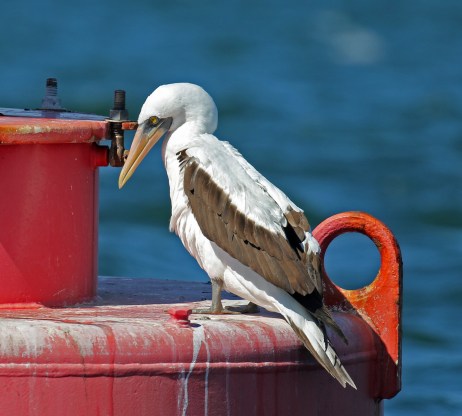
The Booby in the Bay

The Nazca Booby is a species that until mid-November last year had been found only in the Eastern Pacific Ocean – primarily in the Galapagos Islands.  Then one showed up offshore in Southern California.  It was on my “maybe list” on my California trip in late November and early December in 2017 but it had departed a day before I got to the area.  Oh well.

But then the week after I left San Diego two of these mega rarities showed up in San Diego Bay – possibly having hitched a ride on a banana boat.  As tempting as it was, I just could not justify a return trip to where I had just been.  But the Boobies kept being seen – every day.  After my Big Month in Washington in January, I thought about a trip but only if there was a chance for some other “target birds”.  A Red Throated Pipit had been seen just south of San Diego in January and that definitely qualified as a second Lifer – justification for a trip.  BUT…then it seemed to have disappeared.  So I went to Arizona for 4 days instead.  No complaints but no Boobies either.

Then three things occurred that made it impossible for me to resist going after all.  First, seemingly out of the blue, Edmonds birding friend Ann Marie Wood made a one day trip south and got the Booby.  Second, B.C. birding friend Melissa Hafting made the same trip (coincidentally on the same day) and also got the Booby (as well as a photo of a Greater Pewee – one I needed for my ABA Photo list) and third – the Pipit was refound and being seen sporadically.  I cashed in some miles on Alaska Airlines and headed south very early on February 28.  It turned out that another birding friend, Doug Schurman from Seattle, was going to be in San Diego the same time and we coordinated renting a boat to get out close to the Booby in the Bay, the same approach used by Ann Marie and Melissa.

Since Doug could not go for the Booby until March 1st, I first headed to Black Canyon Road just east of Ramona, California – less than 30 miles east of San Diego.  The goal was to finally get an ABA first photo of a Bell’s Sparrow.  Nancy Christenson, a star birder in the area, had given superb directions on the San Diego birding listserv to three spots along that road where the sparrows were regular and she had had many with photos the previous week.  Her instructions should be the template for directions for all to use – precise down to road signs and distances within tenths of a mile.  I found all of the spots easily but alas found maybe a single Bell’s Sparrow, and as had been my experience on the only other occasion where I searched for one, I could not get it out in the open.  It was a beautiful area – very birdy but no Bell’s Sparrow photo.  Not a great start.

I birded without specific focus on the way back towards San Diego and stopped at Santee Lakes where I had finally gotten a photo of Scaly Breasted Munias last year.  A decent smattering of birds including some hide and seek Munias.  The “best” birds were a White Throated Swift and a Vaux’s Swift, both First of Year for me and the latter pretty early there.  The best photos were of a Snowy Egret and a female Wood Duck not as showy as her mate but a very striking bird.

Snowy Egret

Snowy Egret

Female Wood Duck

Wood Duck Female

My hotel for the night was in Chula Vista – not too far from the Tijuana Slough NWR so I headed there next going the long route through Coronado to check out where we would get our boat the next day – definitely a high rent district.  It was very slow at the NWR and starting to lose light.  It had not been a great day and I needed a boost.  One came in the form of a pair of Ridgway’s Rails that came out into the open in one of the channels.  I got my first ABA photo of one here last December.  These photos were MUCH better!!

Ridgway’s Rail

ridgways-rail.jpg

Ridgway's Rail7

Maybe this is what was needed to turn things around – just in time for chasing the Booby in the Bay the next day.

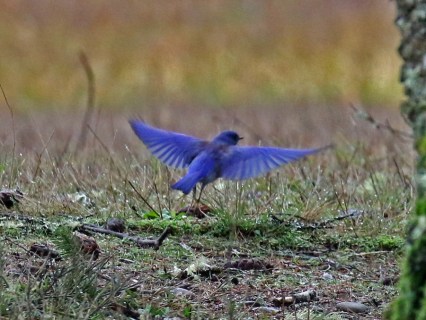
The Greater Pewee was being seen fairly regularly in Balboa Park.  Mel Senac, who I met last year at the Rufous Backed Robin stakeout had advised that the best time to try for it was before (;30 a.m. or in the late afternoon.  Doug could not try for the Nazca Booby until noon so I fought the morning traffic and got to Balboa Park a little after 8:00.  I had very specific instructions from Melissa – necessary as it is a very big park.  It took a while to find parking but I made it to the target area near the restrooms at the intersection of Juniper and Balboa being met by a Western Bluebird – one of many – hopefully that was an omen.

Balboa Park Bluebird

I searched every tree and tried all of the calls and songs I could find.  The place was overrun by Yellow Rumped Warblers, hyperactive Anna’s Hummingbirds and numerous California Towhees in addition to two very vocal Black Phoebes but I could not find the Pewee.  I was getting down.  Then I remembered that in addition to her description of trees and landmarks, Melissa had included very precise GPS coordinates.  What the heck.  I entered them in my phone and went to the exact spot – literally only 100 feet from where I had been.  I played the Greater Pewee’s call note and had a response.  I played again and it flew into a tree right next to me.   I had mistakenly thought I got a photo of this species in Arizona last year (where it belongs) so this was a welcome new ABA photo and just maybe my luck had turned after all.

Greater Pewee

Greater Pewee1

There was plenty of time before our boat ride and I was now batting .500 with a Pewee but not a Bell’s Sparrow.  I figured I would likely keep that average with a failed try for the Red Throated Pipit and success with the Booby.  Time to see.  I headed over to Berry Park .  The Park itself has a big grassy field and is immediately next to a school also with a big grassy play field.  The Red Throated Pipit had been reported on both but almost always only if the “flock of American Pipits” was there.  The advice was to not even bother if the flock was not present.

When I arrived it was immediately clear that there were no Pipits on the grass at the park.  Again lots of Yellow Rumped Warblers and some Western Bluebirds.  There also were some White Crowned Sparrows on the grass but nothing else.  I turned my attention to the play field (which was behind a chain link fence without any access).  Nothing at first, but then I saw one and then another and another bird in the grass.  They were Pipits.  The field was big – larger than a football field and the birds were scattered over the entire area. Would one of them be the prize?

I kept finding more and more birds – at least 24 and probably more.  The trouble was that many were quite distant and the grass was relatively thick and pipit-colored.  There were a couple of sandy areas, but the Pipits stayed in the grass.  I did not have a scope so I relied on my binoculars and relatively good light.  I was looking for a bird with streaking on the back, relatively bold streaking on the chest and pinkish legs.  One after another of the birds had plain brown, unstreaked backs.  Then one bird looked different.  It was facing me and looked somehow paler and with a more distinct facial pattern.  It was in the grass – not on the dirt so I struggled to make out its leg color.  Then it briefly turned and came a bit more in the open.  The back was STREAKED and the legs were PINKISH.  This was the Red Throated Pipit (a new ABA Bird)!!  No more than two minutes afterwards, a bell rang and kids started pouring onto the play field, one by one and then altogether, the birds left.  I had been there no more than 12 minutes before finding the target and fortunately grabbing a photo.

Red Throated Pipit

RTPI

I wish there had been more time, but I could not believe my luck.  First that it was there, second that I found it and lastly that at least the kids did not arrive until after I did.  There were also some fun moments ahead.  One of the teachers came over and we talked about the Pipit.  I was so excited I kept calling it a Sprague’s Pipit (which I had missed in Arizona) but fortunately caught the mistake.  She was only vaguely aware of its presence after having seen dozens of birders with big cameras and scopes in the Park over the past couple of months.  I showed her some photos.  Shortly thereafter a large dark falcon swept over the field.  Three boys had seen it and noting me with a camera and binoculars came over to inquire what they had seen.  It was a Peregrine Falcon.  The kids were great – really interested as I described the difference between hawks and falcons – bombers versus fighter jets.  Each then told me a favorite bird story.  Very cool!!

I then spent a few minutes birding the small park itself.  A Red Shouldered Hawk posted briefly an a light standard.  A few minutes later I saw a bird on another standard seemingly fly catching but looking as if it was throwing the bug up and catching it again and again.  It turned out to be a Cassin’s Kingbird and instead of a bug, it was a large berry (after all it was Berry Park!).  Maybe it was trying to position the berry to swallow it, but it was still working on it when I left.

Red Shouldered Hawk

Red Shouldered Hawk1

Cassin’s Kingbird with Berry

Cassin's Kingbird Tossing Berry  Cassin's Kingbird with Berry1

Planning the trip, I had figured the odds were 90% for the Bell’s Sparrow, 80% for the Greater Pewee, 95% for the Nazca Booby and 10% for the Red Throated Pipit.  I was way off on two of them and hoping I was right for the biggest prize of all.  It was close to the time to see.

First I headed to the South End of Seacoast drive where a Reddish Egret had been seen and where odds were good to find a Little Blue Heron.  I found the latter but could not locate the former.  I also swung by a roost tree near the Tijuana Slough NWR where I had seen some night herons the night before.  I had been told they were Yellow Crowned but in the poor light it was impossible to tell.  The good news was that they were now quite visible and the bad news was that they were Black Crowned Night Herons which we have in Washington and not Yellow Crowned Night Herons which we do not.

Little Blue Heron

Little Blue Heron

Black Crowned Night Heron

Black Crowned Night Heron

Now it was time to head onto Coronado and go Booby watching.  But along the way there was a surprise – an American Flamingo was foraging in the South end of the Bay.  I had heard about an American Flamingo in Imperial Beach last month.  It was originally thought to be an escapee from one of the hotels or the zoo but such was found not to be the case.  It just flew in and has stayed to the delight of many.  See the local news story. http://www.sandiegouniontribune.com/communities/south-county/sd-se-flamingo-folo-20180221-story.html.  I doubt that it is “for real” and countable.  But just in case it is, I took a photo.

American Flamingo
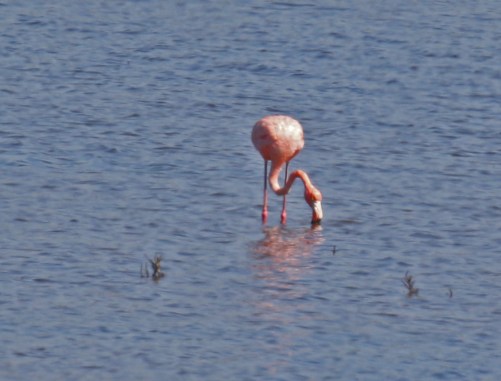
American Flamingo 1

I met Doug at the Marina at Loew’s Coronado Bay Resort – a very posh place.  Another birder was out with “our boat” so we waited.  When he was running quite late, we were upgraded to a larger boat, given safety and operation instructions and then headed out with one of the marina guys who would turn it over to us once he was confident we knew what we were doing.  The other birder was coming in as we rounded the marina so we waited and got word from him.  The good news is that he had seen both Boobies.  The bad news is that one had flown off and the other had left its perch on Buoy 34 – its regular hangout spot.  From the sounds of his story, we believed he may have flushed the birds.  We were a bit concerned.

Leaving the Marina

Leaving the Marina

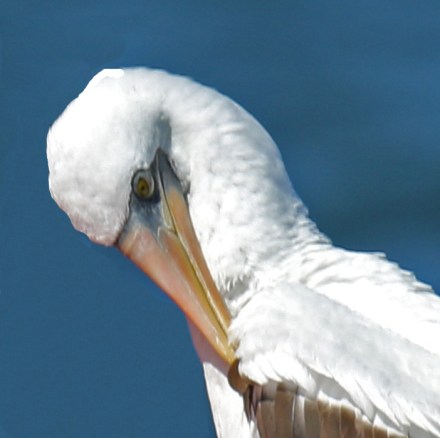
Our fears were at least partially for naught.  There was no Booby on Buoy 34,  But thankfully there was one Nazca Booby on Buoy 36.  We don’t know where the other one went and believe me we looked everywhere.  More than 600 birders have come from all over the U.S. to see the Boobies.  They can be seen from land but only with a scope and even then at quite a distance.  The boat is definitely the way to go and this bird was seemingly unconcerned with our presence.  We circled many times and drifted within maybe 100 feet without any reaction.  Doug is a phenomenal photographer.  I take pictures.  But with this cooperative bird and great light even with a rocking boat some of my more than 250 plus photos came out ok.  A Nazca Booby – ABA Life Bird and photo. Wow!!

The Booby in the Bay – Nazca Booby

Nazca Booby7

Nazca Booby Vertical

Nasca Booby Best

Nazca Booby Headr

This had been quite a day –  three targets and three hits plus that crazy Flamingo.  It was only 1:30 – now what?  I checked out some shorebirds right in front of where I had parked at the Resort and added a pair of Short Billed Dowitchers to my trip and year list.  This is probably my biggest regret for the trip.  I had forgotten about a Thick Billed Kingbird and Scissor Tailed Flycatcher that had been reported from Poggi Creek – literally a stones throw from the hotel I had stayed in the previous night.  I should have headed there to try for these two very nice birds.  But as I said – I forgot.  Maybe it was the sleep deprivation from the very early trip down.  Instead I decided I would try again for the Bell’s Sparrows the next day.  I made a hotel reservation in Ramona and then headed to La Jolla – a beautiful and favorite spot.  I thought there might be a chance to see some Black Vented Shearwaters and Heerman’s Gulls.  I found neither but enjoyed the beautiful place and as always the close up look at nesting Brandt’s Cormorants on the cliffs just below the path.

Brandt’s Cormorant

Brandt's Cormorant2

I headed East to Ramona before traffic got too bad.  I celebrated the day’s success breaking my diet with some barbecued ribs and tried for some sleep.  For such a small town, there sure is a lot of noisy traffic heading through.  So by the next morning I was still feeling pretty tired.  I needed some good birds for an adrenaline rush.  And that story is for my next Blog Post.
After A Big Month and Arizona, Now What

Whether in my birding or in other pursuits, I seem to do best with a project tied to a target – a goal.  After the very intense full month of birding in Washington in January and then my Arizona blitz, I had no projects or goals in mind for February – or at least none related to birds.  This was to be a month of catching up and most importantly of significantly increasing efforts to lose some weight and get into better shape.

So far so good and my crazy concoctions of various fruits, power greens, yogurt, coconut milk and cottage cheese and or yogurt continue to taste good and are satisfying.  No sweets, no fats; seafood and lean turkey or chicken only – high fiber cereal and that’s about it.  The goal is to get back to my college era weight and much less body fat and more muscle tone.  Trying this at 70 is a whole lot different than doing so at 20 or even 40 or 60, but I think it will work – even if it takes longer than I would like.

And birding continues.  Looking for some of the species missed in January, being out with friends, just getting out.  On February 11th, I finally found a species that had eluded me on multiple tries in January when I found a flock of 40 American Pipits on Boe Road.  I spent more time looking for them and the Fir Island Gyrfalcon than for any other species in January.  Just finally was in the right place at the right time.  Wish even one had been found earlier.

American Pipit

American Pipit 1

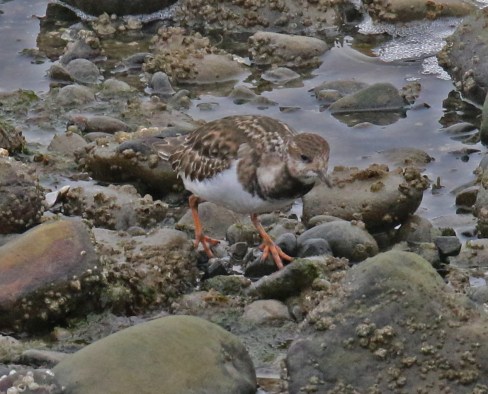
A few days later Ann Marie Wood, Steve Pink  and I successfully chased the Ruddy Turnstone that Maxine Reid had found at Tulalip Bay.  They are uncommon in the winter and are most likely to be found at the Coast or perhaps on Ediz Hook in Port Angeles – very rare in Snohomish County.  I had not specifically looked for one in January although I had considered a trip to Ediz Hook.

Ruddy Turnstone

Ruddy Turnstone

A bird I had missed in January was a Ruffed Grouse.  Others had seen some in the Okanogan but I had not.  David Poortinga told me of a good spot where he had had some in January – The Beaver Lake Trailhead off the Mountain Loop Highway southeast of Darrington.  I decided to go on the spur of the moment one morning.  I should have done a better job looking at the weather.  There was quite a bit of snow on the roads and even more on the trail and it was cold.  The trail ran along the Sauk River and with snow on the ground and dusting the trees and the river running clear, it was beautiful.  Didn’t need any birds, it was great to be out.  Nobody else around – very peaceful.  Unfortunately there had been a lot of damage to and along the trail since David had been there (without any snow).  There were a number of downed trees and in several spots the bank was eroding and the trail was actually falling into the river.  I had to turn back before reaching the end of the trail – impassable and dangerous.

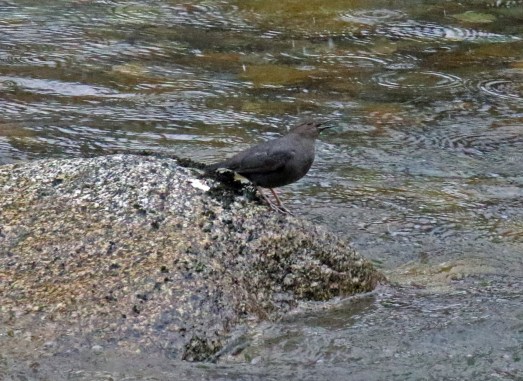
I found exactly three birds on the two mile hike – a Steller’s Jay, an American Dipper and a single Ruffed Grouse.  The Grouse flushed (as expected) so no photo.  As I was hiking and noting the free flowing Sauk River running clear and strong, I had thought there must be a Dipper somewhere.  Not long after seeing the Grouse and just before coming to a seriously eroded spot, I heard a bird singing seemingly from across the river.  At first I thought it might be a Pacific Wren and then I remembered that Dippers sing.  Sure enough, there it was on a rock in the middle of the stream.  I had seen one in Sequim in January but had not gotten a photo.  This one was fairly distant and it was very gray (with some snow still falling) but it was nice to get a photo – even if mediocre at best.

American Dipper – Singing

American Dipper

On the way back, I drove through the town of Darrington, hoping for some Crossbills or Redpolls or better yet for Bohemian Waxwings or a Pine Grosbeak.  I settled for a small flock of Evening Grosbeaks.  I had seen this species earlier in Walla Walla, but they are such striking birds – especially on a gray day.

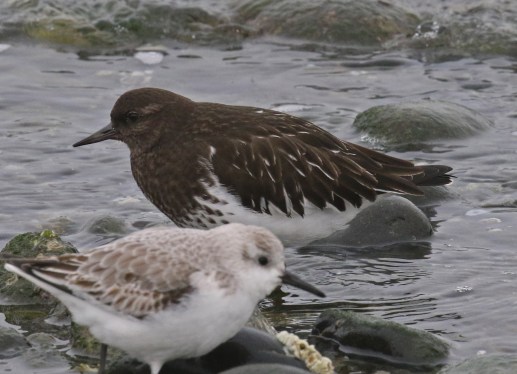
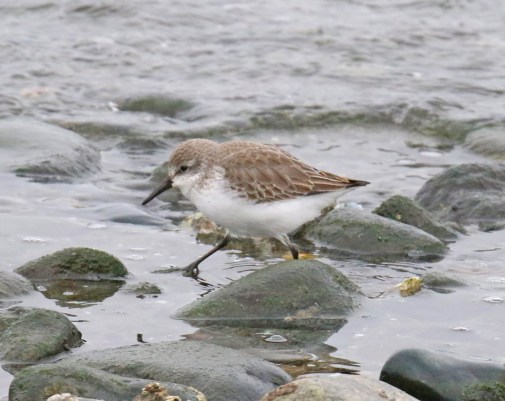
One bird I had simply forgotten to look for in January was a Red Knot.  One had been seen fairly regularly at the spit at Fort Flagler.  Hoping that it was still, there David Poortinga and I went off to look for it on February 20th.  We stopped first to look for the Spotted Sandpiper that was being reported at the Shine Tidelands.  This was probably a mistake.  Not only did we not find the Spotted Sandpiper but it also meant losing 20 minutes before getting to Fort Flagler.  The problem was that the tide was going out and the chances of finding the Knot would be best at a high tide.  When we got to the spit we found lots of shorebirds – Dunlin, Black Turnstones, Sanderlings, and Black Bellied Plovers but no Knot.  But the birds began flying off just as we arrived and continued to do so while we were there.  It was as if there was some magic signal that said – time to leave as the tide hit a certain level.  We believed that we would have found the Knot if we had been there earlier.  Mixed in with the other shorebirds, we did find a couple of Western Sandpipers – first of the year for David.

Black Turnstone and Sanderling

Black Turnstone

Western Sandpiper

Western Sandpiper (2)

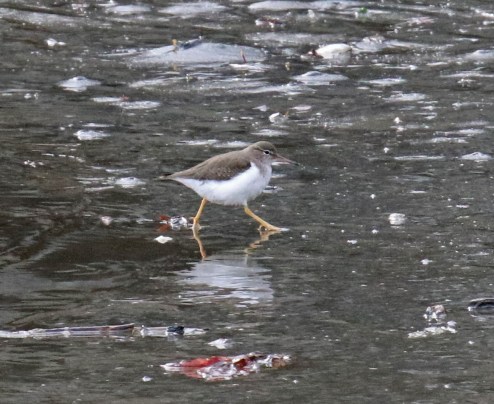
We had gotten a fairly late start and decided to return home early but with another stop at the Shine Tidelands hoping for better luck with the Spotted Sandpiper.  Although not an uncommon bird in the State, they are more often found in the spring and summer and most commonly near rivers and freshwater ponds.  They are quite uncommon in Jefferson County.  We searched the pebbly shore and were again unsuccessful – until just as we were heading out David said he saw a shorebird near the boat launch – an area where the Spotted Sandpiper had been reported.  He said it was a Killdeer but when I looked for it I could not see it – but did see – yep the Spotted Sandpiper.  This was the first one either of us had seen in Jefferson County.  Then the Killdeer appeared as well.

Spotted Sandpiper

Spotted Sandpiper

And just in case you are wondering after looking at the photo, in breeding plumage, the Spotted Sandpiper has very distinct spots on it breast – but none at all in non-breeding plumage like now.

Before getting back to the Kingston/Edmonds Ferry, David and I stopped at Point No Point.  Nothing rare had been reported there recently but it is always an interesting place to bird and has produced rarities over the years.  It is a particularly good place to find Bonaparte’s Gulls and sometimes there are rarer gulls like Little Gull and Franklin’s Gull as well.  Nothing rare today but it was very cool to see several hundred Bonaparte’s Gulls flying high over the water in a murmuration like Starlings.  We finally found a distant Peregrine Falcon whose presence was probably the cause of their mass movement together.

Bonaparte’s Gulls (Just a Small Portion)

Bonaparte's Gulls

We also found two pairs of Marbled Murrelets – still in their black and white winter plumage – always a nice find.  We left contemplating a return to look for the Red Knot with a better tide.

Marbled Murrelets

Marbled Murrelets

On February 22, David and I joined Ann Marie Woods and Steve Pink to again search for the Red Knot and also to look for other birds.  The projected tide was more favorable, but it had snowed the night before and we wondered about the roads and the birds.  Informed by the last visit by David and me, we first stopped again at Shine Tidelands and easily found the Spotted Sandpiper, a new county bird for both Steve and Ann Marie.  We made it down and up the hill leading to that spot in light snow – so far so good.  Off to Fort Flagler.

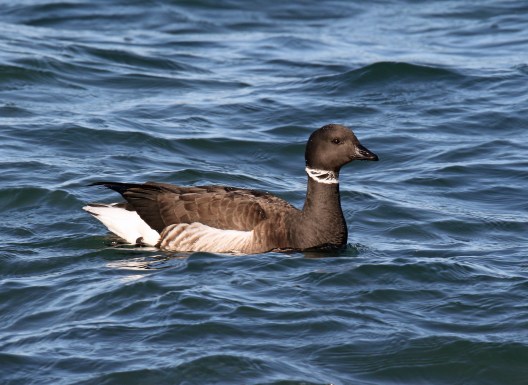
The tide was now more favorable – just past the actual high tide and the shorebirds were numerous and clustered on high ground on the spit which was covered with snow.  As before there were many Brant and other sea birds in the adjacent waters and many gulls and some Harlequin Ducks on the spit.  Light was great in the brilliant sunshine but it was quite cold.  We scoped the shorebirds from a distance and then methodically worked our way up the spit.

Brant

Brant

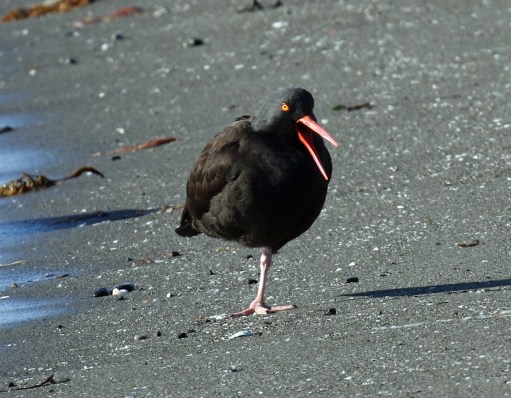
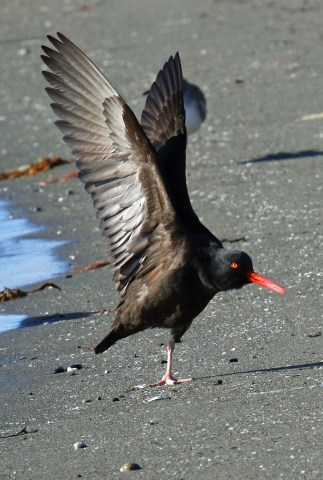
As on our previous visit, there were many Dunlin, Sanderlings and Black Bellied Plovers and we found a couple of Western Sandpipers.  This time, however, there were no Black Turnstones and instead we had a single Black Oystercatcher.

Black Bellied Plover on the Snowy Spit

Black Bellied Plover

Black Oystercatcher

Black Oystercatcher1


Black Oystercatcher Wings

We checked every shorebird and were not able to find the Red Knot – a major disappointment as it is rare in Jefferson County and would have been a new County and year bird for all.  We did find both Herring and Iceland Gulls – less uncommon than the Knot but still new birds for some.  Consolation prizes of a sort.  Moreover though, it was just fun birding with the clear skies, bright sun, snow on the ground and good birds.

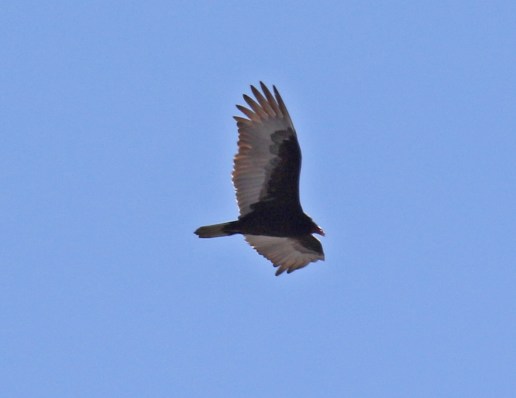
We were now off to the Sequim area in Clallam County to look for some of the birds I had seen there in January but which would be new for the others.  Along the way on Highway 101 Steve spotted a Turkey Vulture soaring with its tell-tale dihedral wing position.  This was a hoped for but still surprising new year bird for me (and the others).  They usually do not come back into the Northwest until at least March, but there have been several early sightings this year.  We saw another one later in the day.

Turkey Vulture

Turkey Vulture

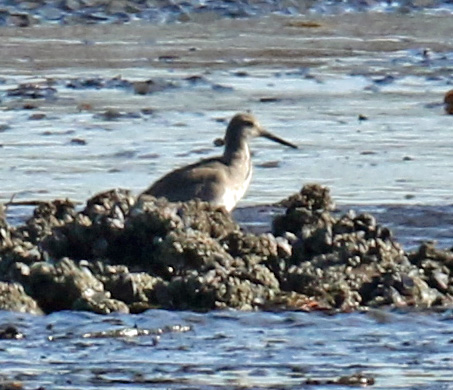
We headed straight to Dungeness Landing Park (The Old Oyster House) where the target was the Willet that had been seen regularly there since last year – usually in the company of Marbled Godwits – as it had been when I saw it in January.  Tide was low and there were birds spread out in all directions.  Steve spotted some Marbled Godwits in the distance and then David found the Willet.  We never saw it in flight with its distinctive black and white wing pattern but it was an easy ID as a larger plain gray shorebird with a long straight bill.

Willet (A Long Way Off)

Willet

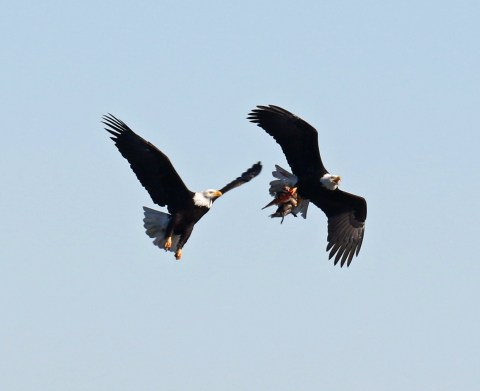
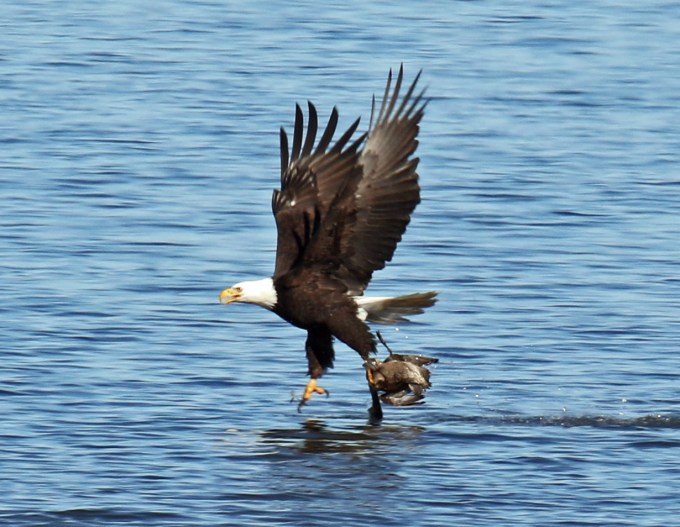
The Bay had many ducks of several species.  There was about to be one fewer.  An adult Bald Eagle appeared on the scene – scattering the ducks from the water.  It focused on a single one in the chaos chasing it as it tried to avoid being caught.  It was a female Northern Pintail.  Then a second adult Eagle joined the hunt and after a moment or so, one of the Eagles struck the Pintail knocking it to the water.  The chase had been exciting to watch and it now got more exciting and dramatic.  Pintails are dabbling ducks, not diving ducks.  They can submerge but do so only briefly.  They feed by tilting down and grabbing food below the surface with their long necks. I expect the Eagles knew this behavior both in selecting the target initially and also in the strategy they then employed for the kill.

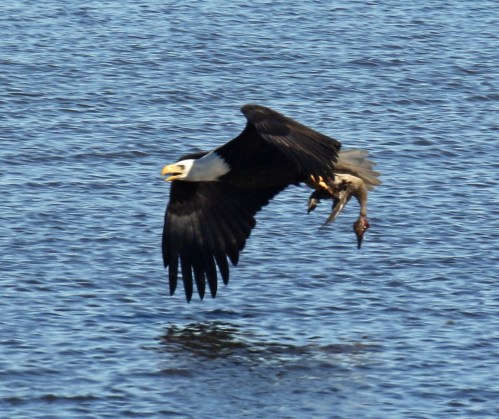
In the water the Pintail would submerge briefly as the Eagles took turns diving at it from above.  Each time the Pintail resurfaced, an eagle would dive at it again.  This continued at least a dozen times.  Finally the Pintail tired and remained on the surface just a bit longer.  This time one of the Eagles grabbed it with its talons and flew off.

Eagle Taking Pintail

Bald Eagle taking Pintail4

Bald eagle taking Pintail2

But the show was far from over as the second Eagle chased the first – contesting its prize.  We don’t know if this was a mated pair, siblings or two generations (even though two full adults evidenced by complete white heads and tails).

The Second Eagle in Pursuit of the First

Bald Eagles with Pintail

After a few seconds as the Eagles swerved and cartwheeled together, the capturing Eagle dropped its prize and, still alive, the Pintail fell to the water.  But it was not going to escape.  Exhausted and probably in shock and injured, it was picked up quickly by one of the Eagles (we didn’t note if it was the original captor) and again carried away.

The Second Capture

Bald Eagles with Pintail2

This time the second Eagle flew off on its own while the victor flew to a nearby piling in the water.  It called – perhaps proclaiming its conquest – and then began its meal.

Duck for Lunch

Bald Eagle Eating Pintail

We were spellbound by the episode which took place maybe 100-150 yards away.  For awhile it had appeared that the Pintail might escape – first the chase and then the capture.  The Eagles were more adept fliers than I had expected and the tactics used to tire the non-diving duck were impressive. Predator and prey – one of nature’s basic laws.  Eagles are often and rightfully seen as scavengers.  This Eagle was a supreme hunter.

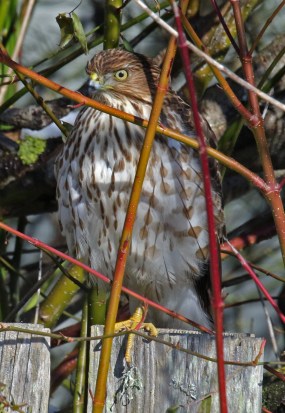
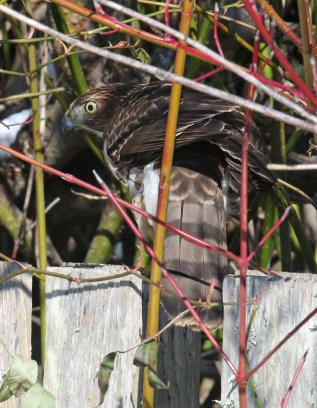
Heading next to the Three Crabs area, we first made a stop at Denny Van Horn’s eclectic shop/residence.  Denny knows as much about what’s going on bird-wise in the area as anyone and is always a fun and informative visit.  He gave us good leads and directions for some of our targets and we were off.  No owls in the fields around Three Crabs but we found a photo friendly Cooper’s Hawk on a roadside fence.  Definitely the eye of a predator.

Cooper’s Hawk

Cooper's Hawk   Cooper's Hawk1

Our next target was a female Redhead (the bird kind) that had been reported in a small pond on Simdars Road.  Following Denny’s instructions we easily found the pond and sifted through the numerous ducks to add the Redhead to our day list and and a County first for everyone.

Redhead Female

Redhead Female

The last stop was at Diamond Point where some Ruddy Ducks were seen as soon as we drove by – our final species for the day.  We had done very little birding not tied to ponds or the ocean and still had 65 species.  My only new bird for the year was the Turkey Vulture which I was very pleased to see.  The Eagle vs. Pintail drama was certainly the highlight.  It was truly a beautiful day with good friends showcasing the best of the Northwest with all the water and mountains – and sunshine – in February!!

Second Efforts – Streak Backed Oriole and Sinaloa Wren


It is 113 miles from from Exit 12 – East Ruby Road and Interstate 19 to Douglas, AZ  most of it good highway.  It is another 20 miles from Douglas to the walk-in trail at the San Bernadino National Wildlife Refuge – most of it a dusty dirt road.  Google said it would take almost three hours to get there.  The Refuge is only a few miles from the Mexican Border.  We are talking remote.  We are talking desolate and in an early Arizona Birding book, it was talking – possibly dangerous.  Who in their right mind would go there?

I guess that depends on two things: How one defines “right mind”; and how badly someone wanted to have a chance to see a Streak Backed Oriole.  All of this would have been irrelevant if the Streak Backed Oriole had continued coming to the feeder in Tucson.  It hadn’t and might not again.  I wanted to see one.  I understood that after getting to the walk-in gate it was another 45 minute walk in the desert to get to the oasis where the Oriole had been seen.  There would not be time to make the drive and do the hike while there was still sunshine that day.  I decided to make the drive and at least get familiar with the entrance to the trail planning to return the next morning early for the hike itself.

The last 15 miles or so were on a very dusty road.  The only other vehicles I saw were from the Border Patrol.  Apparently this is a high activity zone for illegal immigrants and illegal activity.  It was not a physically inviting spot and the thought of a long hike – very much alone except for maybe people with whom I wanted no intersections – had me questioning my decision.  Maybe I should simply return to Tucson the next morning and hope that other Streak Backed Oriole would return.

San Bernadino NWR – The Mountains are in Mexico

San_Bernardino NWR

Douglas, Arizona is not a prosperous place.  I felt good about the birding earlier that day and thought about a celebratory steak dinner.  I found only one restaurant that was listed as a steak house.  It looked more like a saloon when I got there.  The steaks may indeed have been good, but I was already feeling quite out of my element so settled for simple Mexican fare.

I overcame my apprehensions and headed out early hoping to catch bird activity before it got hot.  Hot it wasn’t – not even 40 degrees.  On the test drive the day before, it had been about half way on the dirt drive in I saw a Border Patrol car coming towards me.  I had signaled him to stop and asked him point blank:  “Am I safe out here?”  Not fitting the stereotype in my head, he was a very nice guy and said there were birders (his word) out here often and that I was safe.  He said the last thing anyone out here for other reasons wanted was to see anybody.  They patrolled the road frequently but there would not be anyone on the trail or in the Refuge unless more birders showed up.  It was reassuring and he wished me luck.  I felt bolstered by that input this morning.  But I saw no vehicles this time.

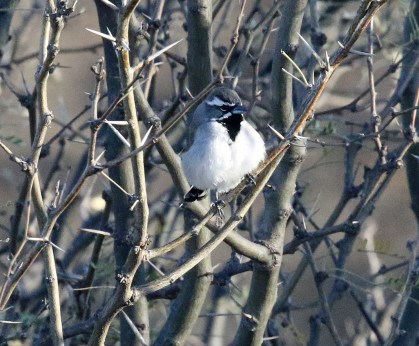
At least the hike in was flat and on a good trail/road.  The first bird I saw was a Phainopepla.  I would see several more.  A little further in some sparrows flew into a small shrub.  They were Black Throated Sparrows – my first of this trip and one of my favorites.  They were seen for several summers on Recreation Road in Gingko State Park in Kittitas County, Washington but have been gone for a few years no.  I hope they return.

Phainopepla

Phainopepla-1

Black Throated Sparrow

Black Throated Sparrow - Copy

The description of where the Streak Backed Oriole had been found was probably helpful if you were familiar with the Refuge.  I was not and the Refuge map was almost useless and the signage minimal and also not helpful.  Except a sign at one fork in the trail indicated there was a bathroom ahead.  I was ready to go “au naturel” if needed but it was actually a well maintained restroom – much appreciated.  I continued along that trail as it led to an oasis of trees and a pond that I could see in the distance.

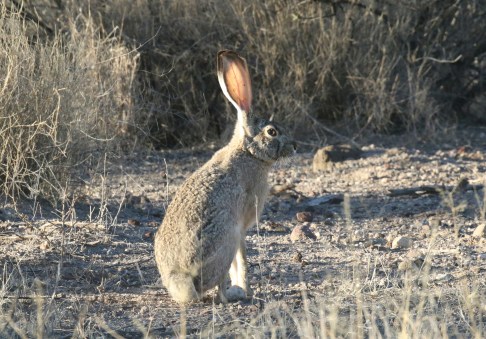
A Greater Roadrunner crossed the path ahead of me.  This was the third I had seen on this trip and again it just kept running along – no photo.  A little further I saw two mammals on the dirt road – the only Jackrabbits I had seen so far.  One posed nicely before running off.

Jackrabbit

Jackrabbit-1

When I made it to the trees and the water, there was bird activity.  Ring Necked Ducks, Cinnamon Teal, American Coots and a Pied Billed Grebe were on the pond.  Black Phoebes were flycatching from the reeds.  Northern Flickers, Gila and Ladderbacked Woodpeckers were in the trees.  More Black Throated Sparrows were joined by a Song Sparrow, Dark Eyed Juncoes, White Crowned Sparrows and Canyon Towhees.  There were very active Ruby Crowned Kinglets, a small group of Lesser Goldfinches and some House Finches.  Would there be an Oriole?

I found a way across a small stream that took me to some grassy areas bordered by mesquite and the Cottonwoods.  I was greeted by a small herd of Javelina or Collared Peccaries.  At least 14. Two days earlier on a dirt road going to the trailhead where I got my Gilded Flicker photos, a young Javelina had come out of brush immediately next to the road and I had no time to avoid it.  It was hit but when I retraced the route, it was not on the road.  Never a good feeling.

Javelina

Javelina-1

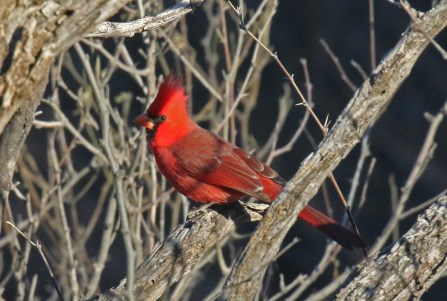
There were few birds so I returned to the area near the pond.  I remembered some report of Sora at the pond and I got a response to some playback – Sora but no Virginia Rail.  I also found both Bewick’s and Marsh Wrens.  Then a flash of color from the trees to the brush – but it was red not yellowish-orange – a male Northern Cardinal.  I was able to get a good photo but even though it was close and I knew where it was, shortly it buried itself in the thick brush and was almost invisible – a reminder that in thickets, even the brightly colored birds can be very difficult to find.  Was the Oriole here and yet invisible?

Northern Cardinal

Northern Cardinal-1 (2)

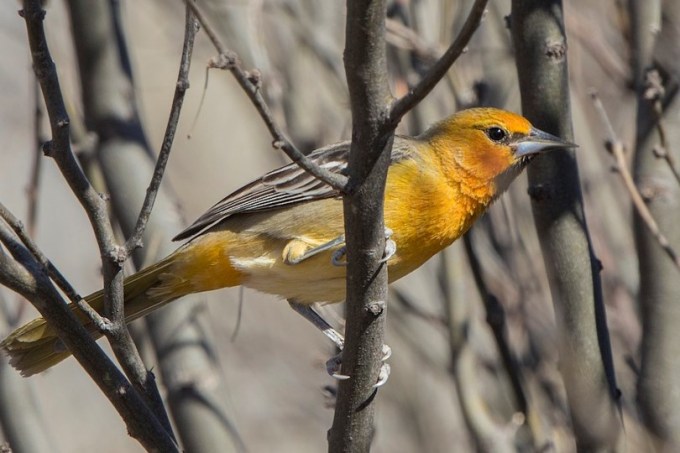
It was barely 8:30 but already it had warmed significantly and the bird activity seemed to be dropping.  Several Yellow Rumped Warblers were flycatching and flitting between the trees, the Cinnamon Teal flew off – a few Verdin were seen.  Then another flash of color – this time yellowish-orange and not reddish.  The Oriole was up in one of the trees.  I tried to bring it in with playback but my options were limited.  Sibley does not have calls or songs for this species.  I Bird Pro does but only a single one and when I got a new phone before leaving for this trip I had forgotten to download the entire database (a multi-hour exercise).  With no internet in this area, I could only try a Bullock’s Oriole call on Sibley – hoping it was “close enough” .  It moved the Oriole closer and briefly into the open.  Good light always helps.  I had a new ABA Life Bird!!!

Streak Backed Oriole

Streak Backed Oriole1

The long dusty drive and the long hike in were worth the effort.  Part of me wished that there had been someone else there to share it with.  Another part of me preferred it this way.  Even including the Border Patrol, there was probably not another human being within 5 or even 10 miles of me.  This is often the case when I am out.  There are times in Eastern Washington when I do not see anyone for many hours and I am many miles from any towns.  Not a good thing if something bad were to happen, and I really do like birding company or even visiting with non-birders when I am out. But there are times like this one that being alone brings me closer to the birds and the natural world we share with them.  It was a very sublime moment.

The day was a success and the day was still young.  Although it would be hours before I could get back to my car and retrace steps back to civilization and other birding spots, I now had time and no agenda.  I began the hike back.  Along the way I found a bird that I had been looking for but had not yet seen –  a Black Tailed Gnatcatcher.  I had seen and photographed one in Arizona on my August trip and was surprised I had not seen one in this seemingly perfect habitat.  It was a nice way to end this visit.

Black Tailed Gnatcatcher

Black Tailed Gnatcatcher1-1 - Copy

I really had no specific plans.  My flight would leave around noon the next day.  I figured I would just head back to Tucson and figure something out on the way.  But I was feeling good and words from my friend Melissa Hafting ran through my head.  I had shared some of the trip details with her – including the unsuccessful try for the Sinaloa Wren – a real prize.  She had come back almost immediately with – it’s still there – try again.  I could take a route that would take me to the De Anza Trail again – why not?

Along the way I noticed a sign for the San Pedro House.  If I had not seen the Louisiana Waterthrush at Pena Blanca Lake, that would have been one of my stops as two had been seen there.  So too had a Green Kingfisher.  There was time, so I made the stop.  There are numerous feeders at the house and then a path to the river.  Feeders can produce great birds anywhere – but especially in Arizona.  Unfortunately here they had been taken over by dozens of White Crowned Sparrows.  I ignored the feeders and headed for the San Pedro River trail.  Along the way I had more Black Throated Sparrows and many of the other birds I had already seen on the trip.  New birds were a Sharp Shinned Hawk, a House Wren and a Gray Flycatcher.  Near the river I got a photo of a Brewer’s Sparrow – seen but not photographed at Pena Blanca and then maybe my best photo ever of a Green Tailed Towhee, my first for this trip.

Brewer’s Sparrow

Brewer's Sparrow

Green Tailed Towhee

Green Tailed Towhee-1

On the trail I met the San Pedro House morning walk group.  They were completing their walk and told me that they had just seen one of the Louisiana Waterthrushes upriver from marker 6 – good news – but also the bad news that the Green Kingfisher had not been seen that day.  I got a fleeting look at the Waterthrush and did not even look in the area where the Kingfisher had been seen earlier in the week.  It was now almost 1:30 and I still had a long ways to go.

About two hours later, I pulled once again into the parking area on Santa Gertrudis lane.  Just as before another car of birders pulled in just as I did.  They were hoping to see the Rufous Backed Robins and I am not sure they even knew of the Sinaloa Wren.  I told them I had been there two days before with a guide and that we had not found the Robins.  I told them the general area where Richard said they had been seen and that they seemed to favor the Hackberry trees.  Hopeful but not optimistic but with Melissa’s encouraging words, I headed off to look for the Wren.  The other two walked in with me for a bit and then took another trail that was more likely to produce the Robins.  As I started my search I tallied up the wrens that I seen on the trip so far.  Earlier I had seen Cactus, Rock, Canyon and Bewick’s Wrens.  This morning I had added Marsh and House Wrens.  Would seven be my lucky number – adding the best of all – a lifer Sinaloa Wren?  

By the river I met a local birder who was also looking for the Sinaloa Wren.  Even older than I am, he had brought a little folding seat and his strategy was to sit at a likely spot and hope the Wren would come to him.  We had a brief but nice visit, wished each other luck and promised to advise each other of any success.  I headed back towards the area where we had looked two days earlier and where it had last been seen.  Frankly the entire area looked good for it habitat-wise – but mostly that meant there was a lot of leaf litter and it could be buried anywhere.

All sources had said that the Sinaloa Wren had not been singing – maybe a couple of call notes – at most once or twice in the week plus that it had been seen.  Also that it had not responded to playback – or at least nobody had admitted to that.  Just as on my earlier visit, there were lots of Gila Woodpeckers, some Bridled Titmice, Verdin, Kinglets and Yellow Rumped Warblers.  But no Wrens  of any kind and except for the Woodpeckers and some Black Phoebes, it was pretty quiet.  I figured it couldn’t hurt to try some playback and went to my I Bird Pro app.  I had downloaded the Sinaloa Wren when I was here earlier so I had access to three calls/songs.  I played the chatter and “churr” notes.  No sounds but about 30 seconds later, a small brown bird came from somewhere behind me and dove into some brush a few feet ahead.  I actually felt an adrenaline hit as it was definitely a Wren and by location, behavior, response and first quick glance it was most likely the Sinaloa Wren.  I yelled “WREN” to give notice to anyone within earshot but stayed focused on it hoping for another look and a photo.

The two birders looking for the Rufous Backed Robins were close enough to hear my shout and joined me within a minute.  The local birder was too far away.  I pointed to where I had seen it fly in.  A moment later, without our seeing any movement at all, it materialized about six feet from that spot – still in the same brushy area.  We all saw it in the open for maybe 3 seconds.  It was enough time to see the supercilium, brown back and mostly brown undersides and most importantly we could clearly see the streaking on the neck that confirmed the identification.  It flew across the trail and landed in some leaf littered brush.  It buried itself again and at least this time I was able to get my camera on the spot where it had disappeared.  I clicked away hoping that one shot would capture – something.  In another 10 seconds it flew off and disappeared.

The whole area was dark and the brush was even darker.  If I had been ready for the first 3 second view completely in the open, I might have gotten a good photo, but there had simply been no time and no warning.  You have to look really hard and use some imagination, but in one of the photos I was able to take at it’s second location, you can make out the head of the Wren, the eye stripe and barely some markings on part of the throat/neck.  Even Photoshop did not help much.  At least the arrow points you to the bird – which was hard enough to find in the photo.

Sinaloa Wren (Winner of the Worst Photo Ever Award)

Sinaloa Wren

We could not relocate it again.  The whole intersection had lasted at most a couple of minutes with it being invisible most of that time.  I went back down the path maybe 150 yards and told the local birder about our experience.  He moved his seat to the area and set up shop.  I don’t know if he was successful.  My success was almost pure luck.  Yes, I made the effort and went to the right area.  Maybe the Wren had responded to playback but mostly I was in the right spot at the right time and just as easily could have missed it entirely.  Definitely one of the skulkiest birds I have seen – and also one of the most rewarding.

When I had planned this trip, there were 4 potential life birds.  I had figured the Rosy Faced Lovebird was a gimme.  I thought the Ruddy Ground Doves were likely, that the Streak Backed Oriole was a maybe and that the Sinaloa Wren was highly doubtful.  Until this morning my only success was the Lovebird and I had dipped on the Ground Doves twice and both the Oriole and the Wren once.  I was still pleased because I got those ABA first photos of the LeConte’s Thrasher, Louisiana Waterthrush, Gilded Flicker and both Black Chinned and Baird’s Sparrows.  But now second efforts had produced great rewards this day and I added the Streak Backed Oriole and Sinaloa Wren to my ABA Life list.  It does not always work that way – but when it does – it keeps us trying and gives us hope fore the next time too.

I got back to Tucson fairly late and abandoned plans to bird again the next morning.  Back home – a happy birder!!

Sparrows Anyone? How About a Waterthrush as Well?

My first visit to Arizona was in December 1976,  I did not keep good records back then – just a list of new birds as I saw them without details as to where, when and how many.  I also did not keep track of all birds seen – just the new ones.  Definitely no digital world for photos, communication, personal computers etc.  But it all worked – lots of great birds and people.  Information was shared and somehow, birds were found and enjoyed.   On that trip I saw many of the Arizona specialties that were around in the winter.

Lots of memories from that first Arizona trip where in addition to general birding I also got to participate in some Christmas bird counts.  I remember the “Mexican Specialties” like Mexican Jay (then named Gray Breasted Jay) and Montezuma Quail (known then as Harlequin Quail).  I remember that there were birders from all over the country.  I remember a very young Kenn Kaufmann giving very precise reports for the Count.  I remember my first Roadrunners and lots of Thrashers and Woodpeckers, especially the Arizona Woodpecker (then named Strickland’s Woodpecker).  There is also the memory of lots of sparrows – including very different ones than I was familiar with in the Northwest and Northern California where I had started birding 5 years earlier.

Arizona Woodpecker (formerly Strickland’s Woodpecker) from my August 2017 Trip

Arizona Woodpecker

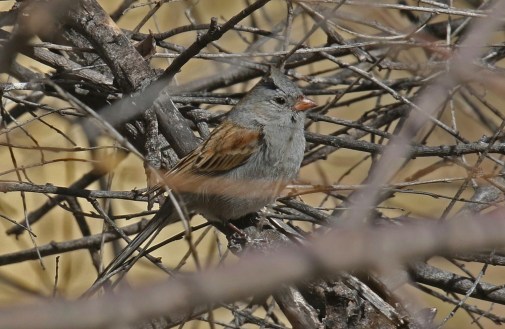
My trip this February did not expect any new sparrows for a life list but I was keen to get photos of some sparrows I had seen in that winter of 1976 but had not photographed – part of my quest/hope to get photographs of all (wishful) or most (possible) of the birds I have observed in the ABA Area.  Specifically I was hoping for ABA first photos of Baird’s and Black Chinned Sparrows and for better photos of Rufous Crowned and Rufous Winged Sparrow photos.  I had photos of the latter two from my Arizona trip last August – but they were not great and there was even a bit of doubt in my mind if I had correctly identified the two somewhat superficially similar birds.

So on February 6th, I was going to bird with Richard Fray, the local guide I had met the previous day at the De Anza trail, hoping for sparrows.  I had liked Richard when I met him and certainly appreciated his expertise and knowledge of Arizona birds.  When I learned that he had shown his clients Baird’s Sparrows that morning and he had reported both Black Chinned Sparrow and Louisiana Waterthrush (another hoped for first photo) at Pena Blanca Lake where I had missed them earlier that day – it seemed an easy decision to hire him for the day.  His website is arizonabirder.com and I liked what I saw when I visited it – full of good information.  And I also liked that he called his company Fun Birding Tours.  Granted I will generally trade success without fun for fun without success but why not at least try for both.  So I signed up.

We were heading to the Las Cienegas Grasslands east of Patagonia and Sonoita – classic Arizona birding areas.  When we got to the grasslands it was immediately clear I had made a good choice.  The grasslands are a huge area and birds could be anywhere – BUT they most definitely were going to be at the specific spot Richard took me – the Curly Horse Road Pond.  You need to go through two chained (but unlocked gates) to get there on dirt roads.  On the way in we saw other birders wandering the grasslands at large.  Maybe they found their targets, maybe not, but when we arrived at the Pond, it was obviously the place to be.  There were dozens of sparrows attracted by the only water for miles.  Better yet in addition to beautiful grass, there were fence lines and a few small shrubs – perfect perching spots – and posing spots for photos.  Richard said there would mostly be Savannah Sparrows but we should find Baird’s and Grasshopper Sparrows as well in addition to the possibility of Chestnut Collared Longspurs – another grasslands species.

It didn’t take long.  The first few birds we saw were Savannah Sparrows but then with perfect low light behind us I saw what I thought might be and hoped would be a Baird’s Sparrow perched in the open on a small bush.  Richard confirmed the ID and I had a photo – the first of many of a species that I thought was a long shot for this trip.

Baird’s Sparrow (First ABA Photo)

Baird's Sparrow6-1 - Copy

Over the next 45 minutes we watched a sparrow parade.  They would fly in from the grasses and either go directly to the pond for a drink or would perch on a shrub before hitting the waters edge.  By far the most abundant were the Savannah Sparrows but there were quite a few Vesper Sparrows, Grasshopper Sparrows, some Brewer’s Sparrows and more Baird’s.

Grasshopper Sparrow

Grasshopper Sparrow1-1

Vesper Sparrow

Vesper Sparrow1-1

Another Baird’s Sparrow at the Pond’s Edge

Baird's Sparrow R - Copy

We stood above the pond and could watch the sparrows in the beaten down grass on the shore as the sparrows came in – almost invisible at times as their markings provided perfect camouflage.  A particularly fun observation was of Baird’s Sparrows and a Grasshopper Sparrow together almost disappearing.

Baird’s Sparrow and Grasshopper Sparrow in Grass at Pond

Sparrows1-1

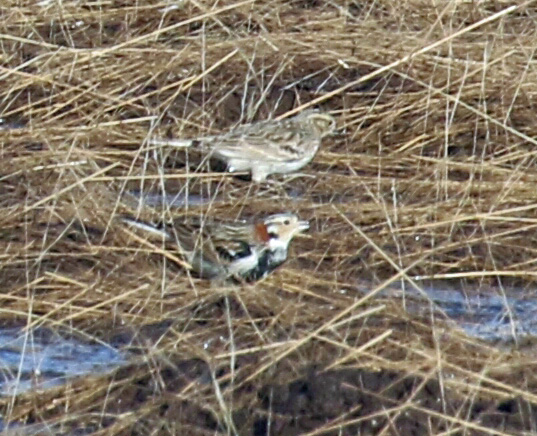
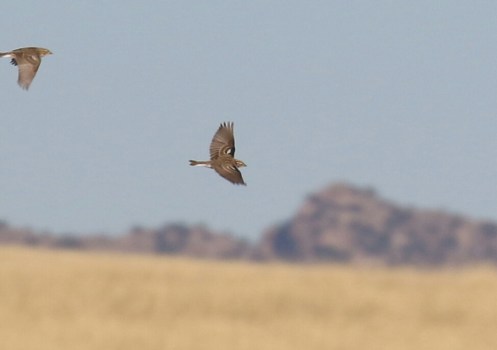
While we watched on numerous occasions small flocks of Chestnut Collared Longspurs would fly in – land for a few seconds – always at the far end of the pond – and then take off again.  Very difficult to get good photos even in the good light.  Here are a couple of my attempts.

Chestnut Collared Longspurs

Chestnut Collared Longspurs-1

Flight Shot

Chestnut Longspur Flight-1

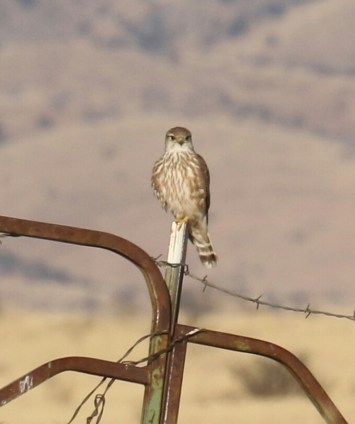
At one point all of the Sparrows at the pond’s edge – maybe 25 or so – took off at once.  A flock of Longspurs that was coming in, swerved away from the pond as well.  It was a Merlin looking for breakfast.  It seemed to focus on one of the Longspurs and followed in closely through two turns but a last diversion meant an escape.  It perched on a nearby fence post and the birds remained quiet for 5 or 10 minutes.

Merlin

Merlin1-1

It was hard to leave this beautiful spot with its ongoing show but there were other places to go and it had been a truly wonderful visit.  Richard had certainly come through on the Baird’s Sparrow.  He had seen a Sprague’s Pipit not far away the day before.  It was the only one reported in Arizona this year.  I had only seen one before and would have loved a photo.  We knew the odds were against us but it was worth a try to return to the spot it was seen.  Unfortunately when we got there – in the middle of nowhere – there was a pickup and trailer on the exact spot – a couple flying model airplanes.  It was a good spot for them – not disturbing anyone – well maybe except for us – but that’s the luck of the draw.  They were clearly enjoying their passion.  Too bad they could not have waited another day…

Sprague’s Pipit from the Previous Day – Rats!!

Jen's Sprague's Pipit

We retraced our steps and went west – crossing I-19 and heading to Pena Blanca Lake.  We arrived about 11:15 a.m. not too different than the time I was there the previous day.  This time however we went directly to the “old boat launch spot” – where Richard had seen the Louisiana Waterthrush earlier in the week.  He reminded me that this was also a great spot for sparrows and that a Black Chinned Sparrow had also been there.

Maybe 15  minutes after we arrived I saw a “small bird” fly over and land in a tall tree behind us in poor light.  This was another case where Richard paid big dividends.  I had noticed, sort of, that the bird seemed to have a relatively long tail.  Richard noticed this too but his expertise told him that it thus might be a Black Chinned Sparrow.  It was impossible for me to tell this looking directly into the sun, but he had a good enough view to be pretty sure.  With a little coaxing we got the bird to fly down and land in some brush in front of us.  At first it was buried but I could make out the fieldmarks for the desired species.  Now about that picture – the real goal.  After a few moments it was out in the open and I had another new ABA photo.

Black Chinned Sparrow (First ABA Photo)

Black Chinned Sparrow-1 - Copy

Black Chinned Sparrow2-1

This species was one of the disappointing misses on my August trip and making up for that was one of the key reasons for this trip in February.  Another was the possibility of that Louisiana Waterthrush and that too soon became a reality.  The Waterthrush’s chip note is a very high pitched metallic “tink”.  We were at a spot that looked perfect for the Waterthrush – just where Richard had first seen it and where I had searched hard with other birders the previous day.  It had to be there.  Maybe 15 minutes after the Black Chinned Sparrow left, Richard said he thought he had heard the call note.  A bit later I heard it as well.  The note is sufficiently distinct that a “lister” could claim the ID on the sound alone.  My interest though was on a visual and much more importantly on a photo.  Finally the Waterthrush obliged.

Louisiana Waterthrush (First ABA Photo)

Louisiana Waterthrush-1a - Copy

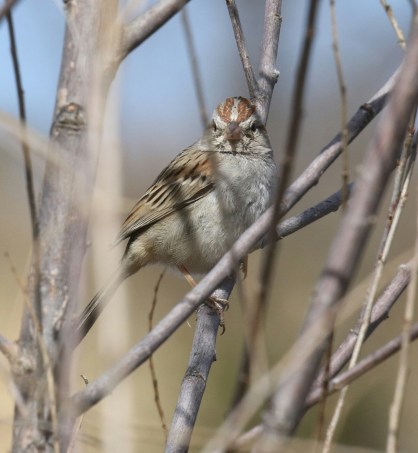
The visit was a big success – both targets seen well and photographed.  But there was more.  I might have it out of order but both Rufous Winged and Rufous Crowned Sparrows also put in an appearance.  It was particularly nice that we could actually see the rufous shoulder patch in the former – making now irrelevant whatever doubts I may have had with my photos from August.

Rufous Winged Sparrow

Rufous Winged Sparrow1-1

Rufous Winged Sparrow Front-1

Rufous Crowned Sparrow

Rufous Crowned Sparrow1-1

Rufous Crowned Sparrow-1

Definitely Mission Accomplished!!  But there were other birds there as well.  A distant fly by of some Mexican Jays, Lincoln’s and White Crowned Sparrows, Gila and Acorn Woodpeckers and a Red Naped Sapsucker.  My favorite though was a very photo friendly male Pyrrhuloxia.

Pyrrhuloxia

Pyrrhuloxia Male-1

Definitely one of the best 90 minutes of productive birding I have had.  Time to leave.  I had a long trip ahead of me to be in position for another attempt at Streak Backed Oriole the next morning a couple of hours away – or we may have just continued birding without targets – as Richard’s company says – Fun Birding Tours!!

Richard drove me back to my car and I said my goodbye and my great appreciation for a great day.  Richard is originally from England and grew up in a birding family.  I bird a lot in Washington with Steve Pink another former Brit.  Our languages are almost the same but I admit that I enjoy the accent and the occasional odd phrases.  One I do like is that Steve always signs off with “Cheers”.  Works for me.  Cheers Richard.  It was “smashing”.

Richard Fray

Richard Fray

I started this post recalling my first Arizona visit and all the sparrows.  The success with Richard had brought my sparrow list for the trip up to 14 species.  I would add 4 more the next day.  And if I were to include species seen in Arizona previously the total would be 25.  Definitely a sparrow rich State!!

Sunny Arizona in February – Loving, Thrashing and Flicking but Ungrounded (Please Excuse All These Puns)

In August last year, Frank Caruso and I went on the Wings “Second Spring” tour in Arizona.  Except for a serious camera meltdown (actually more a washout), it was a great trip with lots of birds.  I chronicled that trip in several blog posts last year.  As I indicated in my previous post, after my Washington “Big Month”, I was going to be concentrating out of state trying to add a few ABA Life Birds and Life Photos.  Adventure one was a return to Arizona with some very specific targets to seek.

I took the early (6:00 a.m.) Alaska Airlines flight from Seattle to Phoenix.  That required a very early wake up but provided two significant advantages compared to later flights: no traffic getting to the airport and an arrival sufficiently early to allow for some birding that first day. I flew into Phoenix rather than Tucson expressly to find a Rosy Faced Lovebird – another of those escaped exotics that have established viable communities and are recognized by the ABA.  This also gave me the best shot at finding a LeConte’s Thrasher at “the Thrasher Spot” west of Phoenix at the intersection of Baseline Road and Salome Highway.

After picking up my rental car, I went straight from the airport to Encanto Park – less than 8 miles away.  “Everyone” had easily found the Lovebirds at this park.  I thought I was going to join everyone when I saw a single parrot like bird fly away from me as I entered the park.  I saw it well enough to know it was my quarry but I never saw it or any other Lovebirds (at least avian ones) despite searching quite a while.  It is a big place and it was a Sunday with many families.  Maybe I looked in the wrong places or was just unlucky, but I was not going too be happy if that was the only look I would get – and definitely no photo.  I had already spent more time than I had planned so I headed off to a hoped for date with a Thrasher.

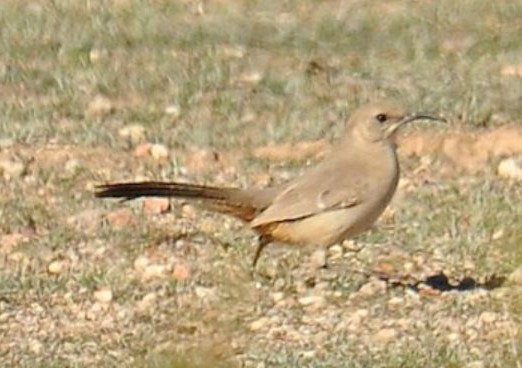
The Thrasher spot looked perfect.  Dry, sandy, with lots of scattered small shrubs.  Places for Thrashers to perch and to run along and hide.  I spent an hour finding a total of three birds – White Crowned Sparrows and was getting pretty depressed.  I decided to try another area on the other side of Baseline Road and after another 20 minutes found some Thrashers – a scurrying LeConte’s Thrasher and two scurrying Crissal Thrashers.  The photos of the latter were diagnostic at best but I had other photos from the trip in August.  The photo of the LeConte’s was definitely more than expected as my first photo of this species.

LeConte’s Thrasher

LeConte's Thrasher

No longer depressed, I was determined to find some friendlier Rosy Faced Lovebirds.  Quick research on Birder’s Dashboard showed that a large number had been seen fairly recently at Steele Indian School Park so off I went.  It was another large park filled with families, but it was also filled with Rosy Faced Lovebirds and I was able to find a photo friendly one quickly and then many more – even friendlier.  I felt better counting a new ABA Life Bird.

Rosy Faced Lovebird

Rosy Faced Lovebird A - Copy

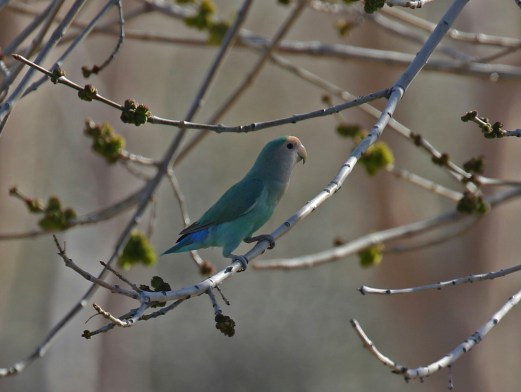
Interestingly in one group of maybe six there was one that was quite blue and without the rosy face.  Everything else matched.  I looked online for a similar photo and found that the blue form is a recessive color trait.  It was the only one I saw in maybe 25+ birds.

Rosy Faced Lovebird – Blue Form

Rosy Faced Lovebird Blue

The day was looking up and I had one more target – a photo of a Gilded Flicker.  It was possible to see them in a number of spots and if I had missed the Lovebirds elsewhere I would have paid the admission charge for entry to the Botanical Gardens and probably would have found them there.  Instead, with the success with the Lovebirds, I headed east to the Phoenician Resort and environs in Scottsdale.  There were many reports from this area.  Definitely the high rent district – some beautiful homes and the resort itself was quite posh.  A Gilded Flicker flew overhead as I was driving on Camelback Road – but there was no opportunity to stop.  This happened again as I turned onto the resort entryway.  But I could not find perched birds anywhere.

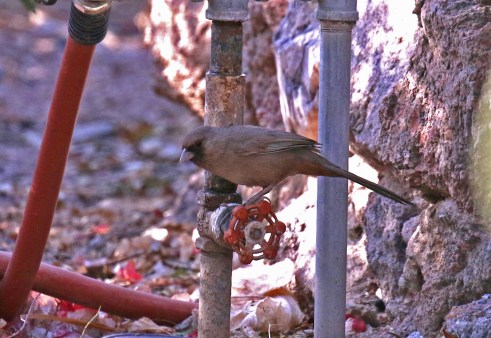
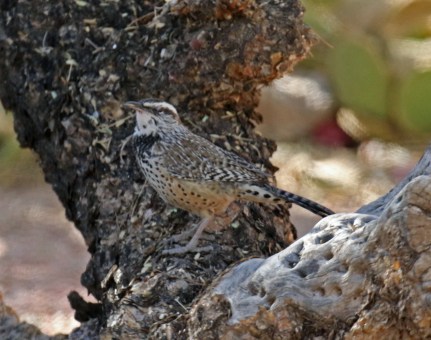
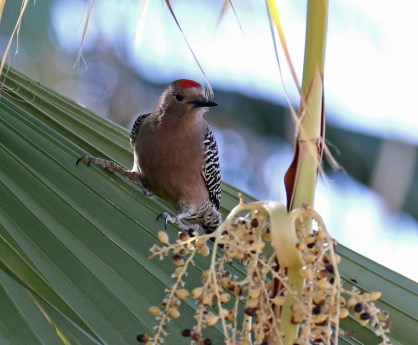
I found a promising spot and turned onto 54th Street and found the Mount Claret Center which had feeders at a residence.  Surely a Flicker would come in.  Nope but there were nice other birds – a Cactus Wren building a nest, Gila Woodpeckers, an Abert’s Towhee, a Northern Mockingbird and a Curved Billed Thrasher – classic Arizona suburban lowland birds.

Curved Billed Thrasher

Curve Billed Thrasher1-1

Abert’s Towhee

Abert's Towhee

Cactus Wren

Cactus Wren2 - Copy

Gila Woodpecker

Gila Woodpecker1.jpg

Again time to move on.  My plan was to spend the night in Tucson and there was one stop to make on the way – the Red Rock Feedlots where Ruddy Ground Doves were being seen.  Maybe it would have mattered – maybe not – but the USB charging port on the car was not working and I had not noticed it until too late.  I knew how to get to the feedlots but I did not know where the Ruddy Ground Doves had been seen.  I now had no access to the internet or to the files I had saved to help find my targeted birds.  Next time I will print out hard copies. I drove around the entire feedlot – a large one – twice and saw hundreds of Doves but no Ground Doves or Inca Doves with which they had been seen.  I would have to come back the next morning – armed with more information.

After a night in Tucson I returned to the feedlots the next morning knowing that the Ruddy Ground Doves had been seen near the ranch house.  I drove to the west end of the feedlot where the house was located – uh-oh.  A crew was at work raking the area all around the house – exactly where the doves had been seen.  Hundreds of doves elsewhere, but none near the house at all.  There were to be no Ruddy Ground Doves on this trip – an ABA Lifer opportunity lost.  So just as had been the case the previous day –  a disappointing start.  I was determined to make up for it with a photo of a Gilded Flicker and I had some good spots to try.  The first was the El Camino de Cerro trailhead.  It was a beautiful spot with many Saguaro Cacti – perfect for the Flickers.
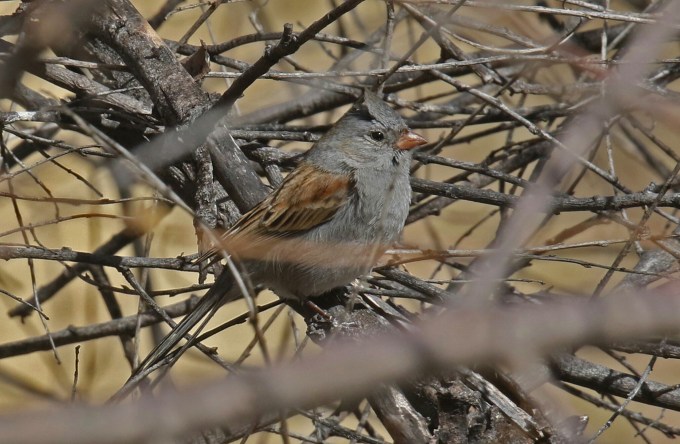
Indeed I spied my first Flicker as soon as I parked – but would be a Gilded Flicker or the also present red shafted version of Northern Flicker – both with red malar lines. A closer look in the brilliant sunshine showed first the cinnamon head and then the golden yellow underwing and undertail of my target.  I had a pair of Gilded Flickers and was able to call them in very close for super photos.

Gilded Flicker Male (Red Malar Line)

Gilded Flicker1 - Copy

Gilded Flicker Female (No Malar Line)

Gilded Flicker Female2-1 - Copy

There were lots of Gila Woodpeckers there as well as my first Verdin, Pyrrhuloxia and Phainopeplas of the trip.

Gila Woodpecker Coming in For a Landing

Gila Landing

I was disappointed not to get the Ruddy Ground Doves but I had REALLY wanted a photo of the Gilded Flicker – an ABA photo – so I was very pleased.  Now I was off for one of the potentially highlights of the trip.  A very rare Streak Backed Oriole had been coming irregularly to a feeder in Tucson.  Maybe I would be lucky.

There were two birders at the stakeout spot when I arrived.  One was local and the other was from Minnesota.  They had not been there too long – but they had not seen the Oriole either.  It had last been seen two days earlier.  We gave it an hour and did not see it.  It was a fun visit – but another disappointment.  Another Streak Backed Oriole was being reported along the Mexican border – a long ways off.  Maybe that would be another opportunity – but that is a story for my next blog post.  Looking at Ebird today, it appears that the Tucson Oriole was not seen again after February 3rd – that time two days before I looked.

An Ebird report listed two of my target species at Pena Blanca Lake – about 30 miles away.  Here was a chance for two ABA Life Photos – Black Chinned Sparrow and Louisiana Waterthrush.  One report had mentioned a boat ramp and that is where I parked and began my search.  Unfortunately I found neither bird.  As I was leaving I noticed a rough parking area at a different part of the lake and as I pulled in, two people were getting out of their car and heading out.  Their binoculars suggested “birders” and I caught up with them.  They were local and were familiar with the area and were also looking for the Waterthrush.  Apparently this was the “old boat launch” although it gave no appearance of being such – and this is where the bird had been seen previously.  Sadly even with their expertise and good eyes, we found no Waterthrush and no Black Chinned Sparrow.  I added Canyon Wren, Rock Wren, Blue Gray Gnatcatcher, Lark and Chipping Sparrow, Hutton’s Vireo, Acorn Woodpecker, White Breasted Nuthatch and Canyon Towhee to my trip list – but no go on the targets.
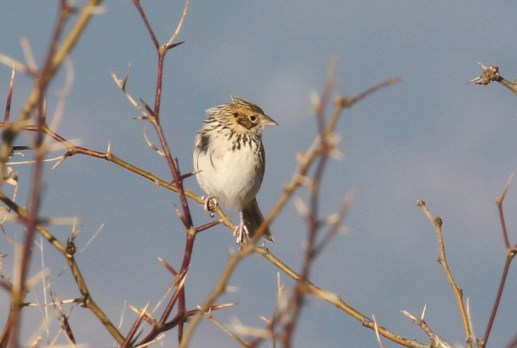
White Breasted Nuthatch

White Breasted Nuthatch-1

One more stop for the day – to the De Anza Trail off Santa Gertrudis Lane to try for a very rare and very hard to find Sinaloa Wren that had been seen there off and on for the past couple of weeks.  Everyone said this was a very challenging bird – very secretive and unresponsive to calls and playback, it could be at your feet in the thick leaf litter and not be seen.  More likely it was in leaf litter somewhere else along the mile of similar habitat along the river.  You had to be in the right place at the right time.

Cornell describes this rare bird as “a medium sized wren that is endemic to western Mexico. Its range has been expanding northwards in recent decades, however, and Sinaloa Wren now is a rare but regular visitor to southern Arizona (United States)…(it) inhabits the understory of tropical deciduous forest.”  As I was parking three other birders were getting out of there vehicle – also looking for the Wren but additionally hoping for Rufous Backed Robin and/or Rose Throated Becard – both of which had been seen in the area recently.  I would have loved to have seen either of those birds as well but had seen and photographed both last year so they were not a priority.  Indeed it was at this same location that I had seen the Becard on the Wings trip.

It could have been an awkward situation as this was a guided group.  The two birders were friends – one from North Carolina and the other from Minnesota.  The guide was Richard Fray – whose name I had just heard at Pena Blanca Lake – from the two locals that I had met there.  It was Richard who had reported the Black Chinned Sparrow and the Louisiana Waterthrush there.  I was allowed to join the group as “additional eyes” although I clearly was the one who was going to get the most benefit both from their additional eyes and from Richard’s expertise.

Without going into all the details, we worked very hard to try to find the challenging birds – and we were not successful.  We met someone who had seen the Wren that morning but had not been able to relocate it in the afternoon.  It was on his third attempt to locate the rarity that he had success.  I spoke to or heard of many birders who had been there that often or even on more attempts without success. We did have other birds – Black Phoebe, Bridled Titmouse, Hammond’s Flycatcher, Great Horned Owl, Yellow Rumped and Black Throated Gray Warblers among others.  The Black Throated Gray Warbler may have been the highlight for the two women clients as they are a Western species.  The Bridled Titmouse is always an appreciated species – even though common in this habitat.

Bridled Titmouse

Bridled Titmouse

So again – fun birding, good company and some nice birds – but disappointing not to find the targets or the rarities.  But this day would have a bonus.  I was very impressed with Richard’s knowledge and birding style.  He did not have a commitment for the next day.  Earlier he had taken these clients to a spot which had Baird’s Sparrows and they had found a Sprague’s Pipit – the only one reported in Arizona this year.  Both of those species were on my target list and he obviously knew about the Black Chinned Sparrow and Louisiana Waterthrush at Pena Blanca Lake.  I signed on for his help the next day.  That story will be in my next post.
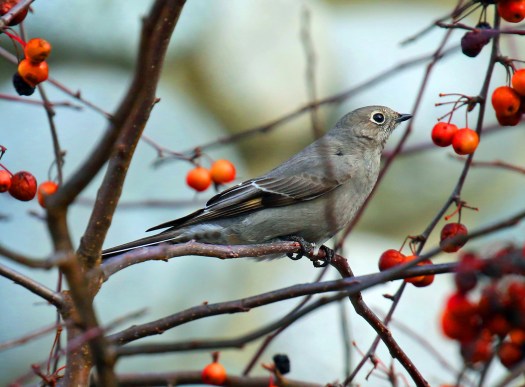


January 2018 – Looking Back – Looking Ahead – Looking at Myself

It has been a very full month.  My quest for 200 species in Washington in a Big Month was reached and passed.  As I have learned from other “numbered quests” or Big Years, even when a targeted number is reached, there is still the feeling – “well, since I won’t be doing this again and there is time left, let’s see what else I can do.”  Maybe that is a form of addiction – just NEED one more… Certainly it was a given that once I hit 200 species and there was time left – I would go for some more.  It is not really a competition – at least certainly not with anyone else.  Moreso it is a personal challenge – “is there more left in ME?”

As I have written before, these kinds of challenges provide a framework for my birding.  Maybe it would be better to just go out and enjoy birds and birding wherever without any specific plan or goal – just be in and enjoy the moment.  I have found that at least for me, having a target, a plan, a goal, a “project” brings me that same “in the moment” feeling but with some structure that not only does not get in the way but actually enhances each moment – whether there is a hit or a miss.  There is just a heightened awareness that is consuming and enjoyable.

Also as I have written before, birding is often a kind of distraction.  Being absorbed in my “birding projects” enables me to distance myself from other things – negative things that unfortunately are part of my life:  Being far away from my kids; imperfect relationships; no longer working – missing those challenges and those client intersections, and the challenges of “yet another deal”.  Probably also at times a distraction from things I should be doing including the mundane things like paying bills, doing laundry, shopping etc.  And maybe from some other not so mundane things – building friendships and relationships, writing that book I have thought about, finding new things to positively occupy my time and use my abilities.  I sure ain’t perfect.  If you are – please write that up with an instructional manual and share it.  But for all of that, months like this one are pretty darn good – not measured by birds seen – but by challenges met, places visited,  and especially people along the way.  Friends, acquaintances, birders and non-birders, a very wide ranging group – all with their imperfections, distractions, engagements, appeals and stories.

And in the end I believe finding stories is the goal – again repeating words previously used.  Life should be about stories – from our experiences and observations – and maybe sharing them – sometimes just again with ourselves and sometimes with others – in the field, on those long drives, over food and drinks, in blogs, posts, messages, calls (and yes for some but not for me – even tweets and selfies).  I have found that taking photographs of birds helps me tell my stories – certainly to others – but maybe more importantly to myself.  I revisit those pictures and remember.  From the perspective of stories, this has been a really good month.  I have chronicled and cataloged some in the blog posts for the Big Month.  But many others have not been shared – at least broadly.

Ten of many more than ten story snapshots:

(1)  Talking with Jim Shinn at the Cowlitz hatchery and learning that he “lost” the competition for Chris Anderson to Phil Anderson (of Westport Seabirds) “way back when” – and that he still loves them both.

(2) Deb Essman throwing corn to the waiting Wild Turkeys on that ranch in Ellensburg and having the turkeys flock in just like the rancher (a real character) said they would.

(3)  Finding out that the fly-fisherman at Rocky Ford Creek was one of the owners of a large Lavender Farm in Sequim and that he really wanted to see what bird was making that pig sound and how happy he was to see the photo of the Virginia Rail I had taken moments before.

(4) Seeing the look on the young boy’s face when I was finally able to locate a Short Eared Owl at the West 90’s and share it with him and his family.

(5) Talking with a lady that I expect is the owner of the Breadfarm in Edison about the bakery’s Kouign Amman pastry – an absolute delight – and their business.

(6) Meeting a photographer/birder at Juanita who was from Aruba and was on vacation and wanted more than anything else to get a picture of Wood Ducks.

(7) Watching Mike Denny tossing loaf after loaf of bread to the gulls at Lower Monumental Dam – and of course it was important to see if he could scale the next slice – even further.

(8) Showing bird pictures to many folks along the way including the hotel clerk in Walla Walla who was doing a night shift to earn money to help pay for her college – and who could not get over the fact that there were owls nearby.

(9)  Great times at feeder stake outs for Blue Jay, Western Tanager, Rose Breasted Grosbeak, and White Throated Sparrow – visits with the feeder owners and others who came to look for the birds.

(10) The MANY folks at gas stations, parking lots, parks, motels and restaurants who when they saw my camera and binoculars wanted to know if I was – a nature photographer, birder, journalist, researcher etc. and then almost no matter what my answer, the next question was whether I had seen “the Eagles“.  How do you properly explain that you have seen hundreds of Eagles and that you are looking for some far less charismatic bird?  You don’t.  You are happy for their enthusiasm and that conservation efforts have made Eagles so commonplace now.

Prior to this year, the most species I had seen in Washington in any January was 154 in 2015.  I originally set a goal of seeing 175 species and if that worked out well – pushing for 200.  Luck, work, the appearance of unexpected species and lots of help from others got me to 200 on January 24th.  On January 28th I saw my 208th species.  On the 29th, Jon Houghton and I tried for a Violet Green Swallow that had been seen at the Green River Natural Wildlife Area the day before.  Neither the weather nor the Swallow cooperated so I declared the Big Month project completed and I am writing this on the 30th.  No birding today.  If something “incredible” shows up today or tomorrow, sure I will go for it, but otherwise 208 it is and I am very pleased.

There were misses along the way and in retrospect I see how I might have “managed this project” differently.  If energy and luck had held, I think finding another 20 species was possible of which maybe 13 were just outright misses.  These include: Lesser Black Backed Gull, Say’s Phoebe, Burrowing Owl, Osprey, Ruffed Grouse, Pine Grosbeak, Sharp Tailed Grouse, Tricolored Blackbird, Yellow Headed Blackbird, American Pipit, Great Gray Owl and that Violet Green Swallow.  A trip to Neah Bay through Port Angeles might have added White Winged Dove, Black Kittiwake and Ruddy Turnstone.  If I were even crazier than I often appear, I could still try for one or more of these tomorrow – but nope, it’s just not going to happen.  And for the record, at least according to Ebird, 234 species have been seen in Washington this January.  Lots of opportunities – but it is a BIG STATE!!  And what about this “opportunity”?  If Westport Seabirds had scheduled their first trip for January instead of February (weather permitting in either case) who knows how many more species might have been seen.

So much for looking back.  What’s ahead?  Most importantly there is that as yet unscheduled trip to Boston to visit my daughter and son-in law and what will then be my first grandchild.  That will be the best trip of the year for sure and by far.  On the birding side, I have scheduled a trip to Texas in April and hope to get to Arizona sometime in the next couple of weeks.  Frank Caruso and I are trying to schedule a visit to North Carolina – head out on two pelagic trips with Brian Patteson.  Possibly another trip to San Diego – more pelagic birds and maybe some new ABA photos.  If all goes well, I can hope to add another 10 to 15 ABA life birds and another 25 to 35 ABA photos.  And I am sure there will be some additional Washington birds as well – but no goals now that January is done.

I also hope to meet many new great people and to see more of those with whom I have  already spent time.  And many thanks to many folks who have helped in the field and behind the scenes this month.  I could not have done it without them.  In alphabetical order they include:  Ann Marie Wood, Blue Jay Barry, Bob Boekelheide, Brian Pendleton, Bruce Labar, Carol Riddell, David Poortinga, Deb Essman, Frank Caruso, John Puschock, Jon Houghton, Mark Tamboulian, Max and Melissa Kingsbury, Melissa Hafting, Mike and MerryLynn Denny, Stefan Schlick, Steve Pink and Todd Sahl.  Apologies to the folks I have forgotten and thanks to everyone who posts on Tweeters and Ebird.

I have been asked a number of times about my “best” or “favorite” birds during this Big Month.  They have all been included in previous writings and are in “my top list” for varying reasons.  I will close with this group of ten – meaning no disrespect to any of the others.  There easily could be another thirty.

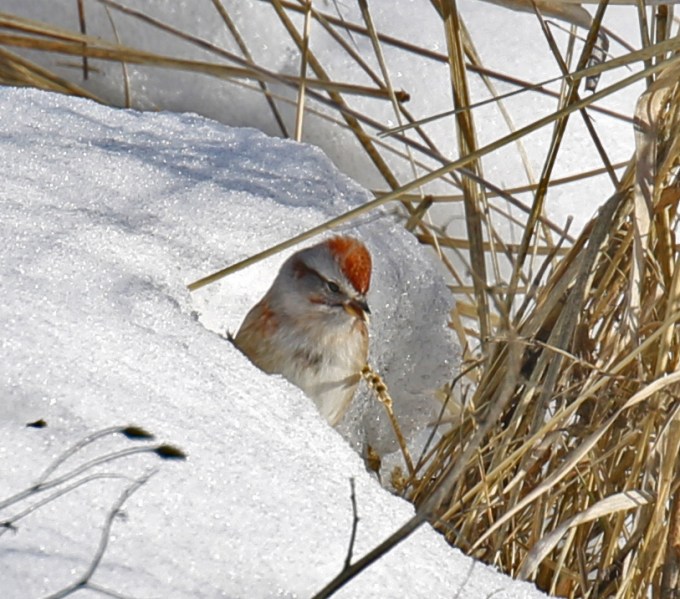
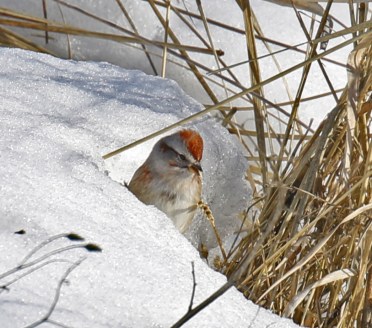
American Tree Sparrow and Blue Jay                                                                       

Gray Partridge and Long Eared Owl                                                         

Prairie Falcon and Rose Breasted Grosbeak

Ross’s Goose and Snowy Owl

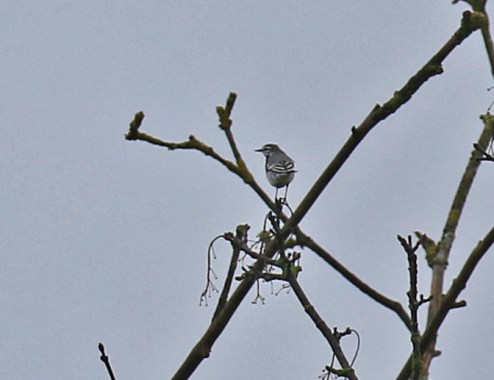
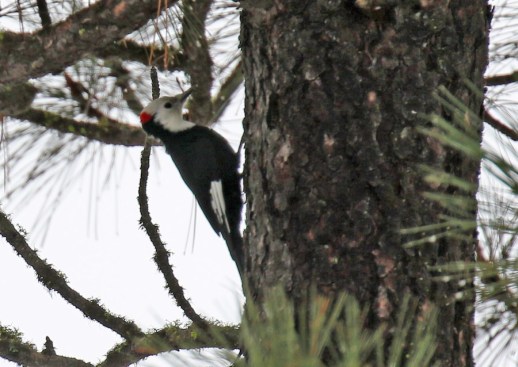
White Headed Woodpecker and White Wagtail


Goodbye January…Thanks for the Memories!!


The Last Week of January and of My Big Month

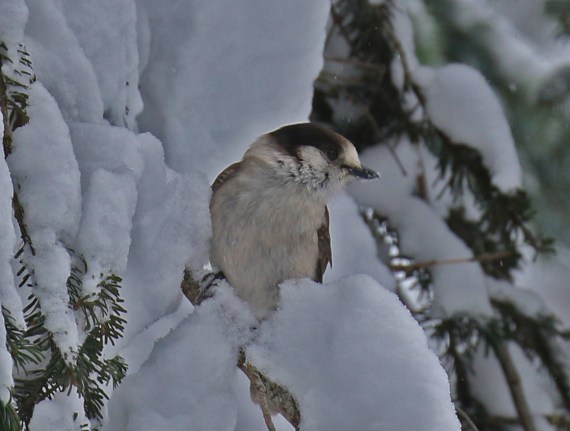
As I looked at the morning of Thursday January 25, I was feeling good about passing my goal, but even though the successes earlier that day had outweighed the failure of finding the White Wagtail on the previous day, I still felt like I wanted to end my “project” on an up note.  I considered going back to Neal Road to see if just maybe the Wagtail would return but if it had not more hours of standing around would compound the negative feeling.  I felt positive though and thought I would use that good feeling to try to make up for another miss.  I decided to look for a Gray Jay at the Stevens Pass Ski Area – atoning for missing them in the Okanogan.

I had never been to the ski area before and I was definitely out of place as I walked among the hundreds of skiers and snow boarders – looking for a bird and playing the Gray Jay call on my cell phone – and armed with some potato chips to entice a Jay closer if I found one.  I had walked around for maybe 20 minutes and had seen only a single Raven.  I saw someone with first aid gear who looked official and assuming he was a regular, I questioned him about whether he had seen any on the mountain.  He said they were common at the top of the lifts and would eat right out of the operator’s hands.  As I was considering whether that was an option, I saw a medium size bird fly into a pine near one of the buildings.  I thanked the guy for “helping me find one” and went off to try to get a better look.  It flew off but I was able to follow it and get a good look and a reasonable photo.  Happy, I started for the parking lot.  And…on the way two Gray Jays flew in close and I got a MUCH better photo.  I was now at 203.

Gray Jay

Gray Jay

On the way home I checked Ebird for any exciting reports and there were none – until I pulled into my garage and saw that indeed the White Wagtail had reappeared .  It was too late for a reasonable attempt but I determined that would be my quest the following day.  So joined by Sherrill Miller and Frank Caruso, it was back to Neal Road the following morning.

To make a too long story short, it took over four hours to finally get a view – fleeting but definite of the White Wagtail.  We finally had moved over to the 19th Avenue viewing spot and that was the key.  It flew in and perched for only a few moments – just long enough to get an ID quality photo.  A White Wagtail is a prized bird south of northern Alaska – very rare in Washington – and while yes it was species #204 for my Big Month, more importantly I now had a photo of one in Washington – my 403rd such in the state and now there were only 11 species in the state I had seen but not photographed.  Frankly I had never expected to remove this one from that list.

White Wagtail

White Wagtail

January 27th – now what?  Go to the Coast for shorebirds or – really Blair? – back up to Skagit County and try yet again for a Gyrfalcon or American Pipits.  How about both?  I hatched a plan.  I would give the Gyrfalcon ONE MORE TRY and then the next day I would do something I had put off  for too long – I would head down to Seaside, Oregon and try to get a photo of the Steller’s Eider that had been there for several weeks now.  It wouldn’t count for my Big Month – wrong state – and it would not get my “photos missing in Washington” list down to 10 – again the wrong state.  But it would be a new ABA Life Photo – one that was not at all likely ever again unless I returned to northern Alaska.  And if I were lucky, I might be able to hit the Washington Coast and try for Semipalmated and Snowy Plovers.

Back on Fir Island, I was torn between looking down on the ground for Pipits or up in the trees and poles and the sky for a Gyrfalcon.  I went to places I had already been numerous times this month and just as in each of those visits – no Gyrfalcons and no Pipits.  Then I noticed some movement of smaller birds in a field at the corner of Maupin and Fir Island Roads.  The birds were shorebirds – a mix of Dunlin and Black Bellied Plovers, 40+ of the first and 70+ of the latter.  Suddenly as I was taking photos, there was pandemonium and all the birds took flight.  This generally means a raptor is around and in a flash a large falcon strafed the group and picked off a Dunlin.  It was a young Gyrfalcon – powerful and very fast.  I could not get on it as it flew off with its prize but FINALLY I had seen one of the Skagit Gyrs.  I continued my birding still hoping for some American Pipits or maybe refinding the Gyrfalcon.  No luck – but Gyrfalcon was no longer on my “missing” list.  Instead it was #205 for the Big Month.  I also just simply enjoyed looking at the “regular” birds of the area – Trumpeter and Tundra Swans, Bald Eagles and Snow Geese.  The numbers there are amazing.

Snow Goose

Snow Goose

Tundra Swans

Tundra Swans

It is about 210 miles from my Edmonds home to the Steller’s Eider’s temporary home in Seaside, Oregon.  Just under 4 hours.  On the morning of January 28th, I left early – just about 5:00 a.m. and hoped to get there around 9:00 and hopefully find the Eider by 10:00 – leaving me time to get to the Washington Coast, but I was ready to remain in Seaside as long as it took.  I had excellent instructions from Melissa Hafting who had seen the Eider earlier this month.  I parked and walked to the beach, looking for the transmitter antennae that marked the area where the Eider had been hanging out.

It took less than 2 minutes – the first bird I saw was the Steller’s Eider – close in and associating loosely with a small group of Surf Scoters.  Somehow after the long wait(s) for the White Wagtail, this seemed “only fair” although I knew it didn’t work that way.  I took a few photos, watched for a couple of minutes and left.  I gave a well received “thumbs up” to birders who were heading out to the spot hoping for the rarity.  I would have plenty of time for the Washington Coast although there was still another two hours of driving to get there.

Steller’s Eider

Steller's Eider

The route from Seaside to the coast took me across the mouth of the Columbia River over the Astoria Bridge.  It is astounding just how wide the river is – an impressive sight.  My first thought had been to drive directly to the Warrenton/Cranberry access road to the beach.  Driving on the open beach – something I always enjoy would hopefully get me one or both of my targeted Plovers.  Since I passed right through Tokeland, I decided to first take the small detour down to the Tokeland Marina to see it any Willets were around.  This is the “go to” spot in Washington for them – at least in the summer and fall.  I had already seen one – barely – in Sequim earlier in the month, but it would only take maybe 30 minutes.

At the Marina I quickly located two intermixed flocks of shorebirds – 19 Willets (the most I had ever seen) and 14 Least Sandpipers.  Again neither was new for the month, but these were superior views and superior photos.

Willets

Willets


Least Sandpiper

Least Sandpiper

There were also quite a few gulls in the Marina – nothing special.  AND – there were also two Grebes with long necks.  One was clearly a Western Grebe – black of the cap completely enclosing the eye and a greenish bill.  The other – completely unexpectedly – was apparently a Clark’s Grebe – the eye outside (almost completely) of the dark of the cap and a bright orange bill – a new bird for the month.  Visiting the Marina was a good decision resulting in #206 for the month.

Western Grebe

Western Grebe

Clark’s Grebe

Clark's Grebe 2

I hit the beach and began my search for shorebirds.  There were two problems.  First the tide was fairly low, so there was a lot of beach, and second it was VERY windy with sand blowing all around.   I found small groups of Sanderlings and Dunlin quickly but no plovers.  I then drove as far south as I could go and found a single Snowy Plover flying fast in the heavy wind.  There was no hope for a photo but this really is a favorite little bird so I include a photo from the same area from a wind free earlier visit.

Snowy Plover

Snowy Plover1

I turned north and when I hit some water that was a bit deeper than I wanted to challenge, I returned to the highway and then came back to the beach from a more northern access point.  Now I found hundreds of shorebirds on the beach – a small group of Black Bellied Plovers and 400+ Sanderling, and I estimated as many as 3000 Dunlin.  Near the Bonge Road access I saw two small dark brown backed shorebirds with short bills flying against the wind right at the surf line as I was heading north with the wind.  I could make out their partial neck/breast bands – definitely two Semipalmated Plovers.  I did a u-turn and raced back down the beach hoping they would land.  They did not and were soon out of sight down the beach.  I was satisfied with the identification and thus with the results of my visit to the beach – both targeted Plovers – Big Month species #207 and #208.

I scanned out to the open ocean hoping that maybe the winds would have blown in a Shearwater – no luck.  I visited the Westport Marina and jetty – hoping for – well whatever.  Nothing new.  It had already been a long day and I had another 2.5 hours to go to get home.  Time to call it quits.  The only thing that could have made it better would have been for the Steller’s Eider to have been in Washington.  It was ABA photo #635.  A week that included that photo and the photo of a White Wagtail was quite a week indeed.


The Big Month – Crossing the Finish Line – and Keeping Going

Continuing from my last post, an unexpected Ebird report made my decision for January 24th pretty easy.  Bill Tweit and Whittier Johnson had reported seeing some Western Bluebirds at Sanderson Airfield in Shelton, WA.  At the beginning of this quest, I had felt there was a remote chance to see Western Bluebirds.  The earliest I had seen them was in March but I knew that some birds over wintered and in fact they were a possibility on my Walla Walla trip.  What was more important here, though, was a good itinerary now took form – try for Mountain Quail in Port Orchard, try for the Bluebirds in Shelton, try for a Palm Warbler in Hoquiam and then head to the coast if time permitted.

So I was on the 7:10 ferry from Edmonds to Kingston and arrived at “the quail spot” adjacent to the Port Orchard Airport at 8:15.  Brian Pendleton and I had Mountain Quail here, and also at the Port Orchard Quarry just a little further on in the past and Brian and his wife Darchelle had some at this spot earlier this month.  It was pretty gray still but I would certainly be the first person at the spot and I hoped to find some quail in the brush.  Sure enough about 5 minutes into my walk two Mountain Quail sounded their “querk” calls as I flushed them and they were off to even denser cover.  If a photo had been important I probably would have tried instead in “Quail Mary’s” (Mary Hrudkaj) neighborhood, but a photo was not needed for this purpose – just the confirmation.  I let out my own variation of a “querk” call when the Mountain Quail brought me to 200 species for my Big Month – and I also gave a sigh of relief.  Everything now would be icing on the cake!!

It was less than an hour to Sanderson Field.  The Ebird report said they had been seen with Robins along the “airport fence line”.  The problem was that there were fences everywhere including along places where the roads were closed or gated.  Which fence line?  I drove them all and saw basically no birds at all.  I tried one more area – an industrial park adjacent to the airfield and saw a flash of blue flying from the ground to a tree.  More flashes and more blue as five Western Bluebirds flew from ground to trees to fence lines.  Pictures captured these beauties – and I was now into bonus territory and had species #201.

Western Bluebird

Western Bluebird1

Western Bluebird

It was another hour to the Hoquiam STP where the Palm Warbler had been found by Alex Patia.  Just as I cleared Aberdeen and was midway through the dismal city of Hoquiam, I got a call from Ann Marie Wood.  A White Wagtail had been found at the Neal Road location where the Rusty Blackbird had been seen two days earlier.  Yikes!!  White Wagtail is EXTREMELY rare in Washington.  I saw one at Fort Casey in Washington almost exactly 34 years ago – on January 21, 1984.  It is one of only 12 species I had seen in Washington for which I had no photo.  It was 128 miles from Hoquiam to Neal Road.  It was almost 11:45 a.m.  If I turned around instantly I might get there by 2:15 that afternoon but that would mean no Palm Warbler and no coast birding.  Time for an executive decision.

I was very close to the STP so I elected to try for the Palm Warbler and then think it through.  I turned onto Paulson Road – came to its end and parked at the turnout next to and between the two ponds – the purported Palm Warbler location.  I pulled out my phone and played the chip note – watching the brush between the ponds where it had been seen.  There was an immediate response – from behind me.  I turned to find a very demonstrative and very beautiful – and very welcomed Palm Warbler in the trees behind me.  It came right out and was pumping its tail vigorously.  Snap, snap – photos and Big Month Species 202 was mine.  It had taken all of 5 minutes from the time Ann Marie had called.

Palm Warbler

Palm Warbler1

I figured the odds on seeing the White Wagtail were lower than seeing a Snowy Plover – and neither was guaranteed.  For purposes of my Big Month, they were the same – one more bird.  But there really was no comparison – the chance for a new state photo drove the decision.  I turned and raced to Fall City.  I will not share the exact amount of time it took, but let’s just say I beat the Google Maps projected time — significantly.  Other birders were there when I arrived – but the Wagtail was not.  More birders arrived – it was a fun social event – but it would have been a lot more fun if the White Wagtail had made an appearance.  It did not.  I located the Rusty Blackbird again and showed some others – that was nice – but not as nice as seeing a Wagtail – or heck even a Snowy Plover.  Worse yet, it was now late and the traffic back to Edmonds was awful.

There was of course disappointment – but somehow it hardly mattered.  It had been a fabulous day – the Mountain Quail for #200 was fantastic and adding both the Western Bluebird and Palm Warbler – completely unexpected a few days earlier – felt extra good.  It was like having an ice cream sundae with whipped cream – and nuts – and chocolate sauce – so what if there was no cherry on the top.

Closer – Closer – Oh So Close

January 20th was a much needed day of rest – allowing me to catch up on bills, cleaning, blog posts and some sleep.  I had gotten to 194 species – and only needed 6 more for my Big Month goal.  The problem was that there were no longer spots with multiple probabilities.  There were lots of possibilities left out there but seemingly few sure things.

Way back on January 6th I had picked up a few birds on Camano Island, but I had missed one as well.  A Townsend’s Solitaire had been reported on Maple Grove Beach Road.  I had not been able to find it.  It had been seen often in the following two weeks and it was time for another try – especially now that I had some more specific information about its favored spot. I arrived just after noon on the 21st and parked across from its two favorite berry-laded trees.  It wasn’t there but if still around, it would probably come in to feed.  Not long after I arrived I thought I heard its whistled call down the street.  I played it on my bird songs app and hoped it would fly right in.  It didn’t but I felt it was only a matter of time.  I had parked such that while I had a view of both trees, one was a little behind me and required me to swivel to check it – which I did periodically.  I had not seen it fly in, but on my third swivel, there it was feeding and mostly in the open – begging for me to take its picture.  Who was I to deny a request from a cooperative bird?

Townsend’s Solitaire

Townsend's Solitaire

Timing and good luck matter.  No more than two minutes after finding Bird of the Month #195, people came out of the house behind the tree and went to a car parked next to it.  Apparently one couple had been visiting the other and now they were leaving and saying goodbye.  This action also was a goodbye for the Solitaire and it flew off over the house and towards the area where I had first heard it.  My timing had been good indeed.  One down and five to go.  I gave the Skagit and Samish flats area yet another go trying for the Gyrfalcon that seemingly everyone but me had seen there.  No go yet again.

The next day I planned to go to Tacoma to try for Least Sandpipers at a spot Bruce Labar had given me but there was another option as well.  A Rusty Blackbird had been seen at the end of Neal Road along the Snoqualmie River.  Rusty Blackbirds often hangout with dozens or even hundreds of their cousins – Red Winged and Brewer’s Blackbirds, Starlings and Brown Headed Cowbirds.  It can be very hard to find in a a moving mass of black.  This one was no exception but the flock seemed smaller and besides I “needed” another “tick” on my list and this species had been on my “high hopes” rather than “highly likely” list of possibilities – a bonus bird so to speak.  I figured I would try for the Rusty first and then head to Tacoma further south.

Fortunately others were already at Neal Road when I arrived.  It took a while but finally it was spotted, first by Marv Breece, high up in one of the two trees that the flock seemed to favor.  Nothing like the extraordinary closeup view last year of a Rusty that visited some salt on a parking lot near a Home Depot in Bellingham, but good enough for a distant photo and a positive ID of Bird of the Month #196.

Rusty Blackbird – Neal Road

Rusty Blackbird1

Rusty Blackbird – 2017

Rusty Blackbird

Time for an aside.  I have made the adjustments in the preceding blog posts so that the numbers are correct, but when I awoke on the morning of the 22nd and headed off for the Rusty Blackbird, I thought I was already at 196.  But before taking a step forward, I took a step backwards.  I left it out of my blog post on the Walla Walla trip but Mike Denny and I thought we had a first cycle Glaucous Gull at Lower Monumental Dam.  I got some good photos but the light was a bit tricky and may have overemphasized some features.  In any event that morning I got word from an Ebird reviewer that our bird was NOT a Glaucous Gull.  Maybe if it was January 31st and it would have made the difference between 199 and 200 I would have counted it anyhow – that was Mike’s reaction.  But I felt there was still time and I removed it from my list and thus went backwards.  As I said the Rusty Blackbird had not been on my expected list so maybe everything was just balancing out.

And besides…a Glaucous Gull was being seen at Gog Le Hi Te in Tacoma so there was a chance to make it up.  That was my first stop in Tacoma.  Finding a Glaucous Gull there means going through dozens or even hundreds of gulls on rooftops of industrial buildings with a scope.  I had just done the “blackbird” equivalent of that to find the Rusty Blackbird – definitely not my favorite kind of birding.  But this time I was lucky, when I arrived, two birders were looking at the Glaucous Gull through their scope.  All I had to do was take a look to confirm.  Okay – a step back, a step forward and now another step forward and I was at #197.

I am not real familiar with Tacoma and often get confused finding niche birding spots along the river or at the Bay usually after wending my way through heavy duty industrial areas.  Bruce’s spot for Least Sandpipers at the end (well sort of) of Alexander Road was no different.  Despite great directions, it still did not seem right when I arrived.  I expected the Least Sandpipers to be on some mud exposed at low tide.  There was a small patch of mud with no birds and lots of rocks and rip rap.  This could not be the right place.  But I had come this far and figured I would explore.  A good decision.  I trudged through some debris and came upon a concrete slab angled into the water.  There were lots of gulls and as I looked closer, I could see some smaller birds skittering about.  Shorebirds – and not Dunlin – these were Least Sandpipers.  Thank you Bruce.  Fourteen of them made for species #198 for the month.  It was an important one because it had been on my “sure thing” list but I was not sure where I would find them.  There were lots of other places to try – but now I did not have to look anywhere else.

Least Sandpiper – Pale Legs, Short Bill and All

Least Sandpiper

It was not yet One o’clock but there really were not any options to pursue for more birds so I headed home before traffic got bad.  Despite a disappointing start losing the Glaucous Gull from Walla Walla, it had been a great day – regaining the Gull, picking up a surprise and adding a sure thing.  I needed two more birds and there were still none days to get them.  Things were looking good.

There are lots of ways I could describe Ann Marie Wood – a trooper, tenacious, positive, tough minded, etc.  I could also describe her as a good birder and a good friend.  I sent an email out on the 23rd to see if anyone wanted to join me for yet another try to find a Gyrfalcon and hopefully some American Pipits in the Skagit/Samish areas – possibly numbers 199 and 200 to reach my goal.  Others were otherwise committed and Ann Marie was game.  I did not know it at the time but this day was also her 80th birthday – yet she was giving me the gift of joining forces.

It would be nice to say that for “her” birthday I got two birds as a gift and hit 200, but not to be.  We spent hours and many miles driving every road in the areas where the Gyrs and the Pipits had been seen – again nothing.  The highlight was a stop at the Breadfarm in Edison.  It is marvelous – everything is fantastic and there are simply too many temptations.  At least I was able to give Ann Marie a birthday treat – a Kouign Amann – one of the specialties of this artisanal bakery.  It is a Breton pastry that has it all: tons of butter, sweet caramelization and a good bit of salt, like a salted caramel in pastry form.  She had never been to the Breadfarm or had one of these delights.  I am sure she will be back.

Ann Marie is a very committed County birder – especially for Snohomish County – and she knew some spots where we had a good chance to add a Spotted Sandpiper and maybe a Semipalmated Plover to get me to or closer to 200.  At Priest Point where she has had one for several Christmas Counts, Ann Marie said the Spotted Sandpiper could be anywhere on the shore.  I stepped up onto a high spot to get a better look and right on cue a Spotted Sandpiper flew up and off – its shallow wingbeat a giveaway.  Now at #199 I was oh so close.  The Semipalmated Plover did not cooperate in Everett but now I knew a good spot to keep trying.

Thanks to Ann Marie, I was on the brink of success.  When I went home I wasn’t sure where I would go next – the coast for Semipalmated or Snowy Plovers, Port Orchard for a Mountain Quail or Stevens Pass to try for a Gray Jay.  I was feeling confident.  Once again an unexpected Ebird report made my decision easy…but that is for the next post.

The Big Month Continues – On to the Okanogan

My visit to the Okanogan in late December had been less successful than I had hoped.  Recent trips by others had been terrific perhaps aided by additional snow accumulation.  I was optimistic and hopeful, but the temperatures had warmed and some snow had melted.  I really was not sure what to expect.  I left Ephrata early on the morning of January 19th and headed towards Mansfield on the Waterville Plateau.  Fortunately the fog cleared and I started looking for Snow Buntings and Partridge.  Near Heritage Road (Road L), I found my first Snow Buntings and at their “regular spot” I found 5 or 6 American Tree Sparrows.  I had seen the latter with the Dennys earlier, but the Snow Buntings were new – and a “must” for this trip.

Snow Buntings  (#190) 

Snow Buntings

No Partridge anywhere.  Next I was on to Bridgeport Hill Road where I hoped to find Sharp Tailed Grouse.  There were none there and also none at a nearby place that was a potentially good spot.  There would be other chances, but this was a regretted miss.  It was on to Cameron Lake Road.  In December there had been so much fresh snow that I was not able to drive the entire road.  But on the small portion that I did drive I had Snow Buntings, Gray Crowned Rosy Finches and Common Redpolls.  There was far less snow now and in fact most of the road was clear.

About 7 miles in, from the southern end of the road. I came upon a Seattle Audubon Trip that was led by Stefan Schlick.  I met up with them 5 minutes too late.  They had just seen a Gyrfalcon.  They had watched it for some time and it had flown off.  I joined them as they continued on hoping for more looks.  We did not see it again.  This was now the second time this month that I had missed this prized bird by just a few minutes.  A bonus though was that Stefan told me about a good spot ahead for White Headed Woodpecker – “where the flag is over the road.”  Before getting to that spot I had a Northern Shrike, a Golden Eagle and a huge flock of at least 300 Snow Buntings – about 100 yards off the road.

It was impossible to miss the “flag spot” as someone had strung a cable across the road supporting  a large American flag.  I stopped, got out of the car and played the call and the drumming sound for White Headed Woodpecker.  Instantly first one and then another appeared – one flying directly over my head and not far from it.  A bit later a third appeared.  These woodpeckers are always a favorite and they were new for the month – #191.

White Headed Woodpecker

White Headed Woodpecker

Nothing else new on Cameron Lake Road and having seen American Tree Sparrows earlier I did not even stop at “their spot” on this trip.  I went on into Omak and then headed up towards Conconully.  Just out of town a dark Merlin flashed by me – far too fast for a photo but maybe a good omen.  Less than a quarter of a mile later on Epley Road, I saw a large flock of birds in a bare tree across from a small orchard.  Usually such flocks are Blackbirds or Starlings, but this was the Okanogan and there are other possibilities.  When I pulled off the road and got by binoculars on the flock, it was quite apparent these were one of those possibilities – a very large flock of Bohemian Waxwings – 130 birds or more.  I had seen this species earlier in the month, but this was truly a spectacle as they flew from tree to ground and then circled and then repeated the performance.

Bohemian Waxwing

BOWA

Bohemian Waxwing Flock (A small portion and with a few Cedar Waxwings)

BOWAs

I continued on towards Conconully with my first stop being at the pasture where I had “missed” the Gray Partridge found there by Jon Houghton a week earlier when I visited in late December.  Missed them again.  Then I spent a lot of time searching for Sharp Tailed Grouse in the Scotch Creek area and on Happy Hill Road.  I had the grouse there on my December trip but only in the early morning – there were none now at midday.

When I planned this trip, I had counted on Gray Partridge and Sharp Tailed Grouse and had hoped for Gyrfalcon.  I wasn’t doing well with these “needed” species.  I had also planned – indeed almost counted on both Gray Jay and Clark’s Nutcrackers in Conconully.  Others had seen them there recently.  Two more misses despite very diligent searching and almost constantly paying various calls for both.  Thankfully though I got a coveted consolation prize as a small flock of Gray Crowned Rosy Finches flew over head and could be identified both by the quick look and also by their calls.  No photos but I was now at 192 for the month.

It was now on to the Highlands and a stop at Fancher Road.  I may have been there before, but I did not recall it.  The ABC Group from Tacoma had had large numbers of both Chukars and Gray Partridge in the cattle pastures.  I was stunned when I reached the area.  There seemed to be Chukars and Partridge everywhere.  In that “stunned” condition though, I confused the two species and thinking that Chukars are usually even harder to find than Partridge, bypassed photos of the Partridge which I had seen first and took MANY of the Chukars thinking I had finally gotten photos of Gray Partridge.  By the time I figured this out, the Partridge had retreated to the hills while dozens of Chukars and even more California Quail remained.  (Stay tuned – there will be more to this story.)

Chukar

Chukar1

Well at least I had finally seen some Gray Partridge and my Big Month count stood at 193.  I headed off to the Havillah Sno Park Area hoping for a Great Gray Owl.  I have only seen one there once, but it is a good area for them.  But not today – and it did not help that this was the one area that was buried in heavy fog.  An owl would have had to have flown right in front of me to see it.  I decided to come back later at dusk and hope the fog had cleared.  I went on to Nealey Road.  I had heard that the feeders were still inactive the previous week, but I hoped that was old news.  It wasn’t.

In the past there have been many birds at the feeders – Rosy Finches, Waxwings and Redpolls among them.  There were birds today despite the absence of seed, but nothing extraordinary.  I got a nice photo of a Mountain Chickadee which shared a tree with a Black Capped Chickadee and then one of my favorite photos ever of a Hairy Woodpecker.

Mountain and Black Capped Chickadees

Hairy Woodpecker

Hairy Woodpecker

Just as I readied to leave I heard some chatter notes.  I had been playing this call earlier in the day and could hardly miss the sound of a Clark’s Nutcracker.  At least one and perhaps a second called from the hill behind the Nealey cabins.  I could get a glimpse in the distant trees – just enough to be sure they were not Black Billed Magpies mimicking the Nutcrackers – so at least one of the earlier misses was erased and I now had 194 species for the month.  I returned to the Havillah Sno-park.  There was less fog but no owls appeared, so it was off to Omak for the night.

An early start the following morning had me at Scotch Creek so early I could see almost nothing.  Two shadows in some Water Birches unfortunately late proved to be Great Horned Owls and not Sharp Tailed Grouse.  More searching as the light improved also improved by still obstructed view of the Great Horned Owls but produced no grouse.

Great Horned Owl

Great Horned Owl

Sharp Tailed Grouse had been on my “near certain” list and was an important find.  I was concerned.  The ABC Group had found some on Siwash Creek Road – near Fancher Road and the Havillah Sno-Park, so that became a priority.  I headed East via the Riverside Cutoff Road.  No Golden Eagle as I had in December, but at a spot I had had one before I found a Canyon Wren – singing its lovely descending note song.

When I stopped at Fancher Road again, I had even more Chukars – maybe as many as 80 – but no Gray Partridge at all.  Now I was worried that my error of the previous day might mean that I would get no Partridge photos.  But again, stay tuned.  Siwash Creek Road was perfect Sharp Tailed Grouse habitat and unlike at other good spots, here the Water Birch were close and at eye level.  Grouse, if present, would be readily seen and readily photographed.  Sadly, as far as I could tell – they just were not present.  Missed again.

I made another pass at he Sno-Park – fog-less, people-less and owl-less.  Time to head back home with another drive of Cameron Lake Road hoping that somehow the Gyrfalcon might give me the privilege of a view.  This time I did not stop for the White Headed Woodpecker, but I did stop at the copse of trees that were good for American Tree Sparrow. I found at least 9 and got a new favorite photo of one.

American Tree Sparrow

American Tree Sparrow in Snow

Also along the road, I had a Golden Eagle, a Northern Shrike – and to complete the story – finally – some photo friendly Gray Partridge.  I breathed a sigh of relief.  But not complete relief as I never saw a Gyrfalcon.

Gray Partridge

Gray Partridge

I tried once more and failed once more to find any Sharp Tailed Grouse along Bridgeport Hill Road – the major disappointment of this trip.  So no new birds this day.  I had done OK for the trip but not great.  My total for the month was at 194.  Including the prelude to the Okanogan, I had added 11 new birds – honestly about what I had originally expected but I had not expected some of the birds I did see and I definitely had expected two I did not – Gray Jay and Sharp Tailed Grouse.  And yet again missing a Gyrfalcon was a downer.  But when I finally got home – very tired – I was optimistic that 200 was reachable – just not sure exactly how.