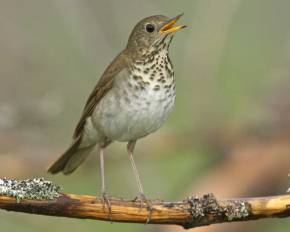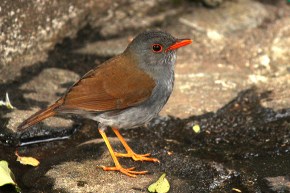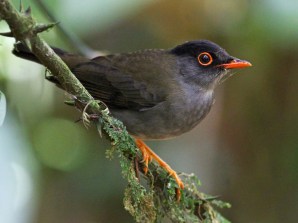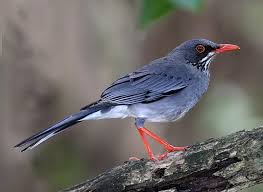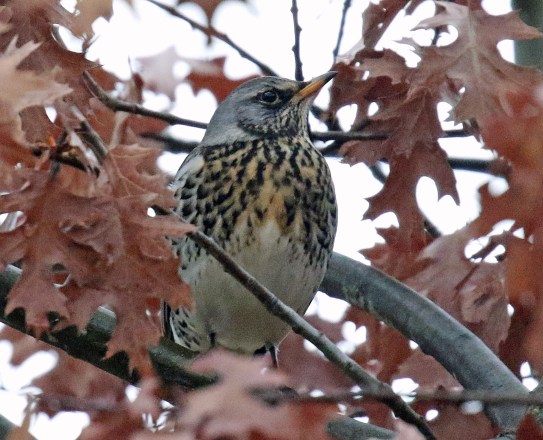
The South Carolina Lowcountry and the Beaufort CBC

The Connection

The pelagic trip out of San Diego on August 19 this year has already been featured in one of my blog posts (https://wordpress.com/post/blairbirding.com/21064).  As I wrote there, I had many frustrations, but there were many great birds including 4 Lifers, but for the purposes of this post, it was the great people – one in particular – that were more important.  Among those on board were 8 birders doing Big Years of one sort or another.  They include the top 6 ABA lists for 2018 with the other 2 being within the top 11.  Another birder on the boat was Ken Scott from Beaufort, South Carolina.

We had only a brief intersection onboard that was interrupted by the appearance of a Red Footed Booby.  But I remembered that he was from South Carolina, so when I was planning my visit there as part of my 50 States adventure, I hoped we might intersect again.  I found an email address and contacted him and it worked out perfectly to be able to join him for a day of birding on the Christmas Bird Count in Beaufort County, South Carolina – midway between Charleston, S.C. and Savannah, GA the two cities I wished to visit birding near each as part of my project.  Ken felt there was a really good chance to get 50 species on his CBC especially if I birded his area in the morning and then went with a different team to a different habitat area in the afternoon.  So my plan was to fly into Charleston and combine some sightseeing with some birding before joining him.  This area stretching from just north of Charleston to the Georgia border is called the “Lowcountry or Low Country” – a geographic and cultural region along South Carolina’s coast, including the Sea Islands with many resorts and beautiful sandy beaches.

Charleston to Beaufort

Before the Count – Charleston to Beaufort

Charleston was founded in 1670 and grew as a seaport with a healthy economy from that activity and the cultivation of rice, indigo and cotton.  The wealth brought the development of many historically and architecturally significant homes and buildings. In April 1861, Confederate soldiers fired on Union-occupied Fort Sumter in Charleston Harbor, beginning the Civil War.  The War brought significant damage to the City but the preservation and reconstruction of the old homes and buildings became a foundation for a thriving tourism – the major driver in its economy today.

My plans to spend a lot of time in the Old City were dampened – literally – when torrential rains and surface flooding came on my first day.  Plan B was to do some birding in the morning and hope it would clear for tourism in the afternoon.  I headed to Fort Moultrie (pronounced “Mool – tree”) National Monument dating back to Revolutionary War days and continuing as a fort in the Civil War.  More than 3 inches of rain fell that morning and I made good use of both rain pants and parka.  I was greeted by a flock of White Ibis on the grass by the Fort and found a number of passerines as I walked the grounds.  The Fort was on the water and this produced a good mix of birds as well including a surprising Black Scoter.  Even in the poor conditions, I had 35 species including hearing a Clapper Rail and seeing a pair of American Oystercatchers.  I had picked up 5 other species before even getting to the Fort

White Ibis – Adult and Juvenile

White Ibis White-Ibis-Immature-.jpg

It was 11:00 a.m. and still pouring.  Coming onto Sullivan Island to get to the Fort I had crossed a causeway and had noticed some shorebirds.  Having found many more species than expected at the Fort,  I thought it might be possible to make a stop on the causeway and maybe one more spot and actually get to 50 species for the day and then hope it would clear for some time in the City.  I added several shorebirds on the Causeway.  Four to go.  An Ebird Hotspot called the I’On Rookery was nearby and promised some ducks and maybe a few passerines so off I went.

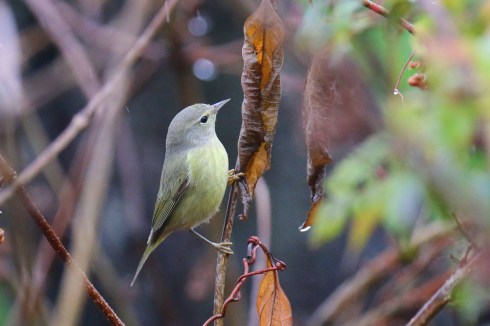
It turned out to be one of my favorite stops.  I added seven species to get over 50 for the day (removing any concern about doing so for South Carolina) including a Blue Headed Vireo, one of my favorites, and a very nice Orange Crowned Warbler.  It was good that I found them because there were only two species of waterfowl and I had expected a few more.

Blue Headed Vireo

Blue Headed Vireo 2

Orange Crowned Warbler

Orange Crowned Warbler1

The birds were nice, but the real appeal was that the pond I visited was in the center of a beautiful planned community of lovely homes and beautiful landscaping.  It was extremely well done and as attractive as any I have seen anywhere.  I later found out that the homes were quite expensive – certainly for the area or for my preconceived notions of housing costs in South Carolina.   Even without large lots, home prices began at $1.3 million and some were substantially higher including the ones in the photo below which were located on the pond. They would have been much higher still in Seattle.

I’On Village Pond and Homes
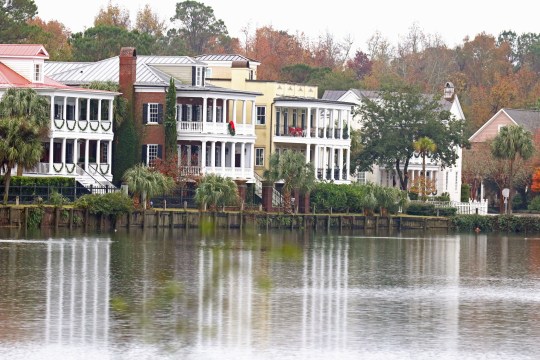
I'On Pond

The rain had slowed and I headed into Historic Downtown Charleston.  I did not go into any of the old mansions but walked through the Historic Market and enjoyed the streetscape.  I did make sure to visit Christophe Artisan Chocolates.  Earlier I had discovered this great chocolatier when Pat Lueders took her Naturalist Journeys group to Charleston.  I arranged chocolates to be delivered to her while she was there as a thank you.  It worked very well and I wanted to personally thank the folks there for their efforts.  It also allowed me to get a wonderful almond croissant for myself, too.  The shop was amazing – beautiful pastries and chocolates – yummy, too.

Christophe Artisan Chocolates and Cafe – Truffles
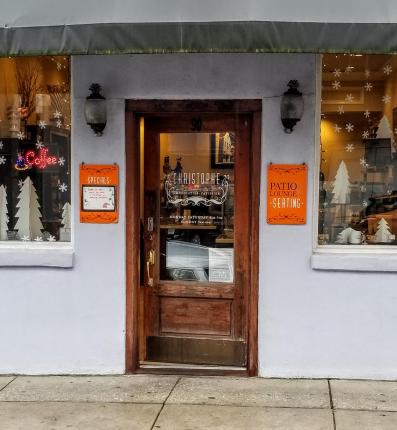
Chocolate

Truffles

I did not have time to visit but wish I could have gone to Henry’s for jazz and food.  Not so great on the outside but it was highly recommended.  It seemed to me that there were restaurants everywhere.  Many downtown but also in every neighborhood and historic area.  Charleston has a reputation as a “foodie paradise”.  I believe it.  That night I did not go fancy but I went “excellent” with barbecue at Bessinger’s – basic, filling and very tasty.

Jazz.jpg

BBQ

The next day I headed to Beaufort (pronounced “Byoo-furt” in South Carolina as opposed “Bo-furt” in North Carolina with birding stops at two great places – Caw Caw Interpretive Center and Donnelly Wildlife Management Area.  Beaufort was  70 miles from Charleston and the entire area looked like great birding habitat. But there had been so much rain that many areas were flooded and when I got to Caw Caw, many of the trails and paths were impassable.  There is a terrific visitor center and an extremely friendly and helpful person there opened early and got me hooked up with a naturalist walk that was scheduled 20 minutes after I got there.

You know that you are not in Washington when the naturalist describes changes that will be made to the usual walk because of the flooded fields and explains that we cannot just go through the brush because while the probability is very slim for Coral Snakes that there is danger from Copperheads, Cottonmouths, and two or three kinds of Rattlesnakes plus Alligators.  Easy decision — I will stay on the trails…

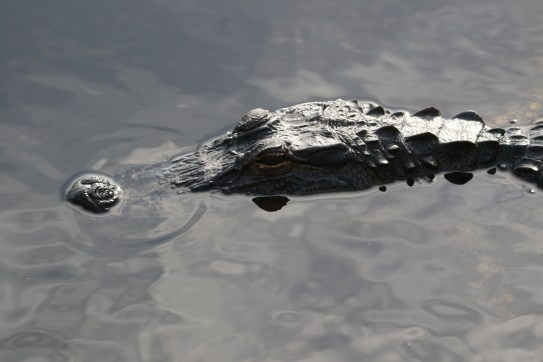
In just over two hours with an amiable group of birders, we saw or heard 39 species including some heard only Wood Ducks the only waterfowl of the trip despite habitat that looked good to me.  The highlight was unquestionably the medium sized (6 foot) Alligator that was on the trail ahead of us with what appeared to be a rabbit in its fearsome jaws. It slithered backwards into one of the canals as we approached – carefully.

Alligator
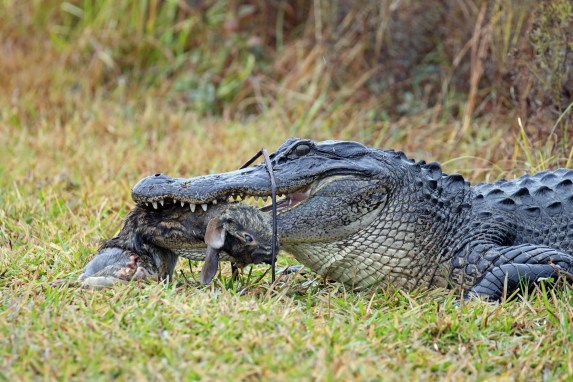
Alligator with Prey1

It was now almost 11:00 a.m. and I had another area to visit – and I also wanted to break away from the group and try to find a Sedge Wren – a species high on my photo wanted list as I did not have one for the ABA.  I thought I had thought I may have heard one as we walked but our guide was not sure and felt it was useless to try to get it to come out.  Not more than 5 minutes after separating from the group I stopped at what seemed to me to be good habitat and got an immediate clear response after a brief playback of Sedge Wren calls.  (Which by the way the guide was not averse o using.)  A small Wren came up into the reeds  and remained hidden – but noisy.  I grabbed a few miserable photos as it darted around never completely in the open.  Even though its calls were dead on for Sedge Wren I am still not sure if the photo is of a Marsh Wren or a Sedge Wren and I got differing opinions from two locals.  The supercilium and clear breast say Marsh to me despite the calls.

Wren – Sedge or Marsh?…Marsh

Marsh Wren

After Caw Caw, I moved on to the Donnelly Wildlife Management Area.  In my early pre-trip planning I had identified this Ebird Hotspot as a great place to either find 50 species in a day or to supplement a list from elsewhere to do so.  Since I was not sure that the Beaufort CBC would produce 50 species, I thought I needed a backup plan.  The only problem was that the Hotspot name included the seemingly limiting “(partial fall and winter restricted access)”.  What did this mean?  When I asked Buddy Campbell – the compiler for the Beaufort County and some other Lowcountry CBC’s that Ken had gotten me in touch with, he said it was related to hunting and would probably not affect me.
Donnelley.jpg

It was a GREAT area – and another example of where hunters and birders share interests in habitat creation, preservation and management and where coexistence can be very positive.  My first stop was on a dike along a wetland barely into the park.  I expected many ducks and found many – well over 100 Wood Ducks but unlike our experience with them in the open in Washington, these ducks were hidden away in the wooded marshy areas, detectable only by their constant calling and then their flights when I got anywhere close.  Buddy (and Ebird reports) said this was also a good Sedge Wren area. I heard at least one but got only brief distant glimpses.

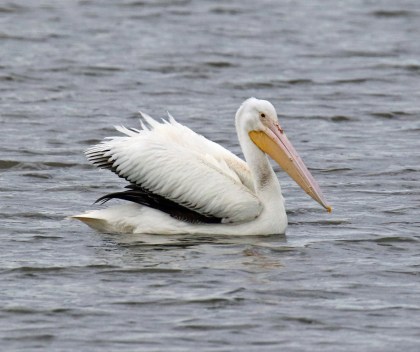
I could write many pages about this place – really fun visit of almost 3 hours.  It was mostly thin forest and wetland.  A good mix of passerines and one spot with some shorebirds (both Yellowlegs and both Dowitchers).  Ebird reports included many waders but other than a couple of Egrets, a Great Blue and a Green Heron, I had found none…until…I discovered the large pond/lake behind “the Lodge”.  What a great spot!! In addition to other species there were 53 American White Pelicans, 6 Great Blue Herons, 18 Great Egrets, 11 Snowy Egrets, 4 Little Blue Herons, 1 Tricolored Heron, 1 Green Heron, 2 Black-crowned Night-Herons, 20 White Ibis, 5 Roseate Spoonbills, Forster’s Terns, an Osprey and a Wood Stork.  A great way to pad a list.

Lesser Yellowlegs

Lesser Yellowlegs

Snowy Egret

Snowy Egret 3

Little Blue Herons (Juvenile and Adult)
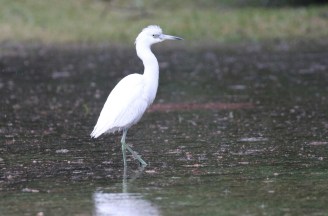
Little Blue Heron  Little Blue Heron Adult

Roseate Spoonbill

Roseate-Spoonbill.jpg

White Pelican

White Pelican.jpg

When I tallied my list after this visit, it was 67 species.  Added to Caw Caw and a couple of species on the highway (American Crow and European Starling), I had 84 species for the day (and over 100 for the trip) – and the planned big Day was yet to come – the Beaufort CBC on the 16th.  I thoroughly enjoyed Donnelly.  In addition to the great birds, it was the feeling of unity with the place.  Very peaceful aided in part by the fact that for the entire time I was there, I did not see another human being – just me and the beauty and wonder of nature.

Beaufort and the CBC

Ken and his lovely wife Betty picked me up at my hotel that evening and we went to dinner at Panini’s on the Waterfront in Beaufort.  I had been hearing about how great the oysters were in the area but Ken said we would have them at lunch the next day.  I chose a Greek Shrimp Panini.  It was exceptional.  After the very short visit on the pelagic trip it was nice to spend relaxed time with Ken and with Betty.  Both, like many people in the area, are transplants and their perspective on the area was very interesting.  Definitely gave me a different take on preconceived notions of South Carolina to some degree.  Like most places there are people of all sorts, cultures, beliefs and attitudes.  This is not the place to go into these matters but it was easy to discuss politics, race, and the culture of place.  Discussing birds was great too as Ken and Betty are well traveled and have many stories.

Panini’s on the Waterfront
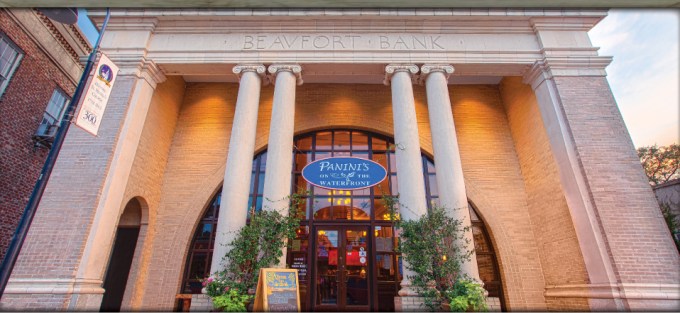
Panini Beaufort

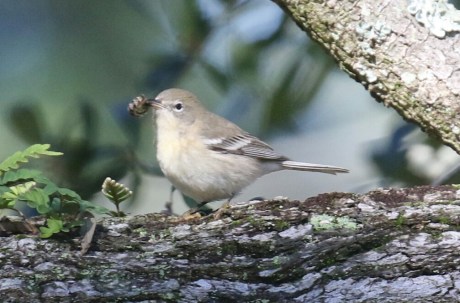
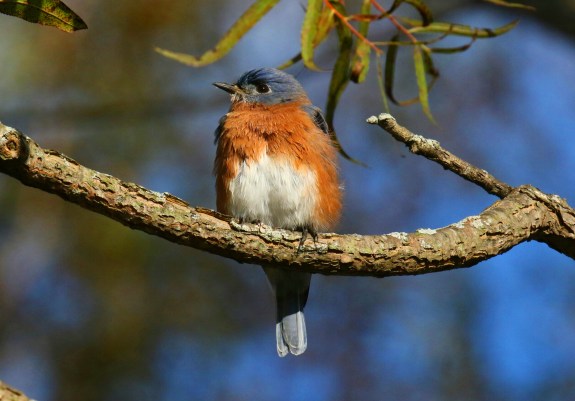
The plan for the next day was simple.  I would be meeting them at 8:00 and we would bird one habitat area on St. Helena’s Island and then I would join another group in the afternoon to bird a very different habitat on Harbor Island.  The morning was steady good birding with a mix of passerines, waterfowl, waders, shorebirds and raptors.  I particularly enjoyed a grassy field and trees that had numerous Palm Warblers, Pine Warblers and Eastern Bluebirds.

Palm Warbler

Palm Warbler

Pine Warbler

Pine-Warbler.jpg

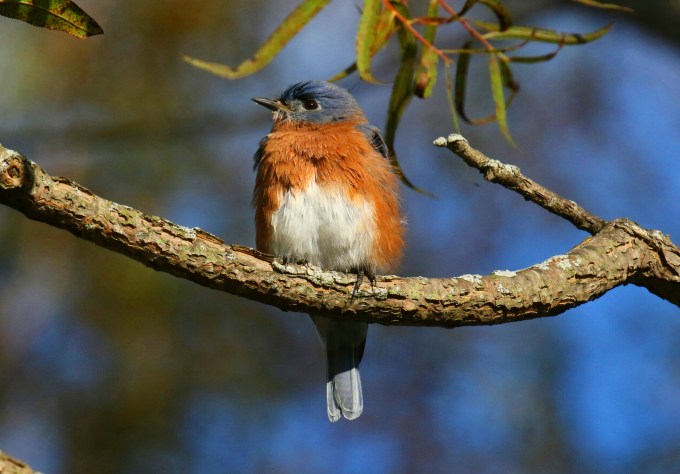
Eastern Bluebird

Eastern Bluebird 4

Raptors included both Black Vulture and Turkey Vultures (some consider them raptors), Northern Harrier, Bald Eagle, Red-shouldered, Red-tailed and Cooper’s Hawks,  and American Kestrel and Peregrine Falcon.

We finished the morning with 59 species, so I guess I needn’t have worried about 50 species in a day.  We then met up with my “afternoon group” led by John Fisk and spouse Karen at a very unique restaurant, the Johnson Creek Tavern.  It was “oyster time”.  Tradition at the restaurant is for visitors to put dollar bills on the wall for good luck. Every inch of every wall was full. When the walls were last cleaned in May 2018 more than $17,500 was collected…and donated to charity…a veterans group.  There was no room for my dollar … but I enjoyed the oysters!!

Johnson Creek Tavern – St. Helen’s Island – South Carolina
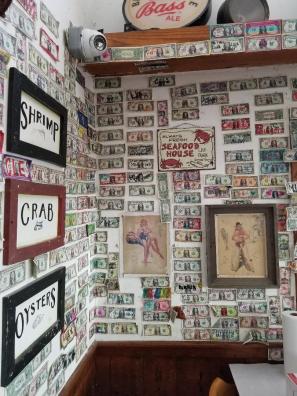
Dollars on Wall

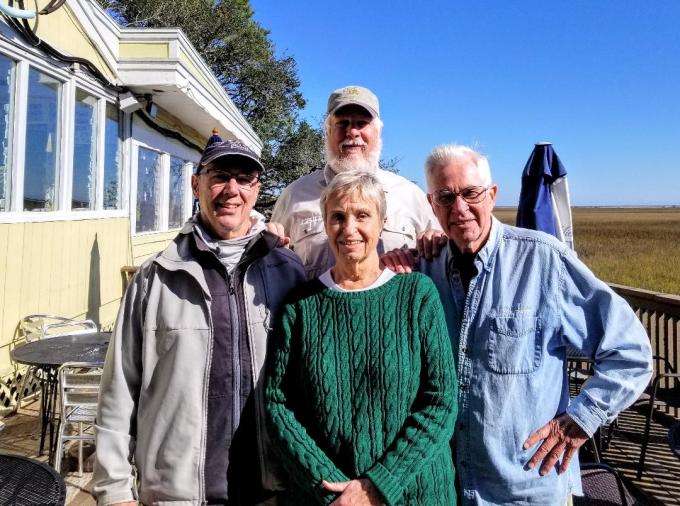
With Ken and Betty Outside the Restaurant

Ken and Betty

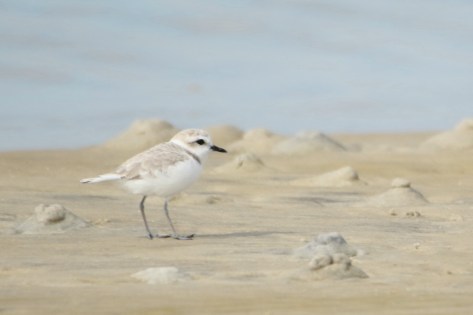
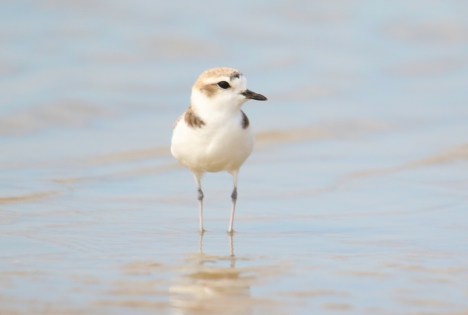
It was then goodbye to Ken and Betty and off with John and Karen and 4 others.  John Fisk is a retired orthopedic surgeon and both he and Karen were interesting, excellent and avid birders.  Our afternoon would primarily be at sand beach habitat on Harbor Island with a couple of wetland areas thrown in.  We had good shorebirds including Black-bellied,  Semipalmated and Piping Plovers, a surprise Marbled Godwit, Sanderling, Dunlin, Least Sandpiper and Willet.  Hard to beat Piping Plovers as favorites.

Piping Plover
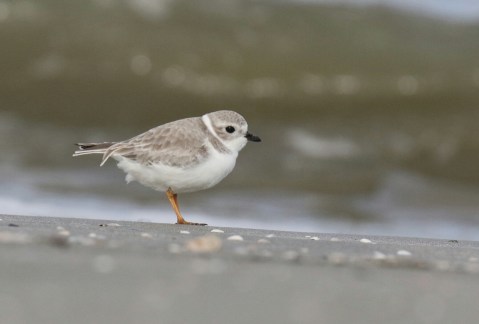
Piping Plover

Marbled Godwit

Marbled-Godwit.jpg

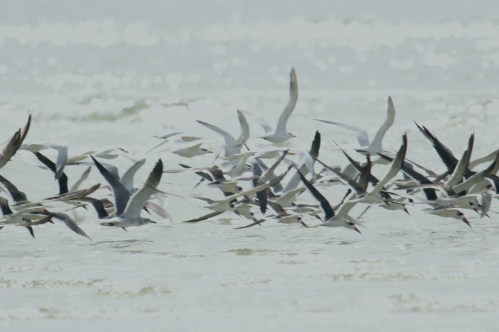
I was not able to get on it fast enough for a photo, but we also had a flyby Northern Gannet and at the very end some Black Skimmers which are always a treat.

Black Skimmers
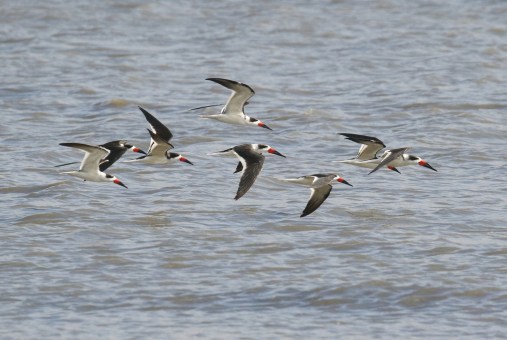
Black Skimmers

Much of the time was spent walking on a beautiful sandy beach.  What was not as beautiful was the impact of storms and erosion on the beach and the homes built there.  Many homes were damaged or destroyed by Hurricane Mathew and other storms.  Some have been torn down but there is a lawsuit underway to require removal of six severely damaged homes that are eyesores to say the least.  We walked through some of the ruins as we birded.  John had studied beach dynamics and I wish I could have recorded his discussion on how the beach was reforming.

Hurricane Destroyed Home on the Beach

Hurricane Damage

We called it a day around 4 p.m.  I made another stop on the way out of town and headed off to Savannah, Georgia where I would be birding the next day.   We had 26 species on our count and I added a couple more on my last stop.  This brought the species count for the day to 73 and for my visit to South Carolina to 116.  It had been a great day for birds, people and places (and oysters) and a wonderful visit to South Carolina.  I hope to get back sometime and spend more time in Charleston and to visit places like Kiawah Island and Hilton Head.  Time with Ken and Betty was too short.  Maybe our paths will cross again.
Thrush Dreams

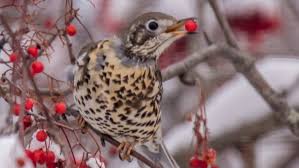
As I was writing up my previous post on the successful Fieldfare chase, I had ‘thrushes” on my mind recalling some new observations or photos the past year or so.  Feeling very full of myself, I listed all of these great birds and found I had decent photos of them.  Then I made the mistake of asking the question, “I wonder what thrushes I have not seen?”  Yikes – there are a lot of thrushes that are included on the AOU/ABA list and a lot I have not seen.  Granted the ones I have not seen are very rare for sure, but that was the case for the Fieldfare too – so why not dream.  There are far more species than I was aware of.

Below are photos of the thrushes I have been fortunate to have seen in the ABA area – followed by photos of ones I have not – but hope to someday (most are highly unlikely).

15 Thrushes I Have Seen in the ABA Area

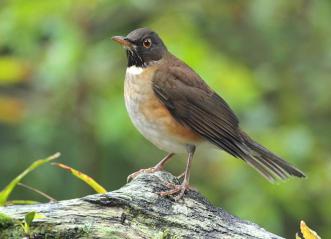
Rufous Backed Robin – California

Rufous Backed Robin 2

Fieldfare – British Columbia

Fieldfare1

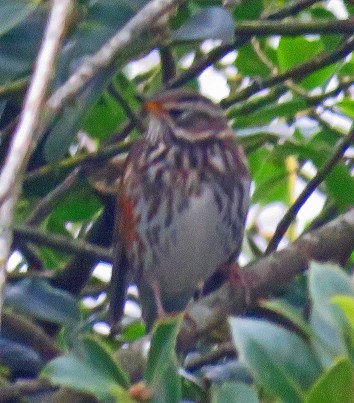
Redwing – British Columbia

Redwing

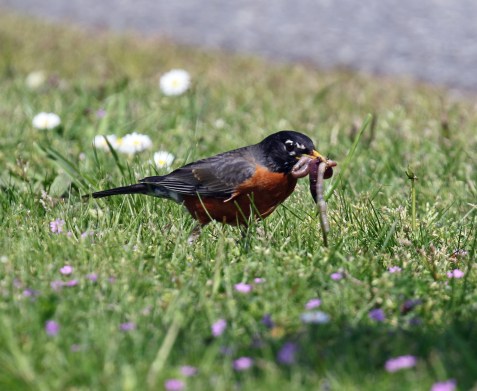
American Robin – Washington

American Robin with Worms

Eastern Bluebird – Indiana

Eastern Bluebird 4

Western Bluebird – Washington

Western Bluebird

Mountain Bluebird – Washington

Mountain Bluebird1

Townsend’s Solitaire – Washington

Townsend's Solitaire

Swainson’s Thrush – Washington

Swainson's Thrush1

Wood Thrush – North Carolina

Wood Thrush

Veery – Washington

Veery

Clay Colored Thrush – Texas

Clay Colored Thrush1

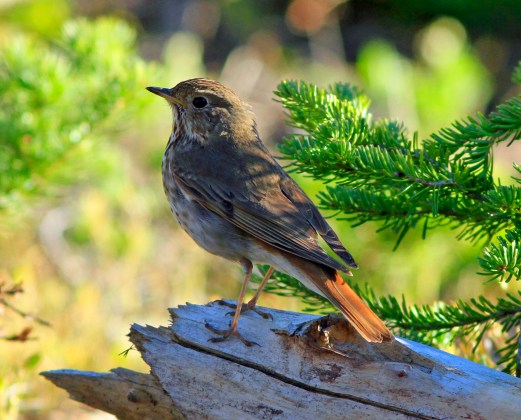
Hermit Thrush – Washington

Hermit Thrush1

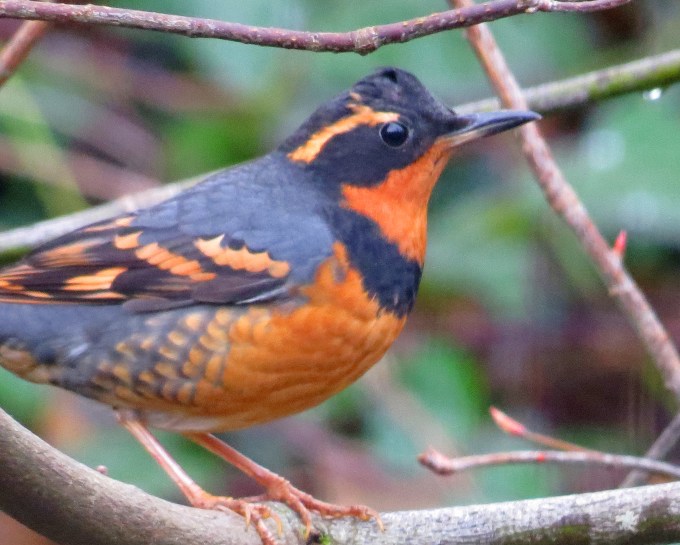
Varied Thrush – Washington

Varied Thrush

Gray Cheeked Thrush – Alaska

Gray Cheeked Thrush 3

I have also seen and photographed Northern Wheatear and Red Flanked Bluetail which used to be grouped with the thrushes but are now Old World Flycatchers.

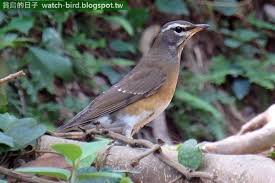
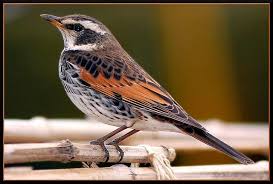
12 Thrushes I Have Not Seen in the ABA Area – Yet (Photos not mine)

Bicknell’s Thrush                                                Aztec Thrush

bicknell's thrush - Copy  Aztec Thrush

Eurasian Blackbird                                       Eyebrowed Thrush

Eurasian Blackbird  Eyebrowed Thrush

Dusky Thrush                                                Mistle Thrush

Dusky Thrush    Mistle Thrush

Brown Backed Solitaire                               Orange Billed Nightingale Thrush

brown backed solitaire - Copy  orange-billed-nightingale-thrush

Black-headed Nightingale Thrush            Red-legged Thrush

Black Headed Nightingale Thrush - Copy  Red Legged Thrush

White Throated Thrush                                        Song Thrush

White Throated Thrush  Song Thrush

A Fieldfare in British Columbia

I very much enjoy my birding travels – new birds, new places, new people.  BUT…one negative is that it seems like there is always some great bird that shows up near home when I am gone.  Two distinct memories of such occurred when I was in Maine and Massachusetts in late June and early July 2015.  The first was a Great Shearwater that was found on a pelagic trip out of Westport on June 27th.  A very rare bird in Washington, it was supposed to have been a “given” on the pelagic trip I took in Maine 10 days earlier through a wonderful program at the Schoodic Institute.  Nope first time ever they had missed it on the trip.  Sigh… But I did see one later on my North Carolina pelagic trip on June 30th this year.

Great Shearwater

Great Shearwater

Earlier that month a Crested Caracara was reported in Skykomish – perhaps the first accepted Washington record.  Every day in Maine and Massachusetts I saw reports coming in for this incredible sighting.  Would it stay?  I was able to see it on July 4th after I got home – and then it was gone – possibly killed by the mad man goat farmer.  So at least that had a happy ending for me if not the Caracara.

Crested Caracara – Skykomish, WA – July 4, 2015

Crested Caracara - Copy

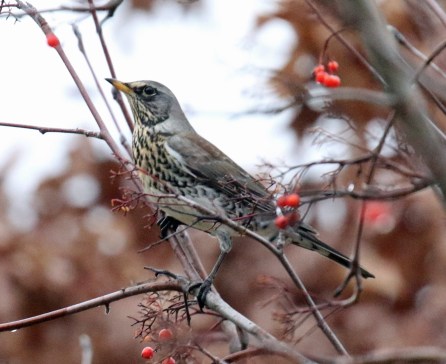
On December 16th, a Fieldfare was found on the Salmon Arm, B.C. Christmas Bird Count.  On that day I was doing the Low Country Christmas Bird Count in Beaufort County, South Carolina.  I learned of the Fieldfare the next day.  Fieldfares are Robin-like thrushes that are common in Europe and occasionally show up in the Northeastern U.S. and Canada.  One was seen in Idaho in 2015 and there is a possible record from B.C. in 2003.  So a VERY rare bird.  I still had three more days in Georgia ahead before flying home on December 19th.  Would it stay?  And it was a very long ways away – 350+ miles from Edmonds.  But quite a great bird…

On December 18th – Ann Marie Wood and John Puschock – Washington birding friends had made the long trek and found the bird.  Others had done so on the 19th.  It was still there.  Figuring that I was still on East Coast time and still high from my great South Carolina and Georgia visits (soon to appear on other posts) I decided if nothing else it would be an adventure and committed to go on the 20th.  Taxiing in to the gate at Seatac Airport, I posted that on Tweeters to see if anyone else was interested.  I got an almost immediate response from good friend Steve Pink that he wanted to go.  A bit later I got a message from B.C. birding bud Melissa Hafting that two of her friends desperately wanted to go but had no car.  Could I take them?  Mel had seen the bird on the 17th and was the first person to tell me about it.  Sure…I would be happy to help.  I then got inquiries from another half dozen people – but my car was full.

This would be a long trek so an early morning start was essential.  Steve came to my house at 4:30 and we headed off to the Sumas border crossing.  It took a bit longer to get there but we sailed through the crossing – “Where are you going?”  – Salmon Arm.  “Why?” – to hopefully see a rare bird.  “Really?” – Yes.  “OK”.  Five minutes later we met Joachim Bertands and Graham Sunderland at the Abbotsford Costco, loaded up and were off.  A complication was that bad weather – lots of snow – was predicted for the Coquihalla Highway (Route 5) so we had to go the even longer route of Highway 1 – the Trans Canada Highway.  This would add almost 90 minutes to the trip – but that was better than getting stuck.  It was 6:15, dark, raining and miserable driving.  Not going to go through all the details, but with a stop for bathrooms and gas, we finally pulled onto Krick Road just south of Salmon Arm around 11:20.  We had a report earlier that one of Joachim’s friends had seen the Fieldfare an hour or so earlier and there was a birder at the stakeout site as we approached.  It wasn’t sunny but it wasn’t snowing or raining…things looked good.

Fieldfare Stakeout Site – Krick and Kernaghan Roads

Intersection

He had a smile on his face – a good sign.  He had indeed seen the Fieldfare – about five minutes ago – but it had flown off to an area behind one of the houses.  He left and we searched – and searched – and searched.  We found a single American Robin, heard a Black Capped Chickadee and watched a small group of European Starlings come and go.  It was QUIET!!!

When I first conceived of this chase, I felt it was a 50/50 proposition.  When I heard that it was seen on the 19th, I raised the odds to 75% and when we hear that Joachim’s friend was successful, I was at least at 98%.  Hearing that it had been seen 5 minutes before we arrived I was now at 100% BUT as it remained quieter and quieter, I was not so sure.  We spread out and after maybe 25 minutes of searching Graham said he saw a group of Robins.  He had not seen the Fieldfare, but Joachim (definitely the sharpest – and youngest – eyes) was able to ID the Fieldfare buried in a distant tree.  We got horrible views and even worse photos but at least we had the bird.  AND then – thank you Bird Gods – the flock flew closer and then even closer as they returned to their favored Mountain Ash trees to feed on the berries right at the corner of Krick and Kernaghan roads.  Great views and great photos – and we all had a new ABA Lifer!!

Fieldfare – Salmon Arm, B.C. – June 20, 2018

Fieldfare1

Fieldfare3

Fieldfare7

We watched the Fieldfare for another 30 minutes – very happy indeed.  We knew we had a long return trip and checking the road conditions, things looked good for the shorter Coquihalla route if we left right away.  So we were off – way beyond satisfied.  It was mostly clear and beautiful as we retraced part of our steps through Kamloops and then hit the Coquihalla – beautiful multi- lane divided highway.  Conditions were great until we hit maybe the last 30 miles where we encountered snow, ice and slush.  All was good until I hit one curve a bit too fast and felt my left front wheel spin and then pull us into a dangerous condition.  Many years ago I had taken a course on driving in snow and ice and the training paid off.  I was able to steer into and through the slide and just missed an area where plowed snow had piled up and after a few seconds that probably seemed much longer top the passengers – got complete control without any harm done – just increased adrenalin and heart rates.  I went slower the remainder of the way and we made it back to Costco safe and sound just before 6:00.

Steve and I said our goodbyes and then continued on for the last 100 miles back to Edmonds.  This border crossing took a bit longer but the guard was very friendly and smiled about our bird.  I had expected to be very tired from the 750+ miles of driving but the good company in the car and then successful chase overcame that and we were back home before 8.

Joachim and Graham proved once again that my enjoyment is as much from the people as from the birds. Joachim is a graduate student from Belgium who has an amazing life list both in the ABA and in the Western Palearctic areas.  He was a fountain of knowledge and stories and taught us a lot.  Graham, like Steve Pink, is a former Brit.  Very interesting bloke who has never driven a car!!  He worked for a cruise line and has traveled the world.  He, too, had many good stories. One was about a Sedge Wren on the Falkland Islands.  Steve and I wondered if maybe this was a misidentification as we could not imagine a Sedge Wren there.  Research confirmed – there is a race of Sedge Wrens there – who knew.

A long almost 16 hours for just one bird.  Non-birders don’t understand but most birders do.  After all it was a Fieldfare!!  It was ABA bird #730 and ABA photo #696 – very nice…

Why We Chase…A Wild Goose Chase with a Happy Ending and Self Questioning

Background

On October 25, 2018 two Finnish birders reported seeing a Bean Goose at the William L. Finley NWR south of Corvallis, OR.  This undocumented sighting made it onto the American Birding Association (ABA) Rare Bird Alert (RBA) on October 28th and the Portland Audubon Society RBA on November 1st.  Then silence and no reports or observations followed…until November 25th when it was located at the McFadden Marsh at the NWR and reported by many.

The ABA and the American Ornithological Union (AOU) currently recognize two species of Bean GooseTundra Bean Goose and Taiga Bean Goose.  The Finley bird was believed to be a Tundra Bean GooseBean Geese breed across Eurasia from Norway to Siberia, and winter south to southern Europe and China, favoring open grassland and farmland – including bean fields – hence its name.  It is a rare but regular visitor to the Aleutians and the Bering Sea region of Alaska during its northward migration in spring but has been seen only extremely rarely elsewhere in North America.  Bean Geese are common in Finland so the initial report by the two Finnish birders was credible if incomplete.

And my research is also incomplete but I found only 6 records on Ebird for Tundra Bean Goose outside of remote Alaskan Islands.  All were of single birds.

  • October 1982 – Quebec Province, Canada
  • October 1999 – Whitehorse, Yukon Province, Canada
  • October 2013 – Salton Sea, California
  • November 2013 – Nova Scotia, Canada
  • December 2014 – Nestucca Area, Oregon (continued for many months)
  • January 2018 – Bird shot by hunter in Arkansas

My focus was on other matters when the Nestucca bird was reported in 2014 and 2015.  Friends made the journey and readily found it.  I did not.

The First Chase

On the afternoon of Sunday November 26th I was on Facebook and saw a report on the ABA Rarities page there that a Tundra Bean Goose had been seen at Finley NWR in OR.  I paid it little attention at first.  Finley NWR is about 290 miles from my home, a distance I have traveled on chases before as part of a Washington Big Year or for the Red Flanked Blue Tail in Idaho.  As rare as that bird was, it was not even a life bird as I had seen one previously in British Columbia – but in miserable rainy conditions and I had no photo.  Photos of the Lewiston, ID bird were exquisite and birding friend Keith Carlson was a willing local guide, so I made the long trek (over and back in two days) and had a great time with great photos.

Red Flanked Bluetail

red-flanked-bluetail1r

Last year in addition to a constant first priority of adding birds and photos to my Washington State List, I set a goal of reaching 700 species on my ABA Life List.  The Island Scrub Jay seen on December 1st accomplished that.  At the beginning of this year I set a goal of getting as close to 700 ABA photos as I could, but knew it would be unlikely and more realistically I could maybe get sufficiently close to reach that goal in 2019.

Island Scrub Jay – Santa Cruz Island – December 1, 2017

Island Scrubjay 1

With some changes in my personal life mid year, I came up with a new “project/adventure” – observing 50 species in each of the 50 states on a single day in each – my so called 50/50/50 Project and my attention lately had primarily been on research, logistics and arrangements for that – maybe adding some of those ABA photos along the way.  The Tundra Bean Goose would be a new ABA Life bird and if photographed a new ABA photo but it was not a Washington bird (first priority) and Oregon was already in the “Done” column for 50 species in a day.  But…what if I could find it, photograph it AND find 50 species in a day?  My previous Oregon 50 was very lackluster.  Another 50 species day with this mega-rarity would be special – adding a new dimension to a chase.

Somehow within a few minutes of first giving it thought, remembering Rule 1 for any chase which is “Go Now”, I decided to give it a try.  I think the key factor was simply that it would be a rewarding thing to do.  And this is important: while in no way thinking I would not find it, my approach to birding had changed.  I had evolved.  I now valued the chase experience itself independently of the result.  Whatever the birding result, ALL of my chases had given me stories, lessons, satisfactions and rewards.  There was nothing on my agenda for the next few days — why not.

I made a couple of calls to see if friends had some interest.  It wasn’t a lot of notice, so maybe that was unlikely, but company is always great.  Several people had made the trek to see the Nestucca Tundra Bean Goose in 2014 so not this time.  I was on my own.  I had seen a comment that many geese roosted at night at the McFadden Marsh. There was no certainty that the Tundra Bean Goose would still be present but I calculated that the greatest likelihood would be that if it was, it would roost with the big flock and that getting there early was wise.  I decided to leave VERY early – around 2:00 a.m. to get there at first light.  I was out the door at 2:15 – at least there would be little traffic.

With only a single stop along the way I arrived at McFadden Marsh at 6:45 a.m. just as there was some light in the sky and some visibility.  I was greeted by thousands of birds – geese, ducks, and swans.  Reports had mentioned “the bridge”, “the blind” and “along Bruce Road”.  I tried them all scoping every bird that I could – some relatively close and many quite distant.  I got excited as I found one goose that was “different”.  But when it finally raised its head, it was a Greater White Fronted Goose – not our guy.  Mostly there were hundreds of Mallards and Cackling Geese.  Within the hour many other birders showed up – on their own “wild goose chases”.

Greater White Fronted Goose

Greater White Fronted Goose

Even with all the eyes on the search, we could have missed the target.  It could have been mixed in and behind others, or behind clumps of grass, or just too distant.  Whatever the case, no success.  Not too long ago, the feelings of disappointment would have been overwhelming and I would have been quite unhappy.  No, I was not thrilled, but somehow it had still been “fun”.  After three hours I decided to head off and explore some other areas including the Cabell Marsh where the Finnish birders had first reported it.  I tried there and visited many other places within the NWR returning to McFadden three more times hoping the Bean Goose had been found.  It was great birding – even without the Bean Goose.  Some highlights:

Red Shouldered Hawk – One of Three Seen

Red Shouldered Hawk1

Red Tailed Hawk – Bathing in Puddle on Road – Allowed me to Get within 6 Feet

Red Tailed Hawk in Puddle1

Wild Turkeys

Wild Turkeys

California Scrub Jay (seen with Acorn Woodpeckers and Western Bluebirds)

California Scrubjay1

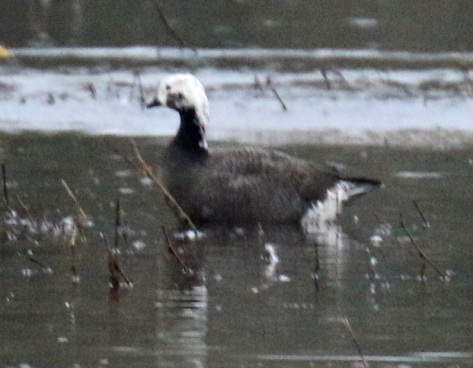
At McFadden there were always hundreds or even thousands of waterfowl, with geese flying off and others flying in.  Nobody found the Tundra Bean Goose.  Maybe it had been a one-day wonder.  There was one really odd goose though.  Others had noted it before – either a hybrid or an oddly plumaged Cackling Goose or Emperor Goose mix. It and other waterfowl are below.

“Odd Plumaged” Goose

Odd Goose

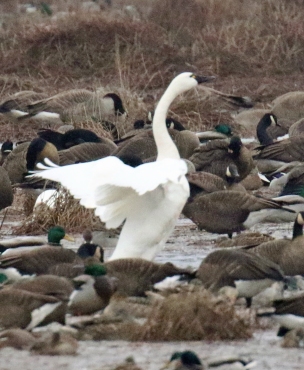
Tundra Swan

Tundra Swan Standing

Aleutian(?) Cackling Goose

Cackling Goose

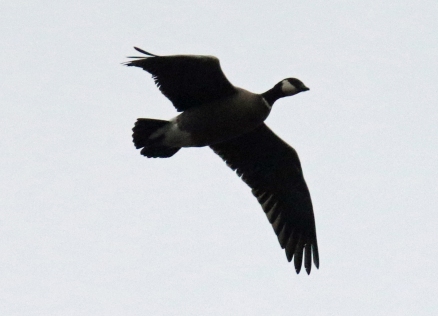
Cackling Geese in Flight

Geese in Flight

Snow Goose

Snow Goose

I hung around until 3:30 – almost 9 hours all told.  No Tundra Bean Goose, even more disappointing since I had found 55 other species that day.  But it was time to leave – fight the traffic around Portland and be home by 10.  Sigh…

And Now for the Rest of the Story…

I wish I had seen the Tundra Bean Goose.  But I also wish that my camera had not malfunctioned as I tried for a photo of a Yellow Rail at the Yellow Rails and Rice Festival in Louisiana.  And I wish that I had bought Amazon in 1998 or Microsoft in 1986.  None of those happened and I am still alive, healthy and looking forward to “next” and I continue to collect experiences, stories and enjoy the process.  That said, I definitely watched the Ebird reports to see if someone else had reported the Tundra Bean Goose from Monday.  Nobody had.  BUT a report did show up for Tuesday, and another for Wednesday and again on Thursday.  Good for them.  Happy for them.  Not competing with them.  But damn…it would have been nice.  I kept working on my trip plans for South Carolina and Georgia, finalized plans for Hawaii and began looking into a winter trip to New Mexico. I also had a couple of social engagements.  But those everyday observations by others did register.

I had dinner with my sister Saturday night.  Literally an hour before heading down to Seattle to see her, I made an executive decision to try again.  Why?  I asked myself that as I made the decision.  There is almost certainly more to it – some psychology – as will be discussed later, but the answer was simple again.  Successful or not this would be a good story, a good experience, something to look back on with a good feeling and something to write about – and something to affirm that I was “ALIVE” – doing something I loved, following a passion and just getting out there and trying.  AND I had a calm sense that I would find the goose and put an exclamation point on the week and the previous attempt.

The Second Chase

After a great dinner at 8:00 p.m. I said goodbye and told my sister I was off to Portland.  She thought I was nuts, and that is likely not the first time she has felt that.  I had thrown a sleeping bag and some pillows in the car and figured I would stop at a rest area somewhere and grab at least a few hours of sleep.  That worked perfectly as I got into Oregon, found a rest area bout 90 minutes from Finley NWR and actually got almost 4 hours of sleep before heading off again around 4:30 a.m.  It was very foggy and pitch black as I pulled into the parking area on Bruce Road near the path out to the blind which is where I planned to start my search.  It would not be light for another hour, but I could already hear geese, swans and ducks cackling, quacking and whistling at the marsh.  I was worried about the fog, but there was nothing I could do about that and I am getting better at not stressing about such things out of my control – unhappy maybe, stressed, no.  I dozed for about 45 minutes and then walked out to the blind with binoculars, camera and scope.  There were thousands of birds – barely visible.  I was  somehow confident that I would find the goose – even if not just then or right there.  But moreso, I truly was already very pleased, because I had followed through on a wish and executed it well – so far.  I was completely alone and completely engaged in my life and a passion for it.

Just after 7:00 a.m. there was enough light to be able to meaningfully start my search through the scope.  Within not more than 5 minutes among the thousands of birds in front of me I found one that raised my heartbeat as it was a goose that was NOT a Cackling Goose and NOT a Greater White Fronted Goose but it had its head turned away and I could not see the tell-tale bi-colored bill that would confirm the ID as a Tundra Bean Goose.  Turn, damn you turn!!  It must have heard me.  It turned and even at 20x magnification in the poor light, I could see the orange marking. Eureka!!!!!  The light was weak.  My ISO was high, the shutter speed slow, but I got a photo.

Tundra Bean Goose – First Photo (ABA Photo 694#)

Tundra Bean Goose First Photo

There was nobody there to share a high five.  Nobody to watch a Snoopy dance.  No congratulations.  On other chases there have often been others or if not, I still gave a shout or did a dance or a jump or a fist pump.  Not this time.  I just savored the moment as deeply as I had any moment.  There was not a need for any outward expression because it was so completely internalized.  This confirmed a really chancy decision and was like the proverbial cherry atop the sundae.  But it was going to get even better.

The goose was resting and I kept my scope on it hoping for better views as the light improved.  About 10 minutes later I heard someone approaching the blind.  When she came in with her birding gear, I asked the almost unnecessary question:  “Would you like to see the goose?”  She beamed.  I lowered the scope and she saw the bill and had a new life bird.  This was the second try for Janet Kelly also.  She had made the 3+hour trip up from Medford, OR earlier in the week on a day the Tundra Bean Goose had been seen by others but not by everyone looking.  She was one of the unlucky ones.  This made up for that.  I was almost as happy for her as I was for myself – almost.

We watched the goose for about 15 minutes and then without any warning it and maybe 2000 other birds took off in a noisy flight and were gone. We had been very fortunate.  We had been at the right place at the right time.  A little bit later and we may have missed it.  I have been in that spot before.  Not more than 5 minutes later, two more birders arrived at the blind and we delivered the words we have all heard and hate more than any others:  “You just missed it!” Our visitors were Bert Filemyr and Casey Weissburg.  To say they are both serious and accomplished birders would be an understatement.  Joining with Laura Keene –  an extremely accomplished and serious birder – they had arrived at the Refuge the day before and had missed the Tundra Bean Goose.  Casey immediately expressed her disappointment and asked which way they had flown.  All we could say was “away”.

Meanwhile Laura Keene had positioned herself at the bridge and this strategy had paid off as a few moments later she texted Casey that she “had the goose!!”.  Casey took off imploring Bert to race along with her.  Let’s just say that there is a significant age difference between the two and as I accompanied Bert running with gear on the icy boardwalk, I felt I had to comment that it was not worth a heart attack.  Bert joined Casey in their rented car and they drove the 1/4+ mile to the bridge where Laura had the Tundra Bean Goose in her scope.  Not the world’s best view but when it raised its head, there was that bi-colored bill.  This was ABA life bird 801 for Laura, and number 748 for Bert.  I don’t know about life birds, but it was ABA number 642 for Casey – this year.  As I said – serious and accomplished birders.  It was wonderful to see and feel their excitement as they found this extremely rare species – a sign of its rarity being that none of them had seen it before.

The Tundra Bean Goose was cooperative in that it remained still, but not so much as it mostly rested with its head tucked down being essentially a lump of brown feathers.  Other birders arrived and we were able to show them the mega rarity.  After more than an hour with an only occasional head lift to show its bill, it joined many other geese and flew off – eventually landing across the road in an even more distant spot.  But in flight, it gave us the best views including it bright orange feet.  It also gave me my best photos.

Tundra Bean Goose Flight Shots

Tundra Bean Goose Flight

Flight in Group

Among the birders to join our group was a father with two young boys and a couple of other young birders.  I would wager that this day will be part of their cherished memories forever.

And I can say the same for me.  A favorite day.  Anyone reading my blogs or talking to me about birding knows that for me birding is that wonderful activity that inserts me in situations where there is the chance to visit interesting places, meet interesting people and see great birds.  There is never a day of birding that does not provide one of these rewards and on days like this, I get all three.  Pretty great!!  And this day it was in spades.  The refuge is not Cascade mountains beautiful, but it is a lovely place and now had given me two days of special attachment.  All of the birds and their movement at the marsh were majestic with the Tundra Bean Goose being as good as it gets.  And how wonderful to share this time and this bird with these folks.

Knowing of her and especially her incredible Big Year in 2016, I had contacted Laura Keene earlier this year as a resource to find contacts in states I would be visiting during my 50/50/50 adventure.  She was gracious and most helpful getting me in touch with someone that I did bird with later.  It was a great treat to meet here in person.  I hope to see her again some day either on her home turf of San Antonio or in the field.

I had not had any previous contact with Bert but had seen his name on Facebook and Ebird.  He is from Philadelphia.  We exchanged “birder cards” and I will contact him for ideas when I will be visiting that area this Spring.  If life is really good, maybe I can join him in the field.

Casey Weissburg describes herself as a nomadic bird biologist living for the love of birds and the natural world.  Her youthful energy, and knowledge of birds, were abundantly clear watching the Tundra Bean Goose.  We have become Facebook friends and I am sure she knows birders out there that may be able to help me in my quest and I hope our paths cross again.
Seeing the Tundra Bean Goose was immensely satisfying.  Sharing the wonderful birding experience with Janet, Bert, Laura, Casey and the young family and others there made it magical.

Final Thoughts and Questions – Why We Chase…

What all is behind our “wild goose chases” and others?

What makes me drive 5  hours from Edmonds to look for a goose in a marsh in Oregon twice in less than a week?

What brings Bert Filemyr from Philadelphia to Seattle to join friend Laura Keene who had flown in from San Antonio and drive 4 and a half hours to to look for a goose in that same marsh, joined by Casey Weissburg who came from I don’t know where?

What moves Janet Kelly to drive 3+ hours from Medford to to look for a goose in that marsh?

What brings us and others – many, many others – to look for “special birds” with “special” defined differently by each searcher – in marshes and sewage treatment plants and forests and deserts and feeders and mudflats and mountains all over the globe.  Why do we travel miles and miles for hours and hours, give up sleep, endure heat, cold, bugs, flat tires, lost communication and miss birthdays and other important dates?

Why do we chase? Why do we chase again and again when too often our chases do not find success – at least in terms of  finding our targets?

  • “Compulsion” is variously defined as “a very strong feeling of wanting to do something repeatedly that is difficult to control” or a “strong and barely controllable emotion” or “any powerful or compelling emotion or feeling”.
  • “Obsession” is variously defined as  “a compulsive preoccupation with an idea or an unwanted feeling or emotion, often accompanied by symptoms of anxiety. – a compulsive, often unreasonable idea or emotion”; or “a persistent disturbing preoccupation with an often unreasonable idea or feeling”; or “an idea or thought that continually preoccupies or intrudes on a person’s mind”.
  • The American Psychiatric Association defines “Addiction” at least as related to substance abuse as a complex condition, a brain disease that is manifested by compulsive substance use despite harmful consequence. People with addiction (severe substance use disorder) have an intense focus on using a certain substance(s), such as alcohol or drugs, to the point that it takes over their life. They keep using alcohol or a drug even when they know it will cause problems.
  • Albert Einstein is widely credited with saying, “The definition of insanity is doing the same thing over and over again, but expecting different results.”
  • “Passion” is defined as a strong inclination toward a self-defining activity that one likes (or even loves), finds important, and in which they invest time and energy on a regular basis.  Passions are seen as existing in two types: harmonious and obsessive.
  • Love”  – one theory developed by psychologist Robert Sternberg, says there are three components of love: intimacy, passion, and commitment where intimacy encompasses feelings of attachment, closeness, and connection.  Poets may define it differently.

To differing degrees and in different ways, I believe that chases have elements of all of the above.  The definitions I have used for compulsion, obsession and addiction are at least somewhat pejorative if not downright negative.  I think there are other takes on all of them but these potentially negative aspects cannot be ignored and if they are not outweighed, balanced and driven by the far more positive aspects of love and passion, we are possibly in dangerous territory for ourselves, others and even the natural world that we engage.  Our chases are driven by these factors and are not always successful.  It took a while, but I have come to so enjoy the attempt, the pursuit itself, the intersections with people, places and the birds so that I am now at peace with finding my target bird — or not.

And besides, there can be another chase tomorrow…


Making the Most of Massachusetts with Mike

This was a quick trip with the priority being Thanksgiving with my son Alex, daughter Miya, son-in-law Lester and most importantly my grandson Griffin.  Late November may not be the ideal time for birding in Massachusetts, but I had an extra day and I had an excellent co-conspirator.  With the superb care and guidance from Mike Resch I was able to find 59 species on a cold and windy day – and I now had met the 50/50/50 goal in my 21st state.  The species count did not include the wonderful Thanksgiving Turkey.

My first interface with Mike Resch was in October 2016.  He was coming out to Washington from Massachusetts to work on his “project” – observing at least 50% of the species recorded in each state.  So for example, the list of birds ever observed in Washington stands at 521 (including some that have only been observed once and many that have not been observed for many years).  Mike’s goal (obsession?) is thus to have observed at least 261 species in the State.  Not terribly hard if you live here, but requiring many days over more than one season at the very least.  And after Washington – there would still be ANOTHER 49 STATES!!! Yikes… Mike had reached his goal in Washington but then Neah Bay started producing several new species for the State and he was no longer over 50%.  Time to visit Neah Bay.  He had seen some of my posts about visits there and contacted me for some advice.  He had a great visit but added to and solved his problem at the same time when he found the first record of a Prothonotary Warbler for the State on November 5, 2016.  Dan and Brad Waggoner were there that day and also got looks and a gorgeous photo. (As an aside, Brad found another Prothonotary Warbler at Neah Bay at a different location this October!!)

Prothonotary Warbler – Neah Bay – November 5, 2016 – found by Mike Resch – Photo by Brad Waggoner

Prothonotary Warbler

Later that month I was in Massachusetts (again for Thanksgiving) and I joined Mike for some birding on November 26th with our two targets being a Tufted Duck and a Pink Footed Goose, the latter of which would have been an ABA Lifer.  We succeeded in finding the duck but the goose eluded us.  I was not aware of it until I did some research for this post, but we actually had 50 species that day.  The Pink Footed Goose had turned up later in the day so I returned to Artichoke Reservoir and found it with the aid of another birder the next morning.  I took no photos on that trip at all but since this post will be light on photos, I am including my ABA Pink Footed Goose photo from British Columbia last year.

Pink Footed Goose – with Melissa Hafting – March 10, 2017 – Blenkinsop–Lohbrunner Road

Hoping to “officially” add Massachusetts to my “completed list” for the 50/50/50 project, I contacted Mike and he graciously agreed to help with my quest.  Back to his “project”.  Whether it is a Big Day, a Big Year or some crazy quest like his or mine, good research, good information, good logistical planning and good luck are very important.  Working with others in our birding community is not only the best way to assure success, it is also the best way to really enjoy the experience.  My little project pales greatly compared to Mike’s – just incredibly impressive for him to have accomplished what he has.  Since a main purpose of my project is to interact with interesting people along the way, I very much wanted Massachusetts to be with him.  More details about that when I write up my 50/50/50 adventure somewhere other than just on a blog post.  Another benefit of working with him was that he did all the work – planning out where we would go and even doing a scouting trip to be sure the itinerary would work.

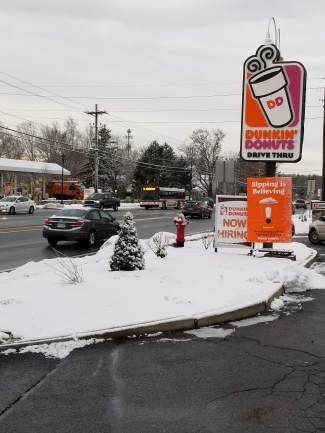
This being Massachusetts, rather than meeting at a Starbucks, we met at Duncan Donuts.  I saw MANY on my visit and do not recall seeing a single Starbucks although I know there are some there.  And, oh yes, as you can see there was snow on the ground.  This was to be my only “winter” trip trying for 50 species and this was the only time there was some snow.  Of bigger concern were the frozen ponds that may have hampered our success finding some ducks and shorebirds.

Dunkin Donuts

I had seen six species on the way to our rendezvous – only 44 more to go.  Our first stop was at Joppa Park in Newburyport where we had 16 species with the best being a singing Eastern Phoebe (late), a flyover flock of Snow Buntings and a flock of Long Tailed Ducks on the water.  Mike said we could not count the two Penguin statues nearby.  We moved on to Parker River NWR, a great area where Mike and I had birded two years earlier.  At several spots within the refuge over 2.5 hours we found 50 species even though ducks were relatively scarce and we had no shorebirds at all.  Some more Long Tailed Ducks and hundreds of Scoters.  We clearly identified some of all three Scoter species: White Winged, Surf and Black with the latter being the most numerous at least for closer birds.

Black Scoters

Black Scoter Flock

There was a light dusting of snow – made it prettier and did not deter ground feeders.  We had small groups of American Tree Sparrows, Dark Eyed Juncoes (Slate Colored) and Snow Buntings.  We had a single Ipswich type Savannah Sparrow and a couple of White Throated and Song Sparrows.  The Tree Sparrows were by far the most numerous I wasn’t taking many photos (and had only my point and shoot camera) but here are a few.

IMG_4264

American Tree Sparrow

American Tree Sparrow

Dark Eyed Junco (Slate Colored)

Junco

A photo I wish I could have gotten was of a small flock of Lapland Longspurs that flew overhead with their chirping flight calls.  With the snow on the ground, it felt like I was in the Okanogan in Washington which in the winter is where thee can be huge flocks of Horned Larks, smaller flocks of Snow Buntings and Lapland Longspurs mixed in.  It is also a good place to find Tree Sparrows.  All of these species were found this day – “Okanogan East”.  Having crossed the 50 species threshold with time to spare, we headed to Rockport hoping for some alcids.

At Andrews Point at Rockport we immediately found a flock of Common Eiders (my first for the year) and had a flyby Northern Gannet (another FOY).  We saw more Long Tailed Ducks, Harlequin Ducks and again many Black Scoters.  A single alcid appeared right below us.  We got a fleeting look before it dove and … disappeared.  The field mark that caught our attention was a line on its face curving down from and behind the eye.  We both immediately concluded it was a winter plumage Common Murre.  If so it would have been the first on the coast this year.  After further reflection later, Mike was pretty sure that it was instead a juvenile Razorbill – more likely at the time and place.  The juveniles can have a similar line behind the eye.  I changed the report but am now having second and third thoughts as I was pretty sure I had checked the bill initially hoping for a Thick Billed Murre which is an extreme rarity in Washington as opposed to the abundant Common Murres.  I did not remember it as a large bill which I associate with Razorbills.  Of course in Washington, we never have Razorbills.  I have only seen them in summer in Maine.  I wish we had photos to study.

Common Eider

Common Eider

Long Tailed Duck

Long Tailed Duck

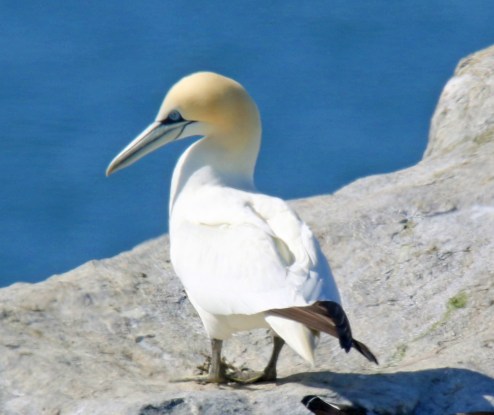
We had both an adult and a juvenile Northern Gannet.  I got flight photos but they are terrible so I am including one from Maine in the summer of 2015.  Gannets are closely related to the Boobies and certainly look like them to me.  This has been by far my best year for this group as I have previously seen Masked, Brown, Red Footed, and Nazca Boobies and am happy to add the Gannet to the list.

Northern Gannet – Maine – June 2015

Northern Gannet

We continued on to a couple of other places in the Rockport/Gloucester area without finding any more alcids or adding new species.  We were at 57 species for the day and it was time to head home for Thanksgiving preparations.  I added a Turkey Vulture and a Western Grebe on the way home (making one more waterfront stop hoping for something new).  Birding with Mike had been great fun and very educational as he recounted stories of Massachusetts and some of his other states.

Mike also provided another great bonus.  He has created an interactive map that he uses to graphically display where he has seen various species across North America.  He kindly provided me a copy that I have adapted to keep track of my progress as I try for all 50 states.  Massachusetts is state number 21 and I have plans for 2 or 3 more in 2018 before a big push in 2019.  This map shows the progress.  Thanks Mike.

Interactive Map as of November 23

I cannot resist adding one more photo to this post.  My grandson just became 9 months old.  He and his mom have been out with me on walks near their home in Newton, MA where I have seen some nice birds.  After Thanksgiving on one such walk I added three more species for this Massachusetts trip.  I look forward to the day when Griffin will know some of the birds we see and hope he will enjoy the time together.  In the meantime, I can at least make sure he has the right “birder look”.

griffin-birder.jpg

Mississippi – My First Visit to a Casino and then Local Birding at Its Best

Prequel – The Beau Rivage Casino

Although I pass them many times on my way to favorite birding spots near tribal lands I have never visited any of the many casinos in Washington.  I have never been to Las Vegas.  I have never even been to Atlantic City.  I do remember a visit to a “casino of sorts” in Ocean City, Maryland.  I was maybe 10.  We played bingo.  The only reason I knew of casinos in Mississippi was because of the publicity following the recent Supreme Court decision that made sports betting no longer illegal if approved by the states.  In August of this year, sports betting became legal in Mississippi. The Beau Rivage Casino was one of the first two casinos in the state to accept sports wagers.  Part of my 50/50/50 adventure is being open to new things and exploring local experiences.  I had checked into my hotel in Moss Point, Mississippi.  It was less than 30 miles to Biloxi.  Heck I had to eat dinner anyway.

It was Monday evening and not yet 6 p.m. when I arrived at the massive parking structure for the Casino/Resort.  It wasn’t full, but definitely not empty either.  At least I did not have to pay for parking.  I negotiated my way to the elevators and figured out how to get to the…well it was not clear what I was getting into.  Definitely something very large and very expensive.  It was an opulent combination of high end shopping arcade, hotel, conference center, restaurants, bars and gaming casino.  I was in birding gear and even so to some degree compared to some there I was over dressed.  Hmmm…

The Beau Rivage Entry 

20181105_173754

I guess I should have known better, but when I took a few photos with my phone, I was almost immediately descended upon by two security types – well dressed but no question who they were.  It was politely and very clearly explained that no photography was allowed – for the privacy of the clientele.  Judging by some of the odd couples I saw, I quickly understood at least part of the message.  I did not erase any photos and in fact had an ok conversation with one of the gentlemen about the sports betting.  Yes business had picked up with the sports wagering.  Six p.m. was indeed a slow time.  If I waited a couple of hours, it would get quite busy.  Since there were already many hundreds of people standing at various gaming tables and sitting at game consoles that were flashing boldly their electronic colors and sounds and were completely indecipherable to me, I could only imagine.  At least the worst of my nightmares did not materialize, even though I did not go to the smoke free area, the area I was in was almost entirely smoke free.

I value my funds too dearly to have tried any of the machines and I certainly was not up for poker, keno, roulette or whatever other games were being played at the tables.  I sat alone at a table at a sports bar with 30 giant screens and had a relatively decent and only slightly overpriced barbecue sandwich.  I was probably the only person there alone and definitely the only one without an alcoholic beverage. It is stretching it a bit to say I had a “casino/gambling experience” but I had a taste and decided that was enough before indigestion followed.  Back to my hotel and to my own gaming/habits for the next day – birds.

A Small Part of the Gaming Area – Definitely Not the High Rollers Club Section

20181105_173946

Back to the Birding

Especially over the past 7 years, much of my birding has focused on listing and chasing.  The majority of that has been in Washington State and even much of that has been “local” in the sense at least that it has been in areas relatively closest to my home in Snohomish County.  In the last few years, I have worked on expanding my ABA lists – observations and photos and that has taken me to many of the bird meccas throughout the U.S. with multiple trips to bird rich areas of Texas, Alaska, Arizona, Florida, California and Maine.  When I first thought up my 50/50/50 project, a major objective was to get me to more places that were not the hot areas and also to have many intersections with traditional local birding and local birders.  Since there had to be 50 species in a single day in each of the states, I still had to find places that were “birdy”, but research told me that with good planning and good help that should be possible in every state – although timing was important and for example Wyoming in February might not be a good idea.

                Getting Connected

My experience birding in Mississippi with Brian Johnston is as good an example as I can imagine of how local birding with local birders is rewarding and productive and definitely fun.  Getting in touch with Brian is a good example of networking in today’s birding world.  I started by researching places in Coastal Mississippi through Ebird that looked good for getting my 50 species in early November.  Among other spots, Ebird took me to Grand Bay Estuarine Research Reserve.  One of the best lists for the area had been submitted by Mark Woodrey.  Ebird does not provide background or contact information for those of us submitting checklists (thankfully probably), but when I researched this hotspot, Mark appeared as one of the top Ebirders for the location – now what?  I found a website for the reserve and it certainly looked like a great place.  But a special permit is needed for access – and the area seemed to be dedicated primarily for conservation, research and education.  I explored to see if maybe my visit would coincide with a program and in that process found an email address for Mark Woodrey.  I also learned that Mark is a big time academic at Mississippi State University and is much involved with research at the Reserve.

Brian Johnston at Buffett Beach in Pascagoula – Yes, Jimmy Buffett

Brian Johnston

With fingers crossed I sent him an email explaining my project and upcoming visit and asked for any help.  His return email was super and supportive.  The timing did not work for him but he had copied several people on that email and I got unsolicited contacts from several people including Brian Johnston who said he birded around Pascagoula, Mississippi and would be happy to help.  I didn’t know if Brian was maybe a student and when I called him, he was so enthusiastic I thought that might be the case.  It turned out that Brian is retired and is just very young at heart and spirit and an enthusiastic birder.  I have been fortunate to have met GREAT folks as I have gone from state to state.  And even as here, when there was no prior connection and getting together took several steps, my experience has been positive and very rewarding.  Our community of birders is a wonderful place.

Brian did some scouting the day before I arrived and had great plans for birding around Pascagoula to get our birds.  I think he took as much ownership of the project as I had and I knew I was in good hands.  We got off to an early start and there really are birds almost everywhere as we picked up seven species in the first few minutes traveling to our first real destination: Fish Crow, Boat Tailed Grackle, House Sparrow, Northern Mockingbird, European Starling, Mourning and Eurasian Collared Doves.  Nothing exciting but it was reassuring to have a good start on numbers right away.  Our first real stop was a little oasis in the middle of an industrial area.  Again nothing special, but we added another 23 species including my first Brown Thrasher and shockingly my only American Robin for my three state trip.  We also had several Palm Warblers and a Blue Gray Gnatcatcher.  Less than a mile away, we hit the water at a boat launch and quickly added 8 more species including both adult and immature Little Blue Herons – one white, one blue – in addition to my first Spotted Sandpiper for the 3 states.  We also had a fabulous fly over by an Osprey.  I had seen several in my birding in Alabama and Louisiana, but this really is a favorite bird – perhaps because I have enjoyed them so much when they compete with me for trout on some of my flyfishing trips.

Osprey

Osprey

It was barely 8:00 a.m. and we were at 37 species.  This is the magic of birding.  We had not been anywhere that would have been thought of as bird rich.  There were no extensive mudflats or water fowl-rich ponds or frankly much of a forest habitat, but birds are everywhere.  You just have to look for them.  (Local assistance helps.)

Our next stop did take us to a “bird” area – the Pascagoula – Scranton Nature Center – not far from where we had been but a spot that had been preserved for its habitat.  Not including the domestic Muscovy Ducks which came begging for handouts as soon as they saw us, we added another 8 species including a “Snake Bird” or Anhinga – a southern specialty.

Muscovy Duck (Not Countable Here – Yet)

2P5A4067

Anhinga (Brian’s Photo)

Barely another mile away we hit the beach on the Gulf Coast.  We spent more time here than we had spent at all of the other places combined.  We had 38 species including 16 new for the day and two more new for my trip:  Yellow Crowned Night Heron and American Oystercatcher.

Yellow Crowned Night Heron

Yellow Crowned Night Heron 1

We had now traveled only about 7 miles from my hotel at Moss Point and had spent about 3.5 hours birding.  We were over 60 species for the morning.  There would be more – starting with an Eastern Screech Owl that Brian knew about at the Pascagoula Greenwood Cemetery.  Brian was the first to hear its bouncing call, but I was very happy to finally get on it a couple of minutes later.  Any checklist with any owl is a great checklist.  Another bird there that I really appreciated was a good view and decent photo of a Yellow Bellied Sapsucker.  I had seen them in both Alabama and Louisiana but we get them only extremely rarely in Washington.  To me they are not as appealing as the Red Breasted, Red Naped and Williamson’s Sapsuckers we do have in Washington, but I was very happy to get the photo.

Yellow Bellied Sapsucker

YB Sapsucker1

There was one more species that Brian very much wanted me to have on my day list.  As shown in the chart below, Mississippi has a very small population of Sandhill Cranes.

Crane Population

In an area just west of the Mississippi Sandhill Crane NWR it barely took us 10 minutes to find two cranes.  We also added 4 shorebird species for the day:  Greater Yellowlegs, Killdeer, Dunlin and a Wilson’s Snipe.  (As an aside, looking back on the three state trip over 6 days of birding, I am surprised to see that the cumulative list includes 24 shorebird species.  By comparison, in all of November in 2017 in the entire state of Washington, only 25 shorebird species were reported.)

Sandhill Crane (Banded)

Mississippi Sandhill Crane

We made one more stop that did not add anything new for the day and wrapped things up around 1:30 p.m. with 68 species for the day.  We had traveled barely 20 miles, most of which was to get the Sandhill Cranes.  Had I been on my own, I doubt that I would have picked many or maybe even any of these spots for a birding trip.  I certainly would not have expected to get my targeted 50 species in places such as these.  And that is what made this trip especially valuable – the reminder that there really are birds everywhere and time spent locally to really know a place is incredibly rewarding.  Brian knew every nook and cranny of his Pascagoula area.  When we first met, he was very self deprecating describing himself as just an average birder at best.  Hardly the case.  I don’t think we missed anything.

I was tired and glad to get back to the hotel.  But the day was not done.  I got a call from Brian who had returned to Tillman Street where we had started the day.  He had found a yellowish Kingbird and wanted me to know.  He thought it might be too yellow for a Western Kingbird which are common in Washington but not so much in Jackson County, Mississippi.  I certainly did not “need” it for the day.  But I really appreciated Brian’s commitment and decided to give it a try.   A good decision.  It took a bit to find the Kingbird as it was down the road past a locked a gate.  If I had not known to look for it I am sure I would not have found it.  I had great scope views and could confirm the white outer edges of the tail so it was a Western.  Then I had a great “bonus”.  Just as I was getting back into my car a larger than Robin sized bird flew over me and perched in trees across the road.  Sadly I had not brought my camera with me, but I was able to get a very poor photo with my phone – sufficient to confirm the identification as a Yellow Billed Cuckoo – species 70 for the day.  I called Brain and he was able to return later and also saw the Cuckoo.  At least I added something to the day – well in addition to my stellar personality LOL!

It had been a long week with too little sleep and I was definitely tired.  One of the birds that had first taken me to explore Grand Bay NERR which started my networking and then the connection with Brian was a Henslow’s Sparrow which appeared on the list there in November.  It would be an ABA Life Bird and thus of course would be nice.  I had missed it in Illinois – too late and was perhaps a bit too early for the best time here.  Before returning to the airport in Mobile to fly home (and returning the rental car and the rental lens) I considered going to the area and giving it a shot.  But I checked on Ebird and found that none had been reported in Mississippi over the past week so guess I will just have to wait.

As I am finishing this post, I just got a notification from the Mississippi listserv that Brian has found a Groove Billed Ani at Tillman Road this afternoon (November 15th) .  I think one had been seen there in October as well. It would not be an ABA Life Bird – but an ABA Life Photo.  Someday…

Reflecting and Birding in Alabama

In a completely honest acknowledgement, Alabama has never been filed in the “positive” drawer in my mind’s filing system.  For many of us who grew up in the 1960’s and particularly in the North, there has been a negative association formed by politics, race, religion and even language.  George Wallace and certain money seeking evangelists were about as negative memories as I have from that era.  If someone mentioned Alabama to me, my first thoughts were of those memories and then probably football – and that was it.  Certainly birds, birding and birders would not come to mind.  Is any of that fair?  At most only in part and re-examining my feelings, thoughts, impressions and biases in many areas has been an important part of my 50/50/50 undertaking.  Using birds, birders and birding as points of entry, I wanted to explore personal experiences not ones from the media or past personalities or even history.  Visit the actual places.  Meet real people.  Listen, look and engage.  Maybe grow…

The original plan was to bird Mississippi after Louisiana then finish the trip in Alabama – flying back to Seattle from Mobile.  As described in my previous blog post, two things changed that.  The most important was that it had taken some time to connect with local birders in Alabama and when I did, I hit a home run (two actually) but scheduling only worked with an earlier visit.  Since reversing order also worked with my Mississippi connection, that was no problem.  The second matter was that malfunctioning camera.  There was what appeared to be an excellent camera store in Mobile, Alabama and nowhere else close, so I wanted to get to the store to see if there was a solution – either a repair or a rental lens.  It was a long drive from Jennings, LA to Mobile, and that precluded more birding in Louisiana but without a functioning camera that was less of a loss than it might otherwise have been.

This is probably a good place to talk about some of the non-birding aspects of my travel undertaking.  In addition to new experiences, I am trying to gain some new perspectives and life approaches.  In any planning or project, the ability to adapt and to be flexible is important.  Stuff happens.  Sometimes completely unforeseeable but sometimes at least somewhat foreseeable if lessons are learned from earlier experiences.  Either way the ability to find solutions is invaluable.  They may not be perfect but if they improve what comes next, then that is a big plus.  AND being able to accept less than perfect but still really good is, well – really good!  There have been times when I have not been as good at that as I would like.  I am trying to improve.  The camera issue is a good example.

First, since photos are an important part of my birding, maybe this will once and for all get me to ALWAYS bring a back up camera with me.  My Canon SX60 is not nearly as good as my SLR set up, but until only three years ago, it and its predecessors were all I had and they enabled me to get serviceable and sometimes even quite good photos.  My SLR had died on my big trip to Arizona last year and had not one of the birders allowed my to use his SX50 I would have had no photos.  I should have learned the lesson – I didn’t.  Stubborn, stupid, overly optimistic?  Maybe all of them, but the reality is that stuff happens.  I need to be a better Boy Scout – and “Be Prepared”.  I WILL NEVER GO ON ONE OF THESE TRIPS WITHOUT A BACK-UP!!!!!

Even though the lens’s sudden inability to communicate with the camera body was inexplicable and definitely maddening – it was a fact.  Now what?  Research solutions online.  Use common sense.  Contact friends with some technical expertise.  I had done all of that and nothing worked.  OK look at plan B – trade birding time with a visit to that camera store in Mobile and see if that would solve it – or if not maybe they could rent me a lens.  It would not make up for the missed photo of a Yellow Rail but maybe it would allow me to get a photo of a Clapper Rail or a Seaside Sparrow – both important to me.  And as I often write in my blog posts, sometimes when a goal or target is not hit, there is a consolation prize that might be pretty darn good as well.

As it happened Calagaz Photo Supply was fairly close to the hotel where I was going to be staying in Mobile.  I could visit the store, check into the hotel and if I was lucky even do some birding on my own.  My visit to Calagaz was unplanned but was one of the best parts of my trip.  Bottom line is that they could not resolve the camera problem, but they did rent me a reasonably priced telephoto lens.  So that was good, but what was really good was the interaction with the folks there.  Calagaz is a small, privately owned camera and photo supply store.  It is not some big national company with a phone tree help line or a call center.  The people there are invested in personal service and care deeply about photography.  We talked about photography and my birding and then shared pictures, mine and Dori’s, taken over the years.  I think they felt almost as bad about my missed photos in Louisiana as I did.  I would gladly recommend them to anyone.

Calagaz

The lens I rented was a Tamron 150-600 mm zoom for Canon.  It is a heavy lens and I knew I would need to get used to it especially for hand held photos which mine would be.  So after checking in at the hotel, I headed south to Dauphin Island – where I would return many times over the next few days.  I birded on the causeway to the Island, at the Airport and a couple of forested spots – providing a variety of conditions to check the lens.  Probably due to my unsteady hand with the heavier and longer lens, I found that my photos were not as crisp as I would have liked.  This required shooting at a faster shutter speed which in turn required some adjustment of the ASA.  Not perfect – but acceptable.  In about 3 hours of birding I was able to find 38 species – so I was confident I would get my 50 the next day with expert help.

Birding friend Chazz Hesselein who now lives in (near?) Tacoma and used to live and  bird in Alabama had told me that the Dauphin Island Airport was an excellent spot for Clapper Rails.  I did not see one on this visit but heard at least 3 so knew I would be trying for a photo on another trip.  At the pond there, however, I did find both a Tricolored Heron and a Reddish Egret – less common than the other waders in the area.

Tricolored Heron

Tricolored Heron

Feeling very good about the birding and photo opportunities for the next day, I returned to my hotel and contacted Larry Gardella who I would be meeting the next morning to finalize arrangements.  This was Saturday night and the next morning would be the shift back from Daylight to Standard time.  Theoretically this meant losing an hour of sleep, but my sleep pattern is so chaotic when I travel that I had been getting up by 4:00 a.m. anyhow.  Without going into details, I was up even earlier AFTER adjusting for the time switch.  Plenty of time to meet Larry at Gate 4 of the Blakeley Island Mud Lakes hotspot.  This is a restricted access area, but we had taken care of the details to get permission to enter the property and were birding in sunlight by 6:45 a.m.

Larry is a top Alabama birder and in fact has the highest species list for this location – 166 species.  Interestingly good friend Chazz is number 2 at 163 even though he has not lived there for many years.  In addition to knowing the area and its birds very well, Larry was fascinating because he has seemingly been everywhere.  He is fortunate to have a spouse that not only supports his birding but also participates and contributes in her own right.  They have been all over the world and it was particularly kind of Larry to take time to help me this day as they were heading off to Hawaii in a day or two – vacationing with birding on all the islands.

Blakeley Island Mud Lakes are a complex of disposal ponds that host a wide array of shorebirds and waterfowl.  A former industrial waste treatment site, the waters in these dredge material management ponds are currently used for the disposal of dredge materials by the U.S. Army Corps of Engineers and the Alabama State Port Authority.  Although Larry said we missed some expected species we did pretty well with a final list of 51 species (including some Common Grackles and Starlings that I had seen just before arriving at the Ponds).  This included 10 shorebird species, 4 ducks,  5 waders and 7 raptors.  Included in this latter group was a Golden Eagle – a very rare bird here and in the area and one that quite pleased Larry,  My terrible long distance photos were confirming but not more.

Even though I had seen many earlier in Louisiana, I was particularly pleased to see and photograph a group of Black Bellied Whistling Ducks – some of my favorites.  In the same pond there were at least 70 American Avocets and 30 Black Necked Stilts.

Black Bellied Whistling Duck

Black Bellied Whistling Duck1

American Avocets (with One Black Necked Stilt)

Avocets and Stilts

This is another area where Glossy and White Faced Ibis overlap with the former being more common.  We had sufficiently good scope views of three to clearly see their brown eyes and ID them as Glossy Ibis.  I just barely had my 50 species for the day.  Larry wanted to visit another spot for some insurance species and also because a Harris’s Hawk was being seen there. Harris’s Hawks are often kept by falconers and it is possible that this bird is an escapee, but it was first seen last year – migrated away and then returned this year.  As it turned out I did not have to worry about whether to count it or not since we were not able to locate it at the Chickasaw Ponds , but we added 9 new species for the day removing any question on hitting 50.

Larry is a Christmas Bird Count Regional Editor, a mostly retired attorney (Legal Services Alabama) and a transplant from the northeast.  Our discussions were mostly about birds and I would welcome an opportunity to talk about Alabama with him.  He likes being there and certainly enjoys the birding.  I am sure I could learn a lot from him on all of those subjects.  I also hope to hear about his Hawaii visit.

I thanked Larry again for putting up with me for the morning and helping me find 50 birds in Alabama.  But the day was still young and I decided to return to Dauphin Island and try to find a photogenic Clapper Rail as well as to add to the species for the day.  I also remembered a restaurant along the way that advertised the best “Po’ Boys” and figured I had to have at least one on my visit.  As I said in my previous post there would be more than one overindulgence on the trip and this was another one – a shrimp Po’ Boy – which is essentially just a sandwich on a baguette type roll – maybe with some sauce.  It was good – why not I like bread and shrimp, but one was enough.

The map below shows the area birded that day – only about 40 miles from Chickasaw to Dauphin Island, mostly through rural countryside.  But before going to the Island I made a detour to Grand Bay Savannah to the west – almost to the Mississippi state line.  Henslow’s Sparrows were a possibility there as well as Clapper Rails and some passerines.  The last 5 miles of road were gravel, red clay and water.  I almost turned back thinking my GPS had to be wrong, but eventually I got to the boardwalk which led out to some reds  after going through a woody area.  No sparrows and no rails but I picked up 6 new passerine species for the day including the only Brown Headed Nuthatches I had seen on the trip so far.

Island

Then I headed to Dauphin Island passing through Bayou la Batre – more exotic sounding than it appeared.  Along the way I passed by the only cotton field that I saw on my entire trip.  Maybe it is from the “land of cotton” reference in the Dixieland song or memories of colonial and Civil War history, but I had expected cotton fields every where.  Maybe they are just farther north.

Cotton Field

Cotton

Dauphin Island has some wooded areas, some bays and a long sandy beach.  It has been hit very hard by hurricanes in the past 20 years.  Some homes have been rebuilt and others not.  The birding is certainly excellent.  My first stop again was the airport. The Tricolored Heron was back and was joined by a Snowy Egret, two Semipalmated Plovers  and a Willet.  An Osprey flew overhead and I heard the rattle of a Kingfisher.  I had not even gotten out of the car and here were new birds.  WAIT – what was that??  A dark form was next to the grass in one of the channels.  OMG it was a Clapper Rail.  I did not dare get out of the car.  I rolled down the window (unfortunately it was on the passenger side) and took a picture – it was my ABA Life picture of a Clapper Rail!!  Not going to win any prizes but no question about the identification.  This alone justified renting that lens.

Clapper Rail – First ABA Photo 

Clapper Rail3

Unfortunately the Clapper was moving further into the channel and it quickly disappeared.  But I had my photo and I was quite happy.  I explored some other spots on the Island and birded for a awhile at the Audubon Bird Sanctuary which produced a really good bird and my best encounter with an alligator.  It was about 5 feet long and was close but fortunately in the lake/pond at the center of the sanctuary and I was on a platform just above it.

Alligator – Audubon Sanctuary – Dauphin Island

2P5A3978

The really good bird got me very excited at first because I just knew it was a warbler and still in bright plumage but I was not sure which warbler it was.  I got a series of photos that helped with the identification and was able to ID it as a male Pine Warbler.  They are not rare at this time at this location, but I later found out that bright ones are very unusual.  Something rarer would have been even better, but it was a great way to end the day – species #77.

Pine Warbler – Audubon Sanctuary – Dauphin Island

Pine Warble1  Pine Warbler2

When I asked about the most “Mobile” thing to do while in town, several options were mentioned including some grand homes but the one that came up most was a visit to the USS Alabama Battleship Memorial Park.  A summary of the Battleship’s history and that of the park is provided by the park as follows:

From its humble beginnings on February 1, 1940 as the keel was laid at the Norfolk Navy Yard in Portsmouth, Virginia, Battleship USS ALABAMA (BB-60) has had a remarkable career.  She began her World War II adventures in the North Atlantic in 1943, then later that year, went to the South Pacific seas.  She ended up in Mobile, Alabama as a National Historic Landmark and memorial to millions.

Home to a crew of 2,500 courageous Americans, this 45,000 ton gentle giant’s WWII adventure culminated with BB-60 leading the American Fleet into Tokyo Bay on September 5, 1945.  Nine Battle Stars for meritorious service were awarded the “Mighty A” during her brief three year tenure as the “Heroine of the Pacific”.

Most American warships end their useful life after wartime, but ALABAMA was destined to live another day. In May 1962, the Federal Government announced that BB-60 and others would be scrapped, but a forward-looking group of Mobilians and other Alabamians saw a bright future in the aging warship.  They envisioned the ALABAMA as the anchor attraction of a Veterans Memorial Park to be located in Mobile.  That impossible dream came true on January 9, 1965 when USS ALABAMA Battleship Memorial Park opened to the public.

More than fifteen million visitors later and a statewide economic impact approaching one billion dollars, the Park is easily the most recognizable symbol of the State of Alabama.”

A more detailed history can be found at:  http://www.encyclopediaofalabama.org/article/h-2958

The Battleship USS Alabama

Related image


I took a short tour – similar to a tour I took of the USS Midway Aircraft Carrier in San Diego last year.  Although I stood fervently against the Vietnam War and believe that most military undertakings in the last 50 years have been misguided and wasteful of resources and lives, it is impossible to visit a ship like this or the USS Midway and see the photos and films of the War in the Pacific in WWII and not appreciate the sacrifices of the men and women who fought in them and the sad need for such sacrifice.  There is a much closer connection to the military in the South than in many other areas of the country.  It is a cultural factor.  Seeing this historical ship helped me understand that – whatever I may think of current conditions.

My usual procedure when I am traveling is to exchange the mini SD card from my camera and the one in my tablet to review photos.  I knew from this experience the previous night that the photos with the rented lens were not super crisp and photos from this day were about the same – and I had to take most of the blame myself just not being steady with the large lens.  I vowed to do better the next morning.  I joined Emma Rhodes – Coastal Assistant Biologist at Birmingham Audubon – at Pelican Island on Dauphin Island who graciously allowed me to join her on her coastal bird survey that morning.  We were also joined by Orin Robinson, a graduate student at Cornell and a native of the area.  I was by far the least talented birder in this group as had been the case with Larry Gardella the day before.

With Emma Rhodes and Orin Robinson at Pelican Island

20181105_085942.jpg

We had excellent weather and excellent birds – 32 species in all including 13 shorebird species, 8 gulls and terns and 4 waders.  The highlights were the Snowy and Piping Plovers, some Red Knots and an incredible fly-by stream of over 3000 Double Crested Cormorants – more than any of us had seen at one time – ever.

Snowy Plovers

Snowy Plover1

Snowy Plover r

Red Knot

Red Knot r1

There were hundreds of terns – primarily Royal but also some Sandwich Terns and many Black Skimmers.

Sandwich Terns (Yellow Tip on Bill Visible)

Sandwich Terns

Black Skimmers

2018-11-07 16.58.00

2018-11-07 17.06.48

It was a beautiful beach with very white sand which was good for the many crabs we saw skittering back into their holes and also great background for close up Dunlin and Short Billed Dowitcher photo ops.  We also found a single Marbled Godwit which was a life bird for Orin – a real treat for the day.

Crab on the Beach

Crab.jpg

Dunlin

Dunlin

Short Billed Dowitcher

Short Billed Dowitcher1

We hiked back about 1.4 miles to the car and headed over to the Airport – by now very familiar to me.  We heard a number of Clapper Rails but never got a visual.  Same with Sedge Wren.  Emma was most interested in a Nelson’s Sparrow and tried to lure one out with playback.  There was no response, but when we tried Seaside Sparrow we got fleeting looks at one and then a second bird that responded with quick inquiries before disappearing in the dense grass.  Emma did not have tall boots so we did not follow it into the swamp to try for a photo.  (I filed this away for future reference.)

A rare Varied Thrush had been reported in a woodlot on the Island.  We gave it our best shot but were unable to locate this bird that I can find regularly at Yost Park about a quarter mile from my home.  We ended the day with 42 species seen.  Had I not already had a great day with Larry the day before, I could easily have gotten over 50 species again with short visits to a couple of different habitats, but that was no longer important.  It had been a really great morning with two outstanding ornithologists/ birders with yet another great Dauphin Island experience.  Two more were ahead.

After a thank you and goodbye to Emma and Orin, I returned to the Airport bolstered by the quick view of the Seaside Sparrow earlier.  Just as I was putting on the rubber boots I had used at the Yellow Rails and Rice Festival and to head out into the muck, I saw movement in a small channel next to the grass.  There was only about 5 seconds before it disappeared, but I now had a second photo of a Clapper Rail.

Clapper Rail

Clapper Rail1


I plodded out hoping it would reappear – but not this time.  I switched gears and thought “sparrow”.  This turned out to be one of the best and worst moments of my trip.  When I got out about as far as I could go in the area where Emma had called out one an hour earlier, I played the various songs and calls for Seaside Sparrow.  A minute or so later in what may have been a delayed response, a very dark sparrow flew in very close.  My inexperienced brain played a trick on me.  I had noted so many dark Savannah Sparrows in the Louisiana rice fields that I initially processed it as another one.  Too late I remembered that Seaside Sparrows are also very dark and in fact larger than Savannahs.  This was a relatively large sparrow.  Just as my poor brain put two and two together, the bird that had been in the open (sort of) disappeared.  I spent another half hour trying for a repeat performance.  There was another brief appearance of what I am sure was the same bird, but this time no perching and it was 20 yards further away.  No photo.

Disappointed I headed off to Mississippi for my next adventure.  That will be covered in my next blog post, and this is where I am going to go out of chronological order and share my last visit to Dauphin Island, after Mississippi, on the morning before my flight home from Mobile.  And now my brain was thinking only Seaside Sparrow.  Before heading into the grass, I noticed some movement out on the airport runway.  It was a distant Red Fox – always a welcome observation and I took it as a good omen.

Red Fox

Red Fox2

Back into the mud – to the same spot where a Seaside Sparrow had made a brief appearance before.  It took about 20 minutes, but finally a large dark sparrow made an appearance hiding in the grass about 10 yards.  Maybe if I had my own lens set up I might have been able to focus through the layers of grass – maybe…  I did the best I could and then got a tail end photo as it flew into some closer reeds and then disappeared.  Barely ID quality photos but the yellow “supraloral” is discernible and given all of the previous failed attempts, these photos – my first of this species – will have to do.  Someday I will get better ones – but these made me very happy.

Seaside Sparrow

Seaside Sparrow 3r

Seaside Sparrow 2

Seaside Sparrow

Pleased with the morning but with time to kill, I revisited Pelican Island and walked the same loop covered earlier with Emma and Orin.  Similar birds as seen with them but without the giant Cormorant fly over.  If you get the impression I really liked Dauphin Island, you are correct.

2P5A3976

It was time to return the lens to Calagaz, return the car to Hertz and head home.  It would be a long wait at the airport, but the long week of early mornings and not enough sleep had taken its toll.  If it were possible to take an earlier flight, I probably would have paid the premium and taken it.  No such option.  I did some reading, edited some photos and actually dozed off for an hour or so.  It had been an excellent visit.  Altogether I had seen 100 species in Alabama.  I had added two ABA Life photos bringing me to 693 species photographed.  I had hoped for photos of Sedge Wren and both Yellow Rail and King Rail, but given the camera woes I was pleased with the two new photos I did get – the glass is not half empty; it is half full – actually way more than half.

Some reflections: (to be added later)


Yellows Rails and Rice

Early on October 31st, I was off to Jennings, Louisiana to attend the 10th Annual Yellow Rails and Rice Festival a first stop on a Southern swing that would also include birding in Alabama and Mississippi.  There was no way this would not be a great trip – lots of birds with the very hard to see Yellow Rail almost guaranteed, interesting folks, new experiences, good food, completely new territory and great fun.  My early morning flight took me to Dallas where I would change planes and fly into Baton Rouge, Louisiana and then a 90 mile drive to Jennings.  There wouldn’t be time for any birding that first day, but I took it as good omen when a Pileated Woodpecker flew directly across the highway in front of me as I neared the turnoff to Jennings.

logo

In the planning stages for this trip, I had great communication with LSU Ornithologist Donna Dittman the coordinator for the Festival and one of its founders 10 years ago.  I was impressed with all the details she provided including numerous personal touches when I explained my 50/50/50 project to her.  She also got me in touch with Bob Reed, a gentleman and retired Army Colonel from Alabama who had attended the festival annually and not only could help me at the festival but also would be a source of information for the Alabama leg of my trip.  Bob indeed was helpful and I met him and his wife Pat and friend Mary Frances for dinner that first night at Mike’s Seafood Restaurant and Steakhouse in Jennings.  Going “native”, I had the Crawfish Platter which included fried crawfish, crawfish pie, crawfish au gratin and crawfish etouffee.  A half portion would have been more than sufficient.  It  would not be my only overindulgence of the trip.

After dinner we returned to the Festival Headquarters at the Hampton Inn for an orientation.  There could be no better example of the rewards from the 50/50/50 project than this evening where in addition to fun talks with Bob et al, I reconnected with birding friend Mel Senac from San Diego, met up with neighbor Ann Marie Wood who I bird with often in Washington State and taking nothing away from those intersections, I also got the chance to talk with Donna, with another LSU ornithologist, Steve Cardiff, the Festival’s field trip coordinator, and best of all to visit with several rice farmers.  As you might expect, this was a first of a kind experience.  An afterword will share some information about the world of rice.

While the main attraction of this trip was the Yellow Rail, this was a very birdy area – thankfully so, because the key to seeing the rails is the harvesting of the rice fields where Yellow, Virginia and King Rails and Soras hang out, and harvesting can only occur when the fields are relatively dry.  The rain that fell on the night of the 31st meant that harvesting was unlikely the next day, so I chose that day to head off for some birding on my own – figuring I would get my 50 species in a day for Louisiana out of the way and then have the entire next day available for the rails.

Then trouble struck…

My plan was to bird the area around Lake Arthur and the Lacassine NWR.  I was unprepared for the numbers of birds that I found.  Frankly it far outdid the Everglades.  I came across two Roseate Spoonbills very close to the highway and pulled over to take a photo.  Uh-oh… An error message informed me that my lens and camera were not communicating.

“Err 01 Communications between the camera and lens is faulty. Clean the lens contacts.” 

I removed the lens and cleaned the contacts.  I turned the camera off and back on.  I took out the battery and waited a couple of minutes and reinserted it.  I carefully wiped all of the connection points again. Nothing worked.  I was camera-less and extremely unhappy as a major purpose of the trip was to get Life photos of several ABA species including of course the Yellow Rail – this being probably the best place to be able to do so.

Even though this was a 7 day trip and I needed my scope, I had managed to pack everything into a single carry-on bag and my backpack.  But this had left no room for a back up point and shoot camera.  Big problem!  There was nothing I could do so I kept on birding reminding myself that mental pictures were good as well.  However, mental pictures are not readily copied onto a blog page, so I will settle for my words and pictures borrowed from some of my other birding trips.

No photos aside the birding was tremendous.  In addition to the two Roseate Spoonbills, one field had a Great Blue Heron, a Great Egret, 4 Snowy Egrets, 10 White Ibis and hundreds of “Dark Ibis”.  This area is at the western end of the range of Glossy Ibis and the eastern edge of the range for White Faced Ibis with the latter being far, far more numerous.  The two species also hybridize, so Ebird wants birders to enter observations as Glossy/White Faced Ibis even though the probability is high that the bird is a White Faced.   Especially in breeding plumage there are some notable differences including the amount of white around the eye and a slight difference in coloring of the wing feathers and the legs.  In really good light and with a close up view, the eye of a Glossy Ibis “usually” appears red while that of the White Faced appears brown.  I had excellent close scope views of about 50 of the birds observed and at least one had a very red eye, so I reported 1 of each species and then “X” Glossy/White Faced Ibis being certain that each of those numbers was inaccurate.
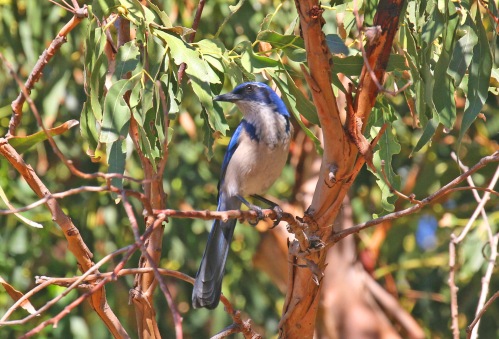
Glossy Ibis – (Photo from Everglades NP – April 27, 2017) Note how white does NOT surround the eye

Glossy Ibis

White Faced Ibis – (Photo from Sprague Lake, Washington) Note how white surrounds the eye.

White Faced Ibis in Pond

A second field a bit further south had even more Ibis and easily 1000 Long Billed Dowitchers in addition to several other shorebird species and lots of Blue Winged Teal and other ducks.  This was one of the very areas where I had many waterfowl on the entire trip and this included flocks of both Greater White Fronted and Snow Geese.  There were Ross’s Geese around, but I never found the large flock of Snow Geese with whom others had reported them.  Continuing into the refuge area, highlights included some juvenile Purple Gallinules (along with American Coots and Common Gallinules), Crested Caracaras, several Gull Billed Terns, Black Bellied Whistling Ducks, a number of Loggerhead Shrikes and one pond with more than 800 Ring Necked Ducks.

I had spent about 3.5 hours birding and had more than 50 species for the day so that was no longer a concern.  So far all of the birding had essentially been in flooded fields, pools and ponds and I wanted to try a different habitat.  This took me to a big tree area on Streeter Road near the Lacassine NWR Headquarters.  In less than 30 minutes I added more than a dozen passerine species including three very good ones: a Barred Owl, a Yellow Billed Cuckoo and a juvenile White Tailed Kite.  The Owl was calling – asking – “Who cooks for you?”.  The Cuckoo flew out from behind me and came right over my head before disappearing down the road.  The real prize was the Kite.  I got a quick glance in a field behind the first line of trees and being completely surprised thought it might be a Mississippi Kite not knowing that White Tailed Kites were even a possibility – albeit a rare one.  With a second look before it flew away, what caught my attention was a slight cinnamon wash on the bird’s breast, and then I noticed the black “wrists” under the wings.  I had never seen a juvenile White Tailed Kite before and was not familiar with the identity- insuring cinnamon wash.

Juvenile White Tailed Kite (photo from Cornell)

White Tailed Kite

It was now about 2:00 p.m. and there was a festival dinner starting at 5:30 p.m.  I headed back to the hotel traveling through the Thornwell Warehouse Area (“TWA”) where we would be meeting for the rice harvesting and rails the next day (hopefully) just to be familiar with it.  A tractor was working one of the fields and there were more than 1000 birds foraging for insects and whatever else the tractor was kicking up.  Mostly Red Winged Blackbirds, Great and Boat Tailed Grackles, Barn Swallows and White Ibis.

Before getting back to the Hampton Inn, I went to a nearby Walmart and bought a fairly cheap point and shoot camera hoping to maybe get some pictures the next day.  I then met up with Bob, Pat and Mary Frances and we were off to a Jambalaya dinner and some down home music.  More visiting with birders from all over and with the rice farmers including especially Kevin Berken whose rice fields we would be visiting and who was providing rides on his combine during the harvesting – truly a unique experience.

Me with Kevin Berken

20181101_182328

Me with Pat Reed, Donna Dittman and Steve Cardiff

20181101_182753

On the way to the dinner, we saw a Cooper’s Hawk and on the way back, Bob Reed said he often had a Great Horned Owl along the road we were travelling.  Not 20 seconds later, we saw one atop a telephone pole.  Had Bob conjured it in?  These species brought my count for the day to 72 species.  So the 50 species in a day part of the mission was definitely accomplished.  But I wanted to include a Yellow Rail in my 50 Louisiana species, so  with the expertise I had picked up in this first day of birding, I decided to get an early start on November 2nd and repeat my travels from the day before – taking less time and getting me to the Thornwell Rice Fields by 10:30 a.m. the proposed meeting time for the rice harvesting and rail viewing.

I retraced the first part of my birding steps from the day before but did not have time to do the full Lacassine loop and thus missed a number of ducks and some other species but still had seen 45 species by the time I got to the assembly area for the rice harvesting at the Thornwell Warehouse Area around 10:30.  The bad news was that due to some mechanical problems with the combine, the harvesting would be delayed.  The good news is that there were lots of birds to be seen in a couple of fields near the warehouses.  I quickly added a dozen new species for the day including three gull species (Ring Billed, Laughing and Franklin’s) – having seen none the day before.  So I already again had more than 50 species for the day and now just wanted those rails.

Just as this area has both Glossy and White Faced Ibis which can be difficult to tell apart, the same is true for Boat Tailed and Great Tailed Grackles.  There are size and voice differences and, for Gulf Coast birds, the eye color is different as well, with the Great Tailed having a pale/yellow eye while the eye of the Boat Tailed is brown.  The Boat Tailed is smaller but I found that very hard to tell when looking at a single specimen.  Fortunately we had a great display on a telephone wire with both species adjacent to each other in good light.  Size and eye color differences were pretty clear.  My back up camera was up to this task as the birds were still and close.

Boat Tailed (left) and Great Tailed (right) Grackles

Great Tailed and Boat Tailed Grackles.jpg

We trudged out to the fields that would be harvested and with the combine repaired it was “go time”.  There were four approaches to viewing rails.  One was the chance to join Kevin and a spotter on the combine itself.  As it moved through the fields, with luck some rails would be flushed and with more luck, you would get a good but quick view, and with even more luck some of the rails would be Yellow Rails.  A second approach was to  wait by the mist nets that were set up to hopefully catch fleeing rails so they could be banded.  The third approach was to walk out into the fields and follow the combine hoping to see the rails as they were flushed.  Finally, and not until later in the day, a fourth approach was to ride on one of the ATV’s that would follow the combine.  This was less stable than the walking approach but it covered a lot more ground.  Over the three hours spent at the Thornwell Rice fields I tried all four approaches.

The Combine in Action

20181102_113704

Forgetting the rails, it was awesome to see the combine in action.  A very sophisticated machine, it cut the rice stalks, separated the grains from the chaff – spitting out the latter behind and collecting the grains in a large bin which was periodically offloaded to another vehicle that would take the rice to the storage area.  This process was repeated over and over.  Kevin harvested at least four fields while I was there.  I may be underestimating but I think each field was at least 10 acres.  The combine took maybe 40 minutes per field including getting festival participants on and off  for their rides.  Harvesting by hand would have taken MANY, MANY man hours for each field.  Maybe that is why a new combine costs just under $500,000!!!

Bob Reed on the Combine

IMG_3707

The Action End of the Combine with the ATV Watching

20181102_140321

Since I had a high number (determined by time of registration), it was unlikely that I would get a chance to ride the combine that day.  In any event I had heard that the best views and only real photo ops were from the ground following the combine – catching a flight shot.  With several others, I trudged into the muddy field (high boots were a necessity) and waited.  It did not take long for birds to fly out from the approaching combine.  At first there was a Sora, then another.  A couple of sparrows flew out – most likely Savannahs and then – the magic moment – a small rail with obvious white secondaries – zoomed out to the right of the combine and maybe 40 yards from us.  The Yellow Rail flew low and disappeared quickly into the next field.  If I had my good camera with me I think I would have gotten a photo.  IF… but the camera I had was not up to the task – too hard and too long to focus and too hard to find with the viewfinder instead of an eyepiece.  A second Yellow Rail flew out a couple of moments later – an even better but also quick view.  No photo…sigh…The photo below is what I saw  and is from the Festival sources.

Yellow Rail in Flight

Yellow Rail

I had already resigned myself to not getting a photo but it was still a low point – balanced by the sighting of my first Yellow Rail since one at Anahuac Refuge in Texas the old “rail buggy” days – more than 40 years ago – April 1978.  My only chance for a photo would be if one was captured by the banding operation.  Unfortunately that did not happen this day.  I remained at the fields for another 2.5 hours.  I was able to get a ride on the combine and had many trips on the ATV’s.  The combine was great fun.  Even though it is comfortable, air conditioned and does have music (I think), it has to be hard to harvest for the 10 to 12 hour stints that Kevin told me he routinely does daily from July into October and then less regularly later.  But it does flush rails.  On my trip we flushed maybe a dozen rails – 2 Virginias, 6 or more Soras and 4 Yellows.  I saw lots more rails from the ground and on the ATV rides which I especially enjoyed.  With a good camera…maybe some photos.

It was great to see the banding operation as well – even though no Yellow Rail was captured.  It was mostly Soras, a couple of Virginias,  Savannah Sparrows and at least one Nelson’s Sparrow.  This was the first time I have watched banding.  Very careful and very meticulous including measuring, weighing and checking for parasites or diseases.  Some banding photos are below.

Netting and Banding a Sora

img_3704.jpg IMG_3719.JPG

A number of King Rail observations were reported by the Festival but I did not see any and neither did anyone else I talked to.  Maybe it was the next day.  Although King Rail shows up on my ABA Life List, I have not actually seen one – or at least seen one since it was split off as a species separate from Clapper Rail.  I had hoped for a view and a photo.  A bird I did see but did not get the photo I hoped for was a Sedge Wren.  I heard a couple and had a buried and quick look at another – no photo was possible with my substitute gear.  I did not keep exact count but estimate that I saw 6 or 7 Virginia Rails, maybe as many as 8 or 9 Yellow Rails and more than 20 Soras – a pretty awesome day.  And it really was great fun and definitely a unique experience!!

My day list was now up to 64 species.  There was time to head back to Streeter Road where I had had such good birding the day before.  I was hoping to again see the White Tailed Kite.  No Kite, but heard the Barred Owl again and added 6 species for the day – 70 in all.  Back to the hotel and a much smaller dinner than the two previous nights.

The original plan had been to bird some more the next day in Louisiana going on one of the field trips or returning to the rice fields and then head off to Mississippi for my “next state”.   That would have been a 260 mile drive.  I could have birded in the morning and then headed off.  But that was changed by two events: the camera problem and the need to switch Alabama and Mississippi scheduling because of the availability of folks I was going to meet.  I had located a good camera store in Mobile Alabama that might be able to fix my problem or if not rent me a usable lens.  And Mobile was also where I would be birding the next day with Larry Gardella.  It was only another 32 miles but I wanted to get to the camera store earlier rather than later – AND without my camera, photos from more birding in Louisiana were unlikely.  So it was going to be Plan B – leave after breakfast for Mobile – and that story will be told in my next blog post.

Area


Rice and Rice Farmers – and Crawfish, Too

A big part of the reason to attend this festival was the opportunity to see the collaboration and cooperation between the rice farming and birding communities.  Like many (most?) urban based birders, I have little direct contact with or knowledge of farming and farmers.  Add to that the enormous differences between Western Washington and states in the Deep South, and this was an opportunity to get out of my so called box and experience a very different place and way of life.  This is one of the great appeals of my 50 birds in 50 states on 50 days project.  It takes me to new places and brings new people into my world view.

Rice is an important crop in Louisiana, joining California and Arkansas as the three leading rice producing states in the U.S.  More than 50% of the Louisiana production is exported.  Top international markets for U.S. rice include: Mexico, Haiti, Central America, Canada, Colombia, Peru, Hong Kong, Japan, South Korea, Taiwan, Turkey, the European Union, Ghana, Jordan and Saudi Arabia.  Mexico, Central and South America are the most important markets for Louisiana.  As I traveled through the state I saw many areas which seemed to have poor soil.  I had a lengthy discussion about growing conditions including soils with the rice farmers at the festival orientation and learned that the soil is shallow but sits on a clay pan that allows the water to remain in the fields – a necessity for rice.  It is also conducive to what has become a somewhat parallel industry – farming for crayfish (crawfish).  They occur naturally in many of the fields and are now cultivated as a cash crop – an important adjunct to rice farming which is not a high return crop.

Louisiana is the largest domestic producer of crawfish, a delicacy whose peak season runs from Mardi Gras to Easter.  Per the LSU AgCenter about 1,600 Louisiana farmers produce 130-150 million pounds of crawfish per year with a combined value to producers of over $172 million.

Crawfish – In the Wild and On the Table

Image result for Crayfish  Related image

In addition to needing the land, rice cultivation is expensive with the need for seed, fertilizers, chemicals, expensive machinery and the gasoline to run the combines and other machinery.  As stated earlier, combines are incredibly productive but also incredibly expensive to acquire, maintain and operate.  Continuous attention is needed for the planting, growth, harvesting and sale of the product.  Risks from weather, storms, flooding, and disease are not insignificant.  The farmers I met were hard working and dedicated to this industry.  Often several generations of their families had been rice farmers before them.

There is a continuing effort to improve yields and protein values of the Louisiana rice with most production being of the long grain variety – higher value and generally more appealing for cooking.

I will not elaborate here – saving it for a later writing about my 50/50/50 experiences, but the majority of people I met were Republican and conservative even if not fond of Donald Trump’s personal qualities.  I navigated cultural and political conversations carefully, but had valuable ones.  One of the biggest problems in our country is the absence of intersection and discussion with “others” who I do not believe have to be “enemies”.  As I said – no elaboration here – more later.


Midwest Wrap Up

Travel Route


Itinerary

Day 1 Fly to St. Louis
Day 2 Bird Missouri
Day 3 Bird Illinois; Travel to Kentucky
Day 4 Travel to Tennessee; Bird Tennessee
Day 5 Travel to Kentucky
Day 6 Bird Kentucky
Day 7 Travel to Indiana
Day 8 Bird Indiana
Day 9 Fly to Seattle


Birding

Missouri 65 species
Illinois 58 species
Tennessee 57 species
Kentucky 57 species
Indiana 68 species
Cumulative for Trip 124 species
ABA Lifers Philadelphia Vireo and Eurasian Tree Sparrow
ABA Life Photos Same
Cumulative for 50/50/50 602 species
ABA Life Total 727 Species
ABA Photo Total 692 species
Seen in all 5 states 23 species
Seen in 4 states 15 species
Waterfowl 7 species
Gallinaceous 3 species
Shorebirds 8 species
Gulls and Terns 6 species
Raptors (incl, Vultures) 12 species
Woodpeckers 7 species
Flycatchers 3 species
Vireos 5 species
Wrens 3 species
Sparrows 6 species
Icterids 5 species
Warblers 16 species

Commentary and Reflection:

  • Great companions – Pat Lueders, Carol Besse, James Wheat, Amy Hodson and Mark Welter
  • 1100 miles traveled by car
  • Special places – Forest Park, Cave Hill Cemetery (Graves of Muhammad Ali, Col. Harland Sanders and grandson of Jim Beam) Mammoth Cave, Jim Beam Distillery, Indianapolis Motor Speedway, Confluence of the Mississippi and Missouri Rivers, St. Louis Gateway Arch
  • Monarch Butterfly Migration
  • Very different geography/topography – rolling hills and flat, big rivers, more deciduous than coniferous forests
  • Very modern and seemingly strong downtowns – St. Louis, Nashville, Louisville and Indianapolis – lots of old and beautiful residential areas with architecture different than Northwest – but evident poverty as well in some areas.
  • Ethnic mix compared to Seattle/Northwest seemed less Hispanic and Asian and more African American
  • Corn and soybeans were dominant crops
  • Definitely hotter and more humid than October in Seattle – but birding was blessed with no rain and very little wind
  • Very different politics – radio talk shows were very “red”
  • Very nice, helpful and engaging people everywhere
  • 17 States completed with 50 species in a single day.


Racing through Indiana – The Power of Community – and a Stop Off at the Indianapolis Speedway

First a Word from Our Sponsors – The Indy 500 and the Indianapolis Motor Speedway

indy-500.jpg

Indiana was to be the last stop on this whirlwind trip to the Midwest.  The birding was preceded by a stop at the Indianapolis Motor Speedway.  Unfortunately the bus tours were not offered that day as there was a hold over from some air races the previous day, but I wanted to visit what may be the most famous place in Indianapolis so I settled for a visit to the Museum.  Motorsports are not my thing but I certainly remember watching the Indy 500 in my youth when there were far fewer offerings on TV.  The 500 mile race means 200 laps of the 2.5 mile track at speeds over 200 mph with the record speed being 238 mph.  Yikes!!

It was very cool to see the cars in the museum – especially how they have evolved over time.  The first Indy 500 was in 1911.  There were 40 entrants then and only a dozen cars completed the race.  The average speed then was just under 75 mph and the interest in the race was at least as much in the major accidents as the finish itself.

First Indy 500 – 1911

1911 Indy

The Indy 500 – 2018 – Things Have Changed Just a Bit

Indy 2018

Some Cars in the Museum

indy-cars.jpg

And now back to the birds — well not quite yet.  One of the best stories of this trip was how I was able to hook up with some terrific birding companions – a story of networking and community – a really wonderful part of the birding world.  I had no contacts or connections with Indiana  at all let alone with birders there.  It was important to get help both for bird finding and identifying but also to get that local flavor that was a critical part of my 50/50/50 adventure.  I proceeded along two different routes to find help and they ended up intersecting – and definitely succeeding.  I am going to detail this because I think it is such an important part of being birders – our connections to each other.

Route 1 involved a suggestion from John Puschock to connect with Laura Keene who he thought might have recommendations for contacts in Indiana and Kentucky.  John own Zugunruhe Bird Tours and lives in north Seattle.  He was my guide on a fabulous visit first to Adak and then Nome, Alaska in 2016, the latter being my 50/50/50 experience in Alaska.  (We also just had an abortive chase of the Pine Bunting that was reported – or misreported – from Victoria, B.C. this week, but let’s not go there.)  Laura was one of the Big Year birders in 2016 who smashed the previous ABA Big Year record.  She saw 763 species – breaking the old record held by Neil Hayward of 749 – only to end up in third place that year behind John Weigel with 783 and Olaf Danielson with 778.  Laura was able to photograph an astounding 741 of her 763 species.

Laura recommended contacting Amy Hodson in Indiana.  I friended Amy on Facebook and shot her a message.  Route 2 – Meanwhile after showing a number of my 2018 photos to the ABC Bird group in Tacoma, I asked if anyone in the audience had any birding friends in Indiana that I might contact.  Joe Tieger said he would check with a friend.  That friend was Lee Sterrenburg. Lee is an English professor at the University of Indiana and is a much honored conservationist and birder in Indiana who has made an enormous impact protecting wildlife habitat especially at the Goose Pond Fish and Wildlife Area.  Lee and I had a great talk and if he did not have a conflict for the time I was visiting, we would have gone out together.  To help he sent an email explaining and supporting my project to a number of Indiana’s top birders and guess what…that included Amy Hodson and she and I then connected and arranged a day together starting at Eagle Creek Park.  So Route 1 met Route 2 and I was all set.  There’s more…

I got to Indianapolis and made a stop at Eagle Creek because I had seen that a Sabine’s Gull was reported there.  A beautiful gull that breeds in the far north (including Nome, AK) and is seen regularly on pelagic trips in the Pacific, it was very, very rare for Indiana.  Not surprisingly when I got to the Eagle Creek Marina, others were there looking for the bird.  One of the birders was Don Gorney.  Don is a top Indiana birder and holds the record for a Big Year in the state.  When I introduced myself, he knew “of me” from the message he had received from Lee Sterrenburg.  With Don was Aidan Rominger, a student at Purdue, another top birder with a big Indiana list.  He, too, knew my story.

Sabine’s Gulls (from Nome, AK)

Sabine's Gulls

A few minutes later, Ryan Sanderson, another of Indiana’s top birders either tied with Don or maybe a species behind for most species in an Indiana Big Year, showed up – and he too had been on Lee’s list.  It was Ryan who had first found the Sabine’s Gull (and had a “fun” kayak experience, lol).  We did not see the Sabine’s Gull then but I had great visits and was made to feel very welcome in Indiana.  I spent the night at a Best Western not far from Eagle Creek and began the next morning birding a tiny marshy area next to the hotel.  I had 12 species including a Common Yellowthroat – a great start before meeting my guide for the day and getting serious.  At Eagle Creek I was met by Amy Hodson and her good friend Mark Welter.  I was in great hands as both are superb birders and know the area in minute detail.  They were also a lot of fun.  Amy is known as the “Bubbly Birder” – a perfect description as she had a smile on her face the entire day.

With Mark Welter and Amy Hodson at Eagle Creek Park

Amy and Mark

In the photo I am in the center wearing an Indiana Audubon hat – a gift from my new best friends.  Eagle Creek Park was a great place to start our day even though again, we did not see the Sabine’s Gull.  We did find 43 species not including 5 of the species (all common) that I had seen earlier in the morning so there was no question that I would have my 50 species.  We had several good birds including yet another Philadelphia Vireo, Bonaparte’s Gull, Forster’s Tern, Northern Parula Warbler, Yellow Bellied Sapsucker and a very late White Eyed Vireo.

Yellow Bellied Sapsucker (Juvenile)

Yellow Bellied Sapsucker 1

We would return to this area later to try again for the Sabine’s Gull, but Mark and Amy had plotted out several more stops not just to get and surpass 50 species and to try for two unlikely but possible Life Birds for me – a Henslow’s Sparrow and a Sedge Wren (which I have seen but have no photo).  Henslow’s Sparrow breeds throughout the area I had visited this week but they have generally departed by the first of October.  We were not successful with either of these in good habitat but we added 9 more new birds for the day including Bobolink, Horned Lark and several sparrow species.  I hope to be able to see both Henslow’s Sparrow and Sedge Wren on my next trip to Louisiana where they live in the winter.  The Bobolinks are among my favorite birds and were great to see.  They are limited to a very few locations in Eastern Washington and I have only seen them in breeding plumage.  These were in non-breeding plumage – still beautiful but not nearly as striking.

Bobolink – Breeding Plumage in Washington

Bobolink

Bobolink – Non-Breeding Plumage in Indiana

Bobolink3

Amy learned that the Sabine’s Gull had been refound and we headed to Rick’s Boatyard – not far from the Eagle Creek Marina.  There is a restaurant there that is supposed to be excellent.  It was now about 11:00 a.m. and not many cars were parked near it.  Note:  when we drove by later, the parking lot was full.  When we arrived Don and Aidan that I had met the previous day were already on the bird and we were able to get good scope views and distant photos.  We did not stick around to try for closer ones.  Later Aidan did get great pictures.  The one below is only showing the image on the back of his camera as he has not had time to process his pictures yet.  Still a beauty. Not including some of the species I had seen at the hotel earlier, the Sabine’s Gull now brought us to 50 species for the day.  We were not done.

Aidan’s Sabine’s Gull Photo

Aidan's Sabine

There were more sparrows on this trip than in all of my other birding in the four previous states combined.  We had Eastern Towhee and Song, Chipping, Vesper, Field and Swamp Sparrows.  We tried hard for some of Amy’s favorite “Orange Sparrows” – sparrows with an orange cast in their faces at the Lebanon Business Park Marsh where we were joined by Roger Hedge.  No orangish Nelson’s or LeConte’s Sparrows but that’s where we had numerous Swamp Sparrows and my only Eastern Meadowlark of the entire trip.  It’s also where we had our first American Crow for the day – hardly rare but somehow missed during the day and they all count.  What I also got was very wet boots, socks and feet.  My boots were waterproof but in water that was several inches deeper than they were tall, that hardly mattered.  Once you are wet however, more wet doesn’t matter.  Fortunately I had a plastic bag to wrap them in for the trip home in my baggage the next day.

These were not special species, but I realized that I had not included photos of them in any other of my posts and since they were seen almost everywhere including with Amy and Mark, I want to include photos of Northern Mockingbird and Blue Jay here.

Northern Mockingbird

northern-mockingbird.jpg

Blue Jay

Blue Jay with Acorn

The species count for the day was now about 60 but Amy and Mark as a minimum wanted Indiana to be state where I had my high count.  They also wanted to find me a Red Headed Woodpecker.  We returned to Eagle Creek Park and had a woodpecker bonanza and adding Red Headed and Pileated Woodpeckers and our only Northern Flicker for the day.  We had other new species as well ending the day with 68 species – and yes, Indiana finished first.

This last stop probably also had the best photo of the day.  An Eastern Bluebird was sitting completely in the open in brilliant light.  Mark had left his camera in the car.  We watched the bird for at least 5 minutes, Amy and I taking MANY photos.  Mark finally could stand it no longer and went back to the car for the camera.  Yep…the Bluebird flew off just as he returned.  The lesson there is pretty evident…

Eastern Bluebird

Eastern Bluebird 4

As I have mentioned in my earlier blog posts for the trip, I was struck by just how enormously different the birding was here compared to my native Northwest.  And each state was different – something I will probably quantify in a wrap up post.  We had only 4 Warbler species in Indiana but did have 6 Sparrow species.  Mallard and Wood Duck were our only ducks and we only had three shorebirds.  Similarly there were only 3 gull species including the very rare Sabine’s.  And there were very few individuals (often just one) of many of these species.  We had no Red Tailed Hawks and no Falcons and only a single Bald Eagle and 2 or 3 Red Shouldered Hawks.  If I had been birding here in May or even a couple of weeks earlier or a couple of weeks later, the story would have been very different.  I don’t know if I will get back, but if I do I could not have better companions that Amy and Mark.  I hope they make it to Washington, I would love to show them my state and our great birds.

The goodbyes were sad because it ended such a great day but also happy because it had been a truly great day!!