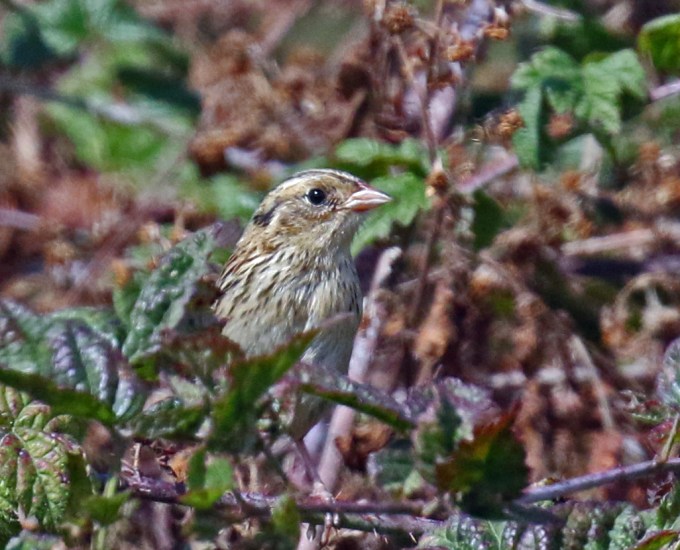
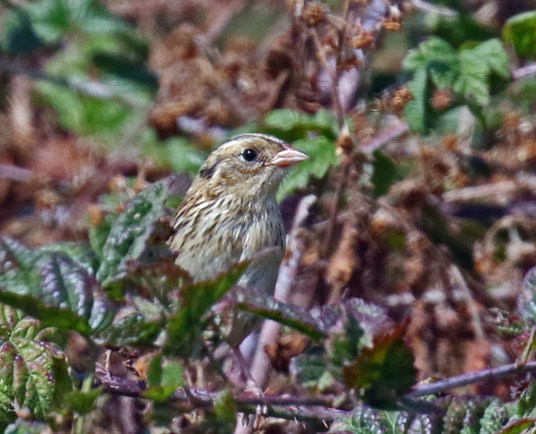
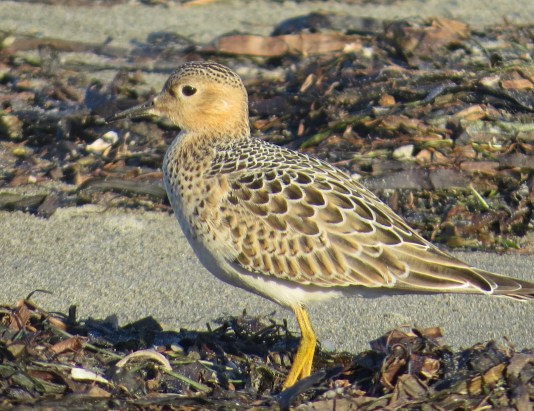
A Very Rare Painted Bird – after a Gull Diversion

This will be a relatively short post, but there was no way I could resist saying something about yet another amazing chase to Neah Bay.  Mid-afternoon on Saturday August 25th I got a rare bird alert from Ebird.  A Painted Redstart was reported from the Cape Flattery Trail near Neah Bay.  It appeared that the report might be from an organized tour group as there were 8 birders on the report – only three of whom were named – none familiar to me.  There was a photo of the view screen of a camera and there was no mistaking the identity of the bird.  Unless this was some kind of cruel hoax this would be the first record of this species in Washington.  It is one of the specialties sought after and regularly seen in Arizona.  There have been many sightings in California and some in neighboring states, but none ever even in Oregon.  This was big news.

I had seen and photographed a Painted Redstart in Arizona last year, but of course, this one would be a new State bird for me if I successfully chased it.  And normally, that is what I would have done.  Following Chase Rule Number 1, “Go Now!”, I would have left immediately for Neah Bay.  But this was not a normal day.  I was still barely into recovery mode from bursitis in my left knee (one of the consequences of the uncomfortable if successful San Diego Pelagic trip) and walking was just becoming possible.  It was questionable whether I could even make the long drive let alone the steep walk down and back up the Cape Flattery trail.  There was no way to get to Neah Bay in time for an attempt that day so it would have to be the next day at the earliest and it is often the nature of these kinds of aberrational rare visitors that they are “one day wonders” – seen one day and then gone the next.  Especially not knowing the observers, it was just too much of a long shot and risk.  I ignored Rule 1.

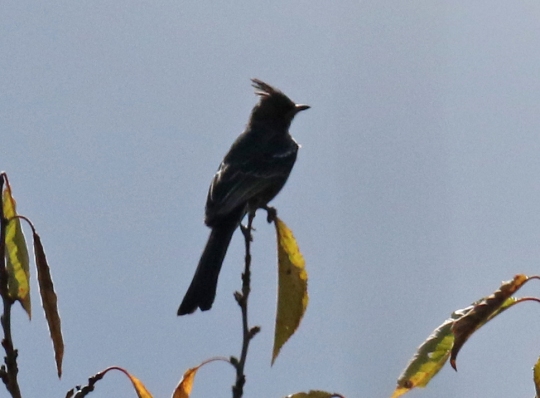
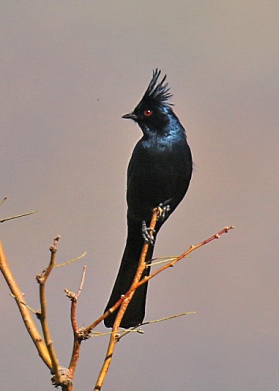
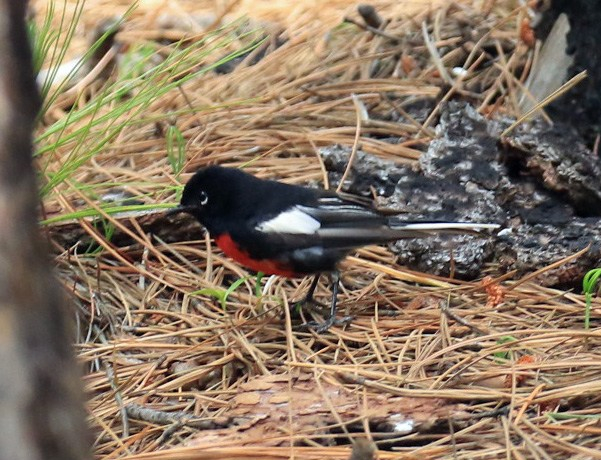
Painted Redstart – Mt. Lemmon, Arizona – August 1, 2017

Painted Redstart 3

I filed the Redstart in a recess of my mind and went out birding the next day on a trial run – see how the knee held up – trying again, and again unsuccessfully – for the Franklin’s Gull at Point No Point.  No luck there but although it got a bit sore later, the knee was “better”.  I figured someone would go look for the Redstart and I would learn if it stuck around.  There were no reports on that next day.  Had nobody looked?  Or was it here today and gone tomorrow?  I forgot about it and took it easy on Monday – the knee continuing to improve as a result.

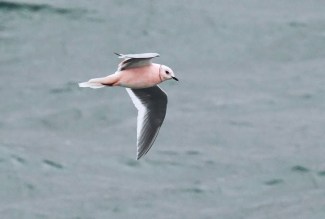
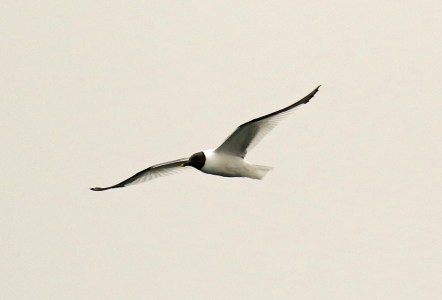
I had some personal matters to attend to on Tuesday the 28th that took me back over to the Point No Point area.  This time I located the Franklin’s Gull but had something far more interesting.  You need to understand the setting.  There are hundreds – maybe a thousand or more Bonaparte’s Gulls in constant motion at Point No Point.  Looking for the Franklin’s Gull is like looking for a needle in the haystack, but if you are looking at the right place at the right time, it is a relatively easy ID as it a tad larger than the “Boneys” and has a darker back and a dark hood.  Through my scope I found the Franklin’s and tried to get on it with my camera for a photo.  Aiming at what I thought was the right spot, i viewed something in the camera that caused my heart to skip a beat.  It was a small gull with a VERY distinctive black collar ring and a small black bill.  Although I had only seen one – a mega rarity on December 21, 2011 at Palmer Lake in north central Washington, I immediately thought Ross’s Gull because of the collar.  I took a number of photos as it continued to fly by at least 150 yards out.   Unfortunately it turned out to be a very strangely plumaged Bonaparte’s Gull – but before studying the photos and finding some “incorrect” fieldmarks, it sure was exciting.  It would have been incredible as a Ross’s Gull is like the Holy Grail to many North American birders!!  Still a lot of fun.

A Real Ross’s Gull (left) and My Attention-getter (Right)

Real Ross's Gull  bonapartes-gull-with-collar21-e1535641811989.jpg

There were no new reports from Cape Flattery on the 27th and then when a report of a Northern Wheatear with a great photo came in from Mt. Rainier on the 28th, I thought about chasing it.  I had seen one in Washington in 2012 and several in Nome in 2016, but they are very rare in Washington – certainly a great year bird for the state and the ABA.  Then it happened – another report from Cape Flattery .  The Painted Redstart had been refound by an “Anonymous Ebirder” that morning.  No way to know who it was or how credible was the report but a horrible photo was included – enough to confirm the identity.  The knee was feeling close to normal so I decided to leave early the next morning, repeating a Neah Bay ritual that had been very successful numerous times.  The chase was on.

I caught the 5:35 a.m. ferry from Edmonds, negotiated the often very windy road without much competing traffic (the log trucks were all coming East as I headed West) and arrived in Neah Bay around 9:00 a.m.  It was another 20 minutes to the Cape Flattery trailhead – and what had been a somewhat overcast day now included some heavy mist – almost rain.  This would not help the search for a bird that favored the treetops.  There was another car already at the trailhead lot and I was hoping it would be another birder and that at the end of the trail – near the picnic table where the Redstart had last been reported, I would find a birder looking at the rare bird who would point me in the right direction.  But there was nobody else on the trail and it was pretty dark and gray.  This might be a long haul – maybe even a futile one.

I played the call and song of the Painted Redstart a couple of time as much to familiarize myself with them as to lure the bird in, although that sure would have been nice.  It was very quiet – until about 5 minutes later when I heard someone approaching down the trail.  He had a telescope and binoculars – another birder!!  Reinforcements.  It was Keith Brady, an excellent birder from the Olympia area.  Keith is right near the top of the list of birders with the most species seen in Washington.  After the second Redstart report he could not pass up this opportunity either.  We immediately joined forces.

In most circumstances, I have pretty good hearing although more often than I would like, I am unsure of what bird is making the call that I hear.  Keith’s hearing put me to shame as he began hearing Golden Crowned Kinglets in the treetops in the distance when I heard nothing.  This was important because the Painted Redstart had been seen associating with Kinglet flocks on the two occasions it was reported.  We  got fleeting glimpses of a couple of Kinglets, but nothing else.  After maybe 30 minutes, we heard an unfamiliar “call”.  It sure sounded like the two-toned (or to me closer to one and a half tone) “cheree” call of our target.  We heard it a couple of times and then high up in a cedar we found several Kinglets and a larger bird with white in the wing, large white edges on the tail and indeed a bright red belly and breast.  With pointing assistance from Keith, I had it!!

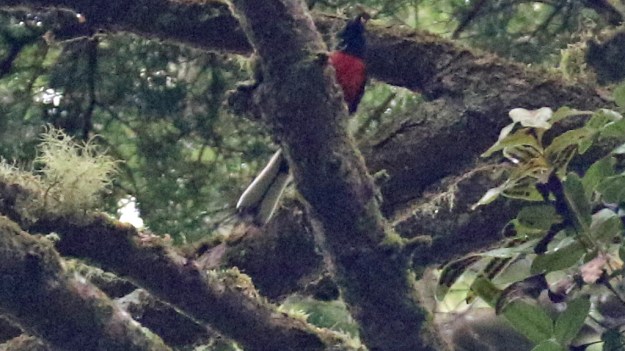
The Painted Redstart flitted around and moved over to a fir tree in the poor light.  It was in the open just enough to get a couple of great views and then would fly off – almost like a flycatcher and land mostly out of sight.  I tried to find it with my camera but with the gray sky and low light and fogging on my view finder, it was a challenge.  I aimed in the right direction and hoped for the best.  The best turned out not to be great, but it was good enough – no mistaking this fellow.

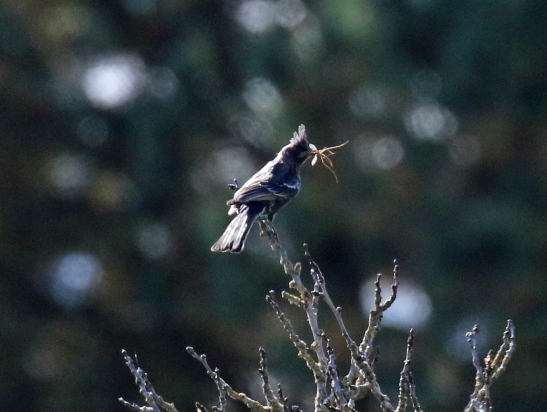
Painted Redstart – Cape Flattery – August 29, 2018

Painted Redstart

We watched in amazement for several minutes getting partial views at best and then it disappeared.  High fives with Keith – two jubilant birders.  We then went over to the observation deck and scanned Tatoosh Island and only because Keith had brought his scope were we able to see Tufted Puffins in the grass and diving off the cliffs to go fishing – around 20 in all.

We returned up trail to try again for the Redstart.  On a couple of occasions we heard its rich full song – a complete surprise.  It was further off and after it came no closer during the next 10 minutes, I departed.  I don’t know if Keith, who remained for awhile, got additional looks.

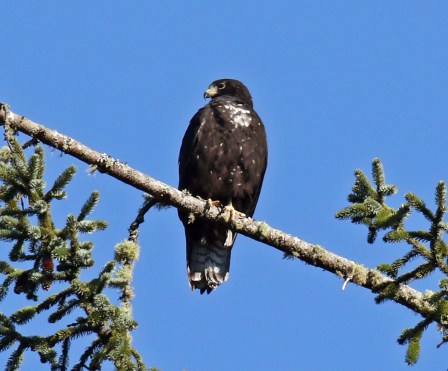
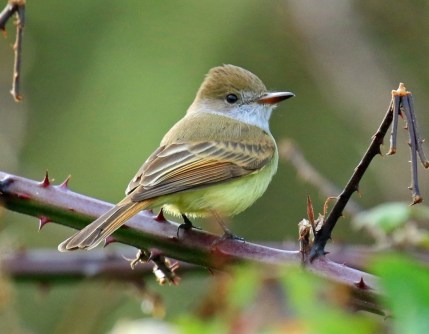
As a bird flies, it is over 1500 miles from Cape Flattery to this bird’s regular breeding habitat in Arizona.  It migrates from Mexico where it generally spends its winters.  What was it doing here?  As a first state record, obviously it is way out of place and there is no way to know what quirk of fate or genetic aberration sent it to us.  I have written often about the incredible rare birds seen at Neah Bay (a few miles from Cape Flattery).  In the past two years there have been two other first time Washington records at Neah Bay for  what are normally Arizona birds.  Last year, there was a Zone Tailed Hawk on November 6th and in 2016 there was a Dusky Capped Flycatcher on November 21st.  Is there a pattern?  If so a late August visit for the Redstart seems really out of place.  Maybe these earlier visitors liked it here and are spreading the word.  What will come next?  I hope I get a chance to find out.

Zone Tailed Hawk November 6, 2017

Zone Tailed Hawk

Dusky Capped Flycatcher – November 21, 2016

Dusky Capped Flycatcher


San Diego Pelagic – Terrific Birds and Birders – Some Frustrations As Well

Background and Preliminaries

Just as on my pelagic trip out of Hatteras, North Carolina earlier this year in June, this trip was a chance to add multiple new ABA Life birds.  There would be some overlap with birds I see regularly on trips out of Westport, Washington, but being much further south, there were a number of new species that ranged from sure things to probable to rare but not impossible.  I was especially interested in a variety of Storm Petrels that have been seen frequently and some others that have been seen recently, if not often.

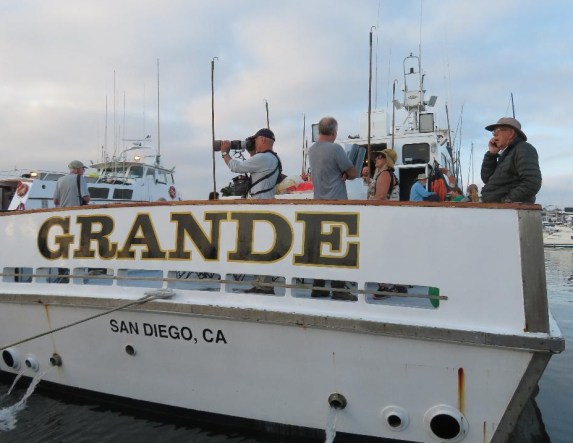
Pelagic trips are different in every location.  This results from the operator, the sea conditions, time of year and especially the distance out to deep water.  Most pelagic trips are on boats that are more commonly used for deep sea fishing ventures and they were not designed with ease of visibility for birders in mind. Our trip was offered through the Buena Vista Audubon Society and was organized by super San Diego birder Paul Lehman.  The boat was the Grande, a large fishing vessel (85′) with a full galley and some bunks, often going out on overnight or even multi-day tuna trips.  It docks at H&M Landing between Shelter Island and Harbor Island and our departure was scheduled for 7:00 a.m. which is 60 to 90 minutes later than the boats depart from Westport or Hatteras.

The Grande

The Grande

And of course the birds are different as well – determined by many factors including food sources, proximity to breeding areas, ocean temperatures and currents and at least for birder observations, luck.  On my Washington trips, finding a shrimper, trawler or processing boat can make a huge difference, as the boats can have hundreds or even thousands of seabirds following them.  I had been on pelagic or semi-pelagic trips in Washington, North Carolina, Maine and South Africa as well as crossing oceanic areas in Florida on the way to the Dry Tortugas and in Southern California on the way to Santa Cruz Island to see the Island Scrub Jay.

This trip was different from all my others in many ways.  The boat was significantly larger (not counting the much larger boats to the Tortugas and Santa Cruz which are more passenger ferries) and there were more than twice as many birders on board compared to my other trips.  As is often the case, there were advantages and disadvantages as a result.  A larger boat has plenty of room and access to spread out, but when a really good bird is seen, there is often a rush to an area where the view is theoretically best.  It was often the case on this trip that it was difficult if not impossible for everyone to see some of the birds with birders crammed in small preferred spaces often three or four deep.

All pelagic trips count on spotters – excellent, experienced birders with particular talent for finding and identifying often very similar species.  All trips I have been on have had great spotters.  I am amazed at how quickly they can identify birds that I can barely see.  Not all spotters and not all operations are equally good at getting others on the birds, however.  In part this is a numbers and location game and in part it depends on the personalities and preferences of the spotters.  For example, with maybe one exception, the spotters on the Washington trips uniformly make it a priority to be sure everyone gets on the birds.

Paul Lehman Preparing the Group

Paul Lehman

Often the Boat Captain with his or her elevated position in the wheelhouse plays a lead role in seeing distant birds.  Captains Phil Anderson in Washington and Brian Patteson in Hatteras are both terrific at this – announcing birds they see often before the spotters or anyone else.   On this trip, the Captain was seemingly not involved with the birds at all as Paul Lehman remained in the wheelhouse and his announcements were the main or at least first source of notice to the birders of what birds were being seen.  Paul was connected to the spotters by radios and I am sure that many of his announcements were of birds seen first by them and then communicated to Paul who so advised the birders via a speaker system that was better than any I have heard on other trips.  With a couple of exceptions, it was my take that the spotters on this trip had relatively little direct communication with the birders to help them get on what were often (too often) distant birds.

We had very favorable calm seas with minimal chop and almost no waves.  This makes it easier to see birds both because there is less movement of the boat and also because the birds do not disappear behind waves – now you see them, now you don’t.  It was very pleasant in the morning but got quite warm in the afternoon.  Sunscreen was a must, but warm clothing was not.  This was a long and full day as we were out a full 12 hours – somewhat longer than other trips I have been on.  The galley was a big plus.

The Birders

There was an extraordinary collection of birders on this trip.  I will mention some that I know or know of and am leaving out many that I don’t know who may as well be as or more noteworthy.  Many were doing “Big Years” of some sort and the specialty birds on this trip plus the possibilities of rarities made it a mandatory stop for them.  I personally knew 12 of the other birders – 5 of whom were from Washington State including Shelli and Meghin Spencer who are doing a mother/daughter Big Year, and Scott and Sierra Downes, a father/daughter combo from Yakima who are racking up many birds in Washington and out of state as well.  Four of the birders, including friend Mel Senac and spotter Nancy Christenson, are the top 4 listers on Ebird for San Diego County for 2018.  The top six and seven of the top ten ABA Area Ebird Listers for 2018 were onboard.  This included Dave and Tammy McQuade from Florida who I had met in North Carolina, and Dan Gesualdo from Ohio who I had met just last week on a Westport Pelagic trip and is doing a lower 48 Big Year – all by car.  I did not meet (shame on me) Richard and Gaylee Dean from Texas who each had over 744 ABA species last year and were out doing it again this year.  Finally there was Nicole Koeltzow who is already at 738 species for 2018 and has set her sights on a Very Big Year.  A big regret was that I did not meet the legendary Guy McCaskie who was also on the trip.  He is affectionately known as the “Godfather of California Birding” and at 85 is still going strong.  Also onboard was Kyle Kittleberg who I met the night before at dinner with Mel SenacKyle is an excellent and enthusiastic young birder who among other things at age 25 has been one of the key spotters on many of the Hatteras pelagic trips.  Again I know I am leaving many great birders off this list – just did not know or know of them.

Before getting to the trip itself, I want to share one of those birding/small world stories.  I stayed at the Dolphin Motel the night before the trip conveniently just across the street from the docks.  A simple breakfast is available on the patio – available early around 5:00 a.m.  One other person was out when I went for some early coffee.  It was someone else from Seattle, John Bjorkman.  The world got even smaller when we learned that John was an attorney at a Seattle Law Firm that I had worked at (before escaping from lawyering) almost 40 years ago.  We had lots to talk about and hope to get some birding in together back in Washington.

The Birds

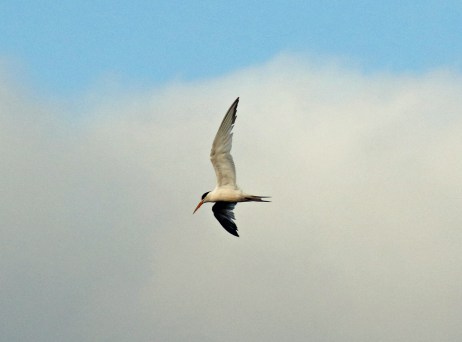
It was perhaps an auspicious start when a Black Crowned Night Heron was on a railing immediately next to us as we boarded the boat.  And it was also not long before we had Elegant Terns overhead as we motored out of the harbor.  I wish some Elegant Terns would make it back to Washington.  The last two years they have been scarce or non-existent.  At other places I had birded in the area before the trip, I had also seen many Forster’s Terns, a species I usually see at Potholes in Washington but missed this year.

Black Crowned Night Heron

Black Crowned Night Heron-1

Elegant Tern

Elegant Tern

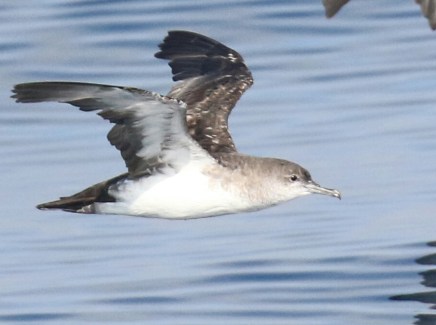
Our first real pelagic species was Black Vented Shearwater, the most common Shearwater in the area.  I got my lifer last year on the boat trip out to Santa Cruz Island to find the Island Scrub Jay.  We also had several Red Necked Phalaropes early and later had Red Phalaropes as well.

Black Vented Shearwater

Black Vented Shearwatera

Not long afterwards several individual Black Storm Petrels appeared crossing the bow  and then flying by on mostly the starboard side. This was my first Lifer on this voyage, the one that was almost a guaranteed observation.  They are quite large and almost look like small shearwaters with a flight pattern that reminds me of them as well.  We would see well over a hundred of this species during the trip, most fairly distant.  Unlike my experience with Wilson’s Storm Petrels in North Carolina and the Fork Tailed Storm Petrels in Washington, these guys did not come in close to the boat.

Black Storm Petrel

black-storm-petrel-spread-1.jpg

Relatively early and perhaps another good omen was a Brown Booby that flew alongside the boat maybe 70 yards away.  A good bird for the year.  Another was seen later.

Brown Booby

Brown Booby1-1

As is usually the case on pelagic trips, there were periods of almost no activity and then times with more birds.  There were no periods of hyperactivity – primarily because there were no congregations behind fishing boats and chumming seemed ineffective.  In Washington chumming is either by throwing fish pieces behind the stern or by creating a slick with fish oil.  It can be very effective bringing birds of a number of species in very close.  The technique in North Carolina was to use oil and to drag some Menhaden in a cage behind the boat.  It mostly attracted Wilson’s Storm Petrels.  There may have been some fish oil put out on this trip but I never saw it and if so, it was ineffective.  Some fish parts were dragged but the main technique seemed to be to throw out popcorn.  The only birds I saw come in for the popcorn were Western Gulls.  We never found any really large rafts of Storm Petrels – maybe chumming would have been effective if we did.

There had been an excellent scouting trip the previous day on a smaller boat.  They had many good birds at was is known as the 9 Mile Bank – a high spot in the bottom that runs for 9 miles north and south.  There was a pick up of activity here as we found our first Pink Footed Shearwaters and continued to see Black Storm Petrels and some Black Vented Shearwaters.  I think it was here that we had our first Craveri’s Murrelets – another Life Bird for me and another disappointment as the birds were never close and were always flying away from the boat giving us only distant views primarily of their backs.  Like Marbled Murrelets in Washington, these birds are generally seen in pairs.  We probably had at least 6 pairs on our trip – all with the same distant fly away views at least from the bow where I spent most of my time.

Craveri’s Murrelet (My best of a lot of bad photos)

Craveri's Murrelet-1

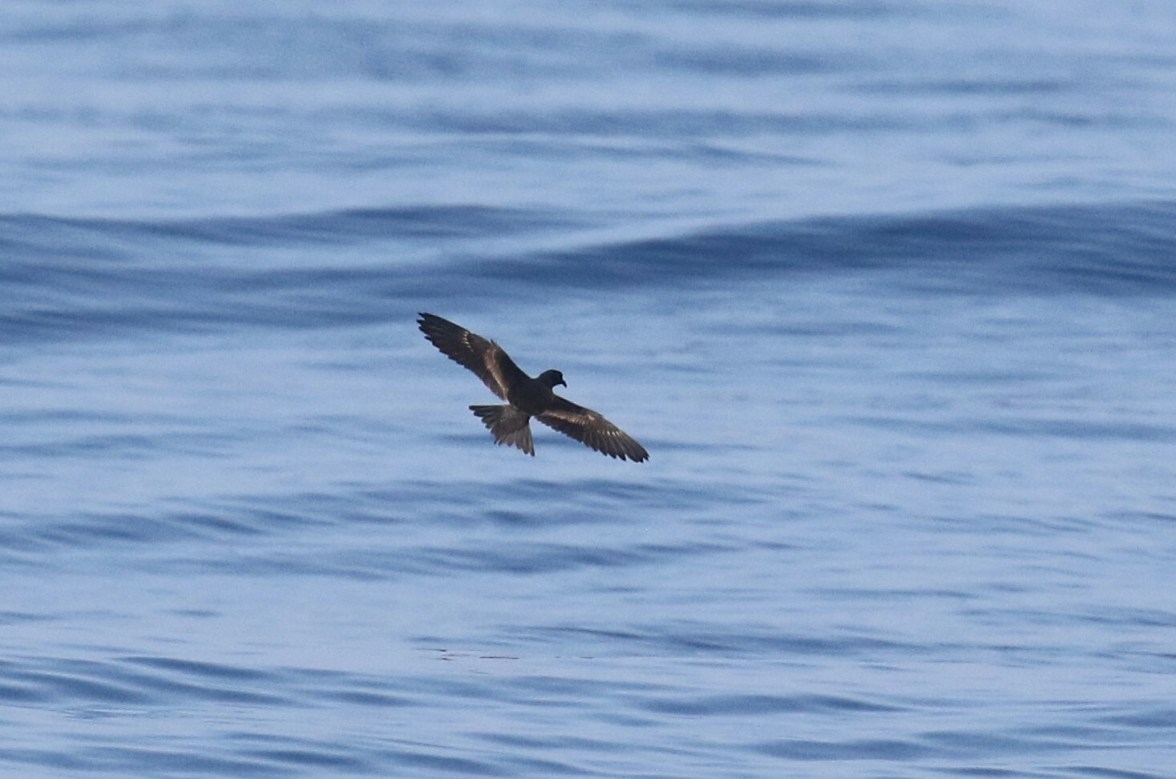
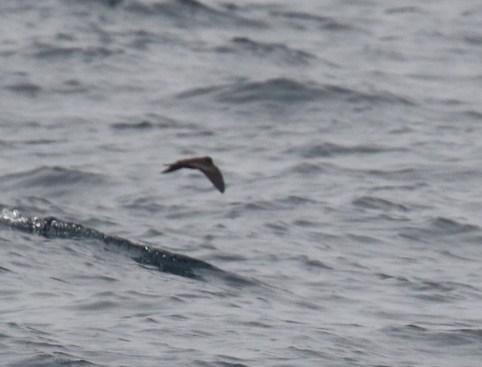
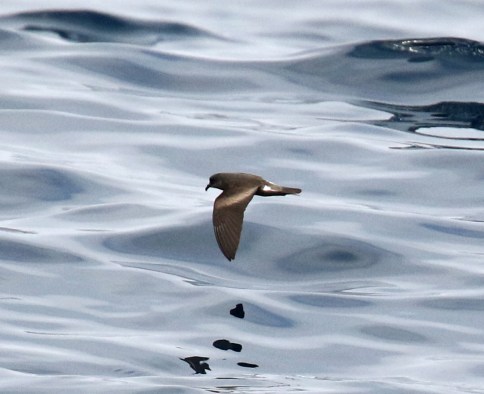
There were not a lot of birds at the 9 mile bank and then even fewer for quite a while after we left it and before we got to what is called the 30 mile bank where there was some increase in both Shearwaters and the Black Storm Petrels and we added some new species.  I don’t know exactly where we saw our first Ashy Storm Petrel but altogether we had only 5 – in hours 2, 3, 5 and 6 of the trip.  These were even further out than the Black Storm Petrels and were very hard to photograph.  They could be identified as a bit smaller than the Black Storm Petrels and with noticeably shallower wingbeats.  To me they were very hard to tell from the Leach’s Storm Petrels except for the Leach’s that had some white on the rump (never fully across).  In flight the Leach’s had a springier wingbeat, but I will need a lot more observations to get that down.  The Ashy Storm Petrel was another Life bird.  I was able to see and identify at least two and maybe three of the Ashy’s but I am not sure of the photo.

Ashy Storm Petrel (Probably)

AShy2

Since there were no gatherings of birds and it was my first trip in the area, it was difficult to keep track of where we were when something was seen.  I will just add some photos without them necessarily being in sequence starting with a picture that did come out well of a Cassin’s Auklet.  We had several during the trip, not quite as many as the Craveri’s Murrelets and these were our only two alcids.

Cassin’s Auklet

Cassin's Auklet-1

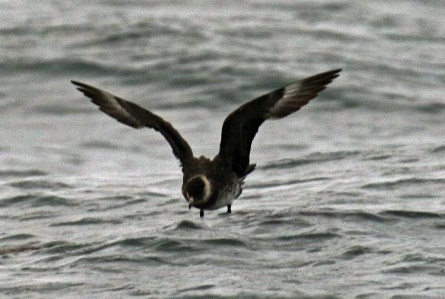
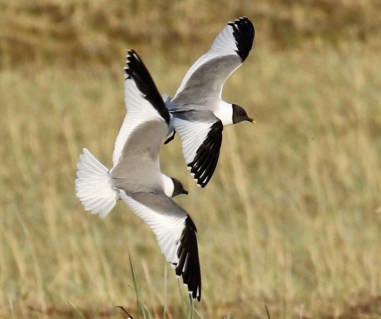
We also found some Sabine’s Gulls, both adults and juveniles and we had a couple of Pomarine Jaegers. Later we would have a Parasitic Jaeger and a distant view of a South Polar Skua.  I thought someone had a Long Tailed Jaeger  that would have completed the so-called Skua Slam, but I never saw it and it did not make it onto the trip lists.

Sabine’s Gull (Juvenile)

Immature Sabine's Gull-1-1

Pomarine Jaeger 

Pomarine Jaeger2-1

Parasitic Jaeger

Parasitic Jaeger1

There was a bit of excitement when a small Storm Petrel which appeared to have a white rump flew by.  I got a few lousy photos and showed them to Paul Lehman.  The question was whether the white went completely around the base of the rump and down on the side not just the top.  If this had been the case, we would have had a Townsend’s Storm Petrel – split from the Leach’s Storm Petrel which either has a dark rump or a pale rump or some white but not fully across the rump.  My photo was at best inconclusive but it did not appear that there was enough white to make it into the very rare Townsend’s.   Later we had quite a few Leach’s Storm Petrels and I got better photos that showed the partially white rump clearly.

Leach’s Storm Petrel

Leach's5

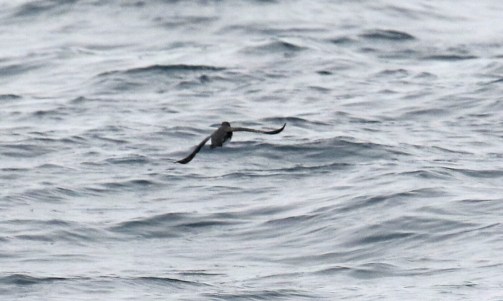
The hoped for large rafts of Storm Petrels never materialized.  I think the largest raft was just over 30 birds – all Black Storm Petrels.  One other raft had a much smaller darker bird – a poorly seen Least Storm Petrel – another ABA Lifer for me.  A second one was also seen.  They are distinguishable by size although if alone and at distance that is problematic.  They also tend to have a very direct flight.  This is my only photo – terrible as it is.  I am also including one taken by Kyle Kittleberg.  I was on the same bird at the time as we were comparing notes but I could not get the photo.

Least Storm Petrel – Second Photo by Kyle Kittleberg

Least

Least 2

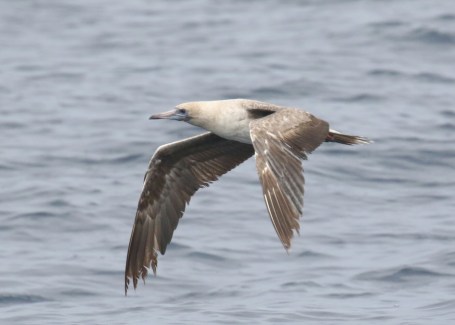
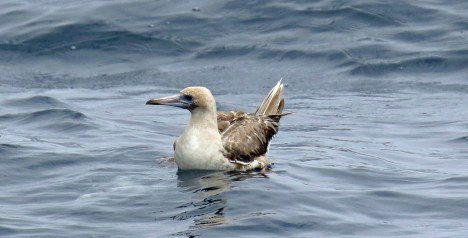
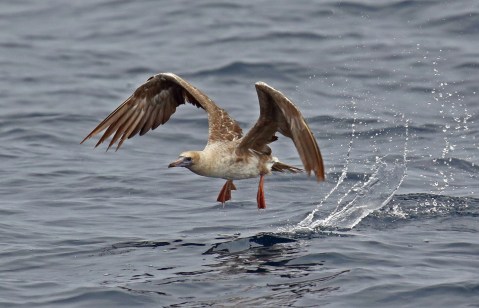
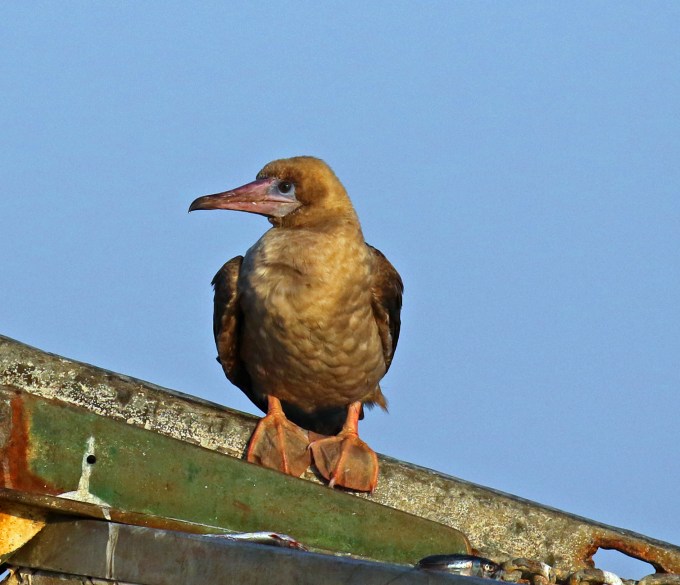
In general birds became few and far between except for continuing immature Western Gulls and a few of the species already mentioned as we were returning to port.  Especially as the clouds and breeze disappeared and the temperature rose, I got very tired and a bit inattentive.  I needed a shot of adrenalin – something to excite.  When someone yelled out “Red Footed Booby“, I was no longer tired and raced to get a view.  This was one of the most cooperative birds on the trip coming relatively close and circling twice and landing twice giving us good views and photo ops.  I had seen my lifer Red Footed Booby at Pillar Point in California last year and got a terrible distant photo.  These would be much better and clearly show the red feet.  Only the second one in my life.

Red Footed Booby

Red Footed Booby2-1

Red Footed Booby on Water-1


Red Footed Booby1-1

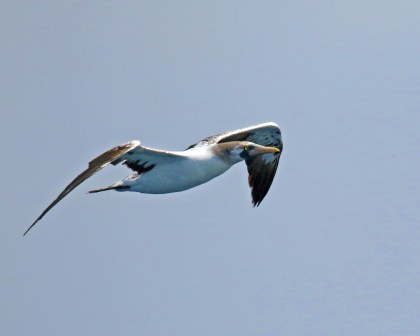
And if a two Booby day is good why not go for three.  About 30 minutes later there was another stirring call: Masked Booby“.  Not quite as cooperative as its Red Footed cousin, but still good and close looks.  I had seen several in Florida in 2017 but this was the first on the West Coast.  Added to the Nazca Booby I had seen earlier this year, it was the fourth Booby species I have seen in San Diego County.

Masked Booby

Masked Booby2

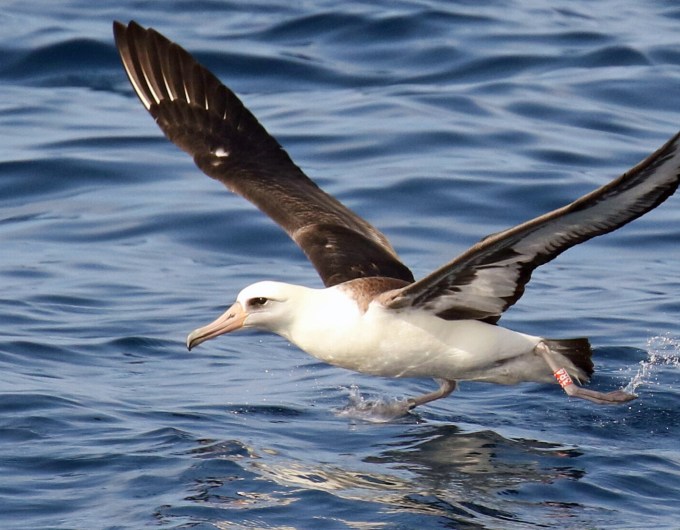
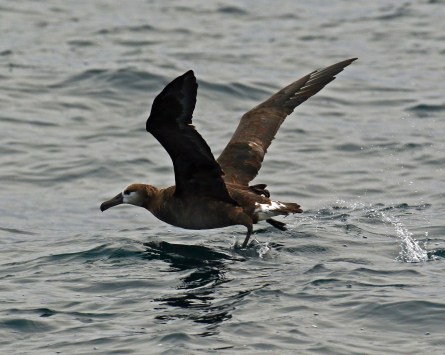
So the smaller birds had been challenging but these big guys were making up for it.  And the show continued first with good looks at a Black Footed Albatross and then with what for most people was the star of the show, a Laysan Albatross.  In Washington the Black Footed Albatross are very common and we often see more than 100 on a trip many just a few feet away.  And lately Laysan Albatross has become pretty regular in Washington as well.  In fact I saw one last week and also had one on my April pelagic trip.  Such has not been the case in San Diego and it was a new county bird for almost everyone including top county listers Mel Senac and Nancy Christenson.  I was thrilled for them and they were definitely happy birders.

Black Footed Albatross

Black Footed Albatross-1

Laysan Albatross

Laysan on Water-1

Laysan Underwing1-1

Purely coincidentally not much before the Laysan showed up I was discussing its occurrence in Washington with one of the San Diego area birders and told him how it had become almost regular and that was being attributed to the development of a new breeding colony on Guadalupe Island off the coast of Mexico,  He said it was not fair if somehow those relatively close  birds flew past San Diego to get to the Northwest.  Then this guy showed up and as can be seen in the next photo, it is a banded bird and sure enough, the band (3R4) indicates that it is from Guadalupe Island.

Banded Laysan Albatross

laysan-banded-1.jpg

There was still one more show ahead as we approached home.  The captain had learned that a second Red Footed Booby was hitching a ride on the Liberty one of the tuna boats returning to the docks.  It had been on the bow quite awhile and we slowed our return to wait for the boat to come in.  Indeed a very tame and photogenic Red Footed Booby was sitting on the anchor chain at the bow of the Liberty as it came up next to us.

Red Footed Booby on the Liberty

RFBO boat2

Especially with the flourish of larger birds at the end, it had been an outstanding trip,  Sure some closer and better views of the Storm Petrels and Craveri’s Murrelets would have been nice, but they were all seen and I got some photos.  I added 4 ABA Life Birds and photos on the trip bringing my totals to 724 and 689 respectively.  I have a couple more trips planned for the year which with luck could add another two ABA Life species and another 6 to 8 ABA photos.  I think my goal of 700 ABA life photos will be in reach in 2019.

It was especially rewarding to spend time with so many excellent birders, to see some old friends and to make new ones.  I am sure that some of us will bird on the same paths in the future again – planned or not.


POSTSCRIPT

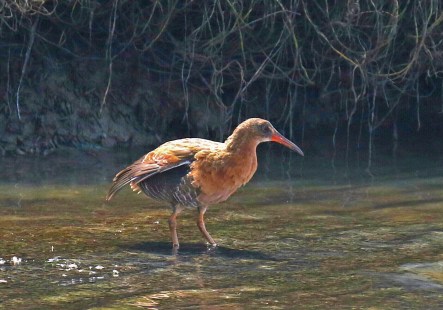
The day after the pelagic I made a brief visit to the Tijuana Slough NWR and again was fortunate to see two Ridgway’s Rails.  One was in the open long enough for a very nice photo.  I also had a Vermilion Flycatcher at the ball fields in the Dairy Mart Road area.

Ridgway’s Rail

Ridgeway's Rail

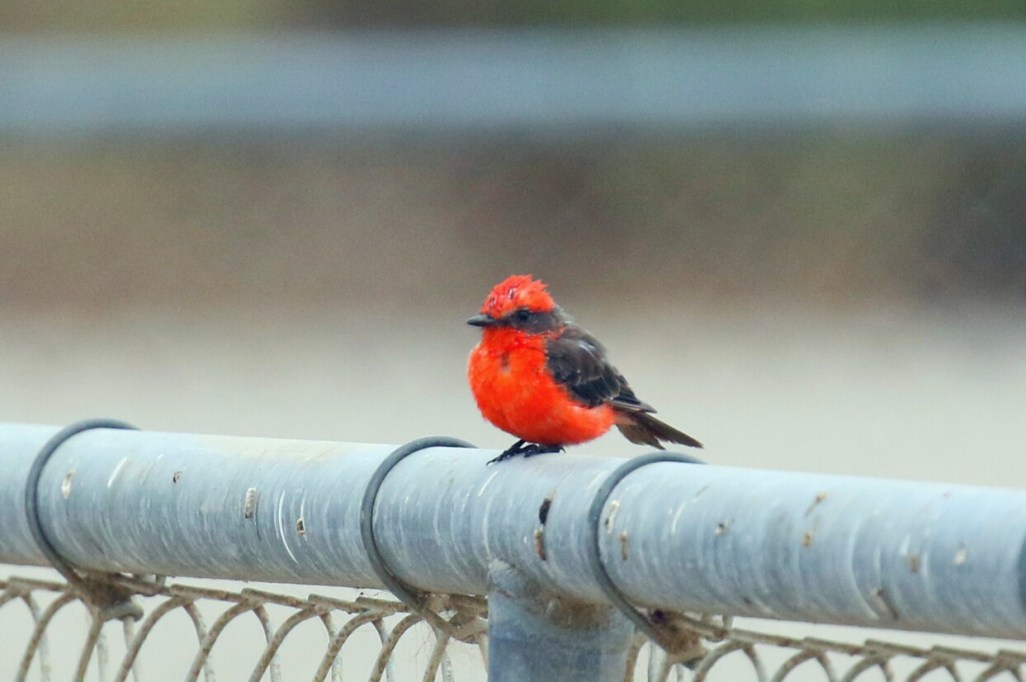
Vermilion Flycatcher

vermilion-flycatcher.jpg

Earlier today (August 23, 2018) I got a nice email from Shelli Spencer who is from Gig Harbor, WA and is doing a Big Year with her daughter Meghin,  She sent the following two photos.

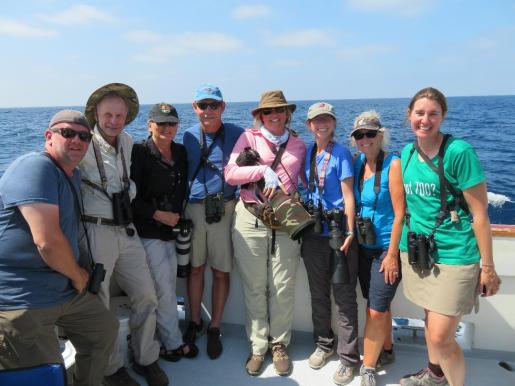
Big Year Birders – from Left to Right:  Dan Gesualdo, Richard and Gaylee Dean, David and Tammy McQuade, Meghin and Shelli Spencer and Nicole Koeltzow.

Big Year Birders

This photo is of me onboard the Grande checking out my camera settings with lens extended.  The gentleman on the right is Guy McCaskie.

Boarding the Grande

Southern California Appetizers – Gray, Yellow, Gold and Spotless

In Washington I may travel even a great distance to chase a single bird.  I no longer do this just for a single new bird for the year like I did in my Big Year quests, but will do so for a new state life bird or a new state life photo.  Beyond Washington though, there have to be multiple targets or motivations.  This was the case for my just completed return to Southern California.  I was going to go on my first San Diego pelagic trip (which I will write about in my next blog) as the main course with appetizers being my continued pursuit of a ABA First Photo of my nemesis Lawrence’s Goldfinch and a first ABA observation of a Yellow Footed Gull. Depending on what was around and the success of those adventures, maybe there would be other possibilities as well.

My plan was to get to San Diego early, rent a car and drive to Kitchen Creek Road – about 90 minutes away and look for the Lawrence’s Goldfinch.  Mid August is not the best time for this species in the area, but San Diego birding friend Mel Senac suggested this spot as a good place to look and it was mostly on the way to the Salton Sea, the place to find the Yellow Footed Gull.  I had met David and Tammy McQuade on my North Carolina pelagic trip and learned they would be on the San Diego trip as well.  We compared notes and they told me they had seen Lawrence’s Goldfinches at Kitchen Creek this year also – but in the spring.  This is where networking really pays off.  I was so focused on the Goldfinches that I had no awareness that this was also a good area for another species that was on my ABA Photo “needs” list – a Gray Vireo.   The McQuades had found a pair at Kitchen Creek in the Spring also and Dave sent me details.

From San Diego to Kitchen Creek Road

San Diego to Kitchen Creek Road

It was almost 11:00 when I got to Kitchen Creek.  It was hot, dry and pretty quiet.  I first tried for the Goldfinches along a trail that connects to the Pacific Crest Trail.   I played the songs and call notes of both the Lawrence’s Goldfinch and the Gray Vireo but had no luck.  I then went to what looked like a riparian area maybe a quarter mile further east.  No water there now, but I guess it is good in the spring.  No Goldfinches of any kind but I heard and had a brief view of a Bullock’s Oriole in flight.  The Gray Vireo was probably the “better” bird to find, but I had missed so many times on the Goldfinches, I was really focused on them.  I almost forgot to try again for the Vireo, since it had been seen in the first area I had birded and not here.  Fortunately, I tried once more.

As soon as I played the song of the Gray Vireo, a single bird flew directly towards me from across the road at least 100 and probably 200 feet away.  It landed in dense brush next to me.  I got a mostly obstructed partial view.  At least in the view I had it was plain and essentially without field marks.  That would fit with Gray Vireo, but I could not get a photo and could not be sure.  I played again and had no movement.  After 5 minutes without any more views, I wondered if it had flown out the back of the brush, and I decided to work another area and then try again.  My guess must have been correct.  After another 5 minutes of birdless looking, I played the Gray Vireo song again.  This time, I heard a responsive song, and again a bird flew from across the road and came to the same brush.  When it landed it gave the “eh-eh-eh” call of a Gray Vireo and I knew I had my bird.  It took some doing and no pictures came out real well, but I finally got a photo – an ABA first for me.

So I had been looking for “gold” and ended up with “gray”, but as I have written many times, you cannot find anything if you are not out there looking and sometimes the consolation prizes are as good or even better than the prize you thought you were seeking.

Gray Vireo – Kitchen Creek Road, San Diego County (Poor Photo)

Gray Vireo

I tried once more for the Goldfinches at the original spot with no success and figured it was time to move on.  The original plan had been to stay the night in Brawley – fairly close to the Salton Sea and to bird the area in the early morning when it would not be so hot.  It was just after noon and Brawley was another 80 miles away.  Although it was definitely getting hot, I figured I would first drive to the Salton Sea and scout the area, staying in my air conditioned car and maybe get a view of one of the Yellow Footed Gulls, an ABA Lifer.  This would maybe save time in the morning since I would know the lay of the land (or the Sea).

Kitchen Creek to Salton Sea

Kitchen Creek to Salton Sea

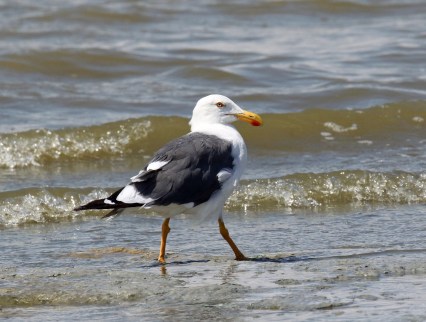
Yellow Footed Gulls were previously thought to be a race of Western Gull but is recognized now as a very distinct different species.  It nests only in the Gulf of California, between Baja California and the Mexican mainland. In the summer, after nesting, many of the gulls come north across the desert to the Salton Sea.  A few may have over wintered and stayed in the area, but those observations are questionable.  The time to see one is in July through September – when temperatures are over 100 degrees and often over 110.  It is also a time when odors at the Sea are also pretty strong.  Not a pristine birding condition.

Mel Senac had given me excellent specific information about where to look for the gulls, so I went directly to Young Road and drove along the sea wall.  It was distant but I quickly found a large dark mantled gull.  I did not have a scope, but I had a good enough view to know that I had a new lifer.  I took a record photo, but it just barely showed the yellow feet.  The shore of the lake at first was pretty far out.  I could see many shorebirds but had no idea what they were except for may larger ones that were Willets.  I kept driving along Young Road and saw several more dark mantled gulls and many more shorebirds including a large number of Black Necked Stilts.  There were also Egrets and Brown Pelicans.

I came to a spot where the shoreline was a lot closer (maybe 200 yards) and I had a much better look at a gull with distinctly yellow feet.  There was no question that this was a Yellow Footed Gull.  The mantle was even darker than that of a Western Gull which has pink/red feet.  Despite the heat (over 105 degrees) and the nasty smell, I decided to walk out into the gunk and see if I could get close for a photo.  Maybe the adrenaline overcame the heat and smell as they mattered not, and I was able to get within about 100 feet and got some really nice photos, ones that I figured would be my best ones.  I was very satisfied and it was worth the yucky stuff on my boots which I would scrape off.

Yellow Footed Gull – First Good Photo

YFGU FIrst

It was nice to get back to the air conditioning of the car and even though it was very dry, I was sweating hard.  I continued north and found a number of small ponds close to the road and had great looks at American Avocets, Black Necked Stilts, Long Billed Dowitchers and mostly Western Sandpipers.  A little further out at one spot, I had some Marbled Godwits and at least one Stilt Sandpiper.

One of the places Mel had suggested as a likely spot to find the gulls was at Obsidian Butte where the road is very close to the Sea.  When I got there I could see two very close Yellow Footed Gulls on the rocks below with a Snowy Egret.  It was a partially obstructed view from the car, but I was able to get out and get killer photos.  I was elated.  I later saw several more Yellow Footed Gulls in the distance – probably at least 10 and maybe as many as 14 in all, not being sure if some were ones I had seen earlier and had relocated.  A flight shot of one of the gulls accentuates the yellow feet.

Yellow Footed Gulls

Yellow Footed Gulls Obsidian

Yellow Footed Gull Takeoff

The Salton Sea is a fascinating place – over 340 square miles and located over the San Andreas Fault.  It’s elevation is  226 feet below sea level.  Some history.  It is a saline lake that was formed when the Colorado River breached its levees in 1905 flooding the “Salton Sink” for two years before the breach was stopped.  At first it was seen as a miraculous paradise with resort communities, yacht clubs and good fishing.  It was a favored spot of Sonny Bono and even the Beach Boys, but by the 1970’s it was becoming a disastrous ecosystem.  There was no drainage outlet and almost no new rainfall. Runoff flowed in from nearby farms and the sea was polluted with pesticides and was saltier than the Pacific Ocean.  Many of the birds that had made the Sea their home were poisoned by the pesticides and botulism.  It is as far from a resort as you can imagine today.

Almost 400 species of birds have been seen in the area – including some rarities.  For example Little Gull, Black Headed Gull and Ross’s Gull have all been seen there.  There are several records of Blue Footed Booby.  One was reported shortly before my visit, but it was not an authenticated record.  As I drove around the area in the heat I found large flocks of Black Bellied Plovers, White Faced Ibises and Cattle Egrets.  It was too hot to really search diligently and I headed to my hotel in Brawley with a new plan in hand.  I was more than happy with the Yellow Footed Gulls I had seen and photographed already so instead of birding the area early as originally planned, I would head north to continue my quest for a Lawrence’s Goldfinch photo.

There were Ebird reports for two places during the past 10 days for Lawrence’s Goldfinches that were “relatively” nearby in San Bernadino County.  The first was Wildwood Park on Wildwood Canyon Road about 120 miles from Brawley.    I think it was primarily set up for horses.  Lots of scrubby habitat and trails and I was pretty sure I heard some Lawrence’s Goldfinches.  I tried hard to find them and to draw them in but I was not successful.  I added Phainopepla, Oak Titmouse and Nuttall’s Woodpecker for the trip.  Then it was on to Glen Helen Regional Park which was another 35 miles north and west.  This was my last and best hope as there had been multiple reports of 12+ Lawrence’s Goldfinches at this location.

When I got to the Park, I was a bit dismayed.  It was a large area with many different spots to check.  I had no clue where to start.  As soon as I parked at the first place, I saw a lot of birds fly out of shrubs and into the grass and then back again.  Could it be that easy?  Nope.  It was a large flock of Lark Sparrows.  The main feature at the Park is a large pond for fishing.  I decided to head that direction and as soon as I parked I heard what I was pretty sure were Lawrence’s Goldfinches in trees between the parking area and the pond.  There were lots of birds but they were staying high in the trees and moving from one invisible spot to another.  I got a few quick fairly open looks and saw mostly young birds or females.  I was pretty sure these were my targets but I had trouble getting a photo and besides I really wanted a male both for ID purposes and also because the male is very fine looking.  It took many minutes to get any photos but even though they were not of the male, the yellow/gold wing patches were enough to distinguish them from Lesser Goldfinches which might also be present.

Finally I found several males and with some coaxing and prayers to the bird gods, a couple showed themselves well enough for my much desired ABA First Photo.  And finally I would no longer have to consider this species a nemesis.

Lawrence’s Goldfinch Male

Lawrence's Goldfinch Male-1

It was getting hot again, but I had hit the target and could relax and see what else was around.  I did not bird real hard and am sure I missed many birds but I found a small group of Rufous Crowned Sparrows which I had mistaken initially as Chipping Sparrows.  I also had some Western Bluebirds and a female Western Tanager.  The best bird however, was a rare for the area Neotropic Cormorant.  It was drying its wings on some snags near the water’s edge on the pond and seemed oblivious to the fishermen or to me.

Neotropic Cormorant

Neotropic Cormorant 1

Now I had added Gold to Gray and Yellow.  I would hopefully be adding Black in the form of a Black Storm Petrel to my bird accomplishments on the pelagic trip.  But that was still two days away.  What now? I knew of no other birds of color to target.  I was 120 miles from San Diego and it was only just after noon.  There were no more targets – well, except maybe one.  Spotted Dove would be a Life Bird.  They had been seen off and on in a couple of parks in Los Angeles earlier this year including by Dave and Tammy McQuade.  There were no recent reports.  Dave was going to look for them again today with his friend Dave Alpeter who had joined them on this trip and would also be on the pelagic.  I had texted Dave earlier to see how that try had gone but had not heard back.  It was about 60 miles to the most likely place to try and I had nothing else to do, so I decided to give it a go.

Surprise, surprise.  When I arrived Dave and Dave were sitting on a bench in the park looking for the Dove.  They had been there without success for 40 minutes.  We visited and watched together for another 20 minutes – again nothing.  They left and I remained for another 20 minutes – nothing.  It was not yet 2:30 and I figured there would be traffic but it would be worse if I did not get going.  I got going.  It is hard to believe the traffic could have been worse.  It was 120 miles to my hotel.  I figured maybe 2.5 hours.  My figuring was an hour short.  But at least it wasn’t raining and the air conditioning worked.

It had been an excellent two days but as my contrived Blog Title states, without spotting the the Spotted Dove, my record had not been unblemished.  Gray? Yes thanks to the Gray Vireo.  Yellow? Most definitely with the Yellow Footed Gulls and most importantly Gold with the Lawrence’s Goldfinch. But without the Dove, success was not Spotless.  But it almost was or maybe could have been.  About thirty minutes after I left the target zone, another birder who would be on the pelagic trip arrived there and two Spotted Doves flew in just as he got there.  I haven’t seen a photo, but will take him at his word.

I do not see a return trip just for that in the future unless somehow I am already in L.A.  Then again, it would be nice to see a Lakers game with LeBron…hmmm?

My next blog will cover the pelagic trip – lots of stories and lots of birds.

Washington Coast and Pelagic – August 11th and 12th

Next week I will be back in Southern California motivated primarily to take my first San Diego Pelagic trip.  In part to get into practice for that, I signed on for the August 12th  trip with Westport Seabirds, with some shorebirding at some other spots on the coast on Saturday.  The first stop was at the Hoquiam STP.  Not real birdy, but a pleasant surprise was meeting Dick Holcomb.  He is another birder from Edmonds and we had not met before.  He was going to be on the pelagic trip the next day as well, so we shared stories and planned to do some birding together later that day as well.

My schedule was dictated primarily by the tides.  High tide would be at 2:06 p.m. which meant that I wanted to be at Bottle Beach not later than 11:15 a.m.  This gave me enough time to drive the open beach south of Westport, beginning at the Bonge Road entrance. There were lots of birds but not much diversity – thousands of Sanderling and thousands of California Gulls, some Western Sandpipers, Caspian Terns and not much else.

California Gull

California Gull Adult

Caspian Tern

Caspian TErn

Sanderling

SAnderling Open Beach

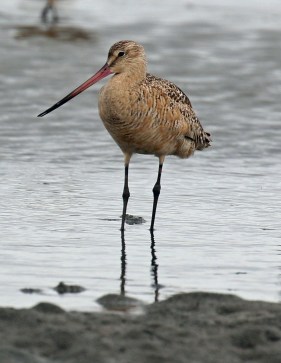
I made it to Bottle Beach on time and was joined by Dick and by Anna Kopitov.  She had contacted me after I posted I would be in the area and would enjoy joining forces with anyone else who was at the coast.  She was an eager and good birder and nice to have along.  We had timed the tide pretty well and immediately found some dowitchers, a large flock of Marbled Godwits, even more Black Bellied Plovers and even more peeps.  It was particularly fun to see the Plovers in so many plumages.  Some still had full black bellies and some had no black at all.  I somehow managed to delete all my photos from Bottle Beach except for the Marbled Godwit so it will have to represent that location for this blog post.

Marbled Godwit

Marbled Godwit 2 Bottle Beach

The tide came in pretty rapidly and the show was over by 12:30 p.m. another reminder that you have to get to this location well in advance of the high tide.  We caravanned down to Tokeland where we found a cooperative group of 11 Willets and many Least Sandpipers on the grass near the boat launch and also had hundreds of Heerman’s Gulls and Brown Pelicans on the island in the bay.

Willet

Willet Tokeland

Least Sandpipers

Least Sandpipers Tokeland

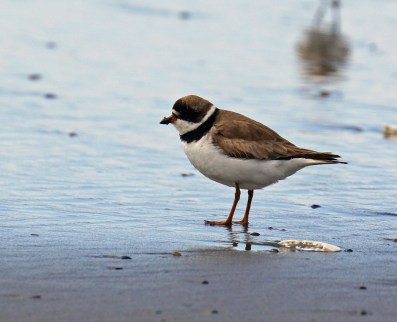
We made a stop at the Fisher Avenue spit and saw hundreds of California Gulls and many Caspian Terns but no shorebirds.  At this point the group split up and I made another long drive on the open beach this time entering from the Midway area and leaving at Bonge.  There was some kind of Waverider party going on and there were hundreds of people and almost as many cars on the beach.  There were no birds near them, but fortunately they were pretty concentrated.  Mostly the same birds as before but this time I also found several hundred Semipalmated Plovers.

Semipalmated Plover

Semipalmated Plover1 Open Beach

The number of California Gulls along the coast was truly staggering.  There was a huge concentration at North Cove.  I would guesstimate that combining them, the ones on the open beach, those at Fisher Avenue and the ones seen on the pelagic trip the next day (primarily juveniles), there were easily 4,000 birds.

Unfortunately I had decided to make this trip somewhat at the last minute, and I was unable to find a room anywhere near Westport.  So after dinner with Dick, it was a night sleeping in the car.  Not all that bad except that the noise from the fog horn, gulls squawking and a seemingly endless coming and going of cars meant only a few hours.  If this had been one of the North Carolina pelagic trips with too much heat and too few birds, I probably would have fallen asleep midway.  Westport is not North Carolina.  Granted no Fea’s Petrels or European Storm Petrels, but we had excellent birds and lots of action.  Adrenalin overcame tiredness.

Everyone was punctual and we met Captain Phil at the boat at 5:15. Our official spotters would be Bill Tweit and Gene Revelas so we were in good hands and Scott Mills was onboard unofficially so even more help.  We headed out in near darkness and had a lot o chop until we got past the jetties.  Then the seas ranged from “ok” to quite smooth the rest of the day.  There had been showers the day before and at night, but we remained dry for the whole trip.  Not great sun light which made some photos challenging, but all in all excellent conditions.

Our first good bird was a Pomarine Jaeger that was resting on a drifting log.  It allowed us to come quite close before flying off.  The lighting was bad and I did not use the best camera settings, so the photos were just fair, but a good start for what turned into a very good trip.

Pomarine Jaeger

Pomarine Jaeger on LOg Pelagic

Pomarine Jaeger4

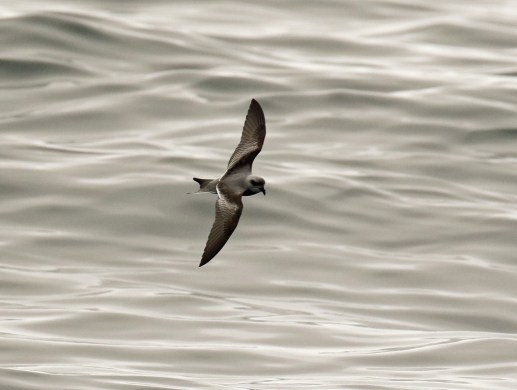
On my earlier Washington pelagic trip this year in March,  the only jaeger seen on that trip was also a Pomarine, so the jaeger on the log was a nice start but from a “listing perspective” a Parasitic or Long Tailed Jaeger would have been preferred.  On each pelagic trip there are generally some “regulars” that you can count on, some “usuals” that are almost always seen and then the chance for something rare and/or exciting.  On that March trip we had some Short Tailed Shearwaters and a Laysan Albatross as better than usual species, and a Manx Shearwater – much better than usual.   But there had been no Pink Footed Shearwaters and no Fork Tailed Storm Petrels, usual fare even for an early in the season trip.  Both of these species were on my expected First of Year list and by the time we got to our first shrimper with hundreds of birds circling it, we had seen both of these species.

Pink Footed Shearwater (note the pink feet)

Pink Footed Shearwater Pelagic

Fork Tailed Storm Petrel

Fork Tailed Storm Petrel Top of Wing Pelagic

On my earlier trip we had also had a Laysan Albatross.  Still a much sought after species, it used to be very rare.  During the last couple of years, however, they have become almost regular or at least not unusual.  Nonetheless they are quite striking and when one was seen among the dozens of Black Footed Albatross with the shrimp boat, there was heightened excitement.  It was a year bird for almost everyone and a life bird for many.  I took a lot of photos.

Laysan Albatross

Laysan Albatross2 Pelagic

Black Footed Albatross (An Adult – see the white above the tail)

Black Footed Albatross Adult Pelagic

There is always something to learn on these trips.  Until fairly recently the Laysan Albatross bred only on a few islands in the Pacific along the Hawaiian Archipelago.  Lately a breeding colony has developed on Guadalupe Island off Mexico.  This has correlated with the increase in sightings of this species on Westport trips.  I don’t think there have been banding and tracking studies to prove it, but it is likely that many if not most of  our birds come from the Mexico breeders.

Captain Phil Anderson took the boat out to the deeper waters of Grays Canyon.  I have been on many of these trips and have learned that some species are most likely to be found in the deeper waters and there is always great anticipation of something really special.  Nothing extraordinary was found but we had two species that were great additions:  some earlier than usual Buller’s Shearwaters and a few Arctic Terns both new for the year.

Buller’s Shearwater

Buller's Shearwater1 Pelagic

Arctic Tern

Arctic Tern Pelagic

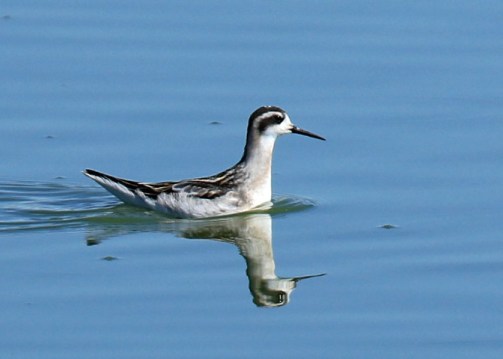
We had seen several Red Phalaropes earlier, but now we had many more and closer looks better for photos and they were easier to distinguish from the Red Necked Phalaropes which were encountered in smaller numbers.  All of the spotters are amazing and can tell the different species from great distance.  In addition to their knowledge of detailed field marks and skill in seeing them, vast experience has also given them an almost sixth sense about the gestalt or “jizz” of a bird – an immediate characteristic impression based on shape or wingbeat or behavior.  Sometimes I get such a feel and it does help, but I also make mistakes and have to be careful not to prejudge.  It was impressive how the spotters could immediately tell that a distant small phalarope was a Red and not a Red Necked.  Yes the bill and coloration details may be different, but those are details that require a good look to discern.  We learned that the best first indicator is the “stockiness” of the bird.  Red Phalaropes are definitely stockier and the Red Necked Phalarope is more svelte.  It actually worked — most of the time.  A similar lesson was learned to distinguish between two alcids in flight, the more football like Rhinoceros Auklet and the Common Murre which is pointier at front and back.

Red Phalarope

Red Phalaropes3 Pelagic

Red Necked Phalarope

Red Necked Phalarope2

Another species we had seen earlier in greater numbers but with better looks in the deeper water was the Sabine’s Gull.  Not great light and not my best photo but a beautiful small gull with a striking wing pattern and a yellow tipped bill.

Sabine’s Gull (The first photo is from this trip and the second is from Nome, Alaska where I saw many in full breeding plumage splendor and in good light)

Sabine's GullBill Pelagic

Sabine's Gulls

As we began our return voyage, I was talking with David Olsen up near the bow of the boat when my eye caught a small bird flying towards but angling away from the stern.  It was one of those times when jizz kicks in and sends a quick mental message – my brain noted it as a storm petrel with a rump patch.  I immediately yelled out “Leach’s”, cut my conversation with David and raced towards the rear of the boat hoping others were on the bird.  Scott Mills was intently looking at something but it turned out to be another Short Tailed Shearwater so everyone was looking away from where this bird might have been seen.  I had processed that it was darker and browner than the Fork Tailed Storm Petrels and there was that unmistakable rump patch at the base of the tail.   From my North Carolina experience distinguishing Wilson’s Storm Petrels from Band Rumped Storm Petrels which both also have white rump patches, my eye had subconsciously noted even in my quick glance that the legs of this bird did not extend beyond the tail – which they do on a Wilson’s.  Finding a Wilson’s in these waters would not have been impossible but extremely unlikely.  I could conclude only that it was a Leach’s Storm Petrel– a bit past the prime of their time here, but several had been seen on this trip the week before.  Sure wish I had a photo.

Leach’s Storm Petrel (from my Westport Seabirds trip in August 2015)

Leach's Storm Petrel2

There were still some more good birds ahead.  We had a couple of Parasitic Jaegers – distant views only but a fun view of one chasing a California Gull.  This is what jaegers do, they “parasitize” other birds, generally gulls, trying to get them to disgorge food which is then taken by the jaeger.

Parasitic Jaeger Chasing a California Gull

Parasitic Jaeger Chase3 Pelagic

We also had a distant South Polar Skua – a close relative of the jaegers.  It is a powerful bird – apparent even at a distance.  Birders may refer to the “Skua Slam” – seeing the three jaegers – Parasitic, Long Tailed and Pomarine – and the South Polar Skua on the same trip.  We fell short because we found no Long Tailed Jaeger – probably.  Gene Revelas had seen a distant jaeger which could have been one but he was not sufficiently certain with the distant look to make a positive ID.  Gene made a great analogy to the Grand Slam in baseball – getting a single, double, triple and home run in the same game.  The triple is the hardest of those hits to get.  For a “Skua Slam”, the South Polar Skua is the home run and the Long Tailed Jaeger is the hard to get triple.

South Polar Skua (taken from at least 100 yards away)

South Polar Skua2 Pelagic

Another good find was a Tufted Puffin – a juvenile without the tuft or the humongous bill of an adult, but still a large bill and an easy ID.  They are not seen often on these trips although they breed in Puget Sound and on islands off the northern coast.

Tufted Puffin Juvenile

Tufted Puffin1 Pelagic

I generally do not pay much attention to the commonly seen gulls on these trips but on this trip I was really struck by the beautiful feathering of the immature California Gulls.  There were hundreds of them seen throughout the day.  I could not resist a photo.

Immature California Gull

California Gull Juvenile Pattern Pelagic  California Gull Juvenile1 Pelagic

The trip back in on a following sea (incoming tide) was smooth.  We would search for rock pipers on the jetties and call it a day.  The search was successful with several Wandering Tattlers on the outer jetty and then Black Turnstones, Surfbirds and Marbled Godwits inside the marina.

Wandering Tattlers

Wandering Tattlers on Jetty2 Pelagic

It had been an excellent trip as usual.  In addition to spending time visiting and soaking up knowledge from the spotters, I had fun chats with a number of birders on board.  It was nice to get to know David Olsen.  We had interacted before only briefly.  David just returned from a summer in Wyoming working on a pediatrics program as part of his med school program at the University of Washington.  He completes his M.D. this year and then is vying for a very competitive residency program.

It was also great to meet Dan Gesualdo, if or no other reason than he makes some of my listing pursuits seem simple and sane.  He is doing a “Lower 48” Big Year – seeing how many species he can see this year in the U.S. excluding Alaska and Hawaii.  The Tufted Puffin was species number 650 for him this year – second in the Ebird rankings.  Among the amazing aspects of this incredible feat is that he has done it without taking a single flight.  I may have the number wrong but I think Dan said he has put on over 60,000 miles this year – yikes!!  Dan had been on pelagic trips in North Carolina in May just before Frank Caruso and I did our trips.  He had seen what may be the Bird of the Year – first record of a Tahitian Petrel.  We missed that by two days.  Dan will also be on the same pelagic trip I am taking in San Diego this upcoming Sunday.  I fly down on Thursday.  Dan of course is driving down.

As always, Westport Seabirds was super – great operation and great results.  I added 9 new species for the year in Washington:  Fork Tailed and Leach’s Storm Petrels, Pink Footed and Buller’s Shearwaters, South Polar Skua, Sabine’s Gull, Arctic Tern, Red Phalarope and Parasitic Jaeger.  The traffic back was abominable – even worse than usual.  Sleeping without a foghorn was welcomed that night.

Keen on Kenya

I often find myself in conversations about bucket list destinations – where would I most like to go on a trip – birding or otherwise.  There are many places on that list ranging from the relatively close like finally getting to Malheur National Wildlife Refuge in Oregon or a little farther away like finally getting to Magee Marsh in Ohio to much more distant and exotic places like Borneo or Ecuador.  I hope to get to all of those places, but if the question were which place I have visited would be on top of my visit again list, there would be many wonderful runners-up, but the top spot would be held by Kenya.

I chronicled a favorite memory of my trip to Kenya in “The Circle of Life” blog which I published on October 4, 2016.  That post included some birds but was primarily about “my father’s leopard”, a magical emotional encounter with this beautiful animal at Samburu National Park in November 2007 – perhaps a “gift” to me from my father who had passed away three months earlier.  That will always be the best moment of that trip, but there were many more.  Some are remembered here.

This was my third significant international trip but my first with a group.  The two earlier ones were on my own to Australia in 2003 and Brazil in 2005.  This trip was with Victor Emanuel Nature Tours – 20 days including very long flights.  It is about 9,000 air miles from Seattle to Nairobi either nonstop or through London.  I went through London and it was an ordeal.  First a 9 hour red-eye flight to Heathrow and then a transfer to Gatwick with a ten hour layover before another 9 hour flight to Nairobi.  I was met at the airport by a driver to take me to the Safari Park Hotel about 20 miles away.  Despite very little sleep the past two days, I was so excited about being in Africa that the adrenalin was running high and I was raring to go.  It was a beautiful sunny morning adding to the excitement.  It should have been no more than 35 minutes to the hotel but…there was a big international marathon going on and the trip took well over an hour.  I received a dose of reality fairly quickly.  In the slow travel, I had my hand out the window in the rear of the town car.  The driver noticed and said:  “Please sir. Pull your arm in.  They will cut it off to get your watch!!”  Whoa…welcome to Africa!

Safari Park Hotel

Safari Park Entrance

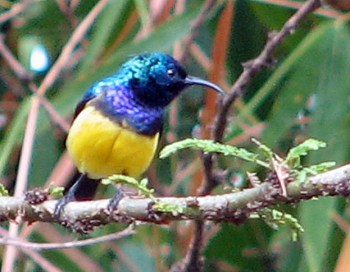
The hotel was terrific and I had an afternoon to kill before meeting the group that night.  The grounds were extensive and there were definitely birds to be seen.  All were new and it was a great beginning for a great trip.  Some highlights on the grounds were Hamerkop, Sacred Ibis, Black Headed Paradise Flycatcher, Superb Starling and several Sunbird species.

Hamerkop
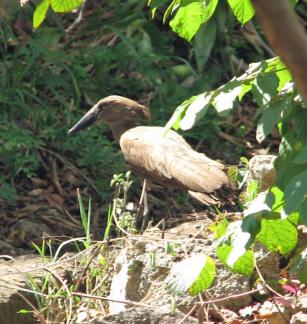
9 Hamerkop

Sacred Ibis

Sacred Ibis

Superb Starling

59 Superb Starling

Variable Sunbird

6 Variable Sunbird

That evening I met with the group – all from the U.S. with our leader David Wolf and second mate Brennan Mulrooney, and the next morning after I birded on the grounds again myself, we birded as a group at the hotel and in the Nairobi area.  There were so many birds and so many animals and so many interesting people and interesting places seen on this trip it would be take way too many pages and hours to include them all.  And the same would be true for a day by day recounting of experiences and observations.  Rather than go day by day and place by place, I am going to include “groups” of birds with photos of some favorites and do the same with the mammals.  Altogether there will be photos of 50 species of birds – less than 10% of those seen and about 30% of those photographed.  I was just starting to take photos and had pretty basic equipment so the quality is not great, but the subjects certainly were.  I will also intersperse some comments on places visited and some special people that I met.  There was so much that was fantastic, sadly many great people, places, birds and animals will be left out.  Even with the painful omissions, this is my longest blog post.  Writing it has brought wonderful memories.

Birds of Kenya

October 28th to November 17th, 2007 — 504 Species –  465 Life Birds

In a category all its own is the iconic Common Ostrich.  With its long neck and long legs, it can reach a height of 9 feet and weigh in at 250 pounds – the tallest and heaviest of all birds.  It cannot fly but running it can reach speeds of over 40 miles per hour.  Our first observations were of a flock at Lake Nakuru National Park.

Common Ostrich — Lake Nakuru National Park, November 6, 2007

Ostrich M

Waterfowl

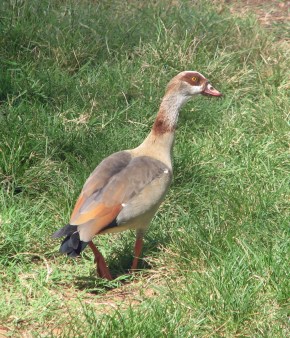
There were relatively few waterfowl – a total of only 12 species.  The Northern Shoveler was the only species seen there and also in North America.  I had my first Egyptian Goose – native to Kenya – and then later seen as an exotic in Florida ten years later.

Egyptian Goose — Mountain Lodge, October 31, 2007
Egyptian Goose 2

LandfowlGallinaceous Birds

Six species including three Francolins, Harlequin Quail, and my favorites the Guineafowl.

Helmeted Guineafowl — Samburu National Reserve, November 1, 2007

Helmeted Guineafowl

Vulturine Guineafowl — Samburu National Reserve, November 1, 2007

61 Vulturine Guineafowl

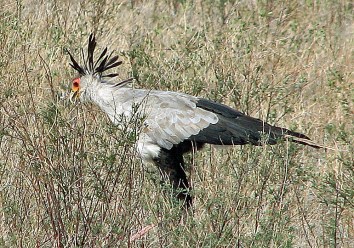
Raptors –   33 species including eagles, kites, vultures, goshawks and my favorite the Secretarybird.

Bateleur — Samburu National Reserve, November 2, 2007

36 Bateleur

Martial Eagle — Samburu National Reserve, November 2, 2007

43-martial-eagle4

Eastern Chanting Goshawk — Samburu National Reserve, November 1, 2007

56 Eastern Chanting Goshawk

African Fish Eagle — Lake Nakuru National Park, November 5, 2007

77 African Fish Eagle

Secretarybird — Samburu National Reserve, November 3, 2007
35-secretary-bird

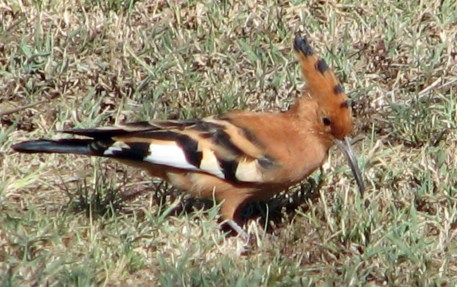
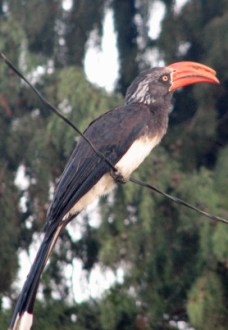
Hornbills and Hoopoes –  9 species of Hornbills and 3 Hoopoes

Eurasian Hoopoe — Samburu National Reserve, November 3, 2007
54 Hoopoe

Crowned Hornbill — Naro Moru River Lodge, November 5, 2007
67a Crowned Hornbill

Northern Red Billed Hornbill — Samburu National Reserve, November 1, 2007
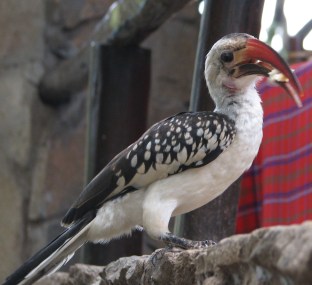
Red Billed Hornbill

Jackson’s Hornbill — Lake Baringo, November 7, 2007
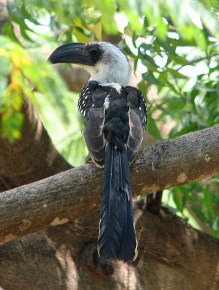
101 Jackson's Hornbill

Shorebirds: 23 Species

Black Headed Lapwing — Lake Nakuru NP, November 6, 2007
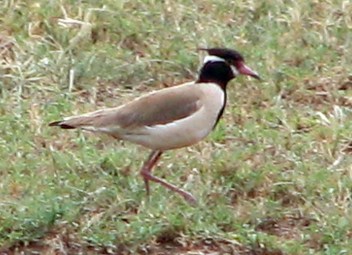
Black Headed Lapwing

Black Winged Stilt — Lake Baringo, November 7, 2007
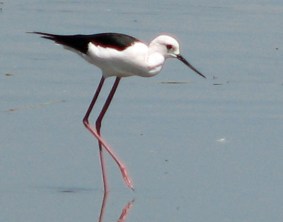
African Stilt

Three Banded Coursers — Lake Baringo, November 7, 2007

2 Banded Coursers

African Jacana — Mountain Lodge, October 31, 2007

African Jacana

Waders (Storks, Cranes, Herons, Flamingos. Egrets etc):  21 Species

Gray Crowned Crane — Mountain Lodge, October 31, 2007
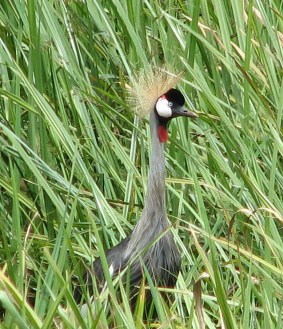
22 Crowned Crane

Marabou Stork — Lake Nakuru NP, November 6, 2007
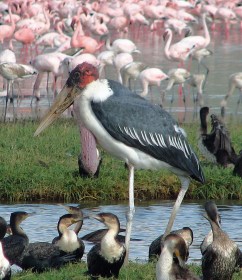
75 Marabou Stork with Others

 Flamingos Hunted by Hyena — Lake Nakuru NP, November 6, 2007

74 Hyena with Flamingoes

Goliath Heron — Lake Baringo, November 7, 2007

96 Goliath Heron

Cuckoos, Turacos and Go Away Birds:  15 species

Great Blue Turaco — Kakamega Forest, August 10, 2007
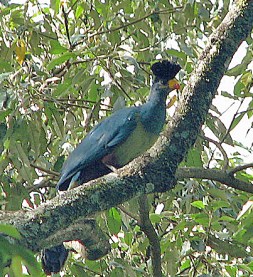
Great Blue Turaco

Hartlaub’s Turaco — Mountain Lodge, October 31, 2007

Hartlaub's Turaco1

Red Chested Cuckoo — Safari Park Hotel, October 30, 2007

Red-chested Cuckoo

White Bellied Go Away Bird — Samburu National Reserve, November 2, 2007
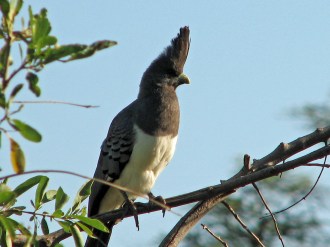
White Bellied Go-Away Bird

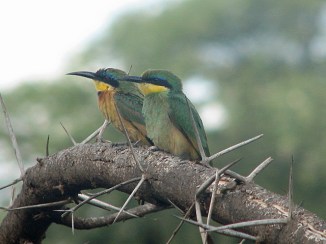
Kingfishers and Bee-Eaters: 14 Species

Little Bee-Eaters — Samburu National Reserve, November 3, 2007
62 Little Bee-Eaters

Cinnamon Chested Bee-Eaters — Safari Park Hotel, October 28, 2007

5 Cinnamon-Chested Bee-eaters

Gray-Headed Kingfisher — Samburu National Reserve, November 1, 2007

55 Gray Headed Kingfisher

Passerines

Rollers and Barbets: 17 Species

Rufous Crowned Roller — Samburu National Reserve, November 1, 2007

Rufous Crowned Roller


Red and Yellow Barbet — Samburu National Reserve, November 2, 2007

Red and Yellow Barbet2

Woodpeckers and Wrynecks – 8 species

Nubian Woodpecker — Samburu National Reserve, November 2, 2007

57 Nubian Woodpecker

Falcons and Parrots – 6 Species

Red Fronted Parrot — Samburu National Reserve, November 1, 2007

58 Red Fronted Parrot

Sunbirds – 18 Species

Sunbird Compilation
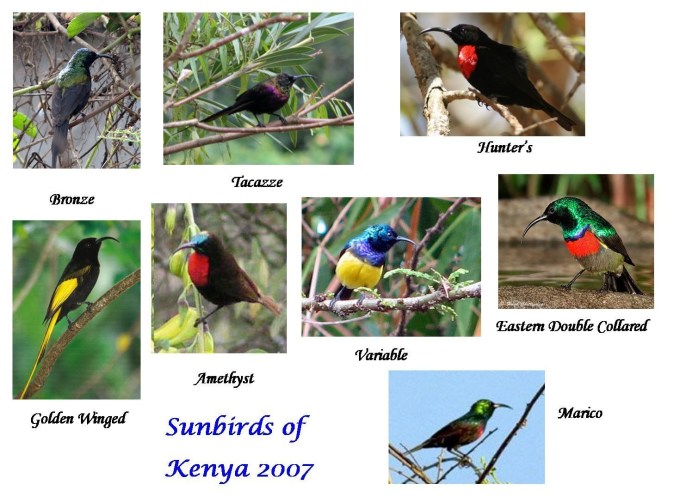
Sunbirds of Kenya

Miscellaneous Passerines

Snowy Crowned Robin Chat — Kakamega Forest, November 10, 2007
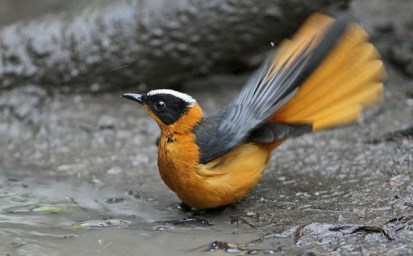
Snowy Capped Robin Chat

Cut-throat — Samburu National Reserve, November 2, 2007

cthroat-360[1]

Red-cheeked Cordonbleu — Safari Park Hotel, November 29, 2007

c_bleu-360[1]

White Headed Buffalo Weaver — Samburu National Reserve, November 1, 2007

White Headed Buffalo Weaver

Fischer’s Sparrow Larks — Samburu National Reserve, November 3, 2007
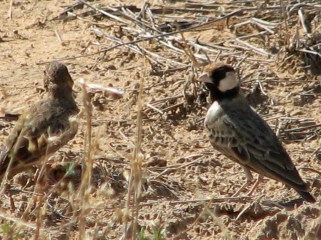
Fischer's Sparrow Larks

MacKinnon’s Fiscal — Kakamega Forest, November 11, 2007

Mackinnon's Fiscal

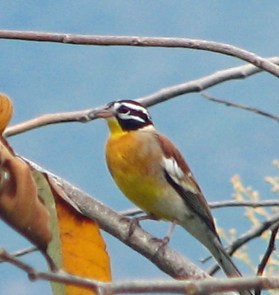
Golden Breasted Bunting

Golden Breasted Bunting

Mammals of Kenya

Reticulated and Rothschild’s Giraffes – Samburu National Reserve

Probably after the big cats, the Giraffes were my favorites.  They are stately and gigantic.  Their size and speed means the adults are rarely hunted, but the young often are.
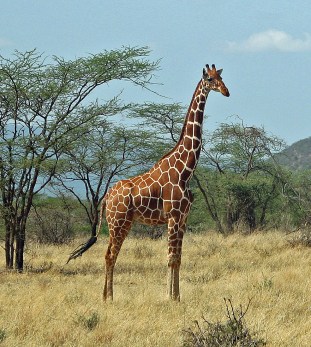
39 Giraffe - Reticulated   134 Giraffe - Rothschild

Gerenuk (Antelope)

This was one of my favorite animals (and I loved them all).  It is the thinnest of all antelopes and has evolved to be able to rear up on its hind legs to feed on leaves on the bushes that are not reached by others.

34 Gerenuk at tree 3

Hippopotamus

The “River Horse” is considered by many to be the most dangerous of the African mammals for man with its unpredictability and mean temper.  This was not a comforting thought as our small boat was immediately next to these giants at Lake Naivasha.

Naivasha Hippo Head 3

White Rhinoceros and Black Rhinoceros 

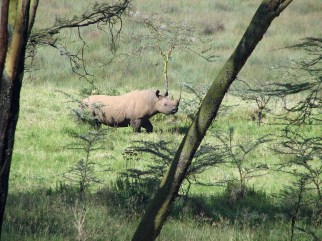
The White Rhino got its name from its “wide” snout.  The Afrikaans/Dutch word for that is “Veidt” which turned into “White”.  The smaller Black Rhino has a smaller snout and smaller horn.  They are browsers in the grasslands.
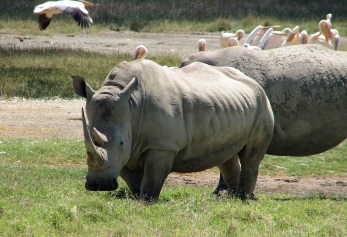
81 White Rhinos  80 Black Rhino

African Elephant

We saw many Elephants in herds.  Sometimes we were quite close.  It is amazing how large they are and how fast they move even when just walking.  African Elephants are larger than the Indian/Asian Elephants and have significantly larger ears.  The latter are somewhat domesticated in Asia.  The African Elephants remain wild.
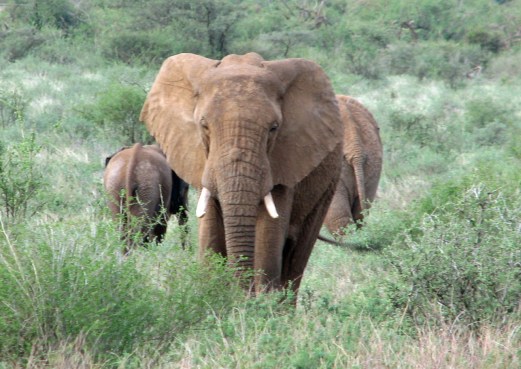
Elephant Front+

Cheetah

We only saw two Cheetahs – a brother and sister team that still hunted together.  Incredible camouflage in the grass.
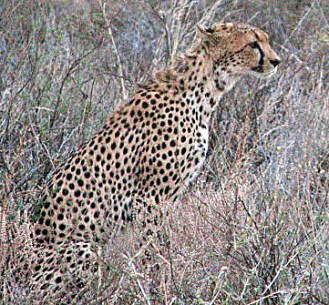
Cheetah 8

African Lion

This may have been the only small disappointment of the trip.  We saw only three Lionesses.  No male Lions at all.  But they were close – very close.  They were literally only feet away from us in our open vehicles.  We were assured that they did not attack humans – in vehicles.  We survived to tell the story.

84 Lion

Leopard

This is “my father’s Leopard” chronicled in my “Circle of Life” Blog post.  By far my favorite experience and animal of the trip – maybe of my life.  I was the one who first saw this cat which materialized out of nowhere behind us as we looking at a Lilac Breasted Roller and then we followed it with great excitement as it climbed a tree.
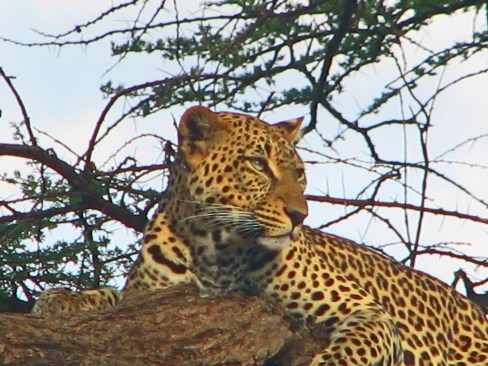
Samburu Leopard

Grevy’s and Plains Zebra

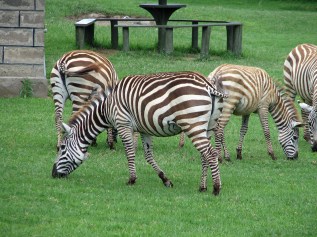
We saw two races of Zebra.  The Grevy’s has a white belly and the Plains Zebra is striped all the way.

.42 Grevy's Zebras  More Zebras

Baboons, Colobus, Sykes and Black Faced Vervet Monkeys

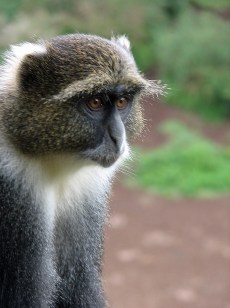
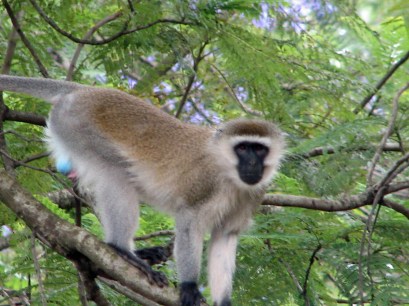
We saw several species of monkeys but not in great numbers.  Baboons are Old World monkeys and are one of the few monkey species without tails – why they are most often seen on the ground.

Baboons with young  15 Colobus

16 Sykes Monkey  Vervet Monkey at SPH

Impala

Impalas were seen on a number of occasions.  In their own herds or mixed with other antelopes especially Gazelles.  The “M” pattern on the rear identifies them easily and quickly.
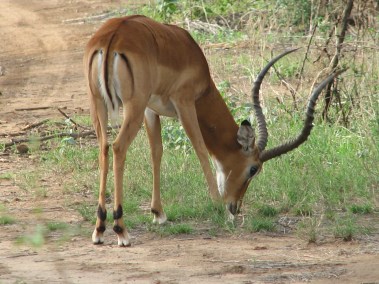
32 Impala

African Buffalo

One of the so-called African Big Five, the African Buffaloes were seen often – always in herds and often resting.

83 Resting Buffaloes

Beisa Oryx

A large antelope, the Oryx is to me a very striking and “handsome” animal.  Its markings remind me of the Black Throated Sparrow.

40 Beisa Oryx

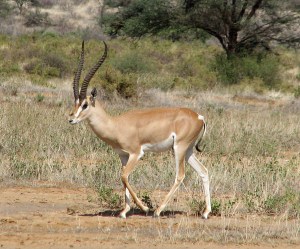
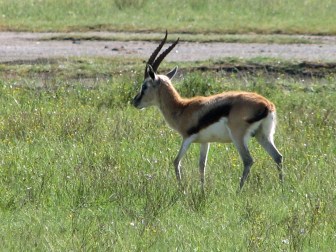
Grant’s and Thompson Gazelles

30 Grants Gazelle  33 Thompson Gazelle

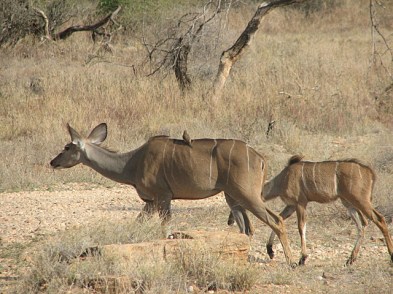
Kudu

41 Kudu

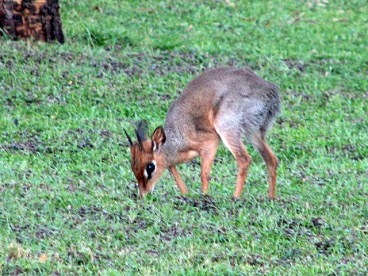
Dik Dik

63 Dik Dik

Waterbuck

129 Water Buck

Warthog

135 Wart Hog

Hyrax

63a Tree Hyrax

Nile Crocodile (Granted not a Mammal)

Crocodile

People and Places

David Wolf – Our Trip Leader at Mountain Lodge

Smoking was probably David’s only “fault”.  He was great finding and identifying birds and animals and was even keeled throughout the entire trip.  Good company.
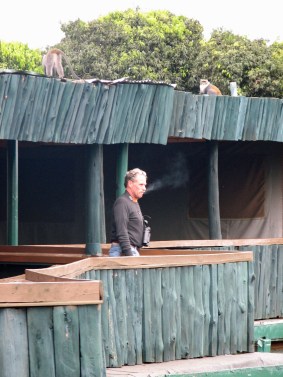
12 David Wolfe at Mountain Lodge

Netting around Bed at Lion Hill

Contrary to expectations, the only insects I saw either outdoors or indoors were some cicadas and a long line of army ants.  Nary a mosquito and no flies.  And the weather was fantastic as well.

69 Bed at Lion Hill

Thomas and Bernard – Our Excellent Drivers

These guys never missed a beat as they navigated on dirt roads and on roadless tracts. Fun stories and good guys all around.

10 Bernard and Thomas

Primitive Hut

Most of our time was in remote areas but we stayed at very nice lodges.  In the field we often saw quite primitive living conditions.  There is great poverty but for the most part we saw it only as we drove past it.

116a Hut

Shoe Store and Markets along the Road

We saw many similar scenes as we drove through small towns.  Produce, dry goods and clothing for sale.  There were very few cars – mostly people on foot or bicycles and some on motor bikes or scooters.

112 Shoes for Sale  11 Street Scene

Tribal Retribution

Early one morning as we were moving to another lodge, we passed an intersection where a number of men from one tribe were armed with sticks and bows and arrows.  Our drivers inquired and found that they were waiting for members of a neighboring village to come by.  There was to be retribution for a theft of this groups most treasured possessions the night before — their goats.
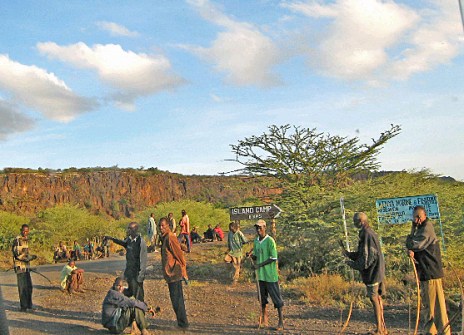
105a Tribal Retribution

Birding in the Field

Our vehicles had pop tops.  A necessity as in most places it was not allowed to be out of the vehicles – nor a smart idea.  Our co-leader – Brennan Mulrooney is the dude with the ponytail.  An excellent birder.

29 Brennan and John

Mt. Kenya and Thomson Falls

There was beautiful scenery everyday but for the most part we were looking for animals and birds and not going to famous landmarks.  At just over 17,500 feet, Mt. Kenya is the highest mountain in Kenya and the second highest behind Mt. Kilimanjaro in Africa.  Thomson Falls was a stop along the way.  It is just under 250 feet.
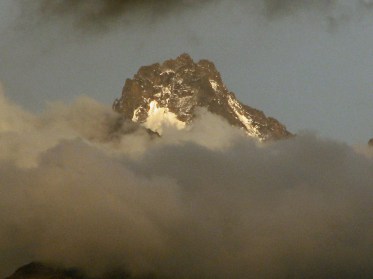
Mt. Kenya  107 Thompson Falls 1

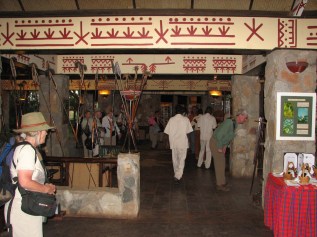
My Cabin and the Main Lodge Lobby at Samburu

Accommodations were excellent – and always near game and birds.  We never stayed at tented lodges which would be fun some day.  The food was excellent as well.
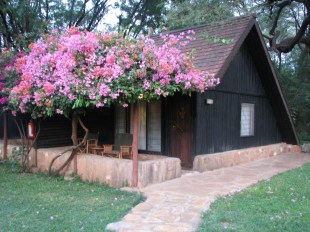
My Samburu Cabin  25 Samburu Lobby

Our Gang

There were ten birders, two guides and two drivers – a perfect sized group.  The photo of me is the only one from the trip.  I sure look younger back then – I guess understandable since it is now 11 years ago – hard to believe.

21 Crazy Birders  29a BB

Some Favorite People Pix

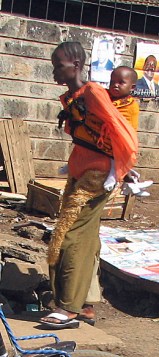
The young girl was carrying wood that would fuel cooking fires or even be used in construction.  Wood was scarce.  We saw many women carrying young children in the towns especially.  The bicycle scene is of a woman going to work by “taxi” – a luxury.  The tribesman feeding the birds was at Samburu – Hornbills and Go Away Birds came in close for photo ops.  Note the slingshot.  He was an adept hunter with it.

117 Pretty Girl with Wood  116 Mother and Child

115a Bike Passenger 48a Samburu Tribesman with Birds

Lost (or Found?) in Translation

This was a favorite sign.  With us, there would be no “lighting of fires” and we were not going to hunt either “Velvet” or “Vervet” Monkeys.  We often saw signs that would begin with “Polite Notice” before their admonitions or warnings.  A very dignified approach.
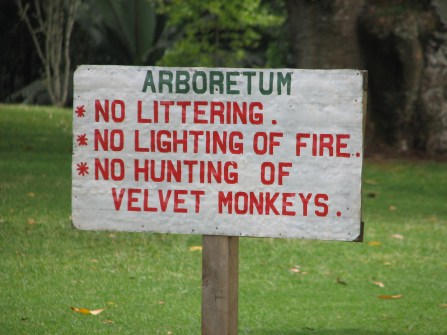
115 Velvet Monkey Sign

My Favorite “Local”

I spent a long time talking with this woman in one of the Lodge souvenir stores.  She had her university degree but this was the best job she could get and she was happy to have it.  In addition to her work and taking care of her family, she also had started an after school project for young girls to encourage them to better their lives.  A fascinating person – engaging and instantly likable.  Maybe my small contribution to her project helped in some way.  The only souvenirs from this trip other than a great bird list, photos and many memories were a plate and a carved antelope from this shop.  Both have been on my mantel ever since.

125 Naivasha Shop Girl with Story

The List and a Farewell Dinner

After every day in the field, the group would gather at our lodge for a drink, making the list for the day and then dinner.  A very civilized way to bird.  Back in Nairobi at the end of the trip we had a great dinner at the Carnivore Restaurant where the menu included wild game and the food, setting and service were excellent.

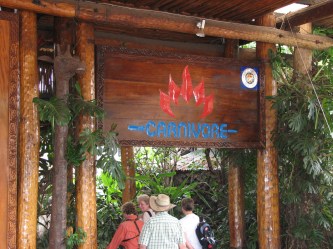
69a The List  137 Carnivore

Our Tour Route

We visited 8 different locations and lodges with the longest stay at Samburu.  Each added something to the trip including a variety of bird and animal habitats.  I would go back in a minute but would also love to visit other parts of Kenya and neighboring Tanzania.  In 2014, I visited South Africa on a joint ABA/Rockjumper tour.  Another fabulous tour which I hope to write up someday soon.

2 Map

South Florida Exotica

[This post was mostly written last year after my return from Florida, but was never finished.  I finished it today and post it now.  Better late than never.] 

Compared to my Northwest, South Florida seems very much like a foreign place.  The geography, the topography, the plants, the animals, the roads, the buildings, the weather, the people and the birds.  Very very different – almost to the point of being Exotic.  When it gets to plants, animals and birds, South Florida indeed is exotic.  Much of what is there really is not from there and maybe should not be there and that in no means is a commentary on our country’s touchy immigration laws – or at least those that apply to people.

There are at least 500 non-native fish and wildlife species in Florida.  Many are harmful and are considered invasive – threatening native species, bringing health problems and creating economic impacts.  Incredibly almost 200 species of birds are considered non-native – exotic.  Many of these have now established breeding and sustaining populations – to the point where the American Birding Association currently recognizes about a dozen of these species and there are many others that are possibly in line for recognition.
Additionally because of its proximity to the Bahamas and Cuba, there are a number of observations of birds from these areas that are the “rarities” that so thrill us birders.  So any bird listing trip to South Florida looks for the introduced exotics – established and possibly yet to be established – rarities from the Bahamas and Cuba – and the South Florida specialties themselves – native but generally found either nowhere else or in only a few places because of the unique conditions and history of the area.

Finally as at other strategic spots, during migration, birders look for migrants at migrant traps – especially places like the Tortugas, the Keys and coastal areas, where migrants land after flights over open water and rest up before the next legs of their journeys.

My other South Florida blog posts chronicle our birding pursuits looking for established introduced exotics, migrants and South Florida specialties.  When Frank Caruso and I first contacted Paul Bithorn to arrange guiding services, we put together a wish list that included migrants, specialties and exotics.  While our interest was greater on the exotics that were ABA Countable, we asked Paul to show us others as well – like putting species in the bank – thinking that maybe someday they would gain recognition status and we could pull them out at that time.  Paul is particularly adept at finding the exotic species and we did very well.  Most were parakeets (or relatives) but we had others as well.  The remainder of this post will share some photos of these species – ABA countable and not.

An overarching comment is that one would think that large birds like parrots/parakeets would be easy to find and easy to identify – especially since they are so noisy – particularly at roost sites.  But such is not the case.  They usually feed in large trees either in dense foliage and/or near the tops.  Differences between species can be minute and particularly to the untrained eye can be easily missed or misinterpreted.  Especially in dim light, many details were just not discernible – at least by me.  Once again photography was handy – either capturing details that supported one identification or another – and often showing details (or their absence) that meant that the initial idea was wrong – even if not helping to determine a correct one.  Here is “Exotic South Florida”.

Monk Parakeet – ABA Countable

Monk Parakeet at Nest

Nanday Parakeet –  ABA Countable

Nanday Parakeet

Yellow Chevroned Parakeet – Not ABA Countable

Yellow Chevroned Parakeet1

Indian Peafowl – Not ABA Countable

Indian Peafowl

Common Hill Myna – Not ABA Countable

Common Hill Myna5

Red Junglefowl – Not ABA Countable

Red Junglefowl

Common Myna – ABA Countable

Common Myna2

Red Mitred Parakeet – Not ABA Countable

Mitred Parakeet1

White Winged Parakeet – ABA Countable

White Winged Parakeet

 Green Parakeets – ABA Countable

Green Parakeets 1

White Eyed Parakeet – Not ABA Countable (Seen but no photo)

Rose Ringed Parakeet – Not ABA Countable

Rose Ringed Parakeet1

Blue Crowned Parakeet – Not ABA Countable

Blue-Crowned Parakeet1

Muscovy Duck – ABA Countable

Muscovy Duck with Chicks

Egyptian Goose – ABA Countable

Egyptian Geese

Gray Headed Swamphen – ABA Countable

Gray HeadedSwamphen2


Lilac Crowned Parakeet – Not ABA Countable

Lilac Crowned Crowned Parrot

Red Whiskered Bulbul – ABA Countable

Red Whiskered Bulbul5


Finally Another Ptarmigan in Washington

Ptarmigan are grouse with feathers covering their toes and are found in the mountains or cold northern regions.  Three species are found in North America: Rock Ptarmigan, Willow Ptarmigan and White Tailed Ptarmigan, with the latter being the only one found in Washington.  Although not an endangered species, the general consensus in Washington, is that their numbers are declining.  My experience and that of birding friends would agree as we have found it more and more difficult to find this high elevation species.
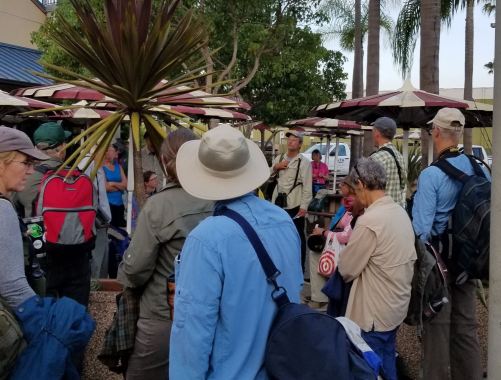
My first White Tailed Ptarmigans were seen in my mountain hiking and climbing days in the early 1970’s.  I recorded my first one at Sunrise at Mount Rainier in July 1972.   We did not think of them as uncommon then.  I did not keep further records after that first sighting but recall that several were seen when I climbed Mount Rainier starting from Paradise in 1974 and on other climbs there and at Mount Baker.  I started keeping detailed records again only in 2012 and saw one on the Mount Fremont trail out of Sunrise in October 2013 when I got my first photo of this species. Two were seen at Artist Point on Mount Baker in July 2014 and then despite several attempts to find another one one in Washington in 2015 through 2017 – none.  Others I know had a similar experience.

White Tailed Ptarmigan October 23, 2013 – my First Photo

Ptarmigan

However, on my great “Chickens” trip in Colorado with High Lonesome Tours in April 2016, our group observed two at Loveland Pass.  Like many birds, all species of Ptarmigan have distinctly different plumage in winter and summer.  For the Ptarmigan this is a matter of survival via camouflage.  In the winter, they live in areas completely covered by snow while in the summer the snow has melted and their territory is Alpine meadows and rocky fields.  Our Colorado birds were almost pure white, making them almost impossible to see by us and by their predator enemies.  Their only color was the black of their eyes, beaks and toes and a rarely seen swash of red over their eyes.

White Tailed Ptarmigan – Loveland Pass, Colorado – April 9 2016

White Tailed Ptarmigan 7

That was the only other White Tailed Ptarmigan I have seen – until today – finally.  Birding friend Jon Houghton has been travelling much of this year, and now back from yet another trip to Alaska, he let it be known he was game for some birding in Washington.  I saw a report on Ebird that a mother White Tailed Ptarmigan and some chicks had been seen on the Sunrise Rim trail at Mount Rainier.  Jon is an avid hiker and I knew he would want to see a White Tailed Ptarmigan, so it was a perfect opportunity to see him and maybe see a much sought after bird.

I am in better shape than I have been in for some time, but I am not mountain hiking tested at altitude.  This would be a moderately arduous hike and I was curious how I would do.  Of course, I wanted to see the White Tailed Ptarmigan but no matter what, at this time of year Mount Rainier is spectacular and it would be a great visit.  We left Edmonds a bit after 6:10 a.m. and with lighter than expected traffic and after a few stops we arrived at Sunrise at Mount Rainier three hours later.  It was a gorgeous day, sunny but not too hot – perfect conditions.

Mount Rainier – in Spectacular Weather

Mt Rainier

The picnic area closest to Sunrise was quite birdy, with lots of Pine Siskins, Cassin’s Finches, Hummingbirds, Mountain Chickadees, some Chipping Sparrows, Dark Eyed Juncoes and a spectacular Mountain Bluebird.  We also heard the “Quick three beers” call of an Olive Sided Flycatcher.  But as we left that area and started our steep climb on the trail that leads to Frozen Lake and then splits to go to both the Fremont Lookout and Burroughs Mountain, the birds disappeared.  The sun was out and the sky was brilliant.  At a couple of open areas, the wind blew and it was quite chilly, but with the exertion of the hike, we both removed layers and we could not have asked for better weather – or better views – or better wildflowers.

Phlox

Phlox

Paintbrush

Paintbrush

Finally we got to Frozen Lake and headed up to First Burroughs – a very steep climb.  We made several rest stops along the way – scanning the meadows and rocks hoping for a Ptarmigan but no luck.   When we made it to the large meadow at the top of First Burroughs, we decided to head back to Sunrise on the Sunrise Rim trail rather than to continue on up to Second Burroughs, another steep hike.  This was the area where we thought the Ptarmigan had been reported earlier, but the details were a bit hazy.  I moved a bit ahead as Jon was much more thorough scanning the hillsides.  Maybe a quarter of a mile down from the junction with The Burrough’s Mountain Trail I saw a movement on the trail maybe 25 feet ahead.  Thank goodness for that movement because otherwise, even though they were right in front of me, I might have missed them as they were perfectly camouflaged.  I yelled for Jon who hustled down to see what the ruckus was.

There they were just off the trail – our prize – a mother White Tailed Ptarmigan and her chicks.  All the huffing and puffing on the climb was immediately forgotten.  We gave each other high fives and watched the mother and babies – grabbing photos with our phones and cameras as best we could.  Other hikers came by and we showed them these rare birds of the Alpine tundra.  Even as non-birders they were captivated.
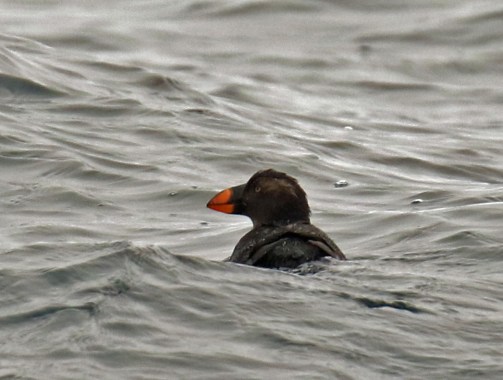
Mother White Tailed Ptarmigan

White Tailed Ptarmigan Hen2

These birds are very tame – not caring at all about people.  I think their camouflage gives them comfort and security.  The chicks were scurrying about – sometimes right next to mom but often as much as 50 or more feet away.  We counted 5 for sure and think there my have been 6.  Either way, this was as many White Tailed Ptarmigans as either of us had seen in total in our lives previously.

White Tailed Ptarmigan Hen with Chick – Well Camouflaged Indeed

White Tailed Ptarmigan Hen with Chick

We watched for quite awhile and then continued down the trail.  It is much easier on the lungs and heart going down, but much harder on the feet and legs as the trail is both steep and slick with small pebbles and loose dirt.  We had to be careful not to fall.  Until almost to the end of the trail, there were no more birds, but the scenery and flowers were magnificent.

View of Mountain Pond and Mt. Tahoma

Scene

Mount Rainier and Mount Tahoma

Mount Rainier

Mixed Wildflowers

Mixed Wildflowers

After lunch at Shadow Lake, we returned to the trail.  Just over a half mile from Sunrise, Jon heard booming from a Sooty Grouse and called me over.  It sounded like it was close.  But as we moved in for a possible look, it sounded just a bit further off.  This continued for at least a hundred yards and finally we found a small copse of trees that “had to have our grouse”.  But try as we might we could not find it as the booming continued, now quite loud.  Finally Jon spied it hidden in the branches almost at the top of the tree – at least 40 feet up.  You have to look real hard, but you can make out the bill, head and chest in the poor photo below.

Sooty Grouse

Sooty Grouse in Tree'

At least we got a photo.  While we tried to zero in on the Sooty Grouse I heard the “teu, teu, teu” call of a Pine Grosbeak. I got a brief view as it flew off – larger than the finches and dark red but I never saw the bill.

We made it back to the parking area exhausted but happy.  The Ptarmigan was the prize and the Sooty Grouse was new for the year for Jon and the Pine Grosbeak was new for both of us.  A most excellent day.

And just for the record and because they are so spectacular, here are the other two Ptarmigan species in North America – both seen in Nome Alaska in June 2016.

Willow Ptarmigan

Willow Ptarmigan 2

Rock Ptarmigan

Rock Ptarmigan 2

These birds are in their summer plumages.  In winter they too are solid white – invisible on the snow fields they live in then.


Duck, Duck, Goose

I got a fun video of my grandson from my daughter this morning.  He is almost 5 months old now and I can’t wait to see him again when I visit Boston for Thanksgiving.  Although my daughter is great at sending photos and videos, I wish I could be there to see each little developmental step.  They seem to happen every day.  I look forward to reading to him and to playing with him as he grows up.  Seeing the video today brought to mind some of the games kids play – or at least used to before cell phones and video games.  Being a birder, the old game of “Duck, Duck, Goose” was one that came to mind.  When I checked my memory of the rules on the internet, I was surprised to find that there is a Netflix  Animated Film of that name.  I can’t say I loved the 2 minute trailer and sure could not tie it to the children’s game.

The game itself, a version of “tag – you’re it” is quite simple:  the players (5 or more sit in a circle) facing in except for “the Goose” who walks around the circle tapping one and then another on the head and pronouncing each to be a “Duck” until he or she taps one and calls out “Goose”.  The tappee chases the tapper around the circle and tries to catch and tag him or her before he or she can sit down and take the tappee’s place.  This continues until everyone gets bored and loses interest.  Come on, admit it, you played it once and thought it was fun back then.

I was in the mood to write something today, and again being a bird nerd type, a “Duck, Duck, Goose” blog post came to mind  – three sets each of two ducks and a goose.  The first set of three are two of the rarer duck species I have seen in Washington and the rarest goose species.  The second set excludes those and is of species that I find the most beautiful and includes a goose species I have not seen in Washington State.  The final set is my dream set, the two duck species and the one goose species that I would most love to see in the ABA Area and hopefully in Washington State someday.

The “Rarities”

Tufted Duck  –  I have seen at least one Tufted Duck in Washington every year since 2012 except for 2017.  I have seen both King and Common Eiders in Washington and both are rarer than the Tufted Duck, but in each case the visitor was a drab female and the photos not real striking.  Many years ago, in 1983, I also saw the much rarer Steller’s Eider that was seen at Point Wilson.  I wasn’t taking photos back then – hope another one comes to the state someday and I see it with my camera ready.  The photo below is from the Sewage Treatment Ponds at Neah Bay in 2016.  We also found a female Tufted Duck there at the same time.  Tufted Ducks are common – even abundant in Europe.

Tufted Duck – Neah Bay, November 21, 2016

tufted-duck1

Falcated Duck – This was one of the prize birds in Washington in 2017 – a mega rarity.  It was found by Rick Klawitter in among many hundred Wigeon on Padilla Bay on January 15th.  Many of us made the trek to look for it the next day.  It was very hard to pick it out with so many Wigeon – at least 500 plus, but we finally found it and I was even able to get a distant photo.  It is a mega rarity anywhere in the ABA Area.  It is a bird of Siberia and East Asia.  I believe this was the fourth Washington record.

Falcated Duck – January 16, 2017 – Padilla Bay 

falcated-duck2

Emperor Goose – The Emperor Goose is another quite rare bird.  One is seen in Washington most years and I have seen one in the State in 2012, 2013, 2014, and 2016.  My first observation was on the golf course in Ocean Shores where it hung out with a Greater White Fronted Goose for two months in 2012.  The others were all seen around Sequim.  It is breeds in Siberia and Western Alaska.

Emperor Goose – Ocean Shores Golf Course – January 1, 2012

Emperor Goose

“Three Beauties”

Wood Duck – It is not uncommon but it is sure gorgeous.  It would be hard to rank the Wood Duck below any other for sheer beauty.  I have more than 80 observations in Washington and have also seen them in California, Oregon, Wisconsin and British Columbia.  Earlier this year, I met an avid birder from Columbia birding at Juanita Bay Park.  It was her first visit to Washington and her main quest was to get a photo of a Wood Duck.

Wood Duck – Juanita Bay Park – April 2015

Wood Duck Head

Common Eider – After returning from a chase to find the Common Eider at the Purdy Spit in January in 2017, a non-birding friend asked why it was such a big deal and I told her it was only the second one I had seen in Washington, the first being at Westport on October 28, 2012, the double rarity day as there was also a Northern Wheatear a few hundred yards away.  She couldn’t understand then why it is called a “Common” Eider.  It is in the other places I have seen them – Alaska, Maine and Massachusetts, but certainly not in Washington.  There may be some other duck species I have seen that are equally beautiful, with the Hooded Merganser definitely ranking high for example, but I chose this one because I have seen them (drab females only) in Washington and because I think they are very distinctive and beautiful.  I might have gone with the King Eider – also seen in Washington – but my photos are only of the once again drab females.

Common Eider Nome June 6, 2016

Common Eiders (2)

Pink Footed Goose – This was a tough choice mostly because I have not seen that many goose species in Washington and did not want to pick the abundant Snow Goose, Brant, Canada Goose or Cackling Goose even though they are all fine looking birds.  And the much rarer Ross’s Goose just doesn’t do it for me.  The proportions are all wrong.  I decided to go with the Pink Footed Goose with its pink feet and rusty head and neck.  I could not find any Washington records for this species but I have seen it in two places the first at Artichoke Reservoir in Massachusetts in November 2016 and the second in Victoria, B.C. in March 2017.  They breed in Greenland and Iceland but migrate to Northwestern Europe for the Winter.

Pink Footed Goose –  Victoria, B.C.  Blekinsop Lohbrunner Road March 10, 2017

Pink Footed Geese

The Dream List

Smew – Anyone who knows me well as a birder knows that at the very top of my bucket list is seeing a male Smew.  One appeared in Washington on the Columbia River in the winter of 1991 and again in 1992.  That was my down time for birding so I missed it.  They are mega-rarities in the ABA area with most being seen in the Western Aleutians.  They are found primarily in Northern Europe and Asia.  This is the ONLY bird that I will drop everything and go chase if a male shows up in North America again.  I have my fingers crossed.  It is a small merganser and although only black and white, to me is a simply gorgeous bird.

Smew

Smew

Baikal Teal There were numerous observations of a Baikal Teal from December 2004 to April 2005 in South King County.  Unfortunately I was not one of the observers.  It has to have one of the most unique facial patterns of any duck.  It is most often seen in Alaska although there was a 2013 record from Montana.  There is always a concern whether birds seen in the U.S. are escapees since they are found in many collections.  I found a report on Ebird from Stephan Lorenz – a guide who I was with on a Colorado “Chickens Tour” with High Lonesome in 2016 – of 50 of these ducks in Japan.   I was there at the wrong time of year – I wish I had seen one – but of course I really wish another one shows up in Washington or at least nearby.

Baikal Teal 

Baikal Teal

Bar Headed Goose –  There are no records of this species in Washington and it is a mega-rarity if it ever shows up anywhere in the U.S.  It is fairly common in India and elsewhere in Asia.  I saw a small flock on my trip to India in 2011.  Pretty simple and straightforward except for those bars on the head.  Maybe someday.

Bar Headed Goose – Bharatpur, India January 2011

Bar-headed Goose 2

This blog post is probably as far afield as any I have done.  As I said at the outset, I just felt like writing – probably since I did not get out birding today – the mid July blahs.  Hopefully some good shorebirds will start showing up.  I need to get out there.


Another Tuesday, Another Pilchuck Audubon Trip

It happens almost every Tuesday morning.  Led by Virginia Clark, 10 to 20 Snohomish County birders head off on a birding trip.  Usually to spots in Snohomish or Skagit Counties, but sometimes as far afield as Island or Whatcom counties.  It is as much a social occasion as a field trip as most of the participants are there for every trip and know each other well.  Virginia is amazing.  I swear she knows every nook and cranny of those counties, or at least the ones which have birds.  She has been doing this for many years and is very good at it – an excellent birder, an excellent leader and, with a touch all her own, an excellent baker.  She brings dozens of scrumptious cookies and other baked goods to every trip.  They are not for the calorie conscious.

Pilchuck Audubon

I have not been able to join the group as often as I would like or probably should, but I enjoy the experience every time I do.  The birders range from ok beginners to seasoned experts.  It is always great to have many eyes looking for the birds and ears listening for their calls.  And always good to share stories – and most of them are usually true – most.  Unlike most of my birding, there are rarely targets.  The goal is to see what is there and to enjoy being out.  Often there are really great finds and sometimes rarities in the area are chased if they are within the area planned for the trip.

On Tuesday, July 10th the gang visited several locations east of Sedro Woolley on State Highway 20 in Skagit County and ending at the Oso Loop Road in Snohomish County.  Altogether 17 birders in 5 cars.  There were plenty of cookies to go around.  I could throw in bits and pieces about personalities, interactions and so forth, but I am not into gossip, so I will stick to the birds.

Our first stop was at the Hansen Creek Restoration Project.  Like many of the stops on these trips, it was not familiar to me.  Generally, especially since I am not a “County Lister” except incidentally, that means that there had not been a new year or state bird there to chase.  A neat spot even though mid-July is not the birdiest of times.  Two highlights:  a pair of American Bitterns seen at distance in flight three times and at least one Virginia Rail at first heard only and then seen in a quick flight.  My photo of the American Bittern was a just miss – almost a good photo and would have been if I were more skilled.

American Bittern in Flight

American Bittern Flicght

We had 21 species at the first stop and then continued east on Highway 20 to Rasar State Park – another place I had not birded before.  A very pleasant place.  I bet it is real birdy in late May or early June, but not so much this day.  Nine species.  Nothing special but hearing Black Throated Gray Warblers, Swainson’s Thrushes and Pacific Wrens was fun.  Hard not to appreciate the song of the Swainson’s Thrushes – and we heard them throughout the day – probably a hundred individuals.

In a field off Cape Horn Road in Concrete we added some Lazuli Buntings and several Vaux’s Swifts mixed in with numerous swallows.  It looked like a perfect day for Black Swifts with low clouds, but despite vigilant searching, none were found.  Someday I will figure out how to get a really good picture of a Vaux’s Swift.  As the photo below shows, this was not to be the day.

Lazuli Bunting

Lazuli Bunting

Vaux’s Swift

Vaux's Swift

Further east we stopped at Martin Road, yet another place that was new to me.  We added another 9 species for the day (now closing in on 50) with the best probably being an immature Red Breasted Sapsucker.  I really enjoyed a pair of Common Yellowthroats actively catching insects and being very territorial.  No doubt there was a nest in the area.

Red Breasted Sapsucker Juvenile

Red Breasted Sapsucker Juvenile

Common Yellowthroat Male and Female with Insects

Common Yellowthroat Male2   Common Yellowthroat Female1

Earlier we had seen a number of birds with insects – seemingly a higher percentage than usual.  Maybe this is related to nesting activity with adults feeding young.  A favorite shot this day was of a Red Winged Blackbird with a mouthful.

Red Winged Blackbird

Reed Winged Blackbird

We went to nearby Howard Miller Steelhead State Park for a bathroom break – not to bird – but it was here that we had one of the true highlights of the trip.  One of the birders, Joyce Hershberger, found a raptor nest in the park.  We could hear young birds and thought they might be Cooper’s Hawks.  We located the nest and through the branches could see an adult and three young birds.  They were not Cooper’s Hawks nor Peregrine Falcons as I had wrongly concluded (my only mistake in at least 20 minutes).  We had a family of Merlins.  Finally one came into the open for a photo and then we watched what may have been the first flight – 20 feet to an adjacent tree – of one of the young.  Very fun indeed.  None of us had seen a nest of Merlins before.

Merlin

Merlin

At the Marblemount boat launch we picked up a couple more species but birding was slow.  We then headed to Bacon Creek Road.  This had not been on the original itinerary, but an Alder Flycatcher, very rare for the state, had been seen there regularly for the past two weeks and Virginia obliged by adding the stop.  Sherrill Miller and Frank Caruso had seen it at the spot a week ago and I had seen it there on June 26.  It had been very cooperative both posing and singing.  The location was very accessible.  As soon as we arrived and parked, we saw a small gray bird flying in the area where the Flycatcher had hung out previously.  We thought we had our target.  But the bird was not seen again and despite thorough coverage and lots of playback, no luck.  It had been so easy to find previously that we doubted it was still around.  The first bird we had seen could just as easily been a Willow Flycatcher, but we did not hear that call either.  This was the only downer for the trip.

Alder Flycatcher (My Photo from June 26)

Alder Flycatcher1

Fortunately the trip ended on a much better note.  We made a last stop on the Oso Loop road in Snohomish County.  The group had seen an American Redstart there last year and it is back in 2018.  They are uncommon in Washington and very much so in Snohomish County.  The bird had been seen regularly at a very specific spot for over a month.  The troop assembled and waited.  Not heard and not seen.  Then playback was used and unlike the experiences that those who had seen it here already this year had previously, the bird did not fly in and respond. Uh-oh.  There is usually a range of views on the use of playback in any group.  Some are very unhappy when it is used at all, others when it is used a second time after a bird had responded.  Admitting a photographer’s bias, I am much further on the other end of the spectrum and don’t hesitate to use it to bring birds to me and others when for example I lead field trips – although I try to limit it if there is obvious concern for the safety of bringing the bird into the open or significantly disturbing nesting/mating activity.

With Virginia a co-conspirator with her wink, I made the executive decision to move a little closer to what I knew to be the bird’s favorite perching spot and played its song twice – zing – in it came and perched in the open right in front of us just feet away.  It is a beautiful bird and there were lots of oohs and aahs. The photos show why.

American Redstart

American Redstart Vertical

American Redstart next to Fungus.jpg

We also saw at least three Spotted Sandpipers as we crossed the river to get from the parking to the Redstart spot.  For the day between 55 and 60 species were seen – although not everyone saw everything.  The weather was good and the company was great.  There were great highlights and great cookies.  This group is just one of many birding groups in the state – formal and informal.  There are lots and lots of birds and lots and lots of birders in Washington.  I really enjoy all of the former – and most – even almost all of the latter.


Black and Blue

On my Facebook page on July 5th, I posted an accounting of the numbers of birds on my ABA Life list that had colors in their names.  The total was 152 species with “Black” being the color that came up the most with 41 species.  I incorrectly had “Blue” with a surprisingly low 9 species.  Rechecking, I find that there are actually 15 “Blue” species as I had cross referenced an alphabetical list only.  Thus 158 of my ABA birds have a color in their name  – about 22 percent.  Too many “Black” birds to include them all in a blog post, but “Blue” is manageable.  Here they are with some comments on each.  They are in alphabetical order with the exception of the Black Throated Blue Warbler which I have saved for last as a segue to some very personal reflections.

Blue Grosbeak

Blue Grosbeak

The Blue Grosbeak is a relatively common breeder throughout the Southern U.S.  My first observation was in Maryland in 1975.  It would be 42 years before seeing another one – on the Dry Tortugas in Florida in April 2017.  Later that year I saw several in Arizona and in New Mexico and this year, others were seen in Texas and North Carolina.  This photo is from Zapata County Texas on April 11, 2018.  Its large bill helps separate this species from Indigo Buntings which are often found in similar field margin habitats.  The solid blue of each make the birds jump out, but I find them both kind of plain – but not nearly as plain as the Blue Grosbeak female which is a very dull light brown.

Blue Jay

Blue Jay (2)

Blue Jays and Northern Cardinals may well be the best known birds of the Eastern U.S.  A corvid, it is raucous, gregarious, and easily identified.  It is common in urban and suburban areas as well as in forests – primarily at forest edges – so long as there are oak trees around.  I am sure my first Blue Jay was seen as a young child in Maryland way before I was keeping lists.  Since then I have seen them on dozens of occasions listing them in 9 states.  They make annual appearances in Washington – more often in the most eastern and southeastern parts of the State.

My Washington “lifer” was a heard only bird in Ephrata in December 2012.   Wanting a better observation, I chased a bird that had been seen at Lyons Ferry State Park in October 2013 during my (first) Washington Big Year.  It is one of my favorite stories.  Palouse Falls is just shy of 8 miles north of Lyons Ferry.  I had never seen the Falls which seem to come out of nowhere in dry country.  I also needed a rest stop so I made a brief detour.  I snapped a few photos of the Falls and then entered the restroom – neither the best nor worst of many such facilities I have visited in our state parks.  When I got out, the Blue Jay was perched on the roof of the restroom.  Sometimes you just get lucky!!

Palouse Falls (on a winter trip in December 2015)

Palouse Falls

The photo above is of the Blue Jay that was a regular visitor and treat for many birders at “Barry’s Farm” on Bow Hill Road in Skagit County beginning in December 2017 and continuing for many months into 2018.

Blue Gray Gnatcatcher

blue-gray-gnatcatcher1

I first saw this fairly drab little bird in San Jose California in 1973 just as I was starting to bird “seriously”.  Although this photo from San Diego in January 2017 emphasizes the “Blue” in “Blue Gray”, I think that was probably at least helped a bit by Photoshop.  Usually these birds are substantially more gray than blue.  They breed throughout much of the U.S. except Washington, Montana and the upper Plains.  In the past few years they have been found regularly in the Neah Bay area in November and December – why not – it’s Neah Bay where anything is possible.  I saw my first Washington one there in November 2015.  I have seen them in Washington several times since and in 7 other states.  Some of my most frustrating birding was trying to get a photo of a very similar California Gnatcatcher last December.  It seemed that every time I thought I had one in the open, it turned out to be another Blue Gray Gnatcatcher.  Finally at the San Elijo Lagoon, I succeeded.

Blue Headed Vireo

Blue-Headed Vireo

Another Eastern species, the Blue Headed Vireo joins the Black Capped Vireo as my favorite Vireos.   Granted I have only seen 13 Vireo species in the ABA area, but I think both of these are quite sharp.  Somewhat like the Blue Gray Gnatcatcher, the “Blue” head often appears more “Gray”.  This photo is from my Maine trip in June 2015 – taken at Schoodic Point.  It is the bluest head I have seen.  As with many eastern species, I saw my first one in Maryland in 1975.  Others have been seen in New Hampshire, Florida and earlier this year in Texas.

Bluethroat

Bluethroat

This Bluethroat was one of the specialty targets in Nome in June 2016.  If you want to see one in the ABA Area, you have to go to northern Alaska.  We found it singing on the Kougarok Road.  In the same area, in addition to lots of mosquitoes, we also found Arctic Warblers – the other targeted breeding species in the area – found only there.  I was very happy to have the observation and get the photo, but I wish we had been a bit closer as it is truly a striking bird.

Blue Throated Hummingbird

Blue Throated Hummingbird 3

I had seen my first Blue Throated Hummingbird at Cave Creek Ranch in Arizona in June 1977 and had not been back to the area since then.  On a Wings Birding Tour, I returned in August 2017 hoping to get photos of many of the specialty birds I had seen but not photographed on that first visit.  This was one.  Obviously I got the photo, but it was one of the major disappointments of the trip.  We had seen one the day before and I got a crappy photo in tough light.  Our trip leader said not to worry as we would see many of them the next day at the Southwest Research Station feeders in Cave Creek Canyon.  We made our first stop at a place that had gifts in the Canyon and then went to the Research Station.  The group dawdled getting to the feeders as the leader “carried on and on” about butterflies and dragonflies and other non-bird stuff.  I went on my own down to the feeders where some Blue Throated Hummers were active.  I had no sooner gotten the photo shown here, when the call came out that we were behind schedule and had to leave. WTF!!??  A much better photo would have easily been possible – but… Not a happy moment!!!

Blue Winged Teal

Blue Winged Teal.1jpg

To me this is a very inaptly named bird.  Yes there is blue in its wing, but there is also blue in the wing of the Cinnamon Teal.  The obvious field mark for the male though is the purplish blue head and the very distinct white crescent at the base of the bill.  But there is “Blue” in its name so it is included here.  It is found throughout the U.S. and Canada except in the Great Basin – breeding in the north and in migration elsewhere.  I first noted one in California in San Jose in May 1973 and have dozens of observations in Washington, most recently in May this year.  The photo is from Wiley Slough in Skagit County in May 2016.

Blue Winged Warbler

Blue Winged Warbler

Here we go again.  Yes this warbler does have some blue (well sort of) in its wing, but to me the wing is mostly gray.  There is also some blue in its tail, but overwhelmingly this is a bright yellow warbler.  It is closely related to and hybridizes with the Golden Winged Warbler which at least has lots of noticeable gold (well, yellow gold) in its wing.  This photo was taken on South Padre Island on April 8th this year.  It was one of my sought after target photos as I had seen one in 1978 on High Island but had no photo.  It is found only in the Eastern U.S. and is taking over more and more areas that were formerly more Golden Winged territory.  I think the species was first specified by noted ornithologist Alexander Wilson (See my earlier blog post on bird names).  Naming this species after him would thus be appropriate but there is already an even yellower Wilson’s Warbler.  I guess Gray Winged Warbler just doesn’t cut it.

Eastern Bluebird

Eastern Bluebird

The Eastern Bluebird is another of the iconic Eastern birds that I first noted in Maryland in May 1975. I expect that I had probably seen one earlier in my non-birding youth.  This photo is from Scarborough Maine in June 2015.  Since then, I have seen them in Florida, Texas, Arizona and most recently in North Carolina.  In Arizona both Eastern and Western Bluebirds are found with the former only in the extreme southeast as with the one I saw in Huachuca Canyon in 2017.  Note the rusty orange throat.  If this were a Western Bluebird the throat would be blue.

Great Blue Heron

Great Blue Heron (2).jpg

This bird often appears more gray than blue although in good light, the blue is definitely there and such is not the case with the very similar Gray Heron found in Eurasia and Africa.  Many non-birders misidentify the Great Blue (or “GBH” in birder shorthand) as a crane.  They are found throughout most of the U.S. and are quite common and very noticeable.  Amazing hunters, I have watched one stand perfectly still for 20 minutes until its prey – a small fish – came to just the right spot and then is snatched with a lightning strike.  I have also watched a Great Blue catch a huge fish in a pond and take 10 minutes to position it perfectly to be able to swallow it whole.  It seemed impossible that it could do so.

This is by far the most common large wader in Washington – seen throughout the year and throughout the State.  I noted my first one in Maryland in 1972 and have seen them in 10 states.  800 of my Ebird reports include this species.

Like its cousin, the Little Blue Heron which comes up next in this post, there is a white morph of the Great Blue Heron – well maybe not for long.  There has been a long debate over whether this morph is actually a separate species – a Great White Heron.  Supposedly the AOU and ABA are soon going to recognize it as such … supposedly.

Little Blue Heron

Little Blue Heron

As just noted above this species also has a white morph – not a speck of blue.  It is much rarer than the blue morph although we saw more white morphs than blue in Texas this April.  It is mostly found in the Southeast U.S. where it is a resident and up the Eastern Coast where it is primarily a non-resident breeder.  It is also fairly common in coastal California.  It is almost unheard of in Washington – almost.  Two friends saw a white morph appear out of nowhere at Wiley Slough in September 2014.  There is only one other record accepted in the State.  My first observation was at Palo Alto Baylands Park in 1973 and I have also seen them in Texas, Maine, Florida and North Carolina.  The photo is from Maine in 2015.  It is about 60% of the size of a Great Blue Heron.

Mountain Bluebird

Mountain Bluebird Darrington

I think a better name for this bird would be Electric Blue Bird because the color is an electrifying and dazzling blue – and oh yeah, at least where I generally see it, it is not in the mountains.  It is found only in the Western U.S. all the way into Alaska.  To be fair, where it is a resident, it usually is in or next to mountainous areas.  I have seen it only in Washington (many, many times), twice in Colorado and once in California.  My first observation was in the Wenas area in 1975.  The complete absence of orange/rust makes it an easy ID compared to Western Bluebirds although they nest in the same area – at least in Washington.  As simple as its coloration is, I find it a very beautiful bird.

Red Flanked Bluetail

red-flanked-bluetail1r

I wrote up the chase for this bird in an earlier blog post.  I had seen one in miserable rainy conditions in British Columbia in January 2013.  The one shown here is from January 2017 in Lewiston Idaho just across the Snake River from Clarkston, Washington.  I sure wish it would have ventured a bit further west so I could have it as a State record.  In some countries it is also called an Orange Flanked Bush Robin.  There is definitely bright blue in its tail, so it deserves to be in this group.  It is probably a chat taxonomically.  It is a mega-rarity in the ABA area, being an “Old World” species found primarily in Asia but expanding westward.

Western Bluebird

Western Bluebird

As with a number of other western species, I saw my first Western Bluebird in San Jose in 1973.  Other observations have been in California, Colorado and Washington.  This photo is from Spokane, Washington in May 2012 and clearly shows the blue throat compared to the orange throat of an Eastern Bluebird.  It is great fun to drive the sage area along Wenas and Umtanum roads between Ellensburg and Yakima where a concerted effort to place and maintain nesting boxes has made this a “go to” spot for both Mountain and Western Bluebirds.

Black Throated Blue Warbler

1442c-black2bthroated2bblue2bwarbler1

Primarily an Eastern Warbler, I first saw a Black Throated Blue Warbler in Maryland in 1975.  Since then I have seen two in Washington with the picture being of the male that visited a feeder in Bothell in late March and early April in 2015.  Later that year I saw several on breeding grounds in Maine and then a female at Gog Le Hi Te Mitigated Wetlands in Tacoma in November.  I have also seen them in Florida in April 2017 in migration.  These warblers winter primarily in Cuba and Hispaniola and are common and doing well.  It is always dangerous to make a list of “most beautiful birds” but this one definitely has its appeal.

Why Did I Write This – a VERY Personal Disclosure and Reflection

Per the introductory paragraph to this post, I saved the Black Throated Blue Warbler for last to be a segue to some personal non-birding reflections.  There have been bits of personal reflection in some of my previous posts and two in particular were very deeply about them – and not about birds at all.  The reality is that all of the posts have had personal connections – not just because they are my personal experiences with people, places and birds I write about, but also because so often my birding has been an “escape” or “distraction” from other matters – personal issues, emotional challenges, feelings that could be avoided – for awhile at least – if birding occupied my time and my mind.  Much good has come from this, but also eventually the piper has to be paid and most things have to be dealt with.

I chose to save the Black Throated Blue Warbler for last simply because it is both “black” and “blue”.  Generally “black and blue” is a reference to the color of bruises on the skin from a fight or injury that turn black … and … blue.  Although it has not been a physical fight and there have been no physical injuries and thus no visible bruises, I have had a very tough week as a personal relationship that I thought was going to great places had a crashing and unexpected fall – and as it did, it felt like the aftermath of a fight or the suffering that accompanies a physical injury.  Yes it was worse because of the timing and some of the details of the end, but mostly it was the sudden emptiness that was so devastating.  There had been so many hopes and even plans for much in the future and they were all gone.  A while ago I had even posted a picture on Facebook with the comment – “even better than birding”.  I foresaw a future that would not be without birds but would include so much else with a special person, that indeed it would be much better than birding.

Then suddenly there seemingly was no such future at all and even birds and birding had lost their appeal.  I removed the photo and the post.  There had been no fight, so why did I feel like I had been through one?  There had been no physical battle, so no outward bruises, but there were some on the inside and like the ones on the outside in a physical fight, they turned Black and Blue.

Black?  Is black the absence of all color or the presence of all color?  In this case it felt like a complete absence – no light – just darkness.  In my pain, I had fallen – let myself fall – into a deep and dark abyss.

Blue?  When someone says they are blue, they are saying they are sad – depressed.  Unquestionably I was very sad – quite depressed in actuality if not clinically.

I was experiencing both black and blue.  Then it got worse.  The morning after my crash and burn, a neighbor in my complex died suddenly.  It was a heart attack.  His wife was away visiting relatives.  He was alone.  There was nobody there to help him and had it not been for a sister worried about unreturned calls, who knows how long it might have been before anyone even knew he was gone.   He was very fit, not that old, didn’t smoke.  We worked out at the same gym.  How could this have happened?  And if it could happen to him. it could happen — to me.  I, too, am alone.  Having just lost what I thought was going to be this incredible future, this death brought home another aspect of loneliness.  Not just the absence of positives, but the presence of negatives as well – the possibility of dying unrescued being just one.

There was now more black and more blue.  The bruises were hurting.  It was getting worse … and then it wasn’t…  The sudden death of my neighbor reminded me that there are no guarantees in life.  There is no guarantee that the birds we chase will be found.  There is no guarantee that the relationships we are in or that we seek will be as planned, as hoped for, or even continue at all.  There is no guarantee even of a tomorrow.  So I started thinking not of tomorrow, but of today.  A bit less black, a bit less blue.

I had gone to private mode on Ebird – my observations no longer cataloged for anyone else to see – no longer on year or month or life lists.  What did they matter?!  Nothing had seemed to matter to me, so I took down what had previously at least superficially mattered the most.  I disappeared.  Some friends noticed.  That helped.  A little less blue, a bit less black.

What is the most important thing in a relationship?  There are many things when if missing, doom the relationship. Any list of “most important” would have to include “TRUST” and “BELIEF”.  I learned she had done something that was understandable, but the way in which it was done was not.  It challenged my perspective on who she was either at the core or at least under some of the pressing external matters that were there.  Most importantly it also challenged “TRUST”.   Which words that had been said, feelings expressed, or even physical expressions had been real?  How could I ever know which ones in the future were?  And this is where there has to be “BELIEF” – any lasting relationship has to have a shared “BELIEF”.  If that is there then something that seems out of character can be re-examined, hopefully discussed and hopefully resolved.  “BELIEF” gets one past unintentional negative and “BELIEF” returns each person  to “TRUST”.  “BELIEF” was being deeply challenged as well, perhaps fatally.  I could hold on to “BELIEF” – did she?

That disappointing discovery came after the words from my friends, the immediacy of my neighbor’s death and the result of beginning to focus on today.  What was left undone when my neighbor died?  What goals unachieved?  What places not visited?  What words had he intended to say to others – later – that were never said because there was no later?  What thank yous unsaid?  What love unexpressed?  We will never know.

But I knew I had some – some of all of those things not yet done, words not yet said.  I could not do them or say them all on that day of sudden awareness, but I could start.  And to start I had to leave the black and the blue – or maybe better said, I had to see them differently.  I thought of the Black Throated Blue Warbler – such a beautiful bird.

Black was not the absence of color, it was its own vivid expression and a marker against which the blue and the white could be appreciated.  The blue was bold and bright.  There is no sadness in this bird.  When it sings on its territory in the spring, it stands out and declares – “Look at me, hear my song.  Come to me.  I am beautiful.  Be with me.  I have purpose.  I have meaning.  I will repeat this today and for every tomorrow that I am allowed to have.  I am alive!!”

No the sadness is not gone.  To seemingly be mistaken about and lose so much is hard.  Some distraction will still be necessary.  It appeared that I had lost what I had valued as better than the best bird I had ever known.  There are other birds and other people – maybe there will never again be a “best” but there are others that are wonderful.  Writing this blog reminds me of that and that each has its beauty and meaning both actually and by analogy to all else in my life. The next chase has begun and I will get better at it and will succeed.  This is a start.


POSTSCRIPT – 8 Years Later

It is now many years after the time I wrote the foregoing blog post – a time that was a tough go, lots of pain, lots of emotions, lots of stress. I wrote then that birding often served as a distraction for me – immersing myself in something that was a passion and that took my thoughts away from pressures, stresses and negatives that were around at the time. I acknowledged that while at that time there was no physical fight or injuries, the damage from a personal relationship that had unexpectedly crashed and burned felt like the aftermath of a fight which had left black and blue bruises because of the feeling of loss and loneliness. At the time, the sadness was very present but thinking of the beautiful Black Throated Blue Warbler I could believe that better times were ahead, good birds and yes good people.

While my sadness came mostly from the personal relationship that had vanished, it was also in large measure because of the greatly discomforting events and words that came with a new President, Donald Trump, who represented all that was bad of humankind and challenged and threatened all that was good or that I had felt was good in our country. What was happening? To get some understanding of the feelings and conditions of the people who had voted for this vile person, I again went to birding both as a respite and an exploration. I undertook what came to be called (by me) my “50 50 50 Project” which would take me to each of the 50 states of the U.S. with the express goal of on single days in each of those states to find 50 species of birds – 50 States, 50 Days, 50 species – and to do so I had to bird with someone local, someone who lived in a place that was very different from the bubble I lived in in Edmonds, Washington – a wonderful place with almost entirely liberal minded people, but also people who were not facing some of the problems very present everywhere – those encounters and experiences somehow shaping a voter mentality that enabled Trump to be elected. The “project” was very meaningful, a success by the numbers at least. I learned much and changed the world not at all, but helped me understand better how we had arrived at the place we were in. There were many blog posts that followed describing my experiences in each state – mostly from a birding perspective, but sometimes with a recognition of places very different from my home town, even my home state, and the political consequences of those differences.

As was usually the case, getting involved in a “project” particularly a birding one gradually brought me out of my sadness, and enabled me to look forward with hope – hope of some more smiles in my life, maybe some meaning in it and even hope that while I had lost a relationship, maybe I had learned some things about relationships and myself. It also gave me hope that just as even though many birds were the same everywhere and maybe not all that exciting, many were different, many were exciting and intersecting with them was a valuable part of my being, so too might there be someone else out there that would bring me excitement, joy, pleasure and meaning. I did not like being alone – I wanted to search again, to find someone special.

And that’s when Cindy Bailey came into my life. I was ready and I was very very fortunate and the timing was perfect. She had just moved to Edmonds, ready to start a new chapter in her life. She probably did not foresee that the new chapter would include birds, just as I did not see that my new chapter would include a Black Lab, but from the very first moments we already believed that the new chapters could be written together. There was an instantaneous belief and trust and hope and darkness became light and sadness became happiness. And I came to love that Black Lab and she came to find some appreciation of birds and birding and birders. Not long after we first met, Cindy flew out to meet me on one of my 50 50 50 adventures including a day at Magee Marsh – new to both of us (covered in a blog post of course). One thing led to another and then to another and another and now it is 7 years later, and it remains clear everyday (even if not every minute of every day) that this is the best thing that ever happened to me. She has saved me and improved me – and yes, at times, tolerated me.

It has been seven years full of so much joy and shared experiences – thousands of times walking our beautiful girl, Chica, a wonderful Black Lab that sadly passed on last November not quite 14 years old – and thousands of birds, too, with incredible trips, not just birding, to Tanzania and Uganda, Ecuador and Chile and Argentina and Mexico and Costa Rica and Italy and Amsterdam and Japan and so many wonderful places in the U.S. – visiting friends, visiting family, good wine, good food, good times. While the world has seemingly taken a turn to the “even worse” with the return of Trump after a 4 year respite and while there seems to be little that any of us can do about it at least for awhile, we do have each other, and thanks mostly to Cindy, we do have wonderful friends, live in a wonderful place, are mostly pretty healthy and we continue to look forward to travels and new experiences. We love each other and politics aside love our lives and know how fortunate we are to be able to have the experiences we do.

I did not plan to write this today, but somehow in a very indirect way I found myself reading the preceding Black and Blue blog post. It seems so long ago and about such a different life. Yesterday Cindy and I attended a memorial service for Ann Marie Wood, a wonderful human being with whom I spent many hours birding and sharing life stories and especially life feelings. She was always an optimist, always positive, always a good friend, always looking forward, always kind. I always felt better after spending time with her. She was one of the first people I told about Cindy and I remember how happy Ann Marie was for me and how she said it was so obvious that this person was so good for me, so right. I remembered that as I read the post, and now writing this postscript, I am honoring and appreciating Ann Marie and especially my Cindy. So glad that both ladies were in my life, So glad that Cindy still is and always will be. No black or blue except when they some of the colors on those special birds that have also brought me happiness and make it easier to forget, at least for awhile some things that are also sadly in our world.