Four Months and Two Thousand Miles

This will be a relatively short post.  October 5th was my birthday.  A Lapland Longspur was reported at the Mouth of the Cedar River that day.  I had not seen one in Washington yet this year and contemplated going to try to find the bird. But I had plans for later that day and so decided against it.  However, when it was reported the next morning, I figured it would be a nice late birthday gift so why not.

The Longspur had been seen foraging in the grass between the path and the road at the park which is maybe a narrow half mile long from entrance to the river mouth itself.  It took only a little while to locate the bird.  Check.  Now for the photo.  Uh-oh.  I had the camera.  The batteries were recharged. But I had forgotten to replace the SD Card that I had removed earlier.  Not the end of the world especially since I had many good photos of Lapland Longspurs in Washington from previous years and also some breeding plumage photos from my Alaska Trip earlier this year.  But still it was disappointing.

Two days later Ann Marie Wood and Steve Pink went to look for the Longspur and did not find it.  But they did find a Sabine’s Gull – regular on pelagic trips, and seen by me on both May and August trips this year, but very rare inland.  I had seen them many times on such trips but never in King County.  I contemplated a return but had other things to do and since I have not yet caught the “County Lister” disease, I felt no compulsion.

Sabine’s Gull from Pelagic Trip on August 28, 2016

Sabine's Gull

The saying is that it takes two to tango.  Well in this case it took two to bring on that compulsive feeling.  The next day, others again reported seeing the Sabine’s Gull and the Lapland Longspur was being seen again.  I had plans to join friends to see the Presidential Debate that night (I have to insert that it turned out to be neither “presidential” nor a “debate” and even for this very sad year of politics it was particularly disgusting.)  The timing was not perfect but I decided to return to the Mouth of the Cedar and give it a shot.  I made sure the SD card was in place this time though.

When I arrived at the park I met two birders who were leaving after having seen both the Longspur and the Gull and got specific directions as to the Longspur’s location.  I headed to that area and found another birder just leaving – a familiar face – Chazz Hesselein.  He had just seen the Longspur and kindly guided me to the spot.  At first we did not see the Longspur but then after almost stepping on it, we got fantastic views of the lovely bird.  Sharing the moment and visiting with Chazz made it extra nice.

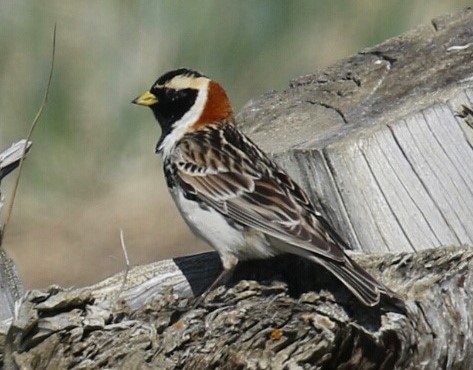
Lapland Longspur at the Mouth of the Cedar Park

lapland-longspur1

We said our goodbyes and then I returned to the northern end of the park to walk out to the actual river mouth and to search the logs and open water for the Sabines’s Gull.  Two birding friends were heading the other direction towards the Longspur having chosen to look for the Sabine’s Gull, which they had found, first.  Gregg Thompson and Dan Reiff gave me details of the Sabine’s location and I gave them details for the Longspur.

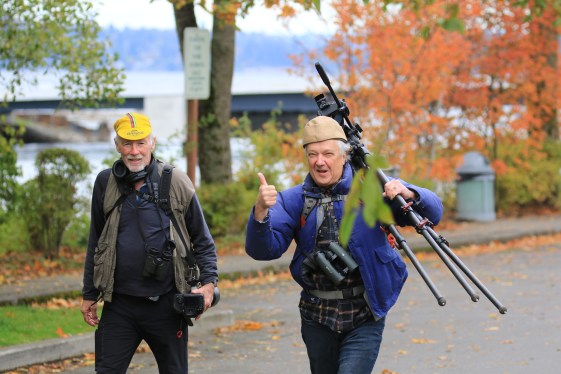
Gregg Thompson and Dan Reiff

img_0133

They had said that the gull was hanging around on the furthest out logs. After a couple of moments I found what I thought was the gull quite far out on either a little gravel bar or a log.  I did not have my scope but the small size was consistent with that of a Sabine’s Gull.  I hoped for it to fly to reveal the distinctive wing pattern. Suddenly all of the hundred or so gulls took flight.  I watched carefully but did not see either a small gull nor that beautiful white and black pattern.  Worse yet, when they all returned I could no longer relocate the probable Sabine’s Gull at all.

Fortunately Dan and Gregg returned and the additional (and superior) eyes found the tiny gull sitting on the same gravel bar/log.  I think I had missed it because another gull had blocked it from my angle.  We watched it for quite a time including several flights where it would head even further out to a slick in the water before returning to the gravel.  The distance and lighting were not the best for good photos, but no mistaking the identification.

Sabine’s Gull on Gravel Bar

sabines-gull

Sabine’s Gull in Flight

sabines-gull-flight1

This visit had been very successful and when I called my hostess for the “Debate” Party, it was ok to come early so that worked out as well.

I could end the blog post here but then you rightly would be completely confused by the “Four Months and Two Thousand Miles” title. So on we go.  In earlier posts I wrote about the wonderful trip to Adak and Nome Alaska in June earlier this year.  That trip was Four Months Ago from the date of these observations and those locations are Two Thousand Miles from the Mouth of the Cedar River Park.  And on that trip I had fabulous views of many Lapland Longspurs and Sabine’s Gulls and unlike these two, those birds were adults in spectacular Alternate (breeding) plumage.  These photos show the extraordinary difference.

Lapland Longspur in Breeding Plumage – Adak, Alaska

Lapland Longspur

Sabine’s Gulls in Breeding Plumage – Nome, Alaska

Sabine's Gulls

I doubt I will ever again see a Lapland Longspur and a Sabine’s Gull on the same day in King County.  Sure was nice to do so.  And I hope I never again see such a pathetic display of what has come to pass for politics in America again either.  Unfortunately I probably will…sigh.

Good Birds, Bad Weather and Bad Views (of Birds That Is) – Salmo Mountain and Northeastern Washington

Salmo Mountain is about as far away from my Edmonds home as you can get and still be in Washington.  Just under 400 miles away, it is in the extreme northeastern corner of the state and is approximately 3 miles from Canada and 3 miles from Idaho.  I first visited the area in 2012 on a wonderful Washington Ornithological Society trip led by Terry Little on October 5th, my birthday.  I have returned in late September or early October each year since.  The area is one of the best and most accessible boreal forest habitats in Washington and has some very special birds accordingly.

A clarification – “most accessible” does not mean you simply pull off the pavement and park.  My destinations this past weekend included Salmo Mountain, Bunchgrass Meadows, Sullivan Lake and Highline Road.  All told that meant almost 100 miles of driving on unpaved roads – mostly in good condition, but I had a flat tire there two years ago.  The nearest towns are Metaline Falls and Ione, Washington.  A couple of motels and not much in the way of food or other services.  We are talking remote – but also talking very beautiful.

salmo-map

Birders, like me,  come to this area with hopes of finding three boreal specialties and several other species that are also found elsewhere but can be fairly reliable here as well.  The three main targets are Boreal Owl, Boreal Chickadee and Spruce Grouse. The other goodies include Dusky and Ruffed Grouse, American Three Toed Woodpecker, Red and White Winged Crossbills, Gray Crowned Rosy Finch, Pine Grosbeak, Northern Pygmy Owl and Northern Goshawk.  I have found all of these species on one or another of my visits and my combined trip list for all visits is 51 species.  While I have been fortunate to have found Boreal Owls each year, they have been “heard only” and this rare owl remains one of only three non-review board species in Washington for which I have no photo.  So getting a visual and a photo was the prime objective for this visit.

Before heading off on my trip I had checked the weather and it looked pretty good with maybe a few sprinkles but in the mountains you never know.  I have been at Salmo in bright sunshine and with several inches of snow on the ground.  This time I had none of either – lots of clouds, a few spotty sunbreaks and sadly lots of wind, rain, thunderstorms and hail.  I arrived midday Friday and had only clouds and after checking in to the very basic but clean Circle Motel in Metaline Falls, I headed off to Bunchgrass Meadows.  Last year I had my first ever photo of a Spruce Grouse there and always had Boreal Chickadees there on previous trips.  Despite being the only car on the road up (Harvey Creek Road), this time I found no grouse and while I had several Boreal Chickadees, they remained camera shy high up in the trees.

Spruce Grouse from Bunchgrass Meadows in 2015

spruce-grouse2

About 12 miles in I met a hunter on a serious off road vehicle who said that grouse “were everywhere” – better at dusk and dawn of course.  Failing to find any gallinaceous birds at all, I planned to return early the next day.  I found a couple of American Three Toed Woodpeckers and I had a flyover by a screaming Northern Goshawk but in general the birding was much slower than I remembered from earlier visit.

After a couple of hours, I headed off to Salmo Mountain planning to bird slowly on the 20+ miles of unpaved road and to arrive at the summit around 5, wait until dark and then seek the main quest – Boreal Owl. It rained lightly for a few moments on my climb but nothing too serious.  Still the birding was slow.  No grouse at all and again some uncooperative Chickadees – both Mountain and Boreal.  Last year we had found a spot where Boreal Chickadees had nested.  None were there this year but some serious tapping told me that some woodpeckers were.  I could not penetrate the thick woods to get to the sound but eventually was able to draw two American Three Toed Woodpeckers out and get a few pictures.  A third remained hidden deep in the woods.

American Three Toed Woodpecker

american-three-toed-woodpecker

I continued up the road and met two hunters in more camouflage clothing than I have ever seen.  Not sure I would have noticed them if they had been standing in the woods rather than by their car.  They were talking to a Border Patrol officer – a local who was also a serious hunter.  They too said that grouse “were everywhere”.  Interestingly though they knew only about Ruffed Grouse and “Blue Grouse” and were unaware of Spruce Grouse even existing.  They were not bird hunters.  Of most interest to me were their stories of bear sightings including two grizzlies about a week ago and also of “many” cougars – also recently.  If push came to shove I would probably take a photo of a Cougar over a Boreal Owl, but it would be a tough decision as both are just below seeing a Smew on my bucket list.

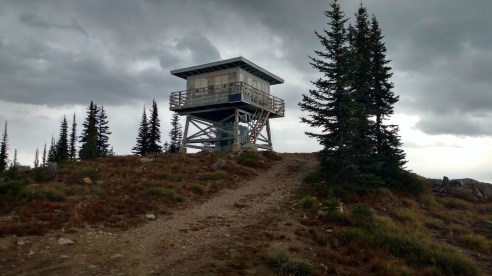
Leaving them I made it to the end of the road at the Lookout Tower and was greeted by peals of thunder and lots of wind and then some very serious hail.  Not exactly good owling conditions.  I was exhausted from almost 12 hours of driving so I waited for a change in weather with a short nap – hoping that lightning would not accompany the thunderstorm and strike the mountaintop.

Salmo Lookout Just before the Storm

salmo-lookout

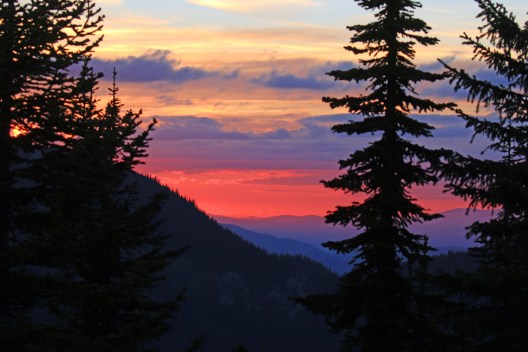
The pounding hail and then heavy rain did not allow for much sleep but I dozed off and on for about an hour.  Finally it cleared enough to enjoy part of the view.  The good news was that the wind was blowing away some of the clouds but it did not portend well for successful owling.  A photo as the sun was going down was a nice reward however.

Sunset from Salmo Mountain

scene-from-salmo1

I waited another hour and then set off to find an owl with spotlight and camera ready.  On previous visits we have had as many as three Boreal Owls within a half mile of the tower.  As said before, I have yet to actually see one – or at least see one clearly – my only “view” being of an even darker form flying over against the dark sky.  Sometimes owls have been heard within the first 20 minutes.  Other times it has taken many hours.  this night was to be in between.  Not a sound for over an hour so I moved further and further down the road.  Finally at about 8:45 I heard a few repeated hoots and then a “skiew” call.  It was not close and there was no response to playback despite many attempts over a quarter mile along the road. It was now somewhat clear but still windy and I think that contributed to the poor results.

A Representative “Photo” of My Typical Boreal Owl Experience

boreal-owl

I went back to the car and began the 20 mile drive back to a paved road.  As I have done successfully with Flammulated Owls, I planned to stop and use playback – although instead of every 1/2 mile it would be every 1/8 mile.  After 5 unsuccessful stops I felt a few rain drops and sensed that more were coming so I gave up and set out for the motel.  On these roads at night there is no visibility except for headlights and even they are not very useful around some of the sharp turns.  There is also the constant awareness that some wildlife might suddenly appear and while I would have loved to have seen a Cougar or Grizzly, I certainly did not want to hit either one or the more likely deer or moose that I knew to be around.  That coupled with a strong desire to not hit any or rocks or worse yet slide off the road meant travel was slow.

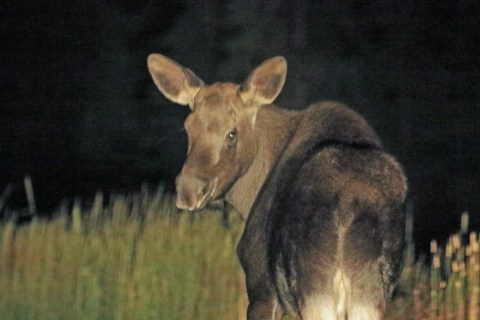
Not more than another half mile down, two shadows appeared on the road.  When my headlights captured them, I saw two young Moose ambling along and then in the center of the road not more than 200 feet ahead of me.  I snapped a couple of photos through the windshield and then flashed my lights to encourage them to move off the road as I followed slowly.  In about 1/8 mile one got the message and bounded off to the right.  The other stayed on the road.  When I approached it trotted ahead.  When I stopped, it stopped.  I tried honking, shouting, and more flashing but this moose really like the road.  Our start and stop game continued for almost a mile – at least 10 minutes.  Finally it slowed enough and pulled off to the right enough that I felt safe getting close enough to try a pass.  It was literally five feet away from the passenger window when I could finally get by and continue.

Moose on Salmo Mountain

2-moose-on-road

The Moose that Just Would Not Leave the Road

moose

During much of my way down, there had been a light rain.  Just as I made it back to the motel around midnight, it started to pour!  I ran up to my room and within minutes of getting in I crashed hard.  Six hours later I was up and wondered what the weather was.  It was still dark and still raining although now just some sprinkles, but there were pools of water in the parking area and I was not optimistic for a good day.  I left shortly thereafter hoping to get back to the Harvey Creek Road to Bunchgrass Meadows at dawn to see those grouse that “were everywhere”.

As expected the Harvey Creek Road was very wet and muddy.  It was no longer raining but there was a constant drip of water from the trees.  Grouse were nowhere to be found and not much else was around either.  I went in over 12 miles and had barely a handful of birds.  The weather did not look like it was about to change, so I made the executive decision to cut the trip short and forego another trip up Salmo for the night. But I really wanted to at least find a grouse so watched carefully on the way back down to Sullivan Lake Road and then decided to try another road I had noticed earlier and which had been mentioned by the Border Patrol guy – Highline Road not far from the road up to Salmo which was north of Sullivan Lake (the road to Bunchgrass is just south of the lake).  I stopped for a photo of one of the many beautiful spots along the creek.

Harvey Creek

harvey-creek1

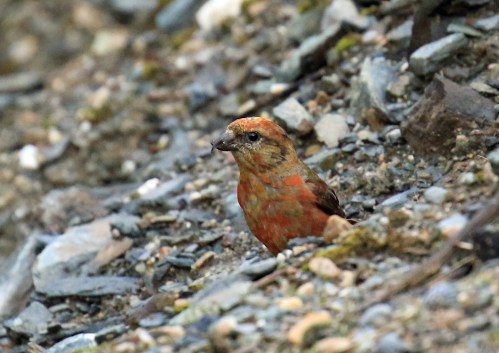
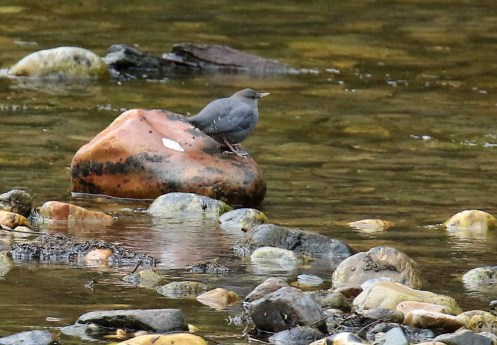
Last year there had been a flock of Gray Crowned Rosy Finches at the bridge just south of Sullivan Lake so I made the stop.  No Rosy Finches but in addition to the Common Mergansers, Mallards and Canada Geese in the lake, there was a pair of Red Crossbills, some Common Yellowthroats and an American Dipper.

Red Crossbill

red-crossbill2

American Dipper

american-dipper

Highline Road proved a good decision.  Less than a mile up the road I came around a bend and flushed a male Spruce Grouse.  It flew to a log still visible in the woods.  In the single most frustrating moment of the trip, I got my camera tangled up in my seatbelt strap.   I had forgotten to go to “birding mode” where I buckle the strap but have it behind my back.  By the time I got untangled the bird had scooted off and there would be no photo.  I hoped for more but felt I had blown my best chance and was NOT a happy camper.  There were no more grouse, but the road was more birdy than any of the others I had been on this trip.  One traveling flock included Boreal, Chestnut Backed and Mountain Chickadees, both Ruby and Golden Crowned Kinglets and Red Breasted Nuthatches with another American Three Toed Woodpecker flying by. Again the birds would not come down from the upper branches and the lighting was terrible in any event.  So still no good photo of a Boreal Chickadee.

Red Breasted Nuthatch

rb-nuthatch

I went in about 7 miles on Highline and saw a single other vehicle on the trip.  On my next visit I think I will go even further to explore.  But not this day so it was back down and a return to the motel to check out early.  Pretty hard to call a trip that includes Moose, Boreal Owl, Boreal Chickadee, Spruce Grouse, Goshawk and American Three Toed Woodpecker a bust but the weather was a downer and the views were just not very good and the photos (the few that I took) even worse.  It was a VERY long drive back   But there was one very good “bird” bonus.  The original plan would have gotten me back late Sunday night.  Instead I was back late Saturday and thus could observe some Seahawks flying very high on Sunday morning.

seahawk

Long Ago but Not Faraway…

By the time I first visited Seattle in the summer of 1972, I was just beginning my journey to become a “birder”.  I had begun to contract that disease – or more positively stated, develop that passion – while in law school  spending far too much time at Palo Alto Baylands and Coyote Hills Regional Park.  I was not so much into listing at that time and of course there was no “Ebird” so record entry and record retrieval was a totally different matter.  But I did keep some notes and records and eventually many of them have become data points in Ebird and thus open to review and catalysts for memories of the past.

Yesterday some work on another birding project included an examination of my birding history in Washington which gave birth to this post – looking back at rarities of the past.  Some have been seen again, but many not.  No digital cameras back then, so no photos and how I regret that.  My first Ebird entry for Washington was from a trip to Sunrise at Mount Rainier on July 27, 1972 – a place I revisited two days ago (September 21) in an unsuccessful attempt to find a Boreal Owl.  While there I made the comment to my companions that I remembered that Ptarmigan sure seemed easier to find in the “good old days” and checking that out was one reason that I looked back at my old birding records in Washington.

The checklist from that first Rainier visit did include White Tailed Ptarmigan.  It was pretty clear that while I identified Sunrise as the location, other spots along the way were actually involved and my record keeping then was not very precise.  All told I reported 34 species and of those 27 were “life birds” – the joy of birding new areas.  Among those “lifers” were Sooty Grouse, Gray Crowned Rosy Finch, Clark’s Nutcracker, Gray Jay, Townsend’s Solitaire, Hermit Warbler, Red and White Winged Crossbills, Black Swift and Mountain Chickadee.  Some of those are not so rare but all were pretty exciting at the time and many would still be considered quite nice today.  Again no photos, but since one rule for blog writing is to not go too long without including some photos, here are two from the failed Owl Prowl on September 21st.

Gray Jay – Sunrise, Mt. Rainier

gray-jay

Clark’s Nutcracker – Sunrise, Mt. Rainier

clarks-nutcracker

The nostalgia seeing that first Washington checklist led me to wonder about other early birding experiences in Washington.  In those early days there was no Ebird and no Tweeters so news about special birds came by word of mouth and a single hotline or “Rare Bird Alert”.  Somehow it worked and while I was actually working and starting a new life in a new place, I found time to go on at least a few chases and looking back at the Ebird entries made many years later, I found a lot of very rare birds including many I have not seen again.  The remainder of this post describes some of them – and I sure wish some would return and I could enjoy them again, this time with a camera at hand.

Arctic Loon – Port Gamble – October 22, 1973.  This is the only Arctic Loon I have seen.  There have been only a couple more recent records in Washington.  I cannot recall any details of this observation other than I believe it may have been on Seattle Audubon RBA at the time.  I had hoped to see one on my Alaska trip in June this year but did not.  Photo from the internet.

arctic-loon-noah-gaines-1804

Scripp’s Murrelet – Westport Pelagic – September 8, 1974  My first observation was on my first pelagic trip – who knew it would be almost 30 years before finding one again – a pair seen on September 7, 2013 and then another on October 19, 2013.  Not surprisingly that first trip included a lot of other life birds including the “Skua Slam” , Buller’s (then New Zealand) Shearwater, Tufted Puffin, Fork Tailed and Leach’s Storm Petrels, Black Footed Albatross (my first albatross), Sabine’s Gull and Arctic Tern.

scripps-murrelet1

McKay’s Bunting – Ocean Shores – February 5, 1979 – beautiful bird that created a lot of excitement.  There have been other McKay’s Buntings at various spots at Ocean Shores.  I chased one a day too late at Damon Point in February 2012.   The photo is by Knut Hansen of that bird.

6877135971_ac831eb170

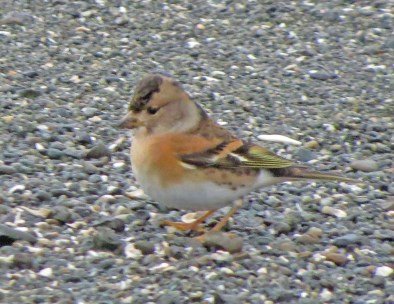
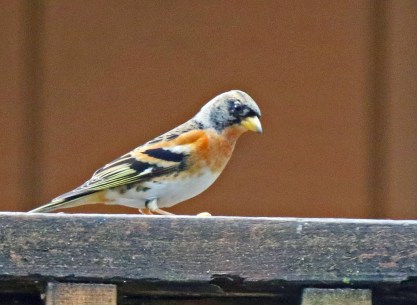
Brambling – Lake Sammamish – January 20, 1982  My first observation was at a stakeout near Lake Sammamish.  Since that time I have seen three more Bramblings in Washington.  The next was in Birch Bay, then one in Neah Bay during the same crazy week that had the Eurasian Hobby among a number of other good birds, and then finally one last year coming to a home in Issaquah.  The photos are from the three more recent sightings.

brambling

brambling2

4ca4f-brambling


White Wagtail – Fort Casey SP – January 21, 1984  This rarity was seen by many on Whidbey Island in 1984.  Another was found at/near Point no Point in 1993 and another possible one in the same area in 2007.  I have expected additional visits but my only other observations have been elsewhere.  The first was on an extraordinary day of birding at the Mai Po Nature Reserve outside Hong Kong on Christmas Day 1979, the next in Corbett National Park in India on January 11, 2011 and most recently in Nome Alaska on June 5, 2016.  The photo is of the Nome bird.

White Wagtail

Little Gull – Everett Sewage Ponds – September 23, 1984 The photo is from a later sighting on October 7, 2013 from Point No Point where it was seen at distance from shore in a massive group of Bonaparte’s Gulls.  My first observation of this bird was from the South Jetty of the Yaquina River in Oregon on September 8, 1979.  A pretty poor photo but I was thrilled to get it.

little-gull

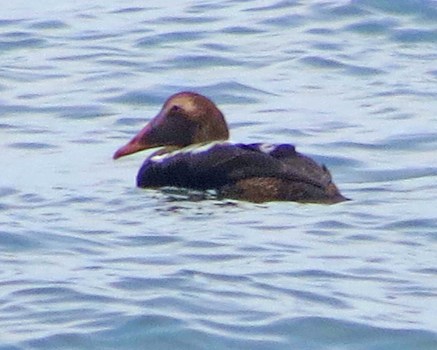
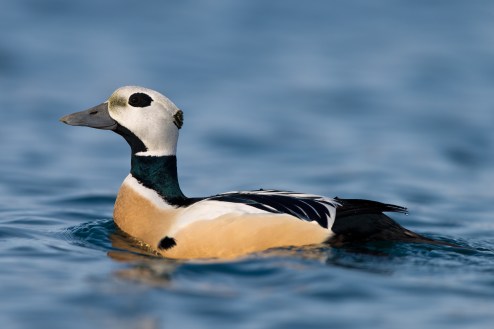
Steller’s Eider – Point Wilson/Fort Worden – November 23, 1986.  This is a photo from the internet.  I believe this is the only Washington record – certainly the only Ebird entry.  It ranks right up there with Smew as what I feel are the most beautiful ducks – even ahead of the showier Wood Duck and Hooded Merganser.

stellers-eider-1

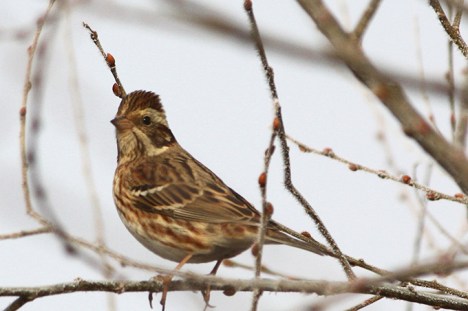
Rustic Bunting – Kent Ponds – December 19, 1986 – This rarity continued into January 1987 and then repeated its performance in 1988/1989.  I had seen one in Wajima, Japan in December 1983, my only other record.  Photo is from the internet.

rustic-bunting_jb

My Washington birding was very active from when I first arrived until the birth of my first child in 1984.  I had moved to Oregon for a few years and birded there but even then more in Washington.  I continued a few chases for the next couple of years after her birth and then became absorbed in activities involving that daughter and the son that followed.  Recreational time was devoted to a new found passion – fly-fishing.  As they moved on to high school and then graduated and went off to college, my birding activity was more international with fun trips to Australia, Brazil and Kenya.  Slowly, however, the interest in Washington returned and from 2010 on that has been a big, enjoyable and rewarding part of my life.

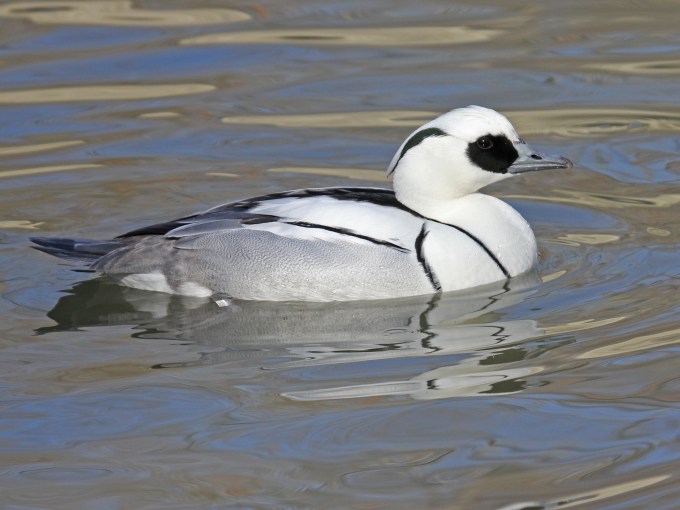
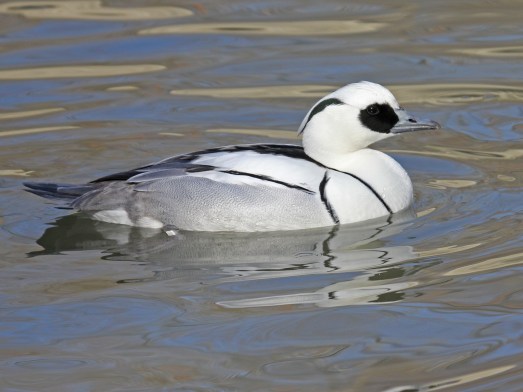
During the years I did not bird in Washington, I missed a lot of great birds, some of which I have been fortunate to see later – some not.  Among those missed and not seen later are White Ibis (Raymond – January 2001), Dotterel (Ocean Shores October and November 1999), Baikal Teal (Kent Ponds April 2005), Garganey (Wenzel Slough April 2005), Fork Tailed Flycatcher (Pacific County – September 1995) and the one bird that remains on the very top of my “birding bucket list” – Smew. One was seen two years in a row near Stevenson, Washington.  I will leave the minute I hear of one being seen anywhere in Washington, anytime.  In fact it may be the one bird that I will leave for immediately if I hear of one anywhere in the U.S. – if it is a male – as I think it is the most beautiful of all the birds.  Just wish the photo below, which will conclude this post, were mine.

Smew – the Very Top of My Birding Bucket List – photo from Internet

smew_rwd1

“TW3 – That Was the Week That Was”

If I ever “grew up” at all, it was in the Sixties – that wonderful decade that set in motion so many of the changes that have shaped America and the World in the following 50 years.  (Damn I am old!!!)  One of my fond memories of the Sixties was a short lived television satire called That Was the Week That Was or in shorthand TW3.  It was an American version of an eponymous British show that first brought David Frost to British audiences just as this TW3 brought him and many other talented artists to America.  Little was sacred, most was irreverent and all was fun – even better than the Daily Show – a favorite that just has not been the same without John Stewart.  What does this have to do with a birding blog you might ask.

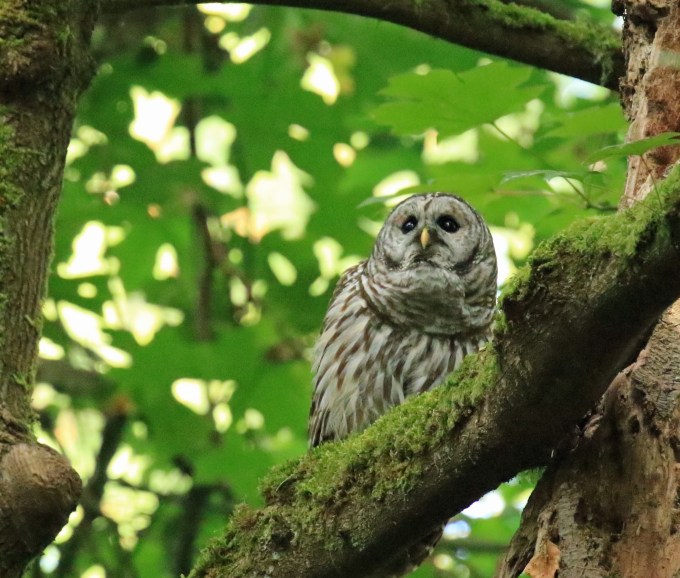
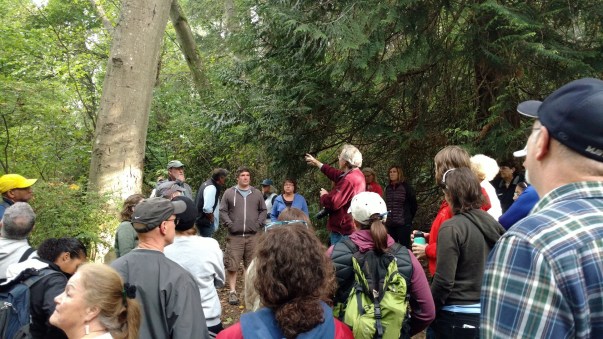
Well aside from the fact that it is my blog and I can write whatever I want, it came to my mind as I considered what to write this week – a week that must be considered as “Birding Lite” even though it included a fun trip to Yost Memorial Park in Edmonds as part of Edmonds Bird Fest.  In great weather we had over 70 people walking the trails in rapt attention of our leader Finn learning about and hoping to see one of the Barred Owls resident in the Park.  My job was to “help” which essentially turned into a combination of crowd management, Finn management (when he gets on a roll, it is great but then again only for those close by – so I  worked to be sure the stories were repeated and heard by all) – and occasionally identification of some additional species.  It was a great trip; we had fabulous looks and photo ops with one of the owls and everyone was happy, but not really enough material for a full post.

Barred Owl at Yost Park

barred-owl

Finn and Edmonds BirdFest Crowd at Yost Park

finn-and-crowd

I recalled that when I first started writing the blog, I expected that there would be down/inactive weeks so to continue to write, I would revisit experiences from my birding past and include a feature called “Bird and Memory of the Week” which I figured would provide lots of content options.  Who knows why, but this morning as I started that exercise, TW3 came to mind and I decided instead to look back at some as yet unidentified week of birding in the past and see if that might be of interest.  Where to start?  Two options first came to mind – go back to my first week of “real” Ebird records or go back to this same past week but in some other year – like last year for example.  I thought the first option would be really cool, but the reality is that when I first switched over to Ebird to enter historical data, it was woefully incomplete – since it was only the “new species” and not really as detailed as to time and place as it could have/should have been.

So I looked at Option 2 instead.  September is usually a great month to look for shorebirds, so I knew I had been out sometime last year for that – but which week.  Turned out I made a great choice.  With the possible exception of the Eurasian Hobby extravaganza at Neah Bay the week of November 14, 2014, the week of September 9- 15 last year just may have been my best week of birding in Washington. Here are  the stories and some of the details for That Week That Was.

The birding part of the week started with a 3:00 a.m. wake up call on September 9.  I have since moved a few blocks away but at that time I lived very close to the aforementioned Yost Park and one of its owls was asking the world “Who..Who Cooks for You”; so this story begins with the hooting of one of the parents of the Barred Owl that we saw last Sunday on the Bird Fest Trip.  How’s that for symmetry…stay tuned there will be more.  It turns out that this particular “week that was” was one that included LOTS of birding and travel. Indeed, while the owl did in fact wake me up a bit earlier than planned, I was heading off to Neah Bay with an early start anyhow.  A Red Legged Kittiwake had been reported from there the day before, so together with Jon Houghton and Nathaniel Peters we were off in search of that mega rarity.  (See earlier Blog Post https://wordpress.com/post/blairbirding.wordpress.com/1900).

We tried hard to find a Kittiwake with red legs, but unfortunately the only one we found had legs that were decidedly black.  Still a nice bird … but…  We birded the area the whole day without anything special but we were planning to stay the night so who knew what the morrow would bring.  It brought some good birds but again nothing with red legs.

Kittiwake – Unfortunately with Black and Not Red Legs

Black Legged Kittiwake

As indicated earlier this trip was covered in an earlier post so I will not go into further details other than to say in the context of this post, there were lots of good birds to add to THE LIST for that week including Sooty Grouse, Northern Pygmy Owl, Black Oystercatcher and a Stilt Sandpiper.

At this point I am going to jump to the end of the story, possibly to build interest for a reader to continue with the details.  It turns out that this was a very birdy week to have chosen as I said.  Here are some bottom line numbers:  Total species seen – 131; shorebird species – 25; waterfowl – 13; gulls and terns – 10.  Even better though, I would say at least 10 of the species were pretty special or even better.  Read on.

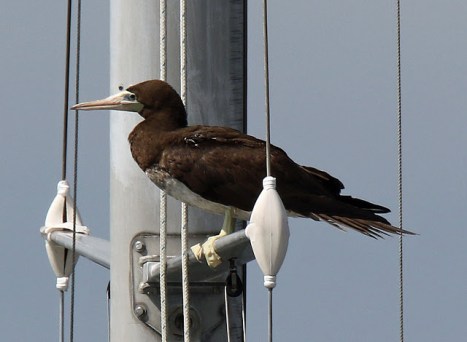
After the long trip to Neah Bay, I took a couple of days off but hit the birding trail again with another  Edmonds Bird Fest trip which I lead to  Kitsap County including a wonderful visit to Point No Point where EVERYONE on the trip was able to observe a relatively close fly by of a Brown Booby, presumably the same one that had been spotted from the Edmonds Pier in August and which I had seen up close and personal as it came into the marina perched on the mast of a sail boat.  Our look at Point No Point was not that good but what a great bird for everyone.

Brown Booby in Flight – September 13, 2015 (not as good as the photo from the Edmonds Marina which I include again here)

brown-booby-flight

Brown Booby from Edmonds Marina (August 21, 2015)

brown-booby-on-mast1

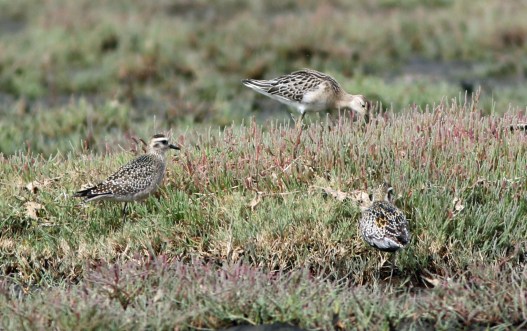
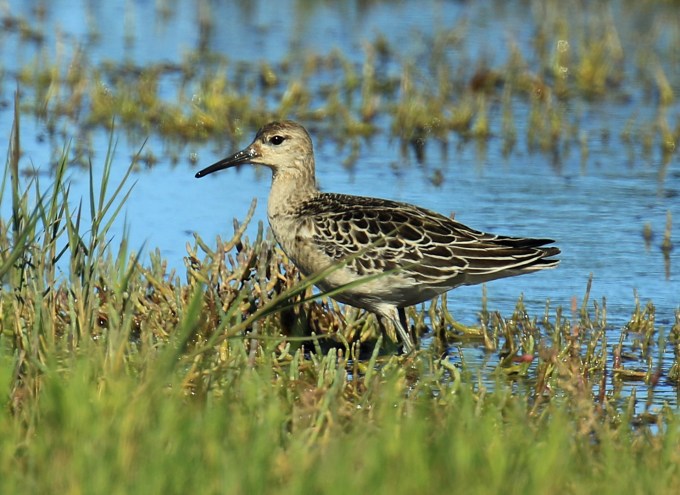
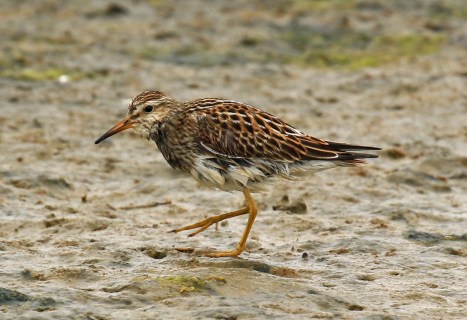
Any week in Washington that includes a Brown Booby is very special – but there is more.  On Monday following the Sunday BirdFest trip, I headed back down to the coast.  I had been there the week before and after another wonderful trip with Westport Seabirds and had some nice shorebirds but nothing special (although there had been Elegant Terns – unlike this year.)  This week in 2015 proved much better – indeed quite spectacular with observations and photos of many great shorebirds including among others:  American and Pacific Golden Plovers, Ruff, Sharp Tailed, Baird’s, Pectoral and Rock Sandpipers!!!

Pacific Golden Plover

gp2

Ruff

ruff4

Golden Plovers and Ruff

ruff-and-goldens

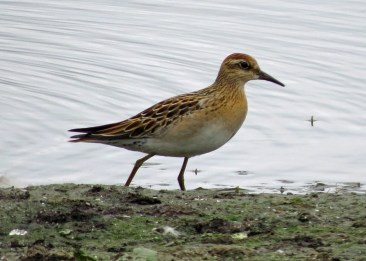
Sharp Tailed Sandpiper

sharp-tailed-sandpiper

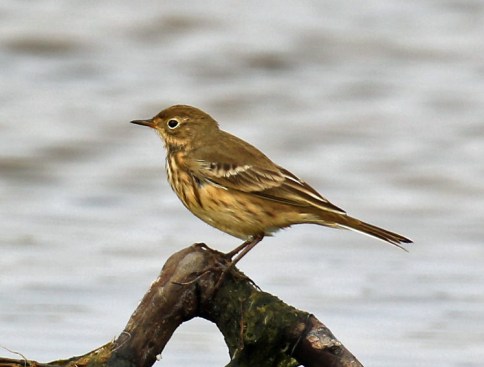
It was also nice to have good looks at both American Pipits and Lapland Longspurs in the salucornia and grass at the Game Range when chasing down the Ruff and Golden Plovers.

American Pipit

american-pipit

Lapland Longspur

lapland-longspur

As is usually the case, I had forgotten how much birding I had done and how much of the state I had covered in that week.  After the birding in Neah Bay, Kitsap County, Edmonds and Ocean Shores, I should have been done but I guess I needed some diversity so the next day I headed east to Soap Lake and Potholes among other spots.  Probably the best birding was a spectacular mix of shorebirds that included another Stilt Sandpiper at Lind Coulee among 11 species there and the huge flock of Eared Grebes (and some Horned and Western but no Clark’s Grebes) at Soap Lake.

My last stop for the week was at Robinson Canyon on the way home – hoping for the picture of a Poorwill that had eluded me all year.  Surprisingly though there were many other “recreationists” using the Canyon that evening so although I added a Merlin and a Sharp Shinned Hawk, a try for a late Poorwill was ill fated.

Looks like I picked a pretty good week to look back on.

Here is the entire list of birds seen that week.  I have highlighted 15 that I think are special – either rare or at least not on my every day bird lists:

American Coot (Red-shielded)
American Crow
American Golden-Plover 
American Goldfinch
American Kestrel
American Pipit
American Robin
American Wigeon
Anna’s Hummingbird
Baird’s Sandpiper
Bald Eagle
Band-tailed Pigeon
Barn Swallow
Barred Owl
Belted Kingfisher
Bewick’s Wren
Black Oystercatcher
Black Turnstone
Black-billed Magpie
Black-capped Chickadee
Black-legged Kittiwake
Bonaparte’s Gull
Brandt’s Cormorant
Brewer’s Blackbird
Brown Booby
Brown Creeper
Brown Pelican
California Gull
California Quail
California Scrub-Jay
Canada Goose
Caspian Tern
Cedar Waxwing
Chestnut-backed Chickadee
Common Loon
Common Murre
Common Raven
Common Tern
Cooper’s Hawk
Dark-eyed Junco
Double-crested Cormorant
Dunlin
Eared Grebe
Eurasian Collared-Dove
European Starling
Gadwall
Glaucous-winged Gull
Golden-crowned Kinglet
Golden-crowned Sparrow
Great Blue Heron
Great Egret
Greater Scaup
Greater Yellowlegs
Green-winged Teal
Hammond’s/Dusky Flycatcher
Harlequin Duck
Heermann’s Gull
Hooded Merganser
Horned Grebe
House Finch
House Sparrow
Hutton’s Vireo
Killdeer
Lapland Longspur
Least Sandpiper
Lesser Scaup
Lesser Yellowlegs
Mallard
Marbled Godwit
Marsh Wren
Merlin
Mew Gull
Mourning Dove
Northern Harrier
Northern Pygmy-Owl
Northern Shoveler
Northwestern Crow
Orange-crowned Warbler
Osprey
Pacific Golden-Plover
Pacific Wren
Pectoral Sandpiper
Pelagic Cormorant
Peregrine Falcon
Pied-billed Grebe
Pigeon Guillemot
Purple Finch
Red Crossbill
Red Tailed Hawk
Red-breasted Merganser
Red-breasted Nuthatch
Red-necked Grebe
Red-necked Phalarope
Red-throated Loon
Rhinoceros Auklet
Ring-billed Gull
Rock Pigeon (Feral Pigeon)
Rock Sandpiper
Ruby-crowned Kinglet
Ruff
Sanderling
Savannah Sparrow
Say’s Phoebe
Semipalmated Plover
Sharp-shinned Hawk
Sharp-tailed Sandpiper
Short Billed Dowitcher
Song Sparrow
Sooty Grouse
Sooty Shearwater
Sora
Spotted Sandpiper
Spotted Towhee
Steller’s Jay
Stilt Sandpiper
Surf Scoter
Swainson’s Hawk
Swainson’s Thrush
Townsend’s Warbler
Turkey Vulture
Varied Thrush
Vaux’s Swift
Violet-green Swallow
 Warbling Vireo
Western Grebe
Western Gull
Western Sandpiper
Whimbrel
White-crowned Sparrow
White-winged Scoter
Wilson’s Phalarope
Wilson’s Snipe
Yellow-rumped Warbler

I found this retrospective to be pretty surprising and also a reflection of a crazy week of travel in our quite wonderful state.  Pretty hard to imagine someplace else with this bird list for this week and/or such diverse places as Neah Bay, Ocean Shores, Soap Lake and Robinson Canyon (among others).  Not now but at some other time I am going to look at other weeks in the Spring or Fall and see how they compare.  Pretty hard to top a Brown Booby, Ruff and Sharp Tailed Sandpiper though.


A Mad but Definitely Not Maddening Dash

With a lot of new birds and new photos from the great pelagic trip on August 28 (see  my earlier Magical Pelagical post), I had met my “goals” for the year and that compulsive urge to go chase every new bird was gone.  Sure I would still go for new state life birds or photos and there were some specific species I definitely wanted to see – yes, I mean you Boreal Owl – and some trips I wanted to make – but I no longer felt the need to go for everything.  I had done that for the past three years and it had been great and successful, but no more.

So yesterday when Russ Koppendreyer posted on Tweeters that he was looking at a Ruff that Jeanelle Richardson had found earlier that morning at Three Crabs in Sequim, I was tempted; but even though a Ruff is a wonderful rare bird and one I really enjoy – nope – no need to rush out to see it.  I set about on another bird project and that was that.  Until…a couple hours later,  I checked email and found that Russ also had a Sharp Tailed Sandpiper at the same location.  That is a favorite shorebird and also quite rare so now the ante had been raised significantly.  Let’s see…it was now 1:20 pm.  The next Edmonds/Kingston ferry was at 1:40 and I was in shorts, T-Shirt and sandals and had not eaten lunch.  I asked myself if I really “needed” these terrific birds and the answer was “no”.  But when I rephrased the question to self as whether I wanted the adventure of a possible mad dash with a potentially great prize, the answer was “hey this could be fun – why not”.  I live less than 10 minutes from the Edmonds Ferry terminal so I put the SD card back in the camera, checked that the battery was okay, grabbed another layer and a protein shake and took off.

It helped that the weather was spectacular – 72 degrees and sunny.  It did not help that apparently a lot of other people were heading off in the great weather and when I got to the ferry toll booth there was a line.  It was now 1:35 and I wondered if I was going to make the ferry.  If not, I was going to abort and head home.  The ticket seller said she thought I would “probably” get on but “no guarantee”.  I bought the ticket and moved forward.  As the cars loaded on ahead of me, I saw that they had stopped letting more cars into the waiting area.  It was looking “iffy”.  I won’t dwell on the agony of suspense – the happy ending was that I was the next to next to last car to board the ferry – so I was on my way.  And details like this add to the adventure and the story.

Room for Me on the Ferry

img_20160909_140026202_hdr

Waiting for the ferry to decide to let me on or not, I had spoken to Russ and was encouraged that the birds would likely stay regardless of tide and that they could be seen well enough for some photos.  Three Crabs has been a great spot for years – even back to when there was actually a restaurant named “Three Crabs” at the spot.  There is a wetlands “restoration” project underway at the location – yet another project to help salmon but not necessarily good for shorebirds, so I hope it will continue as a birding hotspot.  Traffic was good and I arrived at Three Crabs around 3:30 somewhat expecting to see a long line of birders with scopes trained on one or both of the special shorebirds.  But there was only a single parked car with two people looking out at the wetland.   Hmmm???

The Wetland

img_9339

At the northern most part of the area (east of the road and south of the former Three Crabs site) there was a series of pools with a number of shorebirds walking about feeding.  They were small peeps – a mix of Western and Least Sandpipers but then another bird flew in – a little larger and my heart rate went up as I thought it could be the Sharp Tailed Sandpiper.  But no – only one of the three or four Pectoral Sandpipers that were around.

Pectoral and Least Sandpipers

pectoral-and-least

Now that I noticed that the couple in the parked car had a pair of binoculars and a camera, I went over and learned that they had been there earlier, seen both rarities and had now returned after lunch.  Beginning birders, they were excited by what they had seen before and were hoping for better looks, but had not seen either species since they had returned.  Now a Ruff is a good sized shorebird – not quite as big as a Greater Yellowlegs, but hard to miss – unless of course it is buried in or behind some tall grass and there was plenty of that around.  I walked further south when I saw a head above some of that grass.  It turned out to be a distant Greater Yellowlegs, but I also got a fleeting glimpse of a browner large shorebird that I was pretty sure was the Ruff.  It disappeared behind even taller grass so I waited 5 minutes without another view and then decided to return to the earlier area and look for the Sharp Tailed.

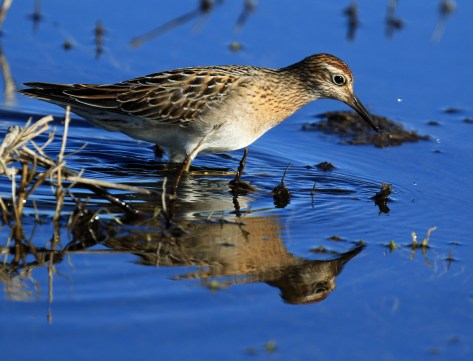
Now there were at least two Pectoral Sandpipers – or maybe three – or maybe that third bird was the Sharp Tailed – as the demarcation on the chest appeared at least less distinct and the cap a more solid reddish.  Then it flew off and I could see it was definitely the Sharp Tailed but now distant and hidden.  The couple from the car had now gotten out – interested in my focus on the birds I was watching – and we were joined by another birder – a local (I will not include the name for her privacy) who while not hard core was also way beyond mere beginner and she was very interested when she learned of the prize birds.  I said I thought we had a good chance of finding the Ruff in the area where I thought I had seen it earlier so the whole gang moved south and we were immediately rewarded as the Ruff had returned to the little pool with now three Greater Yellowlegs and off and on it would come out into the open.  I snapped a few OK pictures and was happy that all of us had gotten acceptable views.

A few more cars came by and stopped to ask what we were looking at.  Most had no interest in birds but still thought it cool that some rare birds had chosen their neighborhood for a show.  One car had some more beginning birders and they joined our party.  Another car had parked up at the north end and two people were busy studying the shorebirds there.  After getting our newly added birders (who had no idea what a Ruff even was) onto to the Ruff, we moved to the north again.  I told the two folks in the car there about the Ruff and Sharp Tailed Sandpiper.  Their only bird book was of Puget Sound Birds and neither species was in that guide.  What was very cool, however, was that the day before they had birded this same spot and found a bird they could not identify.  Their excellent notes clearly indicated that they had seen a Ruff.  When I showed them my photo they immediately said – “that’s it”.  Now they would get to see it again.

First View of Ruff

first-view-of-ruff

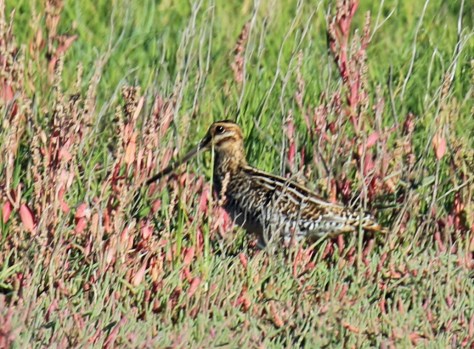
For the next 30 minutes or so, we continued to watch for the Sharp Tailed Sandpiper and hoped the Ruff would come closer (as apparently it had been closer to the road in the morning).  Jason Vasallo joined us – still pumped from seeing his first Broad Winged Hawk out at Neah Bay with the Waggoners.  We immediately got him on the Ruff and that made new state bird number 2 for the day.  Now there were more eyes looking for the Sharp Tailed Sandpiper – always a good thing.  There were a couple of Wilson’s Snipe in the field – and good scope views made it easy for all to see and learn the fieldmarks with the heavily striped back and head and the long bill.  We also studied a Pectoral Sandpiper and focused on the difference between it with a clearly demarcated breast streaking and broken streaks on the head compared to the solid cap and more of a wash on the breast of the Sharp Tailed.

Wilson’s Snipe

wilsons-snipe

The Pectoral study paid off as the Sharp Tailed was spotted directly in front of a clump of grass about 30-40 yards out in the field.  Not a close look but with the scope all of the fieldmarks clearly seen and everyone got on the bird.  And Jason had new state bird number three!!

First View of Sharp Tailed Sandpiper

first-view-of-sharp-tailed-sandpiper

Had the day ended there, everyone would have been happy.  But if happy is good, then thrilled and ecstatic is even better and that is what we got.  We never heard the signal, but there must have been one.  Don’t know why, but BOTH the Ruff and the Sharp Tailed Sandpiper decided to put on a real show and they kept getting closer and closer eventually coming within perhaps 30 feet of the crowd now watching intently with oohs and aahs from the road – with the sun directly behind us and directly on both birds.  At times both species could be seen within feet of each other and at another time the Sharp Tailed was within feet of the Pectoral Sandpiper – giving great comparison views.

Ruff – Up Close and Personal

ruff

ruff3

Sharp Tailed Sandpiper Up Close and Personal

sharp-tailed-sandpiper4

sharp-tailed-sandpiper1

Sharp Tailed and Pectoral Comparison

pectoral-and-sharp-tailed-sandpipers

It simply does not get any better than this.  Very great birds, beautiful weather, perfect positioning and sun for photos, very cool people and a beautiful place.  It had been a mad dash and it had worked – and then some.  Time to leave and when you can end the day with a view of Mount Rainier over Puget Sound from the Kingston Ferry Terminal as the sun sets – just an awesome day.  I think I will continue to be a birder!!!

mount-rainier

Magical Pelagical

Maybe the birds don’t care if the seas are rough or not but the birders do.  Frank Caruso and I did a whirlwind trip to coastal stops on Saturday August 27 the day before we were to join Westport Seabirds for a pelagic trip.  The weather was not very good – drizzly and foggy.  It was not too bad for birding on shore but it did not look too good for a trip out on the ocean if it continued to the next day.  Indeed there was another Westport Seabirds trip that day and we wondered how they fared.  Our first stop was the Point Brown Jetty and we could barely see anything in the mist – definitely could not find the early Rock Sandpiper that had been reported there the week before.  Andy Rogers was there taking photos and getting wet.  He had not seen the Rock Sandpiper either but had a Wandering Tattler which had flown to the other side of the jetty.   We settled for some Sanderlings on the beach and some Black Turnstones on the jetty and then headed to the Oyhut Game Range – our main target area for the day anyhow.

Black Turnstone at Point Brown Jetty (in the mist)

Black Turnstone

We understood that the Game Range was not so great from the Oyhut entrance so we walked in from the STP side.  The skies had cleared a bit but the light was still pretty dim. The tide was high and the bay was full of Sooty Shearwaters, molting Red Throated Loons and gulls.  Some of the loons still had their red throats which was very cool and I was also able to get a photo of one that showed two reasons they were so close to shore – no wing feathers for flight on one and another with a fish.

Red Throated Loon with Red Throat

Red Throated Loon Breeding

Molting and Flightless Red Throated Loon

Red Throated Loon in Molt

Red Throated Loon with Fish

RTLoon withFish

The loons were great but our quest was for shorebirds and we trudged through the sand and mud and salucornia to an area that had some activity.  Not a lot of birds but it looked like there might be some potential for a goody or two.   First though we were distracted by some very friendly calling, flying and posing American Pipits.  Not flamboyant but very pretty birds.  Too bad none of them had red throats.

American Pipit

American Pipit1

As we got close enough to look at the shorebirds, one jumped out immediately as “the right size” meaning bigger that a peep.  It proved to be a Stilt Sandpiper.  We had good scope views before it took off and disappeared.  There were no other “larger” shorebirds – just some Least and Western Sandpipers, Sanderlings and Semipalmated Plovers and a single Baird’s Sandpiper..  We had hoped for some Golden Plovers but not even any Black Bellied Plovers and definitely nothing as exciting as a Ruff or Buff Breasted Sandpiper – two rarities which have been previously found at this location.  We gave up on anything special and headed back.  But somehow without our noticing it , a larger shorebird had come in to the area and was foraging along the channel.  Probably because we wanted it to be one, we tried hard to make it into a Sharp Tailed Sandpiper.  Some of the characteristics were right but – no – the rufous cap was broken and the breast markings too distinct.  So we settled for some very good looks at a Pectoral Sandpiper.

Pectoral Sandpiper – what we saw

Pectoral Sandpiper1

Sharp Tailed Sandpiper – from Hoquiam STP on September 19, 2014 – what we wanted to see

Sharp Tailed Sandpiper

The rest of the day was pretty disappointing although we saw lots of birds.  Nothing of note at the Hoquiam STP.  Thousands of gulls at North Cove but no Elegant Terns.  Not a single shorebird at Tokeland and again no Elegant Terns.  We saw thousands of Sooty Shearwaters from North Cove – not too far offshore – as we had earlier at the Game Range in the bay.  We drove the beach at Midway/Grayland with friends Melissa Hafting and Ilya Povalyaev from Vancouver and had very few shorebirds and definitely nothing of note and definitely no Snowy Plovers although again there were thousands of Sooty Shearwaters.  We did not check the ponds at Midway but Ilya and Melissa did later and had some nice birds but again no Snowies nor Buff Breasted, Ruffs or Sharp Tails.

Time to head to Westport and check into our motel.  We stopped at Float 21 and scanned the hundreds of Marbled Godwits but we were not able to find the Bar Tailed Godwit that had been hanging out with them  Our plan was to get checked in, have an early dinner and then head to Bottle Beach.  High tide there was at 9:38 pm so our goal was to arrive around 7 and catch the shorebirds as they moved in with the incoming tide.  The check-in and dinner part went according to plan.  While waiting for our pizzas, Melissa called to say they had returned and had the Bar Tailed Godwit near the Coast Guard station off Float 21. Fortunately it waited until we finished dinner and got there around 6:30.  There were actually far fewer godwits than when we had seen there before, but the Bar Tailed was pretty easy to find as its paler feathers contrasted with the browner/tanner plumage of the somewhat larger Marbled Godwits.

Bar Tailed Godwit with Marbled Godwits from Float 21

Bar Tailed Godwit

Timing was perfect for us to then get to Bottle Beach by a little before 7:00 pm. From many previous visits I have learned that it is generally necessary to get to Bottle Beach at least 2.5 hours before high tide and bird as the tide comes in bringing what can be many hundreds of shorebirds in with it.  As Frank and I passed over the bridge next to Brady’s Oysters, we wondered if we had read the tide tables wrong since the oyster beds were covered and there was lots of water and little mud.  And when we hiked out to Bottle Beach joined by Melissa and Ilya and again saw very little mud and the pilings almost completely under water we figured we had made a mistake for sure.  Turns out that high tide was indeed at 9:38 and we were more than 2.5 hours ahead of it – BUT the low tide had been a very “high” low tide and the high tide was a very “high” high tide so there was just no mud for the shorebirds.  We had a few peeps, a few Semipalmated Plovers and maybe 150 Black Bellied Plovers – and again thousands of Sooty Shearwaters.  AND the shorebirds we had did not stay long as a Peregrine Falcon flew by and they disappeared.

A small consolation prize was an up close and personal look at a Virginia Rail from the bridge on the boardwalk coming back to the cars.  We heard at least two others in the reeds.

Virginia Rail

Virginia Rail

So much for the preliminaries; time to get some sleep and be ready for the pelagic trip the next day.  I had gotten word that the sea conditions had not been the best for Saturday’s trip but they had some good birds including Scripp’s Murrelets, lots of Red Phalaropes and some Arctic Terns.  I was particularly interested in the latter as I have only seen them a couple of times in Washington and have never had a photo.  The weather had continued to improve though the day so I was optimistic for a good trip on Sunday.

Frank had been fighting a cold most of Saturday and the combination of that battle plus medication for it and Dramamine for the boat trip left him a little groggy but we were on board and in good spirits by 5:45 a.m.  We had great spotters in Bill Tweit, Bill Shelmerdine and Scott Mills and the seas were C-A-L-M and there was no W-I-N-D.  Unlike the previous morning there was also no rain or even fog or mist.  Maybe no sunshine but decent visibility in the cloudy day. Captain Phil and First Mate Chris were their usual wonderful selves and all looked good.  Let’s go!!

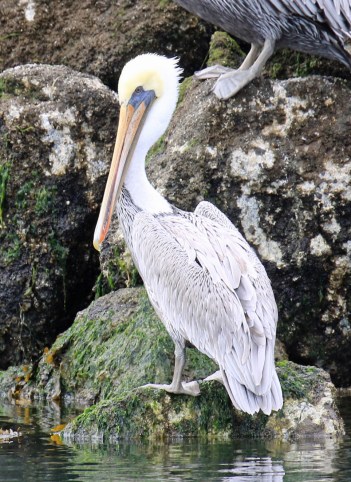
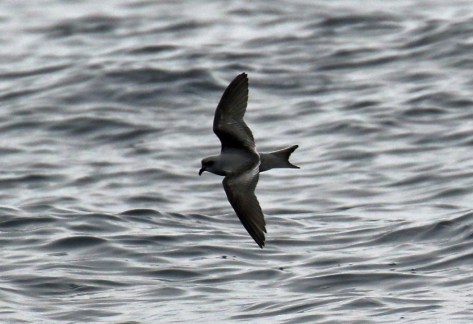
Seas were as calm on this trip as any I can remember. Crossing the bar was a piece of cake and there were essentially no swells or waves the entire way out and the entire way in.  We almost immediately started seeing close in Sooty Shearwaters – continuing our experience from the day before.  Hundreds of Common Murres, some adults with chicks, and in all plumages were seen immediately as well.  Additionally we had the usual large numbers of Brown Pelicans and California Heerman’s and other Gulls.  Also much earlier than usual I spied some small birds floating in the air just above the water – Fork Tailed Storm Petrels – always a treat and this close in – perhaps a good omen.

Brown Pelican

Brown Pelican


Fork Tailed Storm Petrel

Fork Tailed Storm Petrel2

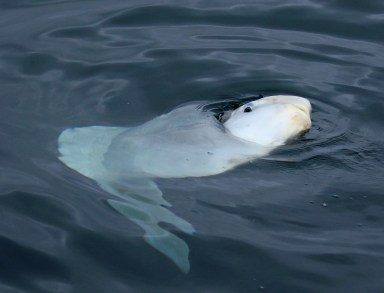
Not too far out we also found our first (and almost only) non-avian treat – a fairly large Mola Mola (Sunfish) swimming on the surface.  I have been on trips where we have seen more than a dozen of these pretty weird fish.

Mola Mola

Mola Mola

We also had some Cassin’s Auklets closer in than usual and lots of Phalaropes – unfortunately all Red Necked.  A striking flock of mostly White Winged Scoters was also fun.

White Winged Scoters (Trailed by a Common Murre)

White Winged Scoters

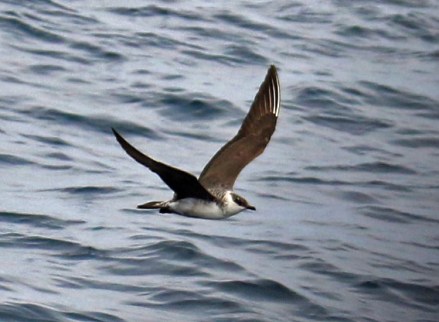
As is often the case, we hit a slow period as we traveled towards deeper water.  We continued to see Cassin’s Auklets and then a number of Rhinoceros Auklets – but no Scripp’s Murrelets which were hoped for by all.  We also had a close fly by from a Pomarine Jaeger.  I wish the focus was better for my photo.  We also had more Red Necked Phalaropes, and a couple of Pink Footed Shearwaters stood out with their white bellies in contrast to the numerous and continuous dark bellied Sooty Shearwaters.

Pomarine Jaeger

Pomarine Jaeger

Captain Phil Anderson had noted that there were some shrimp boats south of us in Pacific County.  These boats are prizes on any pelagic trip as often dozens or even hundreds of birds follow them hoping for scraps. When found on a pelagic trip the close up views and the diverse species and even rarities are treasured.  We saw the boats off in the distance and could tell that there were many birds circling them – adrenaline began to flow.  Phil is a great captain not only because he handles the boat so well but because his years of experience have taught him where to find birds and how to approach them to give his birders the best views etc.  He also has great eyes and identification skills himself.

On the way to the boats I heard a call that was music to my ears “ARCTIC TERN!!”I rushed to the front of the boat just in time to get a few rushed photos.  This has been a nemesis for me in Washington and now I finally had a photo – not a great photo but clearly it was this sought after bird.  It was the 300th species I have photographed in Washington this year and number 397 on my Washington Photo Life List.  YAY!!!

Arctic Tern – Photo 300 for the Year and 397 for my State Photo Life List

Arctic Tern2

As I said not a great photo so I cannot resist again including a very great one from an earlier blog – a breeding plumaged Arctic Tern up close at Machias Seal Island in Maine.

Arctic Tern – Breeding Plumage – Machias Seal Island Maine

Arctic Tern with Fish 2

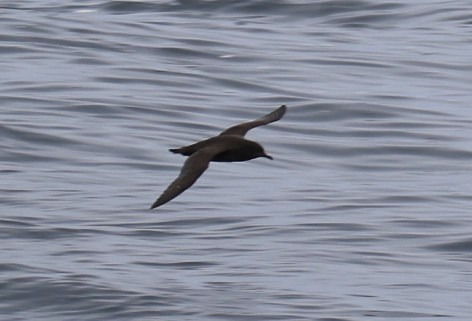
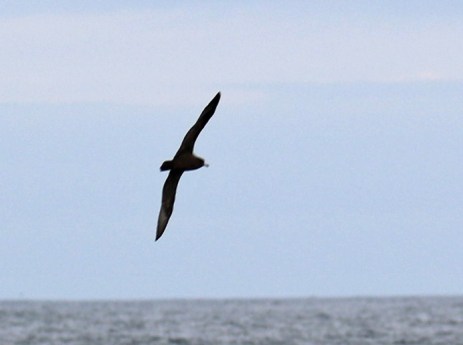
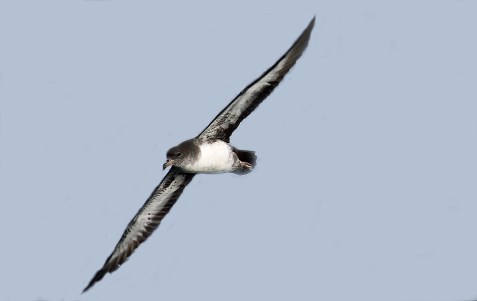
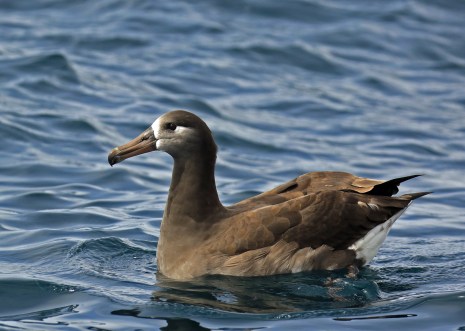
Phil maneuvered us perfectly to the first shrimp boat and we had LOTS of birds.  Lots of numbers and lots of species.  One excellent bird was a Long Tailed Jaeger.  Another was a Short Tailed Shearwater and the very best was a Flesh Footed Shearwater which accommodated the birders with several flights around the shrimp boat its all dark body and pale bill and pale feet easy field marks to see and distinguish it from the other shearwaters.  The Short Tailed Shearwater was not as easy to distinguish as it closely resembles the abundant Sooty Shearwaters, but its thin bill, rounder head and at times visibly shorter tail (with feet extending behind), grayer chin and faster wingbeat were all observed.  More common species included many Pink Footed Shearwaters, Sooty Shearwaters, Northern Fulmar, Sabine’s Gull, more Fork Tailed Storm Petrels and Black Footed Albatross.

Short Tailed Shearwater

Short Tailed Shearwater3

Flesh Footed Shearwater

Flesh Footed Shearwater3

Pink Footed Shearwater

Pink Footed Shearwater2r

Sabine’s Gull

Sabine's Gull

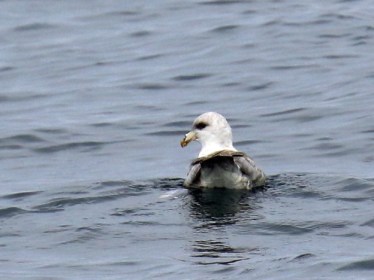
Northern Fulmar

Northern Fulmar

Fork Tailed Storm Petrel

Fork Tailed Storm Petrel4

Black Footed Albatross

Black Footed Albatross1

We changed course and found another fishing boat with more birds but no different species and then in quieter waters Phil and Bill Tweit chummed in some birds and at another time laid out a fish oil slick which brought in more good birds including more than 50 Black Footed Albatross at one time.  At the chum spot we had excellent looks at a Long Tailed Jaeger that circled several times.  Briefly we also had a fly by of a Parasitic Jaeger and more Short Tailed Shearwaters.

Black Footed Albatross at Fish Oil Slick

IMG_20160828_104625110

Long Tailed Jaeger

LT Jaeger4

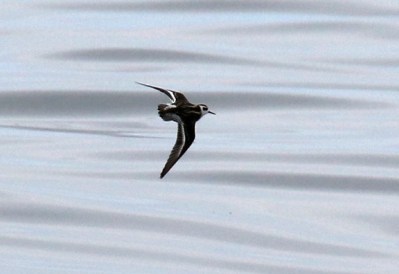
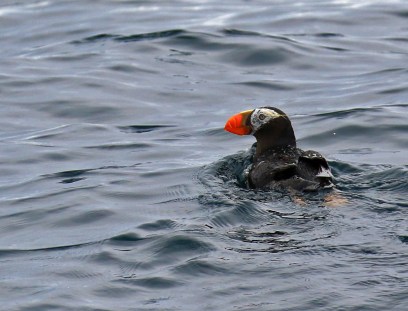
It was time to return to port.  We still had not seen any Red Phalaropes even though the day before they had more than 1300!!  Also no Buller’s Shearwaters – also missed on the earlier trip – a surprise and disappointment.  We remedied the Red Phalarope absence with several groups on the way back – at times mixed with Red Necked Phalaropes.  Best of all we found a single South Polar Skua – completing the so-called Skua Slam with the three species of Jaegers.  A light phase Northern Fulmar was another good bird but we never did see a Buller’s Shearwater nor any Scripp’s Murrelets although we saw many more Common Murres and Cassin’s Auklets and added two more alcids – a single Tufted Puffin and a very close Pigeon Guillemot.

South Polar Skua

South Polar Skua2
South Polar Skua3

Red Phalarope

Red Phalarope3

Northern Fulmar (Light Phased Adult)

Northern Fulmar Light Phase

Tufted Puffin

Tufted Puffin

Cassin’s Auklet

Cassin's Auklet

Pigeon Guillemot

Pigeon Guillemot

As we got closer to Westport we passed through many Sooty Shearwater flocks and off in the distance there was an endless stream of them flying close to the water.  I don’t know how one can count/estimate the numbers of these birds but all agreed that there were more than 35,000 all told and it could have been a large multiple of that number.  We also saw a couple of Wandering Tattlers on the jetty and the large flock of Marbled Godwits circled overhead as we approached our dock.

Passing though a Flock of Sooty Shearwaters

Shearwater Frenzy

It had been another great trip on very calm seas.  Some species were missed but the Skua Slam and both Flesh Footed and Short Tailed Shearwaters more than made up for those misses.  Indeed it was a “Magical Pelagical”.  I added 7 species to my year list for Washington and got photos of them all.  For me at least the bird of the trip was that single Arctic Tern and it no longer will be on either my Want nor Need list for photos in Washington.  But there are others…


A Time for Shorebirds

Each spring and then again each fall the patterns continue:  Millions of birds migrate north to breed and then return south to more hospitable winter homes and then repeat the journeys year after year.  Passerines, waterfowl, raptors and gulls all participate.  I pay them some attention but far less than to the shorebirds that pass through – the regular migrants and especially the rare vagrants that raise the heartbeats of all birders.  I especially love August and September when shorebird migration is at its best – at times lining our shores with thousands of birds – a great variety of species and a great variety of plumages as the striking colors of the breeding season give way to the more drab colors of winter – and everything else in between as the molt continues – adding further challenges to identifying birds that are often only seen in flight, at great distance or in swirling swarms where glimpses may only be momentary.

What Shorebird

Even the plentiful “regulars” bring great joy but admittedly it is the uncommon, the unusual or even the completely unexpected rarity that is the most fun – and is what gets us out tromping into the mud of the Game Range or Bottle Beach or Eide Road or the various sewage treatment plants or drying out lakes and ponds – hoping for something special.

This August has been a good month for shorebirds and I knew I wanted to write something about them but I did not want it to be simply “I went here or there and saw this or that” although some details of my own observations were sure to find their way into the content.  So with the aid of my best friend “Ebird” I decided to look into my observations more analytically and far more accurately than my memory which tends to recall the excitement without the details of place and especially time.  I concentrated only on Washington observations but I did peek at my world lists to see just how significant these species have been in my birding history.  Just for some context, I have seen 47 (or maybe 48 – and more of that at the end of this writing) species of shorebirds in Washington or about 11.4% of my total species seen in state and 117 shorebird species worldwide which is only about 4.4% of my total world list.  While the discrepancy is due in part to the places I have birded worldwide and the times I have been there, the biggest explanation is that especially in avifauna rich areas like the forests of Central and South America and the savannahs of Africa, there is simply far more diversity of non-shorebird species.

When I started my research I expected that I would have seen more shorebird species in the Fall (which I defined as August and September) and fewer in the Spring (defined as April and May) since I thought there were more rarities (mostly with Eurasian affinities) at that time and this proved correct.  Of those 47 species seen in Washington, I saw 45 in the Fall period and only 33 in the Spring.  While some of this may be due to more active looking in the Fall, my experience correlated fairly closely with the general Ebird reporting for others in Washington as well.  I have seen 42 (or maybe 43) species in August and 44 in September.  The only shorebirds I have seen in Washington but not in August or September are Red Necked Stint and Wilson’s Plover – both one time wonders and very rare in our State.

I include pictures with dates and places for all of the shorebirds I have seen and photographed in Washington in the Fall  using photos from August 2016 where I can.  I do not have photos of a couple of species so may borrow from others or mine from elsewhere. Telling all the fun stories from each observation would take too long – maybe some will appear on other blog posts.  Mostly this is my way of showing the diversity of our rich shorebird experience in Washington and my fun in searching for them, observing them and taking their pictures when I can – for August and September each year – A Time for Shorebirds.

The two Non-Fall Observations (but each within 10 days of August /September)

Wilson’s Plover – Midway Beach/Grayland – October 9, 2012
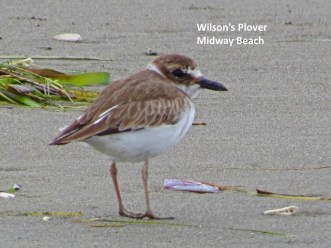
Wilson's Plover

Red Necked Stint – Bottle Beach – July 22, 2013
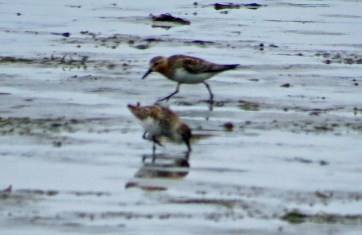
Red Necked Stint at Bottle Beach

Each year is mostly different due to when rarities show up as the core/regular and resident birds can always be seen if you go to the right place at the right time but some of the less common but yet not true rarities birds can be easily missed if you are unlucky or time a tide wrong.  I would include both Golden Plovers, Red Knot (in the Fall) and maybe Red Phalarope in that latter category and might add Bar Tailed Godwit (which has become pretty regular).

Uncommon but Not Rare

American Golden Plover – Tulalip Spit – August 25, 2016
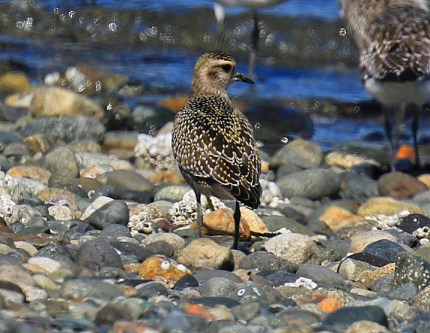
American Golden Plover

Pacific Golden Plover – Oyhut Game Range – September 13, 2011
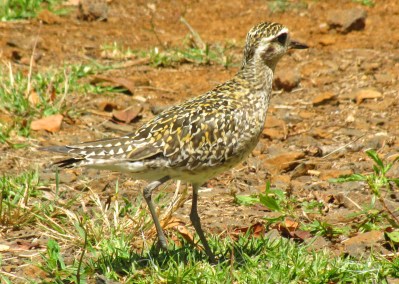
Pacific Golden Plover

Red Knot – Tulalip Spit August 25, 2016
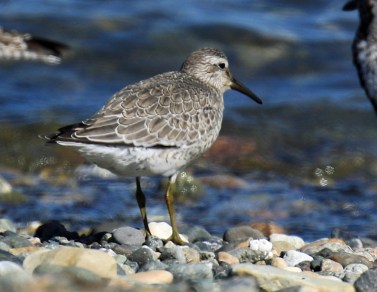
Red Knot 1

Bar Tailed Godwit – Bottle Beach – August 15, 2016
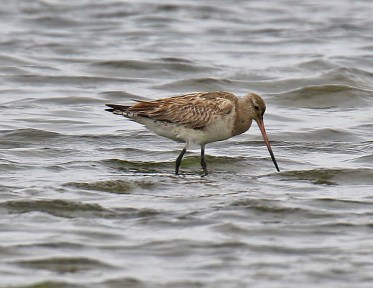
Bar Tailed Godwit2

Probably a notch above those species in terms of regularity or ease of finding them would be species like Stilt Sandpiper, Semipalmated Sandpiper, Wandering Tattler, Willet and Baird’s Sandpiper.  They are readily found in the Fall at the right place and time but may show up as Ebird rarities depending on where they are reported.  Baird’s have been particularly numerous in many places this Fall and it seems that there have been more Stilt Sandpipers this year than in the past.  A Wandering Tattler was an easy and unusual find for Seattle area birders at Carkeek Park this month but are usually found only at rocky outcroppings like the jetties at Westport and Ocean Shores.  Willets are regular at Tokeland but pretty hard to find anywhere else.

Less Common but Regular and Usually Found at the Right Time/Place

Stilt Sandpiper – August 24, 2014 – Eide Road
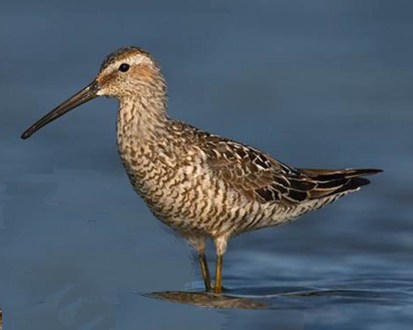
Stilt Sandpiper

Semipalmated Sandpiper – September 2, 2014 – Eide Road

Semipalmated Sandpiper

Wandering Tattler – Carkeek Park- August 22, 2016
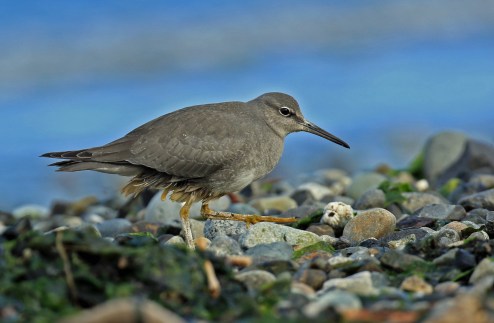
Wandering Tattler 3 Carkeek Park

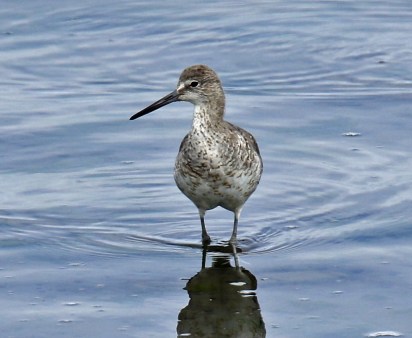
Willet – August 10, 2016 – Tokeland

Willet

Baird’s Sandpiper – August 20, 2015 – Midway Beach
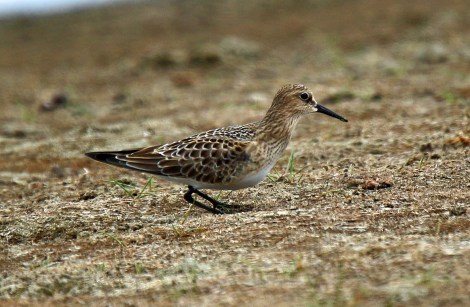
Baird's Sandpiper

At the far end of the spectrum of rarity are the vagrants from Eurasia in addition to the aforementioned Red Necked Stint and Wilson’s Plover (not a Eurasian species) – species like Ruff, Sharp Tailed Sandpiper, Buff Breasted Sandpiper, Hudsonian Godwit (Midwestern not Eurasian) , Lesser Sand Plover and Wood Sandpiper.  Some of these species are seen almost every year in Washington while some others like the Wood Sandpiper are seen maybe just once and only by a few lucky birders.  I was lucky with the Wood Sandpiper found by Ryan Merrill in Skagit County in 2012 but no picture at the time.  I had the good luck together with Tim Boyer to be the firsts to find the nearly full breeding plumage Lesser Sand Plover on the open beach at Ocean shores on August 16, 2015 – much more handsome than the non-breeder seen at Oyhut on September 1, 2013.

Real Rarities 

Ruffs – September 3, 2014 and September 14, 2015 – Oyhut Game Range
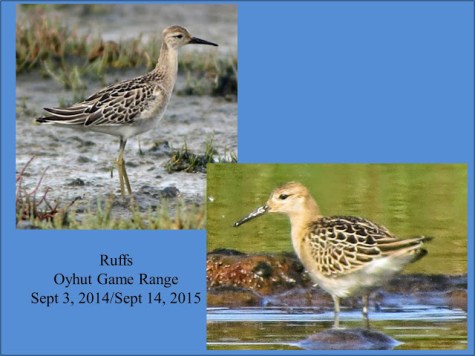
Ruffs

Sharp Tailed Sandpiper (with Pectoral Sandpiper) – Eide Road – September 11, 2012

Pectoral and Sharp Tailed Sandpipers

Buff Breasted Sandpiper – September 7, 2013 – Grayland Beach State Park
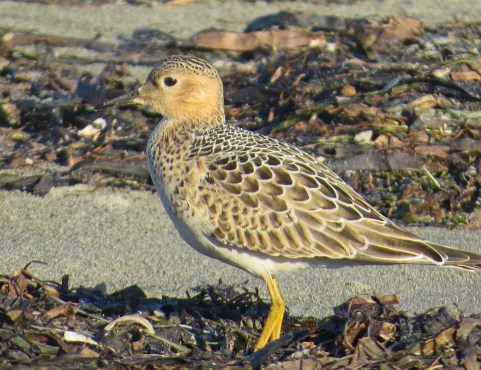
Buff Breasted SP2

Hudsonian Godwit – September 29, 2015 – Ilwaco

Hudsonian Godwit (2)

Lesser Sand Plover – August 16, 2015 -Ocean Shores 
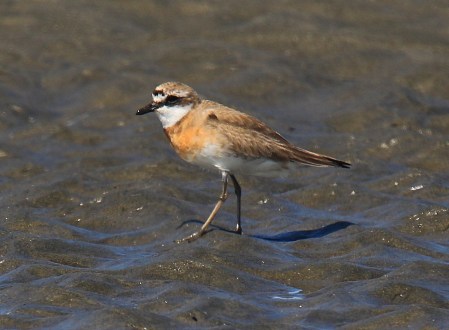
Lesser Sand Plover 5

Although most of the shorebirds in Washington can be found in Western Washington, two beauties are in Eastern Washington almost exclusively – and are major news if on the West side.  These are the Black Necked Stilts and American Avocets that are found in ponds and Sewage Treatment Plants generally east of the Columbia River.  Other birds are with them but these really jump out.  Often these same ponds also have Wilson’s (breeding) and Red Necked (in migration) Phalaropes.  Both of these can be found in Western Washington but more rarely – except on pelagic trips on the Pacific where Red Necked Phalaropes are plentiful in migration and are joined by the much rarer Red Phalaropes – but do appear in Eastern Washington rarely as well.

Eastern Washington Species

Black Necked Stilt – August 13, 2014 – Winchester Wasteway Ponds
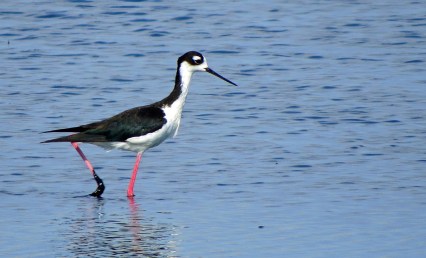
Black Necked Stilt (2) - Copy

American Avocet – August 13, 2014 – Winchester Wasteway Ponds
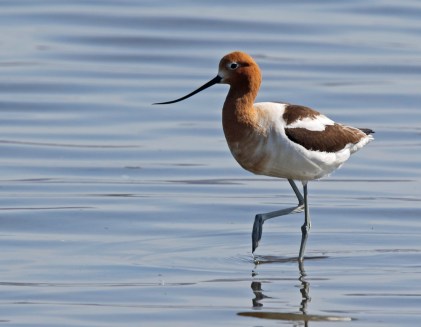
American Avocet2

Red Necked Phalarope – August 12, 2016 – Para/McCain’s Ponds 

Red Necked Phalarope2

Wilson’s Phalarope with Yellowlegs – September 15, 2015 – Soap Lake

Staredown Wilson's Phalarope and Lesser Yellowlegs

Red Phalarope – August 28, 2016 -Pelagic Species on Pacific and sometimes in Eastern Washington
Red Phalarope2

Shorebirds come in all sizes ranging from the smallest “peeps” like the Western, Least and Semipalmated Sandpipers to the largest like the Greater YellowlegsGodwits, Whimbrel and Long Billed Curlew.  In between in addition to many already mentioned are species like the Wilson’s SnipeSpotted and Solitary Sandpipers, Dunlin, Lesser Yellowlegs, Long Billed and Short Billed Dowitchers, Sanderlings and the common Plovers – Black Bellied, Semipalmated and Killdeer. All are regular, widespread and common in season.  The Snowy Plover also belongs in this group but is endangered and limited to a few areas of open beach…regular but can be hard to find.

The “Peeps”

Western Sandpiper – August 21, 2011

Dueling Western Sandpipers

Least Sandpiper – August 10, 2016  – Tokeland

Least Sandpiper2

Semipalmated Sandpiper (pictured earlier above)

Other More Common Shorebirds

Wilson’s Snipe – August 27, 2014 – Ridgefield NWR

Wilson's Snipe

Greater  and Lesser Yellowlegs – August 5, 2015 – Eide Road
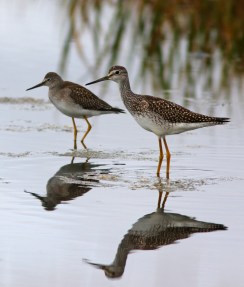
Greater and Lesser Yellowlegs

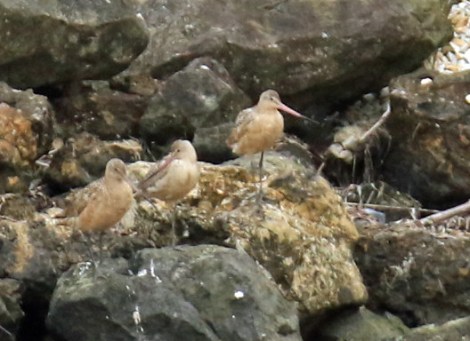
Marbled Godwit (Top Left) and Whimbrel (Lower Right) with Willets – August 20, 2016 – Tokeland

Willet Godwit and Whimbrel

Long Billed Curlew – September 4, 2015 – Bottle Beach
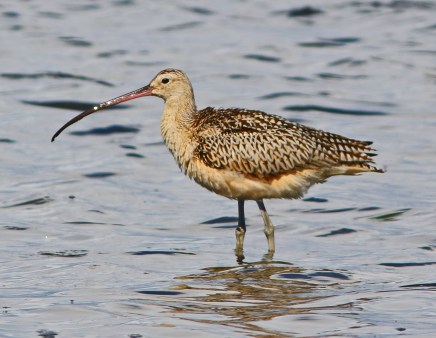
Long Billed Curlew 2 Bottle Beach

Spotted Sandpiper Juvenile – September 10, 2015 – Neah Bay

Spotted Sandpiper Juvenile

Solitary Sandpiper – August 26, 2016 – Wiley Slough

Solitary SP Wiley2

Dunlin – September 14, 2015 – Oyhut Game Range
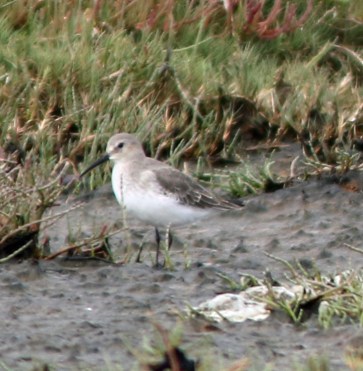
Dunlin

Long Billed Dowitcher – August 1, 2014 – Wylie Slough (More common inland)
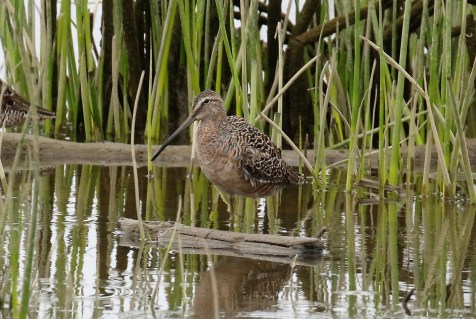
Long Billed Dowitcher1

Short Billed Dowitcher – August 27, 2016 – Bottle Beach (more common on the coast)

Short Billed Dowitcher

Sanderling – August 10, 2016 – Open Beach Midway

Sanderling

Black Bellied Plover – August 15, 2016 – Bottle Beach

Black Bellied Plover Flight

Semipalmated Plover – August 15, 2016 – Bottle Beach

Semipalmated Plover

Snowy Plover – Grayland/Midway Beach

Snowy Plover

Killdeer – August 16, 2015 – Oyhut Game Range
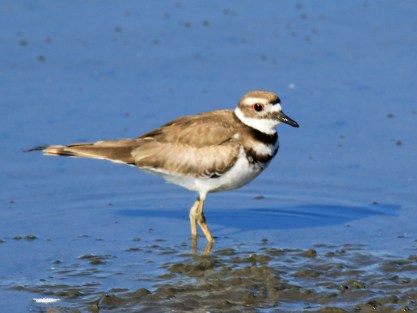
Killdeer

Another grouping of shorebirds that are regularly seen in August and September are the so-called “Rock Pipers“.  These birds are usually found along rocky shores or on log booms in salt water.  They include the Wandering Tattler already pictured above and Surfbirds, and both Black and Ruddy Turnstones.  Rock Sandpipers are in this group and usually come later although I do have a single September record.  I am also including the striking and much larger Black Oystercatcher – not really a Rock Piper – but generally found on rocky shores.

The “Rock Pipers”

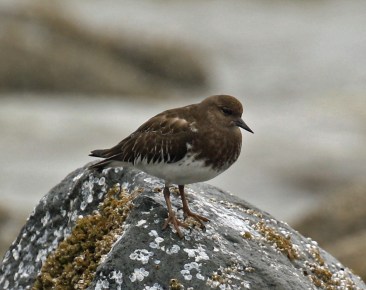
Black Turnstone – August 27, 2016 – Point Brown Jetty
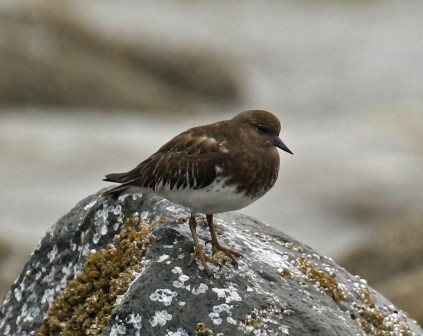
Black Turnstone

Ruddy Turnstone – August 27, 2016 – Point Brown Jetty
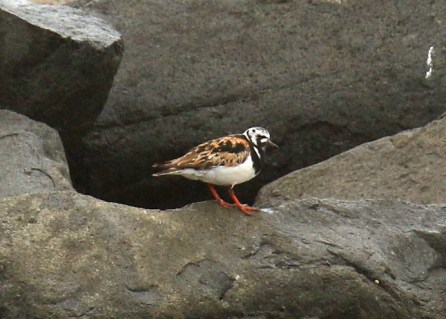
Ruddy Turnstone

Surfbird – August 20, 2011 – Three Crabs – Sequim
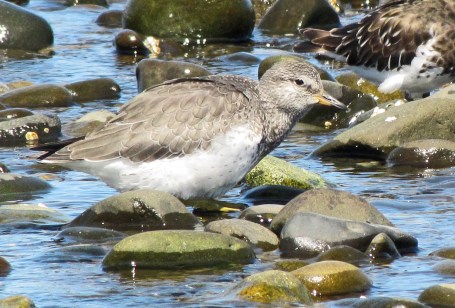
Surfbird

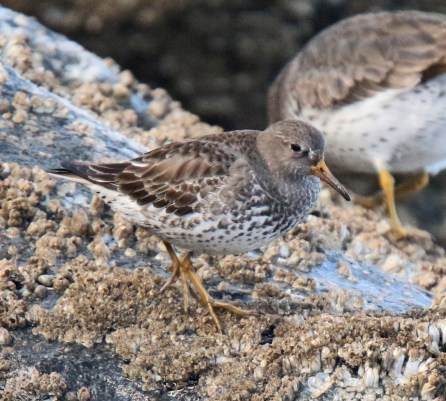
Rock Sandpiper – No photo from August or September so I am using one from February 2014 – from the Point Brown Jetty (but I saw one at the same location last year on September 14) 
Rock Sandpiper1

Black Oystercatchers – September 10, 2015 – Neah Bay

Black Oystercatchers

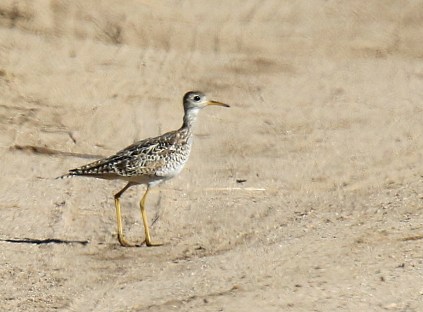
There are two more species of shorebird that I have seen in Washington in August or September but sadly have no pictures of them from the state.  One is the Upland Sandpiper which I saw with Dennis Paulson as a flyover on the Oyhut Game Range on September 6, 2013.  I include a picture I took of one at the Kennebunk Plains in Maine in June 2015.  The other is the aforementioned Wood Sandpiper – a “mega” rarity that is common in Africa and Asia and quite a find as a vagrant in far western Alaska.  One was seen on Adak the week I visited this spring but sadly I was not able to see it and take a photo so the picture is from my South Africa visit in 2014.

Missing Photos from Washington – Two Rarities

Upland Sandpiper – Photo from my Maine Trip  – June 20, 2015 – Kennebunk Plains
Upland Sandpiper2

Wood Sandpiper – October 15, 2014 – My South Africa TripWood Sandpiper

And ah, yes there is one more – well maybe there is and maybe there is not.  Here is the story: On August 2, 2012 I was birding on the coast and in the morning drove the open beach near Midway – a favorite place and one that is the location for some of the photos above.  I was primarily looking for Snowy Plovers which I did not find that day.  However, there were many birds on the beach including a larger than usual number of Whimbrels (12) and many of the more common birds like Semipalmated Plovers and Western Sandpipers and Sanderlings.  I met a woman who worked for the Washington Department of Fish and Wildlife and we chatted for a while next to some logs on the upper beach.  She monitored the Snowy Plovers in the area (their breeding area in the dunes is roped off and protected)  and we had a fascinating chat.

We casually paid attention to the shorebirds along the surf but my  focus was on her Snowy Plover wisdom.  Suddenly all hell broke loose and all of the birds nearby took off.  This is usually initiated by a Peregrine Falcon flying by.  This time there was no falcon but a Parasitic Jaeger, another bird that preys on small shorebirds, flew past – the danger that set the birds to flight.  Although it was admittedly a fleeting view, we clearly noted that one of the birds in the groups was “different”.  Not all field marks were processsed but this one bird was notably larger than the Western Sandpipers and had what appeared to be a gray back and MOST importantly a WHITE RUMP.  At the time I had no idea what it was or could be or what else to look for but that white rump was unmistakable and the size was noticeably if not significantly larger than the Western Sandpipers that flew off with it – but without the white rumps.

I submitted it as a White Rumped Sandpiper on Ebird and not surprisingly it was rejected as insufficient description and of course no photo. I would like to think that if the same thing happened today I would be more attuned to details and I most likely would have a photograph as I have learned how they are not just records that I can enjoy over and over and share but also can be used to identify a bird and often to change an initial impression to something else when the captured field marks can be more closely examined.  So what was that bird?  Sure it is possible that the rump may have appeared more white than it actually was – but it was an overwhelming detail as it flew – as distinctive as the wing pattern of a Willet in flight for example – it just jumps out at you.  If indeed that rump was white as “observed” then the only two possibilities are White Rumped Sandpiper and Curlew Sandpiper.  Either is incredibly rare in Washington.

Since that time I have had the opportunity to observe a Curlew Sandpiper in South Africa. The gray back and white rump certainly match my memory but I would like to think I would have seen and noted the clearly curved and longer bill.  So maybe I did and maybe I didn’t see a White Rumped Sandpiper or even a sandpiper with a white rump that day now more than 4 years ago.  Tell you one thing – if there is a next time, the camera will be ready.

Sandpipers with White Rumps

White Rumped Sandpiper (Photo by Mike Fahay)

White-rumped Sandpiper Flying Showing Rump 1 MF_2

Curlew Sandpiper – October 7, 2014 – My South Africa Trip

Curlew Sandpiper (2)


So there it is – the wondrous migration of shorebirds in August and September – all 48 (or 47) of the ones I have been fortunate to see.  This August has been a pretty good month for shorebirds already as well – 35 species seen.  As stated above, there seem to have been more Stilt Sandpipers and Baird’s Sandpipers reported from all over the state than I can remember in past years.  I have seen 13 different Baird’s Sandpipers in 6 different locations and at least 5 different Stilt Sandpipers in 3 different locations.  I know of other observations of both species elsewhere.  So far no Ruffs or Buff Breasted Sandpipers and no Hudsonian Godwits or Sharp Tailed Sandpipers.  An early Rock Sandpiper was reported from the jetties at both Ocean Shores and Westport, but I was unable to find it.   And too many people were on Midway Beach when I was there so no Snowy Plover either although I saw and photographed some in the Spring.  But September will be here in another two days – and hopefully all of these little beauties will appear and be enjoyed.  Maybe something really special will come in as well.  I am thinking a Terek Sandpiper would be really nice.

Terek SandpiperSomeday if I Am REALLY LUCKY!!

Terek_Sandpiper_h42-4-125_l_1

Don’t get stuck in the mud!!

August 31, 2016 – Addition to the Blog Post

An addition to this blog – I almost went up to Vancouver, B.C. today – encouraged by Melissa Hafting – a wonderful birding friend and resource who was on my recent pelagic trip.  Melissa knows more about what is going on with birds in B.C. than anyone – and frankly often knows about our Washington bird reports before I do – and she shares all of this information openly.  She told me of 4 Buff Breasted Sandpipers and a Ruff that were being seen regularly at Boundary Bay – a wonderful birding spot across the border.  Her pictures are included below – so gorgeous as are all of her photos.  I just could not get it together to make the trip today (August 31).  It would be great to see the birds and get photos and add to my August 2016 Shorebird Species list – BUT – not in Washington even if close and besides she just sent me a note that it is raining there.  May not affect the birds but it does affect the birding.  But the photos are so nice I thought I would make this addition – and thank Melissa for all of her help and support.

Ruff – Boundary Bay B.C.  – Photo by Melissa Hafting

Ruff from Melissa

Buff Breasted Sandpiper – Boundary Bay B.C.  – Photo by Melissa Hafting
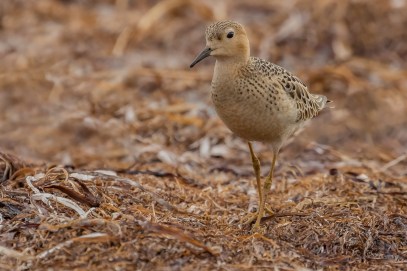
Buff Breasted Sandpiper from Melissa


Guess its A Time for Shorebirds in B.C. as well.  Hope these guys head south for a stop soon!!


Definitely a Laughing Matter at Bottle Beach

This has been an incredible week.  Starting with eight Willets at Tokeland and six Wandering Tattlers at Westport, then a Short Eared Owl and Prairie Falcon on the way to the Scissor Tailed Flycatcher on Highway 24 that was kind enough to fly into and be observed in two counties followed by hundreds of Eared Grebes at Soap Lake and a Clark’s Grebe at Lind Coulee.  Later I got a photo of a Stilt Sandpiper at Wylie Slough to replace the ones lost on a missing SD Card.  That would be quite a week by any measure.

Stilt Sandpiper – Wylie Slough – a “Make Up” for a Lost Photograph

Stilt Sandpiper

But those birds and fun trips were just a prelude to today’s spectacular visit to Bottle Beach.  Over the weekend a Laughing Gull was photographed there by Steve Giles and reported by others.  One had been observed there some months ago as well.  Like the aforementioned Scissor Tailed Flycatcher I had seen this species in Texas and elsewhere but never in Washington.  And if that was not sufficient motivation for a visit, a Bar Tailed Godwit was also being seen there – possibly the same bird seen at the Coast Guard Station in Westport or perhaps a second bird.  I had seen one in breeding plumage in Alaska this spring but Jon, Fran and I had looked for and not found one at either of the Washington locations on our earlier trip.

Laughing Gull – Texas April 2013

Laughing Gull

Bar Tailed Godwit – Nome Alaska June 2016

Bar Tailed Godwit1

I had meetings in Everett this afternoon and a dental appointment tomorrow and high tides were not optimal, so I wondered how I could swing a trip.  The answer came when I awoke early this morning and could not get back to sleep so I headed out at 5:00 a.m.  Actually too early for the tides but a great way to avoid traffic and also to fit in a stop at the Hoquiam STP.  There were almost no gulls at the STP but some good mud in the third pond had some shorebirds, the best of which was a Baird’s Sandpiper.  There have been more reports of this species this year than I remember from years past.

I arrived at Bottle Beach at about 8:00 almost 4 hours before high tide.  I checked the gulls at the pilings where the Laughing Gull had been seen and saw only Ring Billed Gulls.  I also found a group of 6 Semipalmated Plovers, a bird I had not seen there or on the open beach in my last visit to the coast.  There was plenty of time to explore so I went pretty far south where there were hundreds of birds – primarily Western and Least Sandpipers and Black Bellied Plovers.  There were also scattered Short Billed Dowitchers in varying plumages – including a few in near breeding colors.  I thought I had seen a Red Knot but could not get a close look and it was more likely another Dowitcher although the bill seemed short.  There were also two Ruddy Turnstones in breeding plumage.

Semipalmated Plover

Semipalmated Plover

I had now been there over an hour and I was freezing.  With all the hot weather we have had in Puget Sound and in Eastern Washington, I wrongly assumed the same at the Coast and checked only on tides.  A marine layer kept temperatures in the 50’s and a stiff wind made it feel much cooler.  My extra layer left in the car would have been very welcome.  I had expected more birders at Bottle Beach given the great birds reported.  Finally about 9:15 two more birders arrived and shortly thereafter a third.  The first two – Jason Vassallo and Paul Baerny had also been the next to arrive when Frank, Ann Marie and I relocated the Scissor Tailed Flycatcher and I had seen Paul the day before at Wylie Slough where we each independently found the Stilt Sandpiper. The third to arrive was Whittier Johnson.  We definitely had some good birding eyes to look for our birds.

For the next 45 minutes we unsuccessfully searched the MANY Black Bellied Plovers for a Golden Plover and the MANY peeps for a possible Red Necked Stint and the occasional godwits for a lighter one making it our Bar Tailed – but we found only a few Marbled Godwits. And of course we continued to check the gulls by the pilings – but our prize was not to be found.  None of us saw it fly in but at almost exactly 10:00 I checked the pilings again and shrieked that “IT’S THERE!”  A bit smaller than the Ring Bills, with a dark mantle and even darker wing tips, dark legs and a dark thick bill, a white head with a small smudge and crescents above and below the eye, the Laughing Gull had made its appearance.  Perhaps it had been hidden behind a piling but I thought we had searched thoroughly, diligently and often.  Nobody cared about from whence or when it came.  It was gloriously there now and easily observed and photographed.  It was a new state life bird for everyone there – the crowd now grown to perhaps a dozen with the arrival of Bob Morse, Keith Brady, Neil and Carleen Zimmerman and others. WOW!!

Laughing Gull – My First in Washington – as First Seen with Ring Billed Gull

Laughing Gull with Ring Billed Gull

Laughing Gull Posing for Photos

Laughing Gull1

This was my second new state lifer in less than a week (the Scissor Tailed Flycatcher was the other.)  Another adrenaline rush and I even forgot how cold it was.  There was celebration all along and the gull stayed with its cousins in the pilings and drew most of our attention.  Jason, with the youngest eyes, continued the search for the Bar Tailed Godwit and not too many minutes later, he had located it pretty far out at the water’s edge. It was near a few Marbled Godwits, quite a contrast in color.  It was interesting to observe too that it fed constantly while the Marbled Godwits fed only occasionally if at all.  Not the brilliant breeding plumage I had seen in Nome, but quite distinctive and a second celebration was in order when spied.  We were able to move quite a bit closer for decent photos even though the light was poor. WOW again!!

Bar Tailed Godwit

Bar Tailed Godwit

This is the seventh time I have had this species in Washington and the second time at Bottle Beach.  Not quite the thrill of the Laughing Gull but a wonderful bird anytime.

The Laughing Gull is named after a quality of one of its calls – and rightly so.  We did not hear any laughs at Bottle Beach this morning from the Gull but there were many smiles and chuckles and maybe even a laugh or two from some very happy birders.

What a week!!!
Making Lemonade out of Lemons

We were on a mission – find the Scissor Tailed Flycatcher that John Puschock had reported on Highway 24 near Othello on August 10.  Earlier this year I spent three hours at Marymoor Park hoping to find this species that had been seen by one observer the previous day – I missed it as did 20+ other birders who searched in vain.  But this time was going to be different – we knew it.  John had included a picture so the bird was definitely real.  It had been seen the next day (when I was at the Coast) by Charlie Desilets in the morning and by Stefan Schlick in the evening.  So it seemed to like the area and just maybe it would be waiting for Ann Marie Wood, Frank Caruso and me when we arrived.  We were in a hurry – we were going directly there – a single pit stop our only planned diversion.

BUT…in my haste and focus on getting to the appointed spot, I neglected to pay attention to my gas gauge and less than 15 miles from Ground Zero, the warning light told me I had an issue – only enough fuel to make it 35 miles – enough to get to what we hoped would be “our bird” but not enough to then get to the nearest gas station which would be at least 30 miles from there.  We had no choice – we had to back track 14 miles to Mattawa to the nearest gas station – precious time wasted.  Would these moments prove critical.  On a chase these things happen. LEMONS!!!
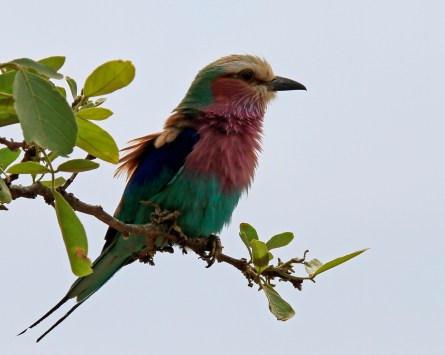
About half way back to Mattawa an unexpected but familiar form flew by – a Short Eared Owl unmistakable with its moth-like flight – a complete surprise and a new county bird for Ann Marie – for whom such things greatly matter – and for me as well – I keep track but do not obsess – as I certainly have more than sufficient obsession about year and life state birds and photos.  This helped relieve my guilt and feeling of stupidity a bit but not much.  We got gas, used the facilities and then retraced our steps towards what we hoped would be a bird with a very long tail that was not a Black Billed Magpie.  Surprise Number 2 – a Prairie Falcon sped by giving a fleeting but decent look.  Maybe these were omens – a hint of LEMONADE.

Tension mounted as we approached Milepost 68 and could see telephone poles and wires ahead – the first in many miles.  This is where the bird had first been seen although miles from the location in one of the Ebird reports.  We had already seen many Western Flycatchers and now we saw a couple more on the wires.  John Puschock had reported the Scissor Tail in the company of Western Flycatchers.  We just need one with those two long tail feathers.

Western Kingbird

Western Kingbird

We were ready and then – “THERE’S OUR BIRD!!!” I shouted as a bird flew over the car from the left – VERY LONG tail feathers clearly trailing.  I pulled off the road immediately and we got out of the car and watched it fly off to the east and land on the wire ahead.  We followed and got clear and unmistakable views and  a few photos.  For the next 20 minutes we watched as this beautiful bird – a new state bird for all of us – flew east and west from the wires between telephone pole 5 and 11 along Highway 24.  Although we did not note the significance at the time we also watched as it crossed Highway 24 and flew south on at least two occasions – at least 150 feet into the sagebrush. In great light and at times quite close we photographed the bird on the wire and I got some photos of it in flight south of Highway 24.

Scissor Tailed Flycatcher (Perched on wire North of Highway 24)

Scissor Tailed Flycatcher2

Scissor Tailed Flycatcher in Flight (South of Highway 24)

STFL in Flight South of Hwy 24

As it turned out this North/South business matters because Highway 24 is the boundary between Franklin (South) and Adams (North) Counties.  So this wonderful bird cooperated not just in remaining where first located and in posing for photos in good light but also in flying back and forth across the road allowing for county records (the first for each) in both Counties.  As Ann Marie said (beaming I am sure) – a “twofer”.

After a few moments we were joined by Paul Baerny, Jason Vassallo and John Guthrie who got the same terrific views.  So six westside birders shared a most wonderful eastside experience.  Now there was no doubt – this was real LEMONDADE!!  And a real adrenaline rush for all of us.  Along with an Upland Sandpiper, the Scissor Tailed Flycatcher had been one of my gotta birds on a trip with Samantha Robinson to Texas in 2013 – easily found there but never expected in Washington.  I thought about an earlier blog post – “You Can’t Always Get What You Want” – and this day would add – but damn, when you do – what a mighty fine feeling.  Oh Yeah!!

Scissor Tailed Flycatcher in Full Breeding Splendor in Texas 2013

Texas Scissor Tail

Upland Sandpiper

Upland Sandpiper2

It was not yet 10:00 a.m. Even with our success and giddiness we had traveled too far to call it a day so we headed off to Para Ponds.  We found not a single Blackbird so the search for a Tricolored Blackbird was moot.  What we did find were many Eastern Kingbirds, Two Red Tailed Hawks, a couple of Black Necked Stilts, a Greater Yellowlegs, some Least Sandpipers, a couple of Killdeer and most importantly two Baird’s Sandpipers (distant), a small flock of Red Necked Phalaropes and numerous swallows including many Bank Swallows.

Red Necked Phalarope

Red Necked Phalarope2

Red Necked Phalaropes in Flight

Red Necked Phalaropes in Flight

Red Necked Phalaropes in Flight Reflection

We continued on – stopping at Lind Coulee to look for a Clark’s Grebe at a spot where I have had good luck finding them in the past including a great view last year with Brian Pendleton of a Clark’s Grebe immediately  adjacent to a Western Grebe – differences clearly apparent.  This would be a year bird for both Frank and Ann Marie.  It took a lot of looking and it was not the greatest look but the ONLY grebe we found indeed was a Clark’s Grebe – more lemonade.

Clark’s Grebe and Western Grebe at Lind Coulee (from 2015)

Western and Clark's Grebes

Earlier Jason and Paul had told us of an Ebird report from Matt Yawney that included a Stilt Sandpiper and 300 Eared Grebes.  I had forgotten to get a photo of an Eared Grebe earlier in the year and it would again be a new year bird for Frank and Ann Marie so we headed off to Soap Lake.  It was getting warm and this is NOT the most scenic part of Washington, but birders are used to such and we arrived at Soap Lake ready for more good birds.  We got them – well sorta got them.  There indeed were many Eared Grebes – mostly still in their dark breeding plumage – probably at least the 300 reported by Matt.  But they were all distant – in the middle of the large lake – viewable through the scope but the photos qualify as ID quality only.

Eared Grebes on Soap Lake

Eared Grebes

We did not find a Stilt Sandpiper – only a couple of Spotted Sandpipers – and in fact found little habitat that seemed shorebird friendly at all – but we did not find good access points and could well have missed out in our unfamiliarity with the area and besides by now it was unpleasantly hot and it was time to head back home.

A stop at the Winchester Wasteway along I-90 found no birds.  We made a last stop at Silica Ponds near George and almost on my cue a single Yellow Headed Blackbird visited for a few moments.  Traffic back to Edmonds was tolerable even with a few inexplicable slowdowns and we returned both safe and very happy.

The gas crisis lemons were long forgotten but we definitely did not forget the “Lemonade” that followed – especially the magnificent Scissor Tailed Flycatcher.  How appropriate to find lemonade on a hot summer day!!

Lemonade


Hits and Misses

Jon Houghton, Frank Caruso, Sherrill Miller and I had a fun day birding yesterday – August 10.  Like many such days we missed some of the birds we hoped to find and we found some other so called targets and also had some other birds that were nice additions.

Our first quarry was a Mountain Quail – never easy except when coming to Mary Hrudkaj’s feeders.  Mary had given us a lead on a possible spot and we headed there first.  Unfortunately I had forgotten to bring my Garmin and phone reception was bad so we could not access directions via Google Maps so we lost a lot of time and never did get to the new area.  We did spend a lot of time at the Port Orchard Quarry where I had a Mountain Quail last year and drove Blacksmith Tahuya Road – lots of good habitat but no quail for us.  At the Quarry there were numerous Turkey Vultures.  We never saw a carcass but there must have been something appetizing (to them) around.

Turkey Vulture

Turkey Vulture

.Mountain Quail (2014 Photo from Mary’s)

Mountain Quail

Not a great start but we had much more to look for and headed off towards the coast where our first stop was the Hoquiam STP.  As written up in an earlier blog, I had a Franklin’s Gull there om July 25 and it has continued to be seen.  But no such luck this time as the only small gull we found was a non-breeding plumage Bonaparte’s Gull.  There was very little mud and no shorebirds.  So now we were 0 for 2 on our targets.  But it was a beautiful day and still lots of birding ahead.

We opted to bird the “Westport” side and thus retraced the unpleasant drive back through Hoquiam and into Aberdeen before heading south.  Sure would be nice to bypass those two towns – sad reminders that the boom times around Seattle have not been felt everywhere in our state.  Coastal birding plans are dictated in large measure by tides and high tide was to be at 6:40.  We wanted to be at the Coast Guard Station at Westport then and wanted to include some beach driving, a visit to Tokeland and also Bottle Beach.  Over the years I have learned that it is best to be at Bottle Beach on an incoming tide and to be there at least 2 hours and maybe even 3 hours before the high tide.  Accordingly we planned to drive the beach at Midway/Grayland then go to Tokeland, then to Bottle Beach and then to Westport.  It all worked out pretty well.

The open beach is always fun.  It was the first time Sherrill had been in the area so much was new.  While we did not find any Snowy Plovers and surprisingly also found no Semipalmated Plovers either, a real treat was the constant stream of Sooty Shearwaters not too far off the coast.  I have seen them there many times – always heading south.  This was a life bird for Sherrill- very cool.  We had hundreds of Sanderlings in varying plumages and many Least but no Western Sandpipers.

Sanderling

Sanderling

Sherrill and Frank at Midway Beach

Frank and Sherrill

Sooty Shearwaters – streaming South just off Grayland Beach

Sooty Shearwaters

Nothing real exciting but Frank yelled out that he glimpsed what he thought might be Black Turnstones flying by.  Fortunately we got a better look and they even stopped just ahead of us – two Ruddy Turnstones and when they moved up towards the dunes we found a single Whimbrel as well. Not the best focus but I got a fun photo of the Whimbrel with its very long wings extended up.

Ruddy Turnstone

Ruddy Turnstone

Whimbrel with Extended Wings

Whimbrel Wings

Time to head south and we checked the many gulls and terns at North Cove hoping for something special – but exclusively Heerman’s, Ring Billed and California Gulls and lots of Caspian Terns.  Probably a little early still for Elegant Terns – hope they are more plentiful than last year.

Approaching the Tokeland Marina always kicks up the heartbeat – will the Willets be there or not.  Definitely the best spot in Washington for these birds, I had one there last month but the only photo I got then was of the Peregrine Falcon that timed its flyover to the exact moment I arrived and it chased off the Willet and the hundreds of Heerman’s Gulls that were present.  This time the bird gods made amends as not only was there great light but also 8 Willets.  They were joined by a single Marbled Godwit and a single Whimbrel and there were both adult and juvenile Least Sandpipers on the other side of the road. This is also a good spot for Elegant Terns but only Caspian Terns were present – with Ring Billed and Heerman’s Gulls.  Also present and noisy were numerous Purple Martins.

Willet

Willet2

Least Sandpiper

Least Sandpiper2

Willets, Whimbrel and Marbled Godwit

Willet Godwit and Whimbrel

It was time to head to Bottle Beach ahead of the incoming tide.  While there had been some cloudiness earlier in the day and on our open beach drive, it was now blue skies and warm temperatures.  The light had been great at Tokeland and remained so for the rest of the day.  When we hit the beach, our timing appeared perfect – lots of shorebirds maybe 100 yards out and the tide was starting to push them in.  I have had many wonderful birds at Bottle Beach over the years including rarities like Red Necked Stint and both Bar Tailed and Hudsonian Godwits.  Today it was just the “regulars” and not even all that many.  Lots of Black Bellied Plovers (I have had both Golden Plovers here in the past), Least and Western Sandpipers, a Greater Yellowlegs and a few Short Billed Dowitchers.   And again no Semipalmated Plovers.

We waited for more birds to arrive but none did so we headed off to Westport hoping for that Bar Tailed Godwit.  One had been seen there on August 6 but the Ebird report had not come in until August 9 and we hoped the passage of the three days would not matter.  When we got to the dock near the Coast Guard Station we found the typical raft of hundreds godwits and had fantastic light to search for a smaller bird that was grey and not tan.  All four of us went over every bird several times for more than 30 minutes and unfortunately all were Marbled Godwits – beautiful birds but not the treasured rarity.  I suggested we head off to my favorite Wandering Tattler spot – hopefully find one and then return to look through the godwit flock again.

Marbled Godwit Flock (only a small portion)

Marbled Godwits

As uncooperative as the godwits had been, my favorite Tattler spot produced immediately and fantastically.  Our first look produced 4 Wandering Tattlers on the rocks on one of the groins and then two more in stunning light very close on the rocks just below us at the observation platform.  I have never had more than 3 Tattlers at one time before (at this same spot last month) so these six were a real surprise.  They were also either life or year birds for the others in the group and there could not have been better looks.

Wandering Tattler

Wandering Tattler1

This proved to be a really good spot for other reasons as well.  Not more than fifty feet off shore was a Common Murre preening and posing for us and further out by the red buoy a Humpback Whale was spouting and diving continuously for the 30 minutes we were there.

Common Murre

Common Murre2

Humpback Whale

Humpback Whale

We returned to the Coast Guard Station and all the Godwits were still Marbled.  Maybe next time.  But the light was perfect for some nice Brown Pelican photos – there were hundreds on the breakwater and flying about.

Brown Pelican

Brown Pelicans

Brown Pelican in Flight

Brown Pelican Flight

So there were some hits and some misses – but two definite additional hits were the dinner that followed at Bennett’s and the great company on the trip.  It also helped that we could listen to the Mariner’s win another game – sixth in a row – on the radio on the long drive back to Edmonds.