One Very Good Day – Three Mini-Posts

July 2, 2017 – This was a VERY GOOD DAY!!  The day before I had been birding in Pend Oreille, Lincoln and Spokane Counties and another blog post will share some of that experience – also a good day – but not as good as this one.  A prelude and then three separate fun experiences – each deserving of its own post – but each is pretty short so I am doing three mini-posts as part of this one.  But first – the prelude.

Prelude – A Night Bird in the Daytime

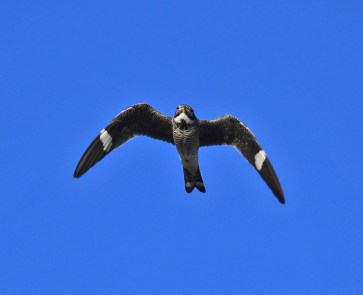
I had spent the night in Ritzville and for the first time in a while, I delayed departure in the morning until after the breakfast that was included in the rate.  I was heading to the Blue Mountains east of Walla Walla and would have preferred to get there not long after dawn, but I was already tired from too many miles.  Fortunately breakfast was available early and I was on the road by just after 6:15 a.m.  This brought me into Washtuchna just before 7:00 a.m.  A remote spot for sure, it has been a great place for rarities in migration.  Too late (or early) in the year for that now, but a fun surprise was waiting for me.  It was already 68 degrees in perfect cloudless sunshine.  As I drove through town a medium sized bird with long pointed wings flashed in front of me.  My first thought of American Kestrel was quickly replaced with a most positive identification of a Common Nighthawk when it banked right in front of me and the two white wrist bars flashed in the sunlight.

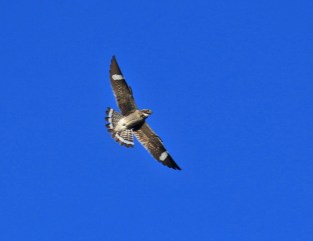
I pulled over, got out of the car and got my best photos ever of a Common Nighthawk in flight including the only one I have showing the tail splayed out showing the black and white terminal bands. I had seen them in the daytime before – but never this early in the morning.  It  sure seemed like a good omen for a great day.  Definitely a great prelude!

Common Nighthawk – Flight Shots

Common Nighthawk Flight1 - Copy  Common Nighthawk Flight - Copy

Common Nighthawk Flight2 - Copy

PART I – “When You Come to a Fork in the Road – Take It…”

This famous statement is generally attributed to Lawrence Peter Berra – better know as Yogi Berra.  He said he used it in giving Joe Garagiola directions to his home.  I decided to take this advice when I came to the end of Coppei Road just south of Waitsburg, WA.  The fork I chose was the North Fork Coppei Creek Road instead of the South Fork.  I had birded both in the past but my primary target this morning was a Green Tailed Towhee and I had seen them on this road before, so the choice was clear.  It is easiest to find this secretive bird earlier in the year when it is singing which it is not supposed to be doing now.  But its preferred habitat of a brushy slope with a rose like bush is a good place to start and I went to the exact spot where I had seen one before and immediately heard the Towhee’s buzzy trill and there went that supposition.  I tried some playback to see if I could get the bird to come into the open and closer to the road.  A second bird responded and the two continued to sing.  One flew from one buried hiding spot to another giving me a quick view, but that was going to be it.  I was still a very happy birder as it was not a given that a Green Tailed Towhee would be found.

Green Tailed Towhee (same area in 2015)

Green Tailed Towhee Singing

This was a great start.  Would my good fortune continue and another special bird of the area be found?  That would be the Great Gray Owl – now dispersed from its nesting sites so not likely but I had to continue the route and try.  No Great Gray Owl but I did have a “great owl” experience.  Birders often use the call of the Northern Pygmy Owl to bring in other species  – small birds that seek to mob the little owl – a united line of defense and a communication to all around that this little predator is in the neighborhood.  I had been seeing or hearing lots of birds as I continued up the North Fork Road.  I found a good spot that was full of bird song and pulled over.  Time to try the Pygmy Owl trick.  WOW!!  Birds responded immediately and more and more kept coming in.

It was an absolute riot – by far more individual birds and more species than I have ever had respond before – to wit:  8 Black Capped Chickadees, 2 Calliope Hummingbirds, 1 American Robin, 2 Cassin’s Vireos, 2 Western Tanagers, 2 Cassin’s Finches, 3 Chipping Sparrows, 2 Red Breasted Nuthatches, 1 Dark Eyed Junco, 2 Golden Crowned Kinglets and 2 Yellow Rumped Warblers.

Nine of the Eleven Species that Responded at Once to Northern Pygmy Owl Call

Chipping Sparrow  Calliope Hummingbird

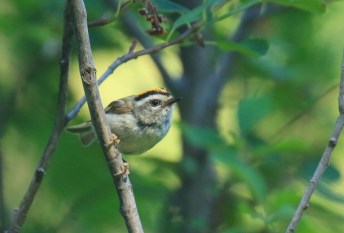
Black Capped Chickadee Golden Crowned Kinglet

IMG_1231 Yellow Rumped Warbler

Red Breasted Nuthatch Cassin's Vireo1

Dark Eyed Junco

In its own way it was one of the most fun and enjoyable experiences I have had birding – 11 species and at least 27 individuals.  (Of course I would have traded them all for a single Great Gray Owl.)  I continued to bird in the area for a while and then it was time to move on – and that leads to Part II.

PART II – Around and Around and Around We Go…

Leaving the Blue Mountains I continued on past Walla Walla on Highway 12 and turned north on Nine Mile Road hoping to find a Ferruginous Hawk.  I have seen them on a nest on this road in the past and they had been reported there on Ebird.  When I got to the nest site, no hawks were in sight.  I did see several Lark Sparrows in addition to many dozens of Horned Larks (and some other sparrows) and my photo of the Lark Sparrow was my first for the year.

Lark Sparrow

Lark Sparrow 1

I had a vague memory of another possible nest site further up the road and headed in that direction.  This is a very dusty gravel road, remote and rarely traveled.  So I was surprised when I saw another car approaching with a trail of dust behind me.  This same type of thing will play out in Part III of this post later – with a far different result.

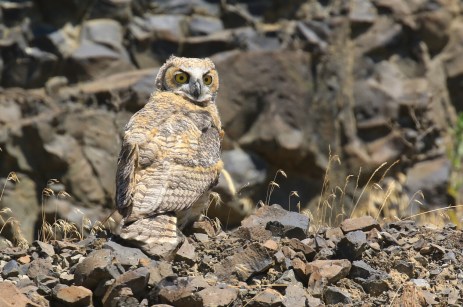
The driver was a birder, an excellent one – Matt Bartels.  It was not the first time that I have met up with him unexpectedly in the field.  I drive insane amounts during the year in my birding pursuits.  What is a number that is “insane times two”?  That is probably how many miles Matt drives each year on his County Listing pursuits.  And now we were about to add some more miles together as he had “definite” info on another nest site – which he said was a little further up the road.  Since my info was a vague memory and his was specific, I deferred and followed him – getting buried in dust.  This is only the short hand version but we continued up Nine Mile Road for more miles than I thought were to be traveled.  Two large birds flew up out of the grass and at first I thought Ferruginous Hawk, but instead we had two juvenile Great Horned Owls – siblings sticking together.

Great Horned Owl

GHOW1

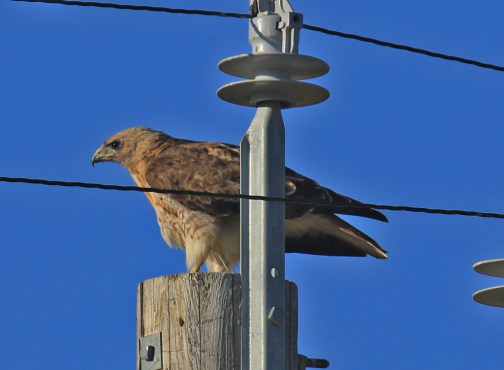
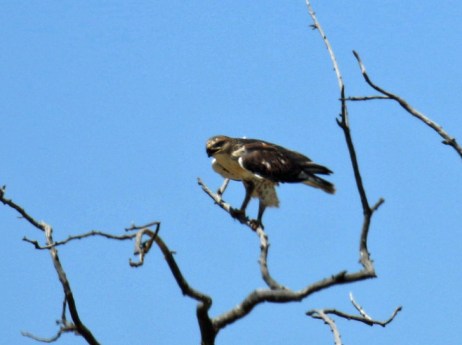
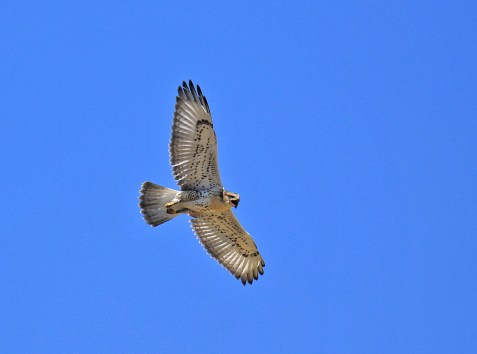
We stopped and checked directions on Matt’s computer.  “This way”, he said “and I guaranty we will find them”.   So we thought we had crossed Johnson Road but somehow turned onto it and then onto Touchet North Road thinking it was Dodd Road.  But it wasn’t.  So we stopped again and at the next intersection, this time we did go onto Dodd Road – except this time it was actually Sims Road.  After a while, I thought something was off, so we checked again and made the correction, retraced steps and this time really were headed to Dodd Road via Gluck Road.  Again Matt said, the nest tree was at Gluck Road and Britton Road “and I guaranty we will find them”.  Plucker Road did lead us to Gluck Road – and an intersection with Britton Road – but being completely disoriented – which way to turn?  We decided to try left and again Matt gave the guaranty – this time for MANY Ferruginous Hawks.  By the way, we had seen NO trees anywhere along the way.  We had seen some nice Swainson’s Hawks on some power poles as we had approached Britton Road and then not too far off, we saw some trees – it HAD to be the place – and thankfully it was.  A single bird was perched and it was our targeted Ferruginous Hawk – then another hawk flew over and relatively close – and a few minutes later a third one flew by – much lighter than the first two – although all were the light morph forms.  When Matt guarantees something – you can count on it – well usually – and also usually on a more direct path.

Swainson’s Hawk

Swainson's Hawk

Ferruginous Hawk Perched

Ferruginous Hawk Perched

Ferruginous Hawks in Flight

Ferruginous Hawk 1 - Copy

Ferruginous Hawk Lighter - Copy

I promised Matt I would tell the story in the blog and now I have – and it was great to see Matt and the hawks were certainly there – and it was Washington species number 294 for the year – so definitely ok to see miles and miles (and extra miles) of wheat fields and gravel roads.  As I said in the beginning, this was a very good day.

Part III – “Close, Oh So Close”

The plan now was to bird some more spots in the area and then head north.  I had to be in Leavenworth the next morning so I thought I would stay in Cle Elum and bird the Liberty area that night looking for owls and woodpeckers.  I added some new birds for the trip but nothing unexpected or exciting and reached Cle Elum around 6 to check into the motel (getting the last room available) and then eat some fast food.  I have had good luck and good birds in the Liberty area but was particularly now interested in a Flammulated Owl – maybe even a photo op.

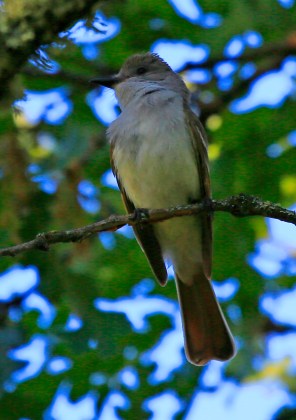
Flam’s would not be possible until it was dark so for the first two hours, I drove the main road through and then up from the town of Liberty – more dust for the car.  A White Crowned Sparrow was my first for the trip and there were many Chipping Sparrows and Swainson’s Thrushes.  Not too far from the town I heard a Great Horned Owl hooting.  Tanagers, Vireos and a number of Warblers were heard or seen. Pewees and other flycatchers were also found including one with a very long tail continually flicking its tail up.  Not a good look in the failing light and no calls so I am not going to attempt an ID.  I heard and then saw a couple of Townsend’s Warblers – again new for the trip.  Around 9:30 I heard my first “night bird” – a Common Poorwill in the distance.  A little later I heard the “peent call” of a Common Nighthawk and then another Poorwill.  I began playing the two-toot call of a Flammulated Owl as much to remind myself as to attract an owl.  No response but about 15 minutes later, with the memory of the call fresh, I was pretty sure I heard one off in the distance.  It was getting dark and it was time to get serious.

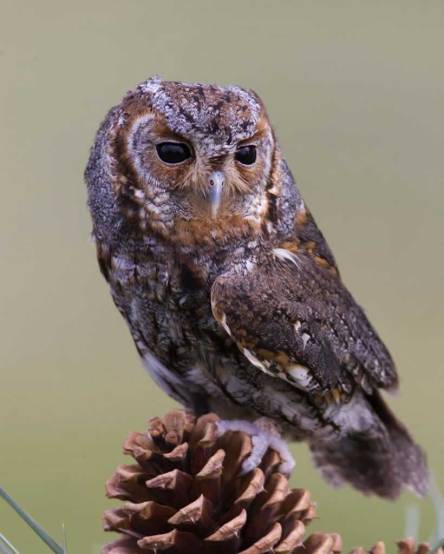
My approach is to stop every 1/2 mile and listen and play the call.  If no response I move on for anther 1/2 mile and try again.  As I approached the 4th stop (coming down) I heard a Poorwill and stopped in the middle of the road.  There had been no cars seen in the previous 2 hours and pull-offs were hard to come by, so I did not think much of it.  With the Poorwill still calling in the distance I heard an unmistakable two note call of a Flammulated Owl.  Not real close – but not real far either.  I started calling and it kept calling as well.  Without me seeing it in flight, the call that had been on the left side of the road (downhill side) stopped and then started up again on the right side – uphill – a little closer.  Then it was on the downhill side again – and closer still.  This continued for 20 minutes and now it was definitely very close.  Using my spotlight, I scanned the two close trees on the downhill side that were right next to the road and I was sure I was going to find the owl and I had my camera ready.  It was the closest I had ever been and this owl was the most responsive I had ever had.  I have wanted this photo for SOOOOO LONG.  And then…

Just as earlier when I saw a car coming up on me in the remote area when I was looking for the Ferruginous Hawk, in the distance I saw the lights of a car coming down the road toward me.  It was maybe 1/2 mile off but there was going to be no way for it to get by without me moving my car.  I could take a chance and hope it was a birder who would stop (if only it was Matt again!!!) and continue to try for the owl.  But it could just as easily be some crazy roaring down the road and I could be in danger.  I flashed my spotlight to warn the oncoming vehicle and then decided I  had to move my car.  I found a spot to just barely pull over enough for another car to come by.  It was maybe 30 yards down the road.  The other car came roaring by – slowing a little but definitely not a birder.  Then a second vehicle came.  Maybe three minutes had passed since I was within moments of getting that prized look and photo.  And the owl was still calling – but it was now way down the valley.  I tried playback again.  Now there was no movement.  I repeated and repeated again – nothing.  I waited five minutes – still nothing.  I was left to wonder what would have happened if I had been off the road, or if there had been no other car, or if it had come 30 minutes later.  I will never know.  I could either cry or laugh.  I decided to laugh – close, oh so close would have to do.  I will be back and will try again.

Flammulated Owl – Sadly Not my Photo

Flammulated_Owl_b53-2-009_l

It had been a very long and a very good day.  Saying it again – great places, great birds, great people – got them all and a couple of good stories as well.  Sign me up for more.

And an added note:  earlier I heard another series of hoots that I am sure was an owl.  It was closer to Liberty than the top of the road.  I could not make a positive ID but it was more similar to Spotted Owl than anything else.  There are Spotted Owls in the area.  I had found one at a “secret spot” in the area in 2013.  Maybe it was – maybe it wasn’t.  Certainly not going to report it or count it.  But when I go back – I will keep listening.

Hitting One of My “Double Zero” Goals – A “Biggish” Day

I enjoy being almost anywhere there are birds to be seen and at almost any times that work well for seeing them.  The nature observer aspect of birding is challenging and rewarding – and to repeat – enjoyable.  But there is definitely a part of my personal make-up that responds to the chase, the hunt, the planning and execution that comes with targeted pursuits – in birding and in other activities.  Having goals has always been a part of my life – some attained and many more not – and even if attained – finding new ones or changing the old ones to find something new or something more or better – defining that differently than perhaps someone else would – but in a way that works for and has meaning for me.

As I have written earlier, this is not going to be a Big Year in Washington – been there, done that, loved it – but now I want and need to look more to other aspects of my life, other people, other activities and other needs.  BUT…I cannot imagine a birdless year and I still want the organization, thrill, enjoyment and sense of accomplishment that comes with setting, pursuing and hopefully meeting goals.  Not the single goal of a Big Year but of several others – arbitrary perhaps but tied to numbers that at least provide some perceived unique quality – because they have two zeroes at the end – multiples of 100 and somehow that makes them more “special” to me and maybe to someone reading this post.  I have set a lot of Double Zero goals for the year.

An earlier post outlined how I hope to reach one of those Double Zero goals – the one with a 3 and two zeroes – seeing 300 species in Washington this year – a far cry from earlier true Big Year pursuits of up to 365 species in a year – but respectable and motivating.  My last post included the realization of one of my other Double Zero goals – the 200 goal – finding life species number 200 in Kittitas County – accomplished with the observation of an Anna’s Hummingbird at the Hyak feeders at Snoqualmie Pass.   That last post dealt mainly with 4 Edmonds birders looking for some rare birds in Yakima County and in the process observing almost 90 species for the day.  This post is about pursuit and attainment of the first of the Double Zero goals – the 100 goal – finding at least 100 species in Washington in a single day.  It was set as a goal some months ago, but the success of that trip with my Edmonds friends motivated me to get out and give it a try this past Saturday.

Even though I think some additional stops and focus on that earlier trip might have gotten us to 100, this time I would be on my own and thus would not have Steve’s knowledge, Frank’s great ears, Ann Marie’s good eyes (and stellar record-keeping),  and also we had seen some really good birds on that earlier trip that were not guaranteed this time.  So in planning my pursuit I decided to repeat most of that earlier route but adding some new spots that would increase the odds of hitting that magical 100 species.  First and foremost that meant some close to home birding in hometown Edmonds – particularly at the waterfront where there would be the chance of birds not possible east of the mountains.

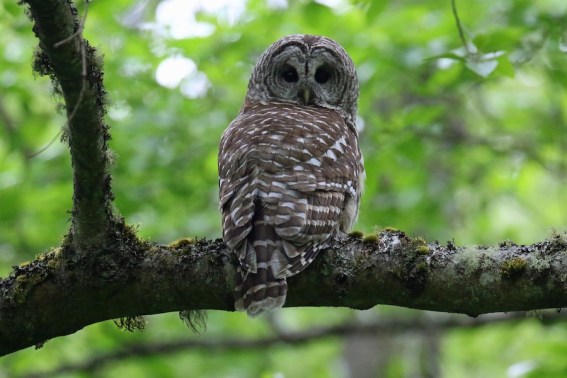
On a whim, I made a first stop at Yost Park – less than 1/2 mile from my house.  Maybe I would get lucky and hear the morning serenade of the resident Barred Owls even though it was now way past breeding season and the only Ebird report of one there this month was from June 3.  My whim was immediately rewarded at 4:40 a.m. when the song of a Black Throated Gray Warbler greeted me as soon as I opened the car door.  It was a species not seen in that 90 species day.  Another new bird came almost as quickly – a Brown Creeper with its high pitched call notes.  I figured both Pacific and Bewick’s Wrens should be around and short plays of their songs resulted in both – coming up to the low growth near the parking area.  It had not yet been three minutes and I already had 4 new birds.  Could an owl be added as well?  It took a single call to answer the question.  I do a reasonably good “Who cooks for you” call and this one immediately brought a response and the Barred Owl flew from its roost near the tennis courts immediately over my head and then, chased by American Crows, down onto a tree in the forest below.  The Crows continued to harass it, and the Owl continued to call for the 10 minutes I remained there.  A Downy Woodpecker made an appearance as I got back into my car (another bird missed on that previous trip). A Great start!!

Yost Park Barred Owl – A Good Omen

Barred Owl

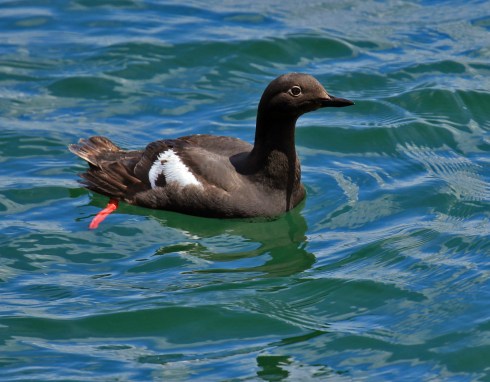
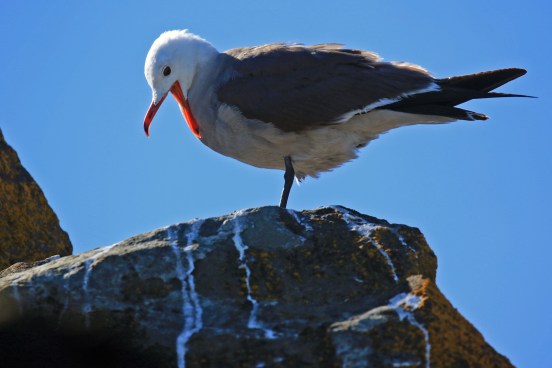
Yost Park was a spur of the moment add – and a bare 15 minutes into the day, I was already at 14 species.  Next was a stop at the Edmonds waterfront hoping for seabirds.  Unfortunately the tide was very high and the birds relatively few, but I easily added Heerman’s and Glaucous Winged Gulls, Pigeon Guillemot, Belted Kingfisher and Caspian Tern – 4 of which were not possible elsewhere on this day.

Heerman’s Gull

Heerman's Gull

The last planned stop was the Edmonds Marsh.  On a mini-scouting trip there the day before I had Virginia Rail, Marsh Wren, Killdeer and Purple Martin – none of which were seen on that previous trip.  No Purple Martin this time but the others were immediately heard and there were three other swallows species, a Great Blue Heron and both Mallards and Gadwalls – neither species a sure thing elsewhere.  I had now been birding about an hour and had seen 35 species – 14 not seen on the previous trip.  Time to head east.

As in the Edmonds Birders Go East trip, I made my Eastern first stop at Snoqualmie Pass.  The place was alive.  I heard an Olive Sided Flycatcher as soon as I got out of the car and then quickly added Swainson’s Thrush, Yellow and Townsend’s Warblers,  Pine Siskins, Rufous Hummingbird, Chestnut Backed Chickadees, Northern Flicker and Brown Headed Cowbird.  Eleven new species for the day and one more that had not been seen on the previous trip.  A quick stop at the Hyak Hummingbird feeders again added Anna’s HummingbirdNashville Warbler, Willow Flycatcher,  Evening Grosbeak, and Common Raven.  Nothing new from the earlier trip but now I was at 50 species – half way there.

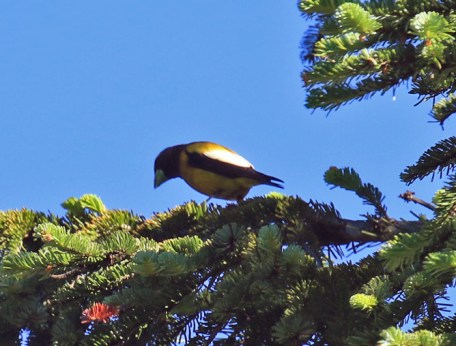
Evening Grosbeak

Evening Grosbeak

My next stop was to be Bullfrog Pond – a favorite place and one not visited on the previous trip.  As usual Bullfrog Pond delivered well.  37 species were seen in the hour spent there including 18 new for the day and 5 that had not been seen on the earlier trip (Williamson’s and Red Breasted Sapsuckers, American Dipper, Gray Catbird and White Breasted Nuthatch).

Gray Catbird

Gray Catbird

On to another favorite place, the nearby Railroad Ponds in South Cle Elum – also not visited before.  Thirty-one species were seen – 9 more new for the day and two not seen previously (Purple Finch and Bank Swallow).  A special observation was an adult Pileated Woodpecker feeding a juvenile.

Pileated Woodpeckers

Pileated Woodpeckers

Purple Finch

Purple Finch

The day count was now at 77 – three quarters of the way there – with lots of birds new from the earlier trip – looking good but many of the great birds from the last trip were not guaranteed – part of the fun.  An Osprey on I-90 made it 78.

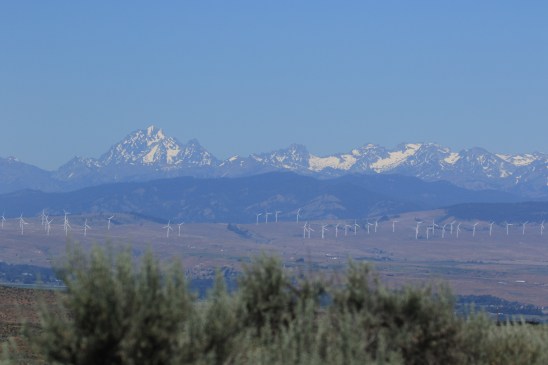
On that earlier trip, we had not spent much time looking for Shrub/Steppe birds.  I decided to bird Durr Road on this trip to look for some.  It was a good decision – only six species seen but 5 were new for the day and two – Vesper Sparrow and Sage Thrasher had not been seen on that other trip.  83 species and counting.  By the way – great views of Mt. Rainier and the Stuart Range – always enjoy them and this time I remembered to take pictures.

Vesper Sparrow

Vesper Sparrow1

Views from Durr Road – Mount Rainier and the Stuart Range

IMG_0875

IMG_0877

The next couple of hours repeated the previous trip – Umptanum Road with a stop at the parking lot for the Umptanum Falls trail, North Wenas Road with a stop at Bluebird Box 7 to look for the Calliope Hummingbird and then to Maloy Road hoping the Least Flycatcher remained and to the Wenas riparian area hoping the same for the Indigo Bunting before heading on to the Wenas Campground area.

Nine species new for the day were added before getting to Maloy Road with the only new one from before being a Cooper’s Hawk.  But no Chukars or Townsend Solitaire this time – so two misses.  Now at 92 species – more than seen on the entire previous trip – thanks primarily to those early Edmonds birds.

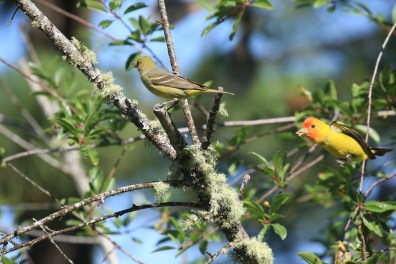
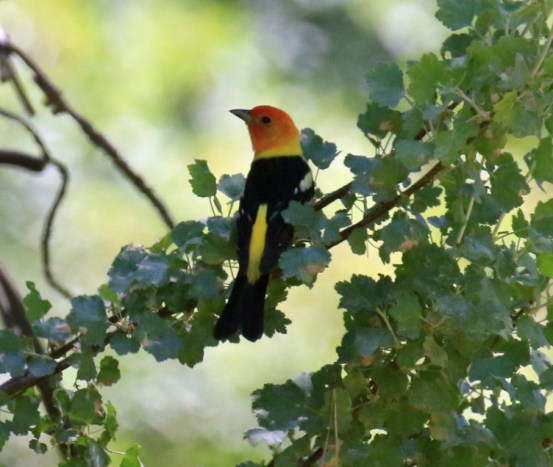
Western Tanager

Western Tanager

The Least Flycatcher was che-bekking loud and clear at Maloy Road – even had a peek-a-boo view but did not try for a photo considering myself fortunate to get one on the earlier trip.  On the way in to the Wenas Riparian area to look for the Indigo Bunting, I had a fun sighting of both an Eastern and a Western Kingbird within maybe 30 feet of each other on a wire.  Both were new for the trip and the former had not been seen on the earlier one. Now at 95 species.

Eastern and Western Kingbirds

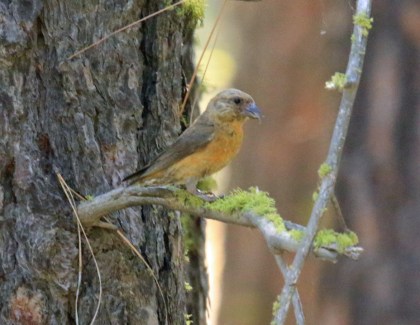
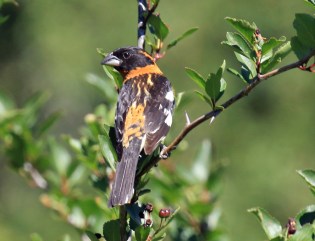
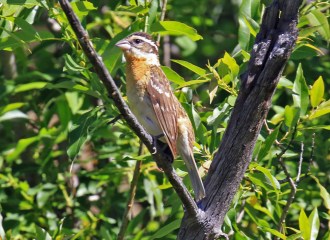
When I got to the Indigo Bunting spot, two birders were looking into the Cottonwood where we had seen it before.  I heard it singing and with some joint effort we got decent views (No. 94).  Another birder arrived and we got him on the bird, too.  I shared directions to the Least Flycatcher, and then proceeded to the Wenas Campground.  It was pretty slow there in the rising heat of the day, but I added another 6 species for the day and had now hit that “magical 100 species”.  The only species not seen from the earlier trip was a Gray Flycatcher.  Before we had heard Red Crossbills and this time I got a photo of one – although I had misidentified it as an odd colored House Finch when I first saw it.  A pair of Black Headed Grosbeaks were particularly photo worthy

Red Crossbill

Red Crossbill


Male and Female Black Headed Grosbeaks

Black Headed Grosbeak  Black Headed Grosbeak Female

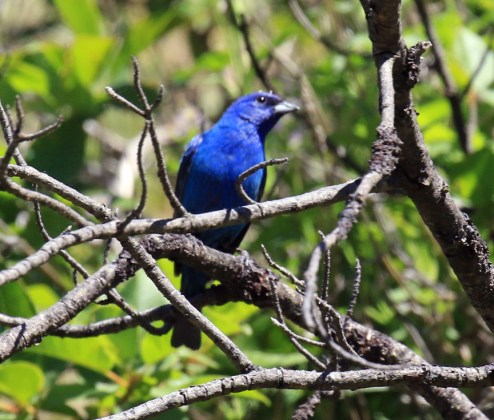
On the way back out, I stopped again for a last look at the Indigo Bunting and tried to lure it in with playback.  I was now closer to the yellow gate and could hear it singing.  No response.  On a whim, I tried the Lazuli Bunting call, and the Indigo Bunting immediately flew right at me and perched up for a good photo.  Hmmm?

Indigo Bunting

Indigo Bunting

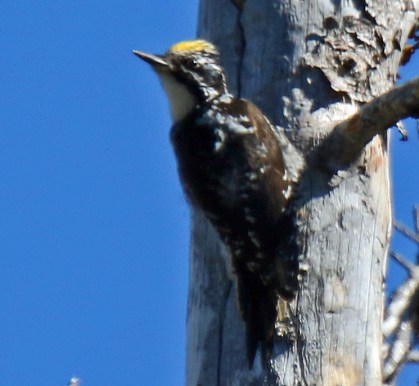
This trip had originally had multiple goals – 100 species for the day but also importantly a try for Black Backed and Three Toed Woodpeckers at Bethel Ridge.  I had located nests for each there in years past but had seen neither this year on two tries.  Paul Baerny had both last week and I had his directions.  Brian Pendleton was already there looking for those species.  I was optimistic.  Getting there included the road past Wenas Lake and through good agricultural habitat and a stop at Oak Creek Canyon (as on the previous trip).  Surprisingly perhaps, the trip down Longmire Road produced the only Black Billed Magpie and American Kestrel of the trip.  There were Canada Geese on Wenas Lake and my only California Quail nearby plus my first Western Meadowlarks and Brewers Blackbirds.   I was now at 106 species.

At Oak Creek Canyon I got my biggest and most pleasant surprise of the trip.  About a quarter of a mile in, a medium sized flycatcher flew down form the uphill area to my right and into the canyon.  It had a grayish head with a crest, was pale yellow below with a reddish tinge to the tail and a distinct ASHY THROAT.  I saw another one later.  These were my first Ash Throated Flycatchers of the year.  They had been reported from the Canyon earlier but I had looked for them and missed them twice including on our Edmonds Goes East trip.  I figured they had departed and had no thought that I would see one – in fact stopping there only for the Lewis’s Woodpecker and a Lazuli Bunting (which I had somehow not yet found) plus a hope for White Throated Swifts – seen here on that earlier trip and maybe Canyon or Rock Wrens.  No Swifts or Wrens, but I had two Lewis’s Woodpeckers, a Lazuli Bunting and remarkably those Ash Throated Flycatchers.  Now at 109 species.

Ash Throated Flycatcher

Ash Throated Flycatcher 1

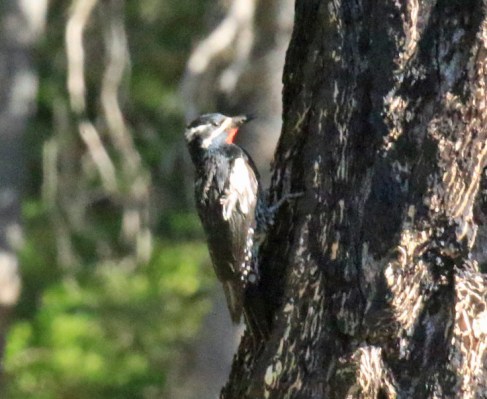
I got to Bethel Ridge much later than I had planned and should have tried earlier.  It was hot and mostly quiet.  No Black Backed Woodpecker, and unlike the previous trip – no White Headed Woodpecker.   As I got up to the area with the big burn towards the top near where the Three Toed Woodpecker had been seen, I saw a Woodpecker fly onto a tree trunk and my hopes soared.  Hard to be disappointed with a beautiful male Williamson’s Sapsucker but it had one toe too many.  Just before that I had my only Clark’s Nutcracker for the trip (and only my second of the year).

Clark’s Nutcracker

Clark's Nutcracker

Williamson’s Sapsucker

Williamson's Sapsucker

At that point I heard a familiar voice – Brian Pendleton was there with spouse Darchelle.  They had looked for hours for the Three Toed Woodpecker without success.  We joined forces and found beautiful wildflowers, views of Mt. Adams and Mt. Rainier, Hairy Woodpeckers, Rock Wren, Townsend’s Solitaire and Hermit Thrush – but no woodpeckers with three toes.

Hairy Woodpecker

Hairy Woodpecker

Townsend’s Solitaire

Townsend's Solitaire

Rock Wren

Rock Wren

Mt. Adams

IMG_1132

Wildflowers

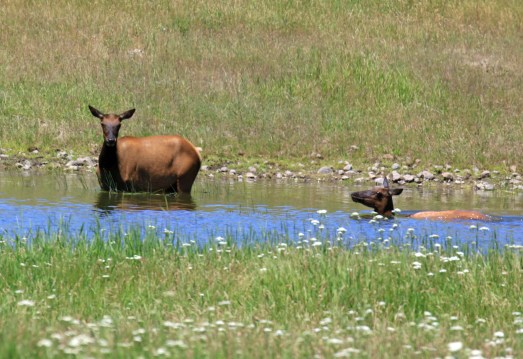
The five new for the day species brought the total to 114.  Clark’s Nutcracker and Hairy Woodpecker were not seen on the previous trip.  I had seen many elk and deer throughout the day including a very clumsy elk calf.  Coming down from Bethel Ridge, I came upon two striking bull elk with sizable racks.  I checked them out and they checked me out and they kept grazing.

Elk Calf

Elk Calf1

Elk Cooling Off

Swimming Elk

Bull Elk

Big Bull Elk

Back on Highway 12 on the way home, I stopped at Trout Lodge hoping for the Black Chinned Hummingbird that had been reported from the feeders there – no luck.  Later I had a Common Merganser on the Tieton River so my “Biggish Day” total was 115 species.  Maybe some day I will try a true Big Day and add stops, limit time at various spots, bird at night and hope for great luck.  I am sure that 145 species are possible even in late June.  Probably more are possible earlier – maybe many more either time.

None of my goals are noteworthy to anyone but me but maybe my stories of attempts to reach them recall attempts to reach different goals by others.  I think in fact that it is the collecting of “stories” as much as it is the collecting of bird observations that makes birding so enjoyable to me.  My goals help organize that collecting process – give order to the pursuits.  I have now accomplished two of my Double Zero goals for the year.  I am getting closer on some others and future blog posts will recount the stories that come from those quests – whether successful or not.

Species Seen June 24, 2017
1 American Crow Edmonds 59 Red-breasted Nuthatch Bullfrog Pond
2 American Robin Edmonds 60 Red-breasted Sapsucker Bullfrog Pond
3 Bald Eagle Edmonds Marsh 61 Red-naped Sapsucker Bullfrog Pond
4 Barn Swallow Edmonds Marsh 62 Red-winged Blackbird Bullfrog Pond
5 Barred Owl Yost Park 63 Turkey Vulture Bullfrog Pond
6 Belted Kingfisher Edmonds Waterfront 64 Veery Bullfrog Pond
7 Bewick’s Wren Yost Park 65 Warbling Vireo Bullfrog Pond
8 Black-capped Chickadee RR Ponds 66 White-breasted Nuthatch Bullfrog Pond
9 Black-headed Grosbeak Wenas Riparian 67 Williamson’s Sapsucker Bullfrog Pond
10 Black Throated Gray Warbler Yost Park 68 Yellow-rumped Warbler Bullfrog Pond
11 Caspian Tern Edmonds Waterfront 69 House Finch Cle Elum
12 Common Yellowthroat Edmonds Marsh 70 House Wren RR Ponds
13 Dark-eyed Junco Edmonds 71 Pileated Woodpecker RR Ponds
14 Downy Woodpecker Edmonds Marsh 72 Purple Finch RR Ponds
15 European Starling Edmonds 73 Pygmy Nuthatch RR Ponds
16 Gadwall Edmonds Marsh 74 Bank Swallow So. Cle Elum
17 Glaucous Winged Gull Edmonds Waterfront 75 Dusky Flycatcher RR Ponds
18 Great Blue Heron Edmonds Marsh 76 Red-tailed Hawk RR Ponds
19 Heerman’s Gull Edmonds Waterfront 77 Mountain Chickadee RR Ponds
20 House Sparrow Edmonds Waterfront 78 Osprey I-90
21 Killdeer Edmonds Marsh 79 Brewer’s Sparrow Durr Road
22 Mallard Edmonds Marsh 80 Mountain Bluebird Durr Road
23 Marsh Wren Edmonds Marsh 81 Western Bluebird Durr Road
24 No. Rough-winged Swallow Edmonds Marsh 82 Sage Thrasher Durr Road
25 Pacific Wren Yost Park 83 Vesper Sparrow Durr Road
26 Pigeon Guillemot Edmonds Waterfront 84 Eurasian Collared-Dove Umptanum Road
27 Rock Pigeon Edmonds 85 Mourning Dove Umptanum Road
28 Song Sparrow Edmonds 86 Say’s Phoebe Umptanum Road
29 Spotted Towhee Edmonds 87 American Goldfinch Wenas Road
30 Steller’s Jay Yost Park 88 Calliope Hummingbird Wenas Road
31 Tree Swallow Edmonds Marsh 89 Cedar Waxwing Wenas Road
32 Violet-green Swallow Edmonds Marsh 90 Cooper’s Hawk Wenas Road
33 Virginia Rail Edmonds Marsh 91 Western Tanager Wenas Road
34 Western Wood-Pewee Yost Park 92 Yellow-breasted Chat Wenas Road
35 White-crowned Sparrow Edmonds Marsh 93 Least Flycatcher Maloy Road
36 Brown-headed Cowbird Snoqualmie 94 Eastern Kingbird Wenas Riparian
37 Chestnut-backed Chickadee Snoqualmie 95 Western Kingbird Wenas Riparian
38 Northern Flicker Snoqualmie 96 Indigo Bunting Wenas Riparian
39 Olive-sided Flycatcher Snoqualmie 97 Gray Flycatcher Wenas Campground
40 Cliff Swallow Snoqualmie 98 Pacific-slope Flycatcher Wenas Campground
41 Rufous Hummingbird Snoqualmie 99 Red Crossbill Wenas Campground
42 Swainson’s Thrush Snoqualmie 100 Bullock’s Oriole Wenas Campground
43 Townsend’s Warbler Snoqualmie 101 American Kestrel Longmire Road
44 Willow Flycatcher Snoqualmie 102 Black-billed Magpie Longmire Road
45 Yellow Warbler Snoqualmie 103 Brewer’s Blackbird Longmire Road
46 Pine Siskin Snoqualmie 104 California Quail Longmire Road
47 Anna’s Hummingbird Hyak Feeders 105 Western Meadowlark Longmire Road
48 Common Raven Hyak Feeders 106 Canada Goose Wenas Lake
49 Nashville Warbler Hyak Feeders 107 Ash-throated Flycatcher Oak Creek Canyon
50 Evening Grosbeak Hyak Feeders 108 Lazuli Bunting Oak Creek Canyon
51 American Dipper Bullfrog Pond 109 Lewis’s Woodpecker Oak Creek Canyon
52 Brown Creeper Bullfrog Pond 110 Clark’s Nutcracker Bethel Ridge
53 Cassin’s Finch Bullfrog Pond 111 Hairy Woodpecker Bethel Ridge
54 Cassin’s Vireo Bullfrog Pond 112 Hermit Thrush Bethel Ridge
55 Chipping Sparrow Bullfrog Pond 113 Rock Wren Bethel Ridge
56 Gray Catbird Bullfrog Pond 114 Townsend’s Solitaire Bethel Ridge
57 Hammond’s Flycatcher Bullfrog Pond 115 Varied Thrush Bethel Ridge
58 MacGillivray’s Warbler Bullfrog Pond 116 Common Merganser Tieton River

Edmonds Goes East – But First, What About those So-called Goatsuckers?

My last blog post dealt in part with the logistics ahead for reaching one of my 2017 Birding Goals – observing 300 species in the State of Washington.  I still have that big Eastern Washington trip ahead, the one that I said would likely add 10-12 new species for the year.   Since writing that however, I have had the occasion to make two shorter trips into Eastern Washington and both forays have involved some of my Edmonds birding buddies and both have added some new species in Washington for the year and both have been fun.

The first was an evening foray to Robinson Canyon just west of Ellensburg.  It has been a good spot in the past to find Common Poorwills and Common Nighthawks.  No Nighthawks had been reported from there yet in 2017, but these voracious bug eaters were just arriving in Washington and new reports had been showing up in Ebird from elsewhere so I thought the chances were good.   Common Nighthawks can often be seen (or more likely heard) during the day, but the best time seems to be at dusk, and the Common Poorwills are also likely just as the skies darken as well, so the plan was to arrive at the Canyon around 8 and hopefully find both birds.  Entrance to the upper Canyon is through an unlocked gate and my first good find that night was at that gate.

As I was pulling up there was another car stopped at the gate and someone was opening it.  Small world, it was Steve Pink – one of the Edmonds birders – and who featured prominently in my previous blog.  He was there with wife Connie – also hoping for the same two species.  Just before arriving at the gate, I thought I had heard the familiar “pe-ent” call of a Nighthawk but it was distant and faint so not a for sure observation.  Not too long after parking at the end of the road, we began hearing first Western Wood Pewees and then unmistakably the call of the Common Nighthawk.  They often fly high in the sky and it can be difficult to locate them, but in this case, there were at least three birds and we finally found them flying almost directly overhead – even if quite high in the sky.  If you look real hard at the ID quality only photo, you can even make out the white “wrist” bands on the wings – definitely not my best photo. (A better photo from last year adjoins it.)

Common Nighthawk

Common Nighthawk  Common Nighthawk3

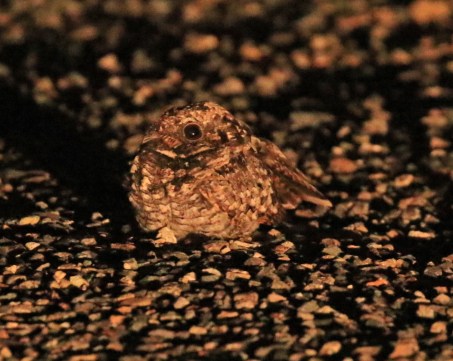
And then as it got darker, we began to hear the repetitive “poor – will” call of our main quest – the Common Poorwill.  They roost up on the Canyon’s rocky slopes and once one starts calling there can be a veritable chorus.  We heard at least a half dozen.  With luck, you can often find one on the road, their eyes reflecting the light from your car’s headlights.  I left first and unfortunately had no birds on the road.  Steve and Connie left 10 minutes later and did find one Poorwill on the road. (The picture is mine of one on the same road last year).

Common Poorwill

Common Poorwill

Common Poorwills and Common Nighthawks are taxonomically pretty closely related and belong to a group of birds often called “goatsuckers”.  Here is probably way more information than you would ever want to know about the origin of that terminology and application to these species (and others).  Goatsucker is

“based on a superstition that goes back well over 2000 years. They (Goatsuckers) all have tiny beaks that open to reveal an impressively large mouth used to catch flying insects, and they are active mainly at night. Their nocturnal habits made them mysterious, and their bizarre appearance required an explanation, and as early as the 300s BC Aristotle wrote about the trouble these birds could cause with goats. Four hundred years later not much had changed, and in 77 AD Pliny passed along the prevailing wisdom:  The Caprimulgi (so called of milking goats) are like the bigger kind of Owsels [Thrush]. They bee night-theeves; for all the day long they see not. Their manner is to come into the sheepeheards coats and goat-pens, and to the goats udders presently they goe, and suck the milke at their teats. And looke what udder is so milked, it giveth no more milke, but misliketh and falleth away afterwards, and the goats become blind withall. (from the 1601 translation)
It’s not clear how many people ever believed this. It sounds like Pliny may have had some doubts, and the superstition faded away centuries ago. We still use the name but the “goatsuckers” eat nothing but flying insects and have no interest in, or effect on, goats.”  (from the SIBLEY GUIDE)

Just so you know, no goats were seen in the Canyon by any of us.

During the following week, Ebird reported that both a Least Flycatcher and an Indigo Bunting were being seen regularly in the Wenas area.  I was pretty sure I had heard one of the former on an earlier trip to Umptanum/North Wenas Road but had not seen it.  They are uncommon in Washington although seen usually at recurring locations each year.  Indigo Buntings are quite rare and generate lots of interest (and chasing) in the birding community.  I had one open day on my calendar and figured a chase was in order, especially if it would also provide some good birding company.  Ann Marie Wood, Steve Pink and Frank Caruso were all game and available, so off we went on June 16.  Four birders from Edmonds (close enough Ann Marie) heading East…

On trips east, a first stop is often the summit at Snoqualmie Pass – a chance for restrooms and the possibility of something good at the hummingbird feeders there.  No hummers there, but when we drove a bit further east (most importantly into Kittitas County) the Hyak feeders were alive with hummingbirds.  West of the Cascades, we have both Rufous and the much more plentiful Anna’s Hummingbirds. the latter often overwintering sustained by feeders and non-native plants.  East of the Mountains, Anna’s Hummingbirds are generally quite uncommon or even rare.  I had not realized that this applied even the few miles east of the Summit at Hyak, and thus when we saw two Anna’s among the two dozen or so Rufous at these feeders, I was quite surprised and very pleased to find that they were my first record of this species in Kittitas County.  More notably, it was the 200th species I had seen in Kittitas County – thus fulfilling one of my goals for 2017 – to bring that county list to 200.

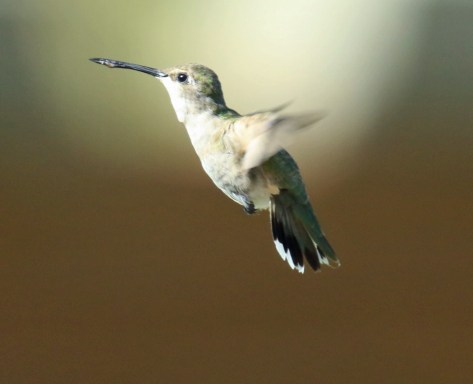
We decided to take the shorter route to get to Wenas by going up over Umptanum Road to North Wenas Road and then first to Maloy Road where the Least Flycatcher had been seen before doubling back a mile to try for the Bunting.  I have birded this stretch many times including often this year and it is always a treat – many bluebirds and sparrows as well as flycatchers, thrashers, warblers and others.  We stopped a few times and saw a number of species, but did not “work” it hard since we were on a mission.  At one stop I head a “chucking sound” up on one of the hills.  We never got a look, but the calls were from at least a few Chukars – new for the year.  I made sure we stopped at Bluebird Box #7.  It is a go-to spot for Calliope Hummingbird.  Two weeks earlier I had seen one briefly but not gotten a photo.  This time, the hummer was more cooperative.

Calliope Hummingbird at Box #7

Calliope Hummingbird2

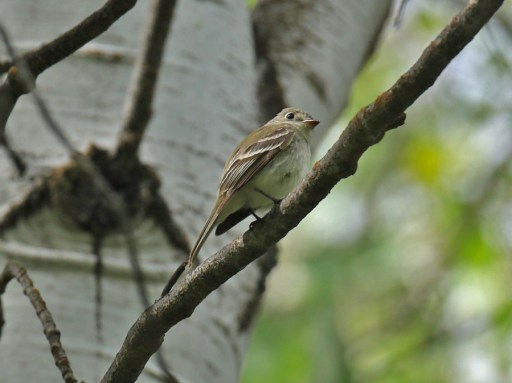
Directions for the Least Flycatcher were pretty specific – in the Aspen Grove on Maloy Road before the bridge over Wenas Creek.  I pulled over when I saw the bridge about a hundred yards ahead and there were Aspens south of the Road.  As soon as I got out of the car, I could hear a faint “Che-bek, Che-bek” call – the Least Flycatcher was there, but it was distant – at least 50 yards in and up in the Aspens.  We tried to lure it to us and it did not seem to want to move at all.  We were going to settle for an identification as “heard only”, but for whatever reason the bird decided to fly in to a last attempt with our recording and it was in the open for split seconds, here and there, flying back and forth across the road.  I timed its brief perch in the open right once and got an ok photo.  It is the smallest of the Empidonax flycatchers and the call and that noted size made the ID certain.

Least Flycatcher

Least Flycatcher

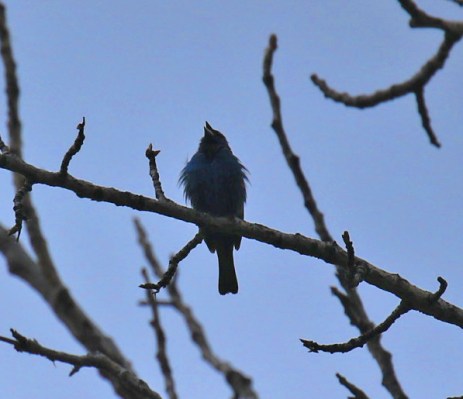
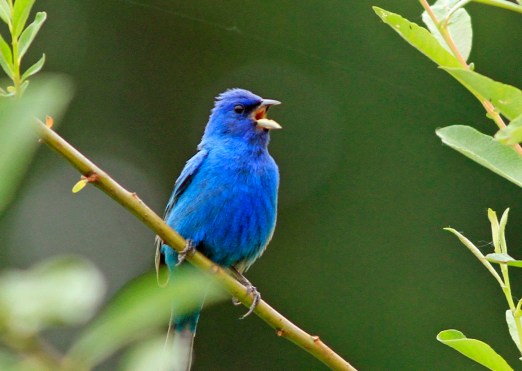
Now we were on to try for the Indigo Bunting.  Those directions were just as good – “at the yellow gate at the Wenas Riparian area”. As we neared the gate, another car was coming towards us.  Was it a birder?  Had he seen the Bunting?  Or was this going to be a shared disappointment?  The license plate “Osprey” answered the first question in the affirmative.  When he turned around and came back to us, he gave an affirmative on the second as well — BUT — after he had observed the Bunting, it had flown off over the hill and was perhaps gone – forever…Uh-oh.  The birder was Denny Granstrand – one of Yakima’s finest – a completely reliable source.  We drove the two cars to a good pull out area just past the gate and started to search.  After a few moments I was attracted by a song back up the road that I thought might be our guy.  I am not good at bird song.  That is Frank’s domain.  But I had earlier played the Indigo Bunting song to familiarize myself with it and this sounded good.  It continued but it was hard to get a spatial sense…until that is we went a little further, and there it was out in the open in a dead cottonwood.  Poor light meant poor photos, but an unmistakable bird and we were feeling pretty good.  Then, just as Denny had said before, it flew off across the road and up the hill.  Satisfied we went back to the car and loaded up to leave.  As we drove past the dead cottonwood, there it was again on its favorite branch – singing away.  As an aside, another Edmonds birding friend, Jon Houghton visited the spot two days later and found the Bunting on the same branch.  (A better photo is included – my first Indigo Bunting in Washington – from Steigerwald NWR in June 2014).

Indigo Bunting (Wenas June 2017)

Indigo Bunting3

Indigo Bunting (Steigerwald June 2014)

Indigo Bunting3

We continued into the Wenas Campground hoping to add some woodpeckers and more flycatchers, but it was not very birdy and we picked up only a few new species for the day – nothing exciting.  Our total was around sixty species so far but our success in finding both special targets, Indigo Bunting and Least Flycatcher plus adding the Chukars and Calliope Hummingbird (and my Kittitas County Anna’s) meant it had already been a great day.  It was still early so what next?  I felt we had time to go to Oak Creek and a short while on Bethel Ridge where we would hopefully find some good woodpeckers and just maybe an Ash Throated Flycatcher.

At Oak Creek, it took some doing to find a Lewis’s Woodpecker.  Only maybe five – the fewest I have ever seen there – and not as close as usual – still a gorgeous bird.  More of a disappointment was that we did not find any Ash Throated Flycatchers.  I had not been able to look for the one at Marymoor Park, so if I still need/want one, I may have to go to Klickitat County later.  Now on to Bethel Ridge.  We would not have a lot of time, but good to share some of my past experience and hopefully find something new – particularly some woodpeckers.

Lewis’s Woodpecker

Lewis's Woodpecker

Oak Creek Scenery

Oak Creek Scenery

After hearing a number of Swainson’s Thrushes and Veeries earlier in the day, I was pleased to hear and recognize a Hermit Thrush at one of our stops about midway up the road.  Not uncommon in Washington, but I had not found one earlier when they were at lower elevations, so this was my first for the year,  (It was also our seventh thrush species for the trip as earlier we had Veery, Robin, Swainson’s Thrush, Western and Mountain Bluebirds and Townsend’s Solitaire.  Unfortunately we did not see any Varied Thrushes or we would have had all of the Washington thrush species.)

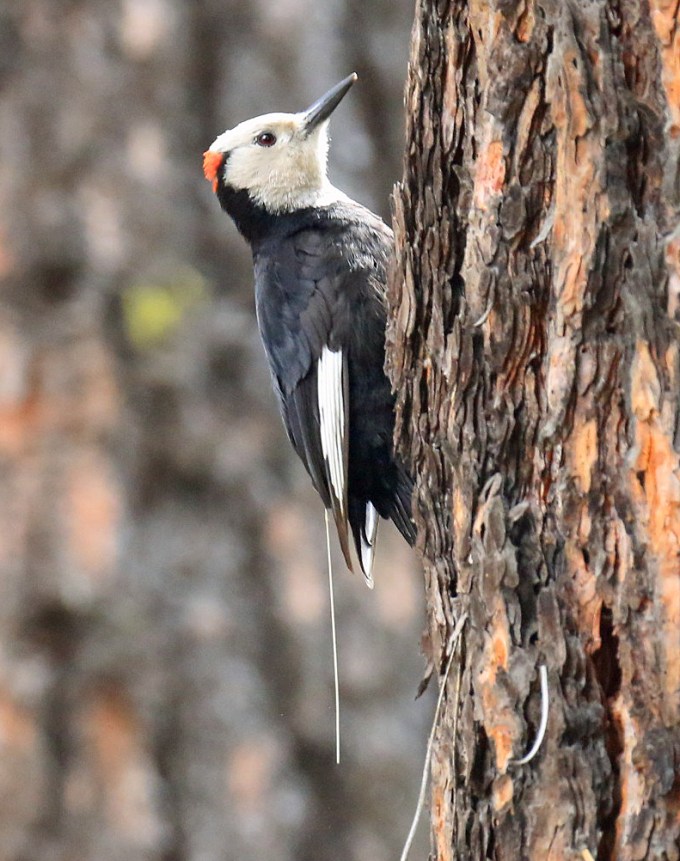
Now it was time to leave and as we approached the bottom of the road, we saw someone with a tracking antenna off to one side.  We wondered if he was a birder/researcher.  I pulled ahead a little bit to both observe him and also to “take one last look”.  This proved a good move as serendipitously, Steve Pink saw a White Headed Woodpecker on the side of a conifer immediately adjacent to the road.  We were able to get out and get photos.  The fellow with the antenna noted our activity and came over and we told him it had been a White Headed Woodpecker and he took off to track it after it had flown.

Later when photos were checked at home, we noted that the Woodpecker was banded and Ann Marie sent the photo on to Jeff Kozma – who is a researcher in Kittitas and Yakima Counties – and who was the fellow we had seen.  Ann Marie got this information back after he identified the bird as one in his study.

White headed Woodpecker

White Headed Woodpecker2a

“Ann Marie, We know a lot about that bird. His transmitter is still functioning and we visit him every 2-3 days. He was banded as a nestling last summer in Tieton Meadow, 1 mile upslope, making him the shortest-distance disperser in our research.

He is a carrier for avian malaria, which can be deadly though he has survived for 1 year despite infection. His infection may explain his sedentary lifestyle – we can’t be sure. He was unsuccessful in attracting a mate this spring, so was unable to nest this summer.

We have tracked his paternal side for 3 generations. His father was hatched in Rattlesnake Creek in 2014. Unfortunately, his maternal side is completely unknown which is pretty common. We’ve never been able to track a female-line for more than 1 generation. The females tend to be more mobile than the males.”

What a great way to end a great day.

As the trip ended we counted up all of the species seen that day and came to just under 90.  Since we had no shorebirds or gulls and only two duck species and we really had not tried for numbers, that was pretty darn good.  When I got back to Bellevue, I added a couple of species of Swallows a Mallard and two species of Chickadee, so I am pretty sure I was over 90 and know we could have hit 100 with targeted effort.

Great birds, great places and great people – the ever present recipe for a wonderful day!

Ann Marie, Frank and Steve

blog-ann-marie  blog-frank 036a0647

(Now at 282 Species for 2017 in Washington and counting…)

Big Years and Not – Logistics, Chases and Comparisons

My last blog post shared some experiences and photos from my first visit to the Washington Coast this year including a pelagic trip out of Westport.  Even though I am not doing any form of a Washington State Big Year in 2017, I do have a modest goal of seeing 300 species and since I report all of my observations on Ebird, I have a continuous self report that keeps me aware of my totals as I go. On Thursday morning May 18 before embarking on that trip to the Coast, my Washington Year List stood at 234 species.  In the previous four years when I had done some form of a Big Year in the state the totals ranged from a low of 251 species to a high of 290 species – an average of 275 species.  So IF I were doing a Big Year this year, I was seemingly way behind previous attempts.

Species in Washington as of May 17th
2013 2014 2015 2016 2017
251 286 290 278 234

But as is almost always the case in comparisons of any kind and certainly ones with experience based numbers, it is just not that simple.  For example, in each of those previous years, by May 18, I had already visited the Coast and done a Pelagic trip – birding ventures sure to add many new species.  Doing a Big Year includes several different approaches to “birding”.  There is first the general activity of covering a lot of different habitats at different times and just spending time in the field.  Then there is “reactive birding” – chasing “needed” birds as they come up whenever and wherever they come up.  As I am sure I have stated in some earlier blog, Rule Number 1 for a chase is “Go now” as often the birds stay briefly and just do not wait for you to try to see them at your convenience.  Rule number 2 is “If you fail to follow Rule Number 1, then you cannot whine about missing a bird – it’s your own fault.”

As important as those two aspects are to a Big Year, probably the most important part is excellent informed planning on where to go when – the logistical planning to get to the right spots at the right time when needed birds are most likely to be there.  As much as I have enjoyed the general birding and the chases, it is the logistical planning and execution that I have enjoyed most and have been most successful at doing – making it possible to get the large totals I have been able to accumulate in each of those years.

Back to this year.  Not striving for the Big Year, it has not been imperative to chase every new and exciting bird nor to include some trips (to the Okanogan for example) that have been a part of each previous Big Year pursuit.  But while the goal this year is far more modest, 300 species is by no means easy and it does require that logistical effort to find birds at likely spots and at the times that they are going to be there.  Looking forward on that May 18th morning and knowing that the Coast and a pelagic trip were close at hand, it was time to do the logistical planning that would enable me to reach 300.

So…on May 18th I headed to Camano Island to find a Wild Turkey and other species.  I had missed this species on an earlier trip there and had looked for it and failed to find one on a Teanaway Valley trip earlier in the year – where they are almost a gimme.  English Boom on Camano Island is also a guaranteed spot for Purple Martins by mid May, and there was the possibility of a new bird or two at Eide Road.   When I got to Hanstad Road, a tom turkey was strutting on a grassy lawn – a good start.  Even better was that when I got out of the car to take a photo, I heard the plaintive song of a Swainson’s Thrust – another new bird for the year.

Wild Turkey

Wild Turkey

On to English Boom, but on the way I heard one of the most recognizable of bird calls.  An Olive Sided Flycatcher was calling for liquid refreshment – “Quick three beers” – and there it was on a nearby tree branch.

Olive Sided Flycatcher

Olive Sided Flycatcher

English Boom delivered as always as Purple Martins were at most of the gourds, well into their mating and nesting and posing for photos.

Purple Martin

Pruple Martin

I had hoped for two new species and now had doubled that.  Would luck hold at Eide Road – well only a little as I did find some Blue Winged Teal but no shorebirds.

The previous blog recounts the trip to the Coast and the Pelagic Trip with a stop off at Capitol Forest where I had first of year Hermit Warbler, Pacific Slope Flycatcher and Sooty Grouse.  Those were both general birding experiences and logistical requirements to get to my intended total by year end.  At the end of that trip with the Camano birds, by the end of day on May 20, I now had 264 species for the year.  The chart looks different a couple of days later.  Might even be good for a Big Year try, but that was not the plan AND there were birds I had not tried for in the right season and would not likely to be added later anyhow.  There was still going to be a lot more work to do to even reach that 300 number.

Species in Washington as of May 20th
2013 2014 2015 2016 2017
251 286 290 278 264

Back to logistics.  I knew I had a big trip to Eastern Washington coming up in late June but that was not going to be enough to get to 300 even with good luck.  I was hoping to avoid a second pelagic trip in the Fall so I now needed to plan that Eastern Washington trip carefully, add a species or two here and there and combine a couple of chases and some good luck.  And another twist was that I was balancing a more substantial social and non-birding schedule than in previous years, so the challenge was to find ways to include some spots to visit that would “kill (see) two birds with one stone” for example.  A first opportunity to do that was the next week at the off leash area at Marymoor Park.  We took Bailey for a walk and found the Pectoral Sandpiper that had been located in the mud adjoining that area the day before and also had my first Willow Flycatcher of the year out amidst the dogs.  (I did not bring a camera and the phone proved incapable of a viable photo.)  Similarly the next day we chose to visit Paradise at Mount Rainier – great scenery, a picnic and yes a couple of new birds – Gray Jay and Clark’s Nutcracker – logistics!!

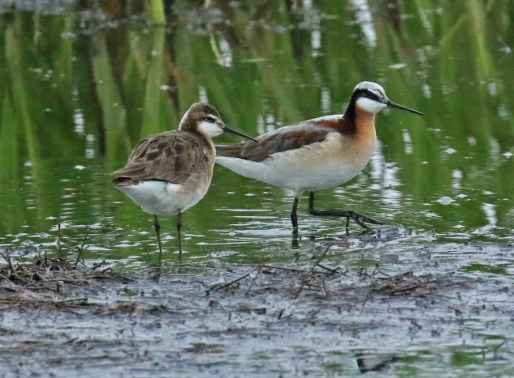
What next?  A chase of course – hoping for the Golden Plovers that had been seen at Eide Road.  Unfortunately chases are not as reliable as good logistics – no Golden Plover – but the bonus was that there were two Wilson’s Phalaropes and a fun photo op for a flock of Blue Winged Teal in flight.

Wilson’s Phalaropes

Wilson Phalaropes

Blue Winged Teal (6 of 18)

6 Blue Winged Tea

The total was growing but that is what has to happen in May – always the best month to add new species as migration brings in both migrants that continue on and those that will be breeding in Washington as well.  But there was now only one more day in May – time for a “logistical chase”.   The Newhalem Agg Ponds are a known spot for American Redstarts.  I was counting on seeing some at Calispell Lake in Pend Oreille County on my big Eastern Washington trip later, but a “bird in the hand is better than one in the bush” as it is said.  Steve Pink was interested in visiting that area so it would be fun and a great chance for me to visit places I usually do not and which Steve knows very well.

We had a great trip in beautiful weather.  First Steve took me to a new spot – the Whitehorse Trail where we found Red Eyed Vireos – another bird I could count on at Calispell Lake but my first in Snohomish County and my first in 2017.  Later we found numerous American Redstarts at the Agg Ponds and also had the bonus of a drumming Ruffed Grouse – a species that I could not count on later in the year so very much appreciated.  It was a new county bird for Steve in Whatcom County – important to him.

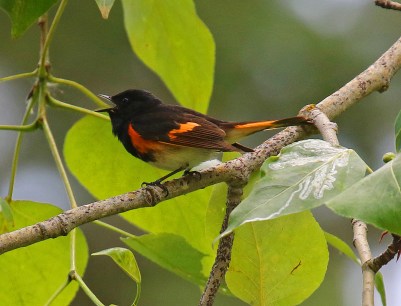
American Redstart

American Redstart

That was the last new bird for the month bringing me to 272 species for the year.  Again let’s look at the comparison with previous years.  I had added 40 species in the two weeks from May 17th.  On the surface it looks like another big year possibility, but I had made my target list for the rest of the year and getting to 300 seems pretty reasonable but even that is going to take work .

Species in Washington as of May 31st
2013 2014 2015 2016 2017
286 290 305 278 272

June has been far less productive than May every year but especially with a long Eastern Washington trip ahead, I am optimistic.  I have very specific stops planned along the way that should put me in good shape but some new shorebirds better show up and that second pelagic trip may be a necessary.  And of course I have not yet been to Neah Bay and that could make all the difference.

I have been out once in June – chasing a Scissor Tailed Flycatcher that was reported by a single observer on Umptanum Road – no luck on that one, but I did add five species – all ones that were planned for on my upcoming trip to Eastern Washington in late June.  The five were Least Flycatcher, Calliope Hummingbird, Lark Sparrow, Veery and Gray Catbird.  I was only able to get a decent photo of the Catbird, so when I see them again later, I will hope for those pictures.

Gray Catbird

Gray Catbird

Now I am at 277 species.  How do I get to 300?  Logistics, chases and luck.  Here is how I see the breakdown (and I will report back in another blog later to see how it went in reality.)   10-12 new species in Eastern Washington trip that will include Calispell Lake, Spokane County, the Blue Mountains and the Cascades.  5 or 6 more shorebirds.  3-4 new species at Neah Bay.  5-10 miscellaneous.  And if need be another pelagic trip in the fall that should be good for another 5-6 species.  And then there are a lot of “ifs” – if there are surprises, if I go to Salmo Mountain, if I go the Okanogan and some species show up well (and early).  In a really good Big Year, you need all of these things to go well – the upper ranges of possibilities to be found, some unexpected rarities to show up, a second (or even a third pelagic trip) and all the “ifs” to happen.  Those seemingly small differences can add 30 or 40 or even 50 species.  Some others are doing Big Years this year – I wish them well.  I have a big trip coming up for Arizona and may do some more ABA area birding as I have some goals for the ABA area this year – but that will be another blog post – or two – later.

Contrasting Coasts

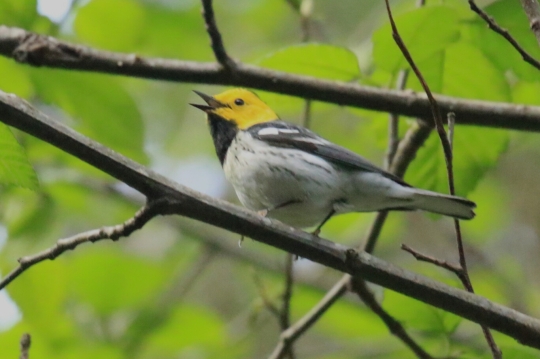
It was a little over two weeks since I had returned from my wonderful trip to Florida.  The two previous weeks had been the mountains in Washington versus mostly the coast in Florida – very different indeed.  But how about our Washington Coast and the one in Florida?  This weekend gave me the opportunity to compare those two very contrasting coasts as I made my first visit of the year to do some pelagic birding with Westport Seabirds.  The early start for the pelagic trip out of Westport makes it almost essential to stay over the night before and thus provides the perfect chance to bird the coastal areas the day before – and possibly some more after the boat trip as well.  Visits are planned around the tides and I always include favorite beaches often with a first stop at the Capitol Forest just south and west of Olympia – a go to spot for Hermit Warblers.  As usual in mid-May they were there in good numbers.  So too were Wilson’s Warblers.

Hermit Warbler

Hermit Warbler

Wilson’s Warbler

Wilson's Warbler

A birder is faced with many strategic decisions when birding the Washington Coast – and the first is whether to try to include places in two different areas – turn south from Aberdeen and go to the Westport area or continue west and go to the Ocean Shores area.  A full day can be spent in each area, but with a sufficiently early start and/or a sufficiently late conclusion, both areas can be included and that was my plan.

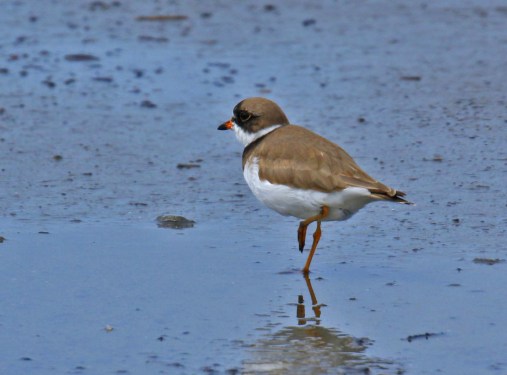
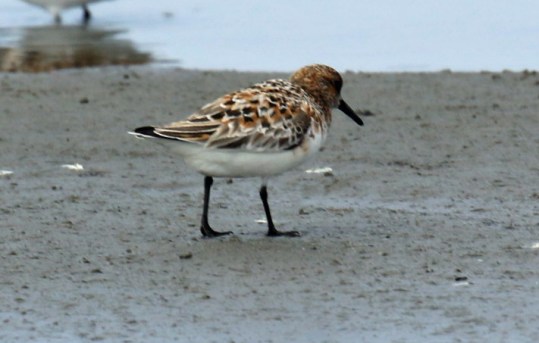
A first stop at the Hoquiam Sewage Treatment Plant was disappointing as I found no shorebirds and my only new bird for the year was a Bonaparte’s Gull.  Many great birds have been found here in the past – not this time.  So I moved on to Ocean Shores – hoping for shorebirds on the sandy beach near the Casino north of town.  I love driving on the sand and there can be thousands of birds if one is lucky.  At first there were no birds at all and I worried that the relatively low tide was the cause.  But then I started to find mixed flocks foraging at the edge of the water.  This was quite the contrast with the Florida coast where shorebirds were relatively few and were generally only found in the tidal wrack.  My first group was primarily Western Sandpipers with a few Dunlin and Sanderlings – maybe 100 birds.  Later groups were similarly sized but also included Semipalmated Plovers – my first for the year and the species I felt I was most likely to add here.

Western Sandpiper

Western Sandpiper

Dunlin (breeding plumage)

Dunlin1

Semipalmated Plover

Semipalmated Plover

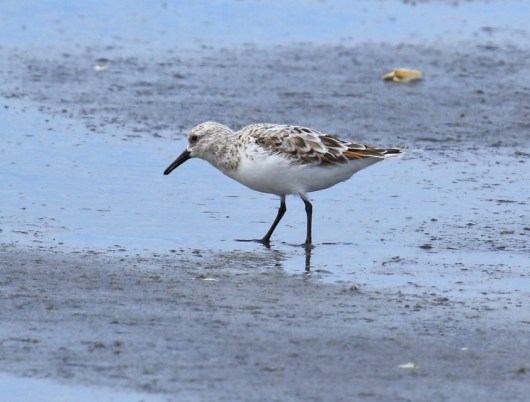
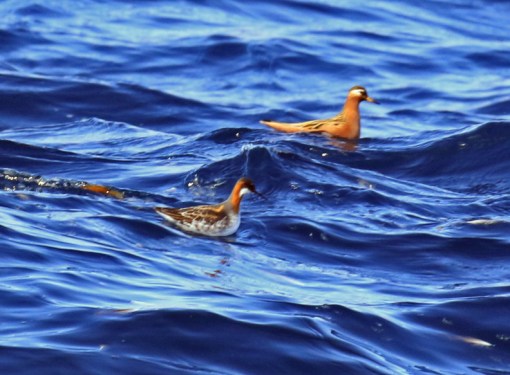
The only similarity with Florida was that Sanderling were present in both basic and alternate plumages.  I had hopes for another bird seen commonly in Florida and relatively rare in Washington but at least a possibility here – a Ruddy Turnstone – but not this trip.  There were also no larger waders or “special sandpipers” but one surprise was a group of four Red Necked Phalaropes.

Sanderling – Basic (non-breeding) Plumage

Sanderling

Sanderling – Alternate (breeding) Plumage

Sanderling Breeding

Red Necked Phalaropes (both male and female)

Red Necked Phalaropes

My next stop was the North Jetty where I hoped to find a Wandering Tattler.  The tide was pretty low and I found no birds on the jetty at all.  I decided not to go to the Oyhut Game Range – often a fantastic spot.  It had not received good reviews lately and the low tide was discouraging so it was off to the Westport area – meaning yet another trip through the ever bleak Hoquiam and Aberdeen.

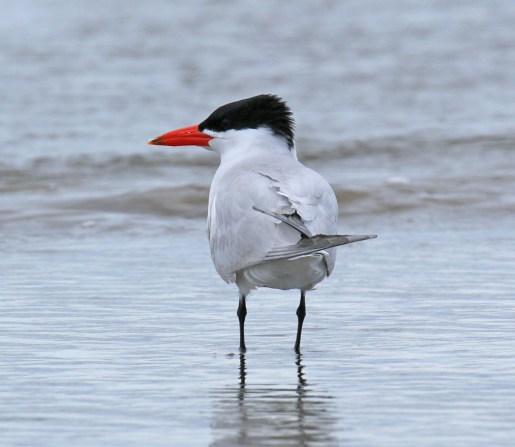
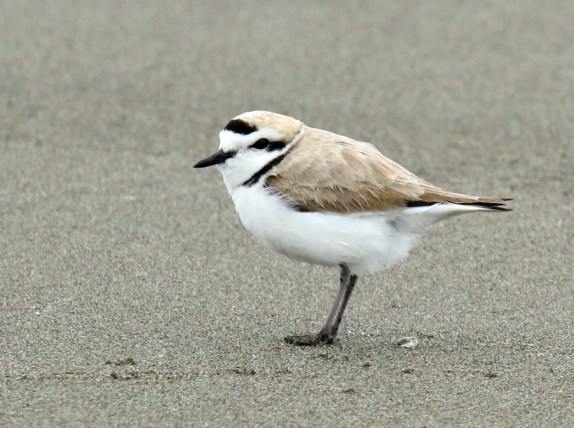
If the tide timing had been right (2.5 to 3 hours before high tide), I would have stopped at Bottle Beach, but as it was barely noon and high tide was not until 8:30 pm, I drove straight to Grayland Beach – another drive on the open beach this time hoping for Snowy Plovers.  The weather was great.  There were some cars on the beach but not that many – and once again the tide was working against me -just too much exposed sand – and I did not find a single shorebird.  A few gulls and a few Caspian Terns and that was it.  Again time to move on.

Caspian Tern

Caspian Tern

It was now on to Tokeland.  It has been a great place for Willets – the most reliable spot on the coast – but there had been none reported recently – so I was not optimistic.  Whimbrels and Godwits were also a possibility – so I was at least hopeful.  But once again the tides were wrong or the bird gods were unhappy as there were no birds there at all.  Now the plan was to go to Westport – check out reports of Fork Tailed Storm Petrels and Phalaropes that had been seen regularly in the marina area and also check a favorite spot for a Wandering Tattler before checking into the hotel and then heading back to Bottle Beach – with a favorable tide.

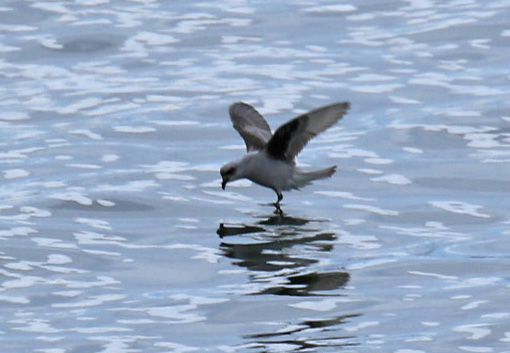
My favorite spot for Tattler is at the far end of the jetty just past the cabins at the “groins” where there is a viewing platform.  No Tattler there, but indeed Fork Tailed Storm Petrels were soaring just atop the water very close in.  Usually this species is seen far out in the open ocean so this was a treat.  So too was a Peregrine Falcon perched on the corner of a nearby building.

Fork Tailed Storm Petrel

Fork Tailed Storm Petrel

Peregrine Falcon

Peregrine Falcon

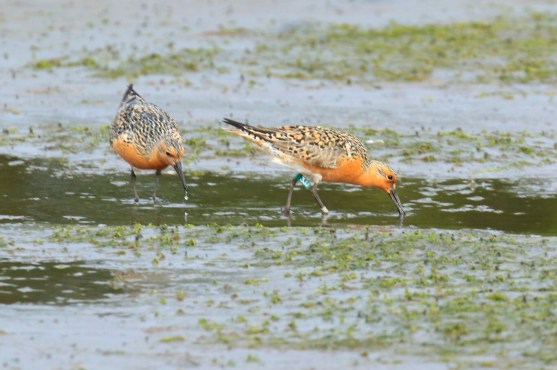
The plan was to get to Bottle Beach 3 hours before high tide.  I arrived a little before that along with Chuck Jensen.  Indeed the tide was still pretty far out but as we started to walk out onto the mud, we could see birds at the water’s edge and my first look through my telescope found the most hoped for bird – Red Knot.  A real beauty in breeding plumage, they can almost always be found – sometimes in the hundreds – at Bottle Beach in May.  There were other shorebirds as well.  As the tide pushed them closer into us we could find Red Knots, Black Bellied Plovers, Western Sandpipers, Dunlin and Short Billed Dowitchers.  No Godwits and again no Ruddy Turnstones, but the Dowitchers and Knots were new for the year and beautiful as the sun came out and provided great light.  Then a flock of Whimbrels flew in and gave us good looks.

Red Knots

Red Knots

Short Billed Dowitcher

Short Billed Dowitcher

Black Bellied Plover and Red Knot

Red Knot and Black Bellied Plover

Whimbrel

Whimbrel2

Figuring the show was over around 7:30, I headed back to town for dinner and then early to bed for an early start the next morning as the boat was to depart at 6:00 a.m.

I don’t know how many pelagic trips I have been on with Westport Seabirds – at least a dozen.  It truly is a first class operation.  Captain Phil Anderson and First Mate Chris Anderson are as good as there are anywhere.  The spotters are always terrific and this time Bruce Labar was aboard as well – not as an official spotter but he just couldn’t help himself and added to the expertise of Bill Shelmerdine, Michael Donahue and Scott Mills.  We were in good hands.  It was also great to see familiar faces on-board as well – Brian Pendleton, Michael Charest, Todd Sahl, Steve Giles and Ed Newbold among others.  The weather was gray but the seas were supposed to be relatively calm and it looked like a good trip.  Certainly a good start when the Fork Tailed Storm Petrels were again seen close in to the marina.

While no two pelagic trips are the same, there is generally a similar pattern as certain birds are seen close in and others are not seen until we reach the deeper water.  Some birds are almost guaranteed (Sooty and even Pink Footed Shearwaters).  Others are almost for sure (Black Footed Albatross, Fulmar and Sabine’s Gull).  Others are regular even if not necessarily seen well (Cassin’s Auklet, Fork Tailed Storm Petrel, Parasitic Jaeger).  Then there is always the chance for something special (or different depending on the time of year) like a Laysan Albatross or a Manx Shearwater or even (be still my heart) a Murphy’s Petrel.  If you are lucky, a processing boat or shrimper is found and there my be hundreds of birds flying all around it.  Other times, birds are more scattered and are seen in small groups or as singletons.  Usually many will come in at chum stops – providing the best views and photo opportunities.  And always some and often many marine mammals – whales, seals, sea lions, dolphins, porpoises.  Each trip is different and this one was definitely no exception.

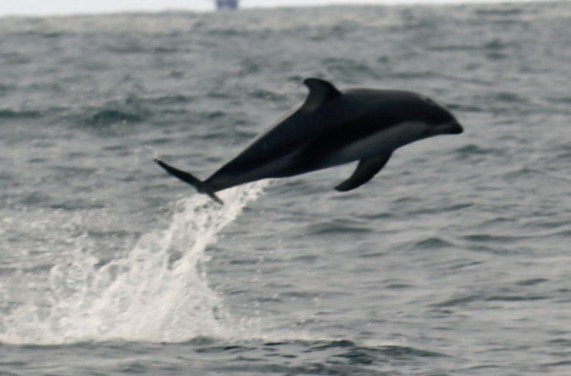
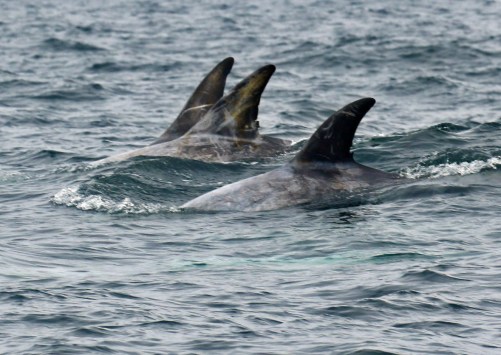
The start was slow – very slow.  A few Pacific Loons, some Gulls and some Common Murres and not much else.  Finally a few miles out, we picked up our first shearwaters – a few and then many Sooty Shearwaters – often seen very close to shore and often in the thousands – or even tens of thousands.  We diligently looked for a Pink Footed Shearwater but it was quite some time before the first one was seen.  A single Sabine’s Gull was seen and then another but it remained slow – except for a mammal show and then another and another.  Some, but not as many good looks at or as many different kinds of whales as on some trips but I have never seen so many dolphins:  100+ Risso’s Dolphins, 350+ Pacific White Sided Dolphins and 70+ Northern Right Whale Dolphins.  Often they were immediately next to or even under the boat and they put on quite a show.  One Humpback Whale fully breached – a spectacular show not far from the boat – unfortunately it was a complete surprise and was not captured by any cameras.

Pacific White Sided Dolphin

WhiteSided Dolphin Breach

Risso’s Dolphin

Risso's Dolphin

Risso’s Dolphins

The Gang of Three

The mammals were fun, but I wanted more birds – and at least for quite a while there just were not many.  Another group of shearwaters did include some Pink Footed and there were a couple of Cassin’s Auklets but they were very hard to see with the 5 foot seas – not enough for real discomfort but unsteady for photos and any birds on the water were hard to observe.

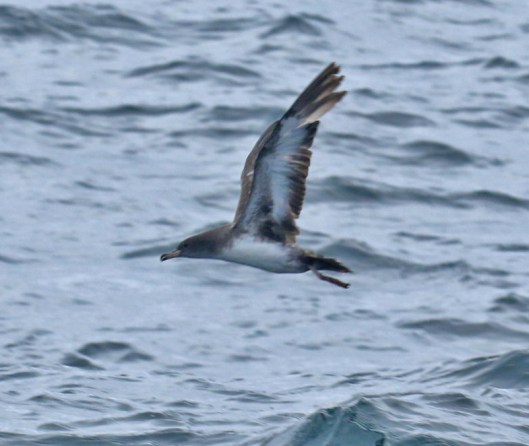
Pink Footed Shearwater

Pink Footed Shearwater

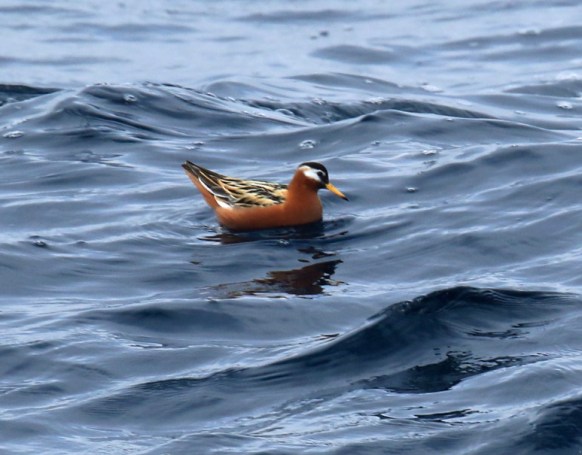
Then we started seeing Phalaropes – lots of Phalaropes – one or two or groups of 5 or 6 and then more of the same.  Most were Red Phalaropes but a good number of Red Necked Phalaropes were also seen.  Sometimes the two species were together giving great comparisons.  Red Phalaropes really are spectacular – especially the females.  Unlike most bird species, Red Phalarope females are both larger and more colorful than their male companions.

Red Necked and Red (Male) Phalaropes

Red and Red Necked Phalaropes

Red Phalarope Female

Red Phalarope1

Red Phalarope – Flight

Red Phalarope Flight1

Red Phalarope Male

Red Phalarope Male

Red Necked Phalarope 

Red Necked Phalarope

Red Necked Phalarope – Flight

Red Necked Phalarope Flight

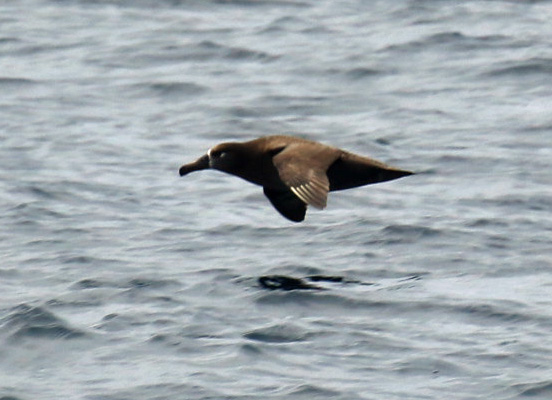
Then at last we had a Black Footed Albatross.  Usually they are plentiful and come quite close to the boat.  On this trip, they were uncommon and mostly remained far away and poor light for all but one did not help photo ops.

Black Footed Albatrosses

Black Footed Albatross

BFALB

Failing to find a fishing boat with birds around it was disappointing but we managed some good birds (even if sporadically nonetheless).  A Jaeger was spotted at some distance but the combination of good luck and Phil’s expertise brought it in closer and we got good looks at a Parasitic Jaeger.  Later in the trip another Jaeger was first thought to be a Long Tailed Jaeger but as it got closer, good looks and photos proved it was another Parasitic Jaeger.

Parasitic Jaegers

Parasitic Jaeger4  Parasitic Jaeger

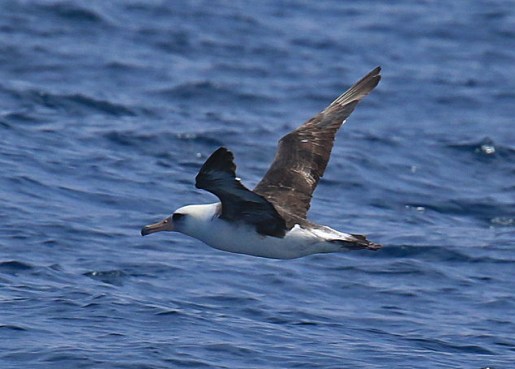
Then the surprise and best bird of the day.  Even though there had been very few Black Footed Albatrosses we were gifted with a visit by a Laysan Albatross – seen almost each year but not regularly and always welcome.

Laysan Albatross

Laysan Albatross

Laysan Albatross1

Now no matter what else – the Laysan Albatross made this a great trip.  Nothing that rare but another good find was a single Tufted Puffin.  Along with the many Common Murres, some Rhinoceros Auklets and a few Pigeon Guillemots and Cassin’s Auklets, this made for a good sampling of alcids for the trip.

Tufted Puffin

Tufted Puffin1

Cassin’s Auklet (Distant)

Cassin's Auklet

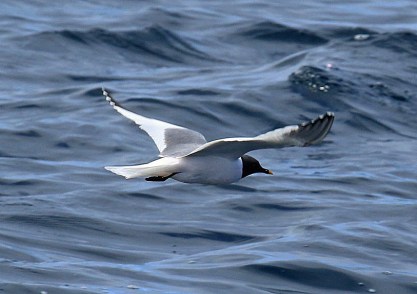
The light had also improved and that allowed for a better photo of some Sabine’s Gulls.  Not killer shots but truly beautiful gulls.

Sabine’s Gulls

Sabine's Gull1

Sabine's Gull

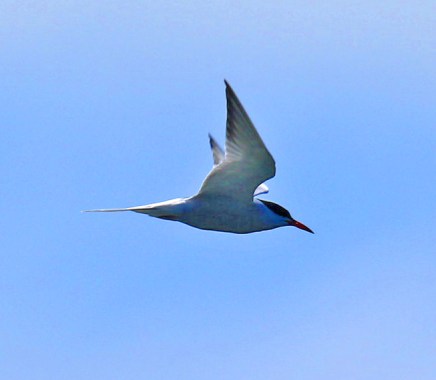
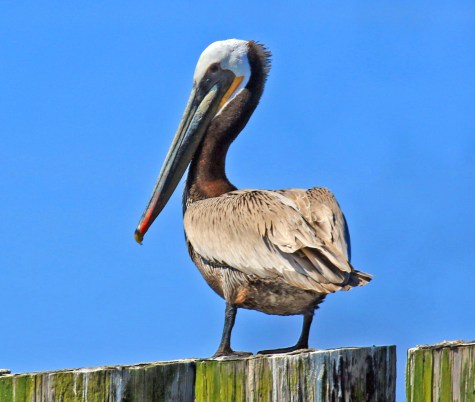
A big surprise and disappointment was that we had only a fleeting and single view of a Northern Fulmar.  They are always cooperative at chum spots – when there are many birds around – but that was not our experience on this trip, so I am glad I have lots of Fulmar photos from other trips.  It was time to head back to port.  We were traveling in sunshine and with an incoming tide which made the trip very smooth.  No exciting new birds on the return and we were not able to find a Wandering Tattler on the jetty – a common feat.  But once in the marina  we had our first terns of the trip – a group of Common Terns, some Brown Pelicans, a photo op for a Double Crested Cormorant that I could not resist, a posing Bonaparte’s Gull and a surprise Heerman’s Gull.

Common Tern

Common Tern1

Brown Pelican

Brown Pelican1

Double Crested Cormorant

Double Crested Cormorant

Bonaparte’s Gull

Bonaparte's Gull2

So another great pelagic trip.  Missed some hoped for birds and not nearly the quantities of many that we usually have.  But great looks at many Phalaropes, a cooperative Puffin and the lovely Laysan Albatross plus quite a marine mammal show.  But the day was still young and I was hoping for some shorebirds that were missed the previous day.  Another try for the Wandering Tattler – but again no luck.  Back to Tokeland – nothing there.  One last gasp – another try for Snowy Plover at Grayland/Midway area.  Again zero shorebirds on the beach – but wait – about 1 mile past the normal breeding area, I saw two little blips on the beach.  Positioned the car for a photo – snap, snap – and they were gone.  Definitely cute little Snowies.

Snow Plover

Snowy Plover

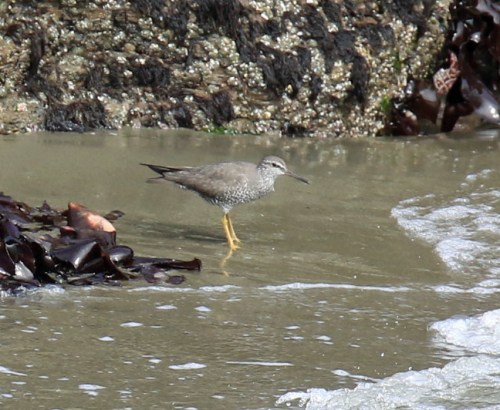
Encouraged by this find – which I had given up on, I decided to make one more try for the Tattler – this time looking at a spot where Brian Pendleton had seen two the day before – at about the same time.  No luck there but at the next “groin” over I finally found one.  A good end to a very good day and a very good trip.

Wandering Tattler

Wandering Tattler

So what about that contrast and comparison with that other Coast – the one in Florida.  My trip there had also included a pelagic trip – the boat trip to the Dry Tortugas.  Other than they were across salt water, there were almost no similarities.  Heck they are only about 3000 miles apart on two different oceans – so what would one expect.  I don’t think there was a single species seen at either coast that was seen at the other one with the exception of the Sanderlings and a couple of Western Sandpipers.  The gulls were different, the terns were different and there were no tubenoses or alcids in Florida at all  although I sure wish there had been an Audubon’s Shearwater!!

As I said, that is one of the things that makes birding so interesting – different birds in different places – all fun to see – challenges and surprises and hopes everywhere.

“Toto, (Blair) I’ve a Feeling We’re Not in Kansas Anymore…

No not Kansas and definitely not Seattle either.  Our guide, Paul Bithorn, picked us up at the Miami Airport after our red-eye flight from Seattle and despite very little sleep, Frank Caruso and I were ready to bird.  My earlier post ( wordpress.com/post/blairbirding. wordpress.com/14301) set the context for this trip and now I am writing about the actual birding.  And the birds we were after are not found in Kansas and definitely not found in the Northwest.  We had sent Paul a long list of target birds – ABA Life Birds for each of us and ABA Life Photo birds for me.  We had a lot territory to cover and a lot of birds to see and Paul had a plan to find us as many as he could.

Adrenaline was already in our system but when Paul told us that a number of Bahamian rarities were being seen at a local park, the adrenaline increased and sleeplessness was forgotten.  We headed directly to Crandon Park south and east of Miami on Key Biscayne.  In addition to a Thick Billed Vireo (a notable South Florida rarity), there had been recent sightings of a Bananaquit, a Western Spindalis, and a  Bahama Mockingbird on the Osprey Trail and a Fork Tailed Flycatcher had been seen at another spot within the Park. Any one of these birds would be fantastic and the possibility of more than one was beyond any reasonable expectation.  There was also a good chance for migrants.

Even before getting to the area where the birds had been seen, I started picking up ABA Life photos.  I would get better photos of each later, but I quickly got photos of Magnificent Frigatebird, Black Whiskered Vireo, Anhinga, Fish Crow, Black and White Warbler  and Red Bellied Woodpecker.  (I am not including photos of some of these because even though these were my first ABA photos of them, we saw them elsewhere (and sometimes often) and better photos will be included in other blog posts).  Then I found a bird that really startled me.  A quick look noted a small warbler with a striking supercilium and I thought I had a Bananaquit  in a tree near the beginning of the trail.  I checked my field guide and nope not a Bananaquit.  It was a female Black Throated Blue Warbler.  I had never seen a female before.  Little did I know how valuable that misidentification would turn out to be.

Black and White Warbler (First ABA Photo)

Black and White Warbler1

Black Throated Blue Warbler – Female – NOT a Bananaquit

Black Throated Blue Warbler Female1

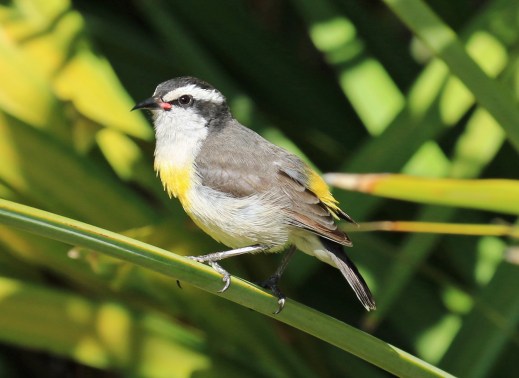
A little further down the path, Paul spied a pretty nondescript little bird that he quickly identified as a Thick Billed Vireo.  It was not very cooperative for a photo but we got sufficient looks to tick the species.  We had lots of warblers but mostly American Redstarts, Prairie, Palm, Northern Parula and Cape May Warblers (which was another ABA Life Photo but since I have a much better one from later in this trip, I am not including one here)Then a small bird flashed in front of me and that earlier confusion with the Blue Throated Gray female paid off.  This time it really was a Bananaquit and I got photos to prove it!!

Bananaquit (ABA Life Bird)

Bananaquit1

Bananaquit Best

We had been birding for at most an hour and I already had a life bird and 8 life photos.  If we could get the Bahama Mockingbird or Western Spindalis, the trip would already be a big success.  Other birders were looking as well and we all struck out.  A surprise and treat was running into Chris Feeney – a BIG TIME ABA Lister who I had met on my trip to Adak with John Puschock last year.  He too was looking for the Mockingbird.  No success this day, but I learned he found it later in the week.  I added a very poor first ABA photo of a Yellow Billed Cuckoo and that was it.  We decided to move on and went to a different area of the Park looking for the Fork Tailed Flycatcher.  Again no luck.  It had moved on and was not seen again during the time we were there.  But there were other goodies.

Yellow Billed Cuckoo (ABA Life Picture – poor for sure)

Yellow Billed Cuckoo

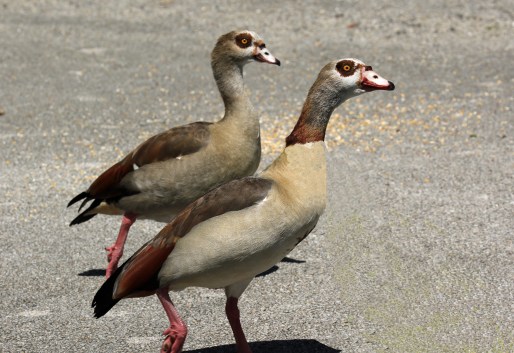
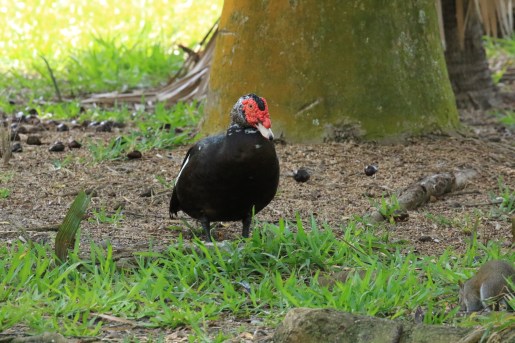
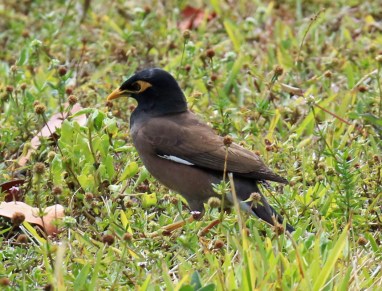
At a large pond, we found Egyptian Geese and Muscovy Ducks – both now recognized by the ABA as countable species.  I had seen the Muscovy Duck that was either a released or escaped bird at the Kingston Ferry Terminal in Washington, but this guy was for real.  Later in the trip, we would see dozens of this species.  The photo here is of the first one seen.  I also added ABA Life photos of Gray Kingbird and yet another countable exotic – a Common Myna.

Egyptian Geese (ABA Life Bird)

Egyptian Geese

Muscovy Duck (ABA Life Bird)

Muscovy Duck

Gray Kingbird (ABA Life Photo)

Gray Kingbird1

Common Myna (ABA Life Photo)

Common Myna2

There was also a Swan Goose – another species I have seen in Washington – but not yet recognized by the ABA.  A couple of very tame Sandhill Cranes gave us great looks and photos and we watched a Tricolor Heron fishing.   As large and colorful and out in the open as it is, it is hard to believe that I first noted this bird by its call.  I remembered it from India where I saw one in the wild.  Here the Indian Peafowl is a domesticated bird or an escapee, but they are thriving and self sustaining in Florida, so who knows, someday they may be “countable’.

Indian Peafowl

Indian Peafowl

But it was time to move on.  We saw birds as we went along the way, but our next stop was to be Dolphin Mall in Sweetwater, FL.  This was more like “Classic Florida” – wetlands, lots of water and lots of birds.  Our quarry here was the Gray-Headed Swamphen – a close relative of the smaller Common and Purple Gallinules.  It took us very little time to find one – a life bird for both of us.

Gray Headed Swamphen (ABA Life Bird)

Gray Headed Swamphen1.JPG

This was only to be a half day of birding and Frank and I really were pretty beat from the red-eye trip.  Paul was generous with his time and we chased down a lot of parakeet species which I will detail in a separate blog post about them and other exotics.  I will include just two more birds from this day – one a countable exotic and the other a Florida specialty that both Frank and I very much wanted.

The countable exotic is the Nanday Parakeet – one that is easy to identify because of its black head.  The other is the Spot Breasted Oriole.  Paul got both of them for us on that first day and then we had other observations of each later in the trip.  Both were life birds for each of.

Nanday Parakeet (ABA Life Bird)

Nanday Parakeet

Spot Breasted Oriole (ABA Life Bird)

Spot Breasted Oriole4

I promised i would not go into details, so lets just say that Paul kept going until the light was gone – literally.  No more said – right Paul?!

Light Casualty

With the three hour change especially after a mostly sleepless night on the flight, my body had no clue what time was what.  Still there was no trouble meeting Paul for an early start for our birding.  We were off to the Evergreen Cemetery chasing another reported Bahama Mockingbird and to Green Cay and Wakadohatchee Wetlands and to Loxahatchee National Wildlife Reserve.  Lots of ground to cover. And exactly what is a “hatchee”?

No Bahama Mockingbird at the cemetery.  It was wild seeing all of the Muscovy Ducks – faces that only another Muscovy Duck could love.  Paul made sure that we saw Leslie Nielsen’s grave there.

Leslie Nielsen’s Grave (I will spare you the stories from Paul and Frank)

036A1655 (2)

Too bad it was only a Northern Mockingbird that was in a nearby tree.  I found a Wood Thrush at the cemetery but could not get my camera to focus and missed what would have been an ABA first photo.  There will be lots of opportunities for that species photo somewhere else someday.  Otherwise, it was basically more of the same regular birds.

Muscovy Duck with Young

Muscovy Duck with Chicks.jpg

Time to move on and we headed to Wakadohatchee Wetlands in Delray Beach which was a “classic” Florida spot to me – birds nesting in the trees and a boardwalk that got you to them.  I have not said much about non-avian wildlife in these blog posts but we had lots of reptiles on our visit and this was definitely a spot with alligators, iguanas, lizards and such.  I will probably cover some of them in another post but throw in an alligator picture here.

Alligator

Alligator

But this was a fun place for birds.  The boardwalk took us up close to a number of small islands with a good variety of waders.  We had nesting Wood Storks, Anhingas, Great Egrets, Cattle Egrets and Roseate Spoonbills.  It was also the place where we found our first Purple Gallinule – giving me another ABA first photo – unfortunately one of the only birds we saw here that was not up close.  And we had more Gray Headed Swamphens and I include another photo to compare it with the Purple Gallinule.

Wood Stork

Wood Stork5.jpg

Wood Stork Chick

Wood Stork Chick

 Anhinga Juvenile

Anhinga Juvenile

Cattle Egret

Cattle Egret

Roseate Spoonbills

Roseate Spoonbills5

Purple Gallinule (ABA Life Photo)

Purple Gallinule5

Gray Headed Swamphen

Gray HeadedSwamphen2

While it is great to see new, rare or target birds especially life birds or life photos, it is most memorable when there is some activity that reminds us that these are real life birds in their natural environments where they eat, breed, compete and display.  We had one such encounter here when two Common Gallinules were seemingly fighting each other to establish dominance – and probably to show off to nearby females.  We watched for many minutes in fascination as they squared off and fought.  The photo captures some of the action and shows the incredibly long toes on their feet.

Fighting Common Gallinules

Fighting Moorhens1  Fighting Moorhens

Just after we watched that display we had another “magic moment” one of my favorites for the entire trip.  We had just seen a Black Necked Stilt on one of the islands, our first shorebird for the trip, when I caught a small form flying across the water.  Even though I have only seen the species once – more than 43 years ago – and it was moving fast – somehow my brain immediately knew what it was and I called it out.  I even caught a fleeting shot of it in the camera.  Not a great shot but my first ever of a Least Bittern.  It had been on my want list but I was not optimistic and any shot even a poor one made me happy.  And then it got way better.  As we rounded a bend in the boardwalk, we saw the Least Bittern fly back behind some reeds and then move its way through some others – coming out into the open on a couple of occasions in good light for an excellent photo opportunity – and then we saw a second one – not as photo friendly.

Least Bittern – (ABA Life Photo)

Least Bittern4

Soon thereafter some more drama as we came upon an Anhinga that had speared a pretty sizable fish – a Bream.  It maneuvered to get the fish into position for several moments and then swallowed it whole down its long neck.  It would seemingly be enough food to last quite a while.

Anhinga with Fish

Anhinga with Fish Close

Anhinga with Bream

We also had a Little Blue Heron, a Tricolored Heron and a Great Blue Heron at Wakadohatchee – a really terrific place.  There were not many ducks on our trip but here we had one of the best looking – a Black Bellied Whistling Duck – a species I had seen in Texas only.  And another terrific place was up next as we headed to Green Cay – another wetlands with a great boardwalk – this one in Boynton Beach.  On the way Paul showed us a Monk Parakeet at its massive nest.  There is a small colony of these Parakeets in Yacolt, Washington where they have successfully nested but unlike here in Florida, it is not countable in my home state.  It is also countable in Texas where I have seen it but this is my first photo of an ABA Countable bird.

Black Bellied Whistling Duck

Black Bellied Whistling Duck5

Monk Parakeet (ABA Life Photo)

Monk Parakeet at Nest

There was a feeder on the way in to Green Cay that Paul said often had Painted Buntings.  We watched for quite a while with great anticipation hoping to see these very colorful birds and then two flew in and perched – but unfortunately they were the very drab females and no males ever made an appearance.

Painted Buntings – Females

Painted Bunting Females

Per the above, we did not have many ducks on this trip and the Mottled Duck  we had at Green Cay sure looked drab compared to the Black Bellied Whistling Duck at Wakadohatchee.  We also had a Blue Winged Teal – the only place we had either species.

Mottled Duck

Mottled Duck

Blue Winged Teal

036A2233

Boardwalks are great both in providing access and also in giving birds places to roost right in front of watchful observers.  These next three photos from Green Cay could not make that point any better.  The first is of a Green Heron that seemed to prefer the Boardwalk railing to any of the mangroves.  We saw many Green Herons here and at other stops, but this was easily my favorite photo. The second is of a young Double Crested Cormorant that never flinched from its railing post – even when one lady literally came within inches as she walked by.  The third is another one of my favorites for the whole trip – a close up of an Eastern Screech Owl – an ABA Life photo.  It was part of a three owl family group near a nest box.

Green Heron

Green Heron5

Double Crested Cormorant – Close-up

Double Crested Cormorant

Eastern Screech Owl – (ABA Life Photo)

Eastern Screech Owl5

We should have been very tired, but Paul kept producing more and better birds and places and we were going strong.  Our next stop was to be at Loxahatchee National Wildlife Reserve, a very large reserve in Palm Beach County which supposedly is the most northern remnant of the Everglades system.  We had a repeat of some of the birds seen previously but it was here that we found our first Limpkin – another ABA Life Photo – and several Glossy Ibis.  We saw them in many places but the best photo of a Tricolored Heron was also from Loxahatchee’

Limpkin (ABA Life Photo)

Limpkin

Glossy Ibis

Glossy Ibis Head

Tricolored Heron

Tricolored Heron5

Although it would get supplanted by an experience in the Everglades the next day, it was at Loxahatchee that we first found a Swallow Tailed Kite, a beautiful bird I had seen only once before and which was at the very top of my Photos Wanted list.  I was riding high when I was able to get its photo.

Swallow Tailed Kite (Life ABA Photo – but Even Better the Next Day)

2017-04-27 18.25.01

We had hoped for a Two Kite day but but we did not find our other target – a Snail Kite – well  that is until just after we left the Refuge.  We were on to our next spot after Loxahatchee when I saw a “form” perched on a wire out of the car window that was clearly a raptor and even at the speed we were going – looked interesting.  Had it been on home turf, I probably would have assumed it was just another Red Tailed Hawk and kept going but it looked smaller – here then it most likely was a Red Shouldered Hawk, but something different had caught my eye and I wondered if we had a Snail Kite.  Paul said we definitely had to find out and he did the first U-Turn he could.  Sure enough it was our first Snail Kite of the trip.  A Life bird for Frank and my first photo.  It flew almost as soon as we parked across from it but we could watch it in flight and then as it landed on a metal post across the road.

Snail Kite (ABA Life Photo)

Snail Kite Flight4

Snail Kite1

It was mid afternoon and Paul’s Plan was to take us to a spot where Red Whiskered Bulbul was likely.  It was a small residential community and we walked through it looking for another exotic that was now established and countable by the ABA.  I spoke to some of the residents out walking dogs or playing with kids – mostly to assuage any concerns about folks with binoculars and cameras in their neighborhood.  Some were familiar with the Bulbuls and had seen birders there looking before.  No luck at first and then we saw a pretty cool thing – sort of.  Seemingly out of nowhere, a Cooper’s Hawk swooped in and picked a dark “something” off of the ground and then perched nearby.  At first we thought it was a Bulbul.  How horrible would that be!  Check out the photo yourself – is that feathery or furry?

Cooper’s Hawk 

Cooper's Hawk5

Shortly thereafter we found a single Red Whiskered Bulbul in a tree and I was able to get a photo.  And it was a very welcomed ABA Life Bird for Frank.

Red Whiskered Bulbul (ABA Life Photo)

Red Whiskered Bulbul5

Not long afterwards, we had another exotic that at least as of yet is not ABA Countable – Common Hill Myna – one of many seen.

Common Hill Myna (Not An ABA Bird – at least not yet)

Common Hill Myna5

It had been another long and great day.  We had dinner at one of Paul’s favorite establishments.  Everyone was friendly and knew Paul.  It was not exactly a birder crowd but everyone was welcome and we welcomed the excellent straightforward food.  Then it was back to the motel – ready for the next day – off to the Everglades.  We had over 100 species for the two days – many of them South Florida Specialties.  Super birding!!  Most definitely we were NOT in Kansas!!

After the Tortugas – Back to Miami and then Heading North

After the long boat ride back from the Tortugas, we got to Key West around 5:15 p.m.  It was still very light – and at least as far as I was concerned, there were still birds to be seen, birding to do.  But this was another case where looking back, I would have done this trip differently – at least for me.  There is a big difference between birding on one’s own and birding with a group; and there are big differences between groups.  Trips with Audubon Societies or local Bird Clubs are different than trips with major tour companies like WINGS, Rockjumper, VENT, High Lonesome Tours or FIELD GUIDES for example.  I have been on trips of both kinds with all of them and for the most part, all have been enjoyable and successful.  It is important to match approaches with expectations or goals – I did not do this well this time.

Birders on the tour company tours tend to be more interested in adding new species to lists with very specific targets and are generally more intense in that pursuit.  It is not that they are necessarily better birders and certainly not necessarily better or more interesting people, but they are more purposeful and dawn to dusk is the usual schedule.  The two and a half days when I was birding with only Paul Bithorn and Frank Caruso were focused like that and included early morning starts, long days and late night finishes.  Food was at most a second thought – grabbing what we could wherever and whenever we could – and then getting back to the birds.  The Tropical Audubon Society tour was far more interested in food and where to eat it than I was.  Many more hours and many more dollars were spent on food than I would have allocated and spent if I were doing this again. Nothing wrong with their way – just not what I would have chosen if asked.

So after returning from the Tortugas, we were done for the day.  The same thing had essentially been the case the evening before when it took a long time to get rooms assigned and then go to what apparently was a favorite place for a long dinner – excellent food and company – but not what I would have expected on a birding tour – especially since the expensive meal was being paid for by me and not the tour itself.   At least on this night it gave me a chance to do something special to commemorate and celebrate Frank’s milestone ABA Bird 700.  I arranged for the restaurant to bring a whole Key Lime pie to the table with “FC 700” written on the top.  You only have one chance to see your 700th species!!

The Key Lime Celebration Pie

Frank 700

The next morning got off to another slow start as it was “essential” that the group go to a particular deli for breakfast.  Having already significantly overloaded on calories and time spent eating, I stayed outside and looked for birds – particularly hoping to finally get a photo of a White Crowned Pigeon, a specialty of the Keys.  Our leader had earlier assured me that they would be “everywhere”, but we had had only a few flybys – no perched birds and definitely no photos.  I did not find the pigeon but got probably my best photo of the trip of a Red Bellied Woodpecker – common enough everywhere but it had been on my “picture wanted list” at the start of the trip.  Perched on the only tree in the parking lot outside of the deli.

Red Bellied Woodpecker

Red Bellied Woodpecker5

And another bird was present in large numbers in that parking lot Red Junglefowl – the direct ancestor of our domestic chickens.  It is not a countable species, but from the numbers we saw in numerous places perhaps it may become so.  There were at least 12 birds scrounging around the lot including two broods of young chicks.

Red Junglefowl

Red Junglefowl

At last the birding began and after a while, we finally found a single White Crowned Pigeon perched high in a tall tree and some distance away.  It would be the only one perched we found and thus is the only photo for the trip.  I had seen them on that 1978 trip, so no lifer, but I was glad to get the photo and appreciative of the spotting by Ed Rumberger – an appreciation that would replay later in the day.

White Crowned Pigeon
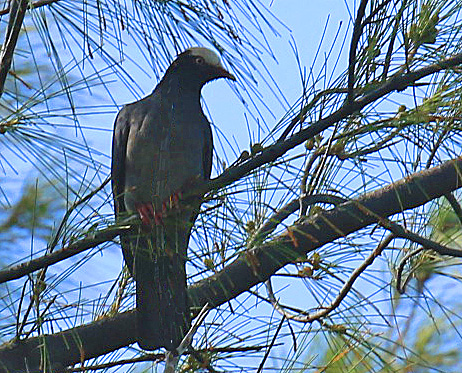
White Crowned Pigeon-r1

Our first main stop heading home was to Fort Zachary Taylor.  A good number of migrants had been reported there earlier in the week, but it was very quiet when we birded there.  The best bird was a Black Whiskered Vireo, another South Florida Specialty.  I had already seen several on my visit, but one birder who had also been on the Tortugas the day before got his lifer there – always nice.

Black Whiskered Vireo (photo from the first day of my visit)

Black Whiskered Vireo1

Birding remained slow most of the day.  There was yet another (to me) waste of time as we went to first one and then another “must eat at” restaurants for lunch.  Both were very crowded so the group moved on and finally came to a third spot for a long lunch.  Given the slow birding, maybe it didn’t matter.  We did find some more shorebirds – once again at the wrack line on the beach.  The most common shorebirds were Least Sandpipers and Ruddy Turnstones.  The latter are uncommon in Washington and seeing them in full breeding plumage was fun.  There were also a lot of Sanderlings – abundant at times in Washington.  Again it was very nice to see them in full breeding plumage – sometimes next to others still in their dull winter garb.  And finally we had our first Short Billed Dowitchers for the trip.

Ruddy Turnstone

Ruddy Turnstone1

Sanderlings – Breeding and Basic

Sanderling Breeding Sanderling Winter

Short Billed Dowitcher

Short Billed Dowitcher Flight

Frank and I had looked for a Mangrove Cuckoo with Paul earlier in our trip and we had stopped once on the way down to Key West as well.  We found none.  We tried once more, this time at Black Point Park and Marina in Homestead.  The thick Mangroves were supposed to be a favored spot for this South Florida specialty – a life bird for almost everyone there.  The raucous call was played out from different apps to what was supposed to be a very responsive bird – nothing.  More playback and more nothing.  Then after maybe 30 minutes of failed effort, Tom Keegan came through once again.  A Cuckoo had apparently flown into a Mangrove in response to the calls but had neither called back nor perched out in the open to see what was going on.  It was very difficult to see from where we were, but as was often the case, Paul was able to get on the bird and was able to get me a good view through a small window in the wind blown foliage.  I tried to get photos as best I could, but there was always something in the way that did not allow my autofocus to work.  If I had been back 25 feet next to Ed Rumberger, the view would have been clearer and Ed’s photo is included here.  Thank you Ed.

Mangrove Cuckoo

Mangrove Cuckoo2

After checking my photo attempts carefully after uploading them on the computer, I found one that showed the bird poorly behind dense foliage – sufficient barely for an ID only.  So I had both a life bird and a life photo.  Frank and much of the rest of the group were not so lucky as the bird was just so difficult to see.

The group also visited Crandon Park hoping for some of the rarities that had been seen there, but it was really dead.   Back to the Audubon Center and our trip was over.  It had been good to end with the Mangrove Cuckoo even if not the best views.  There definitely had been some great birds and it was good to meet some fine folks, especially the two couples, Tom Keegan and Beth Waterbury from Idaho, and Ed and Barbara Rumberger.  Barbara does some incredible work with a group called Operation Smile that does reconstructive surgery for children with cleft palates all over the world.  She was off to Nicaragua within days after our tour ended.  All in all, 100 species had been seen by one or another of the members of the group.  I include some photos of some of them – not included in earlier posts – not life birds or life photos, but great to see and photograph at any time.

Burrowing Owl

Burrowing Owl

Reddish Egret

Reddish Egret

Yellow Crowned Night Heron
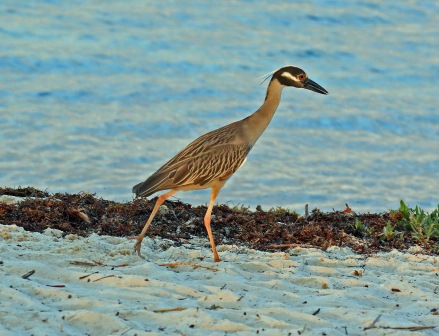
Yellow Crowned Night Heron5

After the three days with the larger group, it was nice to be back to the Paul, Frank and Blair threesome and to head north for some new birds.  Instead of being in Paul’s car, we rented one from Enterprise.  I will give a shout out to them as they were very efficient and after seeing very long lines at the other rental car companies, this proved a good choice.  I was now the driver and driving in South Florida is “different”.  Still way too many cars just like Seattle but the drivers are to my way of thinking much better.  South Florida conjures up images of lots of old retirees who you might expect to be very careful and slow drivers.  There definitely were some but much more the case was of very fast and aggressive drivers.  Unlike the bane of my driving existence in Seattle, here the left lanes really were used for passing and faster drivers.  Speed limits on the major highways were 65 or even 70 and if you were not going at least 7 miles faster than that (and sometimes even 10 or 15 mph faster), you better get out of the way.  Have to admit, that had great appeal – both to join in but moreso because there were just not many out in the left lanes slowing things down.

Our targets heading north were Florida Scrub Jay, Bachman’s Sparrow, Red Cockaded Woodpecker, Crested Caracara and maybe some shorebirds and a long shot – Smooth Billed Ani.  The Scrub Jay and Woodpecker would be life birds for me.  The Sparrow and Ani would be new photos and the Ani would be a life bird for Frank.  Earlier this year I had joined Mike and MerryLynn Denny on their Owls by Day trip (See    ).  On that trip I had met Bruce Lagerquist who has birded a lot in Central Florida and Bruce shared some of his birding wisdom with me – it proved to be extremely helpful.  Paul also knew many of the key spots and that coupled with Ebird reports gave us all we needed to know to find our birds.  It was more than a three hour trip to get to this new area so it was already midday when we got to our territory. – starting in the Three Lakes Area – one of Bruce’s recommendations.  We had been in heavy sunshine throughout the past six days, but now the weather had changed with sun, clouds and showers mixed in.

The Three Lakes area was supposed to be good for Bachman’s Sparrow.  Amazingly we had not seen a single sparrow of any kind during the previous 6 days – hardly like our Washington birding.  We understood that Bachman’s Sparrows were shy and unresponsive so my hopes were high but expectations were low.  Frank, with his ever keen ears was the first to recognize a “different song”.  We compared it to our Bachman’s Sparrow recordings and it was very close – we had our bird – but where was it?  Hardly shy and quite responsive, first one and then another responded to our playback and one came in for my first ever photo.

Bachman’s Sparrow

Bachman's Sparrow Singing

We understood that Whooping Cranes could be found in this spot, but that apparently is no longer very likely as the population has diminished significantly and maybe even disappeared.  I have missed them in Texas twice, so it would have been wonderful.  Sadly we found only Sandhill Cranes.

We did not pursue specific other targets in the immediate area but kept our eyes open for anything new.  We heard the distinctive call of Northern Bobwhites but did not locate any birds.  As with every other place in Florida, Northern Cardinals, Blue Jays, Boat Tailed and Common Grackles and especially Northern Mockingbirds were abundant.  We also had more Red Shouldered Hawks, Swallow Tailed Kites, Black and Turkey Vultures, our first Bald Eagle, Eastern Meadowlarks, a singing Carolina Wren, our first Osprey, another Limpkin, lots of Cattle Egrets and a small group of Snail Kites.

Eastern Meadowlark

Eastern Meadowlark Singing

Limpkin

Limpkin2

We headed for a spot near Vero Beach that Bruce had said was a sure thing for Florida Scrub Jay.  Along the way, we had another Snail Kite, 4 Swallow Tailed Kites and another Short Tailed Hawk.  We found our spot, the Wabasso Scrub Conservation Area in Indian River County.  The last half mile before arriving did not look like a place you would want to visit alone or at night and when we arrived at the park, two cars pulled off and we immediately thought drug transaction – definitely not birders.  A jay appeared – but unfortunately only a Blue Jay.  I went out exploring and found a path leading into a sandy area.  Not too far in I played the Scrub Jay call, and there was an immediate response and a Florida Scrub Jay flew right over my head and perched near the top of a short tree.  Not a perfect photo, but a life bird and life photo nonetheless.  Then without any further prompting on my part, it flew down and landed literally at my feet less than 5 feet away on the sand.  I actually had to back up to get it sufficiently far away to take a much better photo.

Florida Scrub Jay

Florida Scrub-jay

Frank had not originally followed on this path but quickly did so and found the Scrub Jay when I returned with the news.  We were two for two now on our pursuits so far and a Red Cockaded Woodpecker beckoned.  It was getting late and the weather was threatening but we headed off to the St. Sebastian River Preserve State Park – another of Bruce’s can’t miss spots.  By the time we arrived, it was getting dark – a little bit from the hour but moreso from very dark skies portending rain and possibly thunder and lightning.  The preferred habitat for the Red Cockaded Woodpecker is described as forests with little underbrush and few trees except for tall pines.  This area looked perfect.

Pine Woods at St. Sebastian State Park

Pine Woods

Frank and I started down the trail looking for white markings on trees that would indicate that nests were at hand.  We saw none and the skies continued to darken.  We heard some chattering and Frank saw some small birds fly and concluded they were more Brown Headed Nuthatches.  Since he had already seen Red Cockaded Woodpeckers and did not need one as a life bird as I did, and probably also being much wiser when came to the danger of lightning strikes, Frank headed back to the car.

I carried on and in another 100 yards or so was pretty sure I was hearing the Woodpeckers.  The chatter was coming from a spot that looked like it was across a ravine or even a small stream.  As I approached, I got a glimpse of one woodpecker in flight. I had already seen a Red Bellied Woodpecker, but this looked different and when the chatter continued I was certain it was a Red Cockaded.  It turned out that the ravine was both shallow and dry and when I crossed it, just ahead of me two black and white woodpeckers flew in together.  I had the targeted Red Cockaded Woodpeckers.  The light was terrible so the resulting photos were pretty poor, but there was no question about the ID.

Red Cockaded Woodpeckers

Red Cockaded Woodpeckers 5

I looked hard for some red on the head of the birds and found none – and figured maybe it was just the poor light.  Later at home, I looked at better photos on the Internet and even on the best of them, the amount of red was tiny so no surprise none was seen under the conditions I had in the field.  See the photo below.

Red Cockaded Woodpecker with Red Showing (from the Internet)

Red Cockaded Woodpecker with Red

I high tailed it back to the car and got in just as the thunder and lightning started and it poured.  It would have been worth it to get wet – but I was very happy to have avoided that.  Paul’s brother lived fairly close and he had graciously offered to put us up for the night.  After a very effective day of birding with two new life birds for me and an additional life photo, it was nice to relax – have some carry out Chinese food for dinner and get to bed early.

Hoping for a better view of these Woodpeckers, we returned to St. Sebastian the next morning.  We were greeted by very loud “Bob – White” calls.  My ears directed me in the direction of a distant pine tree and sure enough, a male Bobwhite was sitting on an open branch calling frequently.

Northern Bobwhite

Northern Bobwhite1

Frank soon also picked up a recently familiar call.  We were hearing and then seeing several more Bachman’s Sparrows.  And then another familiar call – the “pe-ent” of a Common Nighthawk.  Often heard flying during the day, none of us had ever heard one call from a daytime roost before, which this one seemed to be doing – quite a surprise.  Just as I was about to snap a photo, it flew off the exposed limb of one tree and flew a mere eight feet to the next tree.  None of us had seen a Nighthawk do this before.  This time it remained still for a photo.

Common Nighthawk

Common Nighthawk3

We walked towards where I had found the Red Cockaded Woodpeckers the previous day.  A large raptor flushed and flew silently away from us.  Not a great look but we were 99% sure it was a Great Horned Owl.  Maybe its presence explained why we were not able to find the sought after woodpeckers.  We did get looks to confirm that Frank was right about the Brown Headed Nuthatches the day before.  We also had Pine Warblers and  Eastern Towhees and then a Tufted Titmouse calling.  The latter is a common bird in the right habitat but I had never gotten a photo so was quite disappointed when I was unable to coax it in for a picture.  Unfortunately unlike the previous day, no Red Cockaded Woodpeckers were heard or seen.  More Bachman’s Sparrows and that was it.

Another Bachman’s Sparrow – Not Secretive at All

Bachman's Sparrow5

How strange that before coming to Florida, I had my doubts about seeing a Bachman’s Sparrow.  Not only had it proved easy to find but also easy to photograph and just like the Laughing Gull was our only gull of the trip, the Bachman’s Sparrow was our only sparrow.  Amazing…

We were running out of target birds.  I was interested in a Red Headed Woodpecker – needing a picture, and we were both interested in a Smooth Billed Ani – Frank as a life bird and me for a life photo.  Since there were lots of places where I might find the woodpecker, but this was the only likely area for the Ani, we decided to concentrate on that.  First however, I had found an Ebird report of a seemingly extraordinary shorebird spot – not on a wrack line but a more traditional area of mudflats.  Best of all, the report had included two White Rumped Sandpipers, a species that was on my wanted photo list.  Literally hundreds of shorebirds were reported so off we went to try to find Lake Poinsett and its smaller arm, Lake Florence, in Brevard County.  It was a ways off, really off the beaten path and a bit hard to find – and the weather was definitely turning for the worst with more thunderstorms brewing but when we arrived, there were shorebirds indeed.  Lots of them.  Hundreds of them.

The problem was that the mud flats were both large and hard to access as we were afraid to drive the car out onto obviously soft ground – and it wasn’t going to be easy to walk out closer either.  From the car we could see that there were Dowitchers, peeps, Black Necked Stilts, Semipalmated Plovers, and Yellowlegs.  There were also some sandpipers that were larger than the peeps and at least one that sure looked like it had a white rump when it flew.  The challenge was going to be how to identify specific species.  And then the birds all took off – flying left and right.  In Washington, when this happens we generally look for a Peregrine Falcon or an Eagle on the hunt.  Sure enough we found two immature Bald Eagles on the flats.

The birds resettled but now were more scattered on the sizable mudflats.  And then the rain came – not a light rain – a downpour – making wet ground even wetter.  I waited it out and then could not resist and got Paul’s scope and ventured as far out onto the soft ground as I could.  With the aid of the scope, I could identify 150+ Semipalmated Sandpipers, 46 Semipalmated Plovers, a half dozen Least Sandpipers, both Short and Long Billed Dowitchers, 35 Lesser Yellowlegs, 4 Greater Yellowlegs, 5 Black Necked Stilts and 15 Stilt Sandpipers.  Each of those numbers was probably conservative and there had seemed to be many more individuals than that before the Eagle scare.  And there was one “large peep” that I was pretty sure was the White Rumped Sandpiper that we had seen before.  It was a bit larger than the peeps almost as large as the Stilt Sandpipers but with a less erect posture.  It had relatively long wings.  Mostly brown, it had indistinct spotting on its breast and a bit of a white eye stripe/supercilium.  The bill seemed a bit longer than the Semipalmated Sandpipers but much shorter than the Stilt Sandpipers and with at most a very slight droop.  The legs were dark.  The feather scaling on the back seemed smaller than the Semipalmated’s as well.  Unfortunately it was pretty far out and the light was terrible.  Never have I more wanted a bird to fly but it never did so no chance to see the rump.  Was this the White Rumped Sandpiper?  Paul was convinced that it was.  Two had been reported here two days ago.  Probably was, but it sure would have been nice to get a for sure photo.  The only two even half way decent photos of any shorebirds were from before the deluge (and the gray skies that remained afterwards) and before the birds moved further away – one of a Stilt Sandpiper and one of a Lesser Yellowlegs.

Stilt Sandpiper

Stilt Sandpiper

Lesser Yellowlegs

Lesser Yellowlegs

It was time to go – to try for an Ani.  In the vicinity we also had a Dark Phased Short Tailed Hawk (seen from car on highway only), a Wood Stork, Snowy and Great Egrets, Tricolored and Little Blue Herons and a Roseate Spoonbill.  We kept looking for a Caracara and finally found one perched on a pole as we sped by – with more rain.  We were heading to Stormwater Treatment Area 5/6.  Paul had had Ani’s there in the past and one was reported from a few days earlier.  A remote and pretty unattractive spot.  Another long drive and with lots of very heavy rain – not fun at all.  We arrived and there was bad news and more bad news.  The entry gate was closed and it was raining – hard.  Walking in was still a possibility but not in that rain.  When one of the workers left through the gate we showed him a photo of the Ani and he said – “Oh yeah, see them all the time.”  Indeed the habitat looked perfect – so we decided to wait out the rain and walk in.  After 30 minutes, we got a sufficient break to give it a try.  There was a lovely but wet Loggerhead Shrike and lots of Black Vultures, wings outstretched to dry off from the rains but no go for a Smooth Billed Ani.  And then the rains returned.  We left in defeat.

Loggerhead Shrike

Loggerhead Shrike2

Black Vulture

Black Vulture Drying

The return to Miami was in some of the hardest rains I have ever seen.  We worried about hydroplaning and even seeing the road.  The biggest dangers were the drivers who remained on the highway but toodling along at 30 mph when the rest of us were doing 60 or more.  At least some of them had their lights on.  And when we got back to Miami – the rain stopped.  We were exhausted.  A last dinner with Paul and then our good byes.  We had run out of birds, stories to tell, jokes to share and roads to travel.  It had been wonderful.

Paul, Frank and Blair (and yes Frank got a lot of grief about his Pats shirt)

Paul Frank and Blair

Our flight was not scheduled to leave until the next evening and we still had the car, so the next morning Frank and I – alone in Florida for the first time – headed back to the Black Point Marina with hopes of a much better Mangrove Cuckoo experience.  Just as in our previous visit, we quickly heard Prairie Warblers but now there were other sounds as well – including a number of very active Northern Flickers.  We had heard a couple and seen one at distance earlier in our trip but unlike in Washington, they seemed to want no part of us and remained distant.  I wanted a photo of the Yellow Shafted form that is dominant in the East, but it had not been possible to get one.  This morning they seemed to be everywhere – drumming and calling and persistence finally paid off and here is the photo.  Still at distance and highly magnified but the black mustache is clear.  Our Western Red Shafted forms have a red mustache.

Northern Flicker – Yellow Shafted Form

Northern Flicker2

So much for Flickers what about Cuckoos?  Also unlike the previous visit we started to hear Mangrove Cuckoos. this time.  At first there was one and then we were sure we heard two.  But try as we might, we could not get them to fly in for a look.  I went back to a small bridge over to a walking bath next to the channel and heard at least one more and probably two more there.  They would not fly in and were not visible.  Frank had a possible fly over, but it could have been a Blue Jay.  We gave it our best shot for an hour plus and then called it quits – a Prairie Warbler photo our best souvenir.

Prairie Warbler
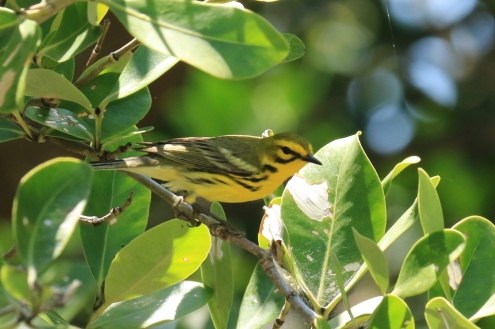
Prairie Warbler 2

It was getting hot – really hot – and really humid again as well.  Crandon Park had been so good to us, so we decided to give it one more try – our last birding in Florida.  For the fourth time, we hiked out along the Osprey Trail.  We were tired and our energy was disappearing – and it must have been the same for the birds – almost nothing was there to be found.  There were more birders than birds and all had the same story – nada.  We left – returned the car to Enterprise – again a shout out to them for making everything so easy  – and then checked in many hours early for our flight home.

The return flight was almost as bumpy as our boat ride to the Tortugas which was already seeming like a long time ago.  It had been a great trip.  As with most trips there were surprises, some disappointing misses and many more happy “gets”.  Frank’s 700th ABA Species was certainly a highlight – especially such a great bird as an Antillean Nighthawk.  The close encounter with the Swallow Tailed Kites at Flamingo remained my most magical moment.  The Bananaquit and Western Spindalis at Crandon Park the biggest surprise rarities.  I don’t expect I will be back that way anytime soon and I sure wouldn’t want to live there, but the birding is extraordinary and it is a must see place to go if one is serious about birding.  If Paul Bithorn is available – grab him as a guide.  He will get you your birds.  I just hope he takes care of his knees so he can continue to walk the trails etc.

It is a little odd ending this blog post at the end of this trip as there are at least two and maybe three more that need to be written to recount the experiences and birds of the trip.  That won’t happen for a few more days as Washington birds beckon.  It is fun to relive the trip as I write and I know I will return to re-read this post later and relive the moments again.  Thanks to all who made it possible.
A Hat Trick and the Everglades

It would be impossible to think of a birding trip to South Florida without thinking of the Everglades.  Everglades National Park was founded in 1947, the same year I came onto Planet Earth.  It is a World Heritage Site that comprises over 1.5 Million Acres – more than 2,500 Square Miles – of primarily wetlands.  There are two basic seasons – the wet and the dry.  The Everglades conjures up images of thousands of birds perched on every Mangrove and flying all about.  To the extent that is true, it is only true during the dry season.

We were there at the beginning of the wet season and there sure weren’t many birds.  Although this was noticed elsewhere in South Florida as well, the mental image of the bird thick Everglades was so far from our reality, that I have to admit to a great disappointment.  As will be apparent later in this post, this day had my very most favorite experience of the week – sufficient to justify any birding trip.  And there were some birds, including some good ones, but just not much to write about.  While all of South Florida is flat, flat, flat, the Everglades seem to define that characteristic.  Visually just not much of interest with mile after mile of Mangroves and low lying land.  We drove over the lowest “Pass” in the U.S. – Rock Reef Pass – Elevation 3 Feet above sea level.  It seemed like we drove many miles on the same road and then came to Dwarf Cypress Forest – Elevation 4 Feet above Sea Level.  Did I mention “FLAT”.

Rock Reef Pass


elevation 4 Feet

If most of the Everglades trip was disappointing, the start of the day was exactly the opposite.  As will be seen in another blog post (I am not doing them chronologically), our first day in South Florida had included a  rarities chase at Crandon Park, near Miami on Key Biscayne.  I will not detail that here except to say that in addition to a couple of other great birds, we had chased and missed a Bahamian rarity – a Western Spindalis.  I don’t know what a Spindalis is, but it was formerly called a Stripe Headed Tanager and since most Tanagers are pretty striking, one would expect a good looking bird.  Before heading south to the Everglades, our guide Paul Bithorn took us back to Crandon and we began the search again.  I was the lucky one that first spotted the Western Spindalis in the thick brush and was able to get a photo with only a few branches in the way.  Probably the rarest ABA bird for the trip, it was a welcomed Lifer for both Frank and me.

Western Spindalis – Crandon Park

Western Spindalis5

Western Spindalis1

At Cutler Bay on our way to the Everglades, we had another sought after species.  Not rare here, but definitely not in the Northwest, many Cave Swallows darted about by and under a bridge.  Too far and too active for any great photos, but still a new ABA photo bird for me.

Cave Swallow

Cave Swallow

The heat and humidity increased as we got into the Park.  I believe it was the hottest day of the trip with the temperature reaching 95 degrees and the humidity was not far behind.  One bird that was at least easy to see was a crow – and here, many if not most of the crows were our familiar American Crow as opposed to the Fish Crows that were seen on the coast around Miami.  The Fish Crow appearance was a little different but as Sibley suggests, the only reliable way to distinguish them is by voice.  To me that was pretty easy to do.

American Crow and Fish Crow

American CrowFish Crow1

Where we found some hardwoods or pines we found some birds.  These included Brown and Great Crested Flycatchers, Gray Kingbirds, Catbirds and a few Warblers.  I was happy to get my first ABA photo of a Pine Warbler.

Brown Crested Flycatcher

Great Crested Flycatcher5

Gray Kingbird

Gray Kingbird1

Pine Warbler

Pine Warbler5

And another welcomed find was a Brown Headed Nuthatch.  Before leaving for Florida, I had visited the Northern Pacific Railroad Ponds in South Cle Elum, Washington.  I had Red Breasted, White Breasted and Pygmy Nuthatches on that visit, so this made it a Nuthatch Grand Slam.  It also provided another ABA Photo Lifer.

Brown Headed Nuthatch

Brown Headed Nuthatch5

A little later we finally found a much sought after bird of note.  We saw a soaring hawk that was very white below and seemed fairly small.  We had seen numerous Red Shouldered Hawks but this was different.  It proved to be our first Short Tailed Hawk of the trip – a Life Bird for Frank and a photo for me.  BUT…unfortunately as I was editing and transferring photos, I somehow deleted this photo.  We saw other Short Tails later in the trip in central Florida but we were not able to stop on the roads to get photos then so I borrow an internet photo here.

Red Shouldered Hawk

Red Shouldered Hawk1

Short Tailed Hawk (not my photo)

Short Tailed Hawk1

I was not aware of it at the time, but when I got out of the car to get a photo of the Short Tailed Hawk my hat had blown off and was not with me when I returned to the car.  It was not until many miles later at Flamingo that I realized it was gone when I looked to put it on as we stepped out to look at some shorebirds – finally some shorebirds as they had been missing until then.  It was only then that Frank recalled that he had seen it on the ground – oh well too late now.

Shorebirds in Florida were found on the wrack line and not on mudflats – or at least that was our experience until much later in the trip.  At Flamingo we found several species with the best – at least for us being a Wilson’s Plover.  I had seen a very rare one in Washington in 2012 at Grayland Beach State Park and gotten good photos, but this was still a welcomed find.  At the same area we also had Least and Western Sandpipers, a Black Bellied Plover, a Spotted Sandpiper and Sanderlings.

Wilson’s Plover

Wilson's Plover5

We also found what at one time was called a Great White Heron and was considered a separate species.  Now it is recognized as the white form of a Great Blue Heron.  If the ABA changes its mind and splits it off, I will have it covered.

Great Blue Heron – White Form

Great White Heron

The Flamingo “Visitor Center/Primitive Campground” is a particularly depressing part of the Park.  It was devastated by a recent hurricane and it does not look like any dollars have gone for restoration.  People may pay attention to such things, but fortunately birds do not.  In fact it is one of the most likely places to find Shiny Cowbirds – a Life Bird target for both Frank and me.  There were maybe two dozen Cowbirds at Flamingo.  No shining males but Paul was pretty certain that one drab darker all brown bird with a somewhat pointy bill was a female Shiny Cowbird.

Shiny Cowbird Female

Shiny Cowbird Female1

Then the highlight of the entire trip happened as we were leaving Flamingo.  We spotted a Swallow Tailed Kite soaring to our left.  We had seen one the day before, but as I jumped out of the car, I could not have planned what followed any better.  The Kites ( a second one appeared as well) put on a spectacular aerial display swooping up and down and circling us and then sailing right near me, coming within no more than 30 feet.  I kept the lens on it as best I could and kept the shutter snapping.  I probably took 100 pictures, so the odds were good that some would come out.  I include many here and you can be the judge.

Swallow Tailed Kite

2017-04-27 18.31.28

2017-04-27 18.30.09


Facing left

Although I had seen a Swallow Tailed Kite on my trip to Florida 39 years ago, I of course had no photo and getting one was maybe my number one goal for this trip.  I was overwhelmed by this experience – simply as good as it gets just to watch these graceful birds in flight.  The pictures were way beyond expectation or even dreams.  We would see others later on our trip – including one group of 4, but nothing came close to this encounter.

When I finally got back into the car after the love affair with the Kites, I felt a little pain on the top of my head.  Having no hair there, I ALWAYS wear a hat either for warmth or for protection against sunburn.  In the blazing sun that day, being hatless meant sunburn – it did not take long – and it recalled that I had stupidly lost my hat.  We had to retrace steps and pass the area where it had come off.  Paul was optimistic that it would still be there.  I was much less so.  But sure enough as we approached the area, there was a small object on the side of the road – I was united with my hat – a hat trick of sorts in the Everglades.  In Hockey a Hat Trick is when one person scores three goals in a game,  I guess we could count the Short Tailed Hawk, the Shiny Cowbird and the magnificent Swallow Tailed Kites as three scores and our Hat Trick here in addition to my hat reunion.

The Lost and Re-found Hat

The Hat

Time to head home.  Nothing new and spectacular along the way back but as we passed by a place at a marina where fishermen often clean their catch, Paul said we should look for a Black Crowned Night Heron.  Sure enough, one stood by patiently waiting for a fish head or something.  I could not pass up that photo.

Black Crowned Night Heron

Black Crowned Night Heron1

Had it not been for the Swallow Tailed Kite display I would have had to count the Everglades as a low point of the trip – pun and double entendre intended.  We had added some birds to the trip list and I got some new ABA photos, but I was not sad to leave the Everglades and the heat and humidity,  It was nice to have my hat back on my head when I did.  And pretty hard to beat starting the day with a Stripe Headed Tanager – oops I mean Western Spindalis – as well

One Good Tern Deserves Another … and Another and Another (and Another and Another)

This Florida Post is going to be about my day birding in Dry Tortugas National Park.  The Dry Tortugas are a collection of  seven small islands and some coral reefs.  They are about 70 miles west of Key West, the southernmost of the Florida Keys.  Accessible only by seaplane or boat, on April 29, we took the Yankee Freedom ferry across open ocean to the Tortugas and docked at Garden Key which is home to Fort Jefferson, built in the 19th Century and abandoned now.  The Tortugas are very popular with snorkelers and of course birders primarily as a migrant trap and for seabirds.  On this visit migrants were relatively few but seabirds were plentiful, and despite rougher than normal seas, it was a great visit.

I had visited the Tortugas early in my birding days – exactly 39 years to the day prior to this visit. I did not keep detailed notes in those days, but saw many of the specialty birds at that time.  Back then, photography was not part of my birding life so I had looked forward to this trip to relive old times, to see familiar and hopefully new birds and to take lots of photos to move closer to goals of 700 species seen in the ABA Area and to get photos of at least 600 of those species seen.  Prior to leaving for Florida, my totals stood at about 675 and 530 respectively, so there was much work to do.  This voyage was expected to help a lot.

Key West is a bustling, crowded tourist and beach town with some beautiful older sections and too many new and to me mostly tacky areas.  It was good to leave and to immediately be on the alert for birds.  Nothing extraordinary on the way out past hundreds of boats and some very expensive homes.

Key West Marina

IMG_3331

A “Nice” Key West Home

IMG_4212

Initial seabirds were limited to some Double Crested Cormorants, Least and Royal Terns, Laughing Gulls and Magnificent Frigatebirds.  They all had been seen earlier on this Florida trip and the latter was a new ABA Life Bird and new ABA Photo.  Actually I am sure I had seen them on my earlier visit to South Florida, the Keys and Tortugas in 1978, but I had not recorded that.  I took some photos including of a flock of birds on the seawall across from the ferry as we left and only later discovered that there were several Black Skimmers in the group.  This was the only time they were seen and my photo was the only record.  A little further out but still within Key West, more terns flew by.  I thought they might be Roseate Terns but they were all Sandwich Terns.  Once hitting open waters, we hoped for Shearwaters, but for the entirety of the crossing, it was only a few birds here and there – all the same species seen on departure.

Magnificent Frigatebird

Magnificent Frigatebird5


Black Skimmers and Royal Terns

Black Skimmers

Things changed dramatically, however, once we neared the Dry Tortugas themselves – with Fort Jefferson a landmark in the distance.

First View of Fort Jefferson

IMG_4210

At first we saw a few Sooty and Noddy Terns and more Sandwich Terns flying by, and then as we passed by tiny little Hospital Key, we saw some larger white birds with black wing tips, on the sand and in the air.  These were Masked Boobies.  I had seen some on my 1978 visit but again no photo and since I had heard that they were pretty scarce and distant, I had hoped for but not expected a photo this time.  One guide said that this was the closest the ferry had come to them in his experience.  There were 50+ Boobies and photos were ok.

Masked Boobies on Hospital Key

Masked Boobies

Masked Boobies in Flight

Masked Booby

Sooty and Noddy Terns nest on Bush Key immediately adjacent to Garden Key and they are present in the thousands – I heard there might be as many as approaching 100,000 altogether.  As we got closer to our landing dock, they started showing up in greater and greater numbers.  As we were pulling in to the dock, a number of small white birds with very long tails flashed by.  In my (our?) excitement and inexperience, I thought they might be Tropicbirds because of the long tails.  A single Tropicbird would have been possible but extraordinary.  These were Roseate Terns – one of my most sought after species.  I had seen a single bird at the Pine Point Beach Jetty in Maine in 2015, but it had been a terrible view at great distance and certainly no photo.  My photos taken as we docked were “good enough” and certainly showed that the birds were not Tropicbirds.  There would be much better views later as there were more Roseate Terns than usual.

Thousands of Terns at Bush Key

IMG_3556

Roseate Terns as We Docked (Sadly Not Tropicbirds)

Roseate Terns 3

We arrived at the island at around 10:30 a.m. and the ferry would leave at 2:30 p.m.  It hardly seemed like enough time, and I wanted to go everywhere at once. Garden Key is small, and birding is mostly in the Fort or just outside of it at the north and south coaling docks or looking out to the tern colonies and open sea.  In April and early May, the hope is that large numbers of very tired migrating birds will have “fallen out” of their migratory path and arrived exhausted at this speck of land to rest up and then continue their journey north.  It is possible to see hundreds of such birds in the few trees within the Fort, coming to the single fountain or even on the ground, too tired to fly or hide.  We did not have such a “fall out” so our search for migrants focused on the few trees and the fountain.  Although some seabirds might fly by just once and thus be missed if you were not watching specifically for them, the odds were that most would be around longer and seen at many times.

Welcome to the Tortugas

IMG_4171

After a few moments taking photos of the abundant Sooty, Sandwich and Brown Noddy Terns, I headed into the Fort hoping for tired birds everywhere.  As I said, such was not the case, so after a quick walk around, I concentrated attention at the fountain and adjacent trees.

Sandwich Tern

Sandwich Tern1

Sooty Tern

Sooty Tern 1

Brown Noddy Tern

Brown Noddy Tern Flight

I will spare you a blow by blow, minute by minute, chronological accounting.  Birds came to the fountain and stayed – or left- and returned – or did not.  Sometimes they would disappear into the trees and then return or sometimes they would just disappear.  Other birds came in and we wondered from where as we had not seen any fly in from outside or above.  All were welcome, and although there were no new ABA Life birds, good light and good proximity provided many photo opportunities – including new ones for my Life Photo list.

Birds at the Fountain and Environs

Scarlet and Summer Tanagers and Indigo Bunting

Three at the Fountain

Yellow Warbler

Yellow Warbler 5

Northern Parulas and Palm Warbler

Palm Warbler with Parulas

Ovenbird

Ovenbird1

Swainson’s Thrush

Swainson's Thrush5

Dickcissel

Dickcissel

Northern Parula Warbler

Northern Parula

Indigo Bunting

Indigo Bunting

Magnolia Warbler

Magnolia Warbler

Scarlet Tanager Male

Scarlet Tanager

Scarlet Tanager Female

Scarlet Tanager Female

Summer Tanager

Summer Tanager

Cape May Warbler

Cape May Warbler 1

Cape May Warbler and Blue Grosbeak Female

Blue Grosbeak Female and Cape May Warbler

While the show at the fountain was rewarding, after a while it was time to do a seabird watch and hopefully get some good photos.  As will probably be stated several times in my Florida blog posts, one of the big surprises was that only a single gull species was recorded.  There were Laughing Gulls in many locations but no others.  Such was not the case for terns, especially here at the Tortugas.  I wanted photos of many of the tern specialties but there were only two two Lifer possibilities:  Bridled Tern and Black Noddy Tern.  The former was a reasonable probability but the latter was a remote chance.  Among the thousands of Brown Noddy Terns, one would be fortunate to find even a single Black Noddy Tern.  Individuals had been seen recently, but not on the majority of trips.  I ran into Washington Birder Randy Knapp at the Fort.  He had been out two days earlier and had seen a Black Noddy at the north coaling station later in the day and it was visible only by scope from atop the Fort looking down on the dock wall.  I was hopeful but not optimistic.  Good photos of the other possible terns were there for the taking, and I was really hoping and optimistic about finding a Bridled Tern.  Long visits to both the South and North coaling Docks provided photos of the more common terns but no Black Noddies or Bridled Terns were found.

My favorite photo is the one below which shows a Royal Tern at the top of the piling and then from left to right below a Brown Noddy Tern, a Sandwich Tern and two Roseate Terns.

IMG_3859

Brown Noddy Tern

Brown Noddy Tern

Roseate Terns (Can you tell that there are three?)

Roseate Terns

As the title to this blog states – “One Good Tern Deserves Another and Another and Another”.  I doubt there are many places in the U.S. where you can find 4 tern species on a single piling.  But wait there is more – flying in the vicinity of this piling were numerous Sooty Terns and Least Terns (the Another and Another add-ons to the title).  If there had been more space on the piling, maybe five or even six species might have been in the photo.

Least Tern

Least Tern

Sooty Tern

Sooty Tern5

Back to the other possibilities.  The photos of the Brown Noddy, Roseate and Sooty Terns were new, but I really was hoping for a lifer as well.  One of the nice things about birding in a group is that there are many eyes and observations can be shared.  Some of the best eyes in our group belonged to Tom Keegan, a relatively new but excellent birder from Idaho.  Especially in denser foliage, Tom was often the first to actually see a bird.  He had found some Bridled Terns at the North Coaling Station.  I was just leaving the South Coaling Station and saw him walking briskly my way.  He had come to tell me that some Bridled Terns had come in and I rushed over to find Randy on them with his scope.  That provided a lifer view and with some maneuvering I was able to get some decent photos even though they were quite distant.  I found Frank Caruso and he got to them and thus added ABA Life Bird #699!!

Bridled Terns

Bridled Terns

This was now tern species #7 for the trip – #8 if you counted the Black Skimmers.  And others were at least possible.  In addition to the very rare Black Noddy Tern, other possibilities are Common, Black, Elegant, Caspian, Forster’s and Arctic Terns. All are found in Florida and I think even at the Tortugas.  I have seen and have photos of all of those (except the Black Noddy) as they can all be found in Washington unlike any of the others.

Back to the Fountain hoping that more birds may have come in.  Nothing new but somehow the Palm Warblers seemed to have multiplied and there were as many as 8 seen at the same time.  The dearth of warblers was probably the biggest disappointment on the trip.  As many as 20 species was possible and we had fewer than 10 on this visit.  A Worm Eating Warbler had been seen by others but missed by me.  It would have been a new photo but not a life bird.  So back outside and now those additional eyes paid off again.  Maybe not quite as keen-eyed as her husband Tom, but still very very good, Beth Waterbury found the bird of the trip – a perched and very visible Antillean Nighthawk.  We had missed them at the Key West Airport the night before where we might have heard one and seen its profile in the darkness.  But in the heavy wind that night, neither was a real possibility.  So this was not only a great find for “ticking” a new ABA Lifer but OMG it was very easy to see and photograph.  Best yet it was ABA #700 for Frank and there were high fives all around.

Antillean Nighthawk

Antillean Nighthawk

It was now getting late and our last efforts were to look down on the Coaling Dock from atop the Fort hoping that the Black Noddy would return to what was apparently a favored roosting spot.  It was so windy that there was concern that we could be blown off the Fort.  More realistically, the wind made it very hard to stabilize the spotting scope that Tom used diligently in the search.  We tried for about 30 minutes and then it was time to get back on the boat and return to Key West.  We had been told that the crossing would be “even rougher” on the way back.  There was still hopes that an Audubon’s Shearwater might fly by the boat.  The passage was indeed quite bouncy which made viewing anything more difficult.  In fact there were several falls and near falls.  No shearwaters were seen.  My only other open ocean (pelagic) birding trips have been on smaller boats devoted to bird watching.  On those trips, birds were chased or chummed in.  This was a “get there and return” trip only so no efforts to find or follow birds.  I wonder if shearwaters would have been found on a pure birding trip.  Here it would just be luck and we had none.  A single shearwater had been seen on a trip earlier in the week.  Maybe some day I will get one on a pelagic trip in Florida or North Carolina.  Some day…

Two life birds and lots of good pictures – an excellent trip.  Unlikely that I will make that trip again and definitely no way that another 39 years will pass until the next time.

And just because, I am adding this photo of our party when we returned to Key West – well not really!!

IMG_4220

Back to Florida – 39 Years Later

There will be several blog posts about my trip to South Florida.  This entry starts things off with an overview and then others will be more focused about segments of the trip or special bird groups or stories.  First some personal birding history and context.

I have been birding now off and on for 47 years, starting way back in law school days in 1970 in Palo Alto when I was 23 years old.  How is that possible?  I don’t feel that old, but pretty soon I will be 70 and the math then says 47 years.  Wow…  I first birded in California and then had great Eastern U.S. birding in Maryland and Delaware during an externship in Washington D.C. in 1972.  I moved to Seattle 1973 and explored our state’s diverse habitats and wonderful birds.  As I became more serious and found others to share the experience, the lure of birding meccas like South Texas and Southeast Arizona resonated strongly.   I traveled to South Texas in November 1975 and added great birds like Green Kingfisher and Brown Jay among many others.  There were then lots of new birds from two trips to Southeast Arizona in December 1976 and then again in June 1976.  Such fun.

Green Kingfisher – First Seen in 1975 – Photo from 2013

Green Kingfisher[1]

Thanks to a ridiculously cheap airline deal from now-defunct Eastern Airlines, in April 1978, I joined three Seattle friends on a trip  that included a return to South Texas and then my first visit to South Florida – the Everglades, the Keys and the Dry Tortugas.  Fabulous birding with lots of specialties and when the trip was over, my ABA List stood at 545 species.  (And that Airline promotion where you could go ANYWHERE in the Eastern Airlines route system for a total of $299 so long as you did not retrace any segment – also allowed my first international as we visited the Asa Wright Center in Trinidad.)

Asa Wright Nature Center Trinidad

Asa-Wright-Nature-Centre

Over the next ten years other commitments and interests diverted me from serious birding although there were some great birding days add-ons to international trips that were for business or vacation.  Great birds in Hong Kong and Argentina and Japan and Jamaica but no more trips within the US to add ABA birds.  And of course, this was before personal computers, cell phones, Ebird and digital photography.  How different it is today.

Life and birding changed greatly with the addition of two great kids and birding was at best sporadic.  A vacation trip to Jamaica with them in 1997 added almost 100 worldwide species but the focus was not birding.  Then nothing for 5 years.  A trip with my daughter to Hungary allowed me a half day of birding in 2002 added another 50 species.  The kids were getting older now and I took my first “mostly birding” international trip – to Australia – in 2003. Over the following dozen years I traveled to and did some (or lots of) birding in Brazil, Kenya, Belize, India, Peru and South Africa.  There was lots of birding in Washington starting again in 2011 but in the 29 years from that Eastern Airlines extravaganza until then, I had added a grand total of 29 birds to my ABA Life List – essentially one a year.  By contrast I added more than 1500 species to my World Life List during those years – not to reach a goal – just enjoying birds in some wonderful places.

Galahs – Australia 2003

galahs

Hyacinth Macaws – Pantanal – Brazil 2005

Hyacinth macaws 4

Hoopoe – Kenya 2007

54 Hoopoe

There would be more international birding after 2011, but that was when interest was refocused onto birding in Washington, spurred by Dennis Paulson’s terrific Master Birder Class through Seattle Audubon and the advent of Ebird and Tweeters and digital photography.  In the beginning of 2010 my state list for Washington was barely 200 species.  That quickly changed and especially after a State Big Year in 2013 and a Photographic Big Year in 2015 that list more than doubled.  One result is that it has become harder and harder to add new state birds – maybe it was time to pursue other challenges…like improving my ABA List and taking photos of as many ABA Birds as I could including all of those birds in Texas and Arizona and Florida from those many years ago.

That is the introduction – albeit a very long one – to this Florida trip.  After trips to Texas,  California, Colorado and Alaska and all that Washington birding over the past few years, I had gotten my ABA list up to just under 670 species and I had photos of almost 540 species.  I set a goal of getting to that magical 700 ABA list and to 600 ABA species with photos.  The biggest opportunities for additions to both lists would be return visits to Florida and to Arizona.  Birding pal Frank Caruso was also looking to add to his ABA list – hoping to get to 700 himself – which would require adding about 20 species.  He had not birded much in South Florida, so he was eager to go there – and to Arizona as well.

I found a trip to the Keys and the Dry Tortugas offered by the Tropical Audubon Society out of Miami and also got a referral for an excellent guide in the area, Paul Bithorn, who had guided Ann Marie Wood a couple of years ago.  And coincidentally, Paul was a co-leader on that Tropical Audubon Society trip.  Arrangements were made and we were set to go.  A red-eye flight to Miami arriving early on Tuesday April 25th, bird with Paul for 2.5 days then off to the Keys on Friday the 29, to the Dry Tortugas on Saturday the 30th and then back to Miami with them on May 1st.  Two more days with Paul heading north to Central Florida and then a day on our own to clean up whatever had been missed in the Miami area before heading home.

Paul Bithorn – Florida Guide Extraordinaire – at Tomb of Leslie Nielsen

Paul and Leslie Nielsen

Although I would do it differently if planning it again, the trip was great.  It is hard to imagine two places as different as South Florida and Western Washington.  Both areas suffer from way too much traffic, but that may be the only similarity.  South Florida is hot and humid – temperatures were in the mid 80’s to the mid 90’s and humidity was always over 90 percent.  I don’t see how anyone can live with that day to day.  We may have rain in Seattle but it is spread over months.  South Florida has even more rain but mostly in concentrated downpours (often accompanied by thunder and lightning).  On our last day in Central Florida, it rained for many hours, often so hard that vision was almost zero.  I would guess there was more rainfall in that 4 hour period than we get in Seattle in our wettest month.

And of course the ethnic mix is completely different.  Paul thought that 75-80% of the population is Latin American.  Sometimes it appeared that English was the second language with Spanish everywhere.  A few Asians but almost nothing compared to our many ethnic Asians and South Asians here in Seattle.  Restaurants reflect that difference.  In both places there is an abundance of water and boats.  In South Florida, there is the open ocean and numerous canals and channels.  We have our lakes and the Sound.  We fish for Salmon.  They fish for a great variety of salt water species including Dolphin (Mahi Mahi), Redfish, Marlin and many others.  We each have our crabs and each are expensive at restaurants wherever.  Architecture is very different.  Seattle is both more traditional and more modern with hardly any stucco which is common in Florida.
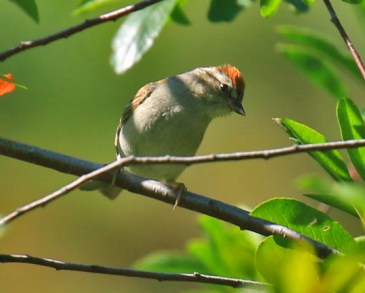
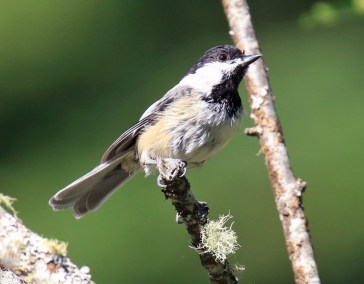
The topography is starkly different.  Florida starts out flat and gets even flatter.  Forget mountains, there aren’t even any hills.  Especially away from the water on the coast, I found it endlessly boring.  And the plant life is completely different as well.  Many exotics, lots of flowers and mangroves and more mangroves.  Some pines and some hardwoods but completely different from our Northwest Forests or even the hardwood forests of the East or the Cottonwoods and such in Eastern Washington.  And of course the animals and the birds are very different as well.  Reptiles and amphibians are plentiful: lizards, frogs, turtles, snakes, crocodiles, anoles, iguanas and the iconic alligators abound and we saw many.  We saw a few deer (endangered Key Deer) but there are no elk or mountain sheep or goats or moose.

Most importantly for us the birdlife is very different.  Washington and Florida have similar numbers of species on their official state lists with Florida having maybe 20 more.  There is of course some overlap but even a quick count suggests there are about 170 species seen in Florida that are either not seen in Washington or seen almost never.   Somewhat fewer birds in Washington but not seen in Florida.  It is the Florida specialties – especially those in South Florida attract birders from all over the U.S. and the world.

And the birding scene in Florida is in flux as escapees that are colonizing, climate change and more and more birders are coming up with more and more species.  There is always the possibility of strays from the Bahamas or Cuba and it is expected that some races such as the Cuban Yellow Warbler will join more and more exotic species as recognized by the AOU/ABA.  We spent a lot of time with Paul looking for exotics – some already ABA countable and others likely to be recognized by the ABA in the future.  In essence, we wanted to stockpile some of these exotics in anticipation of that future day of recognition.

Cuban Yellow Warbler

Cuban Yellow Warbler

Not every species was seen by each of us but altogether Frank and I had just under 190 species seen including 15 exotics.  Extreme rarities included Bahamian species like Bananaquit and Western Spindalis and rarer or less common specialties included Black Whiskered and Thick Billed Vireos, Antillean Nighthawk, Snail Kite, Spot Breasted Oriole, Red Whiskered Bulbul, Common Hill Myna, Shiny Cowbird, Bridled Tern, Short Tailed Hawk, Florida Scrub Jay, Mangrove Cuckoo, Egyptian Goose, Gray Breasted Swamphen, Red Cockaded Woodpecker, Limpkin, Cave Swallow and White Crowned Pigeon.  I got pictures of  all of them except the Thick Billed Vireo.  We missed the Fork Tailed Flycatcher and Bahama Mockingbird that were seen in the area while we were there.  We also missed Audubon’s Shearwater and the very rare Black Noddy Tern on our Dry Tortugas trip.  Our success ratio was higher than expected – due to good luck, hard work and excellent guiding by Paul.

A real highlight was Frank getting his 699th and 700 ABA birds on the Dry Tortugas when he saw first a Bridled Tern and then an Antillean Nighthawk.  Both were new for me as well.  For the trip I had 18 Life Birds and 42 ABA Life Photos.  We did well.

The highlight of the trip for me was a breathtaking interaction with a pair of Swallow Tailed Kites at the Flamingo visitor area in the Everglades National Park.  I had seen a Swallow Tailed Kite on m visit in 1978 and we had seen others earlier in the trip, but this was special as one of the Kites flew by us and circled us for a good 5+ minutes often coming within less than 30 feet of me and my camera.  A couple of times it was so close that I could not focus for a photo.  I probably took more than 50 photos during the encounter, two of which are shown below.  (As an aside I took almost 8000 photos so odds were that at least some would be ok and many will be included in the blog posts to follow.  Of course many are not very good (or even worse than that) and those have already been deleted.)

I am still not sure of what and how many blog posts will follow.  Definitely one on the Tortugas and another on the Everglades.  Probably one on the exotics and another that is either a catchall or maybe two – one on specialties and one on our trip North.  This was another trip where there was the combination of good birds, good places and good people.  That is what it is all about.
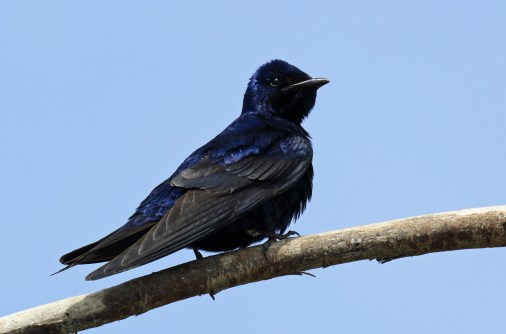
Swallow Tailed Kites in the Everglades

White Tailed Kite 3a

White Tailed Kite 4