
In earlier blog posts it has been great fun to somewhat recreate and share the highlights of our Safari to Tanzania. But those stories and images are of a Tanzania that is mostly experienced by foreign visitors who come from a very privileged existence which is a far cry from the daily lives of the large majority of native Tanzanians. Safaris and foreign visits are an important part of the Tanzanian economy and the areas preserved for the wild animals that attract the tourists play an important part in preservation of a natural world that is constantly threatened by modern man. Throughout most of the trip, we were in wild areas, national parks and reserves. Although these areas are relatively quite close to towns and cities, we had no personal interaction with them and never met Tanzanians except as staff at our lodges. These intersections provided a distorted view of life for the large majority of Tanzanians. Our only views of daily life outside of tourism were as we drove from one place to another on the few occasions where we were not in those restricted preserves. All of us who go on safaris in Tanzania, and elsewhere in Africa, are highly privileged members of the First World. In this blog post, unlike all those that preceded it, we will not be in that privileged world but will rather share images and facts about the rest of Tanzania, mostly through photos of the countryside and street scenes that Cindy took during the course of the tour.
Here is some background context for the country as a whole and for daily life in Tanzania outside of “Safariland”.
Tanzania was formed as a sovereign state in 1964 through the union of former states of Zanzibar and Tanganyika. Bordering on Kenya to the north, the Indian Ocean to the east, Mozambique, Malawi and Zambia to the South and the Democratic Republic of the Congo, Burundi, Rwanda and Uganda to the west, Tanzania is the largest country in East Africa at 365,743 square miles (compare to Texas which is 268,957 square miles).
Tanganyika was a colonial part of German East Africa from 1880 through 1919 when under a League of Nations, it became a British mandate, gaining its independence in 1961. Its current population is about 63 million people and is growing rapidly with one of the highest fertility rates in the world. (Women average 5 children each.) With life expectancy increasing this high fertility rate and concentration of the population in child-bearing ages groups, the population is projected to reach 100 million in the next 15 years. The largest city is the capital city of Dar es Salaam with a metropolitan area population of nearly 5.5 million. The country is very rural with 80% living in rural areas.
The Tanzanian economy in terms of GDP is approximately 30% each in agriculture, industry and services. Almost a third of Tanzanians run small businesses employing fewer than nine employees – small shops, farms, salons, restaurants, repair stations, consulting services etc. The main food crops are maize, sorghum, millet, rice, wheat, beans, cassava, potatoes and bananas. There is also a significant tea and coffee industry. A large majority of Tanzanians work in the agricultural sector. Gold and oil are major mining and industrial products and exports.
Thirty percent of the land in Tanzania is within National Parks and Conservation areas. Despite being surrounded by, bordering or containing some of the largest lakes in Africa and the world, there is a severe problem of access to clean water in much of the rural area.
With an annual GDP of less than $800 US per capita, Tanzania is one of the poorest nations in the world with two-thirds of the population living below the poverty line. More than a third of the population lack basic amenities of electricity, sanitation and education. Only 15 percent of the population completes secondary school.
All countries will be challenged by climate change and Tanzania is no exception with a climate that ranges from tropical to temperate and with its farms and livestock heavily dependent on seasonal rains. Those rains have fallen significantly in recent years with drought conditions threatening an already impoverished country.
Cindy Bailey took the following photos from our moving vehicle with her I-Pad. They capture some of the street scenes as we moved from one park to another and show a very different Tanzania from the one we saw daily in the reserves and at our lodges. They do not intentionally include or omit types of scenes – just representative of all that we experienced. Many speak for themselves but I have added a few comments for context or further information.

On the main roads there was generally a lot of traffic – all moving along pretty well. These little jitneys were seen everywhere – together with cars, trucks, colorful buses, motorbikes and bicycles. The jitneys and motorbikes were the most numerous. Few Tanzanians own their own cars, many more had motorbikes. Both the jitneys and the motorbikes were used like taxis for those without carsand not using the buses.
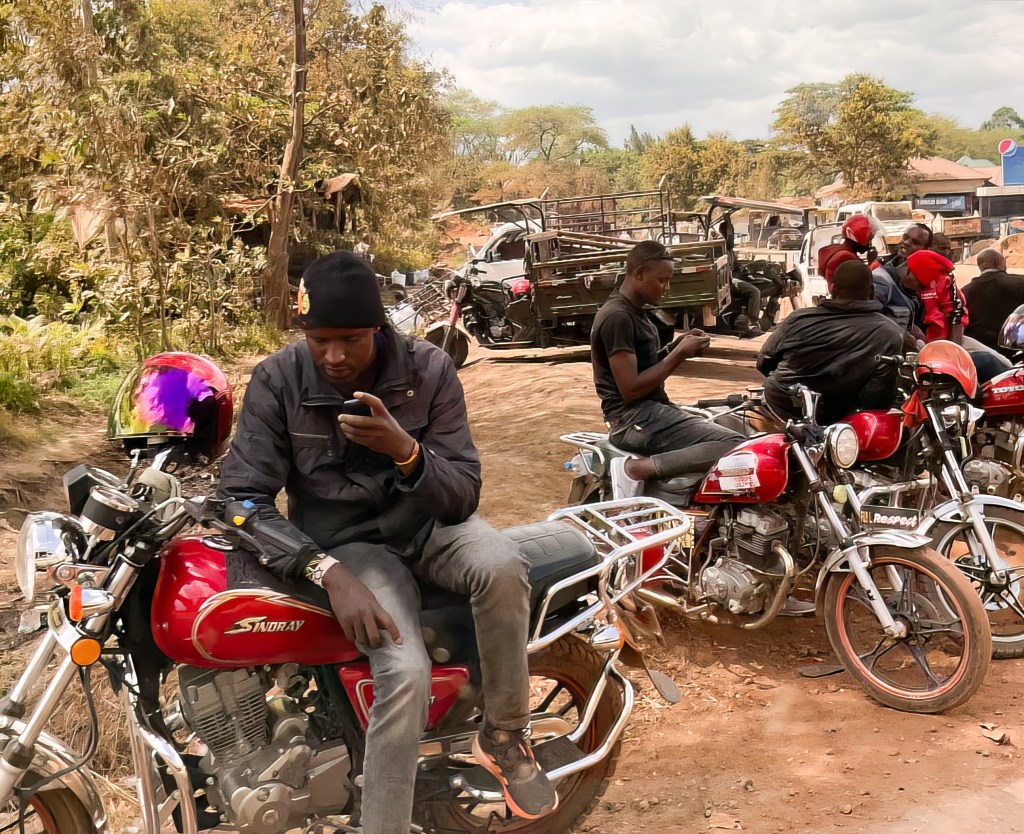
As you can see, cell phone use is commonplace. We understood that most of these young men – and it was always men – were waiting for calls from their riders. While these collections of motorbikes were everywhere, often they were adjacent to bars and restaurants. Lots of idle time.
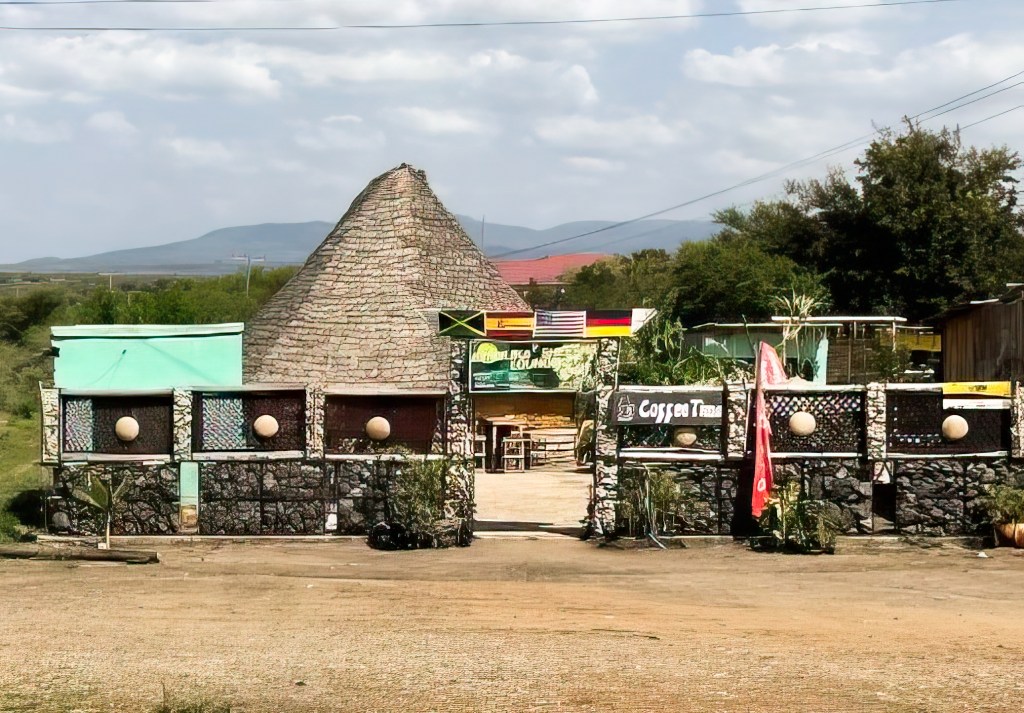
This was one of the better looking establishments – a restaurant/bar on the outskirts of a town. The “Branded name” was “Coffee Time” in English with Swahili as well.

This was a common scene in many towns – lots of people, both men and women – at small shops together in a bazaar – generally not with permanent structures. Goods were also sold laid out essentially on the dirt next to the shops – fabrics, clothes, shoes, small items., fruit, vegetables etc. The density gives a sense of the population pressure. There were likely scores or people on the dirt “sidewalks” coming to or leaving these shopping areas as well.

We often saw uniformed children walking to or from schools. Most often, for the older children, boys would be with boys and girls with girls. Younger children would more often be both girls and boys. All school kids were in uniforms – almost always with white shirts. Tanzania has followers of both Christian and Muslim faiths in addition to tribal groups.
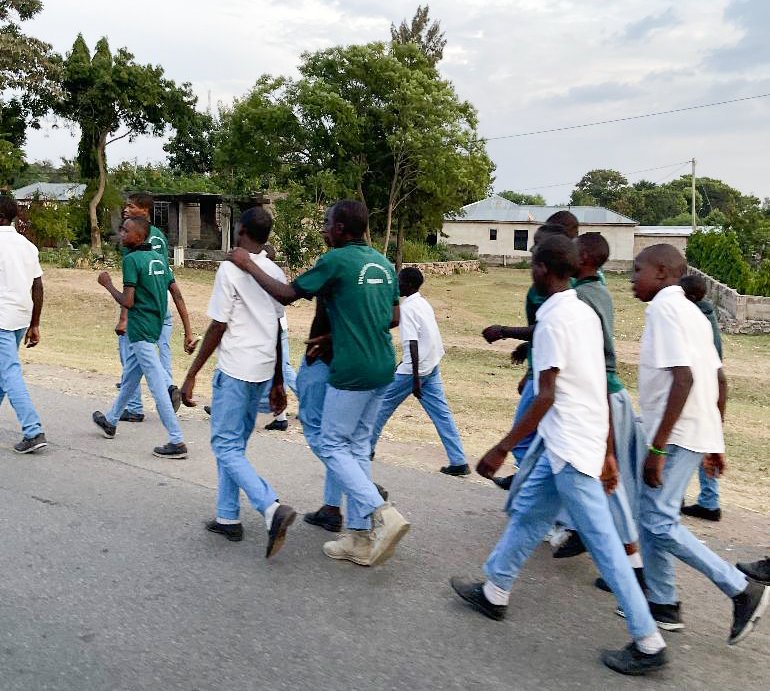
We don’t know if this group of boys were coming from school or some other organized activity.
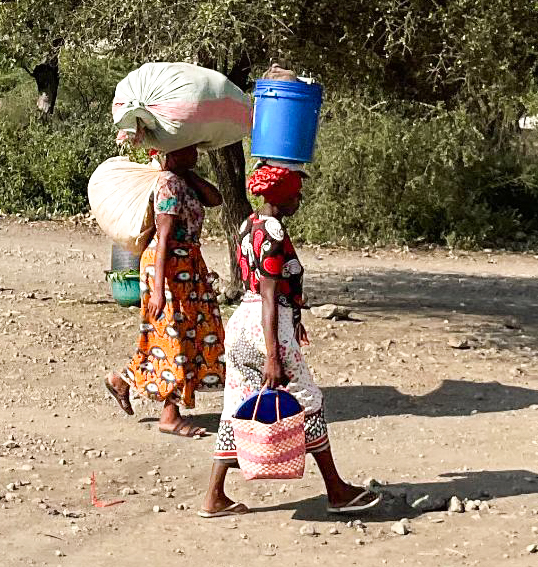
Everywhere we saw women carrying loads on their heads. Most people walked from place to place and often women would carry firewood, goods or water. This was “women’s work”.
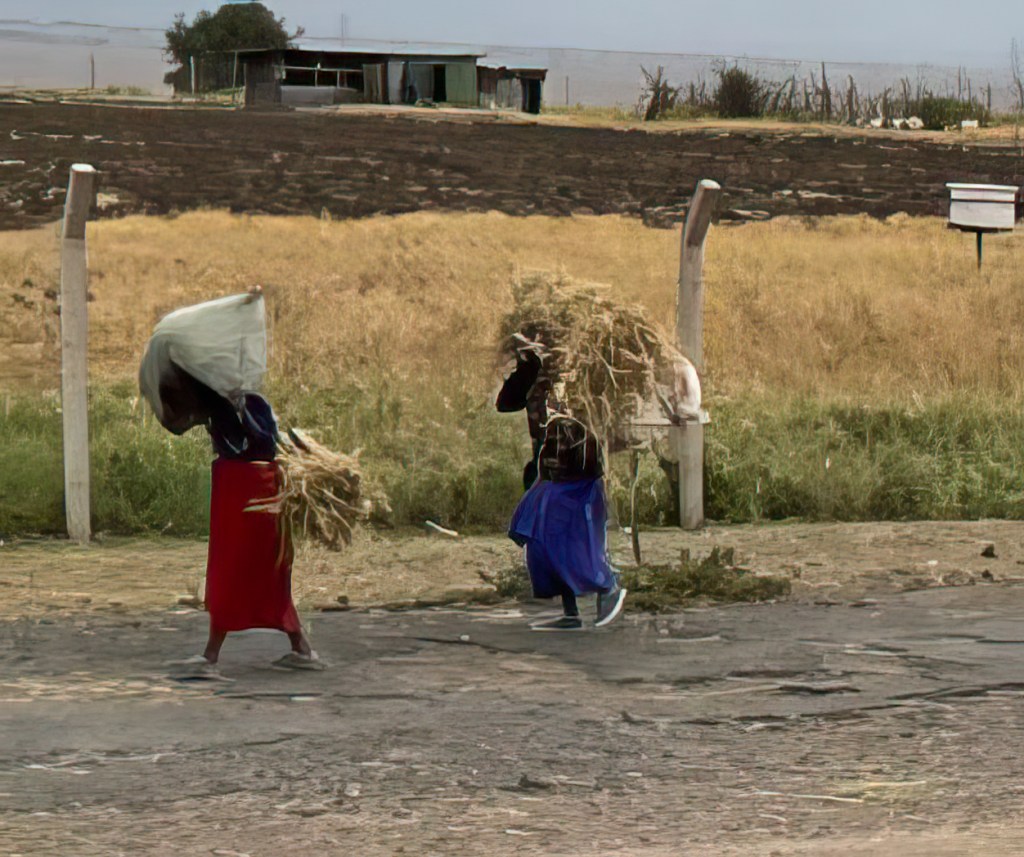
More heavy loads.

Outside the cities, closer to the parks and reserves, tribal peoples were commonly seen near their basic but well-kept homes. This photo exemplifies the fertility rates and population growth where the typical family had five children,
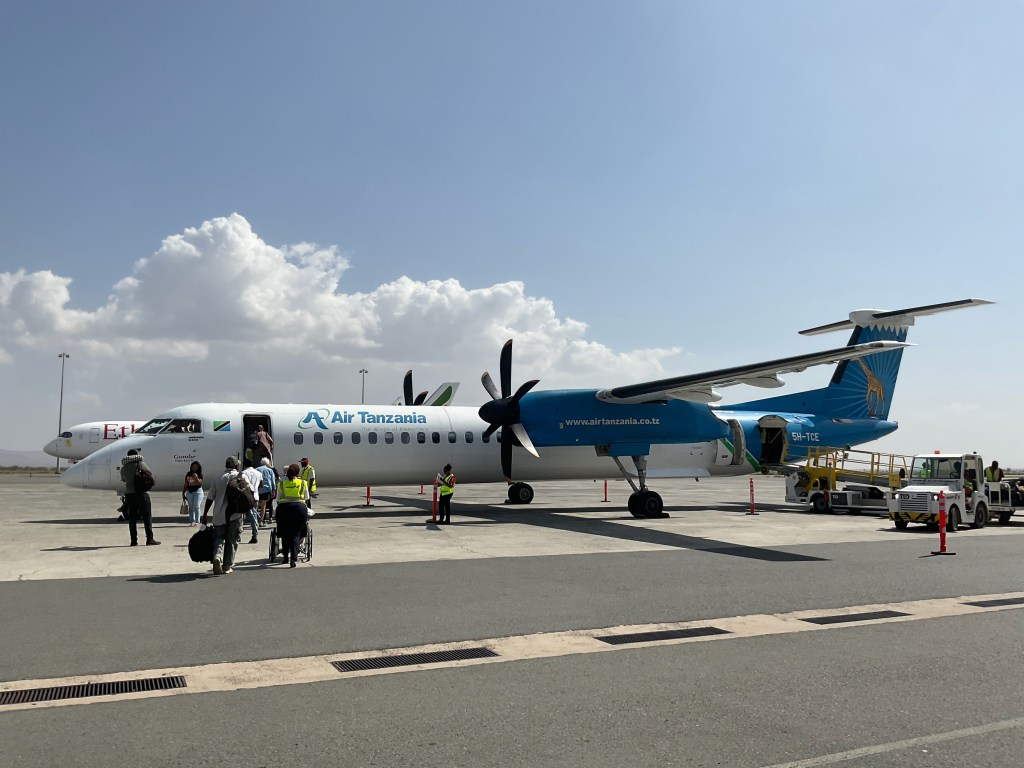
This was our plane from Kilimanjaro to Mwanza – typical of in country service. In an earlier blog I described the long lines to get into the small terminals with limited scanner service – but everyone got in and made their flights.
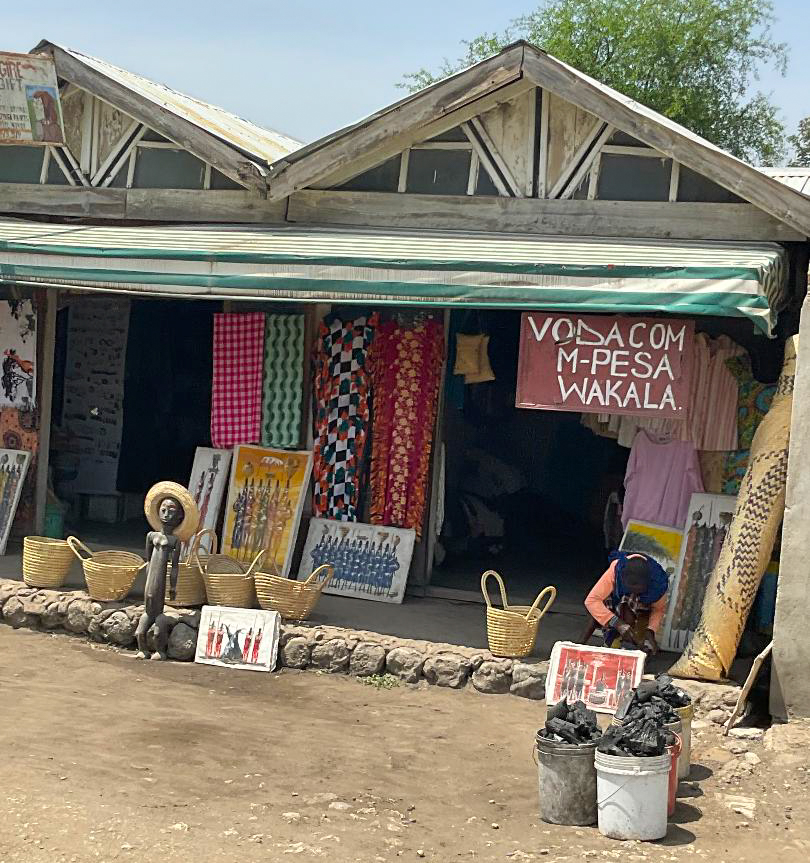
We passed many of these art/souvenir shops on our way back into Arusha at the end of our tour. A collection of baskets, carvings and paintings and probably beadwork. As I wrote in the preceding blog, we stopped only at a centralized “modern” center for our shopping. No complaints about that but it would have been interesting (and probably cheaper) to shop locally.

This was a common occurrence – a small shop set back from the road, generally on dirt and with signage in English. There were always people or small jitneys or motorbikes or bicycles in front of the shops. This was a laundry but why it was called a “Bull Washing Bar” was beyond us. No bulls were seen.
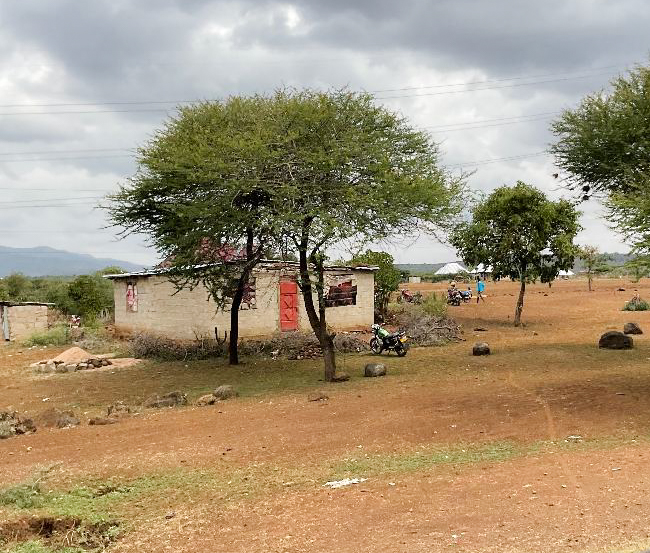
This was not the worst of the homes we saw, probably a little below middle. They were generally small, made of mud bricks with either a thatched or corrugated roof and few windows. As was often the case, a motorbike was parked out front.

This is an interesting juxtaposition, commonly seen, of signage in English and Swahili and of very different small enterprises – here a pub probably having nothing to do with Hawaii, a Hardware, and a tailor shop.

Out in rural areas, we often saw children including very young ones like this one, herding or tending to goats, sheep or cattle. This was on school days, too. There were very few instances where someone, always a child, would approach our vehicle as we were stopped at a light or in traffic, looking for a handout – food, money, whatever. This was a hard reminder of our privilege.

Shops came in many forms and sizes. Most were simple and did not look very prosperous. We wondered how they could sustain themselves. At the lodges, we did not see baskets for sale in the souvenir shops, but we saw them often on the roads.
We did not visit Dar es Salaam (“Dar”) the capital, economic center and by far the largest city in Tanzania. If we had we would have seen some modern buildings, expensive homes, hovels and everything in between, the same as in most big cities in Third World countries. Pictures of Dar should be a part of any examination of Tanzania – but again not seen by us. When I first met Cindy, I told her she had to get to “Wild Africa” before it disappeared. Perhaps that is a bit hyperbolic, but we were very happy to get there after a two-year delay due to Covid. I have used the word “privileged” often. Seeing these pictures again, that is the word that resonates strongest, perhaps in addition to “fortunate”. Privileged and fortunate not just to have been able to visit but also in our own circumstances – honestly, largely the luck of the draw. What if we had instead been born in Tanzania. What if we were there now, not as visitors but as native folks. What lies ahead for Tanzanians and “privileged and fortunate” visitors.
In 2014, the following assessment of Tanzania’s economic hopes was made by the World Bank:
“Despite Tanzania’s good macroeconomic performance over the past decade, the economy has not been able to generate enough productive jobs for a fast growing labor force, which is expected to double in the next 15 years. Tanzania will need to create more than one million jobs in order to absorb the large number of youth joining the labor market each year.
One way to do this is to harness the country’s exploding urban expansion and focus on fostering industry growth. If well managed, urbanization can offer an opportunity for accelerating the transformation of the Tanzanian economy towards more manufacturing and services, thus creating new types of jobs. Thus far, the increase in urban populations has led to the growth of non-farm businesses in urban centers which have been increasing by almost 15% per year.
Despite this, running a business in urban Tanzania remains challenging. While key constraints vary according to the nature of the business, its sector, and its geographical location, the most important include the lack of the required skills of the labor force; lack of access to external finance; the cost of connectivity; burdensome and insecure administrative environment; and the weak rule of law.“
In the decade following that report, the urban population has increased significantly, and the economy has definitely expanded despite the negative impact of the worldwide Covid Pandemic, but the enormous challenges of expanding jobs, education, infrastructure and technology remain, and the future is uncertain. Poverty is widespread and the explosive population growth is both Tanzania’s greatest asset and its greatest challenge. The demand for greater access to land and resources will continue to threaten Tanzania’s wildlife and the related tourism economy as well. Coupled with threats from poaching and climate change, the future of “Wild Africa” is also uncertain. Without question, it has declined greatly over the past 50 years. We have been privileged to experience it before a further decline which I expect is inevitable.
 blairbirding
Interesting and informative article.. thank you.. 😊
LikeLike