
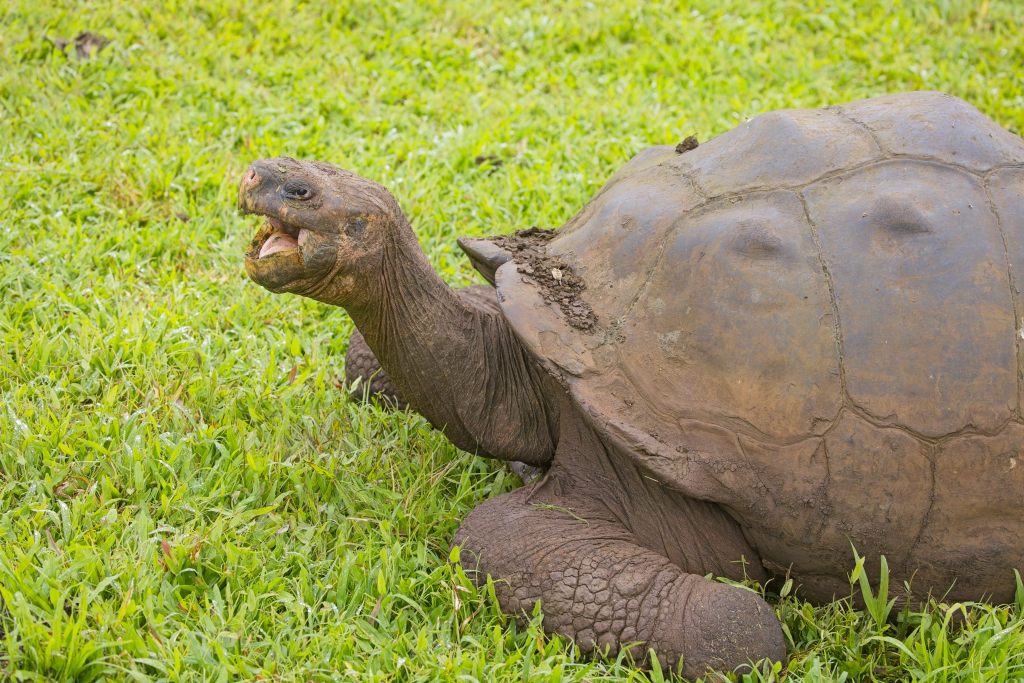
In Spanish “galapagos” are saddles. What do saddles have to do with these beautiful islands 600 miles from the Ecuador mainland? The answer involves the giant land tortoises, one of the most iconic images from the Galapagos Islands. They are found on several of the islands, especially on Santa Cruz. Since the males can reach six feet in length and weigh over 500 pounds, I guess you could ride one – maybe using a saddle, and I expect someone may have tried that, but the connection with a saddle is because the shells of the tortoise apparently reminded early visitors of a horse saddle, so there you have it – the surprising origin of the name for these islands which are full of surprises and many delights.
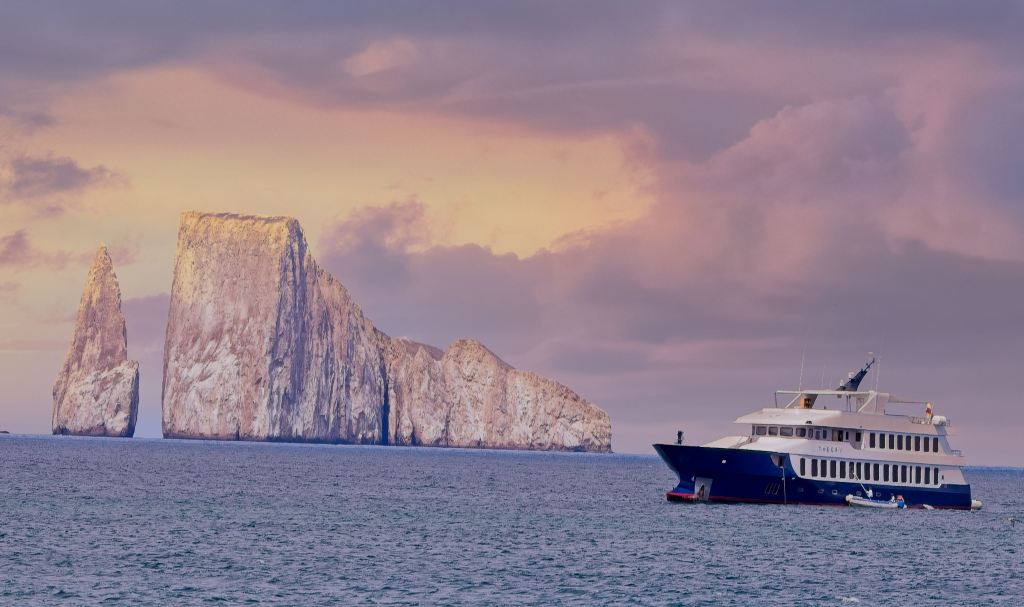
In early October this year, Cindy and I had the special privilege and pleasure of visiting the Galapagos for 8 days joining 14 other guests aboard the “Theory”, one of three spectacular yachts owned and operated by Ecoventura which describes itself as for over three decades, having “redefined the luxury expedition yachting experience by immersing travelers in an intimate voyage with exceptional itineraries, refined gastronomy, and life-enriching experiences in the Galapagos Islands.” Granted we have no other cruise data for comparison, but we could not agree more with that description of our experience with Ecoventura, truly an exceptional adventure.
In this first of probably two blog posts, my objective is to provide some background for our trip, history and details about the Galapagos Islands, our vessel, our itinerary, fellow travelers and an overview of our activities and the wonderful creatures that we encountered. A second post will focus more on specific animals and activities with lots of photos of course. There is no way I can do this journey justice as one simply has to have been there – on the ship, on the ocean and on the islands to really appreciate how incredible it all was. We have been fortunate and spoiled to have now had several “trips of a lifetime” – none have been better than this one.
Background – Before the Trip
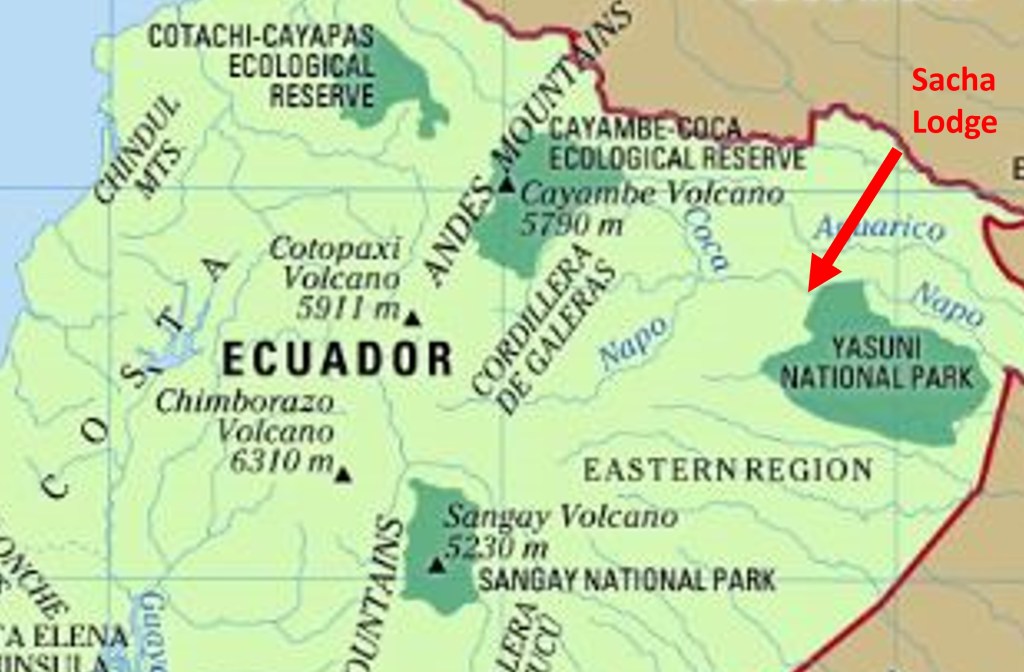
Where to start? How about with why the Galapagos. In 2022 I had dragged Cindy off to Ecuador for a birding trip. She mostly knew what she was getting into as we been on a birding trip to Oaxaca, Mexico with a small group. That trip was just OK as the approach and makeup of the group was not what we would have liked. So for our Ecuador trip, we changed our approach and had a private trip with our own driver and guide, our own itinerary. It cost a little more than with a larger group, but surprisingly not as much more as one might expect. We loved Ecuador, the colorful birds at feeders at charming and comfortable lodges, the empanadas, the amazing Andes, the incredible Sacha Lodge in the Amazon and wonderful people. Ecuador is one of the top birding destinations in the world, and while our 450 species were barely 25% of the species possible in that relatively small country, it was a very successful trip from my perspective which was mostly interested in seeing and photographing birds. Cindy loved many of the birds, especially the hummingbirds and tanagers, but more so, she loved the experience, the feel and flavor of the place. Improving on the Oaxaca experience, we felt comfortable in planning future trips with lots of birds and nature in somewhat exotic out of the way places. Cindy was very happy with Ecuador, but we learned that maybe we had made a mistake planning this trip. Including the travel, our trip in June 2022 had been for just over two weeks with no time in the capital city of Quito and most importantly with no time in a place that came up extremely positively and often in conversations with other travelers we met. That place of course was the Galapagos. People literally gushed about their experiences and said “you have to go”.
The seed had been planted and it grew. But there were other seeds as well including a trip that we had planned even before that first Ecuador trip but that had been cancelled by Covid. It was to Tanzania – on the very top of our wish list. Especially if traveling with tour companies that organize these kinds of trips, it is essential to book well in advance maybe even a year or more out. So we grabbed two open spots on the Tanzania trip for February 2023. Pre-Covid, we had thought we would do two trips a year mixing birding and non-birding activities. With that plan in mind and having an opportunity to travel with friends, we also booked a non-birding trip to Italy in October 2023. Tanzania was fantastic and the Walk About Italy trip was mixed. Lots of good pieces but some disappointments as well. But we loved being with friends and thought we would pursue that again – maybe even with friends interested in at least some birding along the way.
We had also learned that we had to admit that we were getting older (even if hopefully not yet “old”) so with the number of years ahead with good health probably decreasing with each passing year, we decided to do three trips a year if we could, adding travels with friends and combining birds with other interests where possible. What to do in 2024? Before Covid we had planned to join “Field Guides Birding” on a trip to Chile and Argentina combining birds and wines. It had been cancelled but our interest remained. We checked and were at first pleased to see that it was still open for February 2024, but then disappointed to learn that only three people had signed on. Our joining would leave the threshold for a good to go decision still one short. Friends that might have been interested had other plans for the dates, but after some pricing negotiation, the decision to go was finalized. It was a great trip with nice birds (too many nondescript brown ones for non-birder Cindy) and lots (and lots and lots) of excellent wines. We really enjoyed the other couple on the trip, convincing us further that traveling with friends was a great idea.

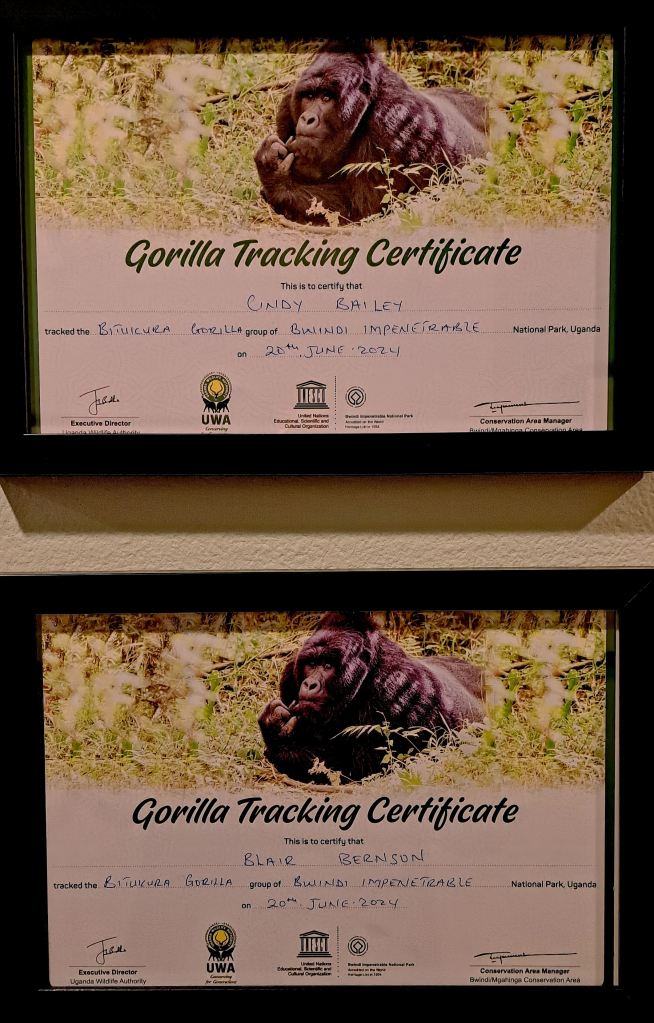
I had a fabulous birding experience with super guide and super photographer Greg Homel in Mexico on my own in December 2023 and wanted to go out with him again this time with Cindy and friends. Cindy really wanted to get back to Africa and Greg had led many trips to Uganda which had great appeal as a new location with the special opportunity of seeing Mountain Gorillas and Chimpanzees. It was also of interest to a couple we knew, so we planned a visit for June 2024. Long story short, Greg’s local partner in Uganda reorganized and the trip fell apart after a month of back and forth negotiations. By that time we were frustrated but had really bought into Uganda as a destination. Unfortunately our potential travel partners soured on the whole idea. We found that a trip to Uganda with Victor Emanuel Nature Tours (the company we used and liked in Tanzania) would go if two more people signed on. We did and we went. What does this have to do with the Galapagos you might ask? First due to a bad experience with our companions on the Uganda trip (i.e. very poor chemistry) we were further committed to traveling with friends and secondly although the couple we hoped to join us in Uganda didn’t go, Tom, the birder in the couple, was still interested in a birding trip (his first). So we looked for a way to get in another trip, go birding with Tom and travel with friends. How about Ecuador now to include the Galapagos Islands? Tom and I could bird ourselves for a week or so and then I could meet Cindy and non-birding members of her family that we were close to for a trip to the Galapagos – that seed now germinated and just needing some attention.
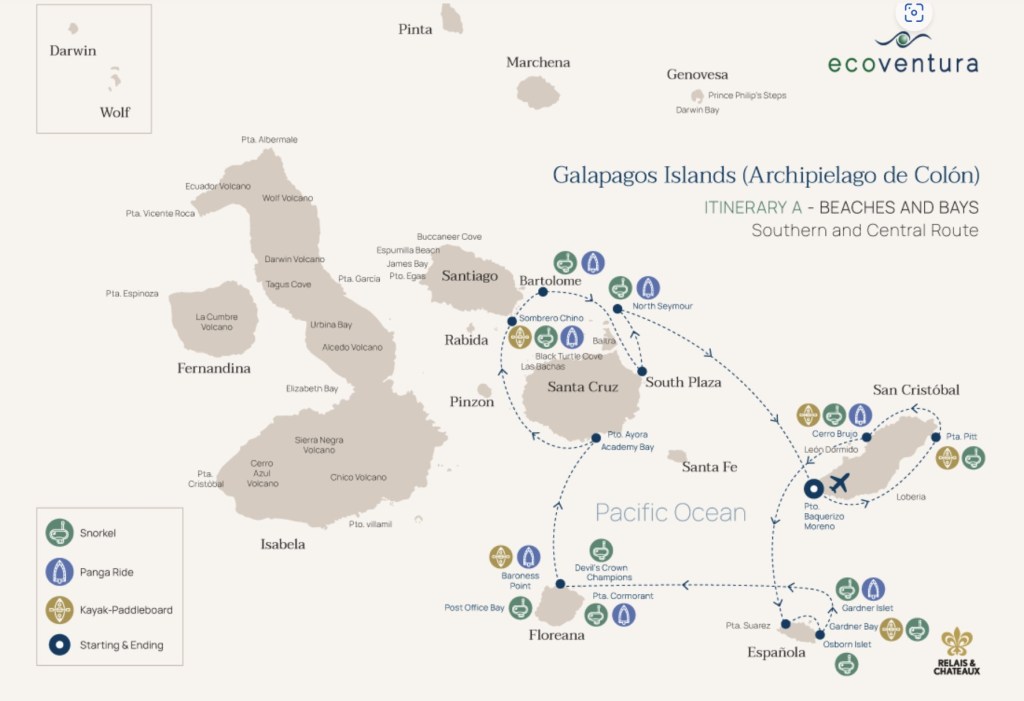
We explored the various ways to visit the Galapagos and through some hard work and lots of luck we discovered Ecoventura. Reviews were fabulous; everything we read was fabulous; the photos and videos were fabulous; the size was very appealing – with a maximum of 20 passengers versus some other boats that were 70 to 100; and the price was … daunting but at least close to within our budget. There were two itinerary choices and the one we preferred was available on workable dates for all of us and I was able to find a birding trip for Tom and me that would fit the scheduling (to be covered in future blog posts) and we found acceptable flights. We were on.
Getting There
Both trips – birding for Tom and me and the Galapagos for Cindy, me, Mike and Stephanie, started with trips from Seattle to Quito. Our flights would all be with United and Copa Airlines and the route was Seattle to Los Angeles then Los Angeles to Panama City, Panama and then to Quito. For me and Tom, there was a problem in Los Angeles that delayed the departure to Panama City meaning we would miss our connection there and we would have to spend the night in Panama City. Since the problem was caused by the airline (Copa) we were given “hotel” vouchers which turned out to be a pass to a lounge at the airport that was pretty crappy with the only chance to lay flat being on the floor or on seats pulled together – awkwardly. Bottom line – maybe an hour or so of restless sleep. We then caught an early flight to Quito arriving midday. More detail will follow in a blog on that trip. For Cindy et al arriving later, they had no connection problems and arrived in Quito around 1:00 a.m. on October 4. After clearing airport hurdles, they got their bags and took a taxi to the Wyndham Quito Airport hotel – barely 5 minutes away and at a cost of $3.00 for the cab. The hotel was obviously super convenient (at least to the airport) and was very nice – good rooms, good service and quiet.

After my birding trip with Tom, I met the family at the Wyndham. We went into Quito the next day for a brief visit – brief only because we really didn’t find much to keep us there – and returned to the Wyndham which we would leave the next morning taking the shuttle back to the airport. Our departure instructions from Ecoventura were concise, accurate and reassuring. We were met by their representative at the airport who walked us through everything and gave us our tickets for the flight from Quito to Guayaquil (about 40 minutes), where we would stay on the plane which after refueling would then head off to San Cristobal in the Galapagos about 90 minutes away. Consistent with everything that would follow on this trip, every detail was perfectly planned and executed and always with a smile. We were clearly in good hands.
The Galapagos – Facts and History
The Galapagos Islands are part of Ecuador, located in the South Pacific Ocean about 600 miles west of the mainland. There are 127 volcanic islands of which 18 are considered major. Located close to the equator, there is approximately 12 hours of daylight year round and temperatures are relatively stable determined more by clouds and rain (which is limited). Although today approximately 30,000 people live on the islands, they were unpopulated when discovered by accident by Tomás de Berlanga, a Spanish noble and the bishop of Panama, whose ship was blown off course in 1535 while sailing from Panama to Peru. He described the barren islands as worthless. Though Spanish sailors, buccaneers, and whalers soon followed in Berlanga’s wake, the islands’ inhospitable dry terrain discouraged permanent habitation. The Galápagos was annexed by Ecuador from Spain in 1832, which led to a trickle of settlements and penal colonies. It wasn’t until the 1960s that an increasing number of Ecuadorians began migrating to the islands, drawn by opportunities in fishing and tourism.
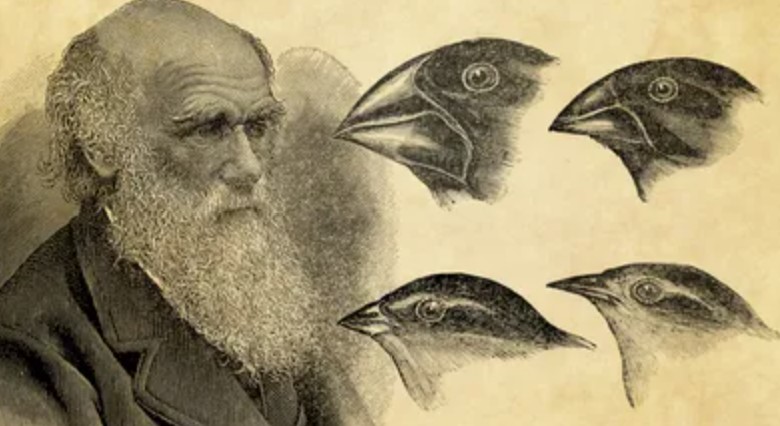
Although Charles Darwin only spent five weeks in the Galápagos in 1835, his time in the archipelago left a lasting impression. Here, the English naturalist famously observed that the islands’ finches (later named in his honor) had beaks that varied from island to island, depending on local conditions and food sources. Darwin would later draw on this research as evidence for his theory of evolution by natural selection, which he presented in On the Origin of the Species.
97 percent of the Galápagos landmass is designated a national park. Established in 1959, Galápagos National Park protects more than 3,000 square miles of islands and islets, while the Galápagos Marine Reserve protects an additional 50,000 square miles of ocean around the islands. There are strict limits on visitation and activities with all visitors needing permits and all ships limited to no more that 100 passengers, with highly regulated itineraries and schedules and all requiring local guides/naturalists. It is illegal to remove or disturb any plant life, sea life or animal life or any geological items. Great care is taken to prevent any organisms from elsewhere to be brought into/onto the Galapagos Islands. As a result of these controls and a conservationist culture, the unique flora and fauna of the islands is being preserved and the animals are incredibly confiding, allowing close observation and appreciation by visitors. During our entire stay on the islands, we did not see a single piece of trash. We did see a few other small tourist vessels but almost always had beaches and hikes completely to ourselves.
Our Gang
The Theory is built for 20 guests. October is not the peak season probably due to little cooler temperatures (air and water) so we only had 16 passengers on board. To our surprise Cindy and I were the oldest passengers. Two others were in their 60’s, three in their 50’s, 6 in their 40’s and one family had three children aged 7, 12 and 14. The family was from Houston, TX, one couple was from Seattle, another from Atlanta and one from Nashville, TN. There was a single woman from New York City and Mike and Stephanie are from Arlington, WA with Cindy and I or course being from Edmonds, WA. Although Cindy and I often felt like parents or grandparents because of the age difference, and to some extent we were probably treated as such, everyone in the group was intelligent, considerate, and good natured. Despite an abundance of available free alcohol, there were no indications of over indulgence. Potentially problematic discussions of politics and/or religion were non-existent.
While our travel companions were major parts of the trip without question it was the quality of all of the crew that made the trip special. Altogether there were 14 members of the crew including many rarely if ever seen because of their engineering or other duties keeping them away from passenger activities. Bartenders, waiters, chefs, cooks, and Zodiac drivers were all consistently helpful, attentive, informative, engaging and well beyond pleasant. Our captain and others responsible for navigating and moving the vessel were the same. I give a special shout out for four special members of the Ecoventura team. I am not sure what title or job description to give for Maria, but she is listed as the Room Attendant which seems to be way too small for her actual work. She saw to it that every cabin was always clean, in perfect order and well stocked. Breakfast each morning would be at 8 and within moments of any cabin being empty, she would be at work, invisibly making it perfect despite the disarray that we may have created. By 8:45 or so when we returned, each room would be in complete order and Maria would have transitioned to help prepare for whatever our next activity would be on land. I never saw Maria without a smile or a kind word, even if in Spanish. A second shout out goes to Jessica officially our Concierge. She made sure everything was in order and everyone was happy, announcing schedules, helping with supplies, bills or anything that anyone wanted – at any time. If something didn’t work – or more likely we did not know how to make it work – like TV, wi-fi, blinds, safes, first-aid or whatever, Jessica was the go to person to take care of it. Again always with a smile and always with kind words.
In a special category of their own were the two wonderful naturalists Martin Loyola and Billy Maquilon. They were our leaders for each adventure on land or in the sea. Typically our group would split into two with one or the other naturalist accompanying each group whether it was for snorkeling, beach walking or hiking. Along the way they would regale us with stories, science, history, culture and laughs. They knew every rock, plant and animal – not just superficially but also in depth. It was impossible to be with them without learning something and without smiling and laughing. They captured many moments on cameras – theirs or ours – souvenirs of the trip.
Our Yacht – Some Details
(Much of the following is from an extensive 5 star review at http://www.cruisemapper.com/ships/Ecoventura-MV-THEORY-Galapagos-2243) Built in 2019 and refurbished in 2022, the 434 gross ton MV Theory is 141 feet long with a 26 foot beam. The maximum passenger capacity is 24 (adding bunk beds to 4 staterooms). All staterooms are 160 sf and are located on the exterior of the deck with large portholes and full bathrooms ensuite. It has a crew of 13. It is classified as an ultra-luxury superyacht. It and its two sister ships are the only ships with the Relais & Chateau brand certification which signifies “charm, courtesy, character, cuisine and calm” for its 580 worldwide unique and independently owned luxury hotels and restaurants. It is operated by Abercrombie & Kent/A&K Travel Group via Ecoventura Galapagos. Each stateroom has its own tv, ample storage, and self regulated heating and cooling systems which were blissfully quiet. For the most part the ship traveled between islands at night with general calm seas. On two nights we had noticeable rocking and rolling. Nobody got seasick during our travels.
The boat has 4 decks, of which 2 are with cabins (one for the crew, one for the passengers). All passenger cabins being on a single deck is rather unusual (especially for a Galapagos-based ship), as opposed to other ships (superyachts and even smaller boats) where guests’ accommodations spread on two or three decks, and some are with small Portholes (round-shaped windows).MV THEORY staterooms (a total of 10 passenger cabins) are all outside and located on Beagle Deck (main deck 2). All cabins provide luxury hotel amenities and unobstructed ocean views. Four pairs (8 cabins) are with interconnecting doors making them ideal for families. All crew cabins (8 total) are on Finch Deck (lower deck 1).
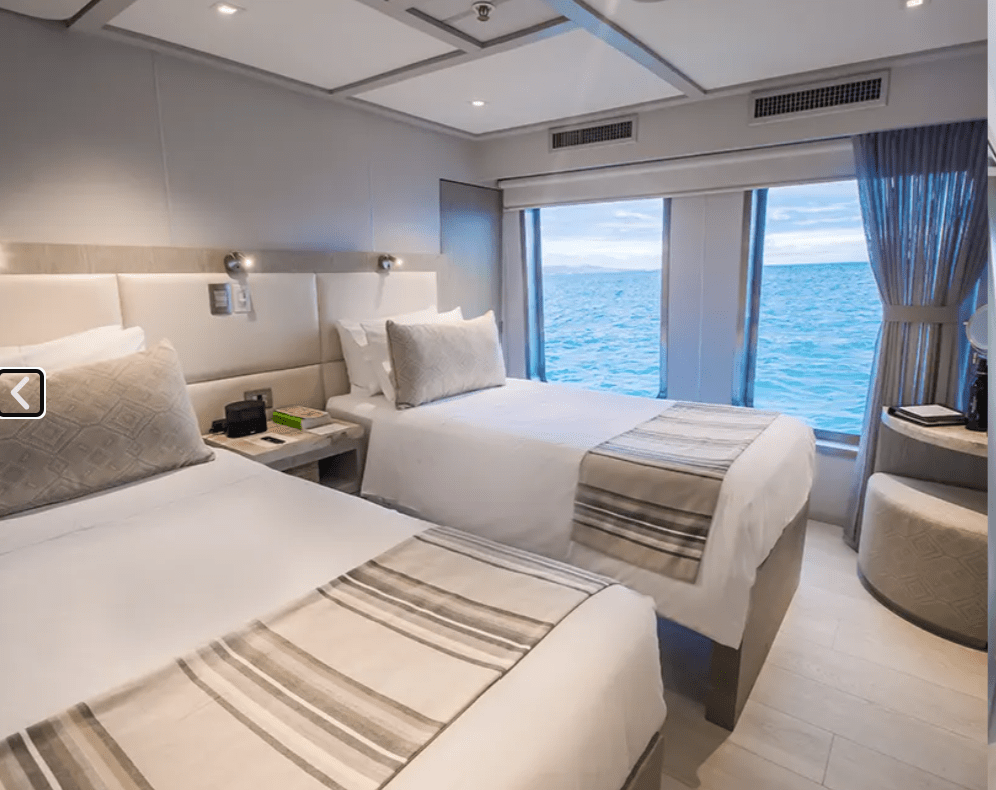
Cabin amenities include King-size double beds (convertible to twins/single beds, premium linens, duvets, 3 pillows per berth), leather headboards, bedside cabinets (with a drawer), wall-mounted reading lamps, hardwood flooring, 2-3 large windows (non-opening, with shades), a small corner table/writing desk (stool, binoculars, magnifying mirror, reusable water bottles), radio/alarm clock, TV, in-built sound system, mood lighting, individually controlled air conditioning.
Cabin bathrooms also have a large window (non-opening) allowing natural light directly into the shower cubicle. Cabin showers are with sliding glass doors, the WCs are wall-hung toilets. All toiletries are biodegradable and include soap, shampoo, conditioner. Premium bathrobes and sleepers are also provided. Triple cabins additionally have a fold-away bed (concealed in the ceiling). Laundry service is provided complimentary.
Onboard venues and facilities include Bar Lounge, Dining Room, Library, Boutique Shop, Sauna Room, small Fitness center. The yacht has two Zodiacs (large-capacity RIBs/rigid inflatable boats stored forward on Deck 2) used for passenger transportation (ship-island-ship) and also for near-shore cruising tours. Besides the Zodiac tours to the islands, Ecoventura also complimentary provides all tourists with snorkeling gear and sea kayaks.
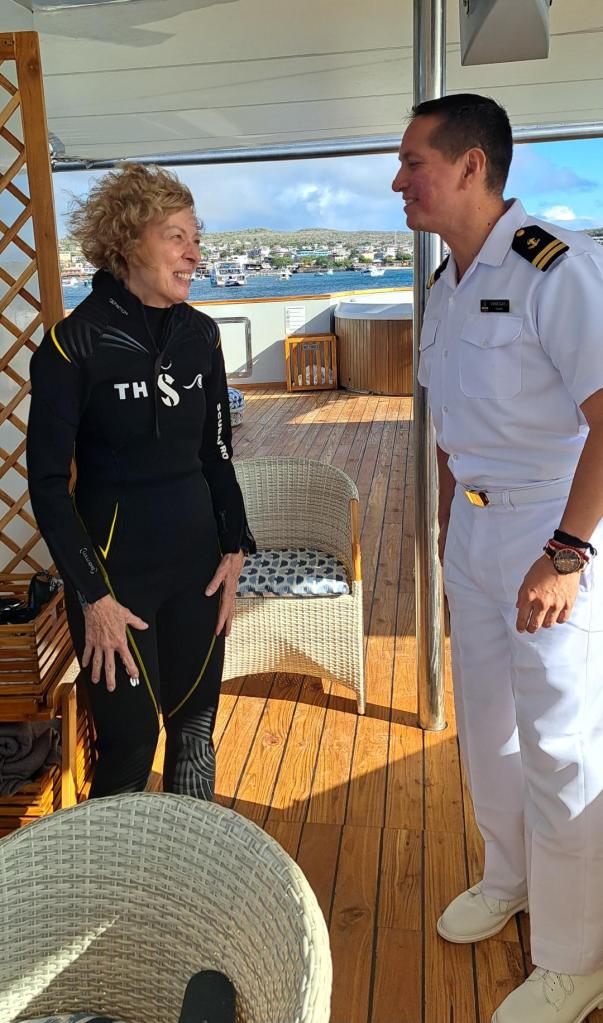
Ecoventura’s vacation travel experience features daily shore excursions (usually starting at dawn, after the buffet-style breakfast) as passengers are ferried via the Zodiacs to the island’s landing point. The Zodiac landings are two types (depending on the island/destination) – wet (you must step into the water and wade to shore) and dry (you step from the boat directly to the rock). Around 3-4 hours are spent ashore at each site. In addition to the guided tours are complimentary offered activities like deep water snorkeling (sometimes twice daily), beach swimming, kayaking, and boat rides.
Upon return to the yacht are offered snacks (meaning special preparations well beyond the common meaning of a mere snack) and fresh juices, leisure activities (swimming/snorkeling/kayaking near the ship or sunbathing/relaxing on the Sun Deck), followed by lunch, and another set of land tours. Dinners (at ~7+ pm) are served and with freshly prepared a-la-carte meals (including vegetarian and vegan dishes) prepared by the ship’s chefs with the freshest (mainly locally sourced) ingredients and inspired by Relais & Chateaux.
The ship’s top deck is a spacious sundeck/outdoor area for relaxation and sunbathing. The Sun Deck features a round Jacuzzi (bow-facing whirlpool bath) and is served by its own Bar (poolside wet bar with stools). Sun Deck’s flooring is of premium teak and the furniture includes 4-seat tables, sofas, daybeds, padded lounge chairs, two hammocks.
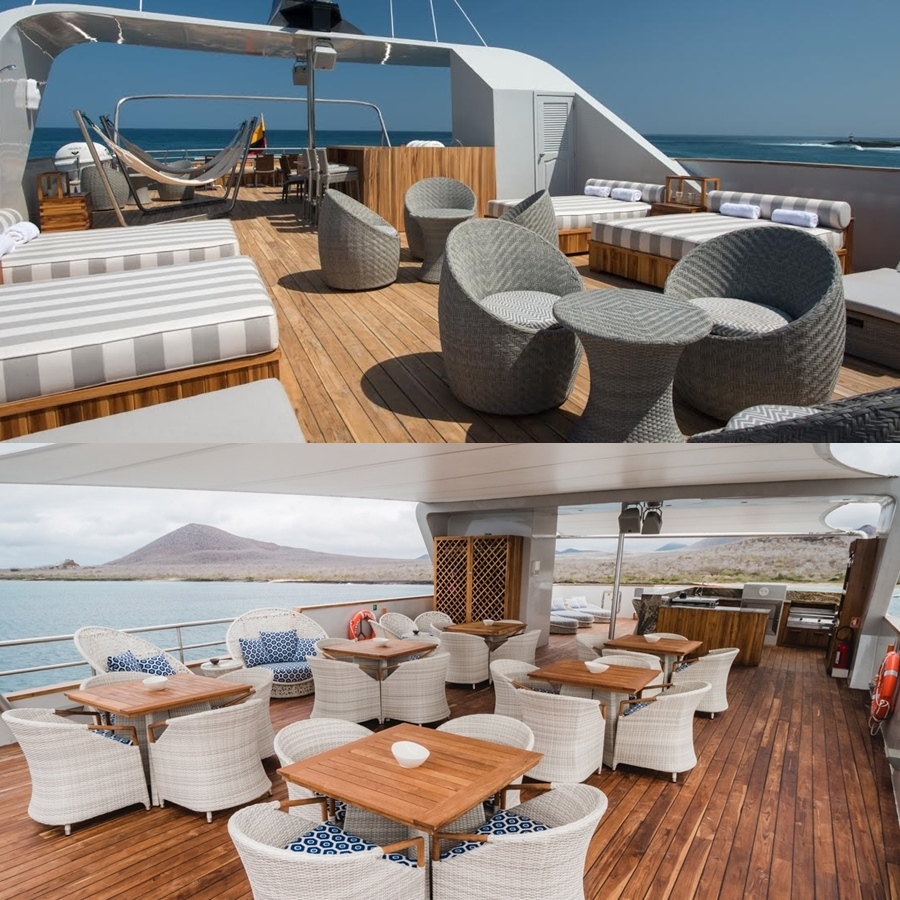
The MV THEORY yacht is equipped with 2x Zodiacs/RIBs (aka pangas), 1x glass-bottom boat, 5x tandem kayaks and 2x SUP boards (stand-up paddle boards/surfboards) which are provided to passengers free of charge during the entire voyage.
Onboard dining (all meals and beverages) are included in the Ecoventura’s fares. The food is freshly prepared using only sustainably sourced meats and seafood. All snacks are complimentary and available at the Bar throughout the day. Ecoventura’s Open-Bar policy provides complimentary beverages (wine by the glass, beers, spirits, cocktails, fresh juices, sodas, brand coffees and teas). Also included in the cruise tickets are the Wi-Fi Internet (ship-wide coverage), kayaking and snorkeling equipment (masks, fins, snorkels), wet suits (available on a first-come-first-serve basis), Galapagos land transfers (airport-ship-airport) and all guided shore excursions/boat tours.
Ecoventura’s Open-Bridge policy allows passengers to visit the Wheelhouse (Navigation Bridge forward on Deck 3) and engage in conversation with the Captain and the officer on duty.
Adding my own critical comments, the food was fantastic and diverse always with paired wines or beers and preceded (and/or followed) by mixed drinks or coffee. Special nights featured ceviche, pizza, tacos, or sushi and in each case they were wonderful and in keeping with the high level of preparation and presentation. Breakfasts were buffet-style with plentiful fresh fruit and juices, quality teas and coffees (including specialty coffee drinks) and omelets/eggs made to order. I was especially happy to have a mix of granola type cereals, my usual in the morning. A sampling of a dinner menu is shown below. It was like this every night. Over the top.

If you think all of this sounds pretty amazing, you are right and since this was my first real cruise adventure, I am spoiled beyond words and wonder if I can ever settle for another ship experience. And while it would have been enjoyable to have remained on the ship the entire time, it really was the onshore opportunities that made this trip so incredible. Everyone returning from the Galapagos says they were overwhelmed by the ability to interface with so many marvelous birds and animals. Darwin’s Finches and their place in the history of evolution are very interesting but frankly are the least visually exciting animals in the Galapagos – very important to birders like me but generally ignored or barely noticed by others. Not hard to understand when the list of possibilities, even probabilities include the following:
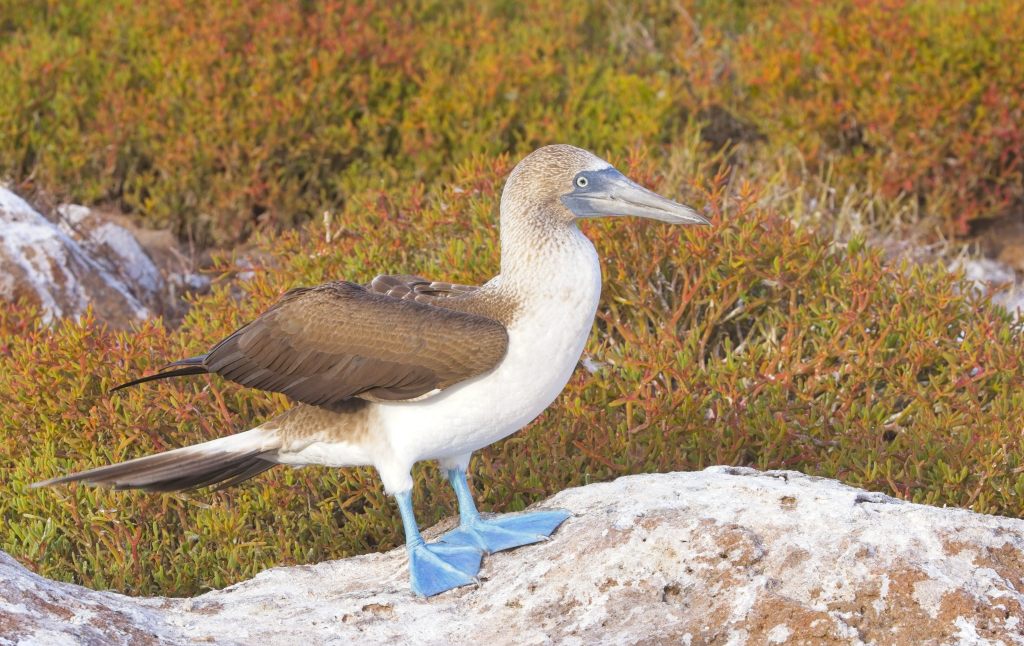
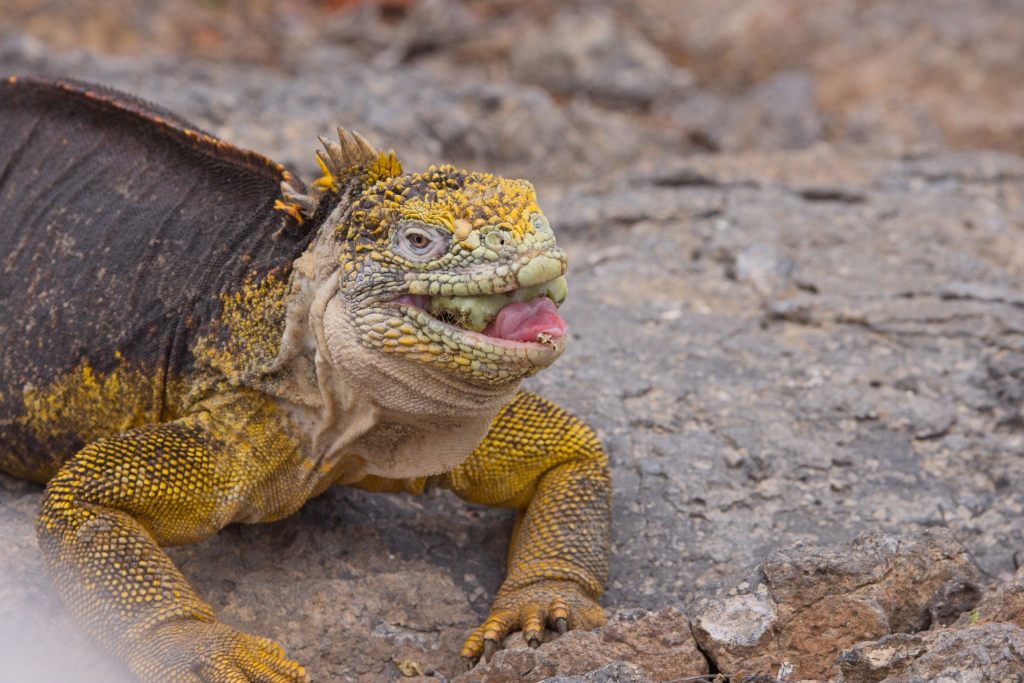
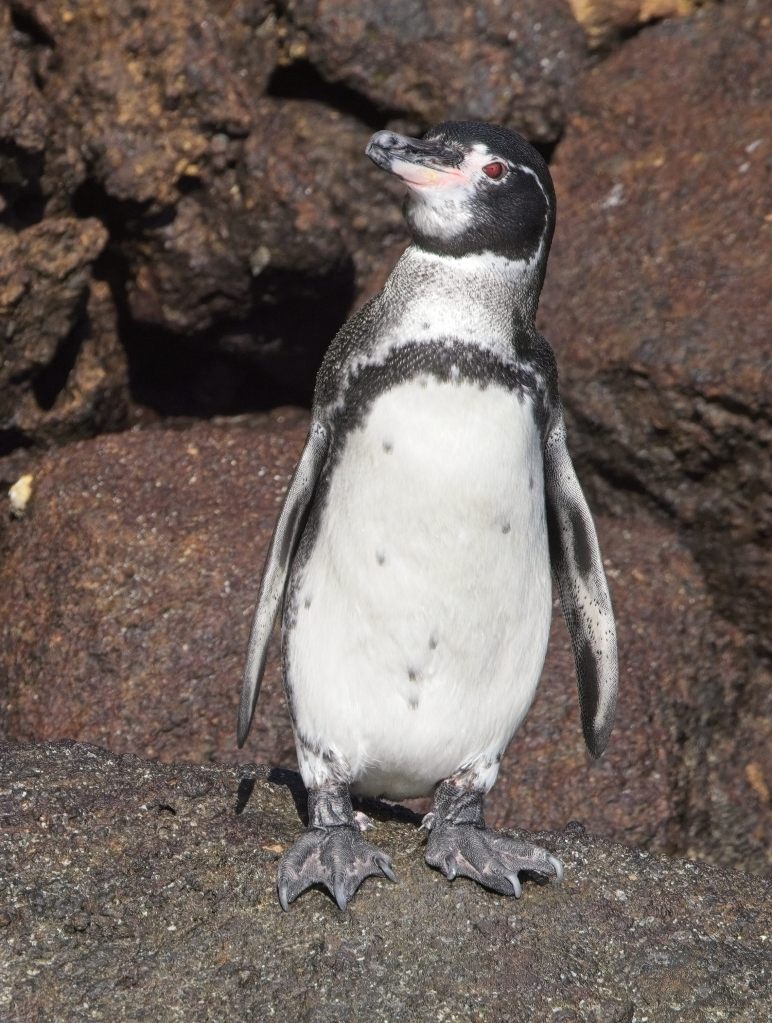
Birds such as Red Footed, Blue Footed and Nazca Boobies; American Flamingos; Magnificent and Great Frigatebirds; Brown Pelicans; Galapagos Penguins; Red Billed Tropicbirds; Waved Albatross; Flightless Cormorants and Lava and Swallow Tailed Gulls – Reptiles such as Marine Iguanas, Green Sea Turtles, Giant Land Tortoises, Lava Lizards and Land Iguanas – and myriad sea creatures including sharks, dolphins, whales, sea lions, octopus, sea stars, crabs and fish by the thousands.
The next blog will be full of our adventures on land and in the sea and will share photos of most of the creatures above – up close and personal. A couple of photos are included below as teasers. Enjoy them and come back for more.




 blairbirding