Birds and Wines of Chile and Argentina – Argentina Part IV – Last Days in Argentina with Water Birds, Creepers, Woodpeckers and Hummers

Argentina had been great – beautiful places, great birds, amazing food and awesome wine. We had one more full day and then a part day before flying from Mendoza back to Santiago for our last two days in Chile to end our tour. Still some target birds to find.

February 13, Day 10:

We departed very early and got a little delayed when the only convenience store where we could get something that would pass as breakfast did not open until 7:00 a.m. It did open and we improvised breakfast before spending the rest of the morning in fairly familiar in mostly scrub habitat and found lots of new birds in three hours of birding along Ruta 142 still in the Mendoza area. Although we missed a hoped for photo of a Campo Flicker, we had a very brief look as we drove by. I had seen it before but no photo. Two other woodpeckers were more cooperative – lifer White-fronted and Checkered Woodpeckers.

White-fronted Woodpecker
Checkered Woodpecker

It apparently was a good morning for species with “wood” in their names and they came in pairs as after the woodpeckers, I had a pair of lifer “woodcreepers” – Narrow and Scimitar-billed Woodcreepers. As is often the case with woodcreepers, we waited for them to come mostly into the open on the trunks or snags of the trees. Great theory but they just did not perform their assigned roles and the photos were less than desired.

Narrow-billed Woodcreeper – awful photo
Scimitar-billed Woodcreeper – Better photo

Even less cooperative was the lifer Tufted Tit-spinetail. I had glimpses as it flitted about buried in the foliage, but never a great look and definitely no photo. Why couldn’t it behave like the Straneck’s Tyrannulet, Black-crowned Monjita and Swainson’s Flycatcher all of which came into the open enough for recognizable photos.

Straneck’s Tyrannulet
Black-crowned Monjita
Swainson’s Flycatcher

There would be one more lifer for the morning – a Many-colored Chaco Finch and some other good photos of birds seen before – Crowned Slaty-flycatcher and Short-billed Canastero. All in all a truly exceptional morning with the NINE lifers!! And oh yeah we had a quick view of a Southern Gray Fox!

Many-Colored Chaco Finch
Crowned Slaty-flycatcher
Short-billed Canastero
Southern Gray Fox

I have not been able to locate notes for what we did at lunch after the great morning, but I know well that we spent a long and very successful afternoon birding the Piletones de El Paramillo, extensive sewage treatment ponds outside Mendoza that were full of waterbirds. Although some of the birds had been seen earlier on the trip, this was the first time I could get photos – lots of photo ops.

Life birds were Black-headed Duck, White-tufted Grebe, South American Painted Snipe and Brown-hooded Gull. Additional life photos included White-cheeked Pintail, Lake Duck, Red Shoveler, Great Grebe, White-winged Coot and Cattle Tyrant. There were lots of other photos too!

Black-headed Duck
White-tufted Grebe
White-cheeked Pintail
South American Painted Snipe
Brown-hooded Gull
Lake Duck
White-winged Coot
Red Shoveler
Great Grebe
Cattle Tyrant

Those were the lifers – species and/or photos, but as I said there were lots of birds and lots of photo ops. Some species would be distant at first but then we would drive by another pond and have them closer, or maybe in poor light at one place and then better light as we continued to drive around the multiple ponds. And on the way out we had another Burrowing Owl and our first Diuca Finch in Argentina.

Burrowing Owl
Diuca Finch – First in Argentina

Especially this late in the trip, the 13 new lifers was awesome – now at 89 for he trip so maybe 100 would be possible. And I also added 30 new species for Argentina. It was a very good day indeed.

February 14, Day 11:

Happy Valentine’s Day – well at least for us Americans. And that is a good segue for a comment about wife Cindy. When we first met – now almost 5 years ago, a deal had to be struck pretty early on: I would learn about dogs and especially her, now our, Black Labrador – Chica. And she would have to learn about birds and birding. Neither of us probably had a real grasp on what each of those undertakings would entail, but I think we have done pretty well. I have become Chica’s “Alpha” in our pack and Cindy, while I can’t say has become a birder, she has come a long way and has enjoyed most of our birding trips with the distinct caveat that there are too many “little brown birds” and that was definitely true on this trip. No specific Valentine’s Day celebration but we did make that toast over yet another great meal with great wine on this day of transition from Argentina back to Chile.

Our Lovely Chica

The agenda today was to have breakfast, pack and load everything onto our van, bird in the morning at the impressive General San Martin park in Mendoza, sneak in a little shopping, have lunch at Espacio Trapiche a 4 star Michelin restaurant in Mendoza at the famous Trapiche winery, head to the airport, fly to Santiago passing next to Mt. Aconcagua, load up in Santiago and drive to Vina del Mar on the Pacific Coast where we would be for the next two nights.

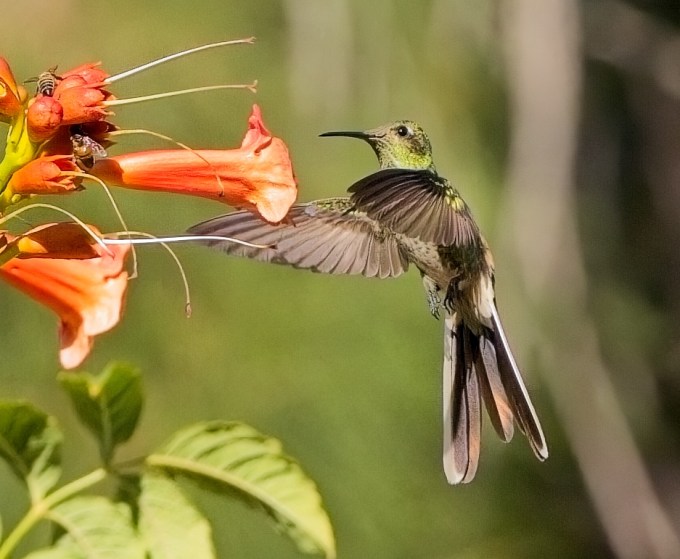
There would be no new life birds on this day, but there were lots of pictures, birds, food, wine and mountains. Two of the bird photos were especially appreciated as I was able to get life photos of two hummingbird species seen earlier but not photographed: Glittering-bellied Emerald and Red-tailed Comet. I also added three species to my Argentina life list: Harris’s Hawk, Rufous-bellied Thrush and Red-crested Cardinal.

Harris’s Hawk
Rufous-bellied Thrush (Seen and photographed in 2005 in Brazil)
Red-crested Cardinal (Seen in Brazil in 2005 and photographed in Hawaii where it is introduced)

Since this was the last day in Argentina I am including some other photos from the park, quite the birdy place.

Before lunch we visited a shopping area in Mendoza City where we hoped to find something to bring home as a memory. The shop was somewhere between a trinket filed tourist shop and a high end boutique. We found some fabric goods, a new hat for me.

In writing these blogs and looking at the web pages for the various wineries, its seems like there is an endless source of awards and ratings where each one is rated the “Best” something at sometime or another. Our last winery and lunch visit in Argentina was at the Trapiche Winery which was declared the “Best Winery in the New World for its 2019 Edition” by the Wine Star Rewards. I don’t know what Wine Star Rewards is or what it is says about them that there is a “New World” category, but our visit was fun with yet again excellent food and wines. The pictures tell the story.

It was then off to the airport for our trip back to Santiago. With his normal attention to detail, Marcelo had arranged for us to have seats on the right side of the plane (looking up to the cockpit at the front). This was so we would have the best views of the mountains and especially Aconcagua – fitting as our first birding in Argentina had been in the shadows of the mountain. The plane passed quite close to the mountain and we indeed had great views – a last memory of Argentina.

Mt. Aconcagua – tallest peak in the Western Hemisphere – over 22,000 feet

We had spent the better part of 7.5 days in Argentina. I did not keep track of the number of wines tried or wineries visited, but with the help of Ebird, I have a precise count of our birding. I had submitted 40 Ebird reports covering 153 species and bringing my Argentina life list to 173 species. Of the birds seen, 62 were new lifers and I had photos of 119 of the species seen (and there were others, like House Sparrow, Great and Western Cattle Egrets, and Rock Pigeon among others where I did not even bother). All of these photos were new for Argentina and more than half were new world photos. We would have a long drive to the Chilean coast after landing in Santiago, but that is a story for another blog post – my last for this trip.

Birds and Wines of Chile and Argentina – Argentina Part II

February 9, Day 6:

We had settled in to the beautiful Salentein Lodge and Winery. We had for us an early morning start birding around the winery at 7:00 a.m. picking up 7 lifers in around 2 hours. The Crested Gallito and Brown Cachalote were seen briefly or heard only but I would get good looks and photos of them later. Then there were the two “Creamy Birds”, Creamy-breasted Canastero and Creamy-bellied Thrush– I thought I had a photo of each but cannot find them possibly confused with other “brown bird” photos. The other lifers were White-banded Mockingbird, Screaming Cowbird, and Ringed Warbling Finch. Here are their photos.

White-banded Mockingbird
Screaming Cowbird

No surprise the breakfast at Salentein was wonderful and then we continued bird on the extensive Salentein holdings adding one more lifer before lunch – a White-tipped Plantcutter, in addition to new birds for the trip like Blue and Yellow Tanager, Banded Seedeater and Mourning Sierra-finch.

White-tipped Plantcutter
Blue and Yellow Tanager
Band-tailed Seedeater

It was great that we had such good birding in the morning because the next many hours would be all about wine. The Salentein Winery was founded in 1997 by a Dutch businessman, Myndert Pon, with the vision of creating a world class winery. One of its vineyards, San Pablo, however, dates back to the 17th Century. Everything we saw and experienced at Salentein was impressive with beautiful buildings, vineyards, facilities and of course food and wines. In 2019 at Mundus Vini, a top European Wine Competition, Salentein was named the best “overseas winery”. Where to start…

Main Building

The Salentein property is over 5,000 acres with 1200 acres currently planted in vineyards. The winery produces red, white, rose and sparkling wines and is probably best known for its Malbec’s. Every architectural detail is beautiful and impressive. We had wonderful food and of course wine including several bottles with the meals in addition to the many wines at a tasting in their exquisite tasing room. I could add dozens of photos taken during our visit but include here just a sampling.

View into one Oak Barrel Storage Area
Marcelo and our host in front of Tasting Room
Our Tasting
Blair and Cindy with the Big Barrels/Vats
Probably My Favorite Wine at Salentein
The architecture was understated but splendid in the details

After the wine at lunch and the tastings but before the wine at dinner, we actually continued birding – all on or near the Salentein property. I added another 3 world lifers: Darwin’s Nothura (unfortunately heard only), White Throated Cachalote and Hudson’s Black Tyrant (a female)- finally photographed after much work. This last photo, despite the poor quality, is noteworthy only because it is a very skulking bird and photos are hard to come by. I also finally got a photo of a Brown Cachalote – a lifer heard only and seen without photo before.

White-throated Cachalote
Hudson’s Black Tyrant – Female
Brown Cachalote

You never know when a bird will appear and just beg to have its photo taken. Such was the case with a Burrowing Owl and a Guira’s Cuckoo near the winery. They were new for the trip but seen by me previously. Both were spied as we drove the access roads to the winery and were seen and photographed from the van. I don’t think I have ever seen any cuckoo so much in the open before.

Burrowing Owl
Guira’s Cuckoo

I also got my best of the trip so far photos of Long-tailed Mockingbird and Chiguanco Thrush and a lovely photo of a Fork-tailed Flycatcher and a posing Chimango Caracara. Lastly I also got a decent shot of a Double Collared Seedeater.

Long-tailed Mockingbird
Chiguanco Thrush
Fork-tailed Flycatcher
Chimango Caracara
Double Collared Seedeater

It had been a great day for wine, food, birds and photos probably as representative of why we chose this tour as any. We had seen 42 species that day with 11 being new lifers and 19 new for my Argentina list. There would be more to come the next day. Dinner this night was another extravaganza at the Gaia Restaurant at the Domaine Bousquet Winery.

February 10, Day 7:

Our first birding on the morning of February 10 added another lifer and a photo of a lifer missed earlier. The new species was a Chaco Earthcreeper and the new photo was of a Crested Gallito, both were again LBJ’s – “little brown jobs” but the crest on the Gallito made that ID a lot easier. Another life photo, but of a bird seen many years ago on that Argentina fishing trip in 1989, was the Red-gartered Coot.

Chaco Earthcreeper
Red-gartered Coot

We were headed to Malargue for the night with lunch along the way at Villa Bonita de Mayo. As was usually the case when we entered the restaurant, Marcelo was embraced by the proprietor – old friends. I wish I had taken notes on all of the meals. Nothing specific on this one except remembering it was very good and the atmosphere was really fun.

After again too much food and wine, it was back to the birds around San Rafael. In fairly short order birding in the scrub habitat, I added 5 more lifers: Short-billed Canastero, Sooty-fronted and Stripe-crowned Spinetails, Greater Wagtail-tyrant and Southern Scrub-flycatcher.

Short-billed Canastero
Southern Scrub-flycatcher
Greater Wagtail-tyrant

There were not many mammals on this tour but on the road we did see a wild Guanaco.

Guanaco

New for the trip but a nice photo of a species I had seen and photographed in Peru in 2012 was a Golden-billed Saltator.

The early afternoon had been great for lifers and photos. Late afternoon added 4 more lifers but I only got a photo of one and not a great photo at that. The photo was of a White-winged Black-tyrant. Lifers added without photos were Carbonated Sierra-finch, Patagonian Canastero, and Band-tailed Earthcreeper. The Sierra-finch was a quick drive-by view and the Canastero never unburied itself. I thought I had a photo of the Earthcreeper but it has not been found if it ever existed.

White-winged Black Tyrant – the View Was Much Better than this Photo

Fortunately we were staying at the Hotel Malargue only one night – pretty low quality and I have already repressed details and took no photos. I do not even have notes or photos of dinner that night. Maybe just as well.

We were now half way into our trip (although not quite half way through the tour). Only 32 species were seen that day but,10 more species had been added to my growing life list (64 added so far). Our group trip list was at 120 species. We would not add that many new ones in the second half of the trip, but there were a lot more to come.