
June 26
How would you feel about a morning where you had 17 species but 10 of them were heard only,?six of the 17 were lifers but you saw only three of them, but you did get -?look at that species, but that 9 was a very rare and hard @’ find Green-breasted Pitta? And oh yeah you also got to see Chimpanzees. I have asked myself that question and my answer is that the disappointments somewhat outweighed the good moments and that maybe I need to recalibrate my expectations and reactions.
The morning in question was our trek in the very dense Kibaale National Park Forest accompanied by a local bird guide and a park ranger. Great weather but very dark and reminiscent of too many of my forest birding experiences, challenging to see anything and even more challenging for photos. I had either not realized or forgotten that while our main reason for being there was to find Chimpanzees, this was also the only likely place to find a Green-breasted Pitta, an uncommon charismatic species that had breeding territories and leks in Kibaale Forest NP. Thus when very early in our trek through the forest I heard what I was almost certain were Chimps, I did not understand why we continued on in a different direction. My thought had been: “Hurray this will not be a repeat of our endless slog through the Bwindi Impenetrable Forest before we found our Mountain Gorillas.” I heard Dion say “Pitta” and while my choice would have been to get the Chimpanzees quickly while we could, that was of course not what happened.
So we trudged on for at least another 30 minutes, memories of Bwindi hard to ignore. Finally our, guide indicated he had located a Pitta – by its call. Pittas are very colorful and sought after species anywhere they can be found. The Kibaale Pittas were high on the target lists of most birders visiting the Park, so I should have been excited. I was, sort of, not so much because it was a Pitta, but because it would of course be a lifer, and when I learned that it had been missed the last two days by others, maybe some competitive juice began to flow. I do not recall if it was Dion or our guide, but a Green-breasted Pitta was located calling on a horizontal branch. It was 70+ feet away and barely visible in the very dark forest and at least from the only angle I had through many layers of foliage. Even then I could see only part of the bird itself. So not exactly a great look and a very poor photo trying to use manual focus on the small target barely visible in the dark. The first photo is directly from the camera unedited and the second is the best I could do. In retrospect I might have had a better result if I had pushed the ISO setting to the upper limit – maybe.


After the “Positive Pitta Pursuit”, it was time to look for our Chimpanzees. We did not find them immediately but fortunately at least time and effort wise it was nothing like our Gorilla trek. For Cindy and me at least, the expectation/hope for the Gorillas had been to find a group at leisure. If you read my blog post on that experience, you know this was far from the case as our Gorillas had rarely stopped moving – generally away from us. Our expectation for the Chimpanzees was different, as we understood they were a much more arboreal species, so any Chimps we would see would almost certainly be in the trees. The questions thus were whether the trees would be closer or further away from us and how much foliage would block our views. The answers were “not too close but not so far” and “yes lots of foliage, but with enough openings for photos and good observations”. Better yet, the Chimps were not constantly in movement and we had many more frontal views. At times it seemed like we were surrounded by Chimpanzees and maybe we got looks at a half dozen or more. Like with the Gorillas, it was impossible to look at them, each with a very distinctive face, and not see our own evolutionary connection or relationship. We did not see much behavioral interaction but their strength and agility was striking as was the breadth of their emotional expression.
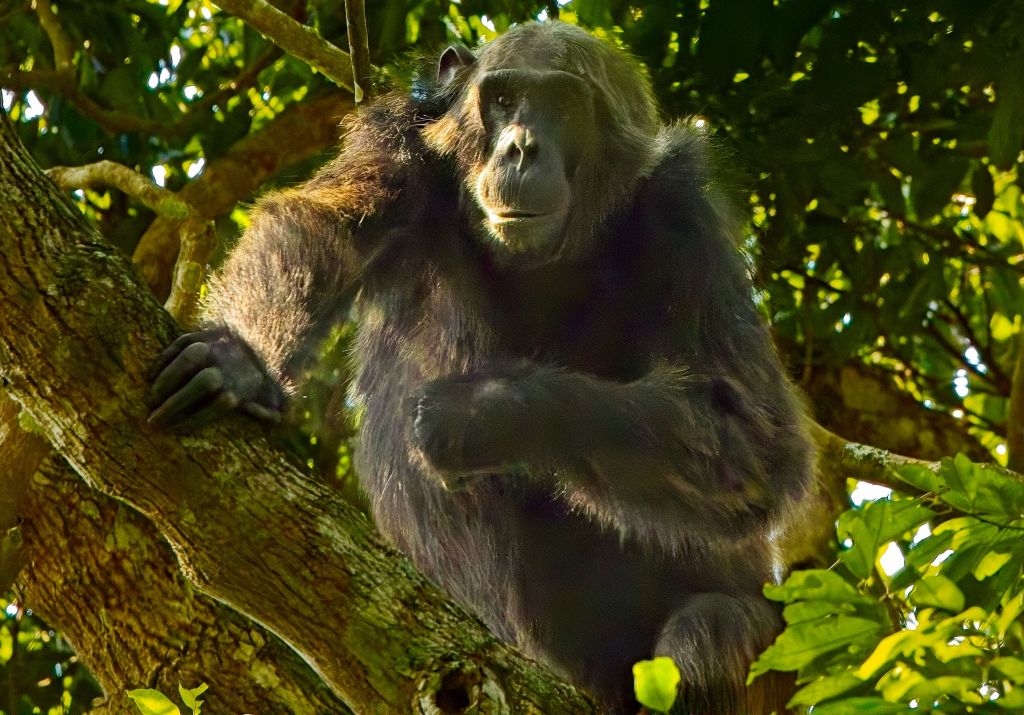


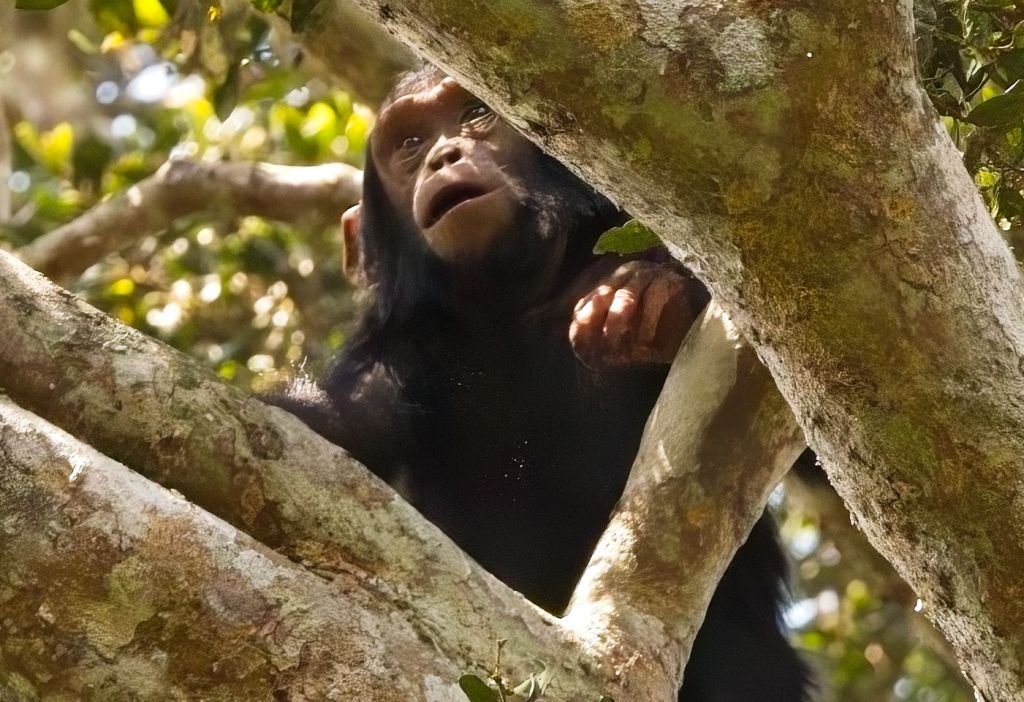

The edited and enlarged photos make it seem otherwise but we were never really close to the Chimpanzees and never felt any danger although they are know to be less docile than the Mountain Gorillas. The light a challenge with varying amounts of sun breaking through the dense forest but fortunately much better than it had been with the Pitta and we were very pleased with the experience and felt privileged to be in their world.
All told, we spent less than an hour with the Chimpanzees and over 4.5 hours in the Forest. As stated earlier, many, too many, of the birds were heard only including two species from a group with one of the strangest names – Brown and Scaly-breasted Illadopsis. What’s the plural? Illadopsises? I just had to know the derivation of this word and found that it comes from the Greek “illas” for “thrush” and “opsis” for “appearing”. Since we never saw them, I would not have known if they appeared like thrushes. We had two more birds, both lifers, that were also heard only and not seen that fit the same thrush bill – Rufous Flycatcher-thrush and Red-tailed Ant-thrush. So it was a good morning for thrushes – as long as visuals were not required.
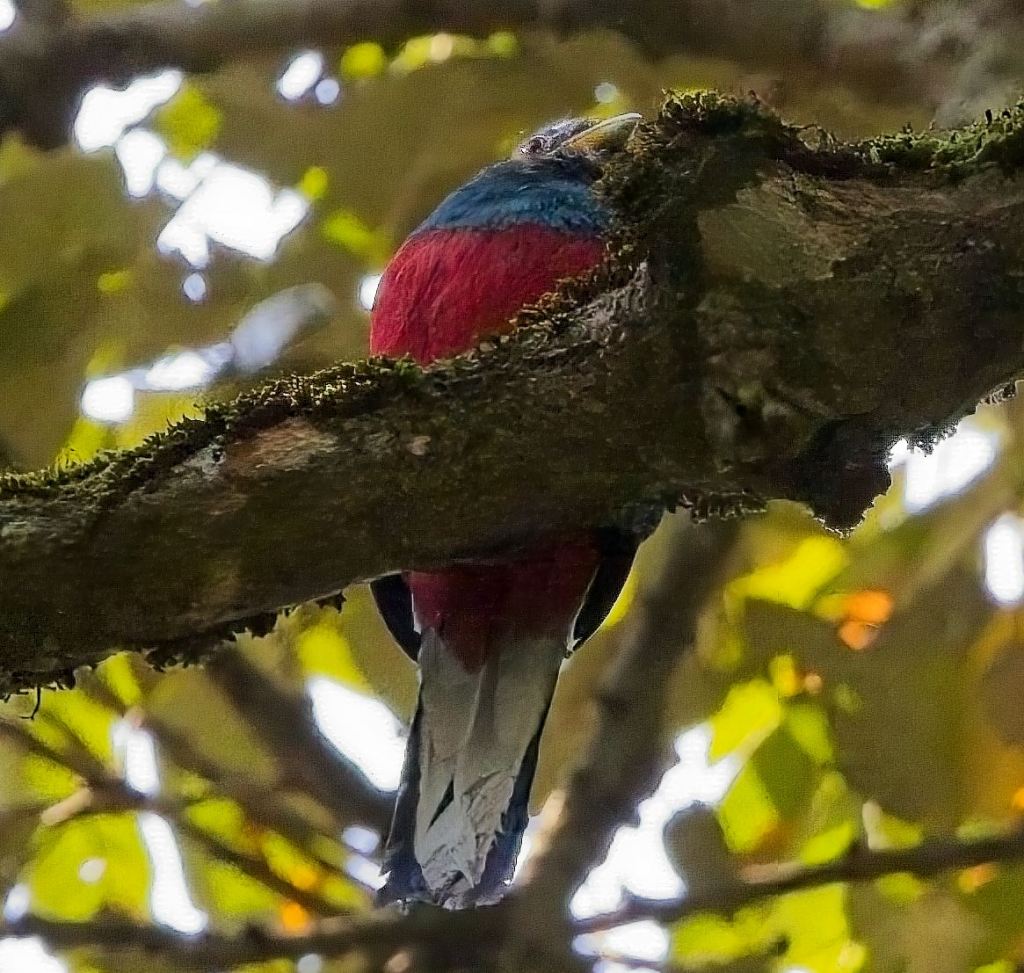
There was a hoped for bird that did require a visual for me to be happy. In fact I was thinking about it as we were coming to the end of our trek. I knew that this was a good place for Narina Trogon and literally within a minute of this bird coming to mind we found one. It was high up in a tree almost directly over us. I was able to get a good view of this lifer and some photos but it just would not turn its head for the shot I really wanted. Somewhat like the also always appealing Barbets, Trogons are found in both the Eastern (Asia and Africa) and Western (North and South America) Hemispheres and are always top targets for birders. The Narina Trogon was my second Trogon in Africa and my 20th worldwide – definitely a worthy target.
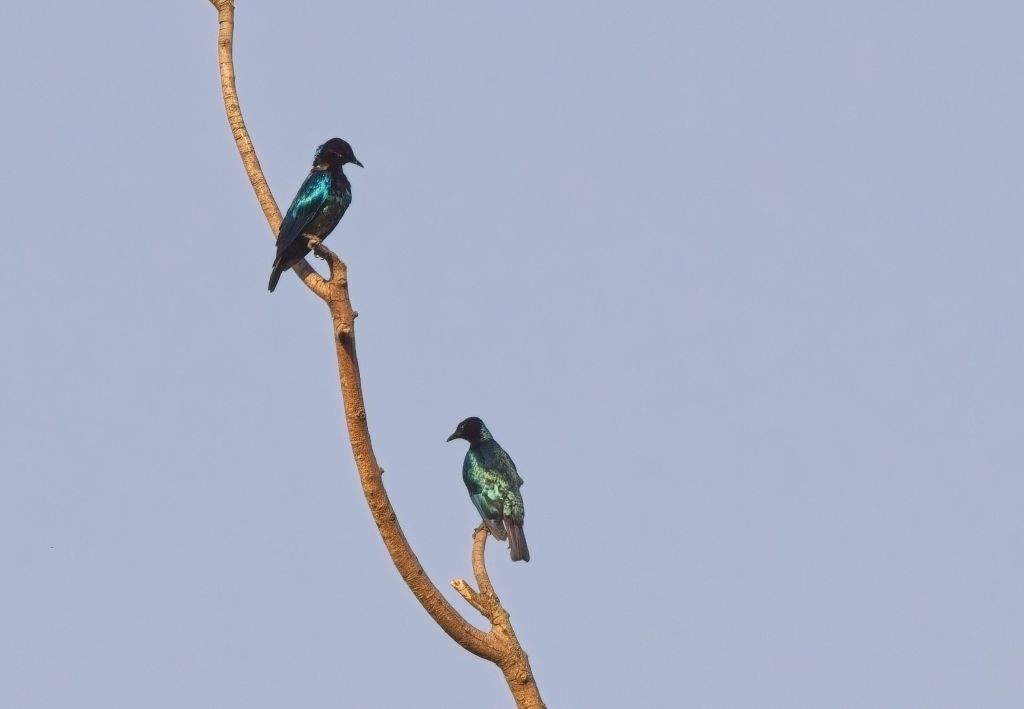
The other seen lifer for the morning was a Narrow-tailed Starling a slender black bird with a golden eye and that narrow tail. In the U.S. our only starling is the European Starling, introduced from Europe and often, perhaps unfairly, considered a trash bird. Including a number of mynas which are classified together with the starlings, this was my 40th starling species, a total that greatly surprised me. Of those 40, 22 are from Africa, one from Europe and one from Australia with all the others from Asia. The only other photos from the morning were a Black-headed Paradise Flycatcher and a pair of Black Bee-eaters.

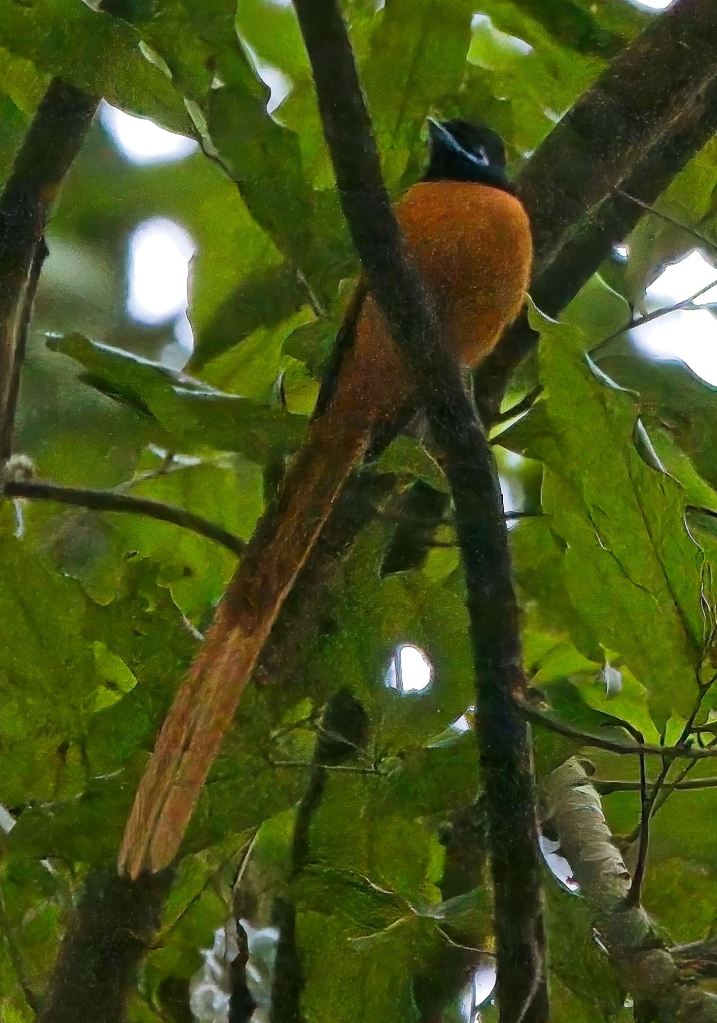

One of the heard-only species (another lifer) was a species I very much wish I had seen and especially photographed – Blue-breasted Kingfisher. It called over and over for several moments in the dense forest but just would not make an appearance. The photo below is from Ebird taken by David Beadle. I doubt there will be another opportunity, what a beauty.

The nine new Uganda species in the morning brought me to 350. In the afternoon, we birded the Bigodi Swamp and added another 6 new for Uganda and 3 more lifers for me. I got a photo of the Magpie Mannikin and missed one of a Black-and-White Shrike-flycatcher. I was certain I had a photo of the Senegal Coucal, but I cannot find it among the thousands of photos taken on the trip. Other photos of note were three life photos: Violet-backed Starling (sadly female only), Purple-headed Starling, and African Harrier-hawk together with non-lifer photos of Black-and White Casqued Hornbills.




It was then back to the Chimpanzee Guest House for our last night there. In the morning we would head off on a long travel day to Masindi and the Budongo Forest – part of the neighboring Congo forest and thus promising many new species.
June 27
It was a long travel day but there were birding stops along the way. In just a few moments at the Fort Portal Wetlands we had 12 species including our first Northern Masked Weaver of the trip and my life photo of that species. A few moments later we did our last birding in the Kibaale Forest. In thirty minutes I added a lifer Masked Apalis and life photos of Scarce Swift, Gray-throated Barbet and Yellow-rumped Tinkerbird, the latter two species which I had been seen but only poorly in forest birding earlier in the trip. We also got good looks at another Golden-crowned Woodpecker.


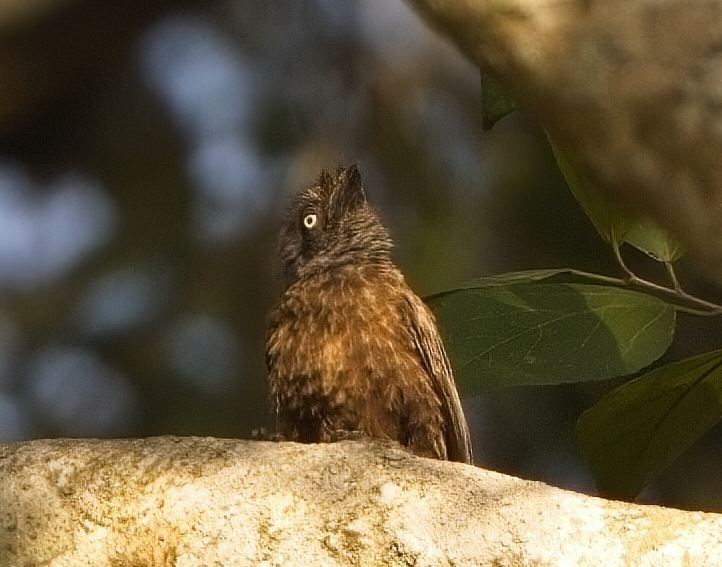


Our next stop was at the Nguse River Camp Restaurant. I cannot recall if we actually had lunch there or just used their bathroom facilities, but there was good birding as I added a lifer Whistling Cisticola and finally got a photo of an African Pygmy Kingfisher in addition to seeing three species of Sunbird.


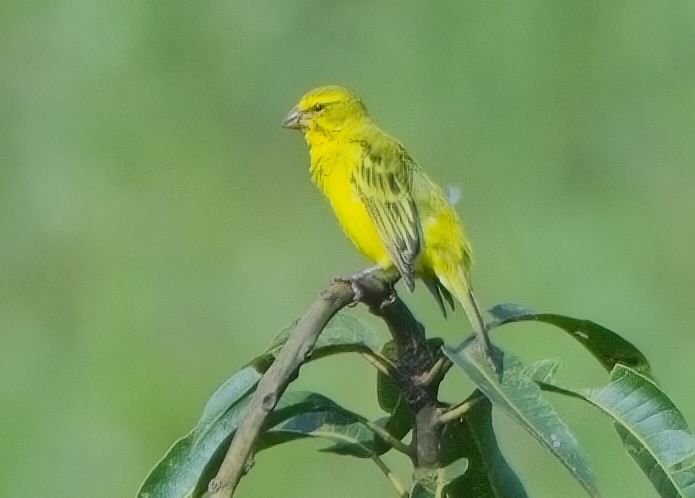
Later in the afternoon we hit an excellent group of birds along Hoima Road in Masindi with mixed species in the grasses. The group included waxbills, mannikins, whydahs, canaries, weavers, and widowbirds. The Red-Collared and Yellow-mantled Widowbirds were lifers. I also had a lifer Copper Sunbird. Birds were pretty active and at one point I saw a bird that had I had been home in Washington State, I would have quickly noted as a Red-winged Blackbird. Of course they are not in Africa, but this was a black bird with a red wing patch – and a hint of color at the base of the bill. It was a lifer Red-shouldered Cuckooshrike. I only saw it once in flight before it disappeared in the tall grass – unfortunately no photo, but an easy ID. I did get a photo of a Brimstone Canary – my first for that species.

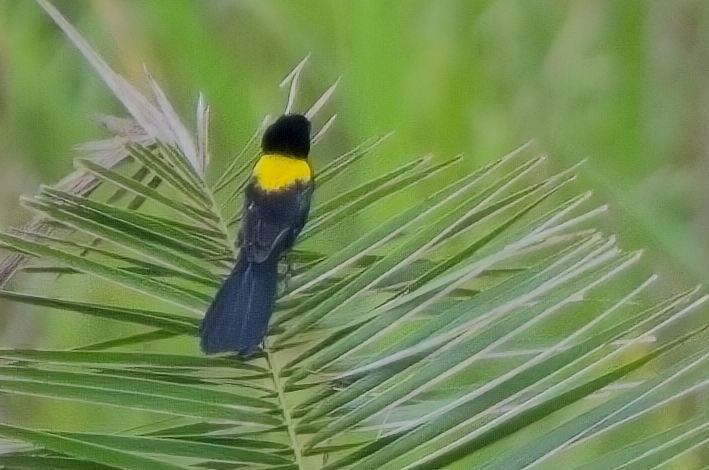

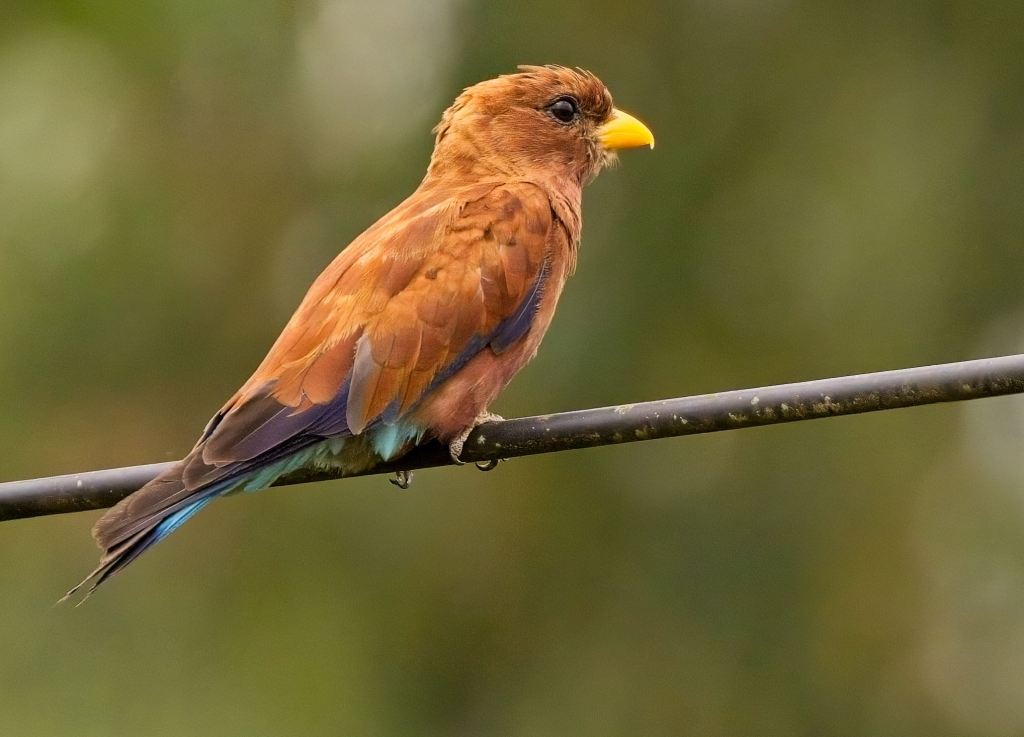
Neither was new for the trip or on any life list, but at this spot, I got good photos of a Broad-billed Roller and two male Pin-tailed Whydahs with their very long tails.

Then there was the Moustached Grass-Warbler. I had seen one last year in Tanzania without a photo. One was feeding in the grasses at this stop as well, generally out of sight with only brief appearances with some of the other species. I kept trying for a photo, and it kept hiding. There are two birds in the photo below, I think the one in the back, even without a distinct moustache, may be the warbler as it is the only species we saw there that has that yellow eye and that bill. I am also including photos of two of the weavers, Vieillot’s Black Weaver and Grosbeak Weaver. It was a very birdy spot as we had 27 species altogether in just under an hour covering less than 200 yards.


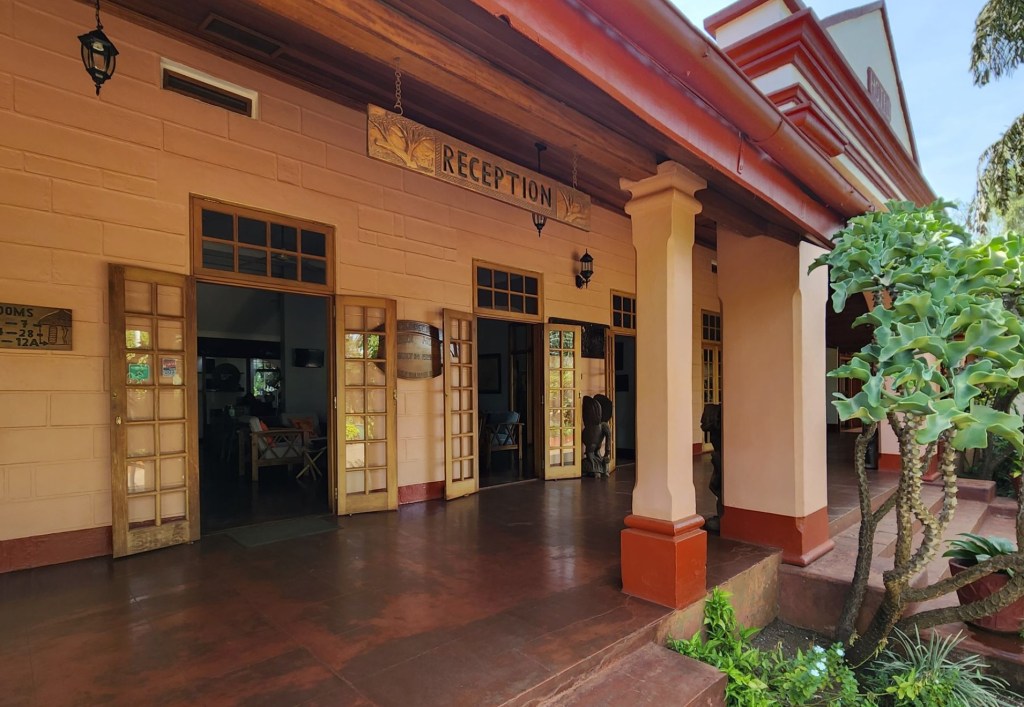
We continued on to our next lodging – the famous Masindi Hotel. It is the oldest hotel in Uganda and is famous mostly because Humphrey Bogart and Katherine Hepburn had stayed there during the filming of The African Queen in 1952, and it was also a favorite of Ernest Hemingway. The hotel was perfectly adequate but let’s just leave it that it was “a bit dated”.

 blairbirding