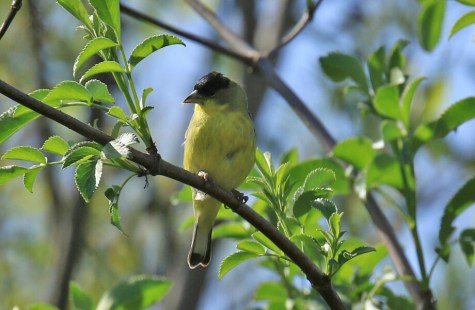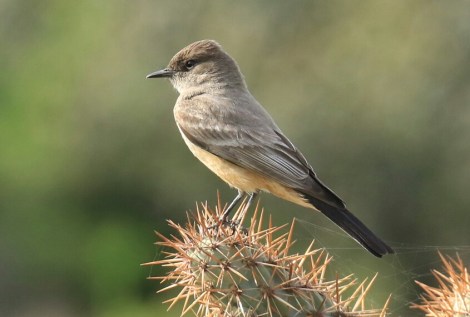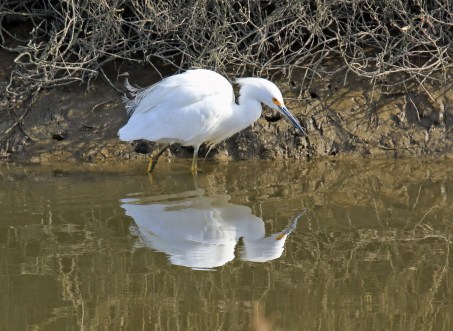
California Dreaming – Part I – Anza Borrego

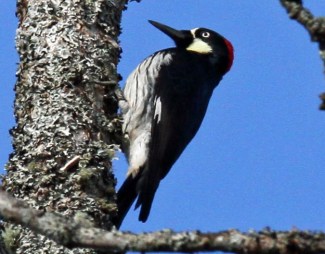
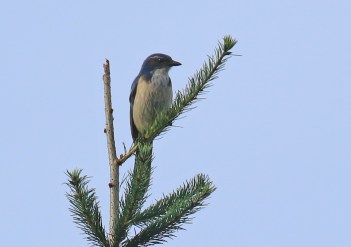
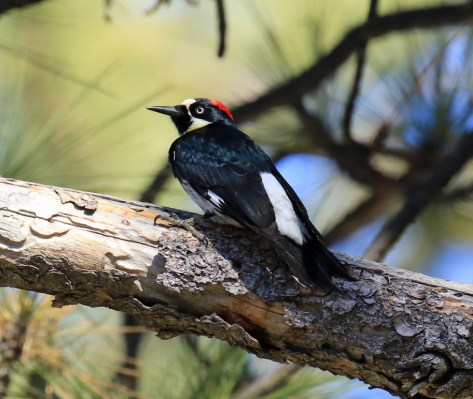
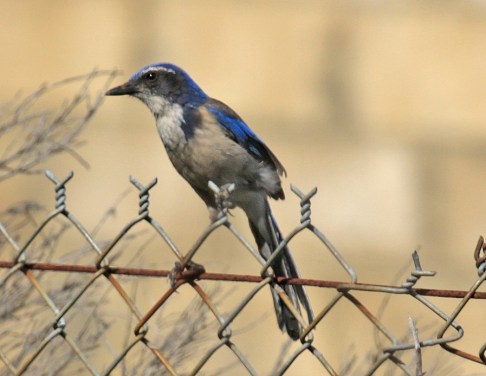
Long ago and faraway in a distant land called California, I began birding.  Most of the earliest experiences were at Baylands Park in Palo Alto or at Coyote Hills Regional Park in San Jose.  I did not keep lists when I started, so no records per se.  I arrived in California in August 1970, found an apartment over a garage in Menlo Park and got ready for Law School at Stanford.  I did not own any binoculars and had only a vague awareness of bird species, but I have a distinct recollection of seeing an Acorn Woodpecker in a neighboring back yard.  I of course remembered birds from growing up in Maryland including a Killdeer nest in the sand at the playground of my elementary school with the parent using the broken wing trip to lure us kids away from that nest.  I also remember that the “Blue Jay” in California was very different from THE Bluejay  I grew up with and it was either that bird or the Acorn Woodpecker that was my first California species.

Acorn Woodpecker and California Scrubjay – my first California Species

Acorn WP1 california-scrubjay

It did not take long for the appeal of birds to grab my interest and I found myself often (too often) paying them a lot of attention and noting differences – becoming a birder.  I spent one semester in the spring of 1972 in Maryland and then had a summer clerkship in Seattle that summer.  It was in those places that I started to keep track of new “life birds” but I did not keep detailed lists so records remained spotty.  By the time I returned for my final year at Stanford, my life list was just under 100 species.  In the next nine months I added 150 species to the list – all in the San Francisco Bay area.   So on May 22, 1973 my life list stood at 248 species and I said goodbye to California.  When I next visited, it was June 1977 and I had done a lot of birding in Washington State, Arizona and Texas and some in Wisconsin.  My life list had swelled to 450 species.  I spent a day at Anza Borrego State Park before another trip to Arizona.  Five new species were added at Anza Borrego and  then 32 more in Arizona.  I was definitely paying attention, but lists were still limited except for new life birds.

It is now February 2017 – almost 40 years since that last trip to Anza Borrego – how could so many years have passed by!?  Had I really not returned to bird where it had all started?  There was a day and a half near Newport Beach in August 2012 and that was it.  In those early years, photography was not part of my birding life.  It very much is now and I wanted photos of some of those birds I had observed in California many years ago but had not seen or photographed elsewhere in the past.  It was time to return to California.  I planned a trip to San Diego and in part wanted to continue baby steps in exposing a friend to birding and thought one day in a four day visit with lots of other fun activities would not be too bird-heavy.  Where to go?  Anza Borrego seemed perfect – a good day trip with some potentially interesting birds (for her and needed photos for me) and some equally appealing scenery – certainly different from Seattle.

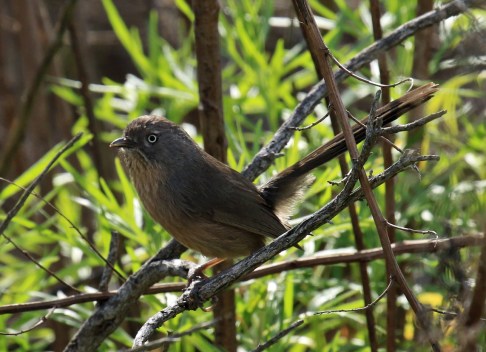
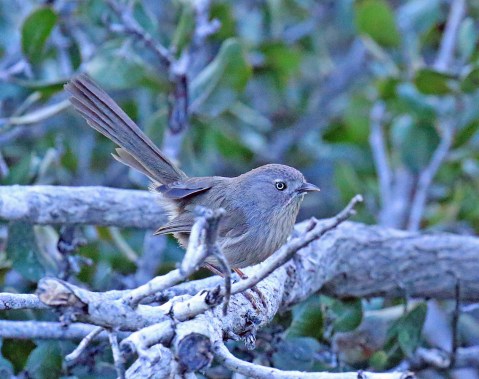
Our first day focused on a very interesting tour of the USS Midway Aircraft Carrier.  Highly recommended for all San Diego visitors.  The scale of the ship is incredible and the aircraft and communications equipment fascinating.  The history of the Midway and its pivotal role in the Pacific Theater of WWII should be known as appreciated by all Americans.  It continued service in the Pacific and the Middle East.  Very impressive.  Afterwards, there was time for a trip down Point Loma to the Cabrillo National Monument with our first look at the Pacific.  Near a parking area I had my first “target” bird of the trip – a Wrentit.  I had only seen this bird a couple of times and of course had no photo.  It is a skulker so I was not sure that any photo would be forthcoming.  I was thrilled to get a pretty good one.

Wrentit

wrentit

The next day was our trip to Anza Borrego.  This park is huge and birds can be scattered.  It is a more than two hour drive from San Diego proper.  We left during what should have been rush hour but we were going against traffic and thankfully had little traffic.  Also thankfully it was not the previous week.  Our weather was spectacular – low to mid 70’s and sunny.  Contrast that to the previous week (when we had originally planned the trip) when it was in the 50’s and VERY rainy.  Getting to Anza Borrego means going over mountains and the previous week there had been LOTS of snow, closing some roads or  requiring chains.  We saw some remnants at a few spots but had no problems.

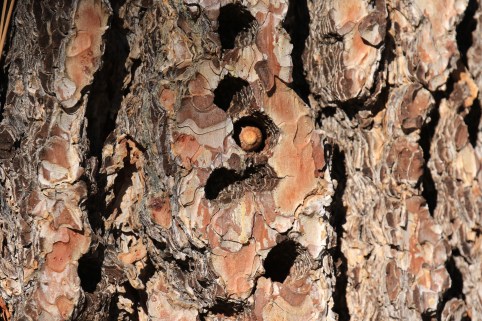
Our first serious stops were in the vicinity of Lake Cuyamaca and Cuyamaca Rancho State Park.  The road was clear but there was quite a bit of snow on the ground and there were lots of birds.  The most abundant interestingly were those first two California birds of memory – Acorn Woodpecker and California Scrubjays.  They seemed to be in every tree.  One was what is known as a “granary tree”, a place where the Acorn Woodpeckers drill holes and then fill them with acorns.

Acorn Woodpecker

acorn-woodpecker

California Scrubjay

california-scrubjay

Granary Tree with Acorn

036a7047

Here is a bit of info from “All About Birds” about these woodpeckers and their granaries: “The woodpeckers harvest acorns directly from oak trees and are famous for their habit of storing nuts—primarily acorns, but also almonds, walnuts, hazelnuts, pecans, and pinyon pine nuts—in individually drilled holes in one or more storage trees. These are known as granaries and can have upwards of 50,000 nuts stored in them. The birds drill the holes primarily in the winter, in the thick bark of dead limbs where the drilling does no harm to a living tree. Each year they reuse old holes and add some new ones. The acorns are wedged so tightly in their holes that they’re very difficult for other animals to remove. After they’ve been stored for a while, the fit becomes looser as the acorn dries out—group members periodically check their stored acorns and move the loose ones to smaller holes.”  One Park Ranger we met said the acorns were stored as “bait” for grubs who fed on the rotting acorns and then became food for the woodpeckers.

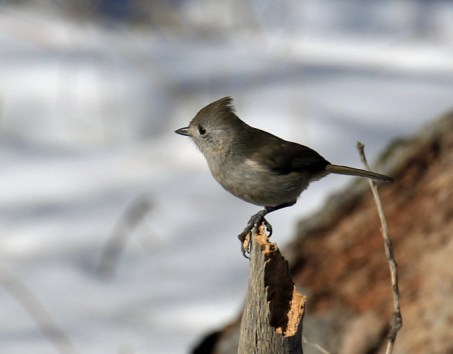
We also found one of my photo target birds, an Oak Titmouse, a very plain little bird but with a nice call and a very distinctive tuft.

Oak Titmouse

oak-titmouse1

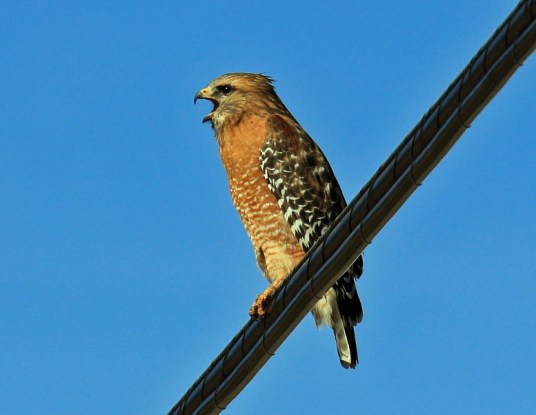
Not far from Lake Cuyamaca we found an incredibly cooperative and photogenic Red Shouldered Hawk.  It made unhappy noises but remained perched on a wire above us as we approached quite close.

Red Shouldered Hawk

red-shouldered-hawk

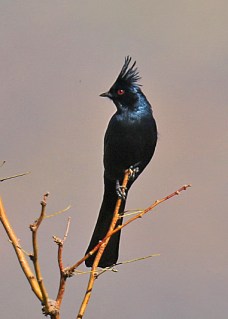
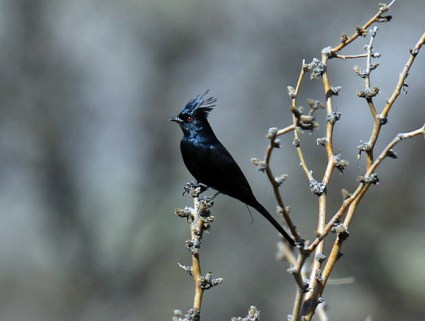
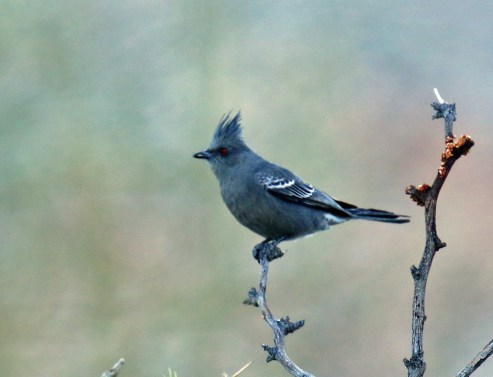
Continuing on Highway 78 I plugged in GPS coordinates looking for a spot listed on an Ebird report that was good for Phainopeplas.  This was another target bird and one that I was not certain I would find. At the exact spot identified in the report I pulled the car off the road and within a minute I spied a dark form on a shrub maybe 60 yards away.  It was a male Phainopepla.  I got a quick photo and then seeing no “No Trespassing” sign, decided to crawl under the barbed wire fence and cross the field to see if I could get closer.  It worked perfectly as the bird was very responsive to my recorded call and I got far better photos than I ever expected.

Phainopepla

phainopepla phainopepla1

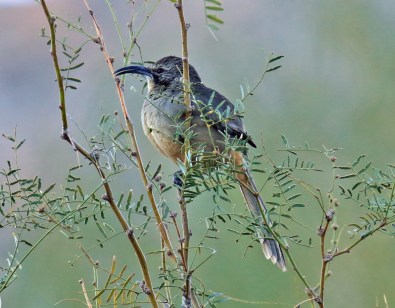
Not too much further along another target bird appeared, a very noisy California Thrasher.  It sang continuously perched high on a shrub and caring not at all that we were approaching. There was a second Thrasher close by – also singing incessantly – must be staking our their breeding territories already.

California Thrasher

california-thrasher1-2

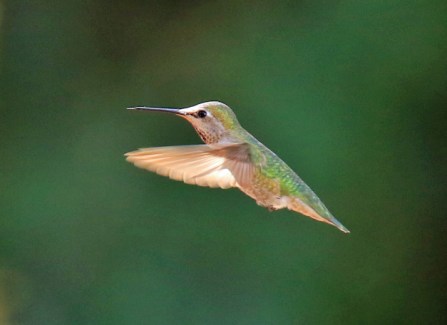
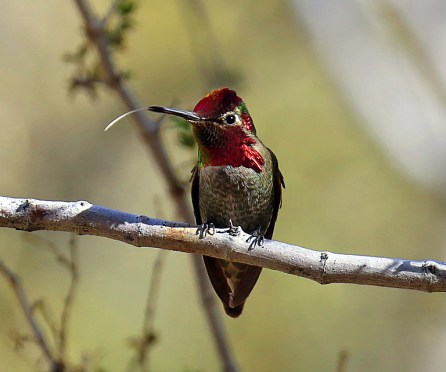
At many spots along our journey we had seen hummingbirds.  I was mostly interested in finding and photographing Allen’s or Costa’s Hummingbirds.  Until this point I was pretty sure that all of the hummers we had seen were Anna’s Hummingbirds, the predominant species in Western Washington.  We stopped at one campground where we had at least 6 and possibly as many as 9 hummers buzzing around in an area near a feeder.  Unfortunately they all seemed to be Anna’s.  Pretty near the Thrasher spot, there was one hummingbird that I am pretty sure was a Costa’s but I could never get the right position for a photo to show the purple mask.  Here are two out of a large number of Anna’s photos – a female in flight and a male with a clearly visible long tongue.

Anna’s Hummingbirds

annas-hummingbird1

annas-hummingbird-tongue-out-copy

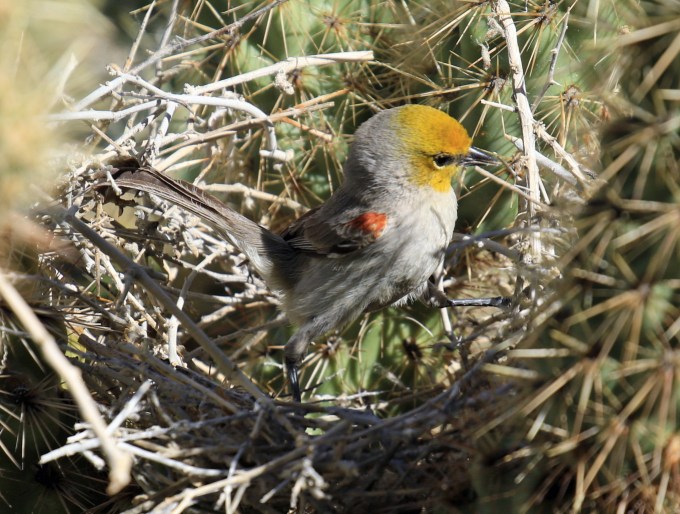
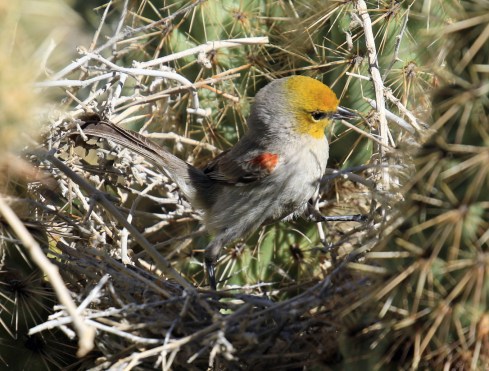
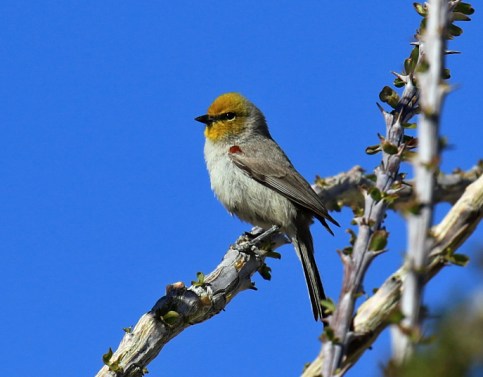
About lunch time we made it to the town of Borrego Springs and then to the Anza Borrego Visitor Center.  A special target here was the lovely little Verdin.  As I was walking in from the parking area I heard its distinctive three note call and then had one fly past me disappearing near a shrub in front of the visitor center.  At first I could not find the bird and was perplexed as I was sure it had landed.  Then I noticed a nest in a low bush and seconds later the Verdin lifted its head for a great view.  This bush was only a few feet from the path and was no more than 3 feet off the ground.  I was fascinated watching it try to weave an unwieldy twig into the nest.  It flew off and returned many times before finally moving further away and out of sight.

Verdin on Nest

verdin-in-nest1

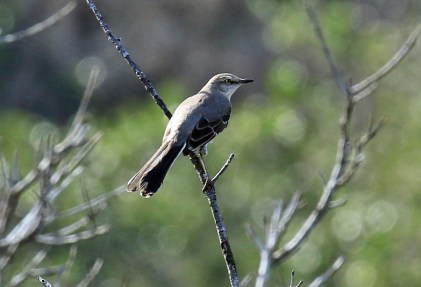
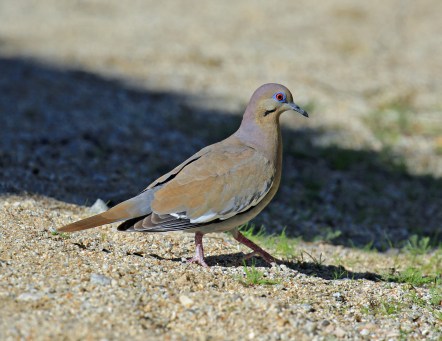
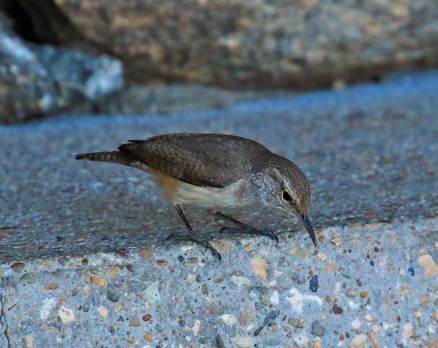
The Verdin may have been my favorite bird of the trip but there were other birds at the Center as well, including more Phainopeplas, Northern Mockingbirds, a definite (but not photo friendly) Costa’s Hummingbird, a gorgeous White Winged Dove and a very inquisitive Rock Wren.

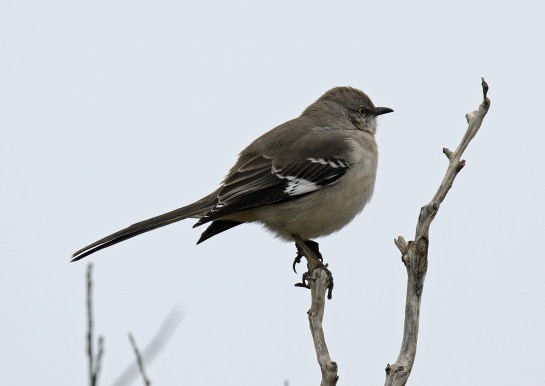
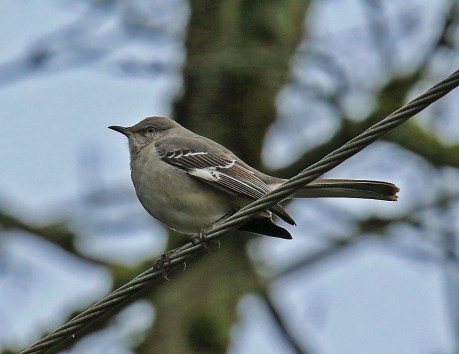
Northern Mockingbird

northern-mockingbird

White Winged Dove

white-winged-dove

Rock Wren 

rock-wren1

It was still a bit early in the year to see some of the other targets at the Visitor Center like a LeConte’s Thrasher – guess I will have to come back again.  But one bird I very much hoped to see was a Black Tailed Gnatcatcher.  It would be a life bird.  Someone we had met told me that he was camping at Agua Caliente and had two “easily found” Roadrunners in the campground.  Gnatcatchers ere also reported there so we decided there was time for the detour to see if we could get lucky.

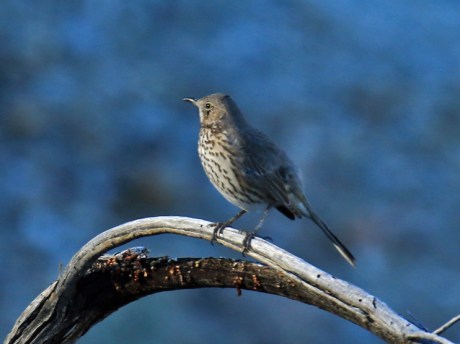
The campground proved to be quite birdy but also Roadrunner-less.  There were a few small rabbits – our only mammals of the day. We also had repeats of many of thee birds we had seen earlier in the day: California Thrasher, Verdin, Oak Titmouse, Phainopepla, White Winged Dove, Costa’s Hummingbird (again no photo) and Northern Mockingbird.  One new bird was a juvenile Sage Thrasher.  I had not seen one before and was surprised by its quite speckled breast.

Juvenile Sage Thrasher

sage-thrasher

Verdin

verdin

Phainopepla Female

phainopepla-female

I heard an unfamiliar call that I thought just might be a Gnatcatcher so I played my Black Tailed Gnatcatcher recording.  Immediately two small birds flew into a nearby bush.  At first they remained hidden but then I clearly saw that they were Gnatcatchers and they had black tails.  I was very excited and waited for them to come into the open for a photo.  Shortly they did that and I got a few ok shots in somewhat failing light. Given the immediate response to the call and the black tails, I thought I had my bird.  Then I looked closely at the photos and my I Bird Pro and saw that they were only Blue Gray Gnatcatchers – a bird I had recently photographed in Neah Bay, Washington and which also has a black tail.  Sigh…

Blue Gray Gnatcatcher

blue-gray-gnatcatcher1

Time to retrace our steps for the long ride back.  The roads seemed even curvier on the return but no traffic and we made good time.  It had been a good visit.  Lots of nice birds including several targets.  Some misses but that is usually the case.  The weather had been great the whole time and Lynette had enjoyed the trip and even some of the birds.  It was neither low key nor hard core so a good introduction.  We made it back in time for a nice Mexican dinner at Miguel’s.  The next day will be the San Diego Zoo and then dinner in La Jolla (with a brief birding stop at the Cove).  Sure do like San Diego.
There Sure Are Lots of Birders Out There

As evidenced by some preceding Blog Posts, January 2017 is proving to be a great start to a birding year with many rare and compelling species.  I have seen a Red Flanked Blue Tail in Lewiston, Idaho, a Purple Sandpiper near Victoria, British Columbia, a Common Eider on Purdy Spit,  and a Falcated Duck on Padilla Bay.  I have not been alone on any of these sightings – not actually on the day each rarity was sighted nor statistically as many other birders added their observations of these birds to Ebird or local listservs or just their own record books.  In just the past four days, I have been able to add Yellow Billed Loon, Northern Mockingbird and Swamp Sparrow to my observations for this month.  Again for each, others were either present at the same time or preceded or followed me and added these special birds to their lists.  Not just a few others – many, many others…there sure are lots of birders out there!  Here are some numbers, stories and photos accordingly.

First some of those birds already in my blog posts.

January 4, 2017 – Red Flanked Blue Tail – Lewiston, Idaho.  

red-flanked-bluetail1r

This rare little beauty may have taken first place in the Most Popular contest.  On the day that I was able to see it, there were another 7 birders there at the same time and I know others came later.  More than 145 birders reported this species on Ebird and not everyone uses Ebird.  I I would not be surprised if more than 200 birders saw this gem.  And go look at a map, not a lot of major population centers near Lewiston.

January 11, 2017 – Common Eider – Purdy Spit

coei-flight

Not quite as rare – nor as photo-friendly as the Bluetail, this misplaced duck was almost as popular and definitely a lot closer to major population centers.  There have been at least 90 Ebird reports of this species this month.  It remains and continues to be seen so no telling what the final count will be.

January 12, 2017 – Purple Sandpiper – Kitty Islet, Victoria, B.C.

purple-sandpiper1

This was definitely the most difficult of the January rarities for me to find.  As reported, had Steve Pink and I arrived there 10 minutes earlier, we likely would not have seen it.  I know of many who have tried and missed and/or for whom it took several attempts.  There are 65 reports on Ebird – even with the U.S./Canadian exchange rate that is a lot – especially given the cost of the ferry to get there from the Mainland – either Canadian or U.S.

January 16, 2017 – Falcated Duck – Padilla Bay

falcated-duck2

At least for me, this was the most treasured of the January rarities, a species I never expected to see anywhere let alone in Washington. It has also been the most ephemeral of the rare visitors. It was first seen on January 15th and last reported on January 17th.  Now you see it and now you don’t.  Only one report was from the 15th and another 15 Ebird reports were from January 17.  On the 16th, the day I saw it, there were 27 Ebird reports – so a total of 43.  I know of at least another dozen birders who saw it and do not report on Ebird.

I may have been the only person who reported all four of those species on Ebird (which you can rightfully translate as the only person crazy enough to make all those trips), but many people reported more than one of the four and some reported three.  The simple math is that there were almost 350 Ebird reports on those four species and my guess is that there were more than 500 observations by more than 300 distinct observers.

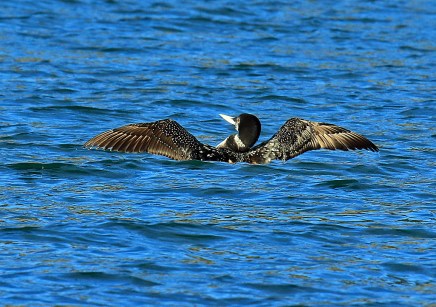
But that was then – how about now?  January has continued to deliver exciting opportunities and the birding community has eagerly responded.  A Yellow Billed Loon was found at Rosario Beach State Park, the same place where many birders went to see a Rock Sandpiper after the Falcated Duck observations.  It was probably first seen on the 17th (by Eric Heisey) but reports did not appear until the next day.  It is continuing to be seen as this is written (January 26th) – often quite close to shore as it seems to come in as the tide changes.  So far it has been reported by 85 observers on Ebird and based on anecdotal experience and many posts on Tweeters, I expect that the actual number of observations/observers may well be twice that many.  A bonus has been that the loon is in almost full breeding plumage – very rare for Washington and even rarer for this early date.  This Yellow Billed Loon is thus very photogenic, and the ease of getting to the location and its cooperative behavior coming in close has resulted in many photos.

I was finally able to look for the loon on January 23rd.  When I first arrived, others were already there and we watched the Yellow Billed Loon pretty far out – maybe a half mile away by the large island in the bay.  After maybe an hour, it began its journey into closer waters and more and more birders arrived with scopes, binoculars and varying photographic equipment.  The weather was beautiful, and the photographers, myself included, jockeyed for position along the beach to take advantage of the sun behind us and the bird in front of us.  Lots of good socializing was a fun part of the day.

Yellow Billed Loon – Rosario Beach – January 23, 2017

yellow-billed-loon4

yblo1

yellow-billed-loon3

This photo gives at least a sense of the birding scene – all happy observers.

036a0424

Brian Pendleton and I were fortunate to be able to participate in the year end wrap up by the ABC birding group in Tacoma on January 24th – sharing some photos and experiences from our 2016 “Big Years” in Washington.  It was an easy decision to do some birding on our way down and we decided to do quick chases for some of the better birds that had been reported locally in the past few days.  Our first stop was to look for the Bohemian Waxwings that were being reported daily at Magnuson Park near where Brian lives.  I had a pretty pathetic look at a couple of the waxwings two weeks earlier but was not able to get a photo.  Unfortunately poor weather and a hunting Cooper’s Hawk precluded a picture on this visit as well.  We had a couple of flocks of waxwings and I am pretty sure there was at least one or two Bohemians with many more Cedar Waxwings – but only from afar.  There have been 110 Ebird reports of Bohemian Waxwings in Magnuson Park in January and their presence continues.  Another 16 Ebird reports for this species at the Park were filed in December 2016.

Cooper’s Hawk – Hunting at Magnuson Park – January 24, 2017

coopers-hawk

Our next stop was to look for the Swamp Sparrow being reported almost daily from the Center for Wooden Boats at South Lake Union Park.  Although the location is well defined and easily approached and birded, the Swamp Sparrow is very furtive and acts more like a little rodent as it scurries from the open into the deep grass/weeds and can thus be a difficult find.  Brian had seen it before but this was my first trip.  He had a fleeting view of it on this visit and I had none.  We decided not to spend much time there and to head off for other opportunities as we worked our way south.  But first a diversion to the East. (More on the Swamp Sparrow later.)

Our Eastern diversion was to look for the Northern Mockingbird that had been reported frequently from a residential area in Kirkland.  We had connected with Gregg Thompson at the Swamp Sparrow stakeout, and he was not encouraging for photo ops for the Northern Mockingbird.  It was generally being reported in a holly tree behind a house, and Gregg had seen the holly and decided to not spend the time there trying for what seemed like an unlikely good photo op. I am pretty sure I have never gotten a better photo than Gregg, but in this case, at least it was a good decision to try for one despite his decision not to.

When we arrived at the designated address in Kirkland, I decided to park in the driveway behind one of the cars, with the intent to knock on the door (the owners had been described in many reports as very friendly) and ask if they had seen the Mockingbird and if we could take a look.  As soon as he got out of the car, however, Brian exclaimed “There it is!”  Our Northern Mockingbird was perched in the open on a small tree at the adjoining home.  I snapped a few photos before it took off to the south.  We followed and found it again briefly in a tree three homes away.  The homeowner saw me with my large lens and came out to ask what we were doing.  Anticipating concern, I explained we were not spies – just chasing a rare bird.  Turned out, he was from Texas and was more than familiar with Mockingbirds and their chatter.  He had not known it was in the area and was happy to have us point it out – just before it took off and headed back north again.

As we started to retrace our steps, we saw another fellow walking towards us.  I wondered if maybe my car was parked behind his and was either blocking his way or at least needed an explanation.  This turned into one of those fun intersections on a birding trip.  Brad was the owner of the house next to where the holly bush was located.  He led us to the house with the holly and into the back yard where the Northern Mockingbird was conveniently perched completely in the open on a wire directly above us and next to said holly tree.  Not great light, but photos were easy and much better than other Washington Mockingbird photos from my past.  We also had a great talk with Brad about hunting, ducks, construction (he is a contractor) and birds and birders. Really a good guy – a perfect host for visiting birders.  At least 25 Ebird reports have included this bird.  Many other observers have seen it as well and it continues as far as I know.

Northern Mockingbird – Kirkland Residential Area – January 24, 2017

northern-mockingbird

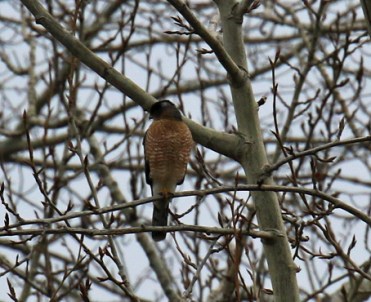
Now it really was time to head south, so we headed to the Kent Ponds – aka the Green River Natural Area where a Red Shouldered Hawk had been reported.  We got a lot of exercise, found another Cooper’s Hawk and little else – well except a Red Tailed Hawk that was located at the exact spot where the Red Shouldered Hawk was described – and our Red Tail was calling just as the Ebird report had indicated the Red Shouldered Hawk had been doing.  The Red Shouldered Hawk report was from a Monthly Census and there were 8 separate Ebird reports as every member of the Census team was included (one apparent sighting otherwise calls only) so maybe 8 actual observations is an over counting. Disappointed, Brian and I continued on to Tacoma where we failed to find the Slaty Backed Gull at either Gog Le Hi Te or the 11th Street Bridge.  Our last stop was at Ruston Way in the area where Bruce Labar first located the King Eider last year.  No Eider but some beautiful Barrow’s and Common Goldeneyes and lots of Mew Gulls.

Barrow’s Goldeneye – Ruston Way – January 25, 2017

barrows-goldeneye

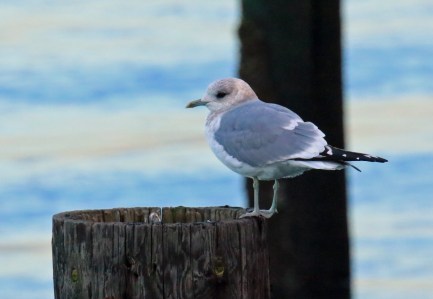
Mew Gull – Ruston Way – January 25, 2017

mew-gull

The event with the ABC group was a lot of fun.  They are super birders and many of their names could be found on the Ebird reports for the rarities which are the subject of this blog post.  We had dipped on some of the birds we chased but the Mockingbird more than made up for that and meeting Brad was another of those great bonus experiences.

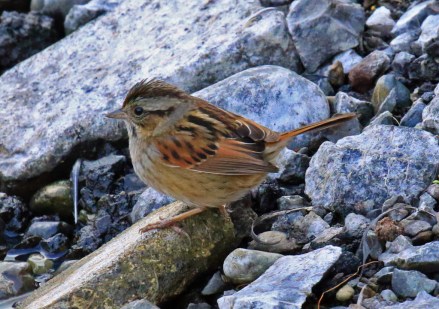
I felt I had unfinished business though as I really wanted a photo of the Swamp Sparrow,  Between errands today I revisited the Center for Wooden Boats.  Immediately upon arrival I saw a sparrow skulking at the water’s edge and started snapping photos.  Was it really going to be that easy?  Well, no.  Turns out it was a Song Sparrow.  I was beginning to wonder if I was going to remain on the list of those missing the target but then saw some movement in the grass.  A fleeting glance confirmed it was the Swamp Sparrow but a photo was out of the question.  I watched it almost completely concealed for maybe 10 minutes and then miraculously it came out into the open for a moment and I was able to finally get some nice shots.  Really a fine looking bird.

Swamp Sparrow – Lake Union Park – Center for Wooden Boats – January 26, 2017

swamp-sparrow1

swamp-sparrow

Mine was the 27th Ebird report for this lovely sparrow.  I expect there will be more in the days to come.

Indeed it has been a great January.  Easy for me to conclude from this great group of rare to very rare birds.  And obviously many others in the area have enjoyed birding this month as well.  As I said. there sure are a lot of birders out there – and many of them are sharing their experiences on Ebird and Tweeters and other sites.  We all benefit from that shared wealth of information.  I wonder what will show up and be enjoyed by so many in the community next.

Afterthought:  The Song Sparrow was spied first and easily and at first I thought it was the targeted Swamp Sparrow.  The real Swamp Sparrow took a lot more effort to find and photograph.  Here is the comparison.

song-sparrow-vs-swamp-sparrow

Conjuring Up a Falcated Duck

Among the benefits of birding with Steve Pink is that his birding in Britain has familiarized him with many species never seen or very rare in the States (or the Provinces if in Canada).  For example, if I were to whimsically say how nice it would be to see a Smew (my top of the bucket list bird), Steve will relate the numerous occasions he has seen one in Britain.  This also makes him a great resource for identification of many Eurasian visitors that are such sought after rarities here.  Additionally Steve is as avid a lister – year/state/county/ABA – as anyone, so he is always up for a chase and for great “wouldn’t it be nice if a such and such shows up” wishful thinking.

In my previous blog post “Chasing, Chasing, Chasing” I detailed my most recent birding experience with Steve, our visit to Victoria where we found the Purple Sandpiper at Kitty Islet.  I am not making this up: On our return from that successful chase, there was plenty of travel time, and we filled some of it discussing how nice it would be if another rarity showed up closer to home and debated whether it would be better if it were a Baikal Teal or a Falcated Duck.  Both would be life birds for me,  while Steve had seen them both.  That was the afternoon of Thursday  January 12th.  It was wishful and playful thinking – not serious but a good way to fill time.

Fast forward less than 72 hours.  On the morning of January 15th, Rick Klawitter – a birder not known by me – found of all things, a Falcated Duck at Bayview State Park in Skagit County – barely an hour from Edmonds where Steve and I reside.  Little did he know that Steve and I had somehow sent a message out to the bird gods to send this little beauty to our great state and to place it where someone with great discernment would find it and then communicate its presence to the world.  We apparently had that power.  If I had only known it would work this way, I would have put all that energy into conjuring up a Smew, the bird I have written about previously as being on the very top of my birding bucket list..  Rick’s posting on Ebird informed us all but not until it was too late to chase it on the 15th.  Early the 16th would have to do.

I had planned to do a lot of catch up that day, but as soon as I learned of this rare find late on the night of the 15th, I called Ann Marie Wood and Steve to see if they were interested (knowing of course that they would be).  Turned out they had already planned to bird on Monday and now there would be a powerful purpose and intent to the venture.  We left Edmonds a bit after 8 and encouraged by Ryan Merrill’s Tweeters post that he had already seen the Falcated Duck that morning, we made a beeline to Bayview State Park.  There were already cars parked at the trail, and we could see birders with scopes in the distance – YES!!!

We trekked maybe just under a mile down the trail and saw a very large (400-500) flock of ducks – mostly American Wigeon but with Mallards, Eurasian Wigeon, Pintails and Greater Scaup also present.  With the help of many birders already there  (thank you Gary Bletsch, Bob Kuntz, Scott Downes among others) and with great difficulty, we all got views of the mega-rarity – losing it almost immediately each time we did  as it repositioned itself in the ever moving flock.  I could not find it once I transferred my view from scope to camera, so I took dozens of random photos of the flock – trying to concentrate on different areas or the ones where I thought I had just viewed it.

Finally the light improved and the Falcated Duck made its way somewhat into the open and I got an acceptable if distant photo. Its iridescent green head with its distinctive helmet shape was only visible when it was sideways with good light.  The white neck or chin was a great marker to aid in finding it and I was struck by its very thin bill.

Falcated Duck – Bayview State Park – South Trail – January 16, 2017

falcated-duck2

falcated-duck1

It turned out that one of my random shots had also captured the duck, and it shows its size relative to the Wigeon, much larger than I had expected.

Falcated Duck – Bayview State Park – South Trail – January 16, 2017 (Lucky Random Shot)

falcated-duck7

This was a new year bird, county bird, state bird, ABA bird and new World Bird – complete “Lifer” in every sense.  The photo also made it the 400th species I had photographed in Washington.  Despite the playful wishful thinking in the conversation with Steve about fun rare birds to find in Washington, I never expected to see let alone photograph this species here.  What a fabulous morning!!  [And an aside – how great it was to see so many young birders on the scene to view this rarity.  They will contribute greatly to our birding community.]

It was about 10:30 a.m. – what next?  Before the Falcated Duck had appeared, Steve and Ann Marie’s day was going to include a visit to Rosario Head, certainly one of the most spectacular spots in Washington, hopefully to see the Rock Sandpiper that had been scouring the rocks there.  So off we went – following many others who had left Bayview before us and headed that way.  When we arrived, the park was closed but there were several dozen cars along the road.  There could not be that many birders there, could there?  Turns out there was a clean up project underway adding to the handful of birder’s cars.  On the way in we saw a man with a scope accompanying his son in a wheelchair.  Hoping for news of a Rock Sandpiper sighting, we stopped to chat.

He gave us the news that his wife was up on the bluff sans scope.  The Rock Sandpiper was there but a difficult view without the scope.  The wheelchair was not going to make it up the steep path, so we volunteered to take the scope up – or to just share ours with her.  We learned that this was Steve Sutherland, with his son Ryan, and his wife Debbie was the birder up above.  The Sutherlands are from Chelan, Washington and are a very cool family.

Chased birds are like magnets, and with their presence advertised on Ebird or Tweeters or BirdYak or other listservs, they draw birders from near and far thus providing the opportunity to meet folks in real life that we only know from their posts on those electronic media.  Such was the case with Debbie Sutherland – and now her family.  We knew her from Tweeters and Ebird but generally as “Sutherland Debbie” and among other claims to fame is the frequent presence of Lesser Goldfinches at her feeders.  Since she does not wear a name badge or sport an “I am from Chelan” sign, we would not know her if we saw her.  But we knew her posts and it was fun to meet her on top of the bluff, to see the Rock Sandpiper together, to share the scope and some stories as well.

The cliff was high and there was no guardrail.  Ann Marie had braved the path up to the viewpoint but her vertigo was a threat to her being able to look over and down the cliff to where the Rock Sandpiper was foraging with some Surfbirds and Black Turnstones at the base.  Ann Marie drew on some inner strength as she always does and was able to get just close enough to the cliff’s edge to view the Rock Sandpiper.

Rock Sandpiper at Rosario Head – January 16, 2017

rock-sandpiper

Surfbird at Rosario Head – January 16, 2017

surfbird1

Something flushed the birds and I snapped a photo that I am pretty sure is the Rock Sandpiper coming in for a landing.

Rock Sandpiper Landing at Rosario Head – January 16, 2017

rock-sandpiper-flight

Debbie had returned to her family below, and this enabled Steve to come up for his look.  Since I had errantly chosen the steeper of the two paths back down, this was a good thing as he added another supporting arm helping Ann Marie down. Returned to the safety of the base of the hill, we continued our visit with the Sutherlands and learned how they utilized some pretty fun technology to further include Ryan in the family birding.  They transmit images directly from their scope to a screen in their van which Ryan can view.  Sometimes he finds birds before they do.  How great is that?!

It was then noon, and I am not going to detail every stop along the way for the rest of the day, many of which were new places for me as I am not the ardent county lister/birder that both Steve and Ann Marie are.  Highlights were hundreds of swans – both Trumpeters and Tundras, some Greater White Fronted Geese, thousands of Snow Geese (in seemingly endless flocks in flight as the day ended), Black Oystercatchers, more hundreds of ducks, many Bald Eagles, a very cooperative Greater Yellowlegs and at the end, just a few loons and alcids, an elegant Lincoln’s Sparrow and of course gorgeous scenery at every turn.

Tundra Swans

tundra-swan

Greater White Fronted Geese

greater-white-fronted-goose

Greater Yellowlegs

greater-yellowlegs1

Black Oystercatcher

black-oystercatcher1

Lincoln Sparrow

lincoln-sparrrow

Scenic Views

scenery

I have written often that birding gives us the opportunity each time we are out to visit beautiful places, mix with great people and see great birds.  All three were surely present on this day.  I do have to add that when one of the birds is a fantastic bird like a Falcated Duck that I have helped conjure up – well that is really special!!

[An afterthought: In less than two weeks this month, I have been fortunate to see a Red Flanked Bluetail in Idaho, a Common Eider and a Falcated Duck in Washington and a Purple Sandpiper in British Columbia.  Each a fantastic bird in the place observed – either a first ever record or one of less than a handful.  True rarities AND NONE of them were in Neah Bay!!!]

Chasing…Chasing…Chasing

My professed birding philosophy this year is to limit chases to new state birds, new ABA birds and new (or improved) ABA photos and when some other factors line up just right, to go for targeted birds with birding friends to enjoy the birds and places and people.  This past week has had three such chases.  They may have been only partially successful in birds found, but they have been very successful in rich experiences with great folks and great places and some of the chased birds as well.  The first of these was a different kind of “chase” – a visit to a favorite spot to find some very charismatic birds in part to build the interest of a special friend in birds and birding.

Especially for “listers”, it is not unusual to drive many hours to stand for many hours at some not all that pretty spot waiting in the cold or even rain waiting for some non-descript bird to come out of hiding just long enough for a glimpse and a “tick” – that statement that we have seen “IT”.  The draw is that the “IT” is a bird that we have not seen before, or not seen before that year or not seen before in that state, or not seen before in that county – thus an addition to our self-important list – our way of competing with ourselves or with others or just our way of organizing and feeding our passion for birds or maybe in this case our passion for birding.  Almost exactly a year ago, that was the experience as Frank Caruso and I took the long ferry ride to 3940 South Valley Drive in Capital County, British Columbia, Canada and then waited and waited with another birder who had come all the way from Chicago, who like us, was hoping to add Redwing to our ABA lists.    Native to and common in Europe and Asia, the Redwing looks a lot like our  American Robin and is VERY uncommon in Canada or the U.S. not even seen most years.  It had been hanging out in a holly bush in a vacant lot and was very furtive – a real challenge to see.  Finally after many hours, it came out almost into the open and we had both visuals and a not very good commemorative and proof positive photo.

Redwing – January 5, 2016 – Victoria B.C.

Redwing

The Redwing chase was successful because the rarity was found.  Had it not been, there still would have been a story but it would have emphasized agony and discomfort instead of the joy of success.  At least that is how it was for birders/listers like me and Frank and our compatriot from Chicago.  To a non-birder or a “not-yet-birder” however, that kind of chase and even that kind of successful “find” would more likely fall into the category of: “Are you kidding?” or “We are going to do what – for what?” Sooo – much better to start out and develop interest by going somewhere pretty with charismatic birds, easy to find, easy to see and identify and with some aesthetic quality that resonates even to a non-birder.

Waterfowl are a good start – if close and not in the rain or wind – and owls are even better as there is that overlay of a mystical quality that they bring with them.  Waterfowl are easy to find and to see and the diversity is always a surprise to someone who has not paid that much attention before.  At a place like the Semiahmoo Spit in Whatcom County, where I had taken Lynette on our first birding trip late last year, the waterfowl were plentiful and colorful; the setting was gorgeous and a good lunch was nearby.  All elements for a good introductory experience.  Finding Bufflehead, Surf Scoters, Long Tailed Ducks, Pintails and  Harlequin Ducks easily brought home the notion that not all ducks are Mallards, that they are quite different in many details while still having their basic “duckiness” and that they are very beautiful.  Hard to beat a male Harlequin Duck for that last point.

Harlequin Duck (seen at Semiahmoo on December 30, 016 – but photo from elsewhere)

harlequin-duck

After that positive introduction, I thought a good next step would be to add some owls to Lynette’s birding experience.  An owl at night would be great but challenging, so the choice was to go to Legue Island – Eide Road in Stanwood, Washington where at this time of year, Short Eared Owls are almost a certainty and with luck there could be many and some would be seen relatively close.  When we arrived the parking lot was full – uh-oh  what was going on?  We saw many (20?) photographers in the field but there did not seem to be any spotting scopes or binoculars – not a birding crowd.  But they were there for the same reason – the owls – and to a lesser extent the scenery – and since there were also MANY owls, we were happy to share.  (An aside.  There were many large and very expensive camera lenses – 500 mm and even 600 mm – probably over $100,000 of equipment – I was very envious.)

The Short Eared Owls were very cooperative flying and perching and diving for prey seemingly everywhere – some very distant and others flying right at or over us.  We know there were at least 8 and maybe 9 giving their aerial displays – the most I have seen at this location.  The lighting was great and the views of Mt. Baker and the Olympics in varying degrees of sunlight were spectacular.  It could not have been a better experience and Lynette noticed and approved – her first owls – so far so good.

Short Eared Owl – Eide Road – January 6, 2017

036a0317

Short Eared Owl – Eide Road – January 6, 2017

036a0460

Mt. Baker from Eide Road – January 6, 2017

baker-in-sun

Sunset and the Olympics – Eide Road – January 6, 2017

036a0516

OK, maybe that was not really a “chase” but it was an intended purposeful trip to look for a specific species – focused and with most of the elements of my other chases.  It was possible that we would have missed an owl, but they are almost assured in those fields at this time of year.  But as I said in the introduction, there have been two other chases this week – and they have been the traditional kinds – looking for a rarity with much less of a certainty for success.  The first of these was with one of my best birding friends, Brian Pendleton, to go look for the Common Eider that had been discovered on Purdy Spit a few days earlier.  I had seen hundreds of Common Eiders on my trips to Maine in 2015 and to Alaska last year.  They indeed are “Common” in both places.  Not so in Washington as there had only been three records previous to this one.  I had seen one of those in Westport on October 28, 2012 – the same day as seeing another MEGA rarity for Washington – a Northern Wheatear.  But Brian had missed that one so this would be a new state bird for him if we found it.

Common Eider – Westport – October 28, 2012 

common-eider-3

Common Eider (Male left and female right) – Nome Alaska – June 3, 2016

Common Eiders (2)

When we got to the spit, there was already a line up of birders with scopes scanning the water.  We made a U-turn, parked and joined the throng.  I noted that Matt Bartels was one of the birders and he had a smile on his face.  It was clear that he had found the targeted Eider and before setting up my own scope, I grabbed a quick peek through his.  This was not the first time I had piggy backed on a Bartel’s Bird – and I was happy to do so again.  I returned to Brian and quickly got him on the bird.  It was pretty far out but the light was good enough to see the distinctive head and bill shape and even to pick up a little bit of white over the eye.  Shortly thereafter, it took to flight and we were able to see the white in the wing as well.  ID photo only but a great bird and a lifer for Brian!!

Common Eider in Flight – Purdy Spit – January 11, 2017

coei-flight

We spent much of the rest of the day looking for Mountain Quail near the Port Orchard Quarry.  It was very cold and we had no luck but it is always good to be out and always a treat to be with Brian.  He was like a little kid skating on the ice we encountered in a number of spots  – frozen ground essentially.  I could not resist this photo.

A Playful Brian Pendleton on Ice

036a0627

While out with Brian, I kept monitoring my emails and text messages.  Steve Pink and I had tentatively planned to chase two real rarities in B.C. the next day IF either was seen again this day and the weather was ok.  The two were a Purple Sandpiper and a Red Throated Pipit.  Both would be ABA life birds for Steve and the Pipit would be an ABA life bird for me.  I had seen a Purple Sandpiper on the East Coast 40 years ago but had no photo despite trying when I was in Massachusetts over Thanksgiving last year.  Red Throated Pipits are another Eurasian species.  They are frequently seen in fields in California and there have been a couple of records I believe in Washington but are never common in any of these areas.  The Purple Sandpiper is regularly found on the Atlantic Coast, but this one is only the second Pacific Coast and first Northwest record.

Late in the day I got a text from Melissa Hafting my infosource extraordinaire for B.C. birds.  The Purple Sandpiper was reported that afternoon.  The Pipit had not been seen or heard for a couple of days, but the Purple Sandpiper was enough and Steve and I agreed to undertake the chase.  The problem was that both birds were near Victoria on Vancouver Island.  This requires at least one ferry ride and means at least a 5 hour trip to get to the spot where the Sandpiper was being seen.  Fortunately Melissa had encouraged me to get the earlier  ferry from Tsawwassen to Swartz Bay – so that we could have a more favorable tide.  The ferry left at 7:00 a.m. which meant Steve and I had to be on the road out of Edmonds by 4:15 a.m.  Such is birding/chasing.  The next ferry left at 9:00 a.m. and we felt it would probably have been too late – how right we were in that calculation.

We made good time heading north and crossed the border without a wait. There was a spectacular full moon as we drove north.  We did not have the luxury of extra time to stop to take a photo but we were glad to have its beauty and abundant light.  As is always the case, the Canadian Border folks are friendly and efficient – not the case re-entering the US.  The BC Ferries are huge and beautiful.  We had not made a reservation so we were pleased to see the sign before arrival that there was space available.  We rolled onto the massive ferry and planned to do some birding on the voyage once the sun rose.

BC Ferry – Tsawwassen to Swartz Bay

036a0638

About 30 minutes into the trip there was enough light to go on deck.  We had a low temperature of 13 degrees Fahrenheit on the way north.  It was probably now 28 degrees but while there was not much wind per se, the travelling ferry made for a very low wind chill on deck.  Fortunately there was some cover and we could scan the waters.  With the exception of one channel we did not see many birds, and even there nothing special, but as we came around one of the small islands, we had a spectacular sunrise with a beautiful reflection on the water.

Sunrise from the Ferry

sunrise

Steve Pink Checking out the Birds from the Ferry

036a0647

If nothing else, we took it as a good omen.  The Purple Sandpiper was our first quest.  It was being seen from Kitty Islet, essentially a small rock just southeast of Victoria – about 25 miles south of the ferry landing.  More traffic than we would have liked, but we found our way to this very cool little spot around 9:25 a.m.  It was supposed to be low tide but it seemed quite high.  We later learned that this morning the tide was pretty flat with the low being almost as high as the high tide.  This meant that there were fewer nearby rocks exposed and they were farther off shore – in this case maybe 50 yards instead of 20 or less.  As we got out of the car, we saw a woman with a humongous lens pointed out to one of the nearby rocks and we saw that there were a number of shorebirds perched on that rock.  Was it going to be that easy?

Well not quite.  It turned out that the bird she was focused on had its head tucked in and while it did have yellowish legs, so do Surfbirds and that is what she had.  Fortunately a young local birder, Geoffrey Newell, had just shown up and had moved further out onto the Islet itself (across a stairway).  We followed him and saw that quickly he had found the Purple Sandpiper.  The rock was full of shorebirds – a mix of Black Turnstones, Surfbirds, Black Oystercatchers and our rarity – the Purple Sandpiper.  It mostly was resting with head tucked in but a few quick looks with the head exposed showed the bicolored longer bill, the smaller size and breast pattern that confirmed that it was the Purple Sandpiper.  It is very similar to a Rock Sandpiper – which is the expected species on the Pacific Coast but the thinner wing stripe and less distinct breast markings differentiated the bird and the ID had been previously confirmed by experts.

I was able to snap a couple of distant photos with the head and bill visible.  Fortunately the sun was immediately behind us, but still the distance made it difficult.  Then, less than ten minutes after we had arrived, a cormorant flew near the rock and almost all of the birds, including the Purple Sandpiper took off.  I was able to follow it briefly in flight – good looks at the wing stripes – but the flock did not return – instead flying off to Trial Island, perhaps a quarter mile away.  Another local showed up and told us this was often the pattern.  The birds leave and may not return for hours.  If we had taken a later ferry or stopped for coffee … or … we probably would have missed the bird.  Instead Steve had his ABA lifer and I had my ABA photo even if not the one I might have had in a lower tide.

Purple Sandpiper – Kitty Islet, B.C. – January 12, 2017

purple-sandpiper1

It was now barely 10:00 a.m.  Time to looking for more.  In addition to the hoped for Red Throated Pipit, we also wanted to find a Eurasian Skylark and to see a Harris’s Sparrow that had been seen recently.  Martindale Flats was the pipit spot and this is also where the Harris’s Sparrow had been reported.  It is also one of the few spots where Skylark’s are still a possibility.   Steve and I both had seen Skylarks before.  Steve’s was near this location and mine was from my early birding days – June 15, 1976 at American Camp on San Juan Island, the only place where they were regular in the U.S.  That is no longer the case as they are extirpated there and the only remaining population – near Victoria where we were – is dwindling.  At Martindale Flats we met Jeremy Gatten, the B.C. birder who had first identified the Purple Sandpiper – a nice coincidence.  He had heard the Red Throated Pipit on an earlier visit a few days ago but had not seen it.  Over the next hour plus we separately walked all of the fields looking for (praying for?) the Pipit.  Steve and I also looked for the Harris’s Sparrow – particularly at the pump house where it had been reported.  No luck for either bird and no Skylark either.  Reluctantly we gave up on the Red Throated Pipit and headed off to the Mount Newton Crossing area where Skylarks were sometimes seen.

Just as we arrived at the fields on Central Saanich Road, two large SUV’s pulled up.  They were B.C. Police doing some canine training.  The good news is that they knew about Skylarks being seen in these fields.  The bad news was that they were going to be running a dog through the fields.  The good news was that this might flush a bird.  The bad news is that when they did, no birds flushed.  We had worked an adjacent field with similar results.  The worse news was that they told us not to go out into the other fields east of the road as the owners would chase us out.  Seemed to us like they were saying they would as well so we left Lark-less.

Canine Training on the Skylark Field in Saanichton

036a0798

We made another stop to look for Skylarks near the airport – again no luck, so we decided to head home hoping to catch the 3:00 ferry which we did.  There were more birds seen from the ferry on the eastward crossing than seen in the morning but again nothing exciting.  A lovely sunset and that was the end of our trip in Canada.  A wonderful time despite the missed birds.  The Purple Sandpiper really was special and it was very fun to meet both Geoffrey and Jeremy on their home turf.  It is beautiful country and I expect to return in the spring when the Skylarks are singing and much more likely to be found – and finally photographed.

There was one last highlight.  Driving south on I-5 we could not fail to notice the spectacular huge moon – low in the east – s it rose.  Again we did not stop for a photo.  But at that same time, another Washington birder was noticing the same thing.  Eric Ellingson posted a truly spectacular photo on Tweeters.  He has given me permission to include the photo in this blog…thank you Eric.  There is more to birding than birds – shots like this make that very clear.

Moon Over Mount Shuksan – January 12, 2017 – Photo by Eric Ellingson

Moon over Mt Baker

That image is not quite as good as a photo of a Red Throated Pipit would have been – but not too bad…

Keith Carlson and Birds with Blue

Not a normal headline I acknowledge but it fits.  Who knows why, but Keith Carlson is somehow tied in to birds I want to see that are at least in part BLUE – Read on.  Keith lives in Lewiston, Idaho but is a premiere birder (and photographer) in Clarkston and Asotin County across the Snake River from that hometown.  Late last year he reported that a Red Flanked Bluetail had been found by John Hanna at Hells Gate State Park in Lewiston and then posted some beautiful photos.   It is a primarily Asian bird that should be wintering in Southeast Asia.  I had seen one at the Mai Po Nature Preserve in Hong Kong on Christmas Day in 1979.  It is extremely rare in North America.  There are Ebird records from the easternmost Aleutian Islands in Alaska, a single record from California and a single record from Oregon.  One was on private property in Ferndale, Washington in 2015 but I did not know of it at the time.  I did see the one at Queen’s Park in British Columbia on January 16, 2013, the only B.C. record until another showed up in Comox recently.
If it had been in Washington I would have gone immediately as it would have been the first state record and a Mega-must see. It was just across the Snake River – less than 1/2 mile from Washington, but borders are borders – so I stayed at home in 2016 perhaps hoping that some other rarity would show up in Washington.  But I had no photo of this species – did not take photos in 1979 and my visit to Queen’s Park was miserable – pouring rain and very poor distant views of an uncooperative bird.  When 2017 arrived I debated making the long drive to Lewiston or the even longer trek to Comox which involved two ferries and the border crossing.  Both would require either a ridiculously long single day trip (although I have done longer before) or an overnight.  I only had two windows of available time and the weather was getting really cold in Idaho, so there was concern whether the Bluetail would survive.  After finishing a morning commitment on Tuesday January 3, I decided to head off to Lewiston, spend the night there and try for the bird on Wednesday morning.

Of course I contacted Keith and he confirmed that the bird was still being seen and that he would be happy to serve as guide and meet me the following morning and try together.  Before concluding that story, here is the other Keith and Blue connection.  In early December 2015, Keith reported a Blue Jay in Clarkston.  I had seen a Blue Jay in Washington in each of the preceding three years but did not have one for 2015 and since I was doing a “Big Picture Year” really wanted to add a picture to my list.  I contacted Keith who did not think he would be available to join me but provided terrific directions to the area where the bird had been seen.  When I got there in the very late morning, I drove the neighborhood and stopped on occasion to listen for the Jay’s raucous call.  At one point I heard the Jay calling from an area close by and down hill from where I had been looking.  Just then I got a call from Keith who told me he had found time to go birding and was on the Blue Jay right then.  Indeed he was downhill from me – just where I thought I had heard the call.  I quickly joined him, and there it was – species number 355 in Washington for 2015 and photo number 352.

Blue Jay – Clarkston – December 5, 2015

blue-jay

I told Keith that I had been just uphill and thought I had heard the Blue Jay calling.  However, as it turned out, Keith said the Jay had not been calling – what I had heard was Keith’s playback trying to attract the bird.  It makes you wonder at least a little about some of those “heard only” identifications…

So that was the first Keith and Blue experience.  This one went even better.  Keith met me at my motel in Lewiston at 8:20 on the morning of January 4th in clear but very cold weather.  It had at least come close to single digits the night before and Keith mused that we might find a Red Flanked “Popsicle” instead of a Red Flanked Bluetail.  It was great to have Keith as guide and companion and we were at the bird’s favorite spot within minutes.  It was immediately next to the river in a small patch of brambles and Russian Olives.  Fortunately the river was not frozen over and despite the cold, there was some bug life.  It was this together with the olives that kept the bird going as it is able to eat both bugs and berries, the olives fitting that nicely – once they thawed that is.

In less than five minutes we saw a flickering buried deep in the tangle of branches.  It was a Song Sparrow.  But a few seconds later, there was a smaller bird that was flicking its tail and although not a great look and impossible for a good photo, at least we knew the bird had survived.  Keith predicted it would come more into the open as the sun (which was conveniently right behind us) warmed the area even a little bit.  I don’t know how much warmer it actually got, but within two more minutes our Red Flanked Bluetail made a brief foray into the open and perched on a branch providing an unobstructed view and a good photo op.

Red Flanked Bluetail – Hells Gate State Park – Lewiston, ID – June 4, 2017

red-flanked-bluetail1r

What a little beauty!!  A wonderful female with an obvious blue tail and orangish-yellow if not red flanks.  The open shot did not last long, and the Bluetail disappeared in the depths of the brush.  Shortly thereafter two more birders showed up.  We assured them that it was still here, and they concentrated on the brush in front of us.  It took maybe another 10 minutes before the Bluetail reappeared and then it put on a good show foraging sometimes deep and sometimes in the opening.  Cameras and cameramen were happy.  More birders arrived and joined the show.  It was a life bird for all of them.

Red Flanked Bluetail – Hells Gate State Park – Lewiston, ID – June 4, 2017

red-flanked-bluetail7

red-flanked-bluetail6

red-flanked-bluetail8r

The light was perfect and the blue tail was a beautiful ID aid.  Everyone was enchanted by this visitor from afar. As all birders/chasers know, it does not always work this way.  Sometimes it takes hours to find the target bird.  Sometimes even after a very long drive and very long search, it is not found at all.  Sometimes, we hear those terrible words – “You just missed it”.  Or “You should have been here yesterday…”  This wonderful experience balanced some of those painful misses.

It was not yet 9:30 and I was ready to head off.  I had to be back home by evening so I figured I would try a few more spots and then call it good.  Keith told me of a Northern Saw Whet Owl that should be easy to find in Swallows Park back across the river in Clarkston.  He said it would be facing the wrong way for a photo but always a good bird.  Another reason to thank Keith, which I did, and then it was off to Swallows Park where I had seen a Glaucous Gull on March 14, 2015.  This was another Keith Carlson aided bird as it was Keith who told me it had returned after I had missed it on an earlier try.  Just to be accurate, Keith was not actually there when I was.  I guess the gull was not Blue enough :-).

Glaucous Gull – Swallows Park, Clarkston – March 14, 2015

0e2de-img_0007

I had learned that the best way to find a roosting Northern Saw Whet Owl was to look for the white droppings on the ground below a roost tree.  I was concerned that with the snow and ice, I would not be able to see any.  Sure enough, however, the ground was bare and the whitewash was apparent.  It was buried and like Keith said, facing the wrong way, but the owl was easy to find.

Northern Saw Whet Owl – Swallows Park Clarkston – January 4th 2017

nswo

My next stop was to try for a Glaucous Gull that had been seen at the Clarkston/Asotin County dump.  When I got there I realized two things – the gull was not there and neither was the sun shade for my camera lens.  I hoped it had somehow come off unnoticed while I was trying for a shot of the owl, so I returned to Swallows Park and fortunately found the sun shade under the tree – where the owl had not moved even a fraction of an inch, so still no face for a photo.

Now it really was time to go.  A Lesser Black Backed Gull had been reported near Chief Timothy Park on the Snake River which was on the way home, so I made that my plan.  Within a mile of the park, there were indeed many gulls but none with dark backs/mantles.  Surprisingly, however, as I was scanning the gulls, a very pale gull flew in and landed long enough for a scope view to confirm that it was a Glaucous Gull.  But before I could get a photo, a Bald Eagle flew overhead and all the gulls scattered.  I waited 5 minutes hoping for their return, but it was not to be.  A couple of Mourning Doves were pretty diversions.

Mourning Dove – Chief Timothy Park – January 5, 2017

mourning-doves

The long trip back was uneventful and without any “special birds”.  There was lots of wind and in a couple of places, trucks ahead of me kicked up enough snow to make visibility at least briefly almost nil.  What I did see along the way back was a very large number of raptors and several hundred Horned Larks.  The hawks were almost evenly split between Red Tails and Northern Rough Legs – more than 35 of each.  There were also many Bald Eagles, over 20 American Kestrels and a single Merlin.  I thought I saw a Northern Shrike perched but I was not able to turn around and go back to check.

Horned Lark – Highway 26 – January 4, 2017 (Photo through window)

horned-lark

If I had not seen a single other bird, the Red Flanked Bluetail with photo would have made the trip a great success.  Thanks again to Keith Carlson for his company and guidance.  I am hoping that a Blue Grosbeak will show up in Clarkston this year.  If so I am sure Keith will find it and share.

Looking Back: Five BIG Years in up Washington 2012 – 2016

Although none of them started out as such, in each year from 2012 through 2016 I have found myself in some kind of Birding Big Year or another.  There were changes going on in my life during this time and concentrated birding has been a diversion from some of those matters and I am sure they contributed greatly to my efforts in the field.  I went through a separation and a divorce, a move from Seattle to Edmonds, a major wind down of business heading to retirement and my first ever surgery.  Birding was one constant and perhaps provided a kind of identity as other past identity markers were disappearing.

In 2012, I was just really getting heavily back into birding in the state, propelled by my participation in  Seattle Audubon’s Master Birder Class with Dennis Paulson that carried over into 2013.  I saw a lot of birds in 2012 but really was not at all organized and I had no real understanding of what was even involved in doing any kind of Big Year.  In 2013, I had a better understanding but still did not really set that as a goal.  Fortunately I had made some good early winter trips and had seen good birds accordingly, but the fervor (fever?) and requisite chases of such an undertaking did not hit until probably March.  As I birded more and more in 2012 and 2013, I began to take photographs of the birds I saw – helpful in identification and enjoyable in itself.  In 2014, I set out to do a “Photographic Big Year” trying to get photos of as many birds as I could.  The taste of doing that in 2014 led to more of the same in 2015 – but it was supposed to be different.  Instead of aiming to get as many photos as I could, I aimed instead to get photos of close to ALL of the birds I saw – setting an arbitrary goal of “at least 300 species” and at least 97% of them with photos.  My camera and lenses and skills improved and photos became easier, so those goals morphed into wanting photos of ALL the birds – and then wanting more and more birds.

Finally this year, there was no real goal at all other than to add birds to my State Life List, travel outside of Washington more, add photos to my Washington Photos list and then finally into birding a lot with birding friends, especially Brian Pendleton, helping him add to his own Big Year quest.

It has been an extraordinary five years.  Way too many miles and a terrible carbon foot print but what great birds, places and people.  Way too little sleep, way too little exercise and way too much junk food.  Still way too much to learn about identifying so many birds – especially those darn gulls – but I have learned so much – about the birds, about our incredible state, the incredible birders in the state and mostly and most importantly about myself.  I am not going to stop birding; not going to end all chases.  But five years is enough and next year will be different – in large measure because I am in a better place myself personally and need and want to spend time differently.  I hope to still see wonderful birds and add to my State List and to my photo list but a year list will not be important.  I hope to continue to spend meaningful time with birding friends and to share experiences with them.  I hope to revisit many places but also to explore new ones.  I definitely hope to FINALLY get a photo of a Boreal Owl and a Flammulated Owl.  For the first time in way too many years, I feel happy with my world (politics aside of course) and I hope to grow that happiness – with birds, people and places all aiding in that process.

That is looking forward, but now I want to look back – summarizing and highlighting the moments and birds from the past five years – so many great memories and birds – many in the blog posts that have preceded this one.  I will not catalog every bird and moment and I will repeat in much smaller part some stories from those earlier posts.  Since so much of the drive has come from listing, first there will be some data, and then I have chosen 30 Washington birds and their related experiences to represent the best of the five years.  It has been great fun.

Some Data

In the past five years I have had the great pleasure of seeing 411 species of birds in Washington State.  Of those five are not recognized by the ABA and were most likely escapees.  I have photographs of 398 of those species (including 4 of the non-recognized species).  Forty-four of those species (including all of the non-recognized ones) were seen only a single time.  Many were seen in each of the five years, others not.  By the numbers, there were 348 species seen in 2012, 365 in 2013, 353 in 2014, 361 in 2015 and 351 this year.  In 2015, I was able to get photos of 358 of those 361 species – failing to photograph only Boreal and Flammulated Owl and Common Poorwill.  I got a decent photo of the latter this year but the other two remain as challenges for …later.
I do not have an exact count, but my best estimate is that I have birded with well over 200 other birders during this time and that I have submitted over 2000 checklists.  All told I am sure I have observed more than 4 million birds, a large percentage of them being shearwaters and geese.  Too many have been Starlings and Eurasian Collared Doves – as pretty as they are.  Taxonomically the 406 non-escapee birds included:  41 Waterfowl; 10 “Chickens”; 37 Raptors; 47 Shorebirds; 25 Gulls and Terns;  20 Flycatchers; 21 Warblers; 22 Sparrows; and 14 Finches.  That still leaves 179 “others”.  Washington is a bird rich State!!
I have been asked and have thought about whether there has been a “best bird”.  There have been many “favorites” and depending on what is meant by “best”, I could probably come up with one or maybe two.  Certainly if I had seen a male Smew, that would be the answer; but I still have not, maybe someday.  So the best I can do is to choose these 30 birds to represent these years – chosen because of their charisma, rarity, beauty, or the surrounding circumstances or story of the observation.  Each will also give me a chance to say thank you to someone(s) who without their help these years would not have been as successful in many ways.

Thirty Special Birds of 2012 – 2016
Arctic Tern Gyrfalcon Rustic Bunting
Boreal Owl Hooded Warbler Scissor-tailed Flycatcher
Brown Booby King Eider Short Tailed Albatross
Cattle Egret Laughing Gull Smith’s Longspur
Common Eider Lesser Sand-Plover Spotted Owl
Crested Caracara Magnolia Warbler Summer Tanager
Dickcissel Northern Hawk Owl Upland Sandpiper
Dusky-capped Flycatcher Northern Wheatear White Tailed Kite
Eurasian Hobby Red-necked Stint Wilson’s Plover
Great Gray Owl Rose-breasted Grosbeak Yellow Throated Warbler

Arctic Tern – Westport Pelagic – August 28, 2016

arctic-tern2  Arctic Tern Flight

The Arctic Tern is not a particularly rare bird in Washington but it is not regularly found every year and is almost always only seen on pelagic trips.  I have included it here, because after seeing one on my first pelagic trip out of Westport in September 1974, it took 42 years to finally find and get a photo of another one (on the left)!!  I had wonderful views of photo friendly Arctic Terns in Alaska earlier this year (photo on the right) and on my Maine trip last year but this is my only Washington photo.  It is also a good start on my thank yous with a very big one to everyone at West Coast Seabirds – especially Captain Phil Anderson and first mate Chris Anderson.  I have taken 2 pelagic trips with them in each of the past 5 years – one in the Spring and one in the Fall.  I have not done an exact count but including some non-pelagic species I am sure that all told there have been more than 50 species seen with them on these trips – in fact many only on these trips.  Thank yous to all of the spotters on the trips as well:  Jim Danzenbaker, Scott Mills, Bill Tweit, Bill Shelmerdine, Bruce Labar among others.

Boreal Owl – Salmo Pass and Sunrise – Mount Rainier

boreal-owl boreal-owl1

The “photo” on the left is mine.  The one on the right was taken by Dan Reiff.  Mine is the one that represents my experience with this species in Washington.  I have heard Boreal Owls many times but have only had two fleeting glances – mostly of a dark shadow in an even darker night.  Observations have been at Salmo Mountain in extreme Northeastern Washington and at Mount Rainier.  Thank yous to Terry Little for that first observation on a fun trip on my birthday in 2012 and to Dan Reiff who maybe someday will help me get that photo – he has tried.

Brown Booby – Edmonds Waterfront – August 21, 2015

brown-booby-on-mast1

I have written about this before – first an amazing find along the Edmonds waterfront by Josh Adams last year (thanks Josh) whose quick post on Tweeters enabled several of us to hustle down to Sunset Avenue to scan Puget Sound to see if we could relocate it.  Just as I was giving up, John Puschock amazingly spied the bird on the mast of a very distant sailboat that we bet was heading to the Edmonds Marina.  We arrived just as indeed the sailboat came in with the Brown Booby still on the mast.  There will be another thank you to John later.  I had a second observation of this species in Washington at Point No Point a month later leading a birding trip.  Good birds are even better when shared.

Cattle Egret – Neah Bay STP – November 6, 2014

cattle-egret

This remains my only record of a Cattle Egret in Washington.  It came during that crazy week plus period in Neah Bay that included the Eurasian Hobby (see below), Brambling, Clay Colored Sparrow and Orchard Oriole which established that area as an exceptional place for rarities and which has given me many of my best observations during this five year period (over 100 there of which at least 25 would be considered – excellent!!).

Common Eider and Northern Wheatear – Westport – October 28, 2012

These species are linked (and have been written about in an earlier blog) because they were seen very near each other within moments at the jetty area in Westport.  The pictures on the left are of the Washington birds and the ones on the right are of ones in Alaska – better photos of birds in breeding plumage.  Those Westport records are the only ones in Washington for me of the two species – a remarkable combination of rarities that drew dozens of birders to add to their state or life lists.  I chased and found another Common Eider earlier this fall in the Skagit area only to find that it was an escapee from a local collection – not “countable”.  I expect there will be another real one someday soon.  A little “aside”.  After I told the story of the non-counting escapee to a non-birding friend, she asked asked how a bird I had described as very rare in Washington could be called a “Common” Eider.  I explained that much has to do with geography and that a bird that is common here is probably very rare elsewhere and vice versa.  Such was definitely the case on my recent trip to Massachusetts where Common Eiders are very common indeed.

Crested Caracara – Skykomish – July 4, 2015

617e8-crested2bcaracara

In any Big Year there are bound to be times when you chase after a bird and you don’t find it – a so called “dip”.  Some rarities are one day wonders and if you don’t go for it immediately, odds are it will not be there even the next day.  Other times, the bird stays around but has the audacity to use its wings and move off to another spot.  You are at Point A where it had been seen regularly but it has moved to Point B.  With luck you learn of or stumble onto that new Point B and find the bird.  The Crested Caracara was a nemesis for a number of people as it remained in the town of Skykomish for almost three weeks in late June and into July.  I had seen this species in Texas and Florida but not in Washington.  When it showed up in Skykomish and hit the Ebird Rarities report I was in Maine – seeing some great birds but wondering every day if it would stick around until I returned.  It was still being seen when I got back, but my first attempt was unsuccessful,  Fortunately on Independence Day, in the company of Ollie and Grace Oliver among others, we found it in the open posing for our photos.

Dickcissel – Hardy Canyon – June 3, 2015

dicksissel

This was another “stakeout” bird.  I believe it had been found by Denny Granstrand on June 3rd and I learned of it as I read my Ebird hourly reports as I was heading in that direction planning on a full day of birding on Bethel Ridge the next day.  I made a detour and got to Hardy Canyon in failing light yet I was able to locate the bird but was not able to get much of a photo.  Early the next morning I was the first to arrive and easily refound it and got the photo above – a welcome addition to my state list.  As I was leaving Ryan Merrill had just arrived and I was able to give him some pointers on getting into the Canyon and finding the bird which he did.  This is a good place to say thank you to Ryan.  An extraordinary birder, he has been the first to find many of the species that I added to my list after following up on his many shared reports on EBird and Tweeters.  He has also corrected many a misidentified bird from some of my reports – a sometimes painful but still appreciated learning experience.  Another Dickcissel was found in Neah Bay this Fall but it was a no show when I looked for it at Butler’s Motel.  It reappeared a couple of days later at a feeder in town – but I did not chase that one.

Dusky Capped Flycatcher -Neah Bay – November 21, 2016

dusky-capped-flycatcher

This is another of my previously and well chronicled Neah Bay rarities.  (See ) Originally misreported it was quickly corrected and drew many birders to see this first ever Washington record of a bird that belongs in Arizona or places even further south.  I was joined by Brian Pendleton, Ann Marie Wood and Steve Pink and it was easily found along with a number of other excellent birds.  My great thanks to all of them for many shared experiences over the past several years.  We took turns as the first to find the birds we chased – team birding at its best.  Even after many long chases together, we still find new things to talk about and have not had any drama along the way (even when I almost ran out of gas…).

Eurasian Hobby  – Neah Bay – Wa’atch Valley – October 30, 2014

eurasian-hobby

Speaking of Neah Bay – which I do here and have done in earlier blog posts often – the Eurasian Hobby may be considered what really put Neah Bay on the map.  Many great birds had been seen there over the years but this was a mega-rarity and drew well over a hundred birders there for the record.  The photo is from Doug Schurman – an extraordinary photographer (and birder) that was also in my Master Birder Class.  It took me two visits to find the Hobby and when it flew over Steve Pink and me, the concentration was on assuring the identification as opposed to yet another Peregrine Falcon of which we had many that day, so no time for a photo.  Two days later it was far more cooperative when I was not in attendance and photos were taken by many.  Thanks to Doug for the photo and for many other shared birding experiences over the years including his organizing our successful trip for a Spotted Owl (see below).

Great Gray Owl – Biscuit Ridge – May 20, 2015

Great Gray Owl (2)

Non-birders and birders alike are fascinated by owls.  Even the ones that are relatively common can be hard to find.  Obviously the ones that are active in the daytime are easier to see but often owls are found only by their calls and these are more often heard at night.  The Great Gray Owl is a spectacular animal.  More active at night and dawn and dusk, it sometimes hunts and even calls during the day and can be found (with frustrating difficulty) perched in the open even in midday.  The most likely places to find them in Washington are in the Okanogan Highlands and in the Blue Mountains.  I have had them both places – a single distance sighting in a blizzard at Havillah in the Okanogan – and finally the visual that resulted in the picture above on Biscuit Ridge in the Blue Mountains near Walla Walla  with Mike and MerryLynn Denny and John Houghton.  This is my only Washington photo and it is the only time I have seen them in the Blues despite MANY other attempts to do so including other trips with the Dennys  who find them there often.  I was the one who spotted the Great Gray on this trip but it is so well camouflaged that if those bright golden yellow eyes had been closed or pointing in another direction, I probably would have missed it.

Gyrfalcon – Snohomish Flats (Near Monroe) – January 24, 2014

gyrfalcon

Although seen every year, the magnificent Gyrfalcon is not at all a common bird in Washington – mostly visiting over the winter.  I include this species because it was so cooperative remaining in the area for many weeks and often providing wonderful photo ops.  I have seen them on the Waterville Plateau and once ran into a professional falconer there who said they were far more common than most people thought – but since that territory is so vast, it could take many hours of driving all of the roads to find them.

Hooded Warbler – Neah Bay Greenhouse Seawatch Spot – November 11, 2015

5cb90-hooded2bwarbler

There are 15 warblers that occur regularly in Washington.  All told, there are records of 36 warbler species that have been seen in the state.  The irregular ones range from very uncommon to very rare – some with barely a few records.  I have seen all of the regularly occurring ones and another six that are much more rare.  Quick math shows that still leaves 15 warbler species I have not seen in the state – by far my biggest gap.  The Hooded Warbler is one of the rare ones.  I saw my first one in Washington on the Cape Horn Trail in the Columbia Gorge on  July 5 2013.  I got a photo there but the photo chosen here is more fun and was taken after a worrisome search in Neah Bay on November 11th last year.  Ann Marie Wood, Frank Caruso and I searched in vain for it for maybe 30 minutes.  Fortunately Matt Bartels showed up and he was the one who first found it.  It skulked around in the trees before a brief sortie out onto the grass which enabled the photo.  Thanks to Matt for that and for other times where his shared info and good eyes and ears led to some of my observations.  And for any non-birders who might be reading this – warblers are found all over the country but are particularly common and diverse in migration in Texas and the mixed wood forests of the East.  It is not uncommon to find 20 or even 30 warblers in a single morning in some of the best warbler spots in migration.

King Eider – Ruston Way/Tacoma – November 4, 2015

king-eider3

On the way home after yet another great day birding in Neah Bay last year I got a call from Bruce Labar who told me he had located a King Eider at the water way off Ruston Way in Tacoma.  Bruce is as good as it gets as a birder and a friend of all who bird.  He knew I was having yet another big year in the state and correctly surmised that I would be interested in this rare bird.  He did not know that I was still some hours away – not yet even back to Port Angeles.  I quickly did the math and calculated that there was still time to get to the spot with some remaining light, so I set course for Tacoma adhering to Rule One for any bird chase – GO NOW!!  Rule Two is if you do not follow Rule One you cannot whine about missing a bird.  Maybe fifteen minutes later I got a call from Paul Lehman who was birding in Neah Bay with Brad Waggoner.  I had been fortunate to have bumped into them earlier and they had helped me find both a Blue Gray Gnatcatcher and a Tennessee Warbler – both new state birds.  Thank you to both of them for those assists and to Brad for many other aids including sharing his first state record of a Lucy’s Warbler – also in Neah Bay.  Paul told me that they had just located a quite rare Summer Tanager in Neah Bay – in fact in the same tree where earlier Randy Hill and I had finally found a Tropical Kingbird.  I was now 15 minutes closer to the King Eider and 15 minutes further from Neah Bay.  I had seen and photographed both species in Washington before.  What to do?  There would not be time to return to Neah Bay and still get to the Eider with any light.  I decided to keep going and made it to Tacoma in time to see the Eider feasting on crabs.  A good decision, but as it turns out not the best decision.  The Eider remained for several weeks while the Summer Tanager was a one day wonder – gone the following day.  Had I returned I might have eventually had both birds – but no complaints.  Pigs get fat and hogs get slaughtered.  Oink – oink.  Another thank you to Bruce Labar – one of many owed him.

Laughing Gull – Bottle Beach – August 15, 2016

laughing-gull1

Laughing Gulls are common and easy to find in summer along the Gulf and Atlantic Coasts – standing out with their black heads in breeding plumage.  Not the case in Washington where it is a very rare species and in its far less distinct basic plumage.  One was reported from the Hoquiam STP in early August and then what was probably the same bird was reported from Bottle Beach where a Bar Tailed Godwit was also making an appearance.   The key to birding that location is to get there long before high tide (as much as three hours before) and bird as the tide comes in bringing more and more birds.  It is best known as the go to spot for Red Knots in Washington but Bottle Beach is a great birding spot with lots of rarities, mostly shorebirds, having been seen there (see the Red Necked Stint below).  I got there early and was shortly joined by at least another half dozen birders.  There was a huge flock of Black Bellied Plovers and another of Western Sandpipers.  I found a couple of Ruddy Turnstones, but the gulls were not very numerous and were all the common Ring Billed, California or Glaucous Winged Gulls.  The Laughing Gull had been reported hanging out by the pilings and that is where we concentrated efforts – finding primarily Ring Billed Gulls.  Somehow despite what we thought was constant vigilance, a “different” gull had sneaked in and I noticed the dark bill and smaller size and called out that we had our bird.  A new state bird and photo for me and everyone else who was there.  A bit later Jason Vassallo relocated the Bar Tailed Godwit – perhaps the same bird that was regularly being found in the large Marbled Godwit flock in the Westport Marina.

Lesser Sand Plover – Ocean Shores – August 16, 2015

Lesser Sand Plover

Because of the combination of its beauty and the circumstances, this may be my favorite bird in the period.  This species used to be called a Mongolian Plover.  I had seen my first one in Washington on September 1, 2013 – a drab bird not in breeding plumage.  I had seen my first one in the world on the Esplanade in Cairns Australia in September 2003 – a place where this Australasian species is regular.  I discovered the bird featured here on a Audubon field trip that I was co-leading with Tim Boyer.  We were driving on the open beach near the casino and were seeing numerous Semipalmated Plovers in casual water that had collected in little ponds in the sand.  As we sped past one of these ponds I spied a small plover with the distinctly orange-rufous chest marking of the Lesser Sand Plover.  I stopped the car and jumped out without even turning off the motor and leaving my passengers quite stunned.  The Plover was very cooperative and posed for photos.  Best yet, it remained for another week and many people attending the WOS Conference the following week also got to see this little gem.

Magnolia Warbler – Gingko Ranger Station – June 5, 2013

The photo on the left is my lousy photo of the Magnolia Warbler in Washington and I have added a far better photo but from Maine in June 2015.  I include this bird in the special birds list in part because it is quite rare in Washington but much moreso because of the story.  George Pagos and I were returning from a great trip in Eastern Washington that included a very birdy visit to Calispell Lake and Pend Oreille County with superb guidance by Jon Isacoff.  I got a call from Mike Clarke who told me that he and Kevin Black were watching a Magnolia Warbler at the Gingko Ranger Station.  We were at least an hour away but I said we would get there as fast as we could and got detailed directions and then Mike added that they would stay and wait for us.  When we got there Mike and Kevin pointed to a shrub below the Ranger Station porch where they had seen the warbler.  It took a little while for it to become visible at all but there it was – a state life bird for all of us.  A bonus was an extreme close up of a Common Nighthawk that was roosting on an open branch not ten feet away.  I had been with Mike in July 2013 when I finally found my Western Screech Owl in Lewis and Clark Trail State Park and had also been together on Biscuit Ridge on that same trip where we had and photographed a Cordilleran Flycatcher and several Green Tailed Towhees.  Thanks to Mike for his help with all of those birds and to both Mike and Kevin for going way beyond staying to show us the Magnolia Warbler.  Thanks for George will come later.

Northern Hawk Owl – Highway 28 – December 22, 2012

Northern Hawk Owl 2 Northern Hawk Owl 1

Any bird that has both Hawk and Owl in its name has to be pretty awesome and the Northern Hawk Owl is AWESOME!!  Fierce looking and gorgeous, it is a rare sight in Washington.  A diurnal hunter, so at least when it is around, it can be seen in the daytime. Such was the case when Samantha Robinson and I chased a report of one near Ephrata on December 22, 2012.  After many miles and hours of looking we found it seven miles from where it had been reported the day before.  Our initial view was of it perched on a light post a couple of hundred yards from the road behind a ranch.  Even that view was a thrill.  Then it dove purposefully and we figured it would catch some prey and not be seen again.  Miraculously it reappeared and flew into a tree right next to us with the prey dangling from its talons (see photo on the left).  One of my favorite birding experiences ever.  My thanks to Samantha Robinson for good company and good eyes on a number of trips.

Red Necked Stint – Bottle Beach – July 22, 2013

Red Necked Stint at Bottle Beach  Red Necked Stint 2

As stated previously, Bottle Beach has been a wonderful spot for good shorebirds.  My species list for that hotspot is 89 of which 25 have been shorebirds.  Of all the shorebirds I have seen there, without question the Red Necked Stint is the rarest – the best find.  After an Ebird report the previous day, George Pagos and I headed there early the next morning well in advance of high tide.  Other eager listers were also on the scene.  As the tide came in the mudflat was literally covered with birds – feeding actively and scurrying and flying about.  The were more than 800 Short Billed Dowitchers, 80 Black Bellied Plovers and 400 Western Sandpipers.  Finding the one sandpiper with a red neck was going to be a challenge.  It took well over an hour but finally someone, I believe it was George, found the right bird and we were able to approach close enough as it kept moving to get at least a distant photo (on the left).  There has been only one additional sighting of this species in Washington since then – by Chazz Hesselein in Yukon Harbor in 2015.  Interestingly Chazz was one of the birders at Bottle Beach who saw the Red Necked Stint the same day George and I did.  My thanks to George for aid on this and many other trips and to Chazz who I do not see that often but is always in good spirits and helpful – including help with the Lapland Longspur at the Mouth of the Cedar River this fall.  The second picture is of a Red Necked Stint that I saw in Nome Alaska this summer.

Rose Breasted Grosbeak – Neah Bat – October 19, 2016

rose-breasted-grosbeak5

This observation was a subject in my earlier post (See ).  It had been reported coming to the feeders at Butler’s Hotel in Neah Bay.  I had chased and missed this species numerous times before and it was the only non-review committee bird I had not seen in Washington.  Brian Pendleton and I headed west and arrived at Butler’s as others including John Gatchet were leaving saying that it had been seen that morning.  Paul Baerny was sitting on the porch and said “you just missed it”.  It had been there 15 minutes earlier.  Panic started to set in, but fortunately he added that it seemed to have a pattern of coming and going and that it favored a particular feeder.  And the pattern held and it returned providing a good view of a female Rose Breasted Grosbeak that was far less striking than the male but more striking than I had expected.  Another good day in Neah Bay.  On other of our many trips to Neah Bay in the next two months, Brian and I ran into and birded with both Paul and John on other occasions.  Both have been helpful over the years and I thank them.  Especially John Gatchet who has been the source of great information for many birds in Clallam County including most recently the Emperor Goose he found at 3 Crabs.

Rustic Bunting – Neah Bay – December 7, 2016

rustic-bunting

A terrible picture of a great bird.  This Rustic Bunting was found by Cara Borre, another of my Master Birder Classmates, on December 6th this year.  She reported it on Ebird and I immediately called Brian Pendleton who I knew would be up for the chase.  We had both seen the one at the Kent Ponds almost exactly 30 years earlier in December 1986 and both wanted another.  I took no photos back then so that was further incentive.  I called Cara who was staying over night and got more details and the super news that she was going to be there the next morning and would help us find the bird.  Although we got there pretty early, not surprisingly others were already in the hunt – with Cara leading the way. She had seen the bird earlier so we were all pretty optimistic.  It took a lot of searching but finally Matt Bartels spied it skulking around near a small outflow creek between the road to the jetty and the beach.  I made some poor decisions as to which way to go when the group split up and then compounded the error by trying to reconnect with the first group just as it was coming into an open view for Brian who remained on the beach side, but I was able to get a quick view of the Bunting and then miraculously one of my photo attempts at least captured the image.  John Gatchet, Asta Tobiassen (who had first discovered the bird with Cara), Cara, Matt, Brian, Nathaniel Peters and I all got great views.  In the days that followed many birders came looking for the bird from all over the U.S.  Not quite the same frenzy as with the Eurasian Hobby two years earlier but a pretty spectacular mega-rarity.  My thanks to Cara and Asta for this find and for Cara’s help over the years and now as she has joined the spotting crew with Westport Seabirds. And again to Matt.

Scissor Tailed Flycatcher – Highway 24 Near Othello – August 12, 2016

Scissor Tailed Flycatcher2

I never expected to see a Scissor Tailed Flycatcher in Washington.  On a trip to Texas in 2013, it had been one of the birds I most wanted to see and get a photo of.  Not hard to do there – but Washington???  When John Puschock reported one there on August 11, 2016, I knew I would go for it – and it was not hard to get Ann Marie Wood and Frank Caruso up for the trip either.  We headed off early and I almost blew it (See my earlier post) when I miscalculated my gas supply and as we got to within about 15 miles of the target area, I had to turn back and get to a known gas station rather than risk not having enough gas to either find the bird or return later.  It worked out well as we found a very unexpected Short Eared Owl on the way to the gas station and then fairly quickly found the Scissor Tailed Flycatcher perched on a wire just about where John had seen it the day before near milepost 68.  What was even better – especially for that crazy county lister Ann Marie, was that we saw the bird on both sides of Highway 24 so it was a new county bird in both Adams and Franklin County.  It was nice too that we were able to get Jason Vassallo and his group onto the bird shortly after we had found it.  Some other good birds for the day included a Prairie Falcon, Eared and Clark’s Grebes, a pair of Baird’s Sandpipers and a flock of Red Necked Phalaropes.

Short Tailed Albatross – Westport Pelagic – April 26, 2014

short-tailed-albatross Short Tailed and Laysan Albatrosses

Especially when following a fishing boat or at a chum stop on a pelagic trip, there can be lots of birds and great views as the birds circle around and even land on the water near you.  Other times however, there is a single bird – maybe distant – flying fast with the boat rocking and the view can be terrible or short lived or both.  On the way back to port on our April 26 trip that was the case when Scott Mills yelled “SHORT TAILED ALBATROSS”, and Michael Charest and I responded immediately  – grabbed cameras – took quick pictures and the bird was gone.  Michael’s picture was far better than mine (on the left) but I was thrilled to get anything at all.  I don’t think many others on the boat had a chance to see it.  Fortunately Michael and I were close to Scott and that made all the difference.  Black Footed Albatrosses are commonplace and  Laysan Albatrosses are seen most years, but the Short Tailed Albatross is rare everywhere having a very small population worldwide.  Alaska is the best place to go and they are almost unheard of in Washington.  This juvenile was a great find.  The following year on John Puschock’s Adak pelagic trip the Short Tailed Albatross was probably the most sought after bird.  We found only one but had wonderful looks in flight and on the water and there was the bonus of it being accompanied by a Laysan Albatross providing great comparative views which clearly show the great wing span.  An albatross sized thank you to Scott Mills – not the first bird Scott has found for us birders.

Smith’s Longspur – Oyehut Game Range – August 26, 2013

smiths-longspur

This may have been my wettest birding chase ever.  This extremely rare bird had been discovered two days earlier by I believe Dave Slager but news did not reach me until the 25th.  Steve Pink and I made a beeline to Ocean Shores the next day in heavy rains.  We went into the Game Range with Gene Revelas and two other birders and sloshed through the grass seeking this very well camouflaged bird.  Pretty miraculous but we found the Smith’s Longspur in the very heavy grass and even got at least an ID photo.  I had previously seen a Chestnut Collared Longspur in Arizona and Lapland Longspurs in Washington.  Just less than a month later, I found a McCown’s Longspur on a visit to Yellowstone – the Longspur Grand Slam I guess.

Spotted Owl – Lewis County – June 7, 2015

10525-spotted2bowl2b2

The sad saga of the Spotted Owl in Washington is all too well known.  Loss of habitat and competition by the rapidly increasing Barred Owl population has made this very much a disappearing species.  I had seen one in my first year of birding in Washington – 1973 and with some “promised to be kept secret” information, I had found another in the Liberty area in 2013.  In June 2015, Doug Schurman organized a trip to Lewis County with a “Spotted Owl expert” to find and photograph this now rare bird.  It took some time but our guide’s vocalizations paid off and a pair was located down a very steep slope.  We clambered down and got great looks and good photos.  Interestingly when contacted again in 2016, the guide was not able to relocate this pair.  More sadness to the saga.  Many thanks to Doug for organizing the trip.  I first met Doug at Interlaken Park where I used my own vocalization to call in a Barred Owl that resided in the park.

Summer Tanager – University District (Seattle) – December 9, 2012

summer-tanager

This  is probably tied as my most unlikely sighting – or at least sighting in a most unlikely place.  News that a Summer Tanager was being seen in the University District in Seattle appeared on Tweeters and with specific directions, I went to the apartment building and kept my fingers crossed.  Sure enough this bright red bird came to the feeder on the window sill and then perched on a nearby tree limb.  First of all, it did not belong in the state and then it surely did not belong in the University District and certainly not at an apartment complex.  Very grateful that it ignored what should have been and made this appearance.  My sighting that is probably tied with this was finding a Western Screech Owl on a trip with the Denny’s.  It was perched on a  brick windowsill on the third floor of the library at Whitman College in Walla Walla on May 8, 2015.

Upland Sandpiper – Oyehut Game Range – September 6, 2013

Upland Sandpiper2

This picture is mine but is not from Washington.  It is from the Kennebunk Plains in Maine taken in June 2015.  But I have seen one in Washington and not many people can say that.  Dennis Paulson and I were birding the Game Range at Ocean Shores when Dennis got a call from Bob Sundstrom who was leading a trip through the Northwest for Victor Emanuel Nature Tours.  He knew Dennis was on the Game Range and he had just seen an Upland Sandpiper (once called an “Upland Plover“) flying over.  Seconds later we saw the bird clearly as it flew directly over our heads and continued West.  There had been no time to get ready for a photo and the view was brief yet positive.  I later found out that Asta Tobiassen – see above as the first spotter of the Neah Bay Rustic Bunting – had the bird land near her and she got a wonderful photo.  It was seen by a couple more people that day and by a few more the next and then it was gone.  We may have been the only ones to see the bird – one of only a very few state records – one in 1987 and another in 1997 (plus a heard only in 2009).  Thanks to Bob for sharing the sighting and to Dennis for getting the call and spotting the bird together with me.  More on Dennis later.

White Tailed Kite – Steigerwald Lake NWR – January 6, 2015

a1df7-white2btailed2bkite2

It is probably going to be a good year when the first two birds you see are a Red Shouldered Hawk and a White Tailed Kite.  That is how 2015 started for me at Steigerwald Lake National Wildlife Refuge.  White Tailed Kites have never been common in Washington but there had been a time when they were fairly regular at Ridgefield Refuge, Ocean Shores or in the Raymond area.  I had hoped that one would show up during my Big Year in 2013 but it did not happen.  When one was reported at Steigerwald on January 5th I was sure to leave very early and be at Steigerwald (3 hours away) at first light.  The first bird I saw was a Red Shouldered Hawk and then a few minutes later, there it was – the White Tailed Kite   hovering and hunting in an open field.  When it landed briefly I was able to get a coveted photo.  Really a gorgeous bird.  Later on the way home I stopped at the Gog-Le-Hi-Te wetland and found the Slaty Backed Gull that continued in the area.  Any of these three birds would have been a great find – all three on the first day of birding for the year really was incredible and did portend a good year ahead.

Wilson’s Plover – Grayland Beach State Park, October 9, 2012

Wilson's Plover

I believe this may be the only record of a Wilson’s Plover in Washington.  It was first located in early October 2012 and was seen by many birders including me in the following 30 days.  Smaller than a Black Bellied Plover and larger than a Semipalmated Plover, its very thick bill is an easy distinguishing field mark.  Not a spectacular bird in this plumage but the rarity alone justifies its inclusion in this list.

Yellow Throated Warbler – Longview – December 16, 2015

yellow-throated-warbler2

This is the bird that almost wasn’t.  It was first reported by Russ Koppendreyer who was also very helpful in directing people to the park where he found it and then often meeting other birders there to locate the bird.  I made a first trip there on December 14, 2016 but due largely to car troubles (I could not turn off the car and then be able to restart it so I had to leave the motor running) I did not find the bird.  After getting the car fixed, I returned two days later and along with a number of others and guided by Russ found the Yellow Throated Warbler brilliant in its breeding plumage foraging at the base of the large trees in the park.  Very rare to have this bird in Washington and very cool to have it still in its breeding plumage.  Many thanks to Russ for his help with this bird and with others over the years.

Bonus Bird – Slaty Backed Gull – 11th Avenue Bridge Tacoma – March 25, 2015

slaty-backed-gull1

I decided to add the Slaty Backed Gull as a bonus bird because it has been with me for all five of these years.  It does not belong in Washington at all, but yet there it has been somewhere along the Puyallup River in Tacoma every year between 2012 and 2016.  Sometimes it has been on the roof of one of the nearby warehouses; sometimes at the “gull bathing spot”; sometimes at the area adjacent to the 11th Avenue Bridge.  Although generally seen only in the Fall and Winter, speculation is that it may have remained in the area throughout the period.  Larger and darker mantled than the other Larus gulls in the area – the Slaty Backed Gull has been easy to identify if not always easy to find.  Very rare in Washington yet it has been reliable all these years – IF you get out and try – maybe more than once each year – but rewarding once found.  It epitomizes my five years and thus I have chosen it as the “featured image” for this post.  Just get out there and try and there are great birds to reward you. And if at first you don’t succeed, keep on trying.  Planning and persevering are two critical parts of any Big Year.  Especially as the year ends, the drive to get “just one more” is very strong.  I have been driven by that of course, but I have also come to value every experience even when the targeted prize is not found.  There is joy in the doing itself…Following the passion.

By choosing just 30 species and the one bonus to represent the great birds of these fabulous five years, I necessarily had to leave out many others with similarly wonderful stories.  Just as with the 30 selected, many of these others have appeared in earlier blog posts so a reader can find more stories by looking through other posts (Go ahead – you may find something you like!!), but since this is the last post of this year, I want to at least name some of those other fun birds – no details:

Emperor Goose and Tufted Duck; Snowy Owl and Snowy Egret; Bar Tailed and Hudsonian Godwits; Buff Breasted and Sharp Tailed Sandpipers; Ruff; Black Headed, Little, Franklin’s, Glaucous and Iceland Gulls; Black Throated Blue, Tennessee and Northern Parula Warblers; Common and Great Tailed Grackles; Eastern Phoebe and Eastern Wood Pewee; Yellow Billed Loon; Laysan Albatross; White Faced Ibis; Thick Billed Murre; Parakeet Auklet; Indigo and Painted Buntings; Hooded Oriole; and Brambling.  My apologies to these birds – you are just as good as the others – and to the people who shared them with me.

People

I have tried to include as many helpful other birders in the descriptions as I could.  I am sure I have omitted some.  I have listed these great birders and friends below – and a repeated thank you to them all.  Some require special words.

Brian Pendleton – I could and probably should write an entire post about Brian.  We have now spent a lot of time together and it has been exceptionally rewarding both in the observations and cool places we have shared but moreso getting to learn from him – how to deal with challenges and find the positive in life.  Just this year we have seen 200 species together.  It has been great fun.  Thank you Brian for SO MUCH!!

blog-brian

The Gang of Four – Ann Marie Wood, Steve Pink, Jon Houghton and Frank Caruso.  These great folks all live near me in Edmonds and are almost always ready for whatever birding adventure I have in mind or bring me into theirs.  Each is a great birder and each brings a fun personality along on every trip.  Who can ever get enough of Steve’s British wit and accent (and his great birding skills).  Ann Marie is always a kick and her perseverance, drive and patience have often resulted in birds otherwise missed.  Jon and I share many life experiences from our pasts and have shared many great chases – mostly successful.  He is the best navigator and weatherman for any trip.  Frank is the newest to the west coast and even though he remains a Red Sox and Patriots fan, he sometimes gives the Seahawks and Mariners some respect.  He is as knowledgeable about sports as he is about birds and has some of the best ears I know – a great aid in finding birds.  Best of all – they all tolerate me (and contribute to ferry tolls and gas costs).

blog-ann-marie blog-hought

blog-frank   036a0647.Mike and MerryLynn Denny:  You simply could not ask for better bird guides anywhere – but especially in their beloved Walla Walla County.  They have kindly taken me along on many of their trips – always finding great birds and expounding on every tree, flower, plant, animal and geographical detail in their beautiful area.  And just fun people to be with.  Thank you for so much help and wisdom.

blog-denny

Samantha Robinson:  Sam and I did a lot of birding together.  She always had an interest in nature and photography and I taught her about birds.  She probably first got me interested in photography and I learned a lot from her – way more about things other than photography including about myself and the sheer joy of being out in nature with great people.  She is definitely one of the best.

_MG_0247.JPG

Deborah Essman:  Deb is my best friend – who hunts.  She and her husband Bill live in Ellensburg and are just great folks.  They are terrific hunters – ethical ones who teach good hunting and nature ethics to many.  Both have been park rangers and are avid back road visitors in their serious 4-wheel drive rigs.  They have taken me into beautiful and otherwise unreachable backcountry in the canyons outside of Ellensburg and we have found great birds together there and elsewhere in Kittitas County.  I wish I could have seen the Common Grackle and White Winged Dove that Deb has had in her yard.

blog-essman

Melissa Hafting:  I wonder if Mel ever sleeps  She knows every bird and birder in British Columbia, where she lives and many in Washington as well.  She follows every info source for birds in both states and I think she has some special brain antennae that allows her to know that someone has seen a rare bird somewhere even before they report it.  She often tells me of birds that have been seen in Washington before I learn of them and encourages me to go find them.  She also posts beautiful photos, paints beautiful paintings, writes a beautiful rare bird alert and blog, mentors young birders, and comments tirelessly about every photo that anyone posts on Facebook and Flickr.  Many hundred (thousand?) people follow and enjoy her photo postings and she is ALWAYS positive, helpful and encouraging.  We have only birded together a few times – how about those Green Tailed Towhees!! – but have had great fun.  I hope to learn more about B.C. birds on trips there with her next year.

mel-and-ilya

Dennis Paulson:  How can I look back on these past five years without talking about Dennis.  Everyone knows and has learned from Dennis.  He tweaks me and other listers but sometimes he just has to go find a rare bird as well.  He knows more about birds and dragonflies and butterflies and probably everything else that is alive than anyone I know.  I learned so much from his Master Birder Class and would love to take it again.  Dozens of others can say the same thing.  I have been fortunate to have birded some in the field with Dennis, have enjoyed his programs for many organizations and am fortunate to be able to go to him as my “go to” guy for any identification question.  He always gives me not just the right ID but also the how’s and why’s and what so I can learn from it.  Dennis thank you for all your help, instruction and leadership.

dennis-paulson

A Long List of terrific people in our birding community who have helped immensely.  Thank you, thank you thank you…

Brian Pendleton, Ann Marie Wood, Steve Pink, John Houghton, Frank Caruso, Mike and MerryLynn Denny, Keith Carlson, Doug Schurman, Cara Borre, John Gatchet, Alex Patia, Dan Reiff, Dennis Paulson, Mike Clarke, Matt Bartels, John Puschock, Phil and Chris Anderson, Bill Shelmerdine, Melissa Hafting, Kevin Black, Jim Danzenbaker, Joe Sweeney, Jean Olson,  Grace and Ollie Oliver, Bob Boekelheide, Denny Van Horn, Deborah Essman, Brad Waggoner, Carol Riddell, Bill Tweit, Bruce Labar, Ryan Merrill, Chazz Hesselein, Paul Baerny, George Pagos, Greg Thompson, Maxine Reid, Neil Zimmerman, Fanter Lane, Russ Koppendreyer, Samantha Robinson, Scott Mills, Tim Boyer, Khanh Tran

Far Away Birds – Two Wild Goose Chases

With this title, this blog could be about some of my birding in faraway places like Australia or Brazil or Africa.  Someday but not today.  Nope, it is about birds much closer to home BUT seen at great distance – really far away and I have pictures – very poor ones – to prove it.  After so many wonderful and rewarding trips to Neah Bay the past two months, two trips to Sequim seemed to barely get the car warmed up.  Here is the story.

On Sunday, December 11, John Gatchet aka the “Emperor Goose Whisperer“, found an Emperor Goose at the 3 Crabs hotspot in Sequim.  This was at least the second time in the past few years that John had found and reported an Emperor Goose in the area.  I had made the trek to Gardiner Beach Road on December 19, 2013 to observe and photograph one and then returned to Sequim at Knapp Road on February 13, 2014 for another one of his geese.  As soon as I saw John’s Ebird post, I contacted Brian Pendleton and it was an easy sale to plan to leave the next morning to try for this new year bird for each of us.

Emperor Goose – Gardiner Beach Road – December 19, 2013

jefferson-emperor-goose2

Emperor Goose – Knapp Road – February 13, 2014

emperor-goose

Repeating our established procedure, Brian and I caught the 6:20 Edmonds Ferry and arrived at the 3 Crabs Hotspot in Sequim by 8:00.  We were there, but the Emperor was not.  We spent much of the next four hours checking every field and shoreline in the vicinity looking for our goose – a definite wild goose chase.  Along the way we ran into Alex Patia who was also looking for the Emperor Goose.  Our paths intersected many times during the day and we shared information, but it was just not meant to be – no Emperor was seen.  On the way back from Neah Bay, some other birders including Ann Marie Wood and Frank Caruso had also searched unsuccessfully for the rare goose.  Was this to be a one day wonder?

Other good birds were being seen in the area, so we sought them as well and settled for a flock of Bohemian Waxwings along Jamestown Beach Road and then a Pacific Golden Plover in a large flock of Black Bellied Plovers that were feeding in a large field on Schmuck Road.

Bohemian Waxwing

bohemian-waxwing-1

At least we got home earlier than we had on all of our Neah Bay trips.  The Pacific Golden Plover and the Bohemian Waxwing were good birds, new birds for Clallam County for me and a good consolation but we expected the Emperor Goose was still somewhere in the area and we were pretty disappointed.  The Emperor was indeed still around and Alex Patia’s persistence paid off as he found it the following day along Dungeness Spit.  We had scanned that area the previous day unsuccessfully.  Birds do have wings after all – and when John Gatchet last saw the bird on Sunday he said it was flying off to the west – and Dungeness Spit was west of 3 Crabs and was an area where one of the previously reported Emperor Geese had hung out.

I called Brian again and we planned a second assault and invited Ann Marie and Frank to join us.  This time we were going to take the 7:10 Ferry, meeting at my place at 6:30 instead of our normal 6:00 a.m.  At 6:30. I got a call from Brian – uh-oh.  They had a car problem on I-5 and were not going to be able to make it in time.  We considered a Plan B rescuing Brian and taking a later ferry, but the problem required AAA assistance and he needed to remain with the car and even the next ferry was not going to work.  Sadly, we had to leave him behind – a major disappointment for all of us.

My plan was to start at the Marine Drive overlook hoping it would provide a view of the inside of Dungeness Spit where just maybe we could find the Emperor Goose as previously reported.  But first we had an OMG moment as we viewed the HUGE moon low in the sky at the Hood Canal Bridge in beautiful clear weather.  Maybe it would be a good omen.

Moon over the Canal

moonshot

We arrived at the overlook around 9:15 and set up our spotting scopes.  Within no more than two minutes, we spotted some Brant near the distant Spit and then Frank picked out the white head of the Emperor Goose.  Where Brian and I had failed to find it with hours of searching on Monday, now two days later we had it within moments; sometimes it just works that way.  The Goose was FAR AWAY – more than a mile and the view was pretty poor, but there was no question about the ID through the scopes as the sky was clear, no wind meant no waves, and the sun was at our back.  The picture is terrible but I include it as it was the best we could do and this would be the theme for the day (and this blog).

VERY DISTANT Emperor Goose

emperor-goose-distant

As we were packing up to look for other goodies, Matt Bartels drove up and I gave him the thumbs up communicating our success and we quickly got Matt onto the Emperor.  I snapped a fun photo of Ann Marie, Frank and Matt looking at the Emperor Goose.

Watching the Emperor – Frank, Matt and Ann Marie

on-the-emperor-goose


With our main target already found, we were now going to look for the Bohemian Waxwings that Brian and I had seen on Monday and which had been around for a week.  It had taken Brian and me only moments to find the Waxwings but that was then and this was now – and now was a challenge.  Where before there had been a hundred or more Waxwings, today we struggled and searched for over an hour to finally find a single bird – again fairly distant.  It was a new year bird for Ann Marie and a new Clallam County bird for both Ann Marie and Frank.  It was also the 300th species Ann Marie had seen in Washington this year – a nice milestone.

Our More Distant Wednesday Bohemian Waxwing

bohemian-waxwing2

A highlight while searching for the Waxwing was a gorgeous Peregrine Falcon that perched on one or another of the leafless trees nearby.  Maybe it was responsible for the absence of the Waxwings.  Another beauty was a Golden Crowned Kinglet – one of a small flock of six.

Peregrine Falcon

peregrine-falcon2

Golden Crowned Kinglet

golden-crowned-kinglet1

Even with the hour plus it took us to finally find a Bohemian Waxwing, we were still early in the day and took off to look for another rarity – the Willet that had been reported at Dungeness Landing County.  Matt had seen it earlier and now joined by Mary Frances Mathis, we caravanned to the site and Matt quickly refound the Willet essentially in the same spot – another FAR AWAY spot – where he had left it more than an hour ago.  Another new county bird for all of us.

VERY DISTANT Willet

willet

Three good birds in less than 3 hours.  Brian and I had observed the Pacific Golden Plover in a group of 150+ Black Bellied Plovers on Monday.  Jon Houghton had looked for it on Tuesday afternoon and had not found any plovers in the field at all.  Matt had the same experience earlier this morning.  However, when Ann Marie, Frank and I arrived at the field on Schmuck Road, Matt and Mary Frances were there and looking at the scattered group of Plovers and it did not take too long to find the much smaller and much browner Pacific Golden Plover foraging with their Black Bellied cousins.  Again – more FAR AWAY birds and this is reflected in the photo, but while I had seen one earlier at Perch Point, I had not gotten a photo so this one would at least make up for that.

Pacific Golden Plover

pacific-golden-pover

Our stop also gave us a beautiful view of the snow covered Olympic Mountains – even as the clouds were starting to come in.

Olympic Mountains

olympics1

They had not been the best of looks – all were FAR AWAY – but we had had a terrific day – four excellent birds: Emperor Goose, Bohemian Waxwing, Willet and Pacific Golden Plover.  We headed back home hoping to hear that Brian had found his way to the Emperor Goose coming on a later ferry.  We arrived in Kingston just after 2:00 P.M. and waited for the 2:30 Ferry – hours before our normal post Neah Bay routine.  It was getting grayer and colder, but we had had great weather to go with the great birds.  The full moon had been a good omen indeed.

The Ferry Arriving at Kingston with Mt. Rainier in the Background

ferry-at-kingston

We got home in daylight and not too long afterwards I got some really good news.  Brian had made it to Dungeness Spit and had walked out to get a close up of the Emperor Goose – a happy ending indeed.

Brian’s Emperor Goose

brians-emgo1

After 30 Years – Another Rustic Bunting

On December 19, 1986 I had the great good fortune to see the Rustic Bunting that had been found at the Kent Ponds.  That observation predated digital photography and I was not a film camera guy at the time so had no photo.  Frankly I figured I never would get a photo and would never see another one – anywhere let alone again in Washington State.  WRONG!!  Yet again Neah Bay came through and on December 7th – almost exactly 30 years after that first sighting, I saw – and photographed (poorly) another one.

Cara Borre posted her observation of a Rustic Bunting at Neah Bay on Tweeters midday on December 6th.  Cara was a classmate in our Master Birder’s Class in 2012-13 and is both an excellent birder and also someone who would not make a mistake.  This was real.  I immediately contacted Brian Pendleton and we agreed to head out to Neah Bay if we could get any more information.  I reached Cara and got good info on the location – along the road out to the jetty not far from where we earlier had found the Dusky Capped Flycatcher.  The better information was that she and Asta were staying over in Neah Bay and could meet us the next morning for some personal guidance.  I called Steve and Frank and Jon and Ann Marie but they all had other commitments, so Brian and I were on our own and we replayed our routine of catching the 6:20 Edmonds ferry and were off once again to the Promised Land.

Wednesday was a beautiful day – bright sunshine – but very cold.  Surprisingly we hit a fair amount of snow in Port Angeles – not on the road but several inches on the trees and the countryside – beautiful.  We noticed many more birds on the road along the way – especially Varied Thrushes – birds we had not seen on previous trips, perhaps pushed to the lowlands by the snow.  Not far east of the new bridge fixing a washout about 10 miles from Neah Bay we had another surprise – a warbler flew almost into the windshield.  We had good but very brief looks as it almost hit us.  The initial impression was a very light Orange Crowned Warbler – with a greenish back and a very pale undersides – almost white.  Could it have been a Tennessee Warbler?  I had had one not too far from there last fall.  We debated going back to try to find it but decided instead to press on to try for the Bunting.

Varied Thrush

varied-thrush

As we neared Neah Bay, I called Cara and found that she was in the area where it had been seen.  Other birders were there and Cara had seen it briefly earlier but had not been able to get the group on the bird.  We met the group about ten minutes later – Bruce Labar, Matt Bartels, John Gatchet and Cara.  They had not refound the Bunting.  Brian and I joined them and we marched up and down the road peering into the thick brush and hoping to find the group of Juncos that it had been associating with.  Nathaniel Peters arrived and joined us.

After maybe 15 minutes, Brian and I split and went onto the beach side of the thick brush as the others continued above.  I don’t know who it was, but a shout let all know that the Bunting had been found.  I caught a quick glimpse but confronted by a lot of water and the creek outflow, I made the bad decision to back track and join the group on the road.  This meant about 1/4 mile of rushing and by the time I arrived, the bird had been out in the open but then had re-buried itself.  I had a couple of good looks but only of the rapidly moving bird and I was fortunate to get any photo at all.  Meanwhile, Brian below had an unobstructed view along the creek while I was retracing steps.  It would have been a fantastic picture with the sun directly on the bird.  A sad miss, but this was a fantastic bird and a picture – even a poor one – that I never expected to get.  It was a life bird for Bruce and that is really saying something as this was State Bird number 445 for him – best in Washington.  So cool!!!!

Rustic Bunting 

rustic-bunting

Even knowing the general area where it had been seen and having some of the best birders in the state looking, it had not been an easy find.  If the bird had not been flushed on the road the day before in front of Cara’s expert eyes, it is doubtful that anyone would have found it in this very challenging brush.  It is a ground feeder – content to remain hidden and almost invisible.  For all we know, it may have been there for a long while – undetected.

We had our MEGA rarity within 30 minutes of arriving.  It was only 10:15 – now what?  The answer was easy – off to Adrianne Akmajian’s feeder – hoping to find the Clay Colored Sparrow and Harris’s Sparrow that had been hanging out there (the same place the Dickcissel had frequented more than a month ago).  The whole group headed over and within minutes both sparrows made an appearance and were very visible as they fed happily with Golden and White Crowned Sparrows on the ground.

Clay Colored Sparrow

clay-colored-sparrow

Harris’s Sparrow

harriss-sparrow4

I had previously missed a photo of the Harris’s Sparrow so was very pleased this time.

We spent the remainder of the day checking out the “regular spots” and trying again to find and get a better picture of the Rustic Bunting.  (We failed to do so.) The great specialties we had seen on recent Neah Bay visits were no longer to be found – or at least by us and admittedly we did not try very hard for the Blue Gray Gnatcatcher or a Palm Warbler.  There was no Orchard Oriole and none of the previously obvious Tropical Kingbirds.  The Tufted Duck was not at the STP although the ponds were full of Ring Necked Ducks, both Greater and Lesser Scaup, Buffleheads, Shovelers and Mallards and a single Common Goldeneye.  There were a number of Trumpeter Swans in the Wa’atch River and a number of Cackling Geese in the adjacent grass – including many of the Aleutian subspecies/race with their white collars.

Aleutian Cackling Goose

cackling-goose-aleutian

We spent a lot of time searching for and not finding a Swamp Sparrow and checked out every gull group hoping for either an Iceland Gull or a Glaucous Gull.  Definitely none of the former and just maybe one of the latter – although the all dark bill probably meant it was a light Firstcycle Glaucous-winged Gull instead.

We left Neah Bay – maybe for the last time this year – earlier than usual and headed home after yet another extraordinary day.  Later I saw John Gatchet’s Ebird list and saw his excellent photos of the Rustic Bunting.  John has been receiving some medical treatments, but he was able to make the trip and he looked super – maybe with an extra glow after seeing the Bunting.  I include one of his excellent photos to end this post.

Rustic Bunting – Photo by John Gatchet

rustic-bunting-gatchet

A Wild Goose Chase on Thanksgiving

Among the many things I am most thankful for are my two great kids: Alex and Miya.  Since they are 28 and 32 respectively and definitely very grown up, it may be wrong to call them “kids”, but I guess that is a prerogative of being a parent.  I had the chance to join them in Boston for Thanksgiving and somehow that holiday seems more real in New England.  We had a fabulous dinner – pumpkin pie (with whipped cream of course), stuffing, gravy, mashed potatoes, sweet potatoes (with marshmallows of course), green beans, broccoli and cauliflower, rolls, cranberry sauce and of course a beautiful brown Turkey.  Plenty of leftovers and way too many calories, but a wonderful meal and good time together.

I had a chance to walk around Miya’s Brookline neighborhood before the meal so the Turkey was not the first bird I encountered, but it was definitely the only one incapable of flight and making no sound.  Although the area is very urban, I was surprised by the amount of birdlife.  Blue Jays scolded me, each others and the world in general from trees and porches. Northern Cardinals added their flash of color in many spots and House Sparrows were conspicuous and noisy.  A few Black Capped Chickadees were joined by even fewer White Breasted Nuthatches and the inevitable Starlings and Rock Pigeons abounded.  Not a long list, but individuals were plentiful and the Jays and Cardinals were a sharp reminder that I was no longer in Washington – how nice if I could find those birds in my Edmonds neighborhood.

Blue Jay

blue-jay

Turkey

turkey

Yes the purpose of the trip was to see family and celebrate Thanksgiving, but I was able to break away for a little birding.  Originally the plan had been to go to Cape Cod and try to add some new ABA Birds – specifically Dovekie and Cory’s and Great Shearwaters.  But birding requires flexibility – and a little luck always helps.  I had the good fortune to have “met” Mike Resch earlier in the month when we exchanged info by phone and online to help him add to his Washington List on a visit.  Mike has the staggering accomplishment of observing more than 50% of the “possible species” in 47 states.  On his visit to Washington, he not only added I think 18 birds to his state list in an insane three day mad dash, he also was the one that first found the Prothonotary Warbler at Neah Bay.  Mike returned the favor by helping me with some ideas for good spots to go and then upped the ante when he informed me that a Pink Footed Goose was being seen near Newburyport and offered to meet me there and serve as tour guide.  The Shearwaters and Dovekie would just have to wait for another time.

I met Mike on Scotland Road just off Interstate 95 in pretty thick fog.  We scoured the fields where the goose had last been seen but found no geese at all.  We tried the waterfront in Newburyport near Parker River NWR and then went to a couple of reservoirs where we finally found some birds including 5 species of Woodpeckers and – some geese!!  The Pink Footed had been associating with flocks of Canada Geese so we were optimistic and excited.  We found more than 100 Canada Geese and a small group of Cackling Geese but sadly no small geese with brown heads and pink feet.  While this was of course a major disappointment, it was still very much a fun excursion for me.

I repeat my mantra that birding inserts us in situations where we have the opportunity to see great places, meet great people, and see great birds.  Definitely the case here as the whole area was lovely, interesting and very different from my normal Washington birding haunts.  Newburyport has homes dating back to the 17th Century and is very picturesque.  Mike is a fascinating guy and super birder whose ears just may challenge Frank Caruso’s – maybe something about starting birding in New England where it is even more of a benefit than in the West.  And often as a result of his acute hearing, I was able to find birds like Tufted Titmouse, Red Bellied Woodpecker, White Throated Sparrow and more Cardinals, Nuthatches and Jays that are definitely not everyday (or even ever) birds in Washington.

White Throated Sparrow

white-throated-sparrow

White Breasted Nuthatch

white-breastede-nuthatch

Tufted Titmouse

tufted-titmouse

And stay tuned because the reservoir will have a repeat performance of great importance.  We met other birders searching for (and not finding) the Pink Footed Goose and one of them told us of a Tufted Duck that he had seen earlier that morning at Johnson’s Pond – not far away in Groveland.  So off we went.  Ponds in New England come in all sizes and this one is quite large, but Mike relatively quickly found a distant duck with a very dark back and very pale sides distinguishing it from its neighboring Scaup and making it our Tufted Duck.  Now especially after my finding a beautiful mature male Tufted Duck with a very prominent tuft, this guy was not impressive with barely a nub of a tuft, but unmistakable and definitely a great find.  I was more impressed with the numerous Mute Swans – debatable if they are even countable in Washington.

Tufted Duck with Scaup and Mute Swan

tufted-duck-small-tuft

Tufted Duck Wings

tufted-duck

Mute Swan

mute-swan

Along the way we also had nice close-ups of American Black Ducks – abundant here but never found in Washington, so I could not pass up the photo-op catching one of the many Ruddy Ducks around as well.

American Black Duck

american-black-duck1

Ruddy Duck

ruddy-duck1

It was approaching the time that Mike was going to have to get on with non-birding matters, so we revisited the Scotland Road fields now with some clearer skies – but still no geese so it really had been a wild goose chase – but without the wild goose.  We parted company and I went off in search of a Purple Sandpiper at Plum Island.  I had been there maybe 20 years ago in the summer and had fond but non-specific memories.  There is a large salt marsh area – very different than our Washington marshes and reminiscent of Scarborough Marsh in Maine which I had enjoyed last year.  Being November there were no shorebirds and very little else in the marsh itself but driving out to the end of the road, I found a few birds along the way including a Barred Owl, several Tree Sparrows and a Northern Mockingbird.  Nice to get a photo since I had missed the Mocker in Neah Bay on our last visit.

Northern Mockingbird

northern-mockingbird

When I got to the rocks at the end of the park another birder was heading out with his scope – his target also a Purple Sandpiper.  We went different directions saying we would wave and scream if either of us met with success.  Unfortunately I think the tide was wrong and the only shorebirds seen were five Sanderlings on a flyby.  I had close-ups of a Greater Black Backed Gull and a Herring Gull – the larus species of choice here.

Greater Black Backed Gull

greater-black-backed-gull

Herring Gull

herring-gull-flight

Time for me to go as well.  I made another stop by Scotland Road again without geese and headed south to Boston – with traffic fortunately being very light.  Sure enough after getting back,  I got a call from Mike who had found a report of the Pink Footed Goose near one of the areas we had visited.  That’s the trouble with birds.  They have wings and they know how to use them.  The area we had searched was quite large and it could have been anywhere – being at Spot A as we had been at Spot B or vice versa.

Although I could not make it work then, I determined to try later and did return to Newburyport and particularly to the Upper Artichoke Reservoir where finally a goose with pink feet cooperated even if often hard to separate from the Canada Geese it was with.  It was too far for a photo – although if I had known the area better I probably could have gotten close enough on a different road, but the ID was pretty easy with the small size, brown body and even browner head and a pinkish bill with a dark tip.  The photo is from another birder.

Pink Footed Goose

pink-footed-goose

Maybe someday one will show up for a chase in Washington.  Mike says he may be out my way again.  Maybe he will repeat the Prothonotary Warbler feat and find one for us – probably at Neah Bay.

The Gift that Keeps on Giving – Neah Bay, Yet Again – (Subtitled – the Four Yells)

6:00 a.m. – meet at my house. 6:20 a.m. – board ferry at Edmonds for Kingston. 8:15 a.m. -stop at Safeway in Port Angeles for a fill up of gas tank and coffee mugs.  9:30 a.m. – arrive in Neah Bay (in good weather regardless of forecasts) and start seeing incredible birds!!  It has almost become routine the past few months – as another and another and another rare bird keeps showing up and more and more birders go to this Makah fishing village to find them.  Truly Neah Bay has been the gift that has kept on giving.

On Wednesday November 16, a Willow Flycatcher was reported at the base of the Jetty in Neah Bay – a good bird for mid-November but hardly a reason to make the long drive.  But hold on there…  It turned out that this was a case of mistaken identity and Thursday’s Willow Flycatcher had morphed on Friday into a Dusky Capped Flycatcher, a bird that breeds as far north as Arizona but generally resides and winters in the tropics.  I have seen the species in Arizona, Costa Rica, Peru and Brazil – but until that day of misidentification – nobody had ever seen it in Washington – it was a new state record and absolutely something to draw one’s attention including mine.  And there was more – another misidentification on that same November 16 with the result that a Brown Headed Cowbird had become a very rare Blue Grosbeak not the first Washington record but a species I had not seen in the state.  Unfortunately the ID was not corrected until Sunday so no other birders had looked for it – no further observations, while the Dusky Capped had been seen again and photographed..

I had important social engagements for the weekend or I would have been on my way to Neah Bay on Saturday but had to be patient and planned to go on Monday.  I called Steve Pink, Brian Pendleton, and Ann Marie Wood and we all agreed we would make the trip but only if one of the rarities was seen again on Sunday.  As of 8:00 Sunday night, neither had been reported.  Looked like the trip was off. Then just after 8:00 p.m., an Ebird report from Keith Brady came through.  He had seen and photographed the Dusky Capped Flycatcher earlier – we were now a GO!! And we followed the routine described at the start of this post and arrived in Neah Bay around 9:30 a.m. intending to head straight to the base of the jetty and hope that another birder was already there and the Dusky Capped Flycatcher was in their sight.

But… a brief departure from the plan.  As we drove along the waterfront, we saw some close in Wigeon and Brian picked out a Eurasian Wigeon so we stopped for Ann Marie to get a look at a bird she had missed on an earlier trip.

Eurasian Wigeon

eurasian-wigeon

We got back in the car and back to the plan – well sort of.  Ann Marie is a great trooper but sometimes she just has to rebel against the rules.  Not too much further along, she yelled “STOP”!  And we (almost) always listen to Ann Marie.  She had spied a Greater White Fronted Goose inside a fenced off play area.  Not rare but always a nice bird.  We stopped – got photos – maybe this was a good omen and hopefully not just a consolation prize.  Now back towards the jetty.

Greater White Fronted Goose

greater-white-fronted-goose

No cars or birders greeted us at the jetty, so we were on our own.  Doing his best Ann Marie impersonation, even before we got out of the car, Steve Pink yelled STOP! – Black Kittiwakes!  We may not listen to Steve as often as we do to Ann Marie (just kidding Steve…), but he has found us many a great bird and a Black Kittiwake certainly qualifies – but Steve must have had his anticipatory adrenalin in high drive, because the birds on the beach were not Black Kittiwakes – they were a much better find – Red Phalaropes which Steve quickly corrected himself to state.  These usually pelagic species seen far out at sea had invaded inland waters in the past week being seen all over the state including by us independently at the Edmonds fishing pier.  There were 5 – close in, in good light and begging for a photograph.  I rose quickly to that easy challenge.

Red Phalarope

red-phalarope

We were precisely at the spot where we hoped to find the Dusky Capped Flycatcher – once again were the Red Phalaropes an omen or a consolation prize?  It took less than a minute to answer that question.  I walked back towards and then behind a series of brambles and now it was my turn to yell.  I saw a quick flash of yellow on a small bird:  “I’ve got it!! It’s the Dusky Capped!!”  The Flycatcher was very active flitting from branch to branch and bramble to tree, at times giving its plaintive little call.  How amazing that this bird was so far from home and that we were looking at it – and in great light – behind us and directly on the bird.  Photos were taken quickly and then I kept trying to improve them hoping the bird would make its way into the open.  Two of the best of those photos are below.

Dusky Capped Flycatcher

dusky-capped-flycatcher3

Dusky Capped Flycatcher

dusky-capped-flycatcher

It was not even 10:00 a.m. and we had seen our quest for the day and had two bonus prizes as well.  Additionally we had had a quick flyover by an Osprey, very rare this late in the year.  We stayed at the jetty and with the flycatcher for almost an hour and had another very rare bird – well make that “birder”.  It was John Weigel, a birder from Australia who is doing an ABA Big Year – and quite a year it has been.  He recently added the Common Scoter in Siletz Bay, Oregon, his 776 ABA bird for 2016!!  Given that the old ABA Big Year record by Neil Hayward (See my blog from my Adak trip) was 749 – this is an almost unfathomable accomplishment.  John stayed only a short while – off to find his next year bird.

Already ecstatic from our good fortune, we ventured out to try to find the Blue Grosbeak.  It had been seen in the vicinity of where our group had had an extraordinary Two Minute Blitz (earlier blog post) two weeks earlier that had Tropical Kingbird, Palm Warbler, Blue Gray Gnatcatcher and Orchard Oriole essentially together.  We drove and walked the entire area and saw neither Cowbird nor Grosbeak.  We found only a single Tropical Kingbird and then we found Matt Bartels who had not been able to resist the chance to add some of the newly reported rarities to his Clallam County list.  He too had seen the Dusky Capped Flycatcher, Greater White Fronted Goose and Red Phalarope.  He had been there much longer than we had and also had seen a Blue Gray Gnatcatcher and a Palm Warbler – but no go on the Blue Grosbeak.  As if on cue, as we talked, the Blue Gray Gnatcatcher literally flew out of a bush and into a tree right in front of us.  It has been around now for almost a month.  Matt was pleased we had the success we had, but he was most interested in the Osprey.  It was a nemesis bird for him in Clallam County – the only county in Washington where he had not seen one.

Blue Gray Gnatcatcher

blue-gray-gnatcatcher

Tropical Kingbird

tropical-kingbird

We drove some more and then headed to Butler’s Motel where we ran into Paul Baerny – just as I had on the wonderful day last month when I finally got my Rose Breasted Grosbeak in Washington.  He had seen all the good birds as well and had nothing new to report.  What next?  Ann Marie recalled that a Tufted Duck had been seen in years past at the Sewage Treatment Plant in the Wa’atch Valley and asked how far that was and if we could go.  Sure, why not.  No expectations other than it was often a good spot and in fact during the Eurasian Hobby frenzy in 2014, that is where I had my first Cattle Egret in the State.

The gate was open at the STP so we drove in and up to park right next to one of the ponds.  There were dozens of ducks mostly Buffleheads, Scaup and Green Winged Teal in the two closest ponds. There was also a gorgeous Northern Pintail, a real beauty in perfect light. A small group of Mew Gulls were feasting on I don’t think I want to know what close by as well.

Northern Pintail

northern-pintail

Mew Gull

mew-gull

There were ducks in the back ponds as well and Brian and I headed off in that direction taking a circuitous route to create as little disturbance as we could.  There were again mostly Buffleheads in the southwestern-most pond, but from a distance it looked like the northwestern-most pond might have some Ring Necked Ducks or Scaup.  As we turned the corner, the ducks in the southwestern pond flew off but fortunately the ones in the northern pond did not and we crept down the bank to further avoid detection.  Then I saw it and again I yelled:  “Tufted Duck”!!  I snapped a couple of quick photos and got Brian on the bird.  We inched closer and I called out to Steve and Ann Marie who were back towards the car and I frenetically motioned them to come.  Unfortunately they were on the path between the ponds and as they approached most of the ducks flew off – including the Tufted Duck.

It wasn’t fair. The Tufted Duck was state year bird #349 for Brian – a new personal best – but Ann Marie’s hope to see a Tufted Duck had been the impetus for the visit.  We had come.  Brian and I had seen it (the first in Washington since last winter), but she had not.  There will be more to the story so stay tuned.

Tufted Duck

tufted-duck1

Tufted Duck

tufted-duck

I called Paul Baerny and told him we had found one but that it had flown off – maybe to the Wa’atch River below.  He was on his way.  We went down to the river but could not find it. Paul and Matt arrived. (Matt does not carry a phone so we could not call him, but we were glad Paul had found him.)  We could not find the Tufted Duck.  Then Charlie Wright drove up.  Charlie is one of the premiere birders in Washington and always comes up with something great.  He had been the one that found the Red Legged Kittiwake at Neah Bay that had prompted my first visit to the area much earlier in the year. It was nice to be able to share our discovery with him and he suggested that it was possible that the ducks had flown to Hobuck Lake instead of landing in the River.  As we stood talking, an Osprey flew directly overhead.  Matt did not get the Tufted Duck but now he had his Osprey!!

Osprey

osprey

We found our way to Hobuck Lake – a few Ring Necked Ducks were there – but no ducks with tufts.  We decided to return to the sewage ponds hoping it may have returned.  As we were pulling in, Matt was pulling out.  He and Charlie had gone to the ponds while we had tried Hobuck Lake.  The bad news was that our male Tufted Duck was not found.  The good news was that they had found a second Tufted Duck – a female.  Matt kindly guided us to the spot and pointed out Tufted Duck #2.  It was now a happy ending for Ann Marie after all!!  Steve had seen females in his native England but this was the first for any of us in the U.S. and definitely the only time we had seen two Tufted Ducks in one day.

Tufted Duck Female

tufted-duck-female4

What had started as an incredible day was now significantly beyond that – we were a very happy group.  There was still time to return to town and see if we could find anything else before heading home.  We tried unsuccessfully in a couple of spots for Swamp Sparrows that had been reported earlier and then went to the woods across from the Minit Mart, a spot where many rarities had been found over the years and where a Palm Warbler was seen earlier in the day.  Seemed very quiet at first, but Brian persevered and  went around the edge and then it was his turn to yell: “Palm Warbler”.  We never got stationary in the open looks but watched as it did its fly-catching and disappearing act.  Another good bird for the day.

We made a bath room stop at the marina and with perfect light this gave me a chance for some additional fun photos as the marina was full of grebes, ducks, loons and scoters. Earlier by the water I had a chance for an unusual sighting and photo. A Tropical Kingbird, perhaps the same one seen in town earlier or perhaps not, was fly-catching behind the Warmhouse Restaurant.  At one point it actually landed on the sand.  I had never seen one on the ground before and I was fortunate to be able to capture the photo in good light.  Earlier also we had some Black Oystercatchers fly in for a photo shoot – always a fun bird.

Tropical Kingbird on the Sand

tropical-kingbird1

Black Oystercatcher

black-oystercatcher

Now back at the water’s edge I first found a photogenic female Belted Kingfisher and then a nice Western Grebe, and a Red Throated Loon, but what drew me onto the walkways and out to the boats was first the bellows of the Sea Lions on one of the rafts and then a White Winged Scoter that seemed to be feeding close by.  I got close to the Sea Lions and snapped some photos and then refound the Scoter – with something large in its mouth.  It proved to be a butter clam and watching the Scoter positioning the large clam and then crunching it open with that powerful and well designed serrated bill was a fascinating experience – somewhat captured in my photos.

Belted Kingfisher

belted-kingfisher-female

Western Grebe

western-grebe

Red Throated Loon

red-throated-loon

Sea Lion

sea-lion

White Winged Scoter with Butter Clam

white-winged-scoter-1

white-winged-scoter3

white-winged-scoter2

It was now time to leave.  A fantastic day – yet again – at Neah Bay, the gift that indeed keeps on giving!  And definitely something to yell about:  Ann Marie’s yell about the Greater White Fronted Goose; Steve’s on the Black Kittiwakes that became Red Phalaropes, mine on first the Dusky Capped Flycatcher and then the Tufted Duck, and finally Brian’s on the Palm Warbler.  Team birding at its best.

On the long drive home we wondered whether in the history of birding if there had ever been a day that included observations in the same place of these wonderful birds:  Dusky Capped Flycatcher, Eurasian Wigeon, Tufted Duck (both male and female – and not even together), Red Phalarope, Osprey, Black Oystercatcher, Tropical Kingbird, Palm Warbler, Blue Gray Gnatcatcher (Eastern) and Harlequin Duck.  We had seen these 10 species and about 60 others and enjoyed each other’s company, great weather and visits with friends.  What a day!!