Birding Both Sides of the Border

One of the many challenges when birding for shorebirds is timing the tides and choosing which spots to bird to best allow for their effects.  When I bird the Washington Coast that first and foremost means choosing between the Ocean Shores area or the Westport area.  Except in the very longest days of summer, there is only one birdable high tide and it is generally best to be in an area on an incoming tide often, such as at Bottle Beach, two or three hours in advance of the high tide itself.  A similar choice had to be made on Friday this week as I was planning a trip North.  Do I try to catch the high tide at Semiahmoo or at the various great shorebird spots in Canada?

Actually the choice was easy albeit somewhat complicated by other factors.  High tide (essentially the same for both areas as with the Washington Coast) was scheduled for 3:40 p.m.  The target for Semiahmoo would be the Hudsonian Godwit (often called a “Hudwit“) that had been seen there fairly regularly over the past two weeks.  I had missed it earlier but it was seemingly more consistent.  In Canada the real target would be spending time with birding pal Melissa Hafting, but there had been several really good birds as well including both American and Pacific Golden Plovers, Hudsonian Godwit, and a Sharp Tailed Sandpiper.  So the choice was seemingly easy … except that the day prior to my visit, none of the Canadian birds had been seen and the Semiahmoo Hudwit had been seen and photographed.

My quick calculation determined that the odds were decent that with Mel’s help and further assistance from her good bud Ilya Polyaev, at least one of the Canadian birds would be found and there would still be the visit with her in any event.  So Canada was the choice stopping first at Semiahmoo on the off chance that somehow the Hudwit would show there early – long before high tide.  Dream on…

I left early and was at Semiahmoo at 7:30 a.m.  It was low tide – very low – and it was cold – only 42 degrees – proof that summer will soon be over.  No shorebirds were to be seen anywhere but the light was good and I had a few hours to kill, so I decided to just enjoy some leisurely non-focused birding, see what was around and take some photos.  The first bird I saw was a beautiful Lincoln’s Sparrow at the south end of the spit.  No photo, but in the same area I quickly added several species including Song, Fox, White and Golden Crowned Sparrows, Spotted Towhee, Anna’s Hummingbird, Pileated Woodpecker, House Finch and Yellow Warbler.

Anna’s Hummingbird

Anna's Hummingbird1

Yellow Warbler

Yellow Warbler

Spotted Towhee

Spotted Towhee

I walked through the bushes to get a view of the shore and hoping for some shorebirds and was greeted by Mew and Ring Billed Gulls.  Far out I could see Scoters and Grebes and many Cormorants and Canada Geese.  No shorebirds in sight anywhere.

Mew Gull

Mew Gull

Ring Billed Gull

Ring Billed Gull

These were all “common” birds but especially in the bright morning light and the solitude of this beautiful place I was reminded of the simple pleasure of just birding – just enjoying what is so easily found and always appreciated – just being out in nature and away from “real world” cares.

Over the next couple of hours, this simple “take what is offered” approach continued and the species list grew – again mostly commonplace birds.  Mallards and both Surf and White Winged Scoters, Common Loons, American Goldfinches, Rock Pigeons, House and Savannah Sparrows, Barn Swallows and Collared Doves.  Hundreds of Cormorants – presumably mostly Double Crested although I did not search carefully for Pelagic or Brandt’s which may well have been in the mix.

Finally a shorebird – a Killdeer of course – first heard in flight and then found posing in front of the condominiums that are rising from expensive lots – planned many years ago but only now being economically viable I guess.

Killdeer
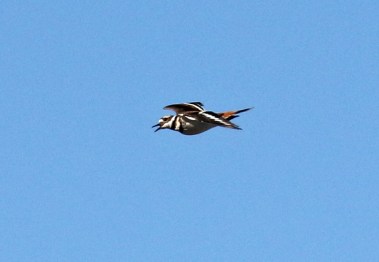
Killdeer FlightKilldeer

Suddenly a Merlin flew overhead chasing what I believe was a House Finch which somehow avoided capture.  Too fast for a photo but somehow the camera in my brain picked out the black and gray tail bands more clearly than I had ever noted them before.  One of those small but delightful moments while birding.

I would have to leave for Canada soon, but as the tide was at least now coming in I wanted to give the Hudwit another chance and headed over to the west side of the spit where the Black Bellied Plover flock that it accompanied chose to forage.  They were there – Black Bellied Plovers!!!  But alas only two instead of the thousand or more that had been seen at high tides on previous days.  I hoped they were the early scouting party and the plenitude would soon join them, but such was not the case and these two just flew off and no others arrived as the tide remained quite low.

Black Bellied Plover

Black Bellied Plover1

My disappointment (but not surprise) was somewhat assuaged by the arrival of first one and then two more Horned Larks – rare for the time and place and very confiding as they posed for photos for me and another birder I met at the spot who was also hoping for a Hudwit.  The light was perfect and the three birds completely ignored our presence as they fed voraciously.

Horned Lark
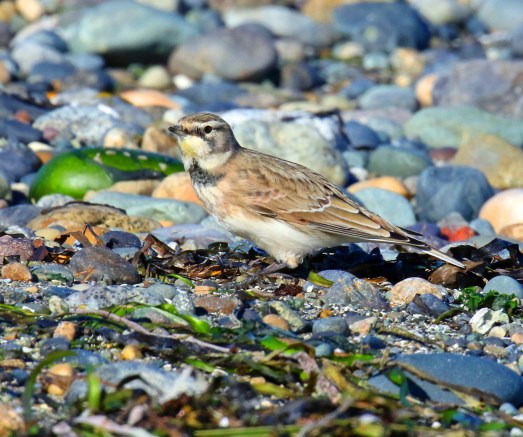
Horned Lark1

It was now just past 11:00 and I was scheduled to meet Melissa at Reifel Refuge at noon so it was time to go.  A last stop along the road heading out gave me a look at the first Black Oystercatchers of the day and resting Caspian Terns but no more Plovers and definitely no Godwits.  I would just have to find one in Canada I thought.  It had been a fun morning though.  Forty species already and there was a whole other country to bird.  The line at the border crossing was relatively short – ten minutes to clear – and no wall to keep me out.  (Sorry could not resist.)

Welcome to Canada

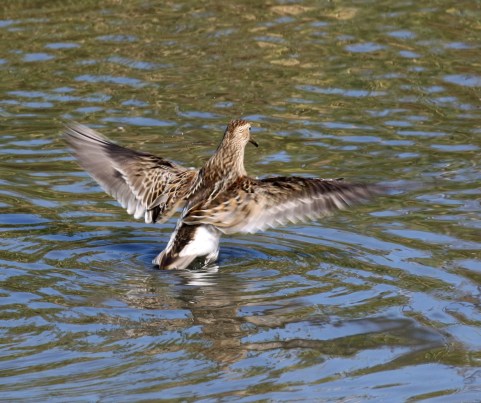
My last visit to Reifel Refuge had been with Pilchuck Audubon in 2015 when we had fabulous views of a Great Gray Owl that had been there for several weeks.  The quest this time was a Sharp Tailed Sandpiper.  Melissa and I explored all of the ponds.  There were a number of shorebirds including Stilt and Pectoral Sandpipers, many Greater and Lesser Yellowlegs and lots of Dowitchers – but no Sharp Tailed.  It had proven to be a one day wonder and this was not the right day.  One photo of the Pec as it was about to take off gave a really good view of the dark feathers extending from its back down through its tail.

Stilt Sandpiper

Stilt Sandpiper1

Pectoral Sandpiper

Pectoral Sandpiper

Pectoral Takeoff

It was now a couple of hours before high tide – time to hit the spots where the Golden Plovers and the Hudsonian Godwit had been seen.  As was the case at Semiahmoo a Marbled Godwit and a Willet had recently been seen with the large flock of Black Bellied Plovers that also had the Hudwit.  Melissa was keenly interested in the Willet (it would be her first this year and is rare in B.C). so we were looking for the flock of Plovers.  But it was not to be.  No Plovers at all at Boundary Bay and none at Roberts Banks.  Blackie’s Spit was now our last hope.

Blackie’s Spit is a cool spot, beautiful with views of distant mountains and the residential towers of Burnaby and good habitat for shorebirds.  We finally found a (“the?”) flock of Black Bellied Plovers – hundreds of them.  That was the good news.  The bad news was that they were so distant that it was very difficult to scan for something different.  We tried for 30 minutes.  At one point I was 95% certain that when one bird lifted its head I could see a long bill and a grayish brown body that was somewhat larger than the adjoining plovers making it most likely the Hudsonian Godwit.  But it dropped its head again and could not be relocated.  But 95% is not 100% and 100% was needed to support the observation.  Sigh…   And then a surprise.

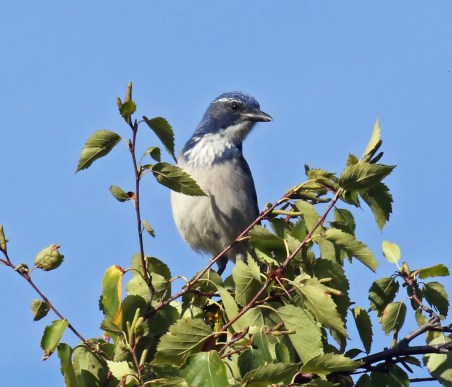
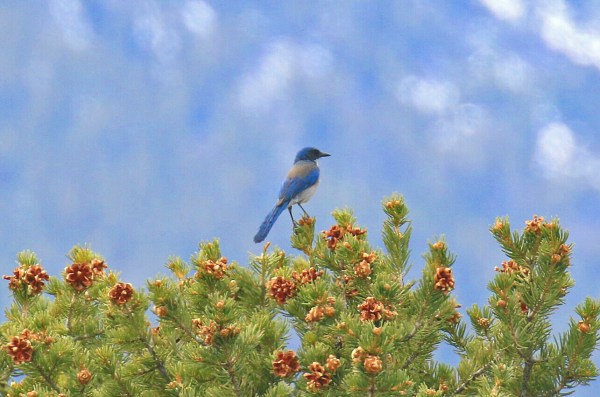
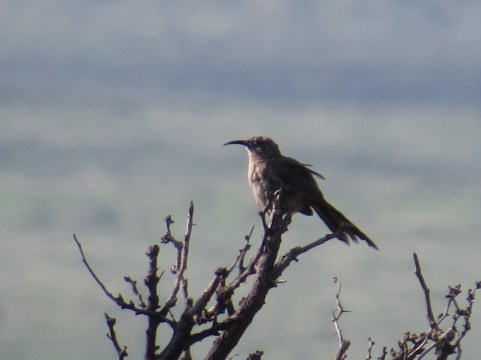
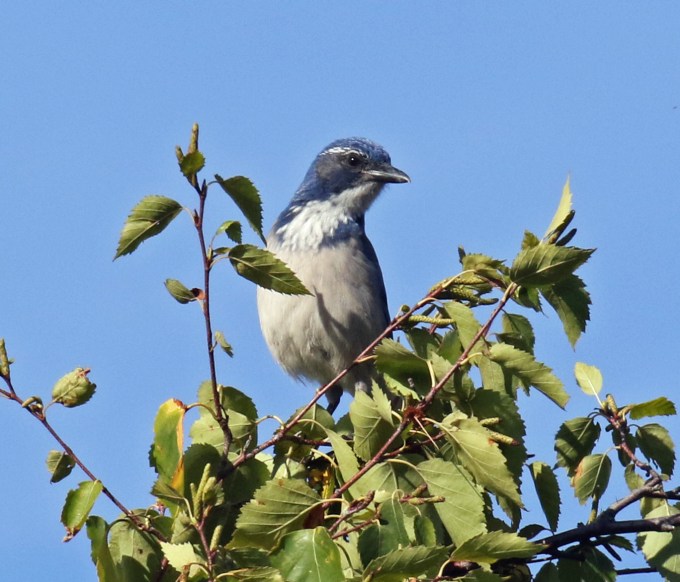
As author/keeper of the BC Rare Bird Alert (www.bcbirdalert.blogspot.com), Melissa learns of rare bird sightings almost as soon as they occur.  She had just received word that a California Scrubjay had been seen 15 minutes earlier at – yes you guessed it – Blackie’s Spit – not far from where we were scoping the Black Bellied Plover throng. When we got to the spot, we found another birder who had been looking for the Scrubjay but had not found it.  We joined the search and for maybe 10 minutes we had no luck.  This is a very rare bird this far north and while I do not worry about a provincial or even Canada list, I certainly hoped Melissa would see it and I wouldn’t mind either.  I suggested using playback and got approval.  No immediate response but maybe five minutes later, we saw what could have been the bird flying behind some trees.  More playback.  No response.  Maybe it had been our imagination.  I headed down a path while they remained above and was lucky to see the Scrubjay with a large nut in its beak.  It flew and Melissa and the other birder got quick views.  Then I spotted a second Scrubjay – only one had been reported before – and this one proved more accommodating as it perched in the open in the sunlight – a great photo op.

California Scrubjay – First Record Shot with Nut and then a Lovely Pose
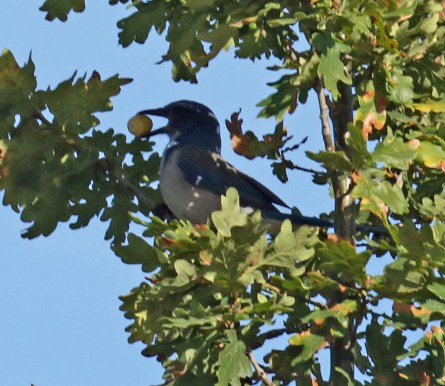
California Scrub Jay with nutCalifornia Scrub Jay

While this made the day for Melissa, for me it was “nice” but not what I had hoped for when I ventured north.  We went back to the distant flock of Black Bellied Plovers and tried again.  The light was now better but we could not relocate the bird I had seen previously. Ilya Povalyaev had joined us and joined the search.  Nothing and then the flock flew off to the west and north and that was that.  Or was it?  Stay tuned.

With the flock gone, we turned our attention to the Scrubjay again and took Ilya to the spot. When we had departed before, both Scrubjays had flown West.  Would we find it again.  I played the call and quickly first one and then the second bird appeared.  No poses this time, and again they flew off to the west just as they had before.  Happy for Ilya but I had really wanted one of the special shorebirds and now time was running out.  As I said, Melissa learns of good sightings almost as soon as they occur.  She received word that the Hudsonian Godwit had been seen at Boundary Bay – exactly where we had been two hours previously.  It was now 5:45 and the light would soon be gone.  Time to follow Rule 1 – “Go Now” – back to Boundary Bay – 14 miles away.  Several birders arrived at the “Scrubjay spot” just we were leaving – all friends of Melissa and Ilya – looking for the rarity there.  I couldn’t wait to visit and raced off.  Fortunately Melissa and Ilya cut their visit short and left shortly after I did to join me – thankfully so.

I had had the foresight to put the Boundary Bay (Mansion) location on my GPS so was able to get there.  I made good (great?) time and was there just after six.  There was still light but already beginning to fade – as I said earlier, summer is leaving us.  Melissa and Ilya arrived shortly after I did and we first set up scopes at the 96th Avenue terminus.  The number of Black Bellied Plovers was astonishing – easily 1000 plus.  This was the same flock that had been seen at Semiahmoo across the bay.  It almost definitely included the flock we had seen at Blackie’s Spit – plus many more.  Would the Hudwit be with them? The Willet? Ilya spotted the Willet.  We got looks in his scope and then found it in our own.  Melissa was a very happy camper but that was not my quest.  I thought I found the Hudwit – larger bird with long bill.  But I had not realized that the Willet had flown and that is what I refound.  Our search continued and the light continued to fade.

We found a Godwit – but it was the more common Marbled Godwit.  Aaargh!  But, again the sharp-eyed Ilya came through.  Further to the East, he found the Hudsonian Godwit.  I got it in my scope as well and now there was no doubt.  Long bi-colored slightly upturned bill.  Plain brownish gray and that definite white supercilium.  Yay!!!  We sped down to the end of the road in front of the Mansion (what was THAT doing there?!) and searched for the American Golden Plover that had also been noted in the message received by Melissa.  It was probably there in the 1000+ Black Bellied Plovers but they were all too far out and the light was now pretty bad.  But I had seen the Hudsonian Godwit – ABA bird 495 for the year – and I too was a happy camper.

To complete the story, we learned that about 90 minutes or so after I had left Semiahmoo earlier that day, the large flock of Black Bellied Plovers had arrived and that the flock included a Willet, a Marbled Godwit and a Hudsonian Godwit.  It was almost 5 hours later that I saw this same flock at Boundary Bay – confirmation that, as suspected, all of the sightings in both places over the past several days had been of the same birds – availing themselves of feeding and resting places within just a few miles as the crow (or the Plover, Willet or Godwit) flies but many more miles as traveled by the birders.  Our Boundary Bay birds had been too distant for photos so I include a photo of a Hudsonian Godwit from Semiahmoo that I took there in late September 2015 – a LOT closer in.  It may even be the same bird.

Hudsonian Godwit (Semiahmoo September 29, 2015)

Hudsonian Godwit (2)

Melissa, Ilya and I had a nice dinner at “The Cabin” in Crescent Beach and I headed home.  It was a very long day.  It was a very good day.  Great places, great birds and especially great people!!
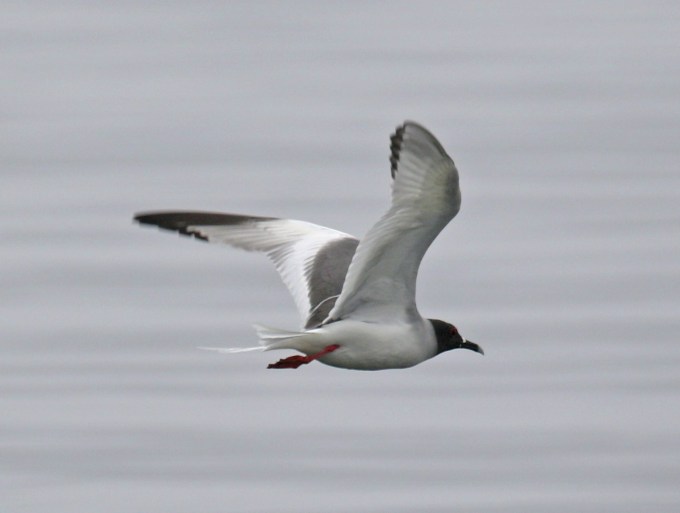
 

A Swallow Tailed Gull – Way Beyond WOW!!


At 6:45 a.m. on the morning of August 31st, the following post appeared on “Tweeters” – the main birder communication site in Washington: “There’s a Swallow Tailed Gull at Carkeek Park now w(ith) California Gulls!!!”  I was in my pajamas in Bellevue figuring out details for the remainder of the day that was going to include some dog sitting, checking out the mail at my condo in Edmonds and more steps to get rid of way too much stuff filling a storage unit.  The post was from Ryan Merrill.  Had it been from anyone else, I would have dismissed it as a joke, a mistake, a very late April Fools prank, but this was from Ryan – as good as there is and as caring and sharing as there is.  Follow Rule 1 —  GO NOW!!!!!!!

I was dressed and out the door within 5 minutes – out into the drizzle and hoping that the traffic would not be too bad and of course that the gull would remain.  Oddly I had just read something about Swallow Tailed Gulls a few days earlier when I was online looking up info about Swallow Tailed Kites and Google had pulled up the Gull before I finished entering the full inquiry.  Wait – had I misread the post – was it a Swallow Tailed Kite – still extraordinary and cause for a mad dash – but at least more plausible than a Swallow Tailed Gull which belongs in the Galapagos?

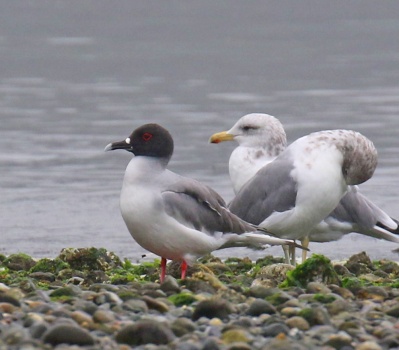
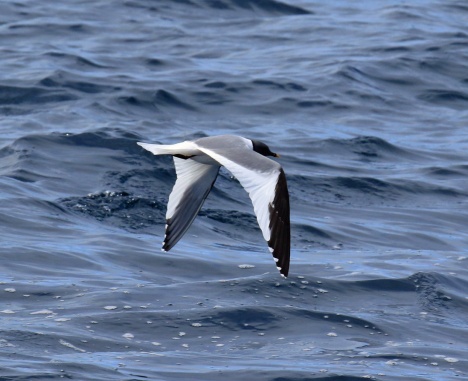
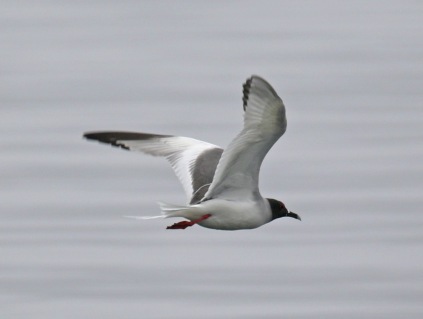
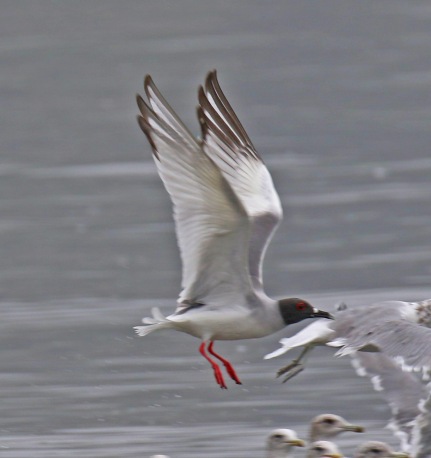
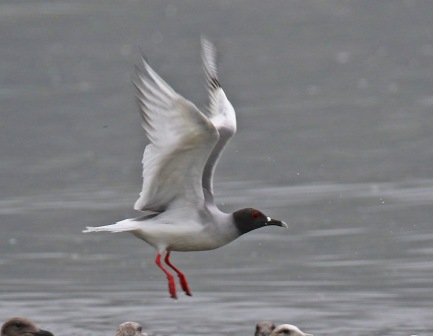
Clearly this was going to be an incredible day – there was NO TRAFFIC – almost as rare in Seattle as – well as a Swallow Tailed Gull.  I called Edmonds birding friends Steve Pink, Ann Marie Wood and Jon Houghton and broke the news to them.  None of them had seen Ryan’s post.  All would join later.  I was at Carkeek Park by 7:30 and down on the beach across the railroad track I could see 4 birders looking at a flock of gulls gathered on the beach.  They were not disinterestedly just looking about.  They were looking at the gulls and I was then sure they were also looking at THE GULL.  And one of them was Ryan Merrill.  I joined them as fast as I could and as I approached they smiled and invited me to look into the scope and at – yes the Swallow Tailed Gull. WOW!!  And that was a word that would be repeated many times over the next two hours as others would join the group.  There it was – a beautiful unbelievable Swallow Tailed Gull in a group of 100+ other gulls.  It was in adult plumage – dark head, white tipped dark bill, red around the eye – black and white patterned wings, white spot at the base of the bill, and of course – a swallow tail.  Way beyond WOW!!!
And unlike many other such finds where the quarry is hidden in a tree or brush or a moving throng of birds, this guy in addition to being the rarest of rare birds and gorgeous was also cooperative beyond belief.  With all those other gulls, this one remained in front with almost continuously unobstructed views and even though in respect to others that would follow us, we remained back some distance not to disturb the flock and cause it to leave, we were close enough for photos and this was going to be a big one for me.  Snap – and with that singular movement I had a photo of my 400th species in Washington – and what a bird for such an honor.

There have been only two records of this species in North America – ever – before today.   Both in California – one in the 1980’s and one in the 1990’s.  Probably at that moment I was one of fewer than ten people who had ever seen this bird in the ABA area.   That number would change over and over throughout the day, but it was a joyous moment.  I actually gave Ryan a big hug – grateful and thankful and ecstatic.

Swallow Tailed Gull – Carkeek Park – 7:35 A.M. – Thursday August 31, 2017 – Photographed Species #400 in Washington

Swallow Tailed Gull 3

Ok – I had seen the bird.  I had gotten the picture.  The adrenalin was flowing but maybe now I could relax and try to comprehend this extraordinary occurrence.  The Swallow Tailed Gull is an equatorial seabird endemic to the Galapagos Islands. When it is not breeding it is totally pelagic, migrating eastward to the coasts of Ecuador and Peru.  The Galapagos are 3,850 miles from Seattle.  What was this bird doing here?  Another amazing fact.  This gull is nocturnal – with eyes that enable it to see squid and such on the ocean and to hunt and feed at night.  It is the only gull in the world that does so.

The gull remained in plain sight – I took more photos and more and more birders arrived.  I hoped the gull might fly a bit and reveal its striking wing pattern and that swallow tail – not fly away – but enough for a peek.  Others were hoping for the same as now many scopes, binoculars and cameras were trained on the bird.  It continued to drizzle and the light was terrible but any photos of this mega-rarity were treasures.  Then it lifted its wings just for a moment and I was lucky to have my camera on it.  Snap, snap – I had the wing pattern.

Swallow Tailed Gull – Wing Pattern

Swallow Tailed Gull Wings2.jpg

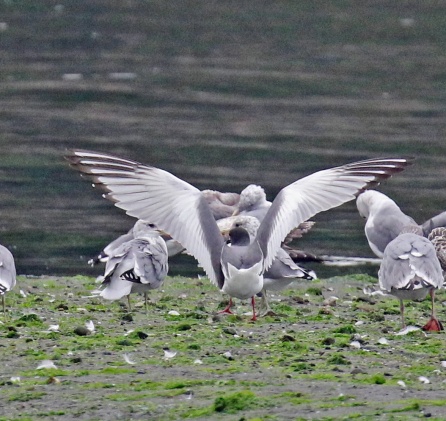
The wing pattern was reminiscent of those of a Sabine’s Gull, another pelagic gull with a dark head.  Very striking and immediately identifiable when seen even at a distance.

Sabine’s Gull Wing Pattern

Sabine's Gull1

My friend Steve Pink had made it and immediately got on the bird – a life bird – as it was for everyone who saw it.  Where was Ann Marie?  Steve told me she had a fall yesterday and was not able to walk out to the beach but she had made it to the walkway over the train tracks and had a distant view from there – she had a lifer too!!  Jon Houghton came.  He had seen this species in the Galapagos but was thrilled to have it closer to home.  More and more people came – people I knew and people I had never seen before.  Older birders, younger birders, experts and beginners.  This was an event – everyone was happy.  Very happy.

By 10:00 more than 60 people had come and seen this bird.  Birders had come by ferry and from the north and east and south and west.  Many more would come.  Over and over again, I heard WOW!! The tide was coming in and the birds were huddling together a bit closer to us.  Trains had come by and we wondered if they would flush the flock.  They did not. An Osprey flew overhead – no effect.  Maybe an Eagle or a Peregrine would have been different.  A Green Heron flew over – an uncommon species but not rare.  Hopes continued for a flight – to see the wings and the swallow tail.  Around 10:30 it happened, the tide had come in sufficiently to cause the flock to take off.  Fortunately I was ready – snap, snap, snap and I had the gull in flight – what a beauty.

Swallow Tailed Gull in Flight

Swallow Tailed Gull Flight1Swallow Tailed Gull WingsSwallow Tailed Gull Wings4

The gulls flew out into Puget Sound – still visible but not good views.  I think more than 75 birders had already come and seen this bird – testimony to the rarity of this sighting and to the enormity of the birding community.  I left but tracked the reports that have continued throughout the day as the gull remained in the area and even returned to the shore.  My friend Melissa Hafting came down from Vancouver B.C.  Russ Koppendreyer had come from Longview.  Birders came from Yakima.  More and more reports came in.  I bet that more than 150 people have seen this bird today… maybe 200.  I expect that there will be birders from all over the country that will visit in the next days as long as the bird remains in the area – and that is a good possibility.  It is that rare – that extraordinary.  We are all indebted to Ryan for finding and identifying the Swallow Tailed Gull and getting the word out so quickly.  It is not the first time he has played this role and assuredly will not be the last – but this will be a very hard act to follow.  WOW!!!

And thus another of my “arbitrary” goals for the year has been met.  Earlier there had been the first goal – 100 species seen in one day.  Then the second – my 200th species in Kittitas County.  And then the third – my 300th species in Washington for the year and now my fourth – my 400th photographed species in Washington.  In Arizona I had already reached my 6th goal with the picture of my 600th species in the ABA area.  And this bird – totally unexpected – gets me within striking distance of my 5th goal – 500 species in the ABA area for the year – 7 more to go and that should be doable.  It also gets me closer to goal #7 – my 700th ABA Life bird.  Closer but probably not close enough.  Although who knows – maybe Ryan will turn up some more mega-rarities.  If so – I will go for them as soon as I can.

Postscript:  The gull was seen almost continuously on the water and then back on shore for the remainder of August 31 until dark.  Being nocturnal, did it head off then for some feeding activity?  Early the next morning, Ryan was back at Carkeek Park – joined by others and the gull was not seen.  It is now 4:00 PM and I have not seen any reports of its presence.  Did it disappear as mysteriously as it arrived?  After feeding at night did it join up with another flock of roosting gulls elsewhere in Puget Sound?  Will it be found again?

Post-Postscript:  It was found again.  After hours of searching by many at Carkeek Park and elsewhere, the Swallow Tailed Gull was relocated north at a hard to access spot near Richmond Beach.  Getting there involved some work and some challenges with “private” property, but many got to see this continuing rarity.  Included in the long list of viewers were Mike and MerryLynn Denny who had made the long trip from their beloved Walla Walla valley (proof positive of how special this bird was) spent four hours at Carkeek Park and then got it when it was relocated later.  I am sure others will travel and not see this bird – part of the deal with rare bird chases, but I was especially happy they saw it as they have contributed so much to my birding enjoyment – and to the enjoyment of others.

Post-Post-Postscript:  This amazing visitor remained in the area until at least September 8th.  It was seen as far north as Everett and also at my my hometown of Edmonds.  There is no way to know the exact number of people who observed this beauty but more than 400 reports were filed on EBird and there very well could have been 1000 observations.  All of the Big Year birders made the trip as did many who had done Big Years in 2016.  Truly an extraordinary event.

August in Arizona – Part II: Mountains, Canyons and Birds

The loaned camera from John Harris really was a life saver, but it was hard to put the loss of my own camera out of mind.  I could not stop blaming myself for failing to pack the back up.  I worried about the repair cost and time but moreso photos and particularly good photos had been such an important reason for this trip and my good camera was a big part of those hopes.  It had already become clear that the approach of this tour was not going to make getting good photos easy, and now it was going to get harder.

Now there was another problem.  The original plan had been to visit California Gulch that night to search for Buff Collared Nightjar.  We had heard horror stories about vehicles getting stuck in flooded roads on the way there, so travelling that challenging road in the dark was out.  This was a big disappointment as the Nightjar is found nowhere else and would have been an ABA Life bird.  It was also a potential problem for another important bird for the trip, Five Striped Sparrow.  I had seen one 40 years ago, but it would be an important life bird for Frank Caruso (and most of the others on the trip) and definitely a new ABA Life Photo for me (now also complicated by the camera issue).  Losing both the Nightjar and this sparrow would have been a big loss.  Our leader came up with another way to get to California Gulch – at least in the daytime.

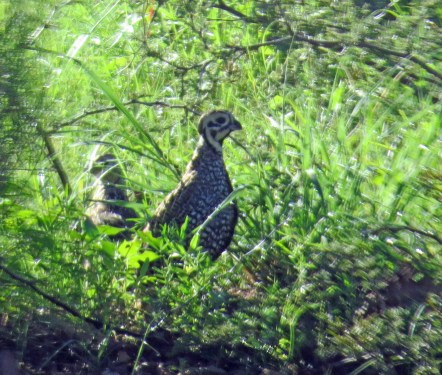
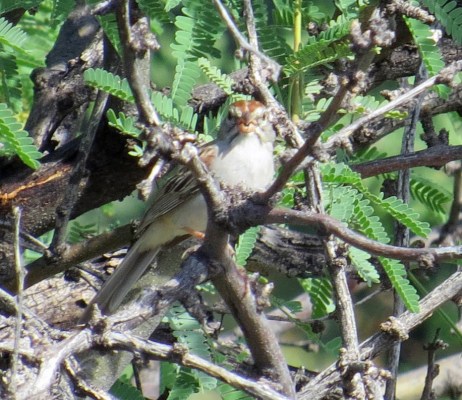
Early the next morning we headed for California Gulch via Arivaca and Warsaw Canyon. Along the way we had Botteri’s and Cassin’s Sparrows and then our first and only views of the much sought after Montezuma Quail.  A tough photo through the van’s windshield (especially as I was four rows back), but still a welcomed addition to my ABA Photo (and year but not Life) lists. (Note that all pictures going forward are with the much appreciated loaned SX50).

Botteri’s Sparrow

Botteri's Sparrow

Montezuma Quail

Montezuma's Quail1

There is simply no way to be sure to find these quail.  We were in good habitat many times during our travels and they just did not cooperate (the same would be true later for Scaled Quail).  I have several friends who have spent many hours looking for/hoping for this bird in Arizona and were unsuccessful. So these were a good find.

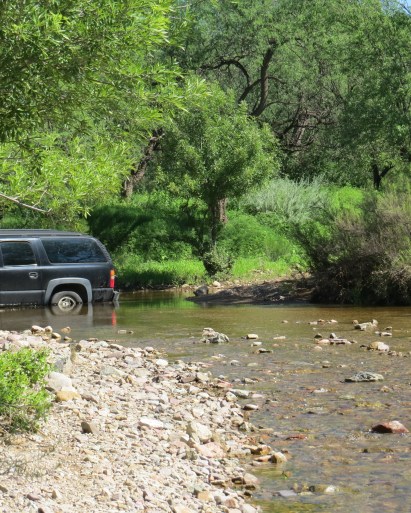
We continued on via Ruby Road and reached the beginning of California Gulch and could go no further as there was a torrent raging down a usually dry wash.  In keeping with those aforementioned horror stories, there was a Chevy Suburban stuck in what was now a stream.  We heard of one group that spent a whole night trapped before being rescued.

Abandoned Stuck Chevy Suburban

Stuck Suburban

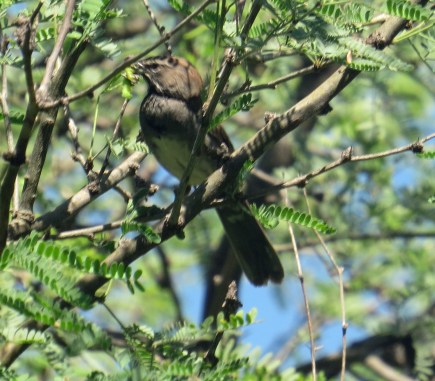
The road in had been terrible – a big jolt every few feet magnified by the van’s poor suspension and springs – but at least we had made it this far.  Was it going to be far enough?  Would we find the Five Striped Sparrow?  There was a bit of confusion at the start and we were told we would wade across the stream to search for the Sparrow.  One other person from the group and I did so only to learn that plans were changed and the try for the Five Striped Sparrow would be done downstream first.  Wet shoes are not my first choice, but I had had enough foresight to remove socks so not a big deal as we waded back across and went downstream.  I think it was Frank and his great birding ears that first heard the call of what turned out to be a Five Striped Sparrow – a much wanted new Life bird for him.  We got fairly good looks at it across the stream.  Were I on my own, I would have worked closer for a good photo, but that was not in the cards with the group.  (And yes, I know I am whining, but it is my blog and I am also being honest.  Especially after the long ride in the back of the uncomfortable van and the unnecessary wade across the stream, the initial good feeling of at least finding the bird (not hard in the Gulch) was moderated by wanting a better photo – and yes with MY camera setup. )

Five Striped Sparrow

Five Striped Sparrow


On our return towards Nogales, we saw some Pronghorns in the Grasslands and added Rufous Crowned and Grasshopper Sparrows to our sparrow list for the day.  We also had some Rock Wrens, another Yellow Billed Cuckoo and more Black Tailed Gnatcatchers. 

Rufous Crowned Sparrow

Rufous Sparrow

Complaining aside, any day that includes both Five Striped Sparrow and Montezuma Quail should be considered a good birding day.  But it just did not feel like it.  The poor photos of the Sparrow and Quail only reinforced the feeling of loss of my own camera.  They also reminded me how the approach of this tour was not what I would have preferred or how I would have (should have?) approached things and gone on my own – and that was surely brought home with the long and hard ride at the back of the van.  And truth in blogging, a big challenge in my relationship had developed a few days before I departed home and was almost constantly on my mind.   All of this continued to weigh heavily on me.  If John had not been so kind in lending me his camera, it really would have been very tough to continue the trip.  I may well have chosen not to.

But then a really good thing happened.  It was our arrival at the Casa de San Pedro Bed and Breakfast.  The Casa de San Pedro is in Hereford, Arizona not far from Sierra Vista (sometimes called “Sorry Vista”) and pretty close to the Mexican Border.  It is a perfect home base for exploration of the many bird filled canyons of the Huachuca Mountains.  It is a place that I would love to visit – even without the birds.  Owners Karl Schmitt and Patrick Dome bought the property in 2002, relocating from the Northwest.  Their love for the place and for its guests is evident in every detail and in every word and action.  It is also evident in their extraordinary breakfasts – reason enough to stay with them.  Do not go if you are on a diet – as the quantity is second only to the quality.  We were going to be there three nights and it could not have come at a better time.  The only problem would be not having enough time to actually enjoy the place itself as we would be off to those Huachuca Canyons and environs every day.

Casa de San Pedro (the photo does not do it justice)

Casa de San Pedro

Breakfast at the Casa de San Pedro (this photo does do the food justice!)

Breakfast

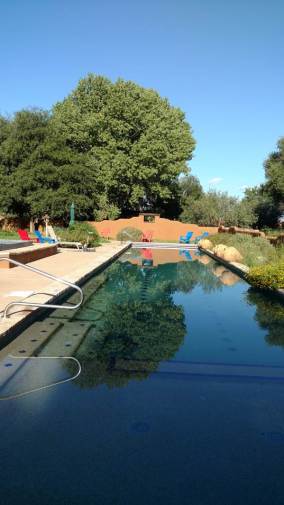
Pool at Casa de San Pedro

Pool

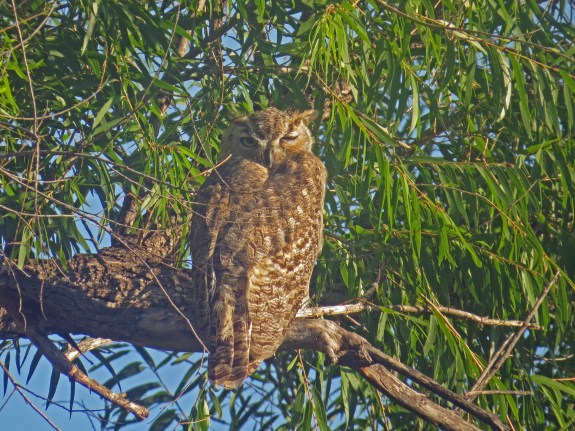
Yes I would have enjoyed just being at this beautiful serene place, but there were birds to see.  Indeed some were seen right there at the Casa.  Great Horned Owls greeted us each morning and beautiful Vermillion Flycatchers were readily found.


Great Horned Owl

Great Horned Owl

Vermillion Flycatcher

Vermillion FC2

After a lovely night at the Casa and a superb breakfast, we left the next morning to go to Fort Huachuca to get security clearance so that we could look for Elegant Trogons in Huachuca Canyon.  The processing was not too bad and we readily found the trogons in the Canyon – hearing their almost bark like call first.  We found a pair at a nest and then two more.  We also had Dusky Capped Flycatchers and more Sulphur Bellied Flycatchers.

Elegant Trogon

Elegant Trogon1  Elegant Trogon 2

Elegant Trogon at Nest

Elegant Trogon2

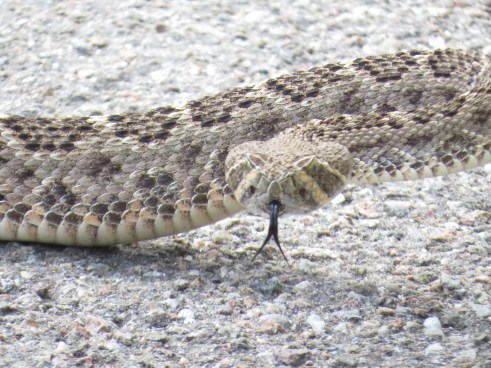
Trogons may well be the most sought after and representative bird of Southeast Arizona – great to find them so readily.  Afterwards we moved on to Garden Canyon still on the Fort property.  A large Western Diamond Backed Rattlesnake was a highlight along the way.

Western Diamond Backed Rattlesnake

Rattlesnake  Rattlesnake Tail

Rattlesnake Head (2)

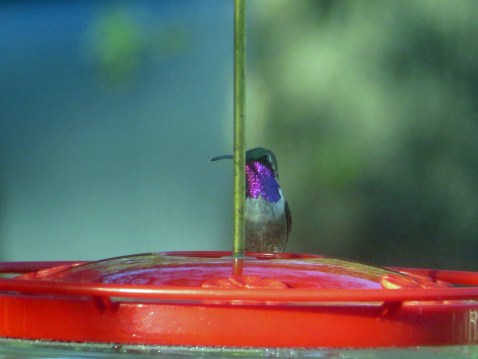
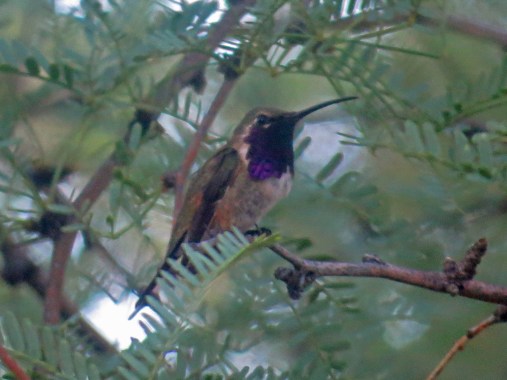
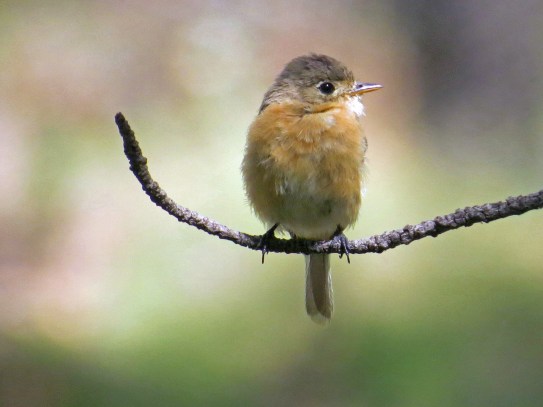
In Garden Canyon our best birds were several Buff Breasted Flycatchers.  I had seen them before 40 years ago and frankly had forgotten about them when thinking about this trip.  Plain but beautiful.  After a too-short respite back at Casa de San Pedro, we visited Mary Jo Ballator’s Ash Canyon B & B with its many hummingbird feeders and the delightful Mary Jo.  There were many Anna’s Hummingbirds but the great treat was a male Lucifer’s Hummingbird.  This had been high up on my want list for the trip – a new ABA Life Bird.  I could not get the perfect photo but was thrilled with the ones I did. Mary Jo was a wonderful and knowledgeable hostess.

Lucifer Hummingbird

Lucifer Hummingbird3

Lucifer Hummingbird2

On the way to and from Mary Jo’s there seemed to be Lark Sparrows everywhere – but not easy to get good photos of this species that I see regularly in Washington.

Great Horned Owls greeted us again the next morning at the Casa where breakfast included the best pancakes I have ever had.  Following breakfast I got a good photo of a Gila Woodpecker (seen frequently during our trip and a new ABA Life photo for me.)

Gila Woodpecker (This photo is earlier in the trip and I forgot to use it in the first part of this post.  I may go back and edit later.)

Gila Woodpecker2

We were now off to Reef Campground near the top of Carr Canyon.  A Tufted Flycatcher had been seen there regularly and was a prized bird.  On the way up we had our first Scott’s Oriole of the trip.  It was frustrating not to be able to get this ABA Life photo from the van and I probably committed a faux pas by opening the side door to at least try for a shot and it flew off.  Later a second one was seen elsewhere on the trip – but again I was blocked by the van and never even got a look.  It is just the nature of things traveling in a van and why I do not think I will go on this kind of trip again.  EVERYONE was cooperative and we rotated seats but there are just too many severe visibility (and photography) limitations.

The search for the Tufted Flycatcher was frustrating.  We got to the campground about 5 minutes after one had been seen well by the many birders already there.  We remained for at least 60 minutes and relocated it only to have it fly off – before many in the group got any look at all.  Seemingly it would go quiet and then go on a feeding frenzy with quick movements from place to place – covering far more territory than I would have expected.  The group split up and kept looking.  Catherine Bland and I were further afield than the others and we had very good looks in the open in a couple of spots as it kept moving.  I grabbed a quick photo (the best I would get) and then went to tell the others.  [If I had focused only on a photo for me, I probably would have done better, but that is not the etiquette for the group – and everyone really was good about helping everyone get on birds and I had certainly benefited from others earlier and would again.]  Of course it flew off.  Eventually after persistence everyone got to see this very rare bird.

Tufted Flycatcher (If only I could magically remove the branch…)\

Tufted Flycatcher 2

Tufted Flycatcher-r

There were also some Buff Breasted Flycatchers in the area and this time there was no interfering branch and there was excellent light – bingo a very nice photo.  The two birds are similar but also very different.  Note the two very different bills for example.  Also in some views the tuft of the Tufted Flycatcher was very noticeable.

Buff Breasted Flycatcher

Buff Breasted Flycatcher (2)

Some of us also found a couple of Brown Creepers of the distinctive Mexican albescens subspecies.  These may be split off as a separate species someday.  We saw others later in the tour.

Brown Creeper (definitely not my best work…)

Brown Creeper

We bounced our way back down yet another challenging road and then visited the Beatty’s feeders in Miller Canyon.  A number of great hummingbirds have been seen here in the past including my much sought after White Eared Hummingbird (last seen here in June).  We had a single male Broad Tailed Hummer and I missed a Costa’s but otherwise nothing different.

Broad Tailed Hummingbird

Broad Tailed Hummingbird

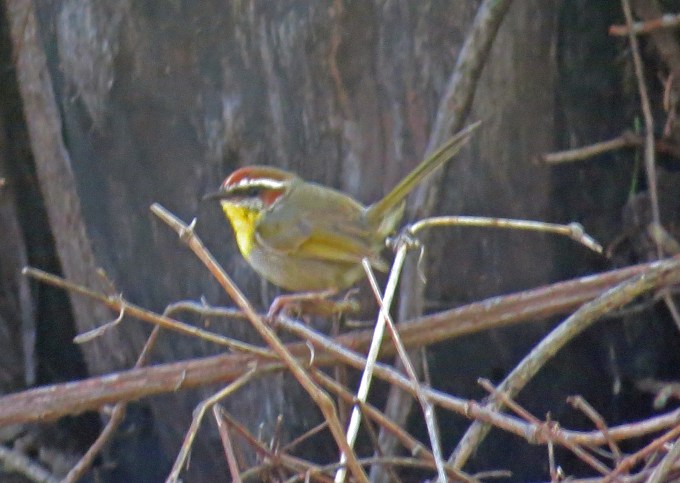
We got back in time for me to do some laundry at the Casa in their top line machines (everything about this place was really superb).  Then the following morning after yet another wonderful breakfast, we met Ron Beck and Dorian Anderson for the steep hike up Hunter Canyon to look for Rufous Capped Warblers.  This was Ron’s home turf and he was terrific.  Some other birders staying at the Casa had tried for and missed the warblers the preceding day.  Ron made sure that we didn’t.  We heard their very quiet calls and got a look not quite at the top.  A few of us continued up with Ron and got even better if fleeting looks and then came back down again for a last look.  This was an ABA Life bird for everyone and was one I had not counted on (but hoped for).  It is a Mexican specialty that is found primarily in this canyon.

Rufous Capped Warbler

Rufous Capped Warbler

We never got a real look but this was the only place on the tour where we had Woodhouse’s Scrubjay – their calls distinctive upslope and just barely seen as they flew away.  I had added this recently split species to my life list on my Colorado trip last year and got a photo then (shown here).

Woodhouse’s Scrubjay (from Colorado trip in 2016)

52-Western Scrubjay Woodhouse Form

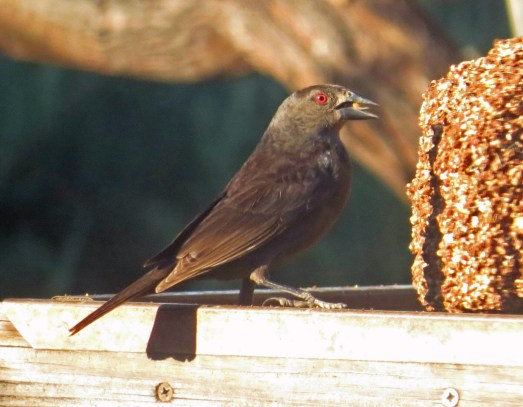
We headed back to the Casa de San Pedro sadly to check out.  It gave us another gift as John Harris spotted our only Bronzed Cowbird of the trip on a feeder.  We said our goodbyes and headed off towards the Chricahuas.

Bronzed Cowbird (ABA Life Photo)

Bronzed Cowbird

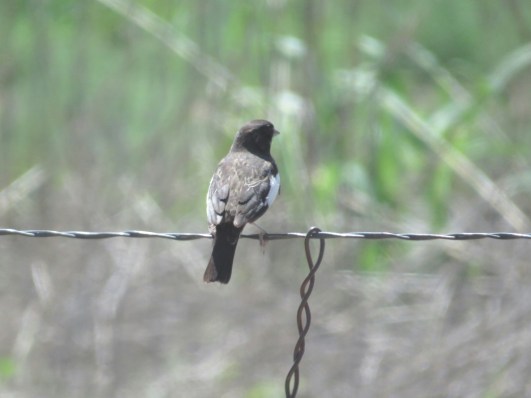
Leaving for the Chiricahuas we passed through a wetland that added a number of species to our trip list.  In the grasslands we also found an adult Lark Bunting and I was able to get a photo from the back.  Not a particularly charismatic bird, but it was important to me as the only ones I had ever seen were in Presho, S.D. in 1970 on my drive out to California – before I had become a birder but it was distinctly remembered.

Lark Bunting

Lark Bunting .jpg

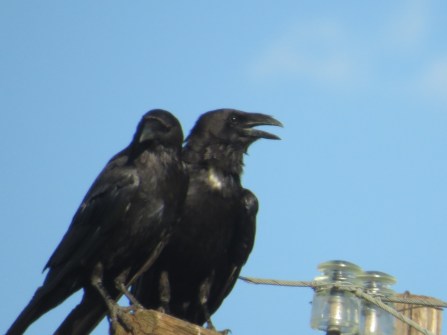
We also had a pair of Chihuahan Ravens.  They were once called White Necked Ravens and as the wind blew some of their feathers, my photo captured some of that white – something I had never seen before.

Chihuahan Ravens

Chihuahan Raven

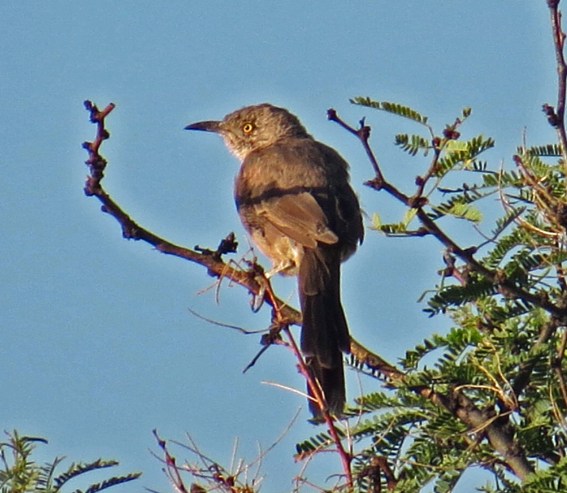
Our new “home” was the Portal Lodge – a far cry from the Casa de San Pedro.  Barely a two star motel, but safe and well located and probably the only place available for us to stay.  Food was available at the Cafe next door, so convenience ruled the day.  The next morning, before breakfast we visited grasslands in both New Mexico and Arizona and found Curve Billed, Crissal, and Bendire’s Thrashers.  The latter two were ABA Life Photos.

Portal Lodge

Portal Peak Lodge

Curve Billed Thrasher

Curve Billed Thrasher2

Crissal Thrasher

Crissal Thrasher

Bendire’s Thrasher

Bendire's THrasher2

We also heard some Scaled Quail – our only ones of the trip – but diligent searching (repeated the next day) failed to produce a visual.  Fortunately I had good looks and photos of them from my 2016 Colorado trip.

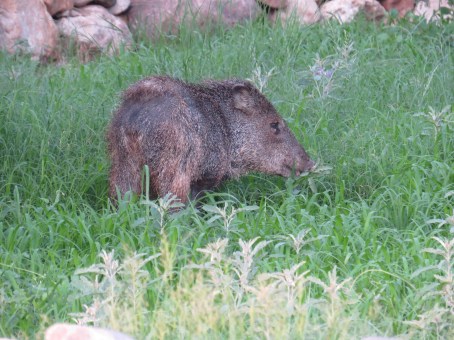
After breakfast and seeing the only Javelina of the trip, we headed up into the Chiricahuas with our main target being Mexican Chickadees – another Life bird for Frank.

Into the Chiricahuas – A Beautiful Place

Portal into the Chiricahuas

Javelina

Javelina

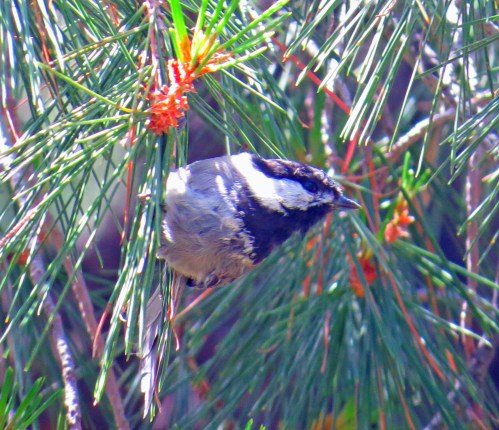
There had been some question as to whether we could get to the right habitat because the main road had washed out at Turkey Creek.  Just as we arrived at the trouble spot we saw a road grader – which conveniently had just finished regrading the road and we passed through without any trouble. Just above Onion Saddle we found some Mexican Chickadees – not great views or photo ops (at least compared to the usual experience with the very similar Black Capped Chickadees back home) – but very welcomed.

Mexican Chickadee

Mexican Chickadee

Returning to Portal we visited Maya’s feeders and had our first Blue Throated Hummingbirds of the trip including a female on a nest.  This picture is from the next day at the Southwest Research Station which was a bit of a disappointing experience for me.  Throughout the trip we were told we would find the Blue Throated Hummingbird at the station’s feeders.  I expected a lengthy stay.  Instead the group focused on butterflies (nothing against them but not really interested).  I had finally gone on ahead and grabbed a quick photo of a hummer on a feeder thinking there would be a chance to improve on it, but instead we were going to move on without any visit to the feeders.  Hmmmm?  Glad I took the one shot.

Blue Throated Hummingbird

Blue Throated Hummingbird 3

It was time to move on – heading back to Tucson for a final dinner and then a departure the following day.  On the way we stopped at Twin Lakes in Wilcox where we had a number of shorebirds including my first Baird’s Sandpipers for the year.  A real treat followed with a stop at St. David’s where our leader knew it might be possible to find a Mississippi Kite.  Frank was the first to see it on a fly by.  I missed that one.  We then did a U-turn and we got out of the van just in time to see the Kite disappear.  No photo and I debated whether I could even count it.  We waited hoping it would fly by again.  It did not.  I walked down the road a couple hundred yards and found one perched in the open.  Everyone got great looks as it flew out and then returned to the perch several times.  This time there was a photo – another ABA Life photo for me.

Mississippi Kite

Mississippi Kite1r

This would be the last new bird for the trip, the year and for my Life Photo List – a wonderful way to end.  We had a fine dinner at the Four Points Restaurant at the Sheraton across from the Hampton Inn next to the Tucson Airport.

Despite some disappointments and some mismatches for me in terms of how I most like to bird, it had been a very successful trip in most ways.  All told we had seen 180 species.  Of these 6 were new ABA Life Birds, 52 were ABA Life Photos and 72 were new ABA birds for the year.  The Life Birds were Black Capped Gnatcatcher, Lucifer Hummingbird, Rose Throated Becard, Tufted Flycatcher, Rufous Capped Warbler and Mexican Whippoorwill.  They brought me to 690 ABA life birds.  I probably cannot reach the magical 700 mark this year.  But the Arizona photos did put me over 620 ABA Life Photos getting me well past my goal of 600.  I had expected (hoped for?) more new year birds and now stand at 488 ABA birds for the year.  500 should be reachable for the year but with more work than I thought would be necessary after the trip.  I may have to take another trip I guess.

When I got home I took my camera in to see what was wrong.  I got the bad news a couple of days later.  The contacts were corroded and I was told it would cost more to repair it than to get a new one.  Ouch!!  I have ordered one from Amazon.  Maybe I won’t take another trip after all.  Sigh…

Some Scenery Shots

Moon over the Chiricahuas

Chiricahuas

Chiricahua Scene2

Picture1

August in Arizona – Part I: The Up before the Down

Similar to my trip to South Florida earlier this year, Southeast Arizona was a repeat of visits long ago – forty years ago in fact.  The two earlier visits, one in December 1976 and one in June 1977 had been early in my birding life (and life in general I guess) and were full of great birds and excitement as visits to one of the great North American birding Meccas should be.  With friends and with some locals but without guides, I had been fortunate to find most of the Arizona specialties.  In those days, however, photography was not even a dream and I had no pictures of any of the great birds.  This trip was intended to hopefully add some new ABA Life birds, lots of new ABA photos and even more new ABA birds for 2017.

Although the vast majority of my birding has been on my own or with friends, I have been fortunate to have been on several tours with well known birding tour companies, and this was the case on this trip joining friend Frank Caruso as I had done in South Florida and participating in the “Second Spring” tour offered by WINGS Birding Tours.  The timing seemed right – August 1 through August 10 – as did the itinerary visiting such iconic places as Mount Lemmon, Madera Canyon, the Huachucas and the Chiricahuas.  The bird lists from previous trips were impressive and suggested that I would find many birds needed to add to all of those aforementioned lists.  Even though most of those birds were seen, it was probably not the best trip for me to take given my specific wants, needs, approaches and quirks – not the best fit for the tour realities and approach – especially as related to photography.  That does not take away from the success of the tour and its quality in most ways at least on the surface and from the perspective of other’s and there were many great moments.  The rest of this post will  be about those good moments without time spent on the mismatching elements.

I have talked about or hinted at some goals for 2017 in earlier posts. Major progress towards three important ones was hoped for on this trip.  Based on Ebird reports and reports of this WINGS trip in previous years, my early analysis for the trip suggested that there was the possibility of adding up to 13 ABA Life birds (some pretty remote), as many as 62 ABA Life photos and as many as 92 new ABA Birds for 2017.  Some species simply did not cooperate this year, as Sinaloa Wren, Plain Capped Starthroat and Aztec Thrush did not reappear in 2017 and the last White Eared Hummingbird sighting was 6 weeks before we arrived.  Road conditions precluded us trying for Buff Collared Nightjar. So that really left only seven new “Lifers” and we were able to find six of them: Mexican Whippoorwill, Tufted Flycatcher, Rufous Capped Warbler, Rose Throated Becard, Black Capped Gnatcatcher and Lucifer Hummingbird – missing the Berylline Hummingbird and Flame Colored Tanager which were both seen by others while we were in the area.  As it turned out another lifer – a Yellow Green Vireo – was also seen while we were in Arizona – the day after we had been in the same spot finding (with great difficulty) the Rose Throated Becards. The looks or photo ops for some of these birds were not terrific, at least in this group setting, but life birds are getting hard to come by and I was happy for those that we had, especially the Rufous Capped Warbler which was expertly found by a local excellent birder, Ron Beck, who joined us specifically to find this rarity in Hunter Canyon.  I had not expected to get the Warbler although I had expected seeing the Tanager, and not doing so was a major disappointment offset by finding the warbler – so it goes.

Rufous Capped Warbler – Hunter Canyon – August 7

Rufous Capped Warbler

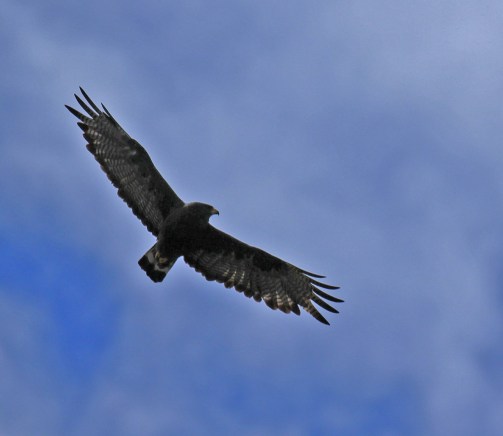
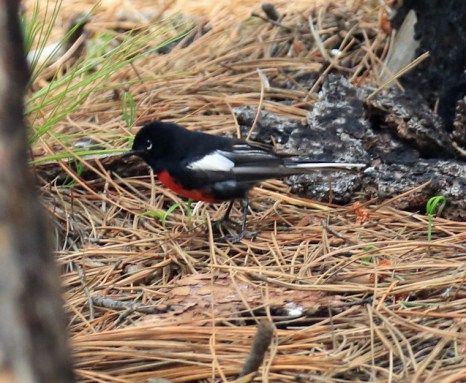
Mount Lemmon in the Santa Catalina Mountains was a wonderful way to start our trip as the species changed as we climbed in elevation and the habitats and birdlife changed as we did.  Included in the more than 50 species we saw on our visit were Arizona specialties like Grace’s, Red Faced, Olive and Virginia’s Warblers, Yellow Eyed Junco, Painted Redstart, Mexican Jay, Greater Pewee, Bell’s and Plumbeous Vireo and Zone Tailed Hawk. We also saw Canyon Towhee’s and both Broad Tailed and Broad Billed Hummingbirds in the lowland area.  All were new for the year and new ABA photos – although in a theme to be repeated often during the trip, views were often too fleeting or distant for much quality.  I had seen all of these species here on my earlier visit.

Grace’s Warbler (ABA Life Photo)

Grace's Warbler

Olive Warbler (ABA Life Photo)

Olive Warbler2

Yellow Eyed Junco (ABA Life Photo)

Yellow Eyed Junco4

Red Faced Warbler (ABA Life Photo)

Red Faced Warbler3

Virginia’s Warbler (ABA Life Photo)

Virginia's Warbler4

Zone Tailed Hawk (ABA Life Photo)

Zone Tailed Hawk3

Painted Redstarts (ABA Life Photo)

Painted Redstarts1

Painted Redstart 3

It was cool in the mountains and no rain fell on us.  One of the oddities of the trip was that while I was gone, the Seattle area experienced a real hot spell and there were days in Arizona where temperatures were actually lower than back home.  In August yet – go figure.

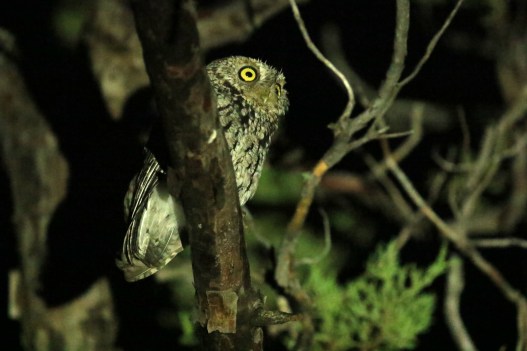
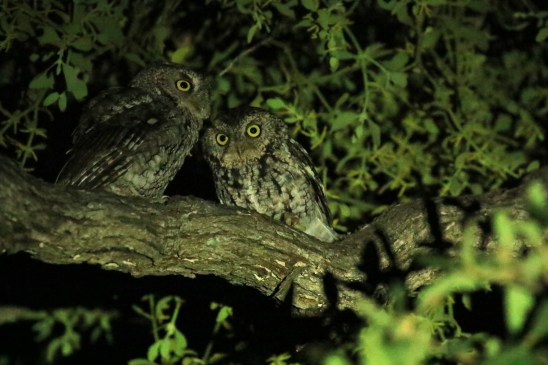
After Mount Lemmon we returned to the Hampton Inn in Tucson (comfortable, convenient and very nice folks) and went on to Madera Canyon after dinner for some early night birding.  At dusk we heard and then called in a Mexican Whippoorwill – my first life bird of the trip.  Quick visuals as it flew very close to us but no chance for a photo.  A bit later we had a response from a pair of Whiskered Screech Owls which obliged us by flying to an overhanging branch right over us.  A third was heard and briefly seen.  We also had at least one Common Poorwill calling in the distance (apparently a surprise).

Whiskered Screech Owls (ABA Life Photo)

Whiskered Screech Owl (2)

Whiskered Screech Owls (3)

Whiskered Screech Owls 1 (2)

The following morning started with a visit to see a pair of Burrowing Owls we had not located the day before and then continued in the lowlands and Green Valley before returning to Madera Canyon.  Along the way we found a female Costa’s Hummingbird, Black Throated and Rufous Winged Sparrows, and an Antelope Jackrabbit.  I had been frustrated the previous day hearing but not finding any Bell’s Vireos.  Today was better as I found a Bell’s Vireo on a nest.  We had great looks at some Black Tailed Gnatcatchers and a less than great look at a female or juvenile Black Capped Gnatcatcher – but good enough to see the tail pattern that allowed the identification of Life bird #2.

Costa’s Hummingbird

Costa ' s Hummingbird Female 1

Black Throated Sparrow

Black Throated Sparrow3

Antelope Jackrabbit

Antelope Jackrabbit

Bell’s Vireo on Nest (ABA Life Photo)

Bell's Vireo at Nest (2)

Black Tailed Gnatcatcher (ABA Life Photo)

Black Tailed Gnatcatcher 1 (2)

Black Capped Gnatcatcher (ABA Life Photo)

Black Capped Gnatcatcher

We found some Cassin’s Sparrows and also at Florida Canyon we had a pair of Northern Beardless Tyrannulets – cooperating for photos and a Varied Bunting, a brief look at Yellow Billed Cuckoo and our first Lucy’s Warblers.

Northern Beardless Tyrannulet (ABA Life Photo)

Northern Beardless Tyrannulet 2

Varied Bunting (ABA Life Photo)

Varied Bunting

Yellow Billed Cuckoo

Yellow Billed Cuckoo2

Lucy’s Warbler (ABA Life Photo)

Lucy's Warbler1 (2)

Then we were back in Madera Canyon watching the many hummingbird feeders.  Nothing super exotic – lots of Black Chinned and Broad Billed Hummers and a couple of Anna’s and then we had our first Rivoli’s (formerly Magnificent) Hummingbirds.  We also had our only Arizona Woodpecker for the trip.

Black Chinned Hummingbird

Black Chinned Hummingbird

Broad Billed Hummingbird (ABA Life Photo)

Broad Billed Hummingbird4

Rivoli’s Hummingbird (ABA Life Photo)

Rivoli's Hummingbird

Arizona Woodpecker (ABA Life Photo)

Arizona Woodpecker

Full disclosure has to include that I bird better and enjoy it more when I am birding alone or in a very small group.  But the many added eyes and ears with a bigger group is often helpful and all of the participants in this group contributed in that and other ways throughout the tour.  I was especially grateful for the good eyes and ears of many in finding some tough birds – in addition to good spirits.  But the resources in this birding paradise are not limited to members of one’s own tour group.  Especially in places like Madera Canyon, there are many others around – drawn by its great birds.  I followed one of these folks across the street from the Madera feeders and we quickly found some Sulphur Bellied Flycatchers, another SE Arizona specialty and this time I was able to alert the rest of our group and they joined in.

Sulphur Bellied Flycatcher (ABA Life Photo)

Sulphur Bellied Flycatcher

Especially since our Comfort Inn accommodations in Green Valley were just “okay”, it would have been nice to have stayed at the Santa Rita Lodge in Madera Canyon (where I had stayed on that trip so many years ago).  While there we had really good looks at a number of Mexican Jays and also learned that the Elf Owls that had nested in the area were still being seen – a fact that would prove valuable that evening.

Mexican Jay (ABA Life Photo)

Mexican Jay

After another good dinner, we headed back to Madera Canyon finding several Lesser Nighthawks enroute.  At Santa Rita Lodge, our guide played the Elf Owl call and perhaps because I wanted the photo so bad, this was a rare time when I first spied a bird – as the owl came into the open just ahead of us.  Not a great photo but no mistaking this little guy.  It was a new ABA photo for me and made up for a major disappointment in my South Texas trip in 2013.  Our guide had saved a visit to a known Elf Owl nest in a cactus for the end of the day – but it was a no-show.  I think the guide had felt almost worse than we did.

Lesser Nighthawks (ABA Life Photo)

Elf Owl (ABA Life Photo)

Elf Owl

The next morning took us to Tumacacori National Historic Park where we met Will Russell and Matt Brooks from the WINGS office in Tucson.  We were also joined by Dorian Anderson , a very interesting guy who in 2015 had done a “Bicycle Big Year”.  Dorian was critical in finding Rose Throated Becards along the Santa Cruz River.  Our views were distant and fleeting and it took a couple of hours, but we did see this species – Lifer #3 for me.  I got a terrible photo but was happy for anything.  (I later learned that a group that came the next day found the Becard’s nest and not only got good photos but also found a Yellow Green Vireo which would have been a lifer as well.

Rose Throated Becard

[Nope – too poor to really include my photo.  🙂 ]

Afterwards we headed towards Nogales and Patagonia.  We found our first Gray Hawk and at the famous Roadside Rest near Patagonia, we found a family of three Thick Billed Kingbirds which we viewed after one of our picnic lunches.

Gray Hawk (ABA Life Photo)

Gray Hawk Perched

Gray Hawk Flight

Thick Billed Kingbirds (Adult and Juvenile) (ABA Life Photo)

Thick Billed Kingbird1

Thick Billed Kingbird Juvenile

Before arriving at our fabulous next place to stay, the Casa de San Pedro B and B, we stopped at the Paton’s Hummingbird feeders and among others had our only Violet Crowned Hummingbirds.  We also had our only Inca Dove in the Paton’s yard.

Violet Crowned Hummingbird (ABA Life Photo)

Violet Crowned Hummingbird 2

Inca Dove (ABA Life Photo)

Inca Dove-r

Just as it had been cooler in Arizona than at home in Seattle, it had also been wetter as Seattle was continuing a record dry spell.  There had been rain a couple of times during our trip and at the Paton’s yard there was more.  Maybe it was because of this or maybe it was already in the works, but disaster struck for me as my camera went – DEAD!!!  The Canon 7D is supposed to be essentially almost waterproof – certainly highly resistant.  The last thing I had decided not to take as I packed for this trip was a back up camera.  Given the broken binoculars experience on the Florida trip I had packed a spare pair of bins but I already had too much stuff and just decided that there was no way the camera would fail.  Not so.  95% of the reason for the trip was to get photos, so this was a very very low moment.  We were only 3 birding days into the trip and I had no camera.  Depression was an understatement.

Deep Breath – Pause – Consider Alternate Plans A, B, C and D.  Maybe a few tears.  Definitely a few swear words.

Alternate Plan A was to order a new camera from Amazon and have it expressed to me.  At best this would take three days and it would be yet another spare camera at home.

Alternate Plan B was to ask Lynette to go to my condo and get the camera that was sitting out – the one I had decided not to take – and have her express mail it to me.  That would probably take two days and I was not real sure where the battery charger was etc.  (Besides the condo was not exactly spiffy clean…)

Alternate Plan C was to see if I might at least take a few photos with another trip members camera – fall far short of my trip goals but get some photos (I already had 33 ABA Life Photos – but was hoping for almost that many more ahead.)  At best this would be awkward.

Alternate Plan D grew out of Alternate Plan C and was one of those beautiful life moments/happenings.  All of the tour participants were really good folks – varying priorities and skill levels and backgrounds and experiences.  Many in the group took some photos, but nobody was really into the photography and three of the others were in fact using the same camera that I would have brought as my backup – the Canon SX50.  John Harris, a now retired professor from Mills College was one of the three.  He was great at finding birds (and mammals and reptiles and plants) and definitely was taking photos, but he came to my rescue and allowed me to use his camera – taking pictures for both of us.  Not what I had planned or expected but very much a saving act of kindness.

John Harris – later at the Portal Lodge

John Harris at Portal Store1

There are lots of good folks in the world – and I would bet a higher than usual percentage in the birding community.

There was now light in the tunnel and we were off to the wonderful Casa de San Pedro Bed and Breakfast for three nights – our base of operations for forays into the Huachuca Mountains.  We had seen 100 species on the trip – 3 ABA Life Birds and the 33 ABA Life Photos and 40 new ABA Year Birds.  This is a good place to close Part I and the Casa de San Pedro will be a good place to start Part II.

Ooh…A Quickie…300 Feels So Good…

At 6:40 P.M. tonight, Rick Tyler posted that he was looking at the Solitary Sandpiper that Houston Flores had reported earlier this afternoon at the retention ponds north of Perrigo Park in Redmond.  I had never even heard of Perrigo Park and was completely unfamiliar with the area (as soon became obvious).  What the heck, it was a beautiful night and Solitary Sandpiper was on my want list for the state this year.

By 7:25  p.m. I had pulled into the Park’s parking area and started looking for ponds.  I met some nice folks who had never seen any ponds.  I saw no ponds – not even any water.  Some really nice play fields though.  So I emailed Rick and asked him to call as I needed help.  If I had paid attention to Houston’s Tweeters post, I would have saved myself some trouble and looked north of the park as opposed to all through it and then to the south (the other north?).

Rick called and clarified the situation – the ponds are actually just north of 95th before you make the turn onto 196th to get to the Park itself.  I was now almost a mile away.  I jogged back to the car and drove to the right spot.  I quickly found the ponds and in the smaller pond, I quickly found the Solitary Sandpiper exactly where Rick had found it about two hours earlier.  The light was already dimming (what happened to that longest day on June 21st with sunlight past 10:00??!!) and I only had my point and shoot camera – but I got a fun photo.  No mistaking this identity.

Solitary Sandpiper

Solitary Sandpiper

This was a new species in Washington state this year.  This meets another goal (admittedly arbitrary) for the year.  Goal 1 was 100 species in one day.  Goal 2 was my 200th County bird in Kittitas County.  Goal 3 was 300 species in the State of Washington for the year.  This Solitary Sandpiper is it.

I am one away from goal number 4 (hopefully to be written up later this year) and in 5 days I leave for Arizona where I hope to meet goals 5 and 6 and just possibly get within striking distance of goal 7.  Stay tuned.

Solitary Sandpiper – Another Photo

Solitary Sandpiper


Rule One takes Me Back to Neah Bay for a Horned Puffin

I got a message from my Canadian birding pal and info source extraordinaire Melissa Hafting, that a Horned Puffin had been reported from Smith Island in Puget Sound.  After numerous exchanges and some research it was determined that a single Horned Puffin had been seen by a research group surveying the Island’s Tufted Puffin population and that a primarily whale watching company out of Bellingham had trips scheduled to Smith Island on the following weekend.  I have seen Horned Puffins in Alaska and had organized a boat trip a few years ago to chase one that had been reported in the Sound.  That trip was unsuccessful so Horned Puffin remained as a coveted new State of Washington species.  The boat trip from Bellingham was long and was not focused on finding a Horned Puffin or any other birds.  There did not seem to be a high probability of success and I had other calendar obligations, so I decided to forego the attempt.

Horned Puffin – Off Adak Island Alaska – May 2016

Horned Puffin1

But Horned Puffins remained on my mind.  Then on the evening of July 19th, I got a Rare Bird Alert from Ebird of an observation by Jonathan Scordino: “(Horned) Puffin observed with rhinoceros auklets inside the outer breakwater at Neah Bay. There is a post (telephone pole size) sticking up out of an area with new rocks in jetty in general vicinity of puffin. Puffin had two dark points coming up above eye, white face, darker bill tip than rest of bill, and a black band around neck when observed in flight. My friend has photo on his phone that is suitable for identification and I can upload it when he sends it.”    As written in my earlier blog post, two special birds were cool coincidences (Red Necked Stint and White Winged Dove – at wordpress.com/post/blairbirding.wordpress.com/17102). Was this going to be great bird karma again?  One way to find out – follow Rule One and “Go Now”!

It was now after 10:00 P.M. so as close to “now” I could get would be to take the 6:20 Edmonds ferry the next morning and as I had done so often last year – get to Neah Bay.  I sent Steve Pink an email with the news of the Horned Puffin and told him my plans.  “Let me know if you want to go”.  I figured he was likely in bed which is where I was headed, but maybe he would rise early and see the message and at least have the chance to go.  But there was no return message in the morning, so I boarded the ferry alone and I was off.

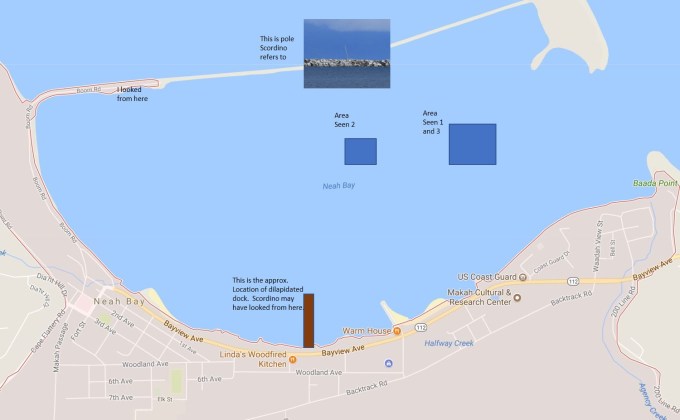
It is about 130 miles to Neah Bay from Edmonds but time for the ferry and to navigate many twisting roads especially near the end makes it an almost three hour drive.  I was on the Boom Road – the long rock jetty/breakwater that protects the harbor by about 9:10.  I had hoped to see other birders – with the Horned Puffin already in their sights.  No such luck.  As it turns out and it would be thus the whole day – I was alone.  The weather was a bit overcast with rain threatening.  I looked for the “post/pole” mentioned in Jonathan Scordino’s report but could not find it.  I was at the end of the road and was not about to walk out on the jumbled boulders of the breakwater.  There were lots of birds out in the harbor.  Would my scope reveal one of them to be the prize?

The first birds seen were Scoters – both White Winged and Surf.  Then I found Rhinoceros Auklets – a couple closer in and then more and more and more further out.  In groups of 3 or 4 and in long rafts of as many as 50 birds, there were hundreds of them.  The harbor was relatively calm as the tide was coming in, but still with the distance and some chop, it made it hard to search through them for a Puffin.  But after maybe 15 minutes of scouring every group, there was one bird that was – different – a very distinctive white face and – YES – a very large parrot like colorful bill.  With the full magnification of my scope at 60x, I could conclude: “IT WAS HERE!!  This had to be the Horned Puffin.”  I watched it in the scope for many minutes and it would disappear and reappear as the raft reformed its order and when even a small ripple would bring the puffin behind a rise in the water and out of scope view.  It was frustrating but exhilarating as each subsequent view confirmed the identification.  Even with the power of the scope, it was not a great view, but I wanted to try for some kind of photo.

I abandoned the scope and raised my 100-400 mm lens.  Which raft was it again?  There were several.  In the dim light and at the distance and with the darkening effect of looking through the camera, I could not find the Puffin among the many Rhinos.  Back to the scope and as all of the rafts had moved, I repeated the search and it seemingly had disappeared.  This is when having other birders is especially helpful as many eyes are far more effective.  I kept looking and refound the raft with my white faced bird.  Again a move to the camera failed to work.  Maybe I was looking in the right spot, maybe not.  I had not just imagined it, but the birds were just too far out and seemingly getting further away.  It was now past 10:00 a.m. and I wondered if the show was over.  It started to rain and I retreated to my car.

My observations had all been on the harbor side, east of the jetty.  When the brief squall passed I returned to the road and I was hearing calls from the other side and now they got my attention.  Marbled Murrelets were seemingly in family groups and the young ones were calling for food.  They swam in closer and closer and I got nice photos – if only the Horned Puffin had been so close.

Marbled Murrelets

Marbled Murrelets

Marbled Murrelets2

I remained at my post and watched a Bald Eagle fly over, more Scoters, some Pigeon Guillemots, more Murrelets, and over and over scanned the many Rhinoceros Auklets hoping for another view of the Horned Puffin.  No luck.  At 11:15 I had been on watch for almost 2 hours.  Something needed to change.  It was getting close to high tide and maybe that would make a difference.  There is a Coast Guard station in Neah Bay.  A Coast Guard boat came into the harbor heading into the area where so many Rhinoceros Auklets continued.  They scattered.  Some flew north and east – out of or at least to the outer edge of the harbor.  Some others returned to the area they had just vacated and others flew closer towards me and the jetty.  As a small group landed maybe 100+ yards away, some white flashed in my binoculars.  I tried to get my scope on them but they were diving and bucking around in the chop.  I got a quick look at one with a white face and that parrot bill.  Finally the Horned Puffin was not buried in a large raft.  But it was still distant and hard to track.  Instead of using my “good camera and big lens”, I switched over to my “old camera”, the Canon SX that had stood me well for so long and which had a much greater magnifying power – if only I could find the bird in the chop.

I had it.  I lost it.  It bobbed up.  I had it.  It bobbed again and I lost it.  I took photos as quick and as best I could, but one of the big problems with this camera is that you cannot take photos in rapid succession. I would either get lucky or miss it entirely – and at best at this magnification, it was not going to be a clear picture.  But oh how I wanted one.  This continued for another 10 minutes or so and then this group of Rhinos and the Horned Puffin were gone.  I looked at my pictures and a couple looked “promising” but I would have to wait until I could get them onto the computer, use my pitiful Photoshop skills and – be lucky.  I watched for another 30 minutes – nothing.  I had good enough views to be sure of the ID and to “count” this new state species.  Maybe that would have to suffice.

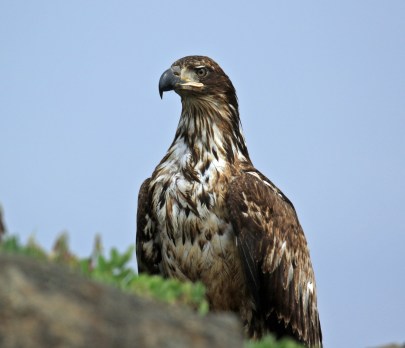
I took a break and headed up the Wa’atch Valley and then up onto Bahokas Peak hoping for some Sooty Grouse.  It was very quiet – almost birdless.  Time to go home?  I had to try the jetty one more time.  On the way out there was a gathering of Bald Eagles, Northwestern Crows and some Turkey Vultures.  There must have been something in the rocks to scavenge.  The weather had changed and now there was good sun and the Eagles made for good photos.

Juvenile Bald Eagles

Juvenile Bald Eagle3  Juvenile Bald Eagle2

Back at the end of the jetty road, I returned to the scope.  Nothing was close and if anything, although the rafts of Rhinoceros Auklets continued, they were even further out.  In the middle of one, there was the barely discernible alcid with a white face – the Horned Puffin was still there now at after 1:00 P.M. but no more photo ops at that distance.  I left.

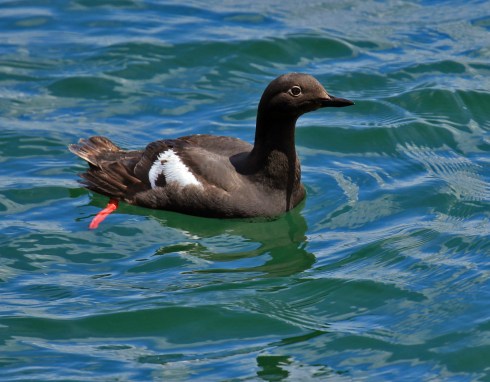
On the jetty I had wondered if a closer view might have been possible from some of the marina areas.  Behind the Warmhouse Restaurant I saw the dilapidated former dock that was now a bit scary to walk but I gave it a try.  There were lots of Pigeon Guillemots very close, a Purple Martin flew overhead, and I could still make out some Auklet rafts but they seemed to be moving out of the harbor.  What if I had started there earlier?  And I also noticed the “post/telephone pole in front of the new rocks at the jetty”.  Jonathan Scordino must have first discovered the Horned Puffin from this vantage point.  I took photos of the Guillemots and then called it a day – time for the long trip home – greatly pleased but worried about the photo.

Two men were bringing in a small fishing boat to a marina dock.  Would a boat trip get me close to the Horned Puffin (if we could find it at all)?  Could I convince them to try?  I will never know the answer to the first question as the amount of money required to interest them in taking me out was more than I was willing to risk.  So home it was.

Pigeon Guillemot

Pigeon Guillemot

Epilogue

I had posted my find on Tweeters and Ebird.  I advised Steve Pink and some others that the Horned Puffin was still present.  When I got home I went through all my photos and could only come up with one that was even ID quality – magnified almost beyond use.  I also put together an area map that showed where I had been, where I had seen the Horned Puffin and then the dilapidated dock behind the Warmhouse and the distant post/telephone pole.  I shared that with many others also.  In the following days MANY birders made the long trek to Neah Bay and also found the Horned Puffin. Carol Riddell figured out a way to rent a boat and it took her and several others out into the harbor for fantastic photos – wish I had figured that out.  After seeing her photos I was tempted to return but that rational thinking overcame that quickly.

The Map

Map

As I wrote in a post last year Neah Bay is a gift that just keeps on giving.  Within less than one mile of the same jetty that had given me my Horned Puffin, I have also seen these amazing birds:  Dusky Capped Flycatcher, Brambling, Rustic Bunting, Orchard Oriole, Blue Gray Gnatcatcher,  Tropical Kingbird, Harris’s Sparrow, Clay Colored Sparrow, and Rose Breasted Grosbeak.  Charlie Wright found a Red Legged Kittiwake there (which three of us chased and missed the next day). Not much further away, I had seen Tufted Ducks, the famous Eurasian Hobby, my only Washington Cattle Egret, heard a Lucy’s Warbler, and saw a Hooded Warbler.  I have also missed a Dickcissel and a Prothonotary Warbler found by others in the same area.  Every one of these birds is a great species in Washington and most are extraordinary.

It’s a terrible photo – but it’s a Horned Puffin —– in WASHINGTON!!!

Picture1


Two Coincidences and Sharing Four Great New Birds for the Year

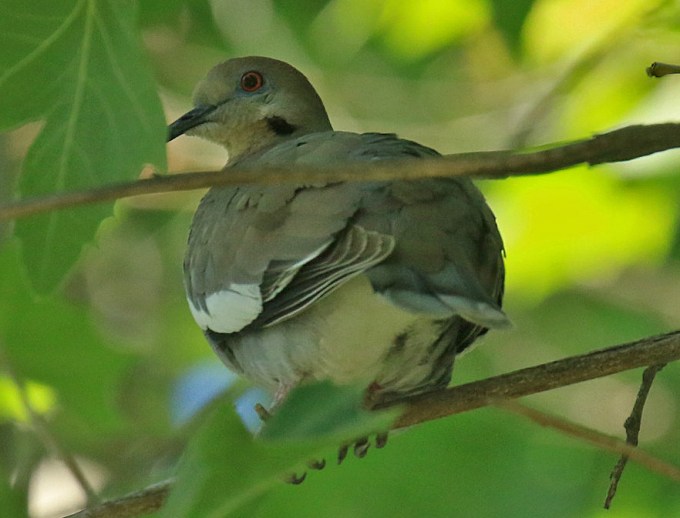
I am going to try to mesh two different stories here and it might not work so well, but doing so at least makes sense to me.  On July 6, Barry Brugman posted a plea for ID help on Tweeters, our local birding listserv.  He had found a “different shorebird” at Canyon Park Wetlands and after checking his photos and various guidebooks concluded that it was a Baird’s Sandpiper – probably.  He asked for others to review the photos and share their thoughts.  At first I concurred as at least in one photo the wings seemed quite long and it appeared noticeably larger than the Least Sandpipers with which it was keeping company.  This was pretty early for a Baird’s Sandpiper but there are exceptions to most rules especially as to when a species might first appear in migration.

I communicated my feeling to Barry, and he replied that he had a number of other responses to the same effect.  I shared the photo with birding pal Steve Pink and Steve thought that the faint stripe over the eye and absence of buffy color suggested instead that the bird was more likely a Semipalmated Sandpiper.  I looked at some of Barry’s other photos and my various field guides and started leaning towards that conclusion as well.  The best way to find out I figured was to go to the Wetlands and see for myself.  Especially since I had not yet seen either a Semipalmated Sandpiper nor a Baird’s Sandpiper this year, it was a no-lose decision.

I arrived at Canyon Park early the next morning and found the small flock of shorebirds that included 7 Least Sandpipers and another that now looked much shorter winged and somewhat smaller than I had concluded from the earlier picture.  The dark legs, straight bill and overall color and pattern confirmed that it was indeed a Semipalmated Sandpiper.  Steve may not always be right – but he usually is.  Glad to have him as a resource.

Semipalmated Sandpiper – Canyon Park Wetlands, July 7, 2017

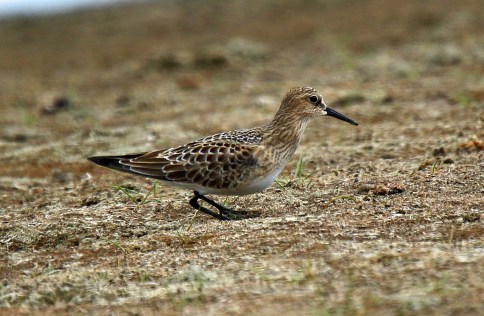
Baird’s Sandpiper for Comparison (Midway Beach August 20, 2015)

Baird's Sandpiper

I returned home, submitted my checklist with photos to Ebird, shared the info with Barry and Steve and then began work on a photo project organizing Washington bird photos in a Word document.  It was a laborious task as I had to select the best photo of each species and organize it in taxonomic order – no real way to short circuit the process.  Having almost 400 such species in my photos, it was going to take a long time – days.  I made progress and then put it away planning to return to the project the next morning.

And so I did.  By about 10:20, I had worked my way mostly through the shorebirds – the largest species group for me in Washington.  I had included my photos of Semipalmated and Baird’s Sandpipers as well as one that became very important – the Red Necked Stint that I had seen with George Pagos at Bottle Beach on July 22, 2013.  No more than three minutes after I had added the photo of the Stint and noted how poor it was, a message appeared on Tweeters from Ryan Merrill.  He and Adrian Lee were looking at a Red Necked Stint in breeding plumage at Crockett Lake on Whidbey Island.  It was barely 10:30 a.m.  I was sitting at the computer in my robe and had not yet showered,  I decided immediately that I had to follow Rule 1 for any chase: “Go Now!” – I advised Steve Pink of the find and he was an immediate co-conspirator.  He advised Ann Marie Wood and she was in also.  Not more than 30 minutes later – dressed and showered,  I had picked up Steve and got Ann Marie at the 128th Street Park and Ride and we were off.  It being a beautiful Saturday, we decided to take the longer route across the top of Whidbey Island and then down to Crockett Lake rather than risk a two hour wait at the much closer Mukilteo Ferry.

Red Necked Stint at Bottle Beach July 22, 2013

Red Necked Stint at Bottle Beach

The good news was that when we arrived at Crockett Lake – about 90 minutes later, and drove towards the Southeast end, we saw three birders standing at the lagoon’s edge with scopes out.  The bad news was that just as we arrived to join them (Ryan and Adrian and another), all of the shorebirds took off and flew away.  The Stint of course had been in the flock – had we really arrived two minutes too late??? Nope – Ryan found the bird about 125 yards away and we got scope views to at least confirm the ID for each of us – a new life bird for Ann Marie.  The even better news was that for the next 10 minutes, the Red Necked Stint worked its way back towards us and with the sun at our back, we had fantastic views and great photo ops.  At times the bird was less than 35 feet away.

The Stint is Out There Somewhere

Blair and RNST

Red Necked Stint – Crockett Lake – July 8, 2017 – a Much Improved Photo

Red Necked Stint 3


How great that Ryan and Adrian had found this very rare bird, that they had communicated its presence so quickly, that they remained at the spot and that the bird had remained for us as well!!  Over the next 90 minutes many other birders appeared on the site and got similarly terrific views.  Then just as another Edmonds birder, David Poortinga arrived, a Peregrine Falcon swooped over the water and scattered all of the shorebirds.  It had a pretty cool battle with a Northern Harrier which was fun to watch – but for the new arrivals, this was bad news.  Steve, Ann Marie and I left after another 10 minutes or so.  Later we learned that the Stint had returned to the same favored area and David got a great look at his life bird!

The coincidence was that I had just included that previous Red Necked Stint photograph in my project (now of course replaced with this far better one).  Interestingly though there were also many Semipalmated Sandpipers in the area and then the next day two Baird’s Sandpipers were found there as well.  Over the next several days, the Red Necked Stint remained in the same general area and was probably seen by more than 100 grateful birders including ones who flew in from Arizona and who knows where else just to see this Siberian species.

That was the first coincidence with two new birds for the year.  Another was coming soon.  It has been a great pleasure to get to know Bill and Deb Essman from Ellensburg/Kittitas.  We have shared great birding, fishing and jeeping times together.  On July 11, just a few days after the Stint trip, I was telling Deb about my Flammulated Owl experience near Liberty and she was telling me about a pair of Three Toed Woodpeckers they had discovered on Table Mountain.  Bill was also hankering for some fishing on the Yakima River so we agreed that I would come over and look for the Woodpecker and take Deb up to my Flammulated Owl spot (a life bird for her) and that Bill and I would go fishing the following day.  You ready for coincidence number 2?

Not more than 15 minutes after having worked out my visit to them, I got an Ebird alert that a White Winged Dove had been seen at a private residence in Selah, Washington – a bit more than an hour from where the Essmans live.  Some detective work determined that the Dove was coming to a feeder at the residence of Kevin Lucas – an excellent birder in the area and a birding acquaintance so I sent him an email inquiring about the possibility of a visit.  He very graciously responded with an invitation for the next morning.  Since I had plans to stay over for fishing, I could not drive anyone else, but I notified Steve and Ann Marie and they notified David.  I had seen (briefly and without any photo possibility) the White Winged Dove that had visited Butler’s Motel in Neah Bay, but it would be a new state bird for all of them – something hard to do for Steve.

I arrived at Kevin’s a bit after 8 on Wednesday the 11th.  His wife had seen the Dove earlier in the morning before she left but he had not seen it come down to the feeders yet – its normal activity.  About 15 minutes later, Steve, Ann Marie and David showed up.  We watched and waited and had a great visit with Kevin – marveling at his set up for taking photos and movies through his scope and also learning of his tracking activities including from a small plane.  But the Dove was a no-show.  Kevin took matters into his own hands and somehow managed to find the White Winged Dove perched in the close by large Sycamore tree – a favorite roost.  We all got good looks and decent photos – even with a branch partially in the way.  We also had a great look at a female Black Chinned Hummingbird that was almost too close to get in focus.

White Winged Dove

White Winged Dove1

Black Chinned Hummingbird Female

Black Chinned Hummingbird Female

A California Scrub Jay also made an appearance.  No longer rare in Yakima County, but not an everyday bird either.  Kevin made us all feel welcome and the White Winged Dove was a real treat.  I understand that many others have been to Kevin’s after us and the Dove put on a better show – but certainly we were thrilled with our views.  Depending on how a couple of “officially” non-countable birds are treated, this photo was species 400 in Washington.  But just to be “official” I am going to wait for one more to claim that distinction.  It is special for me in another way, though.  I am trying to get photos of every species I have seen in Washington.  Since some real rarities were seen many years ago before I began taking photographs, I don’t believe I will ever be able to reach that objective, but since this was one of those “seen but not photographed” birds on my list, I am getting closer.

So the White Winged Dove is the third great bird for this post.  It is also the second of the coincidences as well.  As I mentioned above, I first learned of the White Winged Dove observation barely 15 minutes after finalizing my plans to see the Essmans.  The coincidence is that Deb Essman had a White Winged Dove in her yard – and took a photo of it in June 2002.  There had been a couple of earlier historical records of White Winged Dove in Washington and a few more after that but having set the trip to come to the area and visit Deb moments before seeing the Ebird post for Kevin’s White Winged Dove certainly made an impression on me – another coincidence.

The fourth great bird also involves the Essmans as I followed their excellent directions to a spot far up Reecer Creek Road to the huge burn area on Table Mountain and hiked out on a jeep trail to look for their American Three Toed Woodpeckers.  The area is spectacular.  It is high above the Ellensburg valley at an elevation that Bill said is over 6000 feet.  Incredible views and beautiful flowers and scenery.  The fire burned many thousands of acres and the burned timber is a stark reminder of the danger and destruction from our too common wild fires.  But even the burned trees have their own silent beauty and there are already signs of rebirth as some young trees are emerging.

I did not find the pair of Three Toed Woodpeckers that joined the Essmans on their picnic lunch, but in the exact area that had been described to me, I found a single American Three Toed Woodpecker drumming in its unique patterned way in a grove of trees that had been spared by the fires.  It was my first record of this species for Kittitas County and my first for this year – number 298 in Washington.  So in this single day, I got much closer to two of my goals for the year – 300 species in Washington (for the year) and 400 species photographed in the state (lifetime).

American Three Toed Woodpecker – (Earlier Photo)

American Three Toed WP

But this already long day was not over.  At 8:30 p.m. I met Deb Essman and her friend Lana in the town of Liberty to try for night birds, especially a Flammulated Owl.  Per my previous blog post, I had located a Flamm here the previous week and came as close as I ever had to getting a photograph before two jeeps roared down the road and I had to move my car and myself and the owl that had been oh so close was afterwards oh so gone.  It had seemed to really like the spot and I was hoping that we would find it there again.

As I had done the previous week we drove to the top of the road and waited as the skies darkened.  It was after 9:30 when we heard our first Common Nighthawk and then got a visual as it flew over.  It was particularly fun to hear it “booming” several times.  Perhaps thirty minutes later I heard a distant Common Poorwill and then we all briefly heard what was probably the single hoot of a Flammulated Owl, but it would not respond or repeat so we dismissed it and moved on.  Slowly we worked our way down towards the spot where I had the interaction with the Flammulated Owl the previous week.  We heard more Nighthawks and then at least two more Poorwills, one of which called incessantly.  We arrived near “the spot” and parked – out of the way this time – and listened.  We were just above where I had the owl and there were two sharp calls from below – at the spot itself.  They were the alarm calls of a Flammulated Owl – almost cat-like.  We moved down the road and then began to hear first the single hoot and then the double hoot call of the Flamm.  There was no mistaking it.  We sparingly used playback and got calls in response but on this night the Flamm was just not going to move.  We remained another half hour and the little owl tooted intermittently and a Poorwill called continuously.  No photo tonight, but this was a life bird for Deb and Lana.  Very cool indeed.

When I saw Bill the next morning (not a whole lot of sleep for me after the owling and return to my motel) I asked if his wife had told him of her owl.  “She woke me up and was still high from the experience”.  Big smile on my face – that’s what it is all about.  Ryan had shared “his” Red Necked Stint.  Kevin had shared “his” White Winged Dove and the Essmans had shared “their” American Three Toed Woodpeckers.  Now I had somewhat returned the favor by sharing “my” Flammulated Owl.  Those possessives are only indicators of the observers who found the birds – there is no ownership.  I understand that in some birding communities, people do not share their experiences – keeping them for their own competitive reasons.  How sad and how wonderful that such is not the case here (again thank you Ryan, Kevin and Deb) – or at least usually so (and if someone reading this understands what I mean …well shame on you…)

Pend Oreille County and Hafer Road

For each of the last 6 years, I have made an annual pilgrimage to Pend Oreille County which has become not only a reliable spot for some special species but also just a favorite beautiful place in Washington.  The special birds are Bobolink, American Redstart, Red Eyed Vireo, Black Chinned Hummingbird and Northern Waterthrush.  All can be found elsewhere, but being able to reliably see all of them within a few miles of each other is a lister’s dream and a major reason for the trip.

These are great places to go in late May through late June for the shear diversity of species, the specialties and the beautiful scenery.  My visits have ranged from fantastic to fantastic plus plus plus.  The first visit was on June 9, 2012 on a WOS (Washington Ornithological Society) Trip led by Terry Little.  Terry knows every birdy spot in the county and he took us to all of them.  We had an amazing 114 species in our 10 hours of birding covering 100 miles.

The next year on June 5, 2013 George Pagos and I visited the area concentrating around Calispell Lake with Jon Isacoff – another expert who knows every spot and every bird.  In just 3 hours, we had 76 species on a gorgeous day.  The following year on June 18, I visited it alone and in 2015, Brian Pendleton and I visited the area on June 3rd.  Last year was another solo trip on June 16.  The weather was not as good and the species count was smaller, but the specialty birds cooperated.

This year my visit came later – July 1st – so I wasn’t sure if the birds would still be there or found as easily as some would be finished breeding and there would be less territoriality and accompanying singing.  My first stop was on McKenzie Road in Usk where the uncut high grass is home to a small population of Bobolinks.  I had barely reached the first field when I heard the Bobolink’s whistling, warbling, gurgling song.  One perched in the open for a so-so photo.  I continued around the bend in the road to Cusick where a Bobolink was much more photogenic.

Bobolink

Bobolink1

I then went south to Westside Calispell Road birding in general but specifically looking for some of the specialties.  I had seen American Redstarts and Red Eyed Vireos earlier this year so even though I saw and heard both, I did not work hard for photos.  Although there were many species of birds along my route perhaps due to the late date, they did not seem as active and responsive as in earlier visits.  Red Eyed Vireos were in the same tree I had them on a previous visit but even though they would sing, they remained high up in the foliage.  The same was true with the American Redstarts in another specific spot where I had them last year.  The Northern Waterthrushes at the Bridge were also actively singing but they darted about in the open for brief seconds only – disappointing for photos – okay for listing.  I include pictures of those species from previous visits and another blog post.

Red Eyed Vireo

Red Eyed Vireo

American Redstart

American Redstart Singing - Copy

Northern Waterthrush

Northern Waterthrush

Before getting to the Waterthrush bridge, I stopped at a small house with a hummingbird feeder that I had first seen on an earlier trip.  At least one male and one female Black Chinned Hummingbird were visiting.  It was private property so I did not go real close but I did get some OK shots.  As I was taking pictures a young man came out of a small house across the street and approached.  It is always potentially uncomfortable when taking photos near private homes, but this turned out to be fun.  He was the great grandson of the owner of the house with the feeder and many other relatives lived on adjoining properties – the original family homestead from early in the last century.

Black Chinned Hummingbird Male

Black Chinned Hummingbird

Black Chinned Hummingbird Female

Black Chinned Hummingbird Female

Not as many species as on earlier visits – largely because I had a long way still to go for other areas and was not real thorough but also because there just were not as many waterfowl as before and particularly there were not any Black Terns – a species I had missed the day before and hoped to have found at Calispell Lake.

Once during each of the last three years, I have stopped at Hafer Road in Stevens County on the way to Pend Oreille.  It is less than a mile long but it has proven to be one of the birdiest stretches of road for me – a must visit each year.  This was the case this year as well, even though I am writing out of order and covering it later.  In the past two years, in addition to just great birding in general, targeted species on Hafer Road have been Clay Colored Sparrow and Least Flycatcher.  Earlier reports this year had observations of the former but not the latter.  Fortunately I had seen Least Flycatchers in several places but the previous day I had failed to find a Clay Colored Sparrow on Stroup Road near Medical Lake where I have had them the last two years so this was a much wanted bird here.  There was concern however, because on the previous day a group of very good birders from the Tacoma area had visited Hafer Road and failed to find any Clay Colored Sparrows.  Uh-oh.

I had spent the night in North Spokane so I was less than an hour from Hafer Road.  An early start got me to the turn off onto the road at 5:30 a.m.  I immediately went to the grassy uphill field where I had Clay Colored Sparrows the past two years – no go.  But there was a second weedy field just a bit downhill and when I got there I immediately heard the buzzy song of the Clay Colored Sparrow – success!!  The sun was not high enough for good light on the field and the sparrows were not real close. They responded to playback but unlike in other years, they would not come close in for a visit and photo.  I was sure there were two birds and thought there might be some juveniles as well, but I could not get a good enough look for that ID.  (Photo from another visit.)

Clay Colored Sparrow (Hafer Road 2015)

Clay Colored Sparrow

Overall I spent about 90 minutes on this little stretch of road.  I had 42 species there including both Eastern and Western Kingbirds, Bank Swallows, a Sora (calling from the wetland below), a Black Chinned Hummingbird, Bullock’s Oriole, Say’s Phoebe, and a flock of 17 Wild Turkeys among others.  In the past three years, all told I have had 66 species here – an amazing spot.

Western Kingbird

Western Kingbird

Eastern Kingbird

Eastern Kingbird1a

Wild Turkeys

WIld Turkeys

California Quail

California Quail

A nice add on to this day was that Bruce Labar noted that I had reported Clay Colored Sparrows – which the group he was with had missed the day before.  I gave Bruce the specific location but told him that while they had been singing when I arrived at 5:30 a.m., they had stopped by 6:00.  I don’t know what time they revisited the spot the following morning, but they found 5 Clay Colored Sparrows there just where they were supposed to be – a life bird for some in the group.  Hafer Road had delivered yet again.

Afterwards I went to Pend Oreille County as described above and then returned to the Spokane area including another try for Black Terns – this time at the southwest end of Sprague Lake.  They were distant (except for one) and I did not have a scope, but I did find four – my only ones for 2017.  I ended that night doing a feeder watch with Jim Acton hoping that the male Rose Breasted Grosbeak that had been coming each day would return.  It did not that evening although it did the next two mornings (rats!!!) but Jim is a terrific birder with great stories about a lot of rarities he has seen over his many years of birding.  It was still a lot of fun.

Here are the birds seen at Hafer Road the past three years.

Hafer Road Birds 2015-17
American Coot Cinnamon Teal MacGillivray’s Warbler Song Sparrow
American Goldfinch Clay-colored Sparrow Mallard Sora
American Kestrel Common Raven Merlin Spotted Towhee
American Robin Common Yellowthroat Mourning Dove Tree Swallow
American Wigeon Eastern Kingbird Northern Flicker Turkey Vulture
Barn Swallow Eurasian Collared-Dove Northern Rough-winged Swallow Vesper Sparrow
Black-billed Magpie European Starling Pied-billed Grebe Violet-green Swallow
Black-capped Chickadee Fox Sparrow Pygmy Nuthatch Western Kingbird
Black-chinned Hummingbird Gadwall Red Crossbill Western Tanager
Black-headed Grosbeak Gray Catbird Red-breasted Nuthatch Western Wood-Pewee
Brown-headed Cowbird Great Blue Heron Red-tailed Hawk Wild Turkey
Bullock’s Oriole House Finch Red-winged Blackbird Willow Flycatcher
California Quail House Sparrow Ring-necked Duck Wilson’s Phalarope
Calliope Hummingbird House Wren Ruddy Duck Wilson’s Snipe
Canada Goose Killdeer Savannah Sparrow Yellow Warbler
Cedar Waxwing Lazuli Bunting Say’s Phoebe Yellow-headed Blackbird
Chipping Sparrow Least Flycatcher    

One Very Good Day – Three Mini-Posts

July 2, 2017 – This was a VERY GOOD DAY!!  The day before I had been birding in Pend Oreille, Lincoln and Spokane Counties and another blog post will share some of that experience – also a good day – but not as good as this one.  A prelude and then three separate fun experiences – each deserving of its own post – but each is pretty short so I am doing three mini-posts as part of this one.  But first – the prelude.

Prelude – A Night Bird in the Daytime

I had spent the night in Ritzville and for the first time in a while, I delayed departure in the morning until after the breakfast that was included in the rate.  I was heading to the Blue Mountains east of Walla Walla and would have preferred to get there not long after dawn, but I was already tired from too many miles.  Fortunately breakfast was available early and I was on the road by just after 6:15 a.m.  This brought me into Washtuchna just before 7:00 a.m.  A remote spot for sure, it has been a great place for rarities in migration.  Too late (or early) in the year for that now, but a fun surprise was waiting for me.  It was already 68 degrees in perfect cloudless sunshine.  As I drove through town a medium sized bird with long pointed wings flashed in front of me.  My first thought of American Kestrel was quickly replaced with a most positive identification of a Common Nighthawk when it banked right in front of me and the two white wrist bars flashed in the sunlight.

I pulled over, got out of the car and got my best photos ever of a Common Nighthawk in flight including the only one I have showing the tail splayed out showing the black and white terminal bands. I had seen them in the daytime before – but never this early in the morning.  It  sure seemed like a good omen for a great day.  Definitely a great prelude!

Common Nighthawk – Flight Shots

Common Nighthawk Flight1 - Copy  Common Nighthawk Flight - Copy

Common Nighthawk Flight2 - Copy

PART I – “When You Come to a Fork in the Road – Take It…”

This famous statement is generally attributed to Lawrence Peter Berra – better know as Yogi Berra.  He said he used it in giving Joe Garagiola directions to his home.  I decided to take this advice when I came to the end of Coppei Road just south of Waitsburg, WA.  The fork I chose was the North Fork Coppei Creek Road instead of the South Fork.  I had birded both in the past but my primary target this morning was a Green Tailed Towhee and I had seen them on this road before, so the choice was clear.  It is easiest to find this secretive bird earlier in the year when it is singing which it is not supposed to be doing now.  But its preferred habitat of a brushy slope with a rose like bush is a good place to start and I went to the exact spot where I had seen one before and immediately heard the Towhee’s buzzy trill and there went that supposition.  I tried some playback to see if I could get the bird to come into the open and closer to the road.  A second bird responded and the two continued to sing.  One flew from one buried hiding spot to another giving me a quick view, but that was going to be it.  I was still a very happy birder as it was not a given that a Green Tailed Towhee would be found.

Green Tailed Towhee (same area in 2015)

Green Tailed Towhee Singing

This was a great start.  Would my good fortune continue and another special bird of the area be found?  That would be the Great Gray Owl – now dispersed from its nesting sites so not likely but I had to continue the route and try.  No Great Gray Owl but I did have a “great owl” experience.  Birders often use the call of the Northern Pygmy Owl to bring in other species  – small birds that seek to mob the little owl – a united line of defense and a communication to all around that this little predator is in the neighborhood.  I had been seeing or hearing lots of birds as I continued up the North Fork Road.  I found a good spot that was full of bird song and pulled over.  Time to try the Pygmy Owl trick.  WOW!!  Birds responded immediately and more and more kept coming in.

It was an absolute riot – by far more individual birds and more species than I have ever had respond before – to wit:  8 Black Capped Chickadees, 2 Calliope Hummingbirds, 1 American Robin, 2 Cassin’s Vireos, 2 Western Tanagers, 2 Cassin’s Finches, 3 Chipping Sparrows, 2 Red Breasted Nuthatches, 1 Dark Eyed Junco, 2 Golden Crowned Kinglets and 2 Yellow Rumped Warblers.

Nine of the Eleven Species that Responded at Once to Northern Pygmy Owl Call

Chipping Sparrow  Calliope Hummingbird

Black Capped Chickadee Golden Crowned Kinglet

IMG_1231 Yellow Rumped Warbler

Red Breasted Nuthatch Cassin's Vireo1

Dark Eyed Junco

In its own way it was one of the most fun and enjoyable experiences I have had birding – 11 species and at least 27 individuals.  (Of course I would have traded them all for a single Great Gray Owl.)  I continued to bird in the area for a while and then it was time to move on – and that leads to Part II.

PART II – Around and Around and Around We Go…

Leaving the Blue Mountains I continued on past Walla Walla on Highway 12 and turned north on Nine Mile Road hoping to find a Ferruginous Hawk.  I have seen them on a nest on this road in the past and they had been reported there on Ebird.  When I got to the nest site, no hawks were in sight.  I did see several Lark Sparrows in addition to many dozens of Horned Larks (and some other sparrows) and my photo of the Lark Sparrow was my first for the year.

Lark Sparrow

Lark Sparrow 1

I had a vague memory of another possible nest site further up the road and headed in that direction.  This is a very dusty gravel road, remote and rarely traveled.  So I was surprised when I saw another car approaching with a trail of dust behind me.  This same type of thing will play out in Part III of this post later – with a far different result.

The driver was a birder, an excellent one – Matt Bartels.  It was not the first time that I have met up with him unexpectedly in the field.  I drive insane amounts during the year in my birding pursuits.  What is a number that is “insane times two”?  That is probably how many miles Matt drives each year on his County Listing pursuits.  And now we were about to add some more miles together as he had “definite” info on another nest site – which he said was a little further up the road.  Since my info was a vague memory and his was specific, I deferred and followed him – getting buried in dust.  This is only the short hand version but we continued up Nine Mile Road for more miles than I thought were to be traveled.  Two large birds flew up out of the grass and at first I thought Ferruginous Hawk, but instead we had two juvenile Great Horned Owls – siblings sticking together.

Great Horned Owl

GHOW1

We stopped and checked directions on Matt’s computer.  “This way”, he said “and I guaranty we will find them”.   So we thought we had crossed Johnson Road but somehow turned onto it and then onto Touchet North Road thinking it was Dodd Road.  But it wasn’t.  So we stopped again and at the next intersection, this time we did go onto Dodd Road – except this time it was actually Sims Road.  After a while, I thought something was off, so we checked again and made the correction, retraced steps and this time really were headed to Dodd Road via Gluck Road.  Again Matt said, the nest tree was at Gluck Road and Britton Road “and I guaranty we will find them”.  Plucker Road did lead us to Gluck Road – and an intersection with Britton Road – but being completely disoriented – which way to turn?  We decided to try left and again Matt gave the guaranty – this time for MANY Ferruginous Hawks.  By the way, we had seen NO trees anywhere along the way.  We had seen some nice Swainson’s Hawks on some power poles as we had approached Britton Road and then not too far off, we saw some trees – it HAD to be the place – and thankfully it was.  A single bird was perched and it was our targeted Ferruginous Hawk – then another hawk flew over and relatively close – and a few minutes later a third one flew by – much lighter than the first two – although all were the light morph forms.  When Matt guarantees something – you can count on it – well usually – and also usually on a more direct path.

Swainson’s Hawk

Swainson's Hawk

Ferruginous Hawk Perched

Ferruginous Hawk Perched

Ferruginous Hawks in Flight

Ferruginous Hawk 1 - Copy

Ferruginous Hawk Lighter - Copy

I promised Matt I would tell the story in the blog and now I have – and it was great to see Matt and the hawks were certainly there – and it was Washington species number 294 for the year – so definitely ok to see miles and miles (and extra miles) of wheat fields and gravel roads.  As I said in the beginning, this was a very good day.

Part III – “Close, Oh So Close”

The plan now was to bird some more spots in the area and then head north.  I had to be in Leavenworth the next morning so I thought I would stay in Cle Elum and bird the Liberty area that night looking for owls and woodpeckers.  I added some new birds for the trip but nothing unexpected or exciting and reached Cle Elum around 6 to check into the motel (getting the last room available) and then eat some fast food.  I have had good luck and good birds in the Liberty area but was particularly now interested in a Flammulated Owl – maybe even a photo op.

Flam’s would not be possible until it was dark so for the first two hours, I drove the main road through and then up from the town of Liberty – more dust for the car.  A White Crowned Sparrow was my first for the trip and there were many Chipping Sparrows and Swainson’s Thrushes.  Not too far from the town I heard a Great Horned Owl hooting.  Tanagers, Vireos and a number of Warblers were heard or seen. Pewees and other flycatchers were also found including one with a very long tail continually flicking its tail up.  Not a good look in the failing light and no calls so I am not going to attempt an ID.  I heard and then saw a couple of Townsend’s Warblers – again new for the trip.  Around 9:30 I heard my first “night bird” – a Common Poorwill in the distance.  A little later I heard the “peent call” of a Common Nighthawk and then another Poorwill.  I began playing the two-toot call of a Flammulated Owl as much to remind myself as to attract an owl.  No response but about 15 minutes later, with the memory of the call fresh, I was pretty sure I heard one off in the distance.  It was getting dark and it was time to get serious.

My approach is to stop every 1/2 mile and listen and play the call.  If no response I move on for anther 1/2 mile and try again.  As I approached the 4th stop (coming down) I heard a Poorwill and stopped in the middle of the road.  There had been no cars seen in the previous 2 hours and pull-offs were hard to come by, so I did not think much of it.  With the Poorwill still calling in the distance I heard an unmistakable two note call of a Flammulated Owl.  Not real close – but not real far either.  I started calling and it kept calling as well.  Without me seeing it in flight, the call that had been on the left side of the road (downhill side) stopped and then started up again on the right side – uphill – a little closer.  Then it was on the downhill side again – and closer still.  This continued for 20 minutes and now it was definitely very close.  Using my spotlight, I scanned the two close trees on the downhill side that were right next to the road and I was sure I was going to find the owl and I had my camera ready.  It was the closest I had ever been and this owl was the most responsive I had ever had.  I have wanted this photo for SOOOOO LONG.  And then…

Just as earlier when I saw a car coming up on me in the remote area when I was looking for the Ferruginous Hawk, in the distance I saw the lights of a car coming down the road toward me.  It was maybe 1/2 mile off but there was going to be no way for it to get by without me moving my car.  I could take a chance and hope it was a birder who would stop (if only it was Matt again!!!) and continue to try for the owl.  But it could just as easily be some crazy roaring down the road and I could be in danger.  I flashed my spotlight to warn the oncoming vehicle and then decided I  had to move my car.  I found a spot to just barely pull over enough for another car to come by.  It was maybe 30 yards down the road.  The other car came roaring by – slowing a little but definitely not a birder.  Then a second vehicle came.  Maybe three minutes had passed since I was within moments of getting that prized look and photo.  And the owl was still calling – but it was now way down the valley.  I tried playback again.  Now there was no movement.  I repeated and repeated again – nothing.  I waited five minutes – still nothing.  I was left to wonder what would have happened if I had been off the road, or if there had been no other car, or if it had come 30 minutes later.  I will never know.  I could either cry or laugh.  I decided to laugh – close, oh so close would have to do.  I will be back and will try again.

Flammulated Owl – Sadly Not my Photo

Flammulated_Owl_b53-2-009_l

It had been a very long and a very good day.  Saying it again – great places, great birds, great people – got them all and a couple of good stories as well.  Sign me up for more.

And an added note:  earlier I heard another series of hoots that I am sure was an owl.  It was closer to Liberty than the top of the road.  I could not make a positive ID but it was more similar to Spotted Owl than anything else.  There are Spotted Owls in the area.  I had found one at a “secret spot” in the area in 2013.  Maybe it was – maybe it wasn’t.  Certainly not going to report it or count it.  But when I go back – I will keep listening.

Hitting One of My “Double Zero” Goals – A “Biggish” Day

I enjoy being almost anywhere there are birds to be seen and at almost any times that work well for seeing them.  The nature observer aspect of birding is challenging and rewarding – and to repeat – enjoyable.  But there is definitely a part of my personal make-up that responds to the chase, the hunt, the planning and execution that comes with targeted pursuits – in birding and in other activities.  Having goals has always been a part of my life – some attained and many more not – and even if attained – finding new ones or changing the old ones to find something new or something more or better – defining that differently than perhaps someone else would – but in a way that works for and has meaning for me.

As I have written earlier, this is not going to be a Big Year in Washington – been there, done that, loved it – but now I want and need to look more to other aspects of my life, other people, other activities and other needs.  BUT…I cannot imagine a birdless year and I still want the organization, thrill, enjoyment and sense of accomplishment that comes with setting, pursuing and hopefully meeting goals.  Not the single goal of a Big Year but of several others – arbitrary perhaps but tied to numbers that at least provide some perceived unique quality – because they have two zeroes at the end – multiples of 100 and somehow that makes them more “special” to me and maybe to someone reading this post.  I have set a lot of Double Zero goals for the year.

An earlier post outlined how I hope to reach one of those Double Zero goals – the one with a 3 and two zeroes – seeing 300 species in Washington this year – a far cry from earlier true Big Year pursuits of up to 365 species in a year – but respectable and motivating.  My last post included the realization of one of my other Double Zero goals – the 200 goal – finding life species number 200 in Kittitas County – accomplished with the observation of an Anna’s Hummingbird at the Hyak feeders at Snoqualmie Pass.   That last post dealt mainly with 4 Edmonds birders looking for some rare birds in Yakima County and in the process observing almost 90 species for the day.  This post is about pursuit and attainment of the first of the Double Zero goals – the 100 goal – finding at least 100 species in Washington in a single day.  It was set as a goal some months ago, but the success of that trip with my Edmonds friends motivated me to get out and give it a try this past Saturday.

Even though I think some additional stops and focus on that earlier trip might have gotten us to 100, this time I would be on my own and thus would not have Steve’s knowledge, Frank’s great ears, Ann Marie’s good eyes (and stellar record-keeping),  and also we had seen some really good birds on that earlier trip that were not guaranteed this time.  So in planning my pursuit I decided to repeat most of that earlier route but adding some new spots that would increase the odds of hitting that magical 100 species.  First and foremost that meant some close to home birding in hometown Edmonds – particularly at the waterfront where there would be the chance of birds not possible east of the mountains.

On a whim, I made a first stop at Yost Park – less than 1/2 mile from my house.  Maybe I would get lucky and hear the morning serenade of the resident Barred Owls even though it was now way past breeding season and the only Ebird report of one there this month was from June 3.  My whim was immediately rewarded at 4:40 a.m. when the song of a Black Throated Gray Warbler greeted me as soon as I opened the car door.  It was a species not seen in that 90 species day.  Another new bird came almost as quickly – a Brown Creeper with its high pitched call notes.  I figured both Pacific and Bewick’s Wrens should be around and short plays of their songs resulted in both – coming up to the low growth near the parking area.  It had not yet been three minutes and I already had 4 new birds.  Could an owl be added as well?  It took a single call to answer the question.  I do a reasonably good “Who cooks for you” call and this one immediately brought a response and the Barred Owl flew from its roost near the tennis courts immediately over my head and then, chased by American Crows, down onto a tree in the forest below.  The Crows continued to harass it, and the Owl continued to call for the 10 minutes I remained there.  A Downy Woodpecker made an appearance as I got back into my car (another bird missed on that previous trip). A Great start!!

Yost Park Barred Owl – A Good Omen

Barred Owl

Yost Park was a spur of the moment add – and a bare 15 minutes into the day, I was already at 14 species.  Next was a stop at the Edmonds waterfront hoping for seabirds.  Unfortunately the tide was very high and the birds relatively few, but I easily added Heerman’s and Glaucous Winged Gulls, Pigeon Guillemot, Belted Kingfisher and Caspian Tern – 4 of which were not possible elsewhere on this day.

Heerman’s Gull

Heerman's Gull

The last planned stop was the Edmonds Marsh.  On a mini-scouting trip there the day before I had Virginia Rail, Marsh Wren, Killdeer and Purple Martin – none of which were seen on that previous trip.  No Purple Martin this time but the others were immediately heard and there were three other swallows species, a Great Blue Heron and both Mallards and Gadwalls – neither species a sure thing elsewhere.  I had now been birding about an hour and had seen 35 species – 14 not seen on the previous trip.  Time to head east.

As in the Edmonds Birders Go East trip, I made my Eastern first stop at Snoqualmie Pass.  The place was alive.  I heard an Olive Sided Flycatcher as soon as I got out of the car and then quickly added Swainson’s Thrush, Yellow and Townsend’s Warblers,  Pine Siskins, Rufous Hummingbird, Chestnut Backed Chickadees, Northern Flicker and Brown Headed Cowbird.  Eleven new species for the day and one more that had not been seen on the previous trip.  A quick stop at the Hyak Hummingbird feeders again added Anna’s HummingbirdNashville Warbler, Willow Flycatcher,  Evening Grosbeak, and Common Raven.  Nothing new from the earlier trip but now I was at 50 species – half way there.

Evening Grosbeak

Evening Grosbeak

My next stop was to be Bullfrog Pond – a favorite place and one not visited on the previous trip.  As usual Bullfrog Pond delivered well.  37 species were seen in the hour spent there including 18 new for the day and 5 that had not been seen on the earlier trip (Williamson’s and Red Breasted Sapsuckers, American Dipper, Gray Catbird and White Breasted Nuthatch).

Gray Catbird

Gray Catbird

On to another favorite place, the nearby Railroad Ponds in South Cle Elum – also not visited before.  Thirty-one species were seen – 9 more new for the day and two not seen previously (Purple Finch and Bank Swallow).  A special observation was an adult Pileated Woodpecker feeding a juvenile.

Pileated Woodpeckers

Pileated Woodpeckers

Purple Finch

Purple Finch

The day count was now at 77 – three quarters of the way there – with lots of birds new from the earlier trip – looking good but many of the great birds from the last trip were not guaranteed – part of the fun.  An Osprey on I-90 made it 78.

On that earlier trip, we had not spent much time looking for Shrub/Steppe birds.  I decided to bird Durr Road on this trip to look for some.  It was a good decision – only six species seen but 5 were new for the day and two – Vesper Sparrow and Sage Thrasher had not been seen on that other trip.  83 species and counting.  By the way – great views of Mt. Rainier and the Stuart Range – always enjoy them and this time I remembered to take pictures.

Vesper Sparrow

Vesper Sparrow1

Views from Durr Road – Mount Rainier and the Stuart Range

IMG_0875

IMG_0877

The next couple of hours repeated the previous trip – Umptanum Road with a stop at the parking lot for the Umptanum Falls trail, North Wenas Road with a stop at Bluebird Box 7 to look for the Calliope Hummingbird and then to Maloy Road hoping the Least Flycatcher remained and to the Wenas riparian area hoping the same for the Indigo Bunting before heading on to the Wenas Campground area.

Nine species new for the day were added before getting to Maloy Road with the only new one from before being a Cooper’s Hawk.  But no Chukars or Townsend Solitaire this time – so two misses.  Now at 92 species – more than seen on the entire previous trip – thanks primarily to those early Edmonds birds.

Western Tanager

Western Tanager

The Least Flycatcher was che-bekking loud and clear at Maloy Road – even had a peek-a-boo view but did not try for a photo considering myself fortunate to get one on the earlier trip.  On the way in to the Wenas Riparian area to look for the Indigo Bunting, I had a fun sighting of both an Eastern and a Western Kingbird within maybe 30 feet of each other on a wire.  Both were new for the trip and the former had not been seen on the earlier one. Now at 95 species.

Eastern and Western Kingbirds

When I got to the Indigo Bunting spot, two birders were looking into the Cottonwood where we had seen it before.  I heard it singing and with some joint effort we got decent views (No. 94).  Another birder arrived and we got him on the bird, too.  I shared directions to the Least Flycatcher, and then proceeded to the Wenas Campground.  It was pretty slow there in the rising heat of the day, but I added another 6 species for the day and had now hit that “magical 100 species”.  The only species not seen from the earlier trip was a Gray Flycatcher.  Before we had heard Red Crossbills and this time I got a photo of one – although I had misidentified it as an odd colored House Finch when I first saw it.  A pair of Black Headed Grosbeaks were particularly photo worthy

Red Crossbill

Red Crossbill


Male and Female Black Headed Grosbeaks

Black Headed Grosbeak  Black Headed Grosbeak Female

On the way back out, I stopped again for a last look at the Indigo Bunting and tried to lure it in with playback.  I was now closer to the yellow gate and could hear it singing.  No response.  On a whim, I tried the Lazuli Bunting call, and the Indigo Bunting immediately flew right at me and perched up for a good photo.  Hmmm?

Indigo Bunting

Indigo Bunting

This trip had originally had multiple goals – 100 species for the day but also importantly a try for Black Backed and Three Toed Woodpeckers at Bethel Ridge.  I had located nests for each there in years past but had seen neither this year on two tries.  Paul Baerny had both last week and I had his directions.  Brian Pendleton was already there looking for those species.  I was optimistic.  Getting there included the road past Wenas Lake and through good agricultural habitat and a stop at Oak Creek Canyon (as on the previous trip).  Surprisingly perhaps, the trip down Longmire Road produced the only Black Billed Magpie and American Kestrel of the trip.  There were Canada Geese on Wenas Lake and my only California Quail nearby plus my first Western Meadowlarks and Brewers Blackbirds.   I was now at 106 species.

At Oak Creek Canyon I got my biggest and most pleasant surprise of the trip.  About a quarter of a mile in, a medium sized flycatcher flew down form the uphill area to my right and into the canyon.  It had a grayish head with a crest, was pale yellow below with a reddish tinge to the tail and a distinct ASHY THROAT.  I saw another one later.  These were my first Ash Throated Flycatchers of the year.  They had been reported from the Canyon earlier but I had looked for them and missed them twice including on our Edmonds Goes East trip.  I figured they had departed and had no thought that I would see one – in fact stopping there only for the Lewis’s Woodpecker and a Lazuli Bunting (which I had somehow not yet found) plus a hope for White Throated Swifts – seen here on that earlier trip and maybe Canyon or Rock Wrens.  No Swifts or Wrens, but I had two Lewis’s Woodpeckers, a Lazuli Bunting and remarkably those Ash Throated Flycatchers.  Now at 109 species.

Ash Throated Flycatcher

Ash Throated Flycatcher 1

I got to Bethel Ridge much later than I had planned and should have tried earlier.  It was hot and mostly quiet.  No Black Backed Woodpecker, and unlike the previous trip – no White Headed Woodpecker.   As I got up to the area with the big burn towards the top near where the Three Toed Woodpecker had been seen, I saw a Woodpecker fly onto a tree trunk and my hopes soared.  Hard to be disappointed with a beautiful male Williamson’s Sapsucker but it had one toe too many.  Just before that I had my only Clark’s Nutcracker for the trip (and only my second of the year).

Clark’s Nutcracker

Clark's Nutcracker

Williamson’s Sapsucker

Williamson's Sapsucker

At that point I heard a familiar voice – Brian Pendleton was there with spouse Darchelle.  They had looked for hours for the Three Toed Woodpecker without success.  We joined forces and found beautiful wildflowers, views of Mt. Adams and Mt. Rainier, Hairy Woodpeckers, Rock Wren, Townsend’s Solitaire and Hermit Thrush – but no woodpeckers with three toes.

Hairy Woodpecker

Hairy Woodpecker

Townsend’s Solitaire

Townsend's Solitaire

Rock Wren

Rock Wren

Mt. Adams

IMG_1132

Wildflowers

The five new for the day species brought the total to 114.  Clark’s Nutcracker and Hairy Woodpecker were not seen on the previous trip.  I had seen many elk and deer throughout the day including a very clumsy elk calf.  Coming down from Bethel Ridge, I came upon two striking bull elk with sizable racks.  I checked them out and they checked me out and they kept grazing.

Elk Calf

Elk Calf1

Elk Cooling Off

Swimming Elk

Bull Elk

Big Bull Elk

Back on Highway 12 on the way home, I stopped at Trout Lodge hoping for the Black Chinned Hummingbird that had been reported from the feeders there – no luck.  Later I had a Common Merganser on the Tieton River so my “Biggish Day” total was 115 species.  Maybe some day I will try a true Big Day and add stops, limit time at various spots, bird at night and hope for great luck.  I am sure that 145 species are possible even in late June.  Probably more are possible earlier – maybe many more either time.

None of my goals are noteworthy to anyone but me but maybe my stories of attempts to reach them recall attempts to reach different goals by others.  I think in fact that it is the collecting of “stories” as much as it is the collecting of bird observations that makes birding so enjoyable to me.  My goals help organize that collecting process – give order to the pursuits.  I have now accomplished two of my Double Zero goals for the year.  I am getting closer on some others and future blog posts will recount the stories that come from those quests – whether successful or not.

Species Seen June 24, 2017
1 American Crow Edmonds 59 Red-breasted Nuthatch Bullfrog Pond
2 American Robin Edmonds 60 Red-breasted Sapsucker Bullfrog Pond
3 Bald Eagle Edmonds Marsh 61 Red-naped Sapsucker Bullfrog Pond
4 Barn Swallow Edmonds Marsh 62 Red-winged Blackbird Bullfrog Pond
5 Barred Owl Yost Park 63 Turkey Vulture Bullfrog Pond
6 Belted Kingfisher Edmonds Waterfront 64 Veery Bullfrog Pond
7 Bewick’s Wren Yost Park 65 Warbling Vireo Bullfrog Pond
8 Black-capped Chickadee RR Ponds 66 White-breasted Nuthatch Bullfrog Pond
9 Black-headed Grosbeak Wenas Riparian 67 Williamson’s Sapsucker Bullfrog Pond
10 Black Throated Gray Warbler Yost Park 68 Yellow-rumped Warbler Bullfrog Pond
11 Caspian Tern Edmonds Waterfront 69 House Finch Cle Elum
12 Common Yellowthroat Edmonds Marsh 70 House Wren RR Ponds
13 Dark-eyed Junco Edmonds 71 Pileated Woodpecker RR Ponds
14 Downy Woodpecker Edmonds Marsh 72 Purple Finch RR Ponds
15 European Starling Edmonds 73 Pygmy Nuthatch RR Ponds
16 Gadwall Edmonds Marsh 74 Bank Swallow So. Cle Elum
17 Glaucous Winged Gull Edmonds Waterfront 75 Dusky Flycatcher RR Ponds
18 Great Blue Heron Edmonds Marsh 76 Red-tailed Hawk RR Ponds
19 Heerman’s Gull Edmonds Waterfront 77 Mountain Chickadee RR Ponds
20 House Sparrow Edmonds Waterfront 78 Osprey I-90
21 Killdeer Edmonds Marsh 79 Brewer’s Sparrow Durr Road
22 Mallard Edmonds Marsh 80 Mountain Bluebird Durr Road
23 Marsh Wren Edmonds Marsh 81 Western Bluebird Durr Road
24 No. Rough-winged Swallow Edmonds Marsh 82 Sage Thrasher Durr Road
25 Pacific Wren Yost Park 83 Vesper Sparrow Durr Road
26 Pigeon Guillemot Edmonds Waterfront 84 Eurasian Collared-Dove Umptanum Road
27 Rock Pigeon Edmonds 85 Mourning Dove Umptanum Road
28 Song Sparrow Edmonds 86 Say’s Phoebe Umptanum Road
29 Spotted Towhee Edmonds 87 American Goldfinch Wenas Road
30 Steller’s Jay Yost Park 88 Calliope Hummingbird Wenas Road
31 Tree Swallow Edmonds Marsh 89 Cedar Waxwing Wenas Road
32 Violet-green Swallow Edmonds Marsh 90 Cooper’s Hawk Wenas Road
33 Virginia Rail Edmonds Marsh 91 Western Tanager Wenas Road
34 Western Wood-Pewee Yost Park 92 Yellow-breasted Chat Wenas Road
35 White-crowned Sparrow Edmonds Marsh 93 Least Flycatcher Maloy Road
36 Brown-headed Cowbird Snoqualmie 94 Eastern Kingbird Wenas Riparian
37 Chestnut-backed Chickadee Snoqualmie 95 Western Kingbird Wenas Riparian
38 Northern Flicker Snoqualmie 96 Indigo Bunting Wenas Riparian
39 Olive-sided Flycatcher Snoqualmie 97 Gray Flycatcher Wenas Campground
40 Cliff Swallow Snoqualmie 98 Pacific-slope Flycatcher Wenas Campground
41 Rufous Hummingbird Snoqualmie 99 Red Crossbill Wenas Campground
42 Swainson’s Thrush Snoqualmie 100 Bullock’s Oriole Wenas Campground
43 Townsend’s Warbler Snoqualmie 101 American Kestrel Longmire Road
44 Willow Flycatcher Snoqualmie 102 Black-billed Magpie Longmire Road
45 Yellow Warbler Snoqualmie 103 Brewer’s Blackbird Longmire Road
46 Pine Siskin Snoqualmie 104 California Quail Longmire Road
47 Anna’s Hummingbird Hyak Feeders 105 Western Meadowlark Longmire Road
48 Common Raven Hyak Feeders 106 Canada Goose Wenas Lake
49 Nashville Warbler Hyak Feeders 107 Ash-throated Flycatcher Oak Creek Canyon
50 Evening Grosbeak Hyak Feeders 108 Lazuli Bunting Oak Creek Canyon
51 American Dipper Bullfrog Pond 109 Lewis’s Woodpecker Oak Creek Canyon
52 Brown Creeper Bullfrog Pond 110 Clark’s Nutcracker Bethel Ridge
53 Cassin’s Finch Bullfrog Pond 111 Hairy Woodpecker Bethel Ridge
54 Cassin’s Vireo Bullfrog Pond 112 Hermit Thrush Bethel Ridge
55 Chipping Sparrow Bullfrog Pond 113 Rock Wren Bethel Ridge
56 Gray Catbird Bullfrog Pond 114 Townsend’s Solitaire Bethel Ridge
57 Hammond’s Flycatcher Bullfrog Pond 115 Varied Thrush Bethel Ridge
58 MacGillivray’s Warbler Bullfrog Pond 116 Common Merganser Tieton River