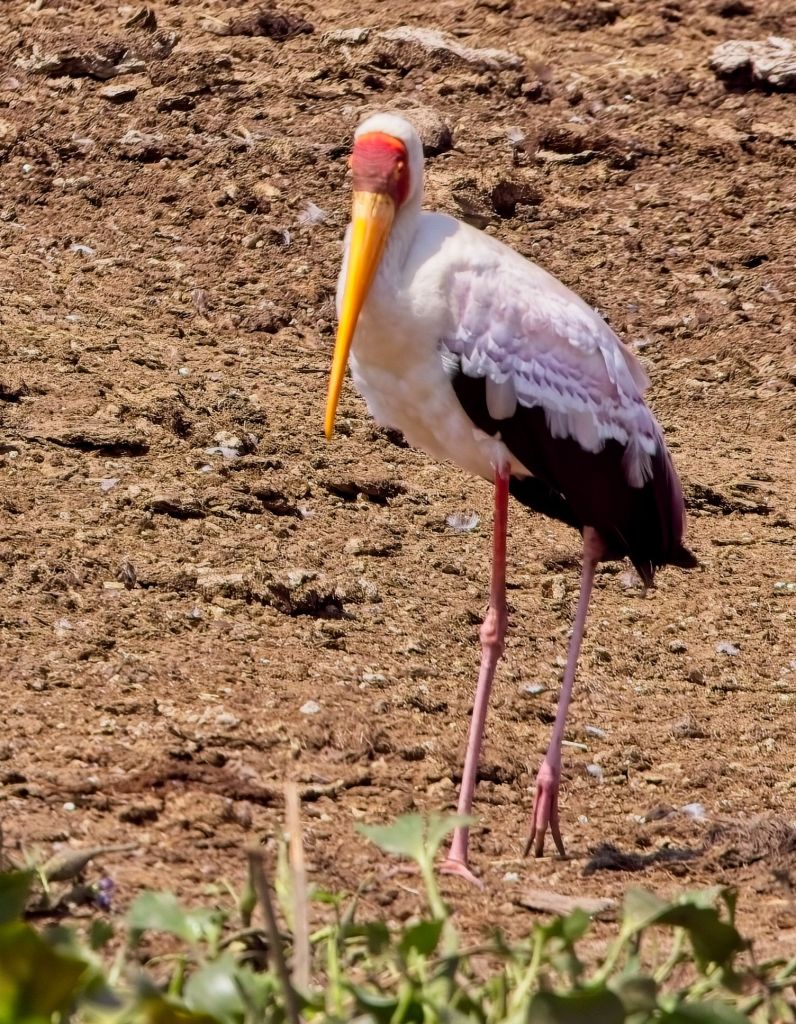
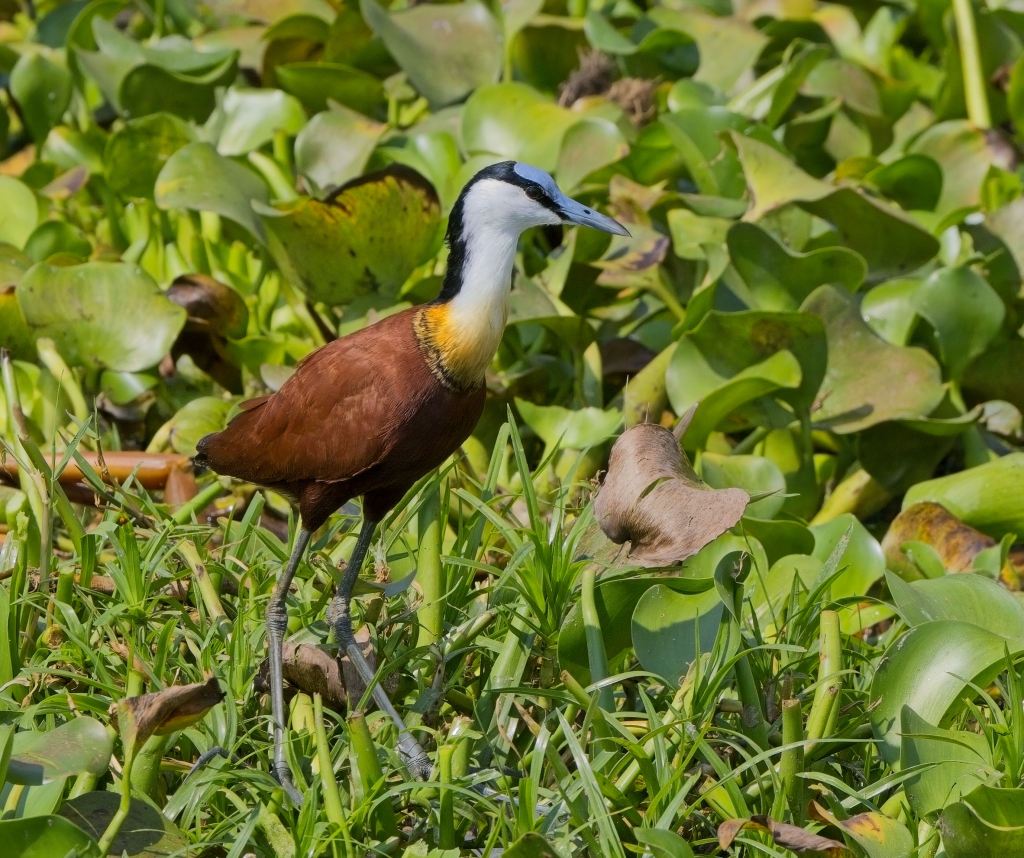
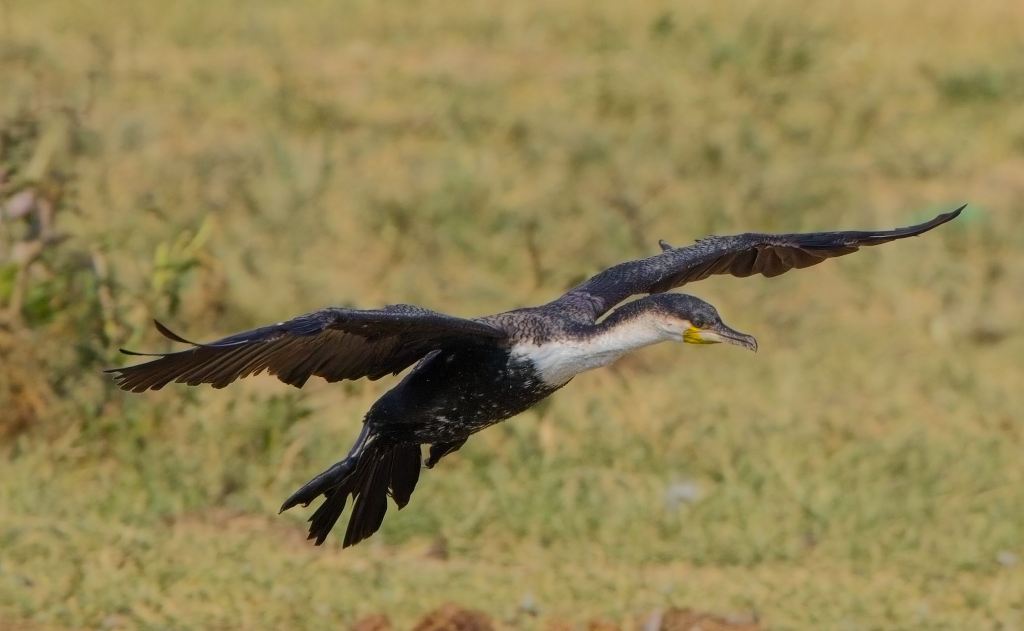
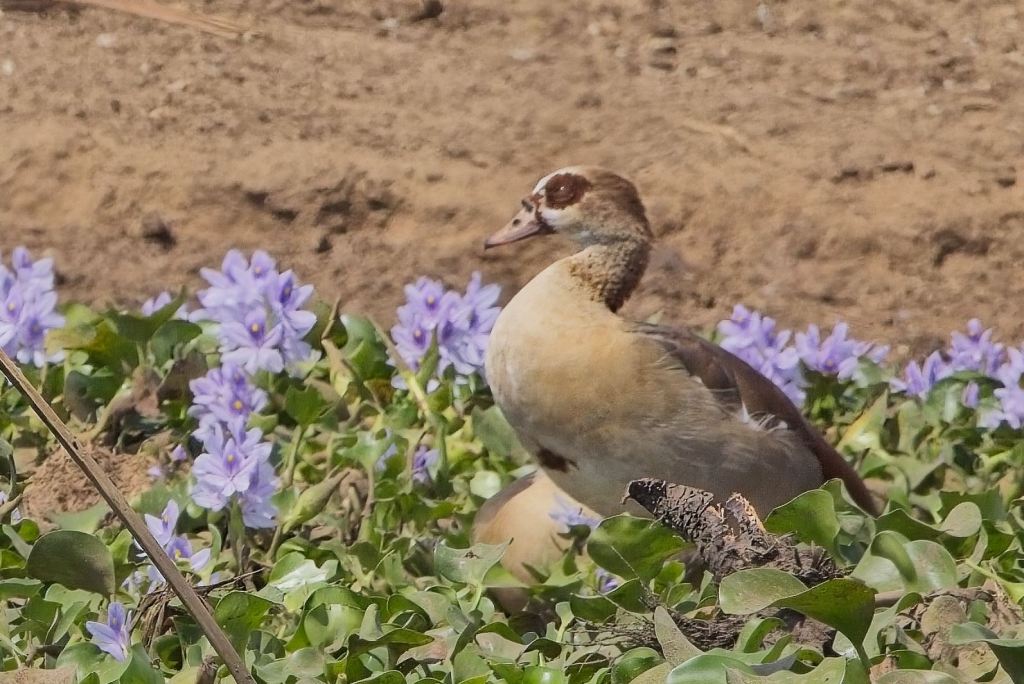
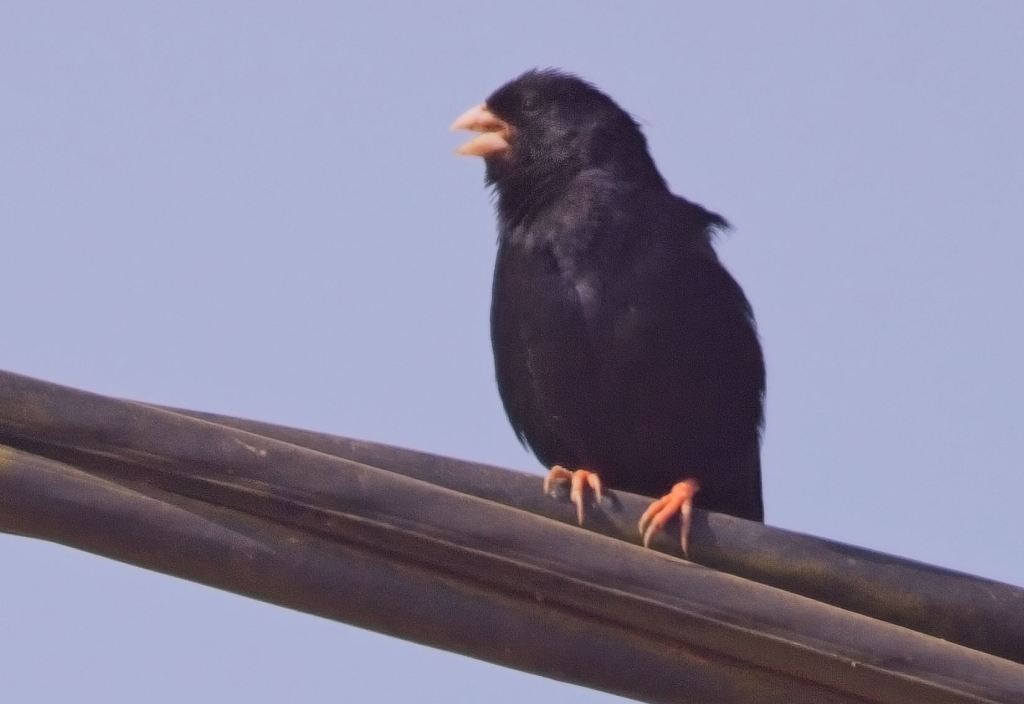
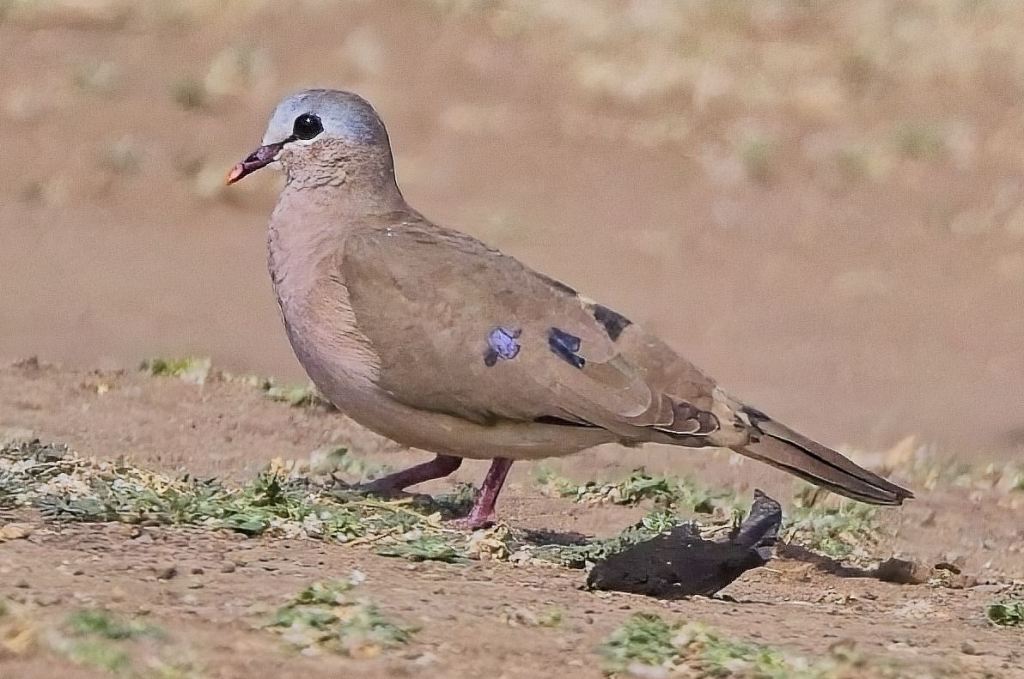
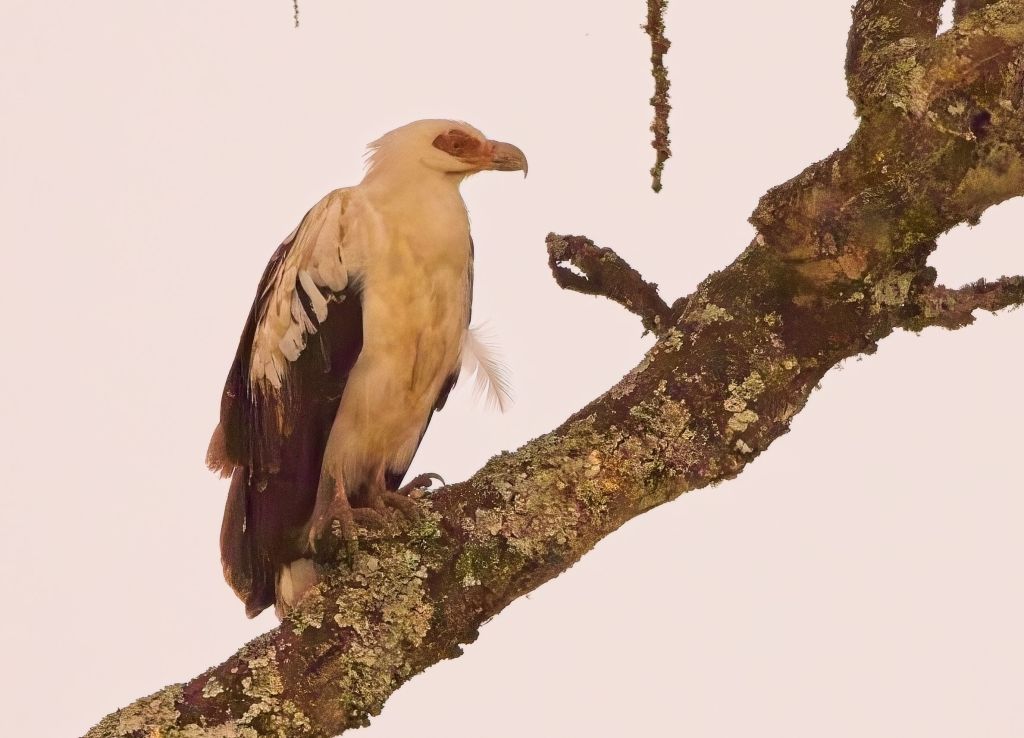
Queen Elizabeth II National Park – Birds and Mammals

June 23rd – Afternoon

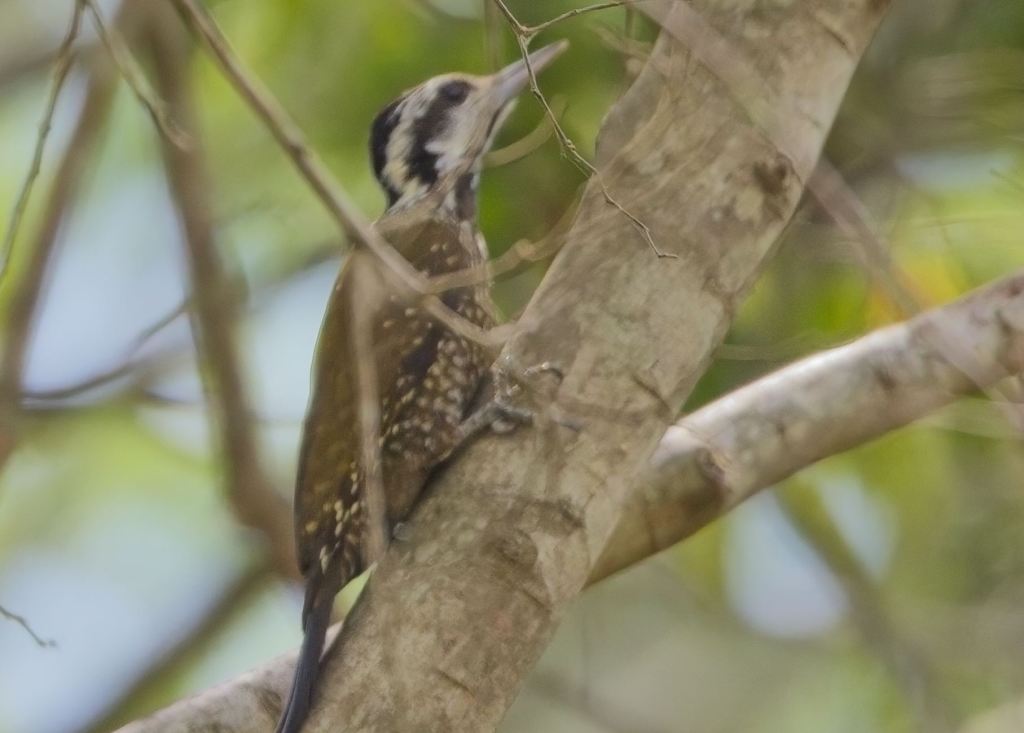
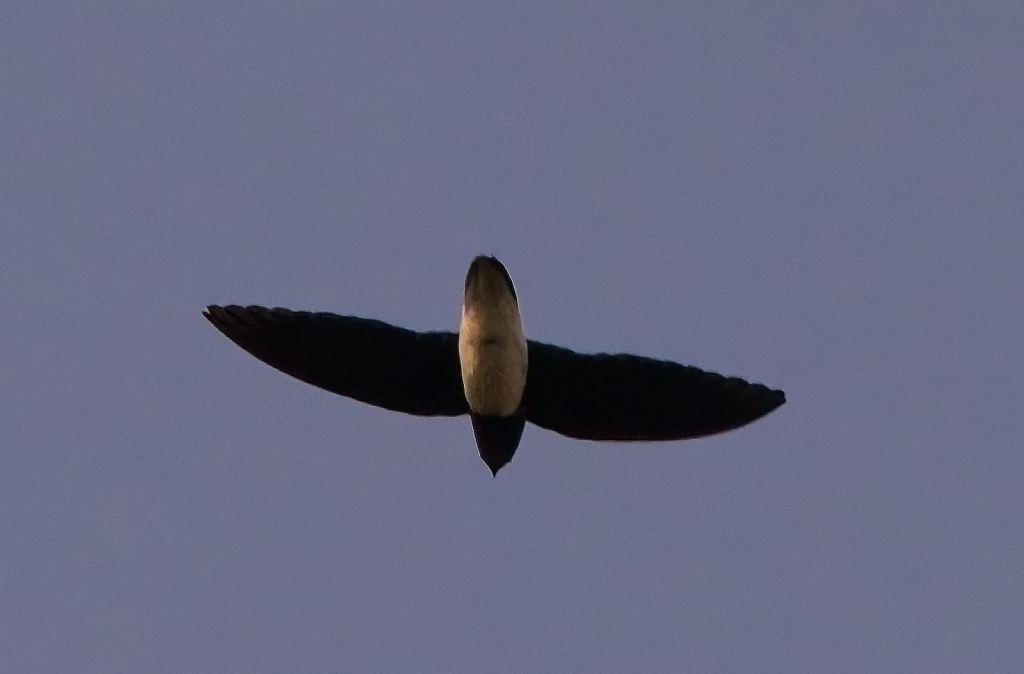
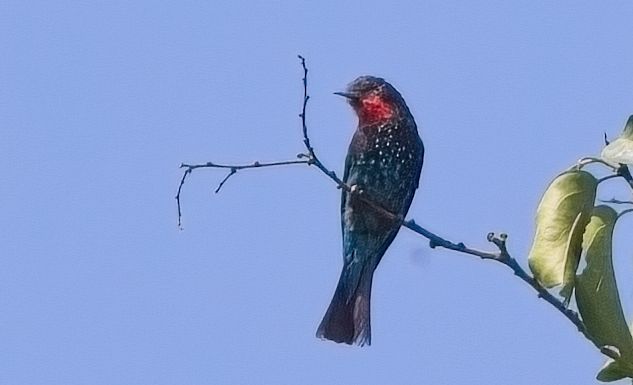
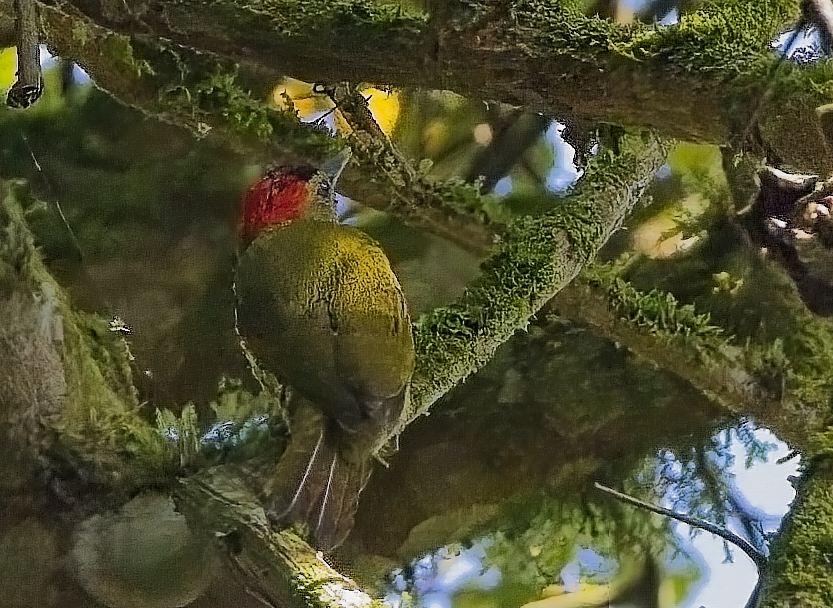
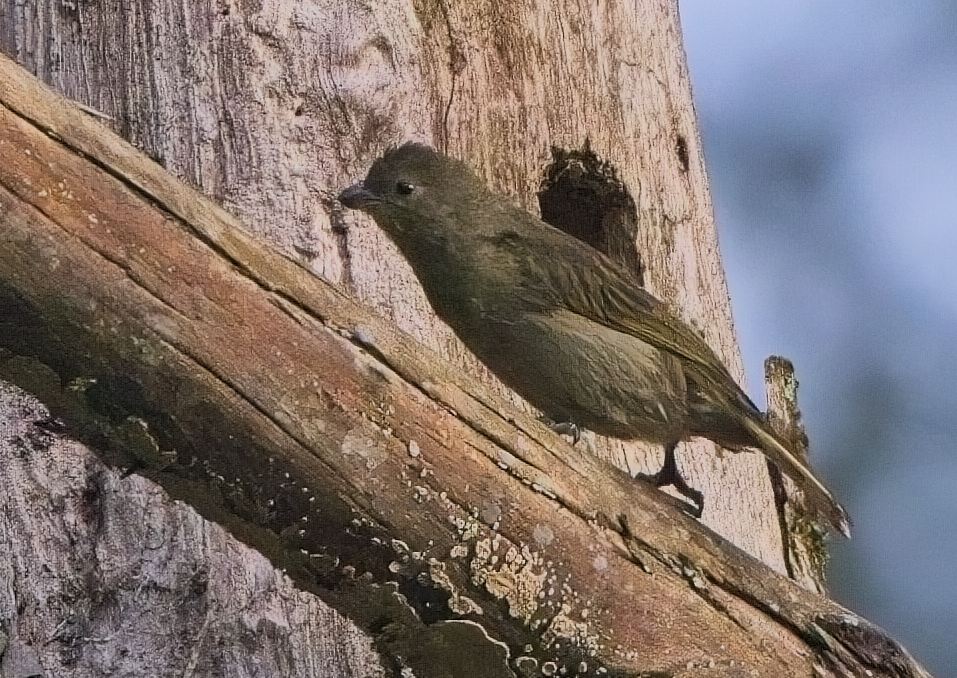
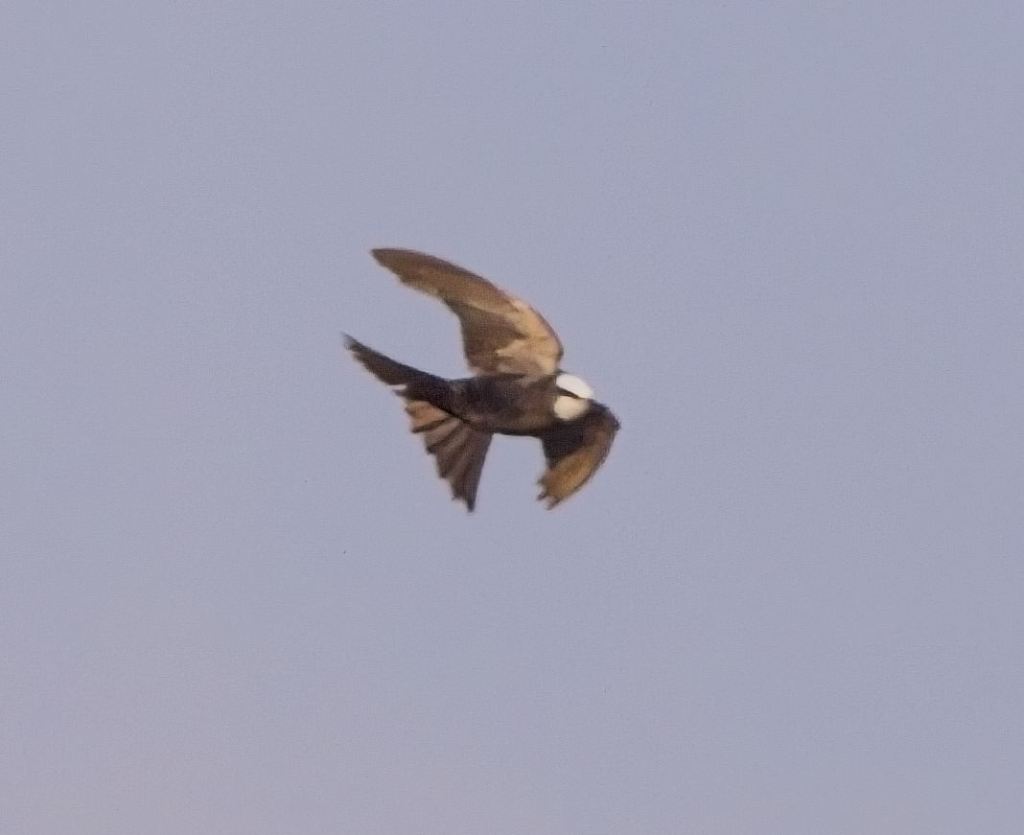
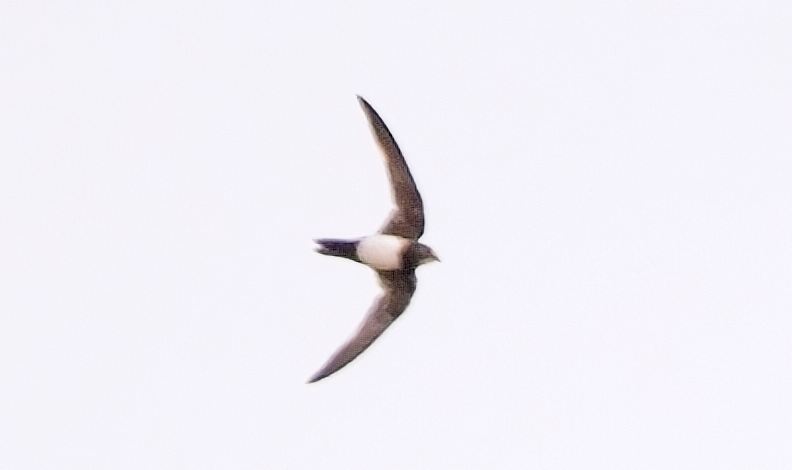
My last blog post ended with our arrival at Queen Elizabeth II National Park around noon on June 23rd marking the halfway point for our scheduled tour. My Uganda bird list stood at 294 species and we had had a taste of the big mammals of Africa. Both lists would grow starting with our first afternoon in the park which had 68 bird species. We were now mostly in habitat that we had birded before but the 6 new species brought our tour list to 300 and one of these was a much desired new lifer for me – Madagascar Bee-eater. Even better, both individuals we saw provided great photo ops. Two birds were also new life photos – Alpine Swift and Golden-crowned Woodpecker.

Madagascar Bee-eater – Lifer
Alpine Swift – Life Photo
Golden Crowned Woodpecker – Life Photo

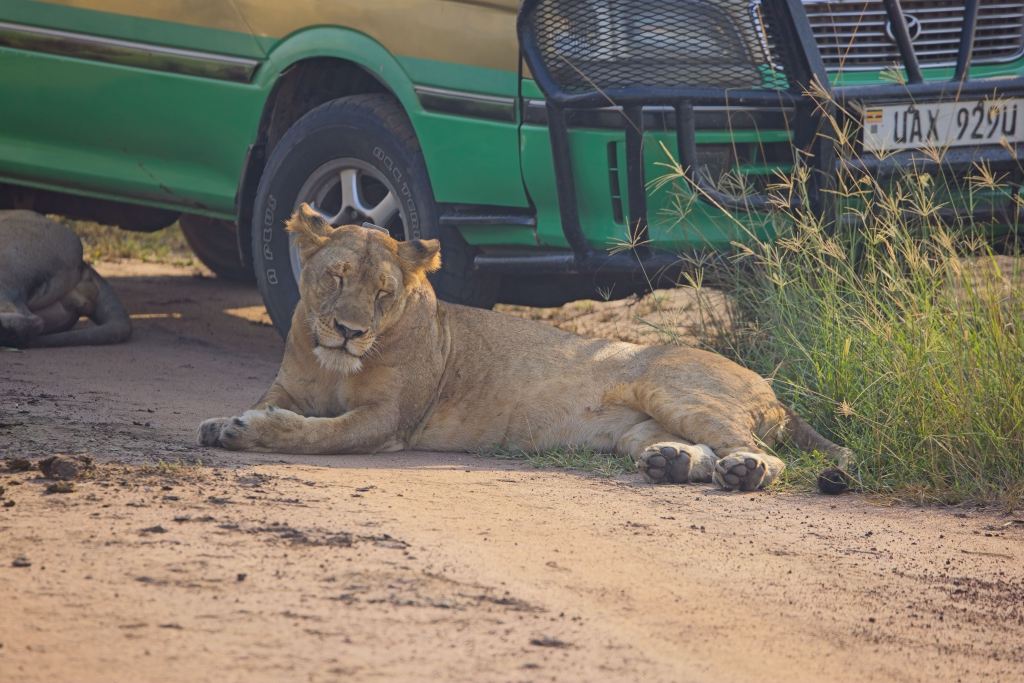
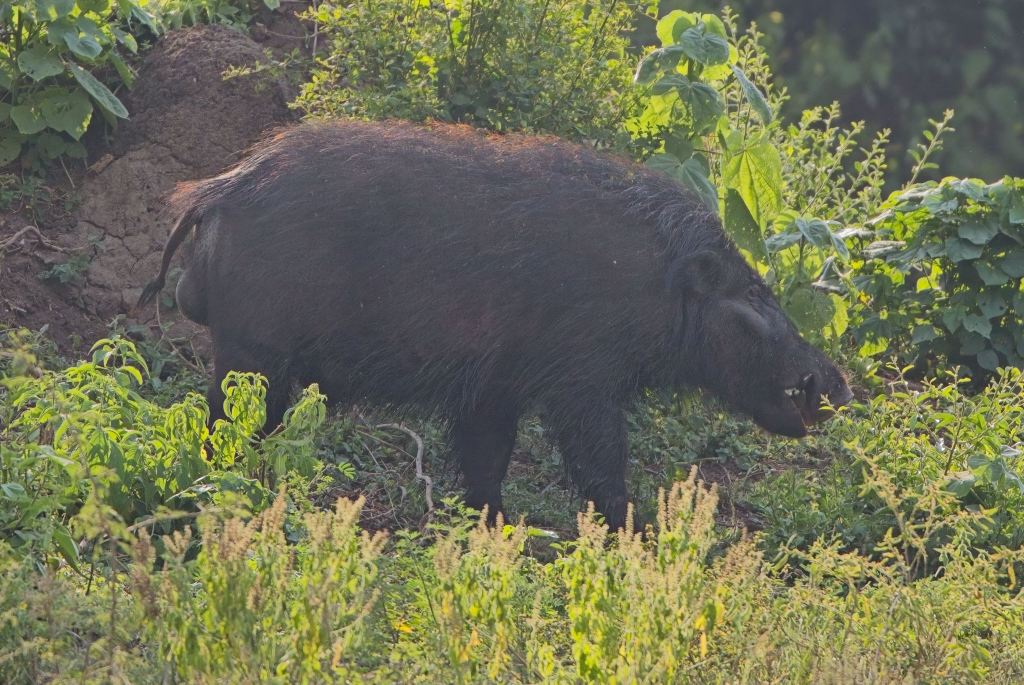
There were also several mammals of note although with one exception, our intersections with them would improve later in the park. It was here that we had our first Lions, our first Elephants, our first Uganda Kob and our first Giant Forest Hogs. The latter two were “life mammals”. We would see hundreds of Kob over the next week but the one small group of the Giant Hogs would be our only ones. The lions were surrounded by and immediately next to several vehicles – definitely not the natural setting you would want for any lion encounter. Fortunately we would have others including another on our last day in the Park and others much later at Murchison Falls on a night game drive.

Uganda Kob – Male – Life Mammal
Giant Forest Hog – Life Mammal
First (and fortunately not our last) Lion

June 24

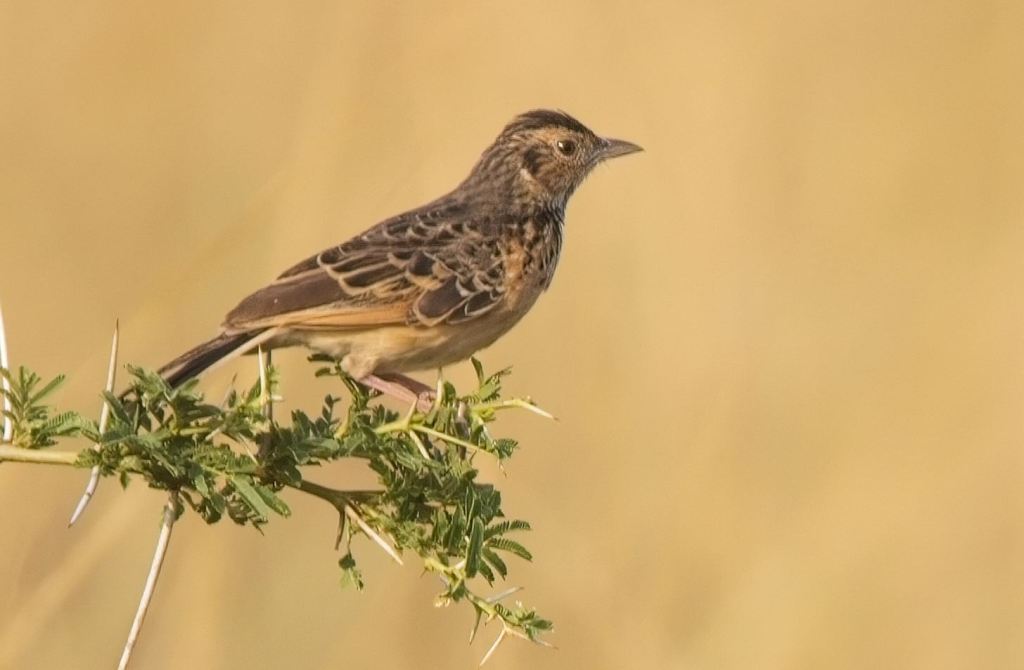
We stayed that night (and the next) at the Mweya Safari Lodge in the Park – comfortable with a great location overlooking the Kazinga Channel connecting Lake George and Lake Edward. As always service was great and every Ugandan we met was super. After an early breakfast, we were out in the Northern sector of the Park looking for new birds and for animals. In 4 hours we found 75 species, 15 new for the tour, two lifers for me and some life photos including two lark species – Flappet and Rufous-naped. It was a real challenge finding let alone photograhing the lifer Small Buttonquail in the grass. Unfortunately I was not up to the challenge of grabbing a photo of the lifer Banded Martin that flew quickly by us.

Small Buttonquail – Lifer and Very Challenging Photo
Rufous-naped Lark – Life Photo
Flappet Lark – Life Photo

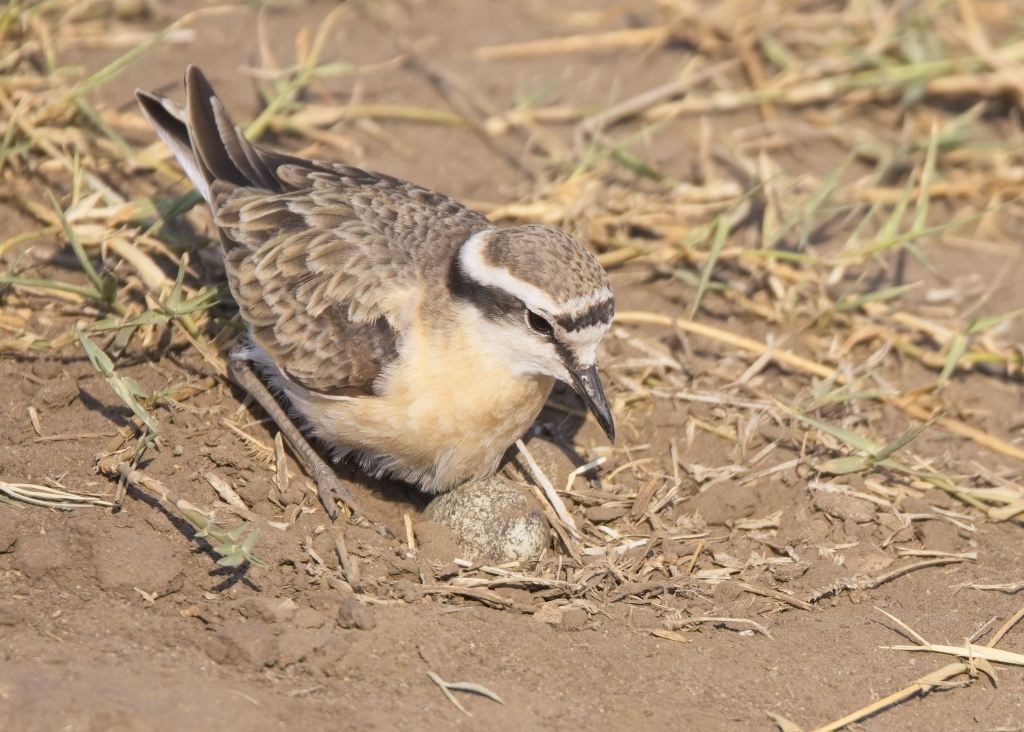
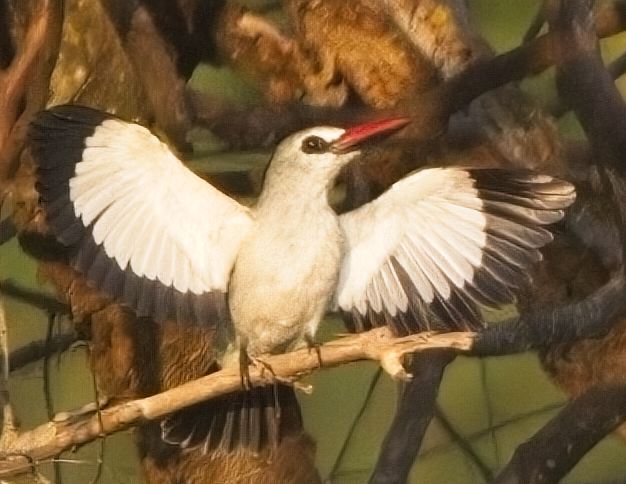
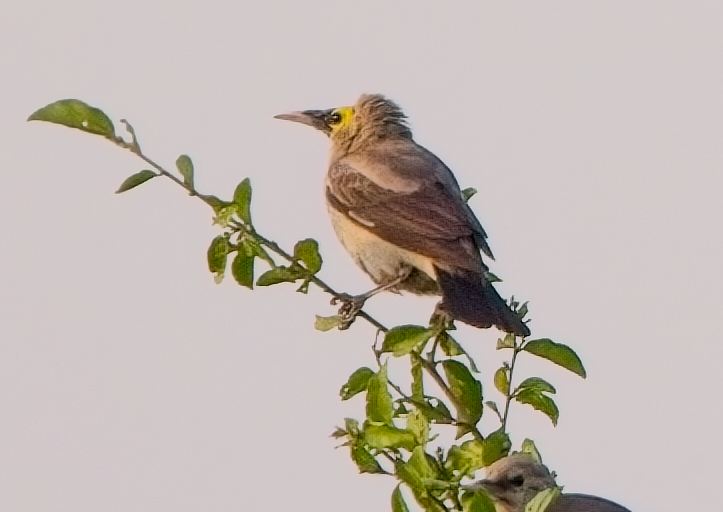
Although I had seen and photographed these species before, either earlier on this tour or during earlier tours elsewhere in Africa, some really fun photos were of a Village Weaver at our lunch stop, a nesting Kittzlitz’s Plover on an egg it its nest, a Saddle-billed Stork surrounded by Cattle Egrets, a Woodland Kingfisher with its wings spread and a Wattled Starling – just an odd looking bird.

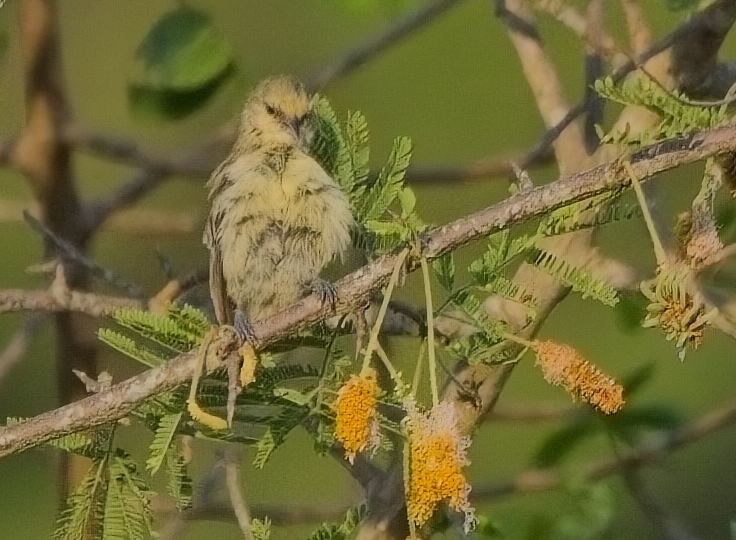
Village Weaver on Our Lunch Table
Saddle-billed Stork and Cattle Egrets
Woodland Kingfisher
Wattled Starling

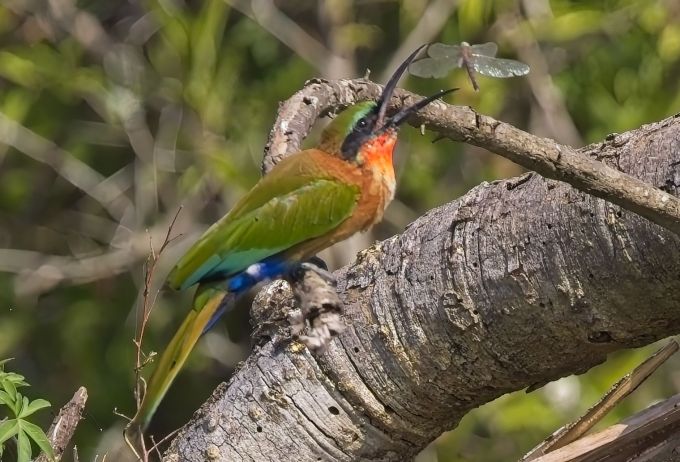
The morning had been great but our afternoon boat trip on the Kazinga Channel surpassed it and was definitely among the best parts of our entire tour. Combining bird lists from the morning and the afternoon, we had 107 species for the day with especially great looks at both mammals and birds on the boat trip that lasted 4 hours. As tours progress, it becomes harder to add new species, yet in addition to the 15 new Uganda species in the morning, we managed to add another 10 on the boat ride. Like in the morning, only two were lifers (both photographed) and another two were life photos, but there were unlimited photo ops for familiar species and our interactions with elephants and hippos were wonderful and photo-rich. The two lifers were African Skimmer and Red-throated Bee-eater and the additional new photos were Angola Swallow and Northern Black Flycatcher. Pure luck that I got the Bee-eater just as it was about to grab a dragonfly.
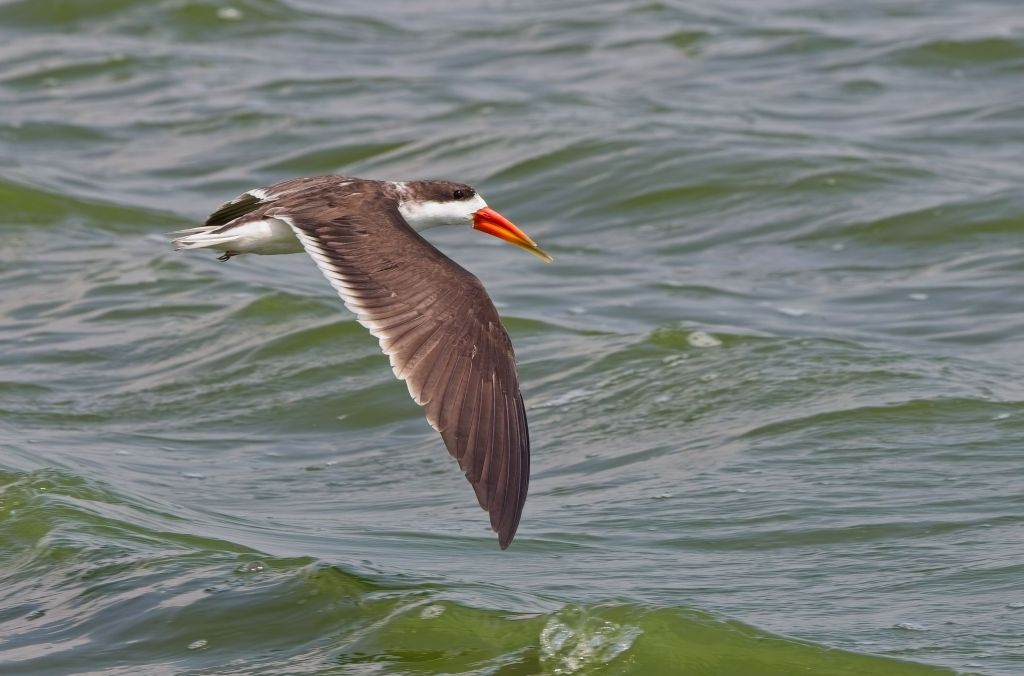
African Skimmer – Lifer
Red-throated Bee-eater – Lifer
Northern Black-flycatcher

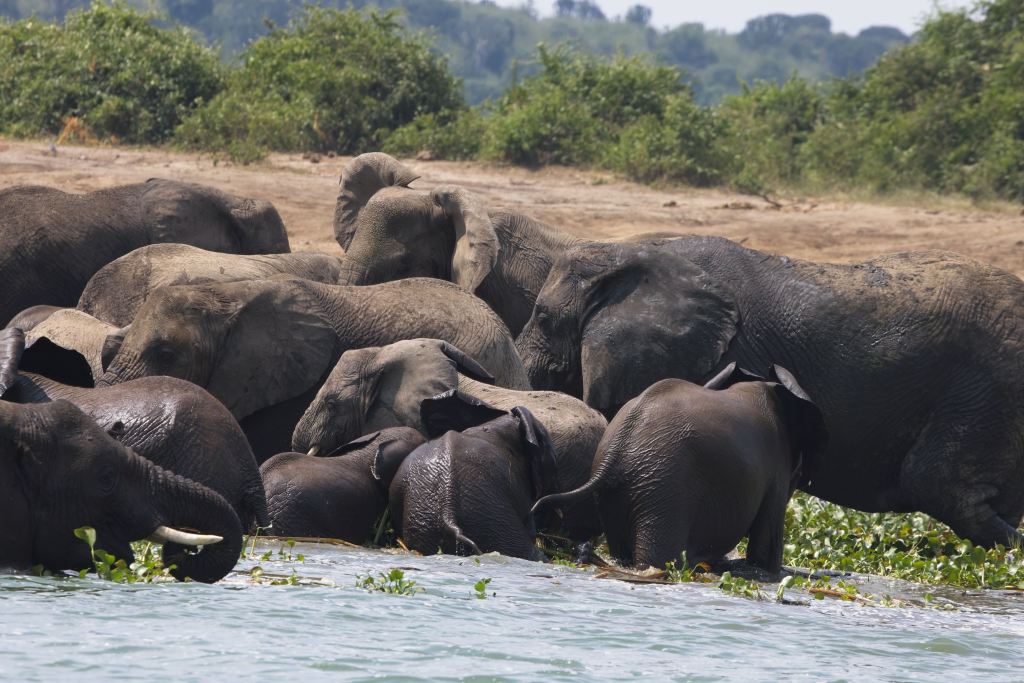
As we approached the dock to load onto our boat, we had a good if distant look at a large group of elephants directly across from us – with more than a hundred African Skimmers flying near and around them. It looked like they would stay as we made our way across the channel and they did, providing the photo above – and many more of the Skimmers – but more impressively some great views of the elephants as they devoured a floating island of vegetation. We watched them for 15 minutes with a number of them in various interactions – mostly friendly but in a couple of instances jostling for better access to the food.
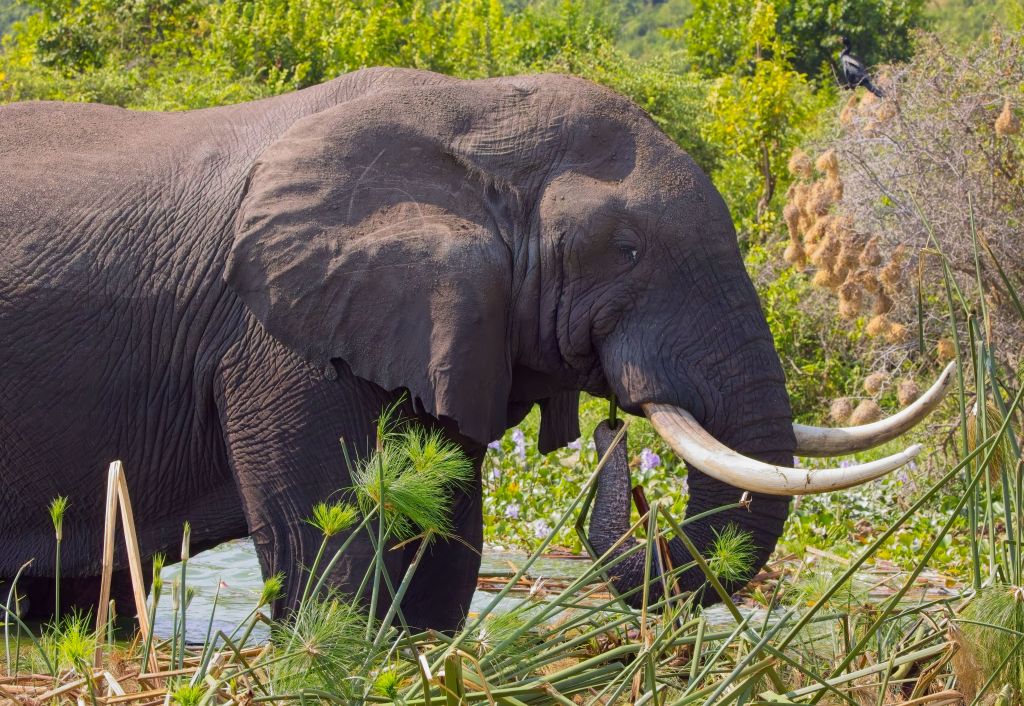
Big Tusker
Now That’s a Mouthful
Young Elephant in Deep Water (for him)
Feeding Free for All

As we were watching the elephants maybe 60 feet away from the boat to our left, we were being watched by several hippos about the same distance way to our right.

Spying Hippo

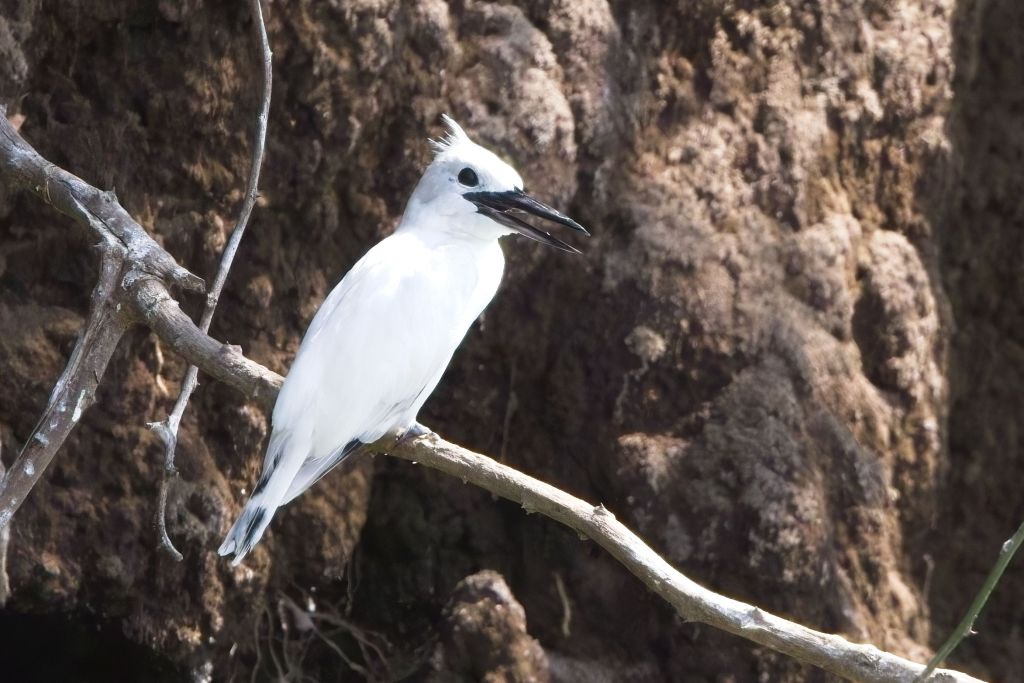
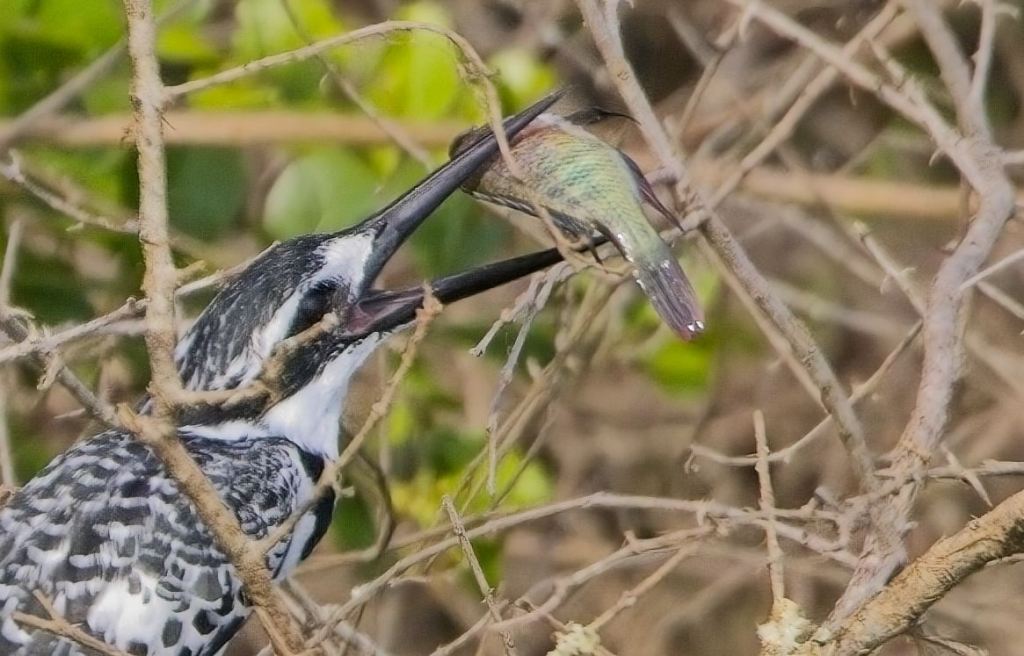
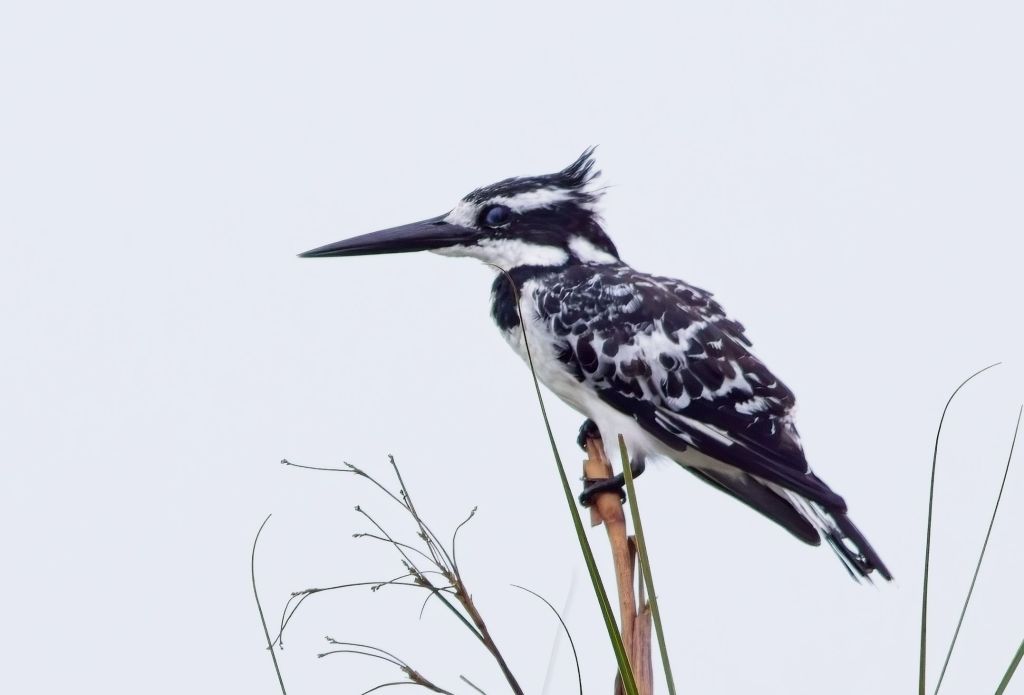
The Channel was great for close-up looks at many water related birds – waders, shorebirds, Egyptian Geese and three species of kingfishers including at least 200 Pied Kingfishers which nest in the dirt banks, and we often could see a dozen or more at one time. One stood out from the others, an almost pure white Pied Kingfisher – not albino but highly leucistic. The other  kingfishers were numerous Malachite Kingfishers.

Leucistic Pied Kingfisher
Pied Kingfisher at Nest Burrow in Bank
Malachite Kingfisher

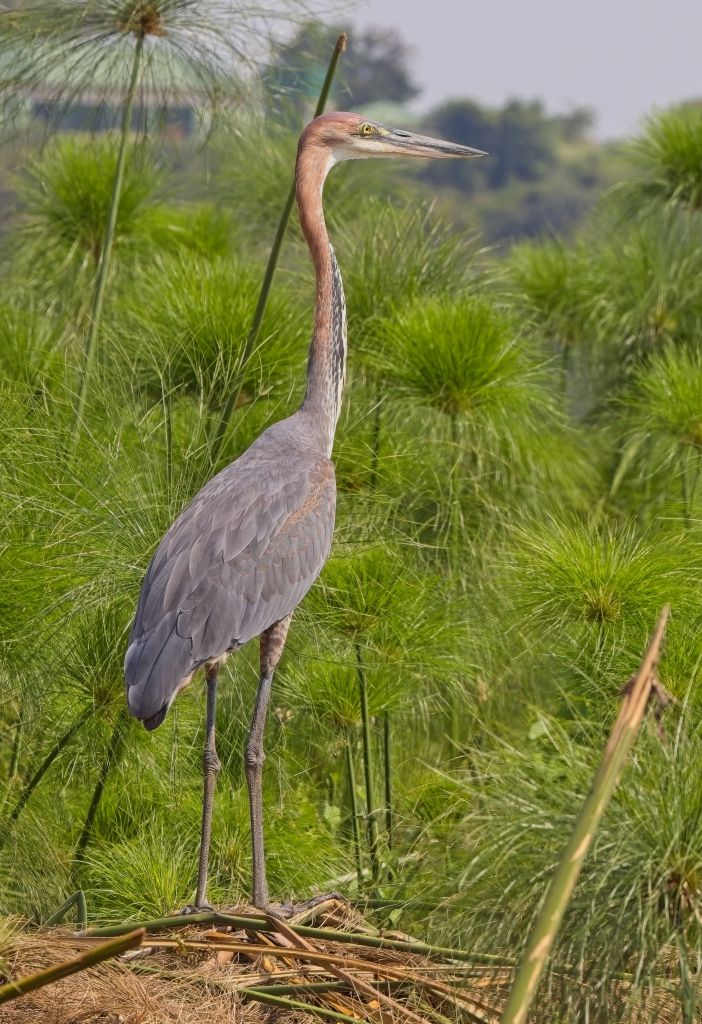
As we continued our boat trip in the channel, there were almost always birds in view. In no particular order I am including photos of most of these species.
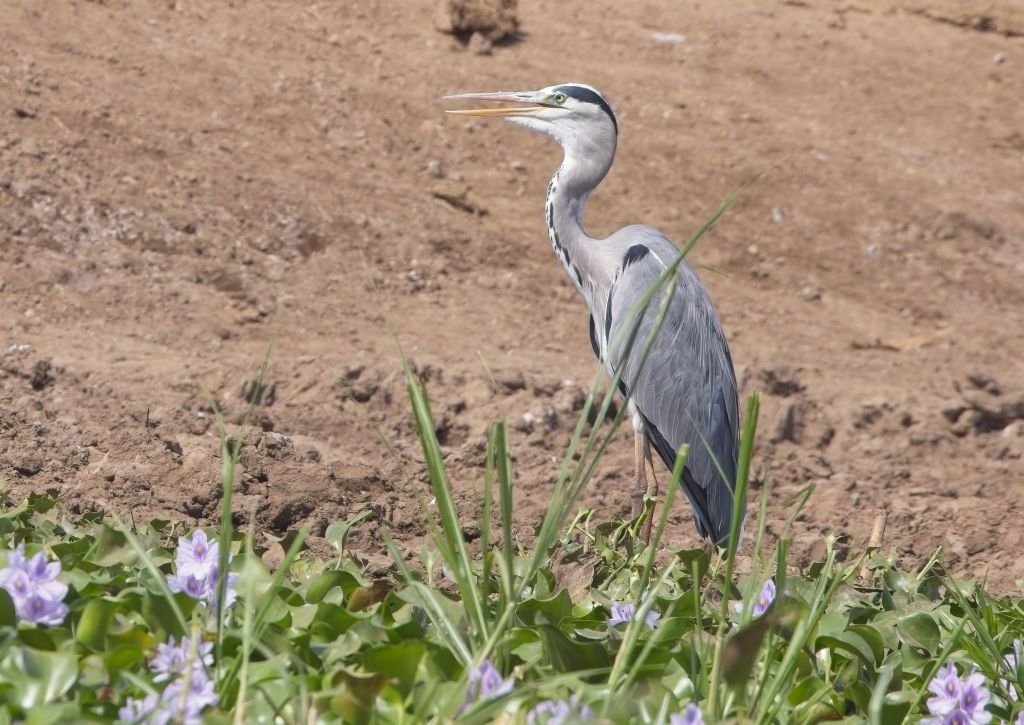
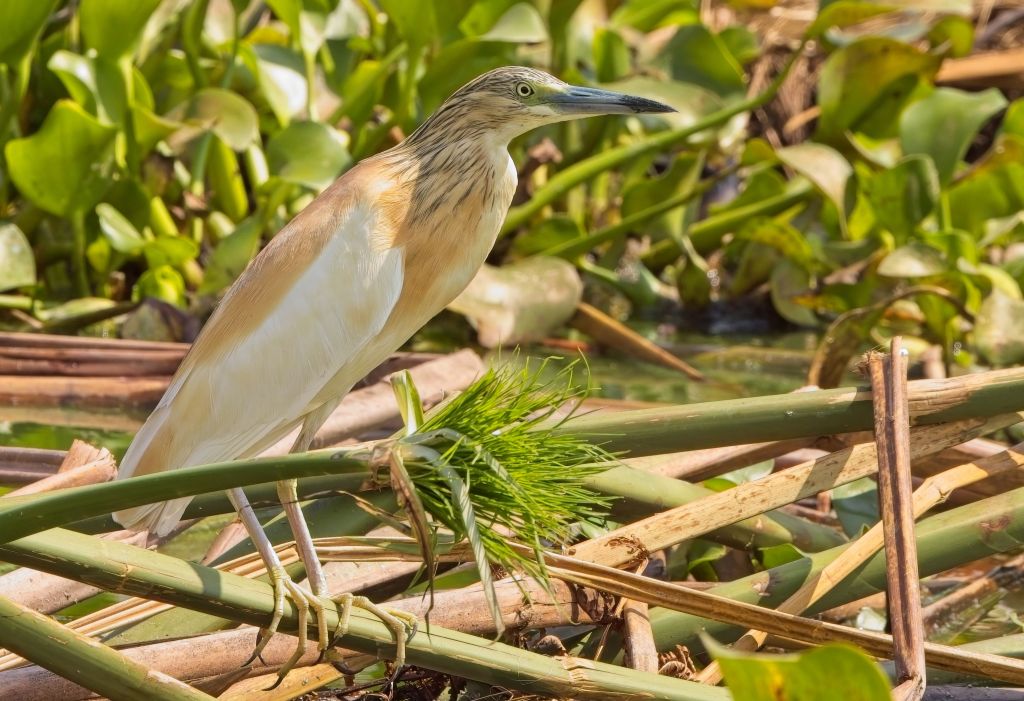
Squacco Heron
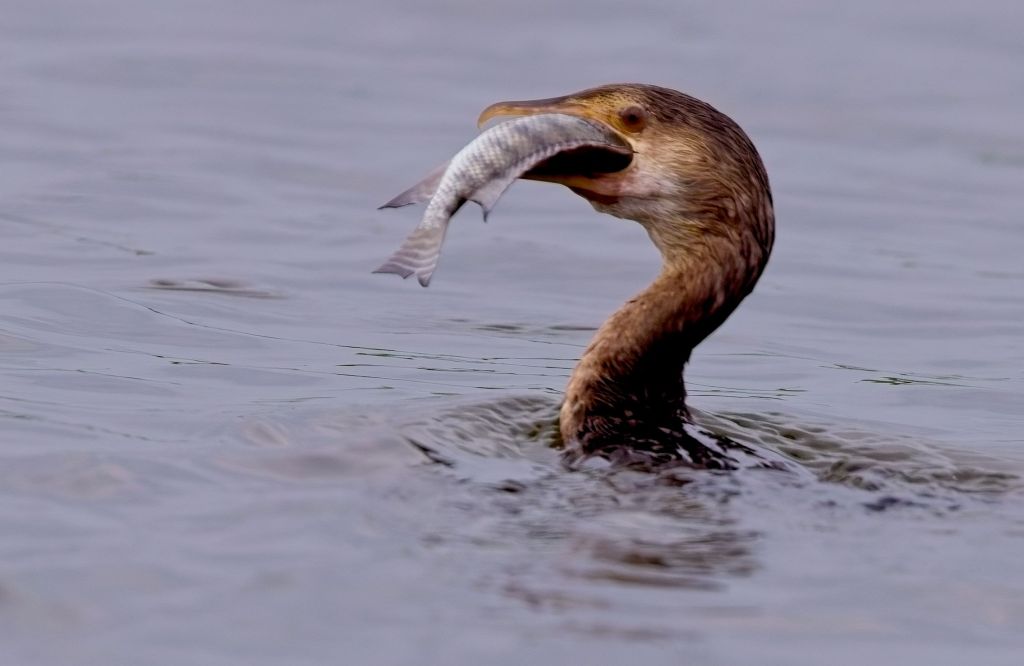
Long-tailed Cormorant – Breeding

Midway through our boat trip we came across another group of elephants. This time they were not so engaged with a meal, and after we had observed them for awhile, continuing to get closer and closer, it became clear that we were near that boundary where a further approach could be dangerous. Maybe it was because there were some babies, and when one of the larger elephants flared its ears and stared right at us, it was time to back off and move on.
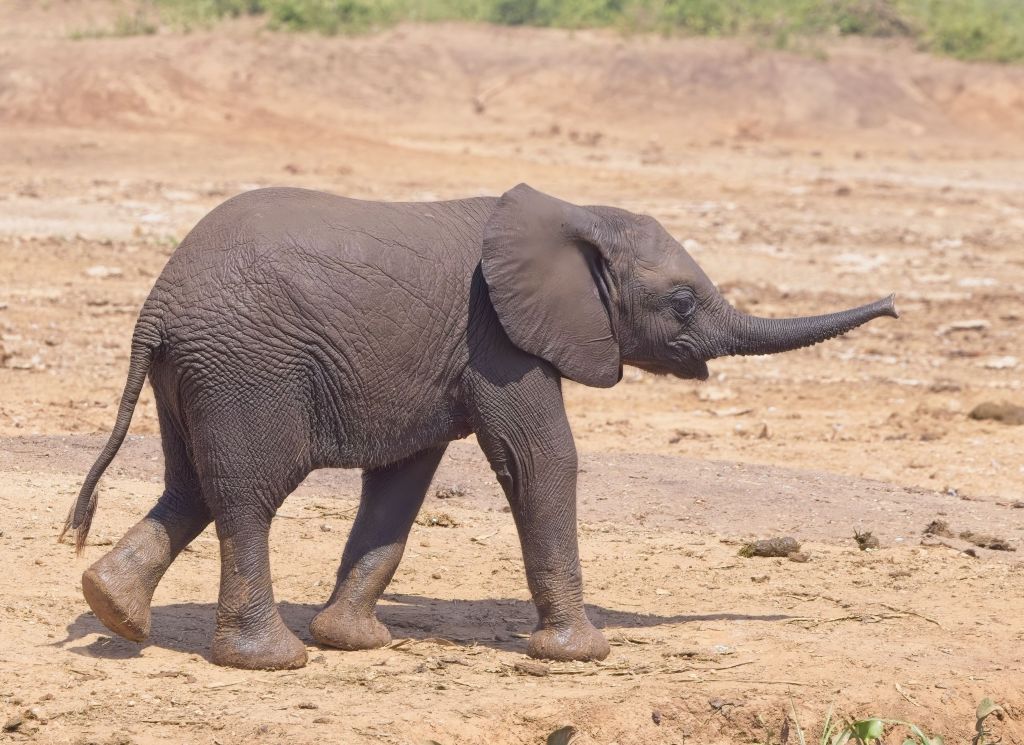
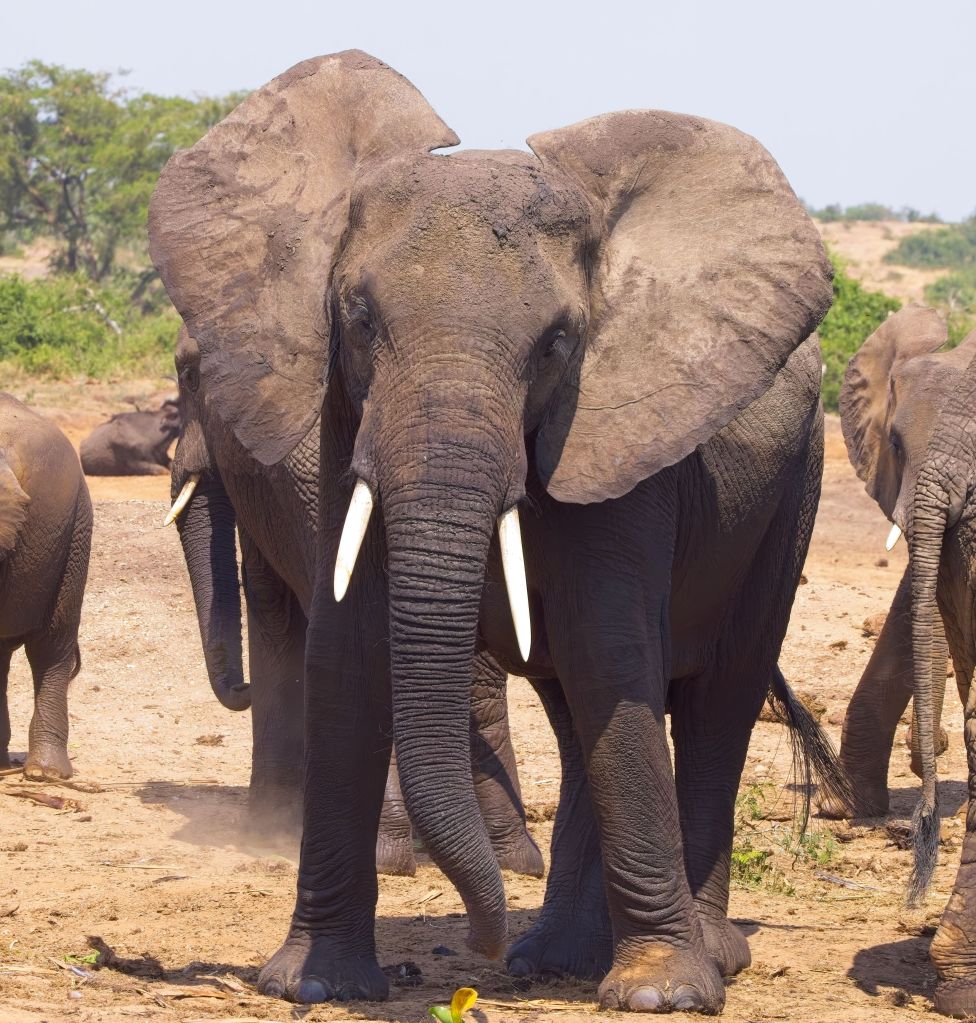
Young Elephant
We got the message and moved on

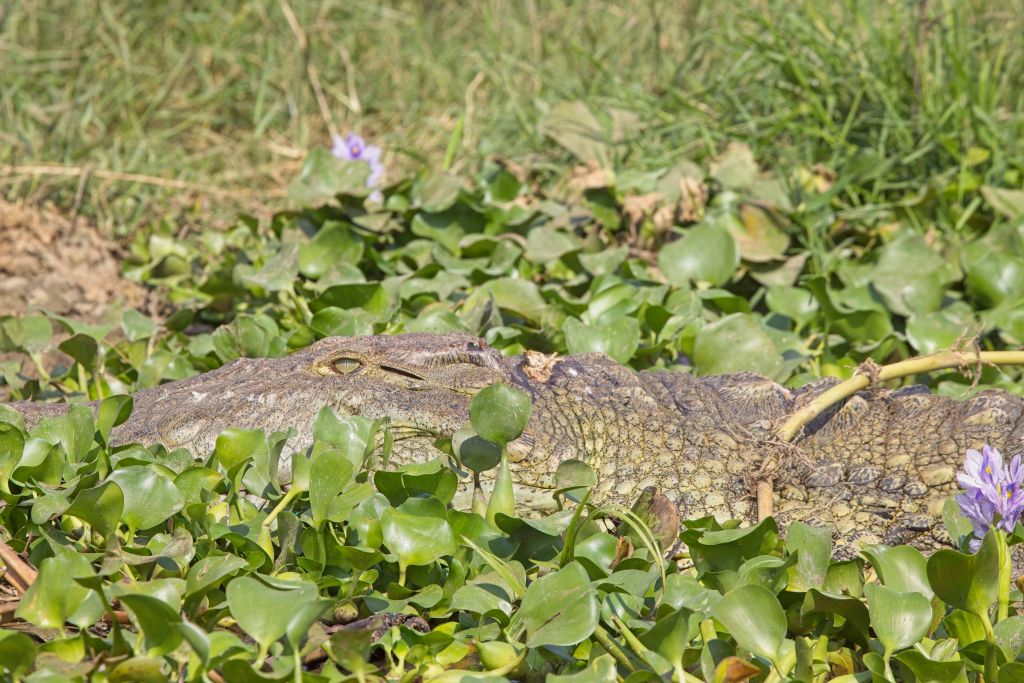
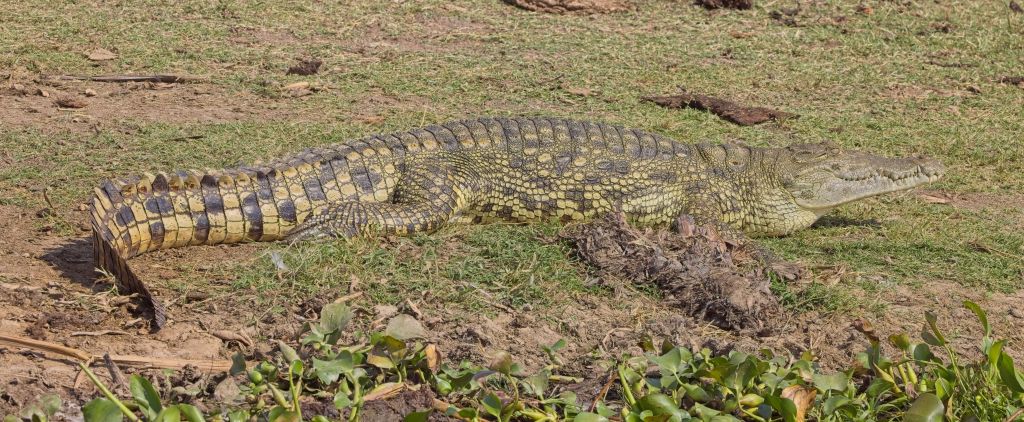
We saw more hippos and a few antelope on the shores of the Channel together with numerous Buffalo. There had been a couple of smaller ones earlier, but finally we found a pretty large Nile Crocodile with a mouthful of very serious teeth.

One of the Many Buffalo
Nile Crocodile

The boat ride was a wonderful experience with good weather and calm water. Great birds and great animals. Our intersection at the beginning with the African Skimmers and the feasting elephants could not have been a better start. As we returned to the dock, another boat was heading out and we noted that the African Skimmers had moved on and so had the elephants. They had completely consumed the floating vegetation. Our timing had been perfect. We returned to the lodge for a rest and a relatively early dinner. We would be out at a reasonable time the next morning continuing our journey through the Park and moving on to the Chimpanzee Forest Lodge.

June 25

I saw my first Verreaux’s Eagle Owl at Lake Nakuru in Kenya in November 2007 and my second in South Africa in October 2014. Last year Cindy and I saw one at Lake Manyara in Tanzania in February. This morning I would keep the streak alive with one seen on an abandoned Hamerkop nest almost as soon as we left the lodge. All owls are great. What makes this one special is it’s decidedly pink eyelids. A great way to start the morning.
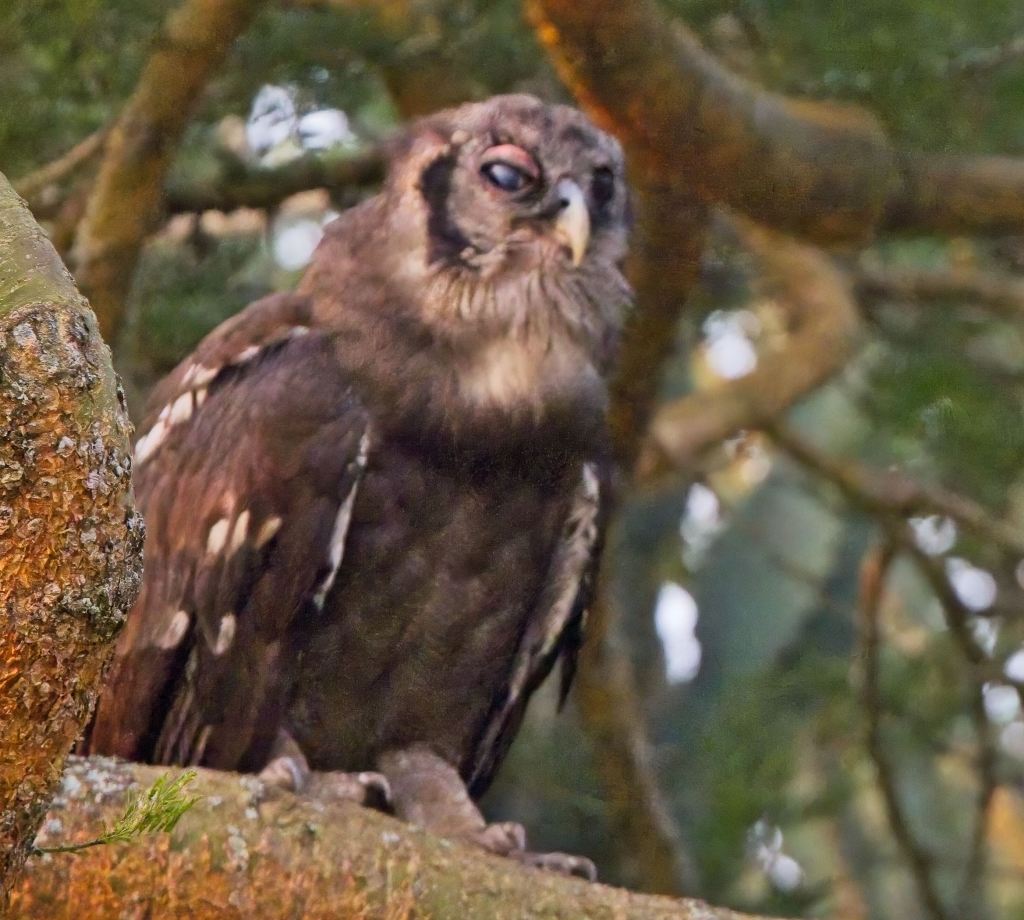
Verreaux’s Eagle-Owl

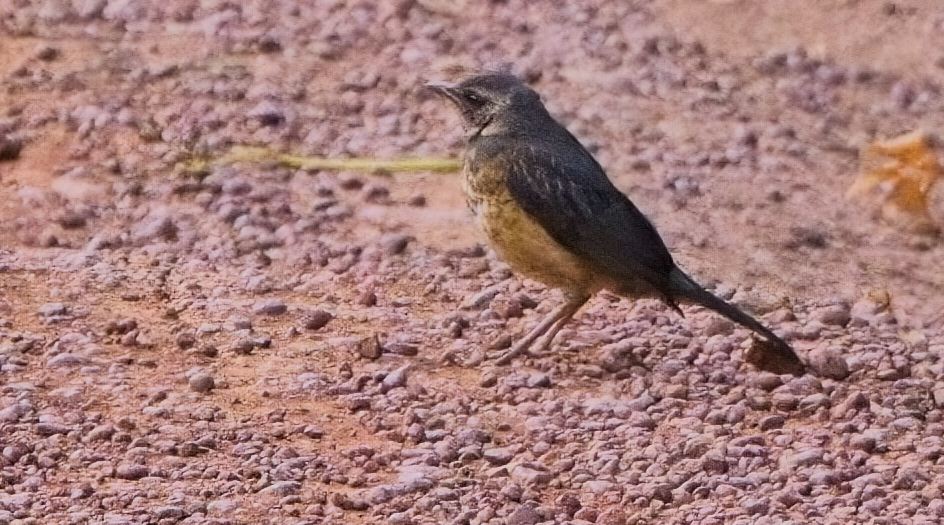
Shortly after the Eagle-Owl I added a lifer – a Brown-backed Scrub-robin. Although I am sure this photo is of the bird we saw, it looks to me more like a Red-Backed Scrub-robin. I will let the Ebird reviewers let me know. We had another Brown-backed Scrub-robin later, so I won’t lose a lifer in any event. I had Red-backed in Kenya, so nothing to gain either way.
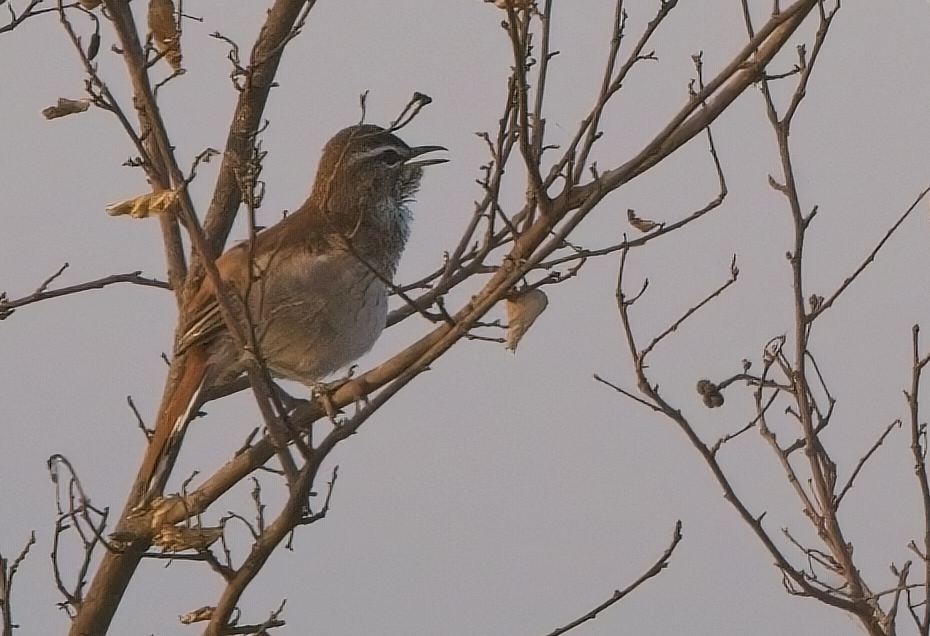
Brown-backed Scrub-robin – Lifer

Shortly after the Scrub-robin we added three birds to our Uganda trip list: Red-faced Cisticola, Green-winged Pytilia and Crimson-rumped Waxbill, all of which I had seen and photographed before during earlier Africa trips.

Crimson-rumped Waxbill
Red-faced Cisticola

We had one more birding drive through Queen Elizabeth II Park and then headed to Chimpanzee Forest Lodge. An apparently pretty unusual find was a Beaudouin’s Snake-Eagle distinguished by the very fine complete barring across its chest and belly. We first saw it in flight and I got a quick photo, improved when it landed on an Euphorbia and perched for a few seconds. A second lifer was an African Crake – a fleeting view that did not include a photo.

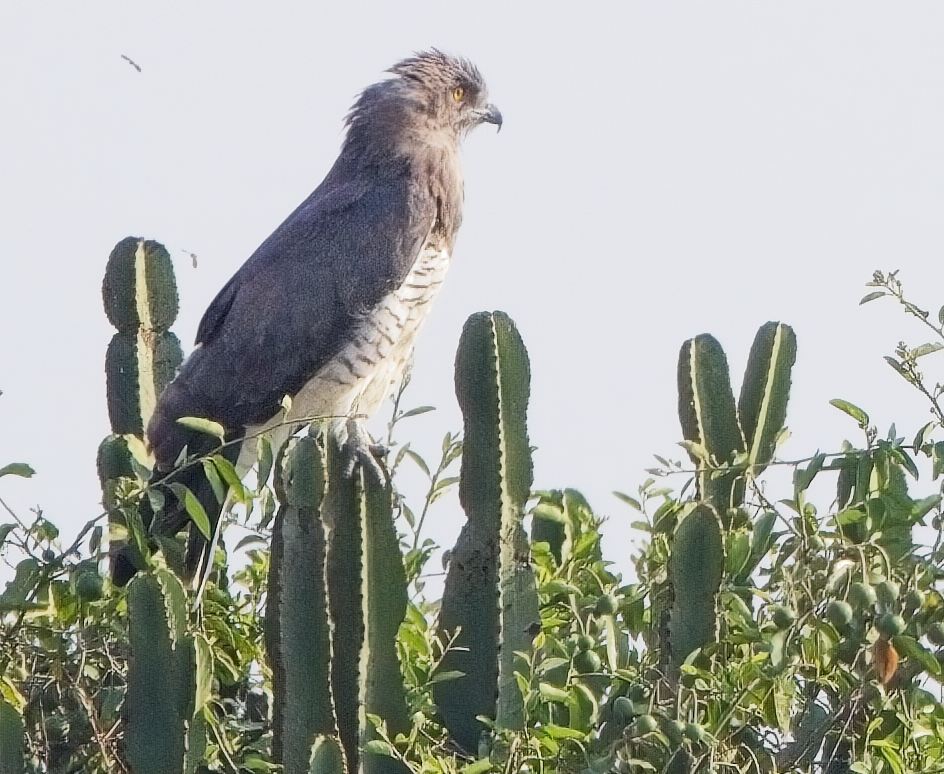
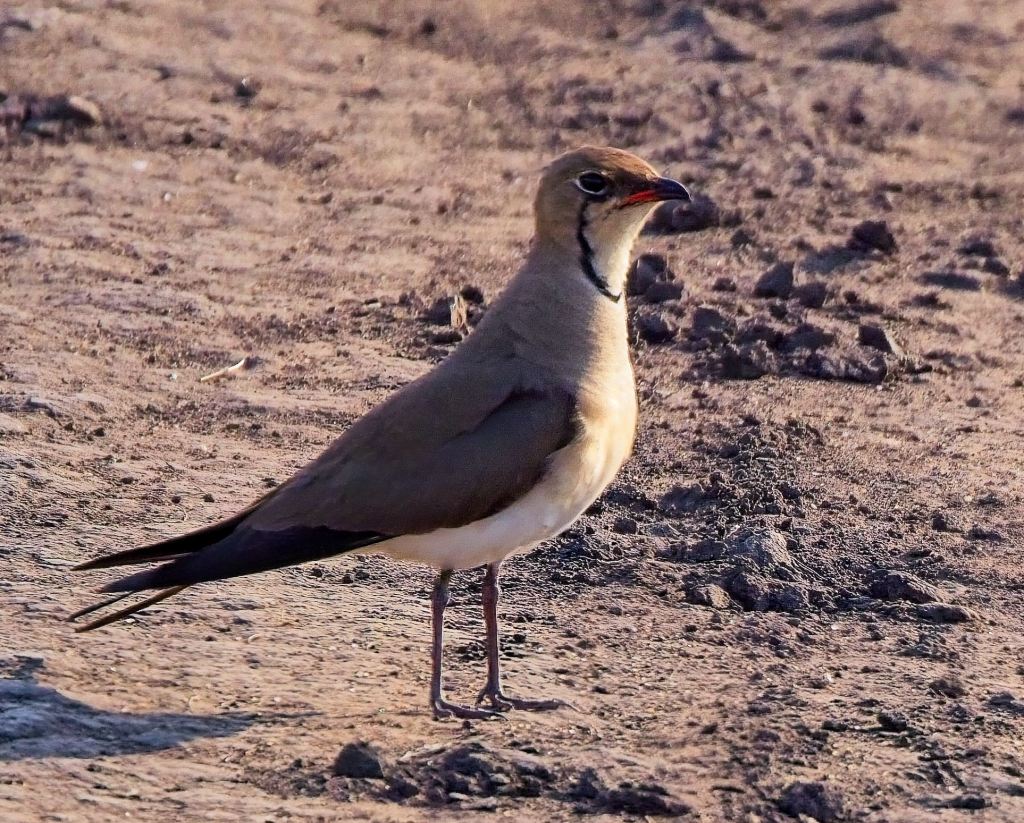
Although not a lifer or even a life photo, for me by far the best birds of the morning were a flock of Collared Pratincoles that landed on the road ahead of our vehicle, would allow us to get a little closer and then move on a bit, repeating this every time we followed but eventually resulting in some nice photos – definite improvements over the ones from distant Collared Pratincoles last year in Tanzania. They look like a mix between shorebirds and swallows with striking markings.
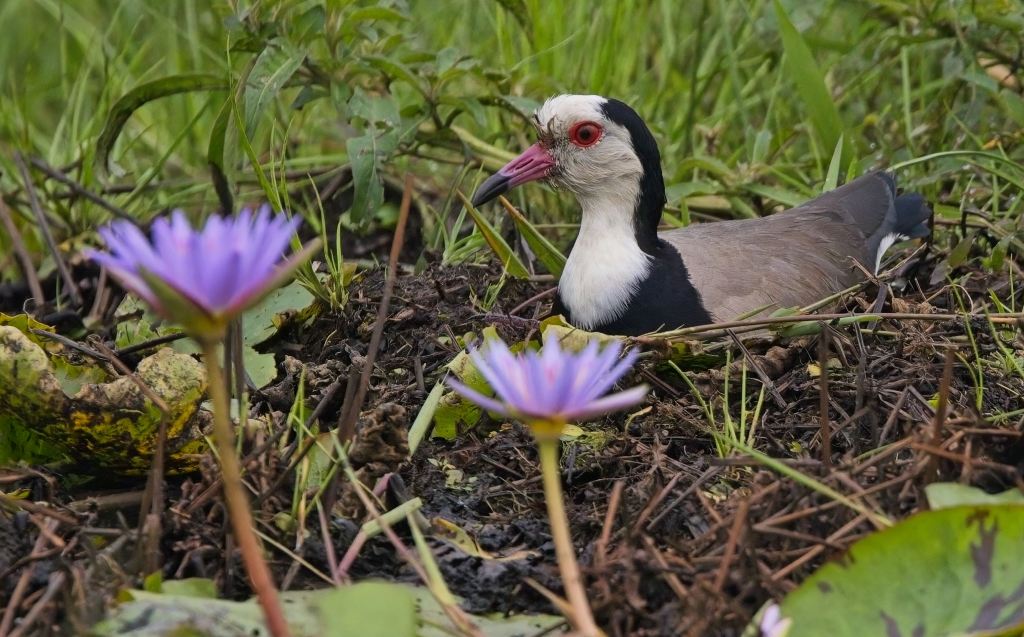
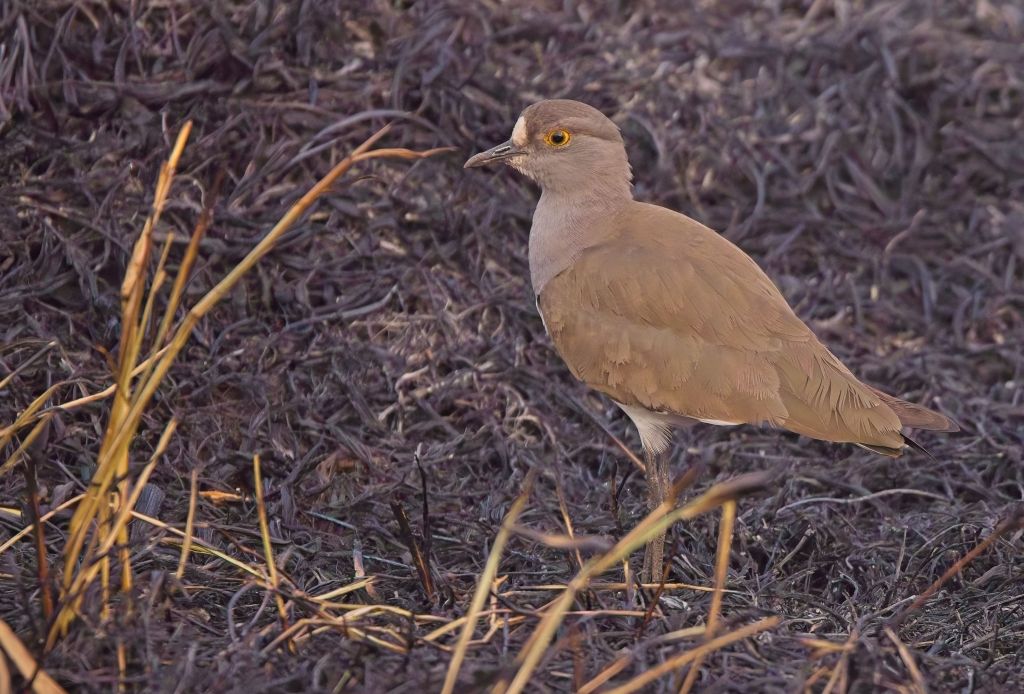
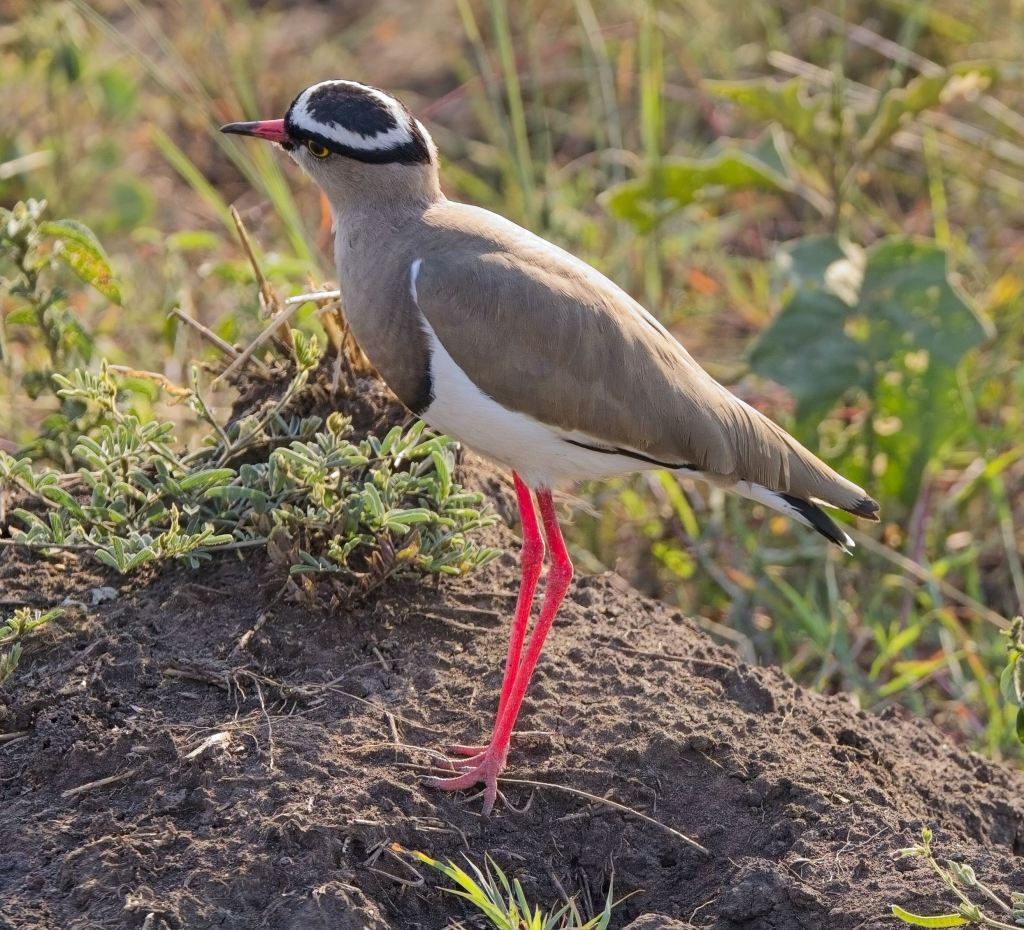
Probably the most notable birds of the morning were the Senegal Lapwings which seemed to be everywhere, more than 100 of them, sometimes joined by a few Crowned Lapwings. We also had a couple of Wattled Lapwing’s and a Kittzlitz’s Plover – so a four plover morning.
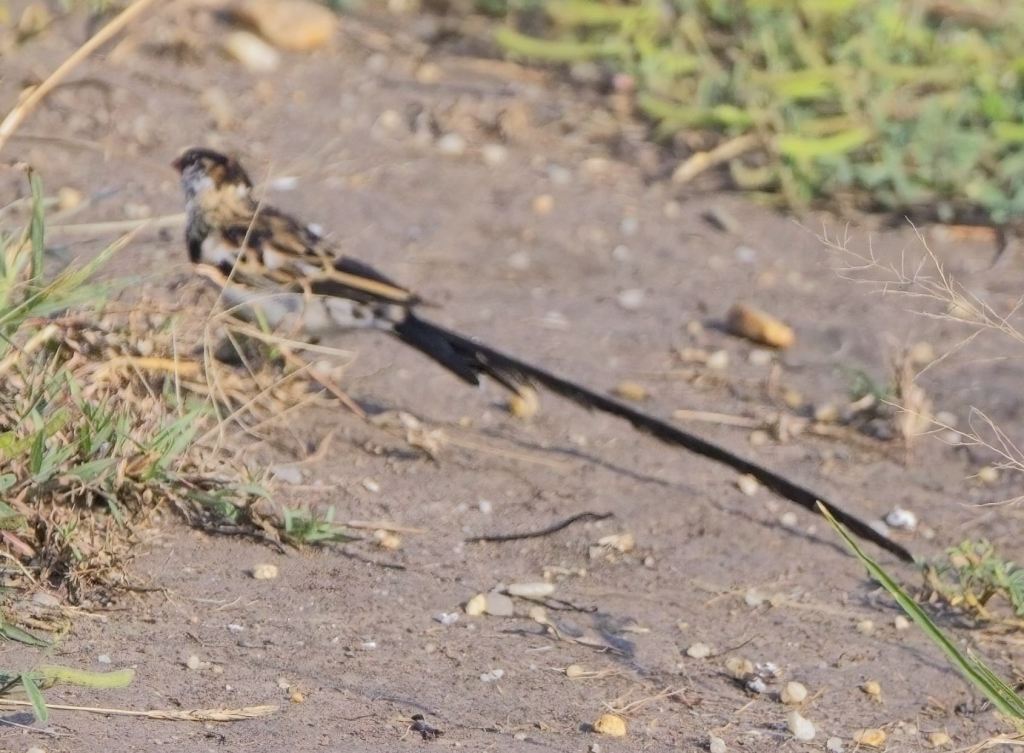
It was also a good morning for cisticolas as we had Zitting Cisticolas singing everywhere and a couple of Croaking Cisticolas as well. We had seen a number of Pin-tailed Whydahs earlier, but they were plentiful here with a number of long tailed males.

Pin-tailed Whydah Male

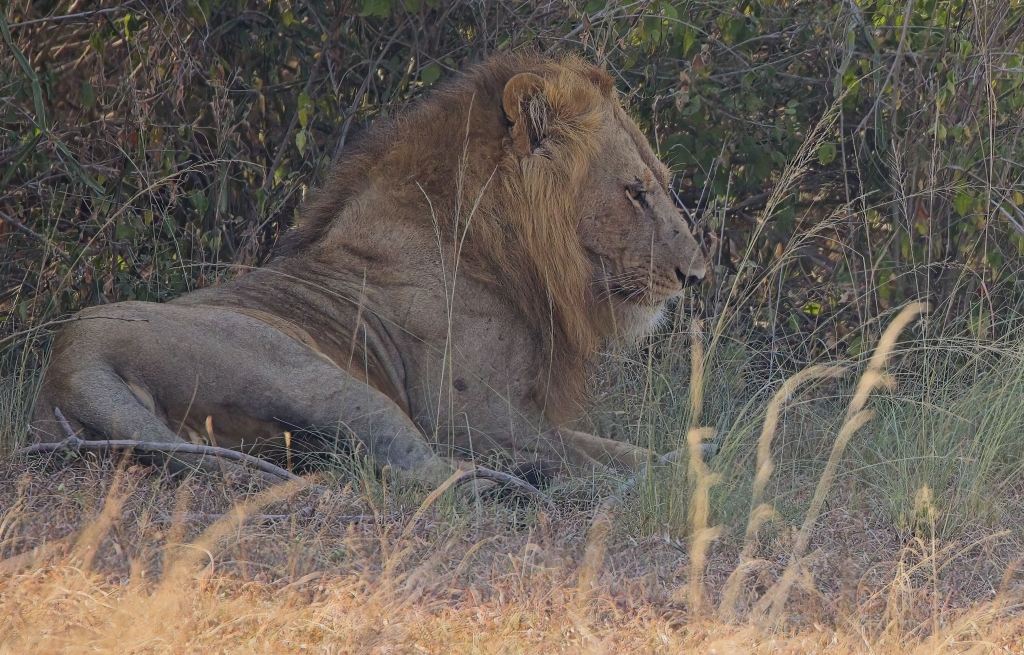
There were two non-bird highlights of the morning. The first was watching a male Uganda Kob try to have hhis way with a female. It did not work but believing in “if at first you don’t succeed, try try again”, he did and it still did not work – rejection. The second was seeing our first “real Lion“. Sure the two Lions seen two days earlier surrounded by safari vehicles, indeed almost touching them, were real, but this one – a male sitting in the grass just off the road in front of us with nobody else around was many times better even more so as were we were in the Lion Savannah area of the Park. A fitting farewell to Queen Elizabeth II National Park.

Nice try – but not this time.
Male Lion
Male Lion

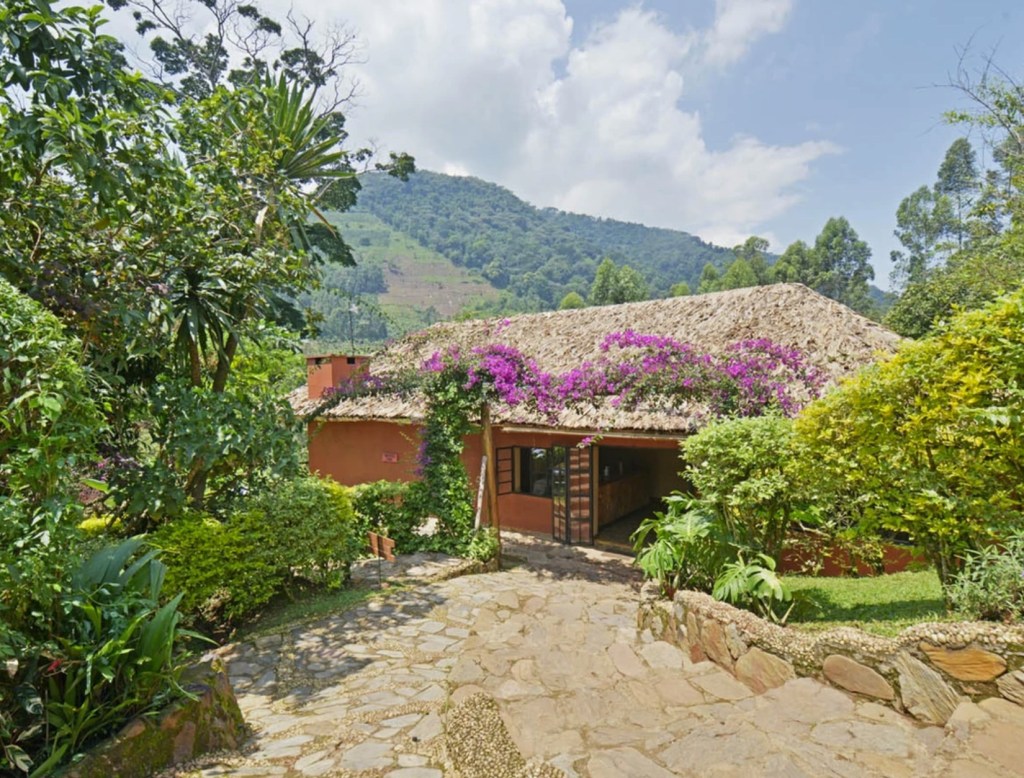
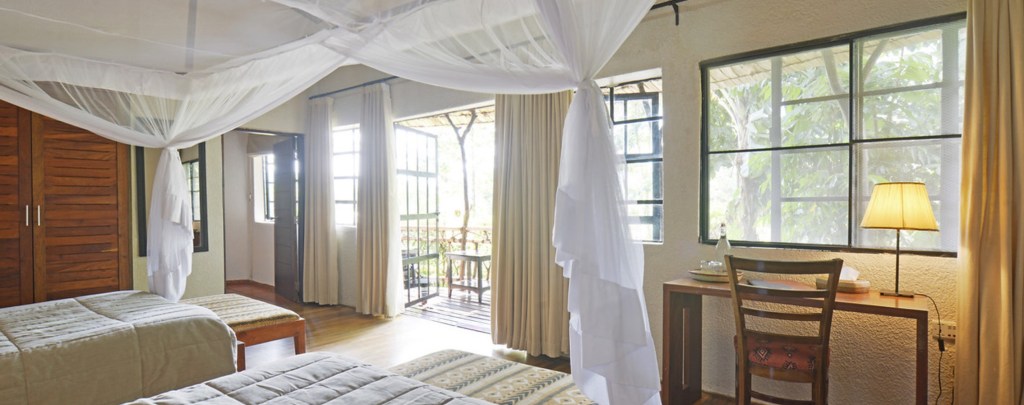
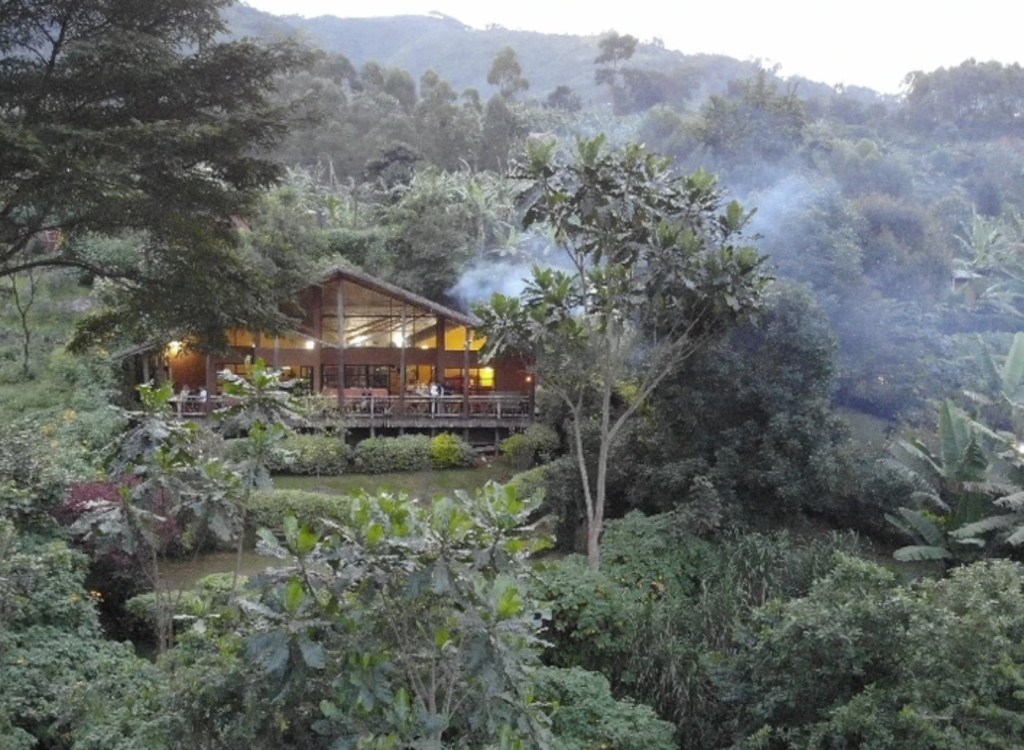
We arrived at the Chimpanzee Forest Lodge in the early afternoon and checked in. The lodge was comfortable with each of us having our own cottage. These pictures from the website give an idea of the accommodations.
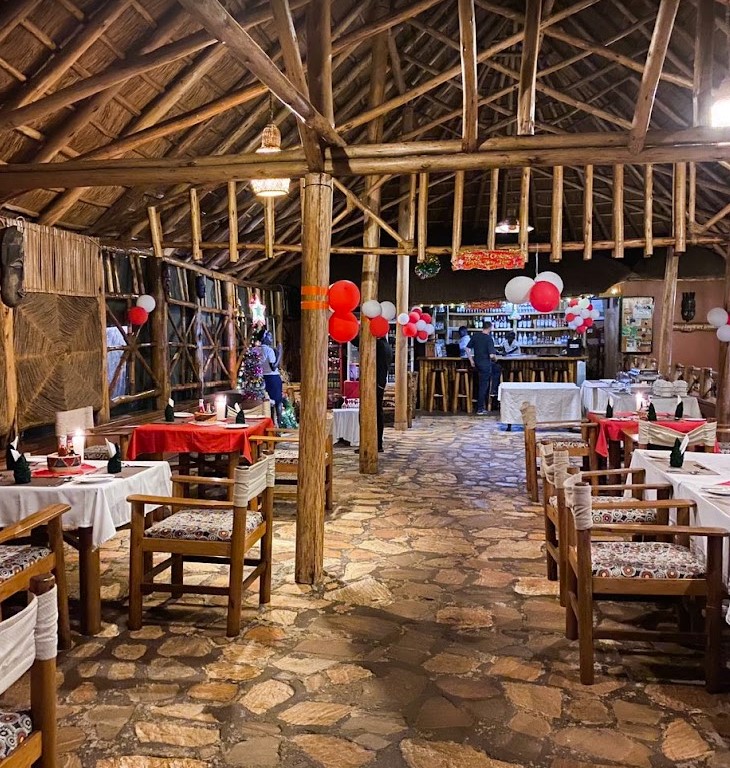
Dining Room
Cottage
Twin Room

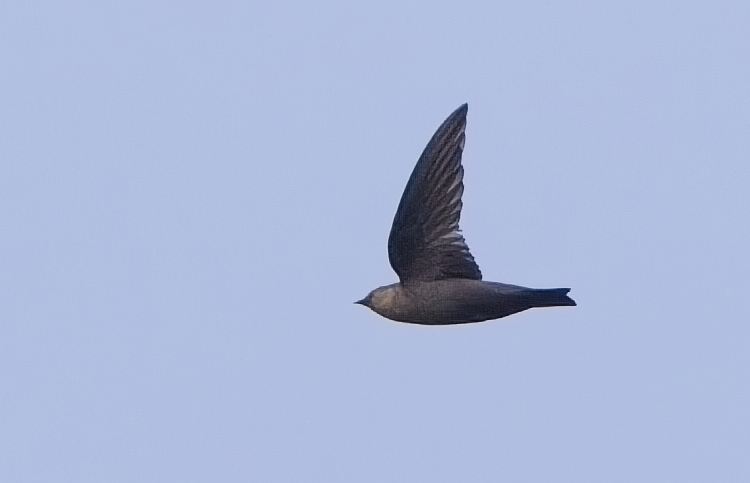
We birded at the lodge and surrounding area for an hour and then birded for another hour in Kibaale National Park where we would do our Chimpanzee trek the next morning. We added another half dozen species for our Uganda list (mine was then at 341) and four were also lifers for me: Afep Pigeon (fast flyover without time to get a photo and then never seen again), Speckle Breasted Woodpecker (seen only by me with a poor photo), Black Crowned Waxbill – photographed, and Sabine’s Spinetail – also photographed.

Out of Focus Speckle-breasted Woodpecker – Lifer
Black Crowned Waxbill – Lifer
Sabine’s Spinetail – Lifer

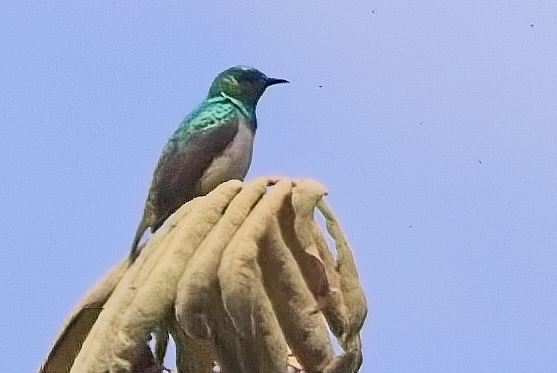
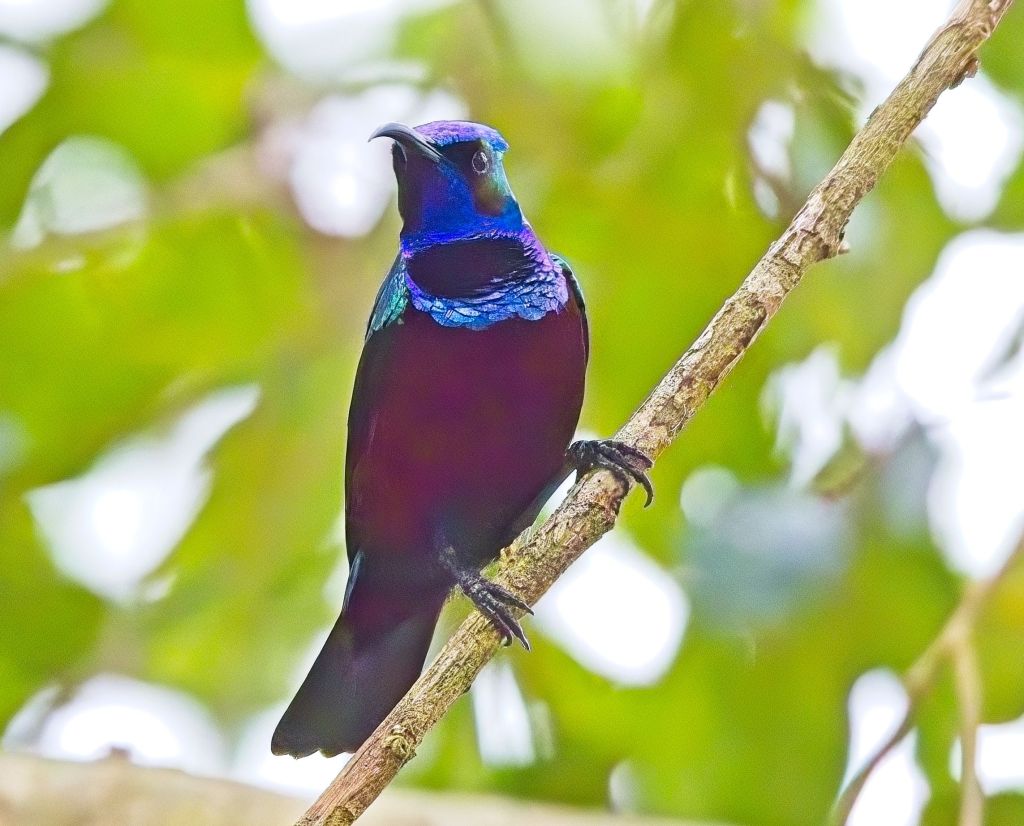
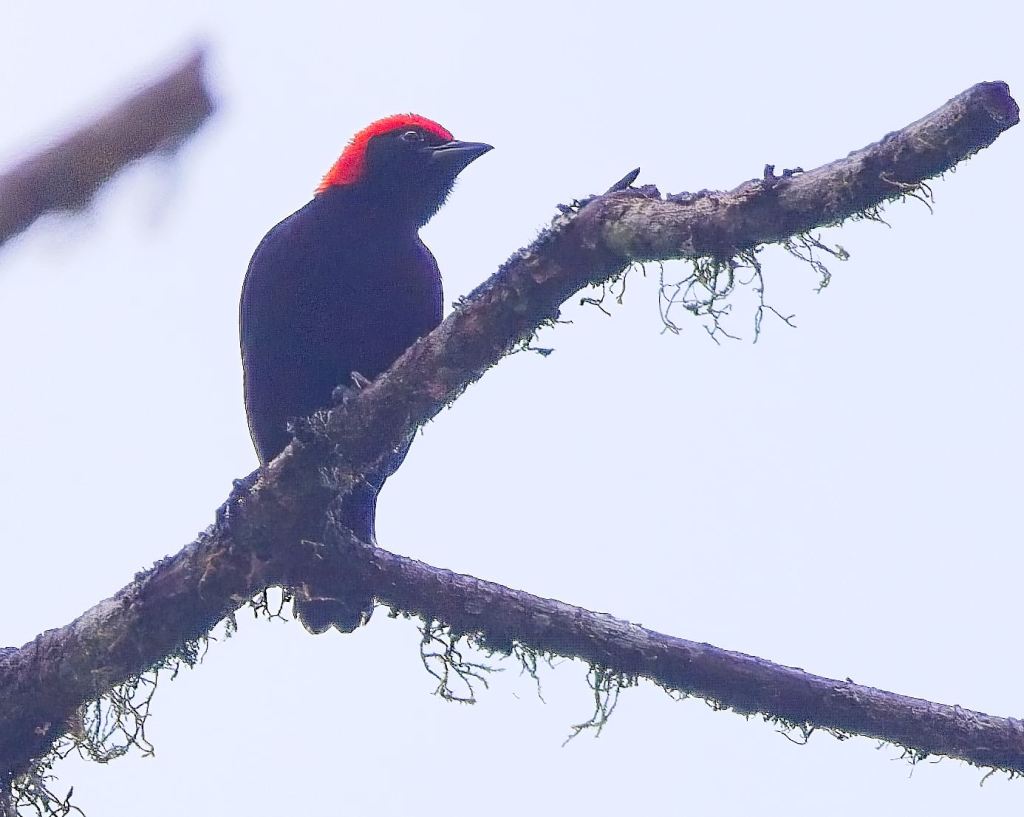
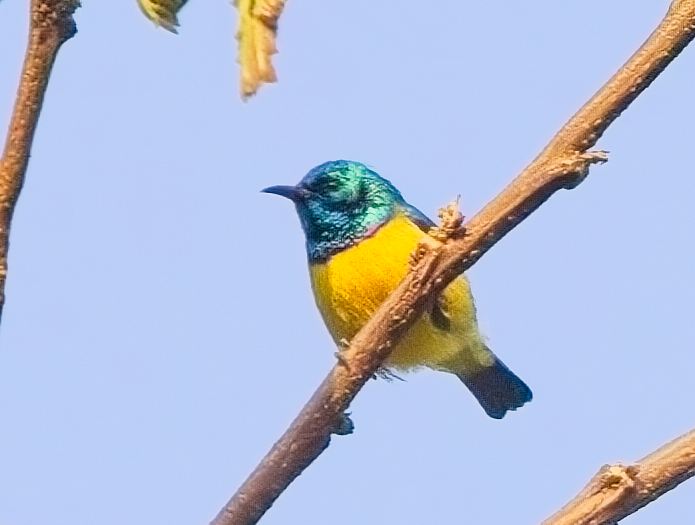
I also got lifer photos of two sunbirds, Olive-bellied and Green-throated or was it Blue-throated Brown-Sunbird – or did I get photos of both? After much debate I am close to sure that the for sure photo is of the latter and just not sure about the other.
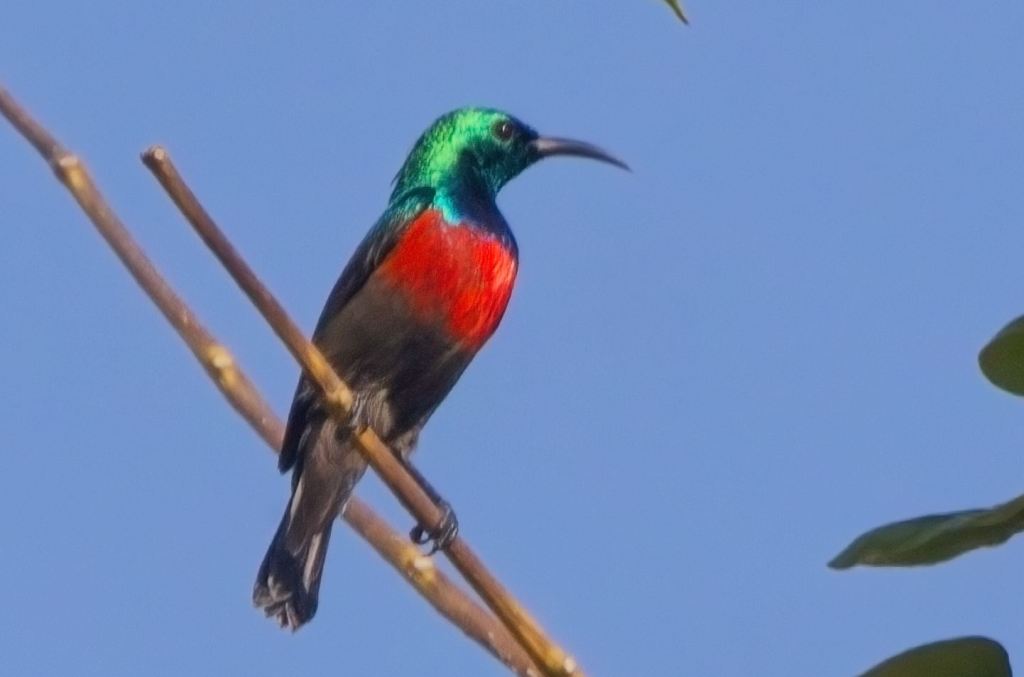
Olive-bellied Sunbird
Blue-throated Brown Sunbird (I think)
Not Sure What Sunbird

A last photo for the day and a lifer photo for me was of a Hairy-breasted Barbet – an odd name for a bird as clearly no birds have hair, but I guess I can see how the plumage could lead to the name.

Hairy-breasted Barbet

Somehow we had added 15 species to our Uganda trip list – or at least to mine as there were species seen by others that I had missed either because I sat out a couple of walks or just could not find or hear birds seen by others – especially Dion our guide. So as I said my Uganda list was at 341 species and the tour list was probably approaching 350 species. There would be birds the next day, too, but our main quest really did have hair as we would be looking for Chimpanzees.
Uganda Day 8: Birds in the Morning – Ride 4 A Woman in the Afternoon; Uganda Day 9: On to Queen Elizabeth II National Park

June 22

After a good night’s sleep followed by a good breakfast (custom omelets really help) at Mahogany Springs, our favorite lodge on the trip, our morning would be a long birding session along the Buhoma Tract still in the Bwindi Impenetrable Forest, a very bird rich area. We would be rewarded with lots of new species but once again much frustration for me as this was deep forest/jungle birding with many birds high up in the big trees, buried in dense foliage – or both. Honestly, I had barely ID quality looks at many of the birds and photos were very hard to come by. Of the 56 species on our list for the 4 hours of birding, I was only able to get photos of 9 and some of those were not very good. At least 6 species were heard only (but distinctly) and another dozen were seen poorly at best. Again, very frustrating.

But there were birds. Twenty-three were new for our trip and 14 were lifers for me including 2 new sunbirds, a new woodpecker and a new bee-eater. Another lifer, found by Veronica and in the open briefly, was the Red-headed Malimbe, a kind of weaver. It is was the first time I have seen a bird with that very African sounding name although there are three other Malimbes in East Africa.

Red-headed Malimbe – Lifer
Black Bee-eater – Lifer
Eliot’s Woodpecker – Lifer
Luhder’s Bushshrike – Lifer
Black-tailed Oriole – Life Photo
Sooty Flycatcher – Lifer
African Emerald Cuckoo – Life Photo
Golden Breasted Bunting

Those were the best of the photos. There were many others that had unidentifiable parts of birds buried in the foliage – probably greenbuls (we had 7 species) but not really enough to even go with an ID suggestion. We had already gone over 2 miles and the question was what would be next. Dion really wanted to carry-on farther in search of a new Uganda bird for him (and of course for all of us as well) but that would involve at least another mile out and back and maybe more.

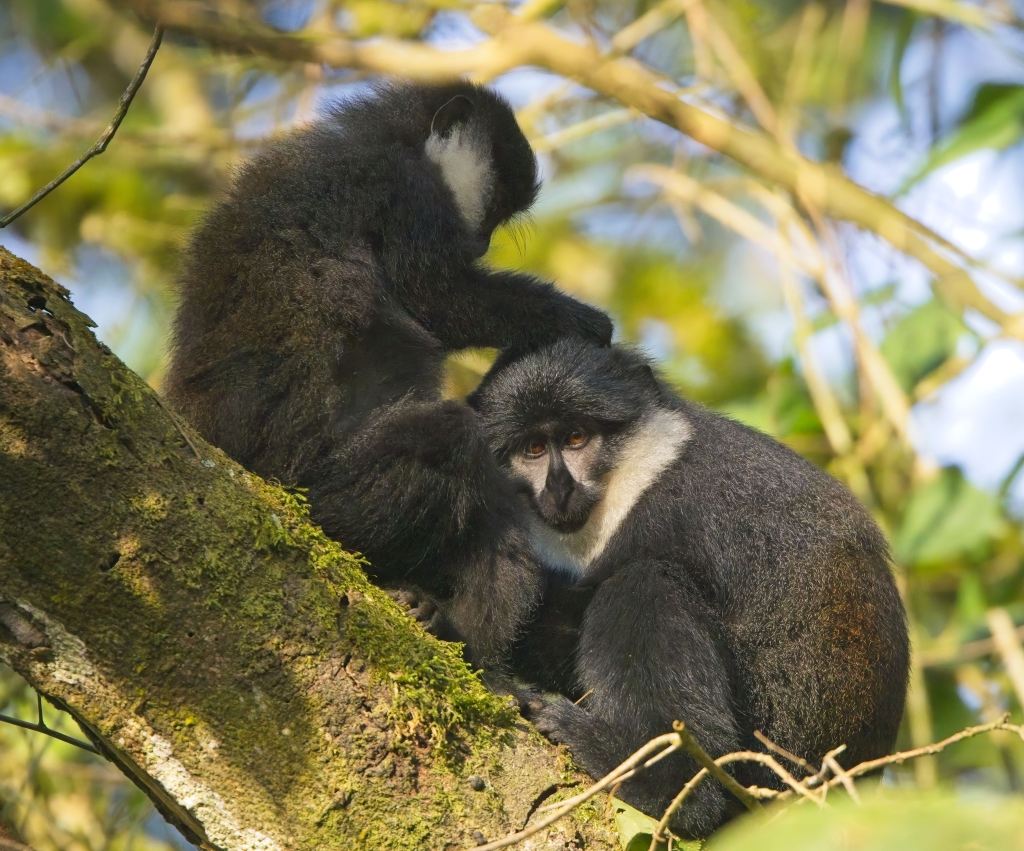
I probably could/should have included these photos above or even in the previous post as along with the many birds, we also had lots of monkeys – often just a movement high in the trees but sometimes at least relatively in the open for photo ops. The most common monkeys were Red Tailed Monkeys with incredibly long tails (yes red) and L’Hoest’s Monkeys which were somewhat more common and more in the open.

Red-Tailed Monkeys which Might Have Been Named Blue-Masked Monkey Just as Easily
L’Hoest’s Monkeys

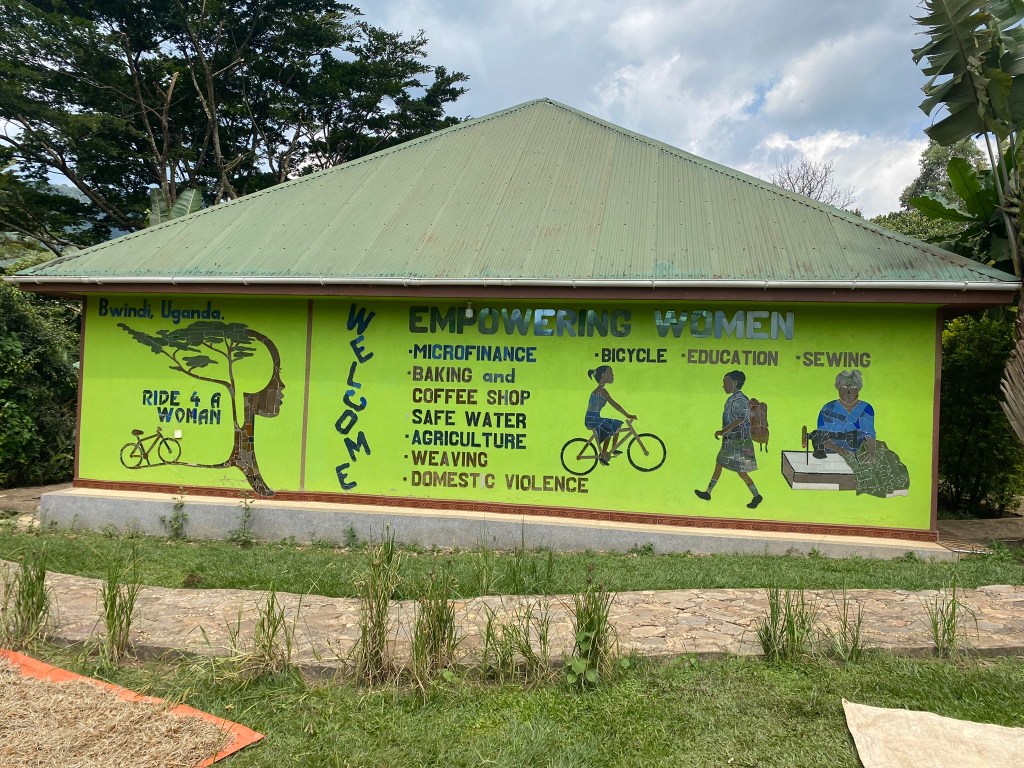
We had been given the option to continue on with Dion or to walk back to the vehicle with Veronica who would return us to Mahogany Springs. One of the party chose to continue with Dion and the rest of us went back. Veronica dropped the other tour member back at the lodge but Cindy and I very much wanted to visit a women’s cooperative that Cindy had learned about at dinner the previous night. It was called “ride 4 a Woman” and was not far from the Lodge. Veronica drove us there. It turned out to be one of the highlights of our trip.

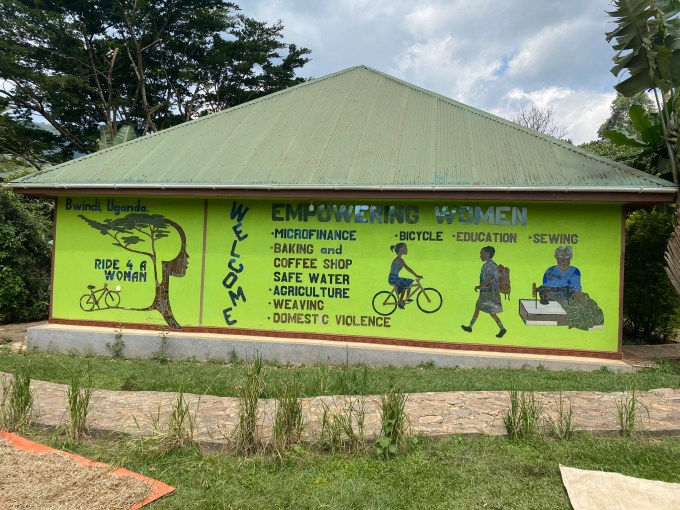
Ride 4 a Woman

Cindy and I spent several hours at this inspirational place. Its website http://www.ride4awoman.org introduces the organization perfectly: “Ride 4 a Woman was set up in 2009 by Evelyn Habasa and her husband Denis Rubalema. The organization exists to support local women struggling at home with issues associated with HIV, domestic violence and poverty….More than 300 women from 11 villages now use or work at the Ride 4 a Woman community center, where they can learn to pedal sew, weave baskets, dance, sing and drum; learning new skills, making a living and making it possible for their children to gain an education…The organization also offers microfinance, helping women to help themselves and support their families. To date over 100 women are actively engaged in the Ride 4 a Woman Microfinance Program…This retreat in the local community offers local women a place to stay, something to eat and a wage while they learn new skills. Every day we welcome visitors to Stay With Us, Learn From Us, Shop or simply drop by to see what is going on.
When Veronica dropped us off, we met by a young woman, Shallon, who became our guide as we toured the impressive retreat/community center interacting with many of the 30 or more women who were all busy weaving, sewing, serving food or attending to other matters for the organization. Shallon gave us the background and history of the place and told us a lot about Ugandan culture which is slowly changing especially related to the place of women in society and in the villages. Ride 4 a Woman started with She also introduced us to the founders Evelyn Habasa and Denis Rubalema and took us through the different buildings including some lovely rooms which provide a respite for women who have experienced domestic violence. Every woman we met was busy, completely engaged in their work and certainly outwardly and in interactions with us, smiling and happy.
Cindy with Founder Evelyn Habasa
Shallon Showing Us one of the Pedal Sewing Machines in Action

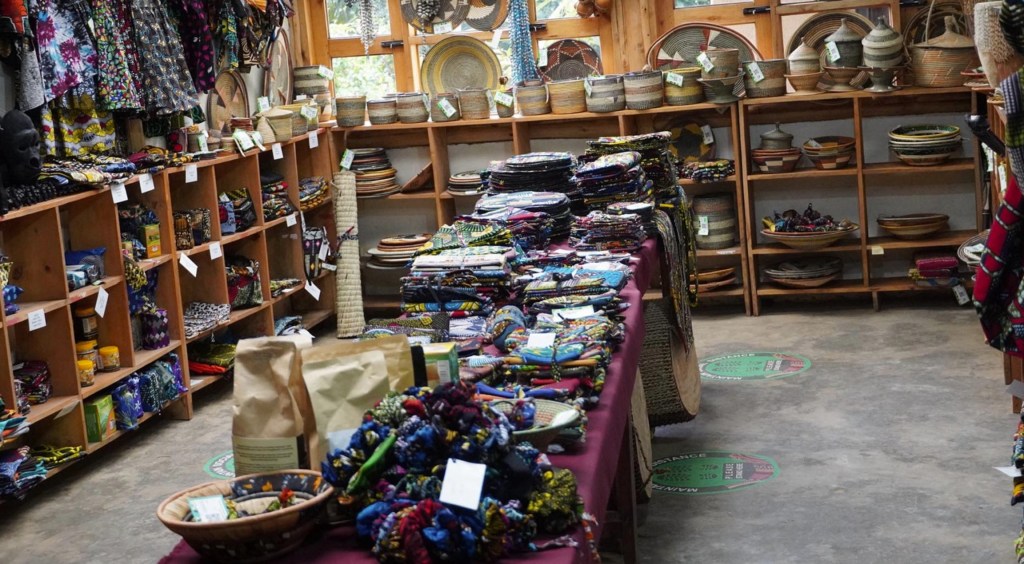
Evelyn and Denis started out renting bicycles to tourists who visited the area primarily for gorilla trekking. With those funds and hard work and some donations, they have expanded the operations to reach many women in the nearby small villages. There is a small gift shop where items made by the women can be purchased – at very reasonable (actually very low) prices. We had seen some particularly appealing fabric as we had toured and asked if it was possible to have a tablecloth made with it. Several women immediately went to work calculating how much fabric would be needed, laying out the design and then beginning to cut and sew it. We found some complementary cloth for a set of napkins and added that and a couple of weavings to our purchase. It was getting late and we had to return to our lodge. We were told that the finished goods would be delivered to us there. Right after dinner we found them in a beautiful colorful bag waiting for us in the lobby.
Gift Shop – Photo from Ann Lauer who visited with NatHab
Working on Our Tablecloth

Most of the people in these villages live at not much above subsistence level with no electricity or running water in their simple homes. Getting clean water generally involves long walks returning with heavy jugs. Goats are an incredibly important and valuable addition to any family. Ride 4 A Woman has made it an aim to be able to provide a goat for all of the families they serve. It is also undertaking a program to provide solar panels to bring electric power to the communities. All of this of course costs money and opportunities to bring in significant revenue at such a remote area are limited. When Covid seriously cut into the tourism in the area, Ride 4 A Woman was seriously hurt. Private donations helped them weather the storm. Cindy and I have committed to try to aid this worthy organization both with some of our own personal funds and also through some fund raising activities tarting to develop that we are starting to develop. Stay tuned. Interpret this comment as you wish: it was disappointing to us that the tour and all of the other tour members showed no interest in this remarkable place. There was no interest in visiting it or frankly in hearing about it. OK, it’s a birding tour, but Cindy and I felt much enriched from our visit.

Women of Ride 4 A Woman Photo – Ann Lauer

June 23

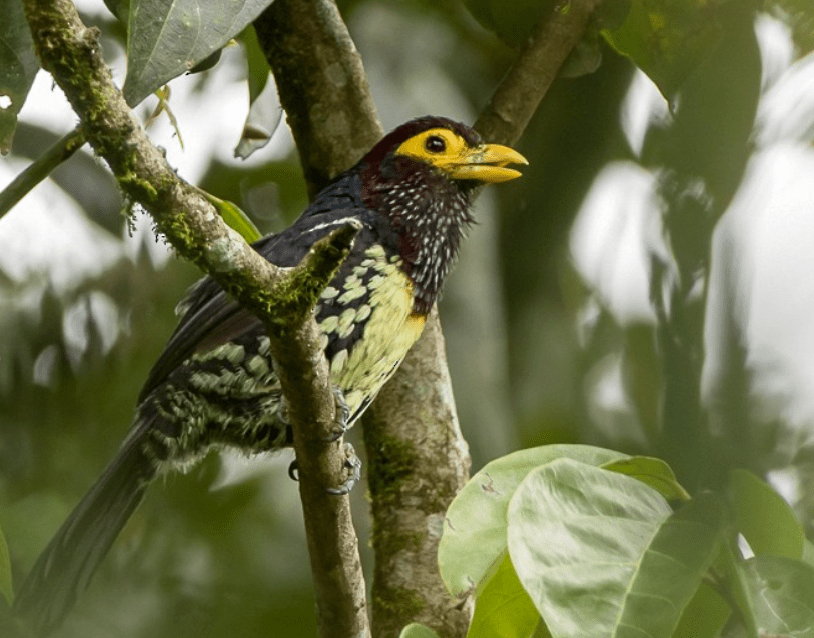
After breakfast we packed up to sadly leave Mahogany Springs but with excitement as we were heading to Queen Elizabeth II NP with the promise of big mammals, another boat trip and of course more birds. To start we again birded the Bwindi Impenetrable Forest Entrance Road with 21 species – six new for the tour, 2 lifers for me and a couple of new life photos. Again the birding and especially the photography was tough with birds high in dense foliage. A particularly sad miss for a photo was a Yellow-billed Barbet. I had seen one in Kenya 17 years ago and we would have them later on this trip, but I love barbets and this is a very striking one. I have a photo that is possibly of this bird but it is truly awful and does not do even a bit of justice to the real deal and I am not counting it.

Least Honeyguide – Lifer
Olive Sunbird – Life Photo
Gray-winged Robin-chat
Yellow-Billed Barbet – Photo Frederic Pelsy

We had a few incidental species as we continued on towards the Park. At one spot we had a field full of Red-billed Quelea, one of the most numerous birds in Africa. I had seen them before but somehow never got a photo. Today would be the day.

Red Quelea – Life Photo
A Bush full of Queleas

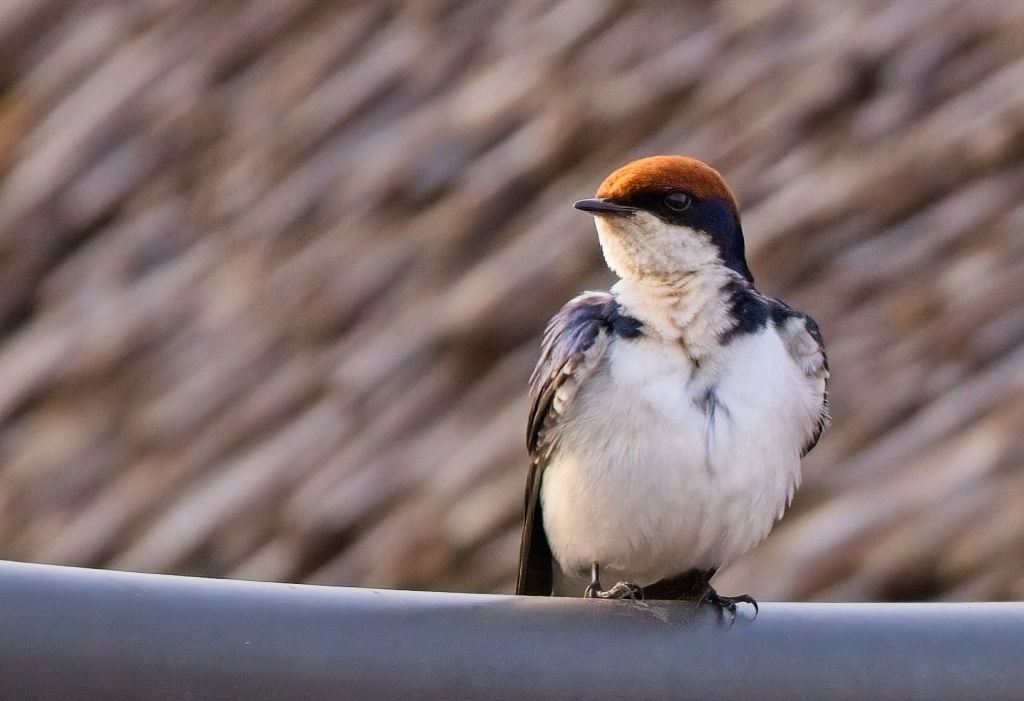
A little further along, we had our first Village Indigobird. The previous day I got a fairly poor photo of a perched Wire-tailed Swallow showing the wire tail. Now I added one of another perched Wire-tailed Swallow better showing its face etc.

Village Indigobird

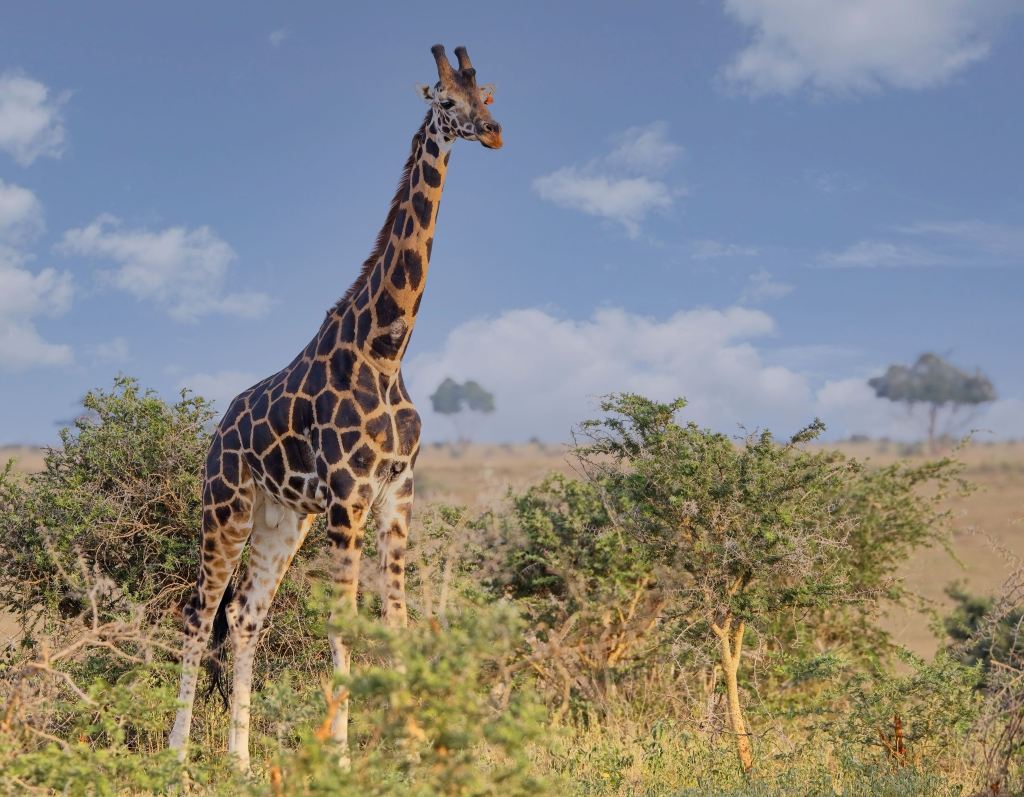
We had another box lunch (always way too much food) and then spent the next 5 hours mammal and bird watching in Queen Elizabeth II National Park. It was founded in 1952 by combining the Lake George and Lake Edwards Games preserves, first named at Rwenzori National Park and then changed to its current name. The 764 square mile park, like many parks in Africa, has a somewhat tainted history due to the forced relocation/removal of many tribal people. With a large mammal and bird population, it is a very popular safari location. There are no Zebra, Giraffes or Impala as we had seen previously, but it was here that we had our first lions and elephants. We would also add 31 species to our growing Uganda bird list. Our boat trip on the Kazinga Channel connecting the two lakes was once again a trip highlight. Our time at the park will be covered in the next blog post.

Please visit the Ride 4 A Woman website. ride4awoman.org

Penetrating the Bwindi Impenetrable Forest – Gorilla Trekking and then off to Mahogany Springs

June 20 – Bwindi Impenetrable Forest – Our Mountain Gorilla Trek

Probably the single most important factor in our choosing Uganda as our next Africa destination was the possibility of seeing Mountain Gorillas. According to the latest released data, there are only 1063 of these large and powerful primates remaining in the world, with two separate population groups, one in the Bwindi Impenetrable Forest and one in Virunga Volcanoes – a region spanning three national parks in Uganda, Rwanda and the Democratic Republic of the Congo. They are found in high-elevation montane and bamboo forests adjoining agricultural areas. A little less than half of the Mountain Gorillas are in Bwindi. The other gorilla species, Lowland Gorillas, has a much larger population.

As humans we share more than 98 percent of our DNA with gorillas, only slightly less than the amount we share with Chimpanzees and Bonobos. Mature males are known as Silverbacks and can weigh over 400 pounds, measuring over 5 feet on all fours and over 6 feet tall when erect with a wingspan of 8.5 feet. They are incredibly strong being able to lift over 4000 lbs. and yet are able to effortlessly climb trees if branches will support their weight. Gorillas can live to 40 years of age. They do not eat meat, favoring plants, fruits and nuts. They can run at speeds up to 25 miles per hour. Gorillas live in family groups with a dominant male and change their sleeping areas nightly.

There is an elaborate system for gorilla trekking at Bwindi – strictly regulated and allowed only with park rangers and with a permit issued by the Bwindi National Park – limited each day and costing $700 each – funds that support the park and its administrative and ranger details and the community. There is no guarantee that gorillas will be seen but the Park makes great efforts to make it “highly likely”.

Here is the gorilla trekking process: Meet at the Park Headquarters where a head ranger gives background on gorillas and explains how it works. Local villagers from Ruhija – mostly women but some men then do several dances for the assembled “trekkers” (maybe 30). The dances are very energetic and sometimes the dancers pull people out of the audience to join them (usually embarrassing themselves in the process). Both Cindy and I were invited (coerced) to join in – separately. Viewers are encouraged to leave a gratuity in a can in front of the dancers. Cindy did great; fortunately there are no photos of me dancing.

Dancers from the Village
Cindy Dancing

After the dance, viewers are assigned to groups of no more than 10 who will then trek previously identified gorilla groups. Ours was the Bituicura Group. There are three such groups in the Bwindi Forest that are acculturated to and thus comfortable with humans in their midst. Trackers have staked out the general locations of the individual gorilla groups based on where they slept the night before. The trekkers are driven to trail entries into the jungle which will take them to the gorillas – hopefully. In our case the entry point was a mile or two from the headquarters. Any trekker that so chooses can hire a porter to carry their gear and help them with the ascent and/or descent and trek through the jungle. The porters are from the village – both men and women – and only get to do this maybe once a month. The charge for the porter is $20 – a significant amount to them. Cindy and I both elected to engage a porter – hers was named Hilda and mine was named Michael. (Just a note, most of the Ugandans we met who interacted with tourists had “English names” as well as their Ugandan names in their tribal language.”) The porters also provide walking sticks for the trekkers – generally bamboo rods – which proved essential. We would not have made it without the porters or the sticks.

Porters including Hilda

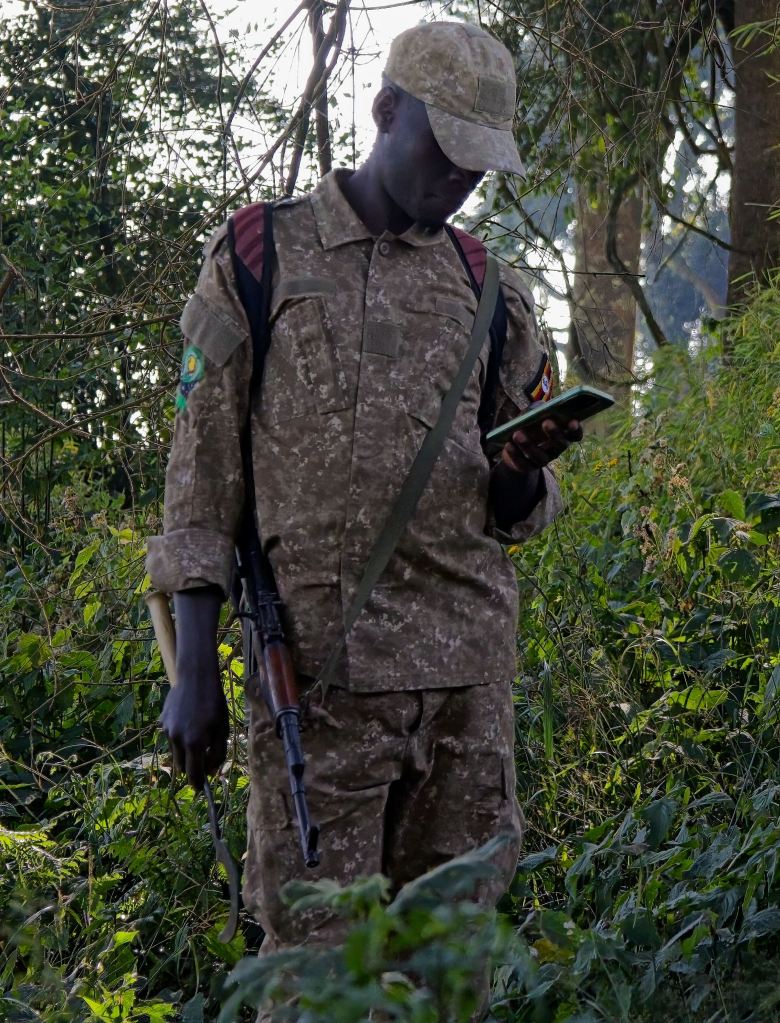
Each group is accompanied by a tracker – with machete in hand and used continuously as there are narrow trails that quickly end and it is necessary to bushwhack through the brush to make any progress. Each group is accompanied also by a ranger with a rifle. The gun is not to shoot a dangerous gorilla if trouble arises but to make scary noises in case any forest elephants show up. The elephants are very dangerous and need to be scared off. Fortunately this did not happen for us. Our group of 5 was joined by a young couple from Spain.

Our Protection – In Touch with Other Rangers by Cellphone

There is no way of knowing in advance how far one must go to reach the gorillas (hopefully). It can be as little as a quarter of a mile or several miles. When/if the gorillas are reached, you are allotted one hour with them. The porters stay away leaving the group and tracker and ranger to enjoy the gorillas, take photos etc. There are rules of conduct to be sure the behavior of the guests does not provoke the gorillas – passive, quiet, non-threatening, slow movements, avoiding eye-contact etc. In the event of a medical problem or if someone just cannot make it, you can call in a “helicopter” to rescue you. Not the flying mechanical kind, but a group of 4 to 6 villagers with a stretcher/litter who will carry it out with you on it. The cost is $300. One of the people in our party was very overweight and did consider calling for one. He persevered and made it without the helicopter.

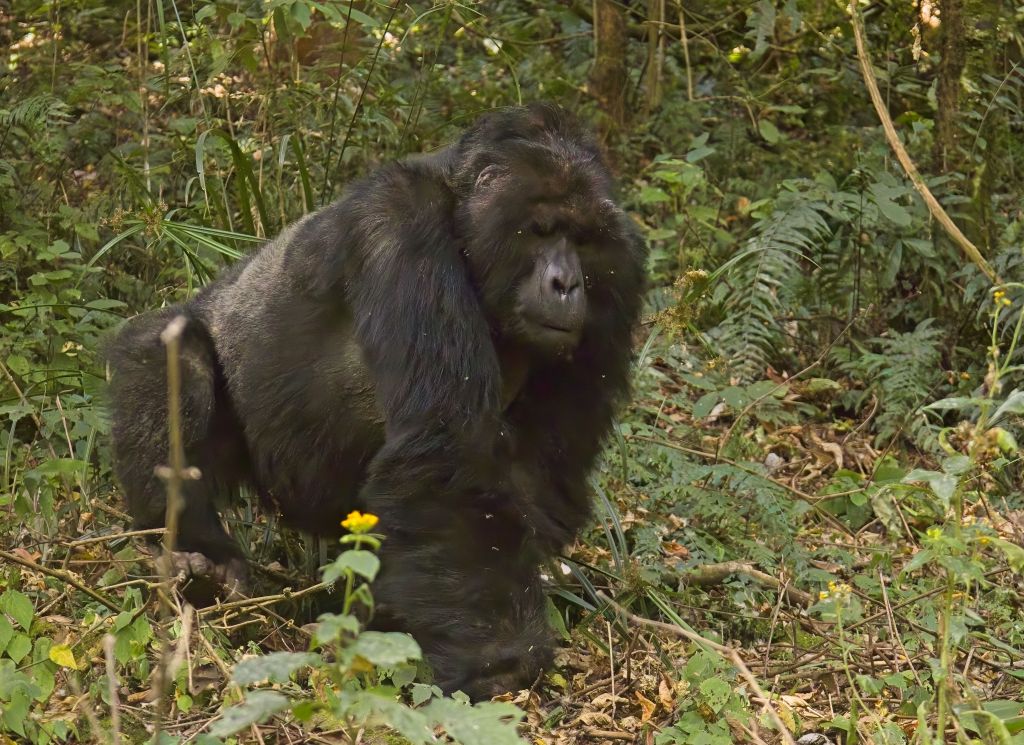
So much for the general background – what about our trek? Bottom line – we did find a group of at least 8 gorillas – eventually. It was after an hour and a half of very difficult steep slow-go downhill “trekking” for significantly over a mile – all through very thick jungle with very little of it on any kind of trail – stepping over or through logs, roots, ferns, nettles, rocks, vines etc. For at much of this journey we were physically aided by and indeed relied upon our porters who were very strong and in great shape. And when we finally found the gorillas, they never kept still for more than a few moments. The hoped for situation is that you find them after they had eaten and are passively resting – and mostly still. Not our group – they were almost constantly on the move through heavy foliage looking for more food and barely interacting as we had seen on many reels on Facebook and You Tube. Most of our looks were of gorilla’s backs as they continued their foraging going downhill away from us. This continued for an hour and we kept going further and further downhill away from the vehicles up on the road where they had left us. Our porters continued on with us – again a necessity as the tracker continued to cut the way with his machete. Fortunately it did not rain and due to the elevation and being in thick jungle and thus out of the sun, it was neither hot nor humid – a blessing for sure. However the darkness in the jungle also made photography challenging even when there were possible shots of the animals.

At one point I was leaning up against a tree concentrating trying to get a better angle for a photo of a Silverback that was maybe 40 feet away. I felt something graze my shoulder from above and heard a shriek from behind me which was followed by a shriek from me. It was a fairly young gorilla coming down from the tree where apparently it had been eating some fruits high up and out of our sight. My shriek was not from pain or fear, just absolute shock. Even though the gorilla barely touched me, I could feel how solid it was, all muscle – not an encounter to be encouraged. Despite the difficulties and challenges, we certainly saw the gorillas and were able to get some decent photos, regretting mostly that the gorillas we had very few straight on looks to see the faces – each unique just as with us humans.

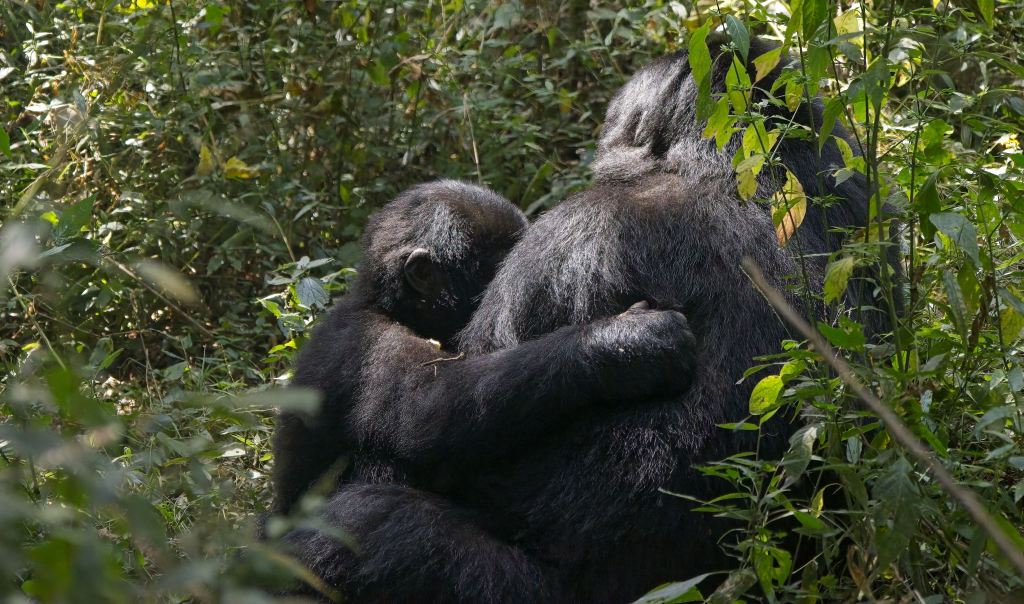
Almost the Picture We Wanted but Neither Mother or Baby Turned Around
This Old Silverback Had Relinquished His Dominant Place
Big Dominant Silverback
Younger Gorilla
This Picture Shows our Typical Situation with the Gorilla Moving Away from Us – Downhill and Through the Jungle – Usually Even More Dense

After maybe 70 or 80 minutes overall where we had been in contact with the gorillas, the ranger signaled that it was time to let them go and start our return. We had been given some extra time because it was realized that we had had to keep moving to have them in sight at all. By this time, we had come a long way down the steep slope and the thought of climbing back up was daunting and quickly dismissed. Instead we would continue further down until we hit an agricultural area and then a road. This sounded better than a climb back up especially with us thinking that our vehicles would be waiting for us. No not the case, the continued descent was longer than expected and when we got to the road, we learned we would have to hike up it for a mile or two to get to a place accessible by the vehicles. And now we would be in the open in the heat and the road was a very steep climb. After more than another hour, we finally got to the vehicles – ending what Cindy and I both agreed was the hardest thing we had ever done. Our porters had accompanied us the entire way, thankfully continuing to carry our packs and water. They rode back to Ruhija with us, and we gratefully acknowledged their efforts with a second $20 payment. This was a big deal for them as even a single $20 payment is highly sought after and recall they only get to do it once a month.

Given the great difficulty getting to the gorillas, the limited intersection and observation of them and the difficult hike down after the gorillas and then the challenge to get back up to get to the vehicles, despite the amazing experience of seeing them at all, Cindy and I both agreed that if we had known that our trek and interactoin would be what it was, we would not have gone – just not enough reward for the effort and cost. Of course we did not know this at the start and it could have been very different and better. There will not be another opportunity so this will be our only gorilla experience of our lives. Without the present agony of the trek, we can say we are glad we did it and we have certificates to prove that we completely the trek and some photos to memorialize the day.

Proof of Trekking

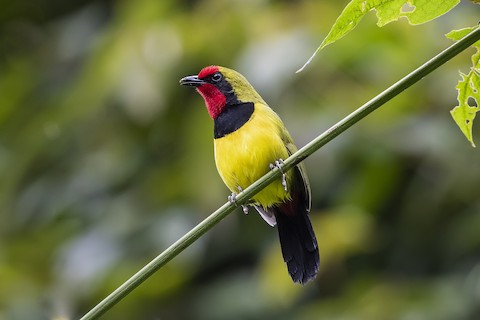
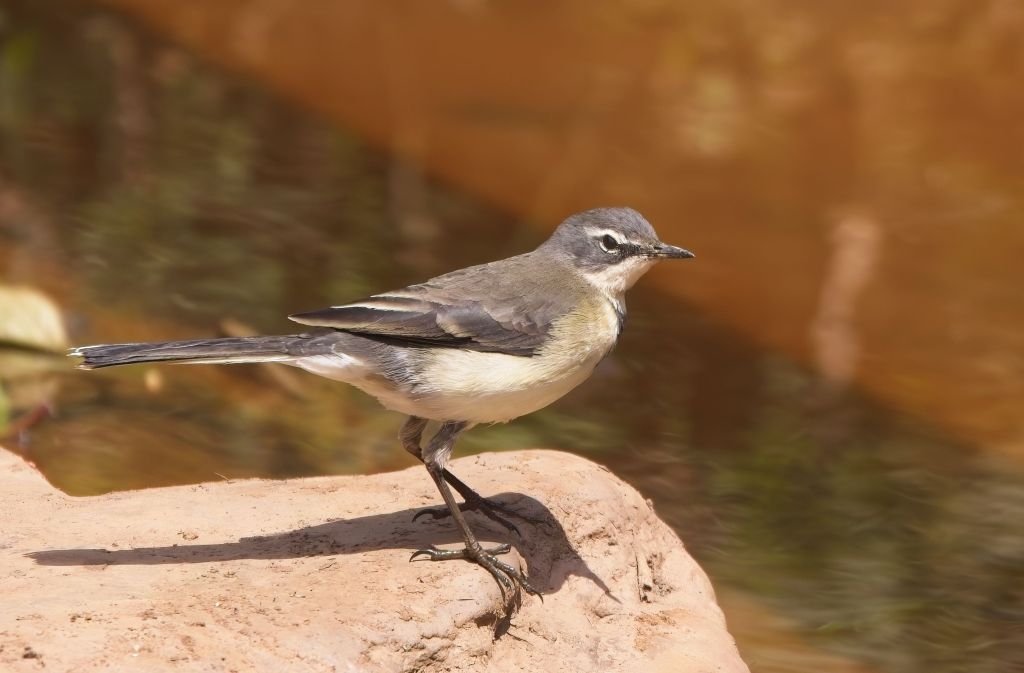
There were birds along the way as we were trekking but our concentration was elsewhere and we were mostly looking down making sure we did trip on the roots or rocks or avoiding thorns and nettles. Our only visuals were after we parted from the gorillas. Before that the species were essentially heard only including two lifers Rwenzori Apalis and Doherty’s Bushshrike. I am particularly sad that we never saw the latter – a very striking bird. The only bird photo I got was of a Mountain Wagtail, a species I had photographed last year in Tanzania.

Doherty’s Bushshrike – Internet Photo
Mountain Wagtail

Finally we were done trekking. Two vehicles met us at the top of the road – one for our group and the other for the two Spaniards. All porters, trackers and guards loaded into the two vehicles for the return to Ruhija. We dropped Michael off at the Headquarters building and Hilda off at her handicraft shop in Ruhija and our very tired lot made it back to Gorilla Mist Camp. It had been a long day and it was now late afternoon. Time for a little rest and then dinner.

June 21 – Bwindi Impenetrable Forest Part 2 – Birding as We Left the Park

Today we would have a reasonably late breakfast (even later for Cindy who slept in), bird for a couple of hours in Bwindi near Ruhija, return to get our bags from Gorilla Mist Camp/Lodge and then bird for awhile further along in Bwindi Impenetrable Forest NP as we worked our way to our next accommodations at Mahogany Springs on the other side of the Bwindi Impenetrable Forest NP where we would spend the next two nights.

We had 38 species in our 2 hours of birding in the morning. Fourteen species were new for the tour and 4 were lifers and 8 were life photos – an excellent morning.

Cassin’s Hawk-eagle – Lifer
Abyssinian Thrush – Life Photo
Green White-eye – Life Photo (finally)
Strange Weaver – Distant Poor Photo – Lifer
Regal Sunbird – Lifer
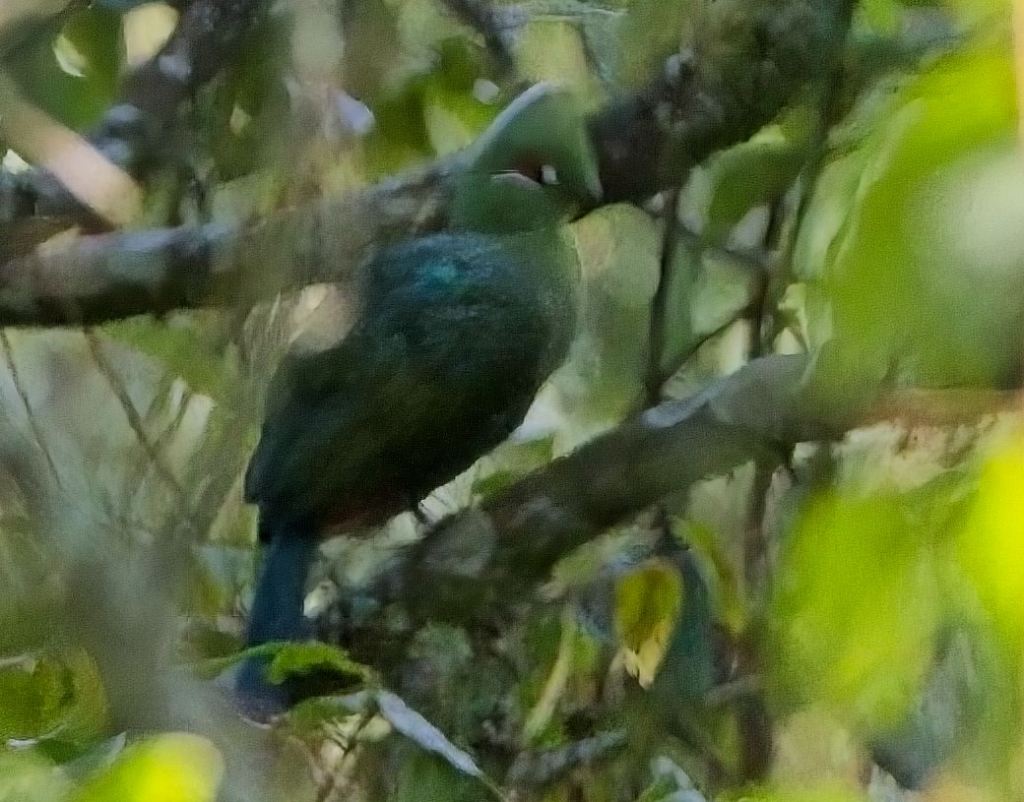
Black-billed Turaco – Really Tough Shot
Northern Double-collared Sunbird (My best photo of this species)

I was sadly unable to get photos of a couple of the lifers, little birds that I could not pull out of the foliage. Not a lifer but a would have been life photo was a Blue Malkoha. I have a photo that is probably it with a blurry yellow bill, but I just cannot stretch standards enough to include it. The photo below is from Ebird.

Blue Malkoha – Ebird Photo (Jan Harm Wiers)

It was then back to Gorilla Mist Camp to load up and grab box lunches for the road. There was one important stop on our way out of Ruhija – the crafts shop of Cindy’s porter, Hilda. We had seen some masks earlier at hotel/lodge gift shops and were interested. When we saw that Hilda had masks in her shop it was easy – well except for choosing which one. They were all very reasonably priced. There was some extra room in our luggage for a smaller one as we had brought an extra bag so we made the purchased and bid goodbye to Hilda – more on that later.

Cindy with our Mask and Hilda at Her Shop

Our main stop would be to a hotspot in Bwindi Impenetrable Forest NP called “The Neck” where we birded along the road for something over an hour after our box lunches. There were 17 species of which all but 2 were new for the trip and 3 were lifers (one heard only) and with 4 life photos.

Cassin’s Flycatcher – Lifer
Green Sunbird – Life Photo
Speckled Tinkerbird – Lifer

We reached Mahogany Springs mid-afternoon and checked in to our lovely rooms. Cindy stayed behind and had what she said was the best facial she has ever had and the rest of us birded for an hour on the Park Entrance Road adding another 10 species to the trip list (now at 261 species) including 4 more lifers for me but photos were hard to come by with mostly small and distant birds in thick foliage. I managed poor photos of two of the lifers – White Breasted Nigrita and Toro Olive Greenbul and a lifer photo of a Rock Martin.

Rock Martin – Life Photo

We were glad to check-in to the Mahogany Springs Lodge which was at least one and maybe two or three steps above the accommodations the previous 4 nights. Those places were fine but only fine with electrical switches and outlets either absent or in odd places, with generally poor lighting and challenges with water temperatures and Wi-Fi. Remember we had been spoiled in Tanzania where those had not been issues at all. Cindy was particularly pleased to have access to a hair dryer again. Definitely 1st world criticisms – and again, not in any way unsafe and sleep challenging, but still we really enjoyed Mahogany Springs. The photos tell at least part of the story.

Accommodations in Separate Chalets
Large Beautiful Rooms
The Setting at the Edge of the Forest
Our Always Smiling, Always Attentive, Always Gracious Host

Uganda – On to Lake Mburo

June 17 – Day 2 (or 4)

It seems like all the tour companies now add days in transit to the advertised length of their tours. So even though this was really only the second full day of the tour, it is reflected as Day 4 since the travel day to get to Uganda and the day of the meeting dinner were included. Since it was our 4th day in country and we had birded on all the days, it did not matter to me. BUT another timing issue did matter. I forgot to reset the time on my camera so it was actually still recording photos on Pacific Daylight time. Thus a photo date stamped as 10 pm on June 15th was actually taken on the morning of June 16th. I did not catch this error until late in the tour and then reset the time but by then I had a lot of photos that were out of place. Theoretically easy to fix, but since I had processed and/or downloaded some photos as we progressed, it was more of a challenge than it should be. I promise I will never do that again…but that only matters if my memory recalls the promise.

We had breakfast at the Boma and said goodbye, loading our goods onto the Land Cruiser. One nice thing about this tour was that we stayed at least two nights at every stop, so the packing and unpacking was not too bad. Of course, this also meant that there were some places where a single night might have been preferred had stays of two or more. From the Boma Guesthouse we set out for our first stop at the Mpanga Central Forestry Reserve traveling through Kampala, the Ugandan capital. Kampala is a large metropolitan area with a population approaching 4.0 million with the population of the whole country being around 48 million. The traffic is pretty staggering with the mix of buses, jitneys, motorbikes, trucks, and perhaps even thousands of pedestrians feeling pretty chaotic to my western eyes – not dissimilar though to other large cities in un- or under- developed countries. Veronica masterfully handled the traffic and although it looked like accidents should happen every moment, we saw none. We got out of the urban density and arrived at the Mpanga Forest Reserve. Unfortunately so did a lot of clouds.

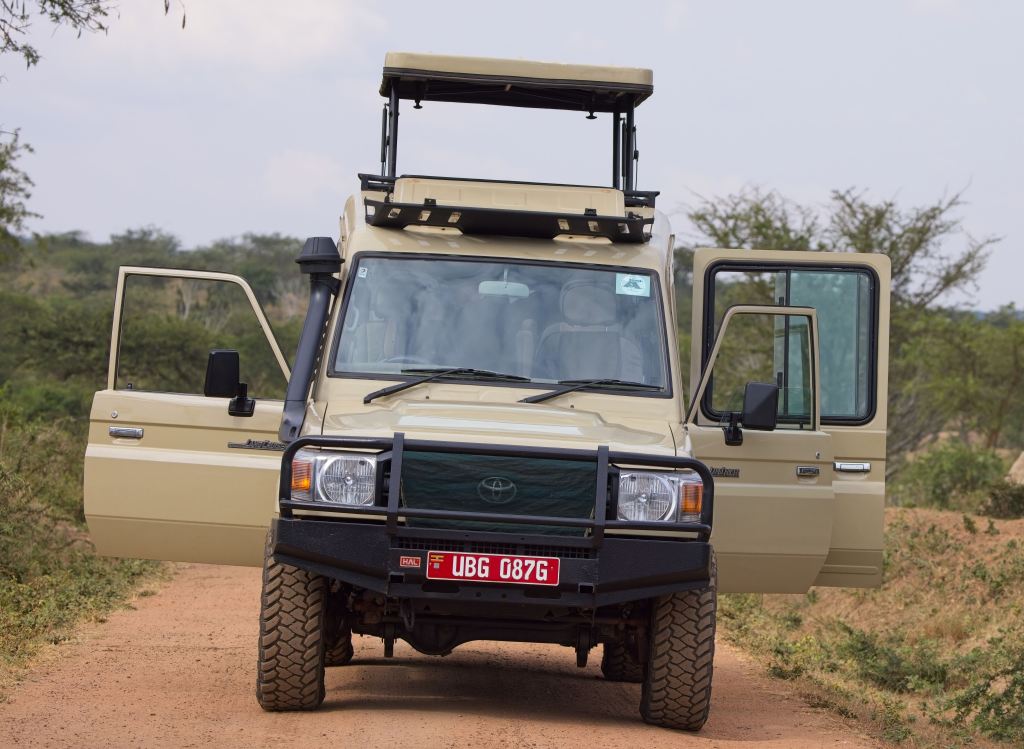
Our Trusty Land Cruiser – two seats up front and six in the back – with a pop top

With the threat of rain seeming certain, we began birding and cautiously added only a few species to our trip list. But apparently the birds knew that rain was coming and it very quiet and birds, if active at all, were seeking shelter. Photo ops were non-existent in the wind, under gray skies and with birds hiding in the brush. I got glimpses only of two species that would have been nice to photograph: Brown-throated and Green-throated Sunbirds, the former a lifer. Then the threat of rain became actual rain, starting slow and picking up to a pretty hard downpour. We tried to wait it out for 30 minutes, but no go – so we left. This would be our only rain of the tour so hardly a reason for complaint, but still a disappointment as in addition to the two sunbirds, it was supposed to be a good place for Green-backed Twinspot and Fire-crested Alethe – two would-be lifers.

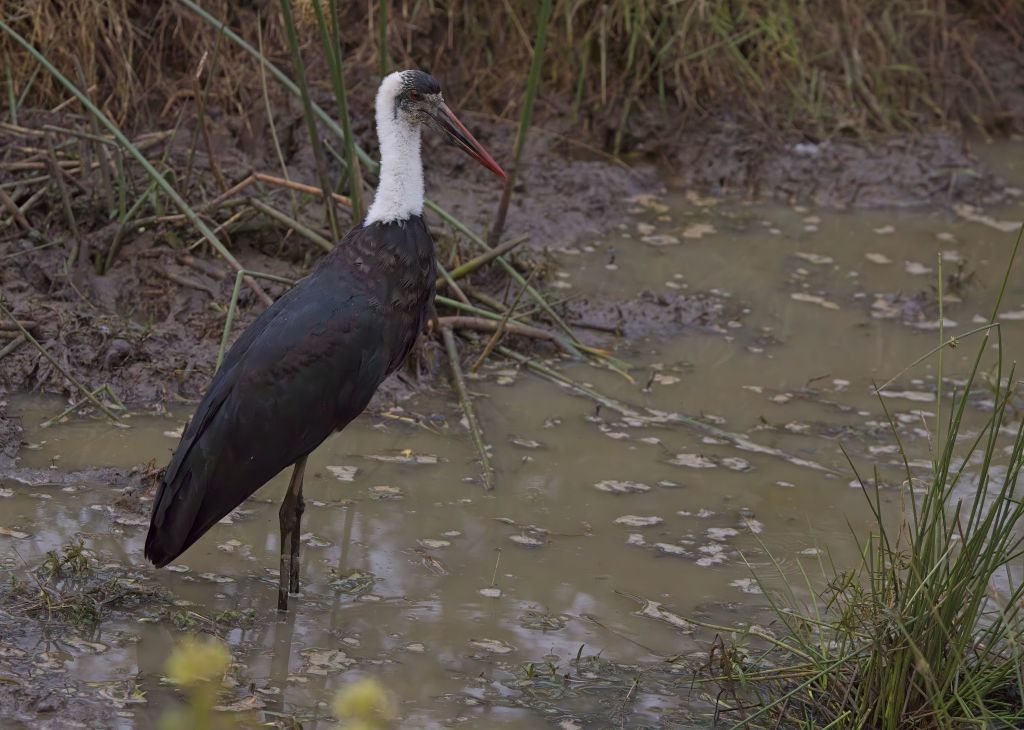
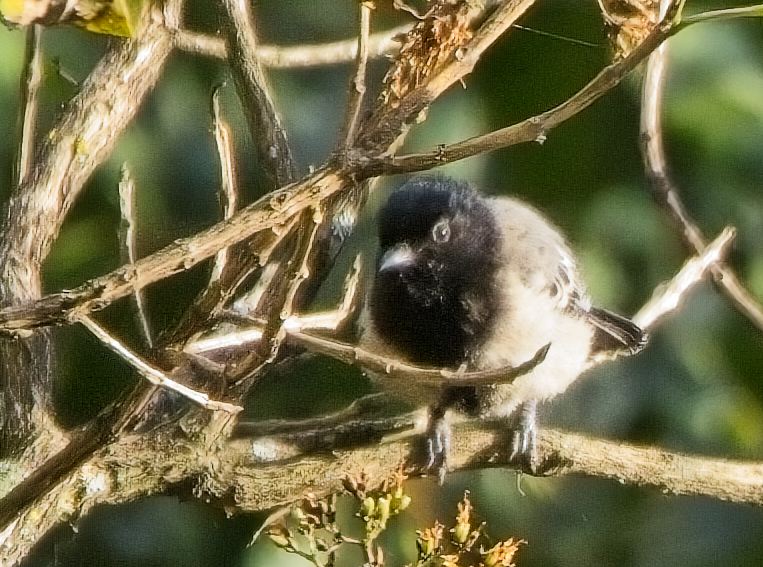
We continued on with a few brief birding stops or observations along Masaka Road with the best being a field with 100+ Gray Crowned Cranes – the National bird of Uganda. We also had what would turn out to be our only look at a Lilac-breasted Roller, one of the most beautiful birds anywhere and maybe the most frequently photographed bird in Africa. No photos this time, but I had many from previous African trips. We finally arrived at Lake Mburu National Park, birding first along the entrance road and then in the park itself – now under clear skies. We added lots of new Uganda birds at both places but no new lifers and in part because of the camera time error and maybe some other mishap on my part, I have not been able to find/retrieve many photos from this day – noting however, that I have photos from later for all of the species we saw then. One of the photos I did find was of an African Penduline-tit – a life photo but not a lifer. Two other photos are from a little pond outside the park where several birds were seen together. Good photo ops for African Woolly-necked Stork and one of my favorites, Saddle Billed Stork.

Gray-crowned Crane – National Bird of Uganda
African Penduline-tit

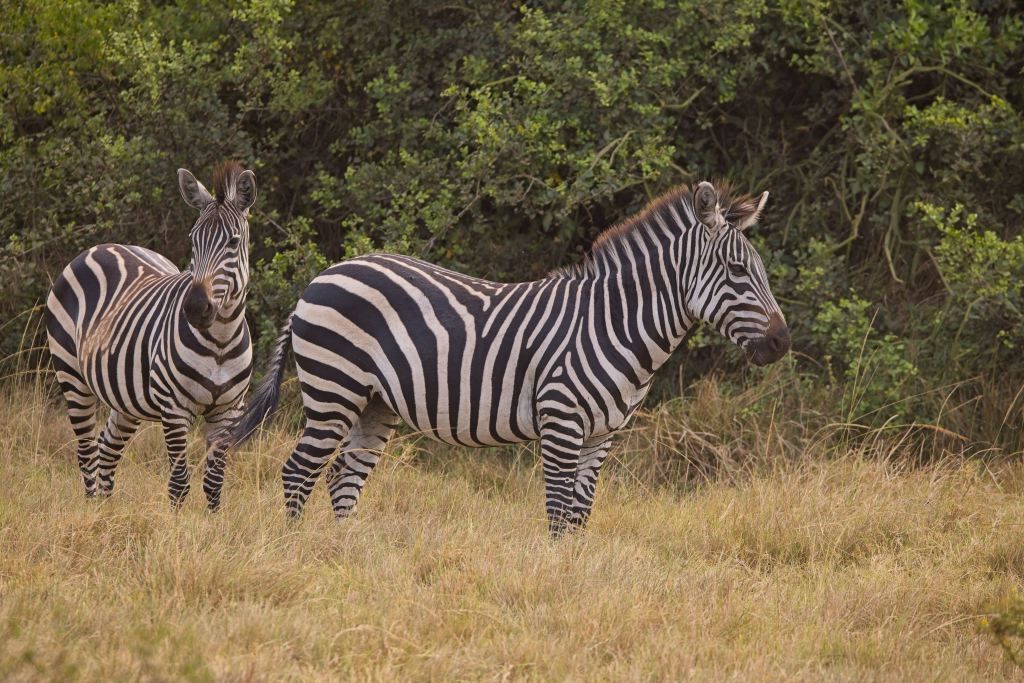
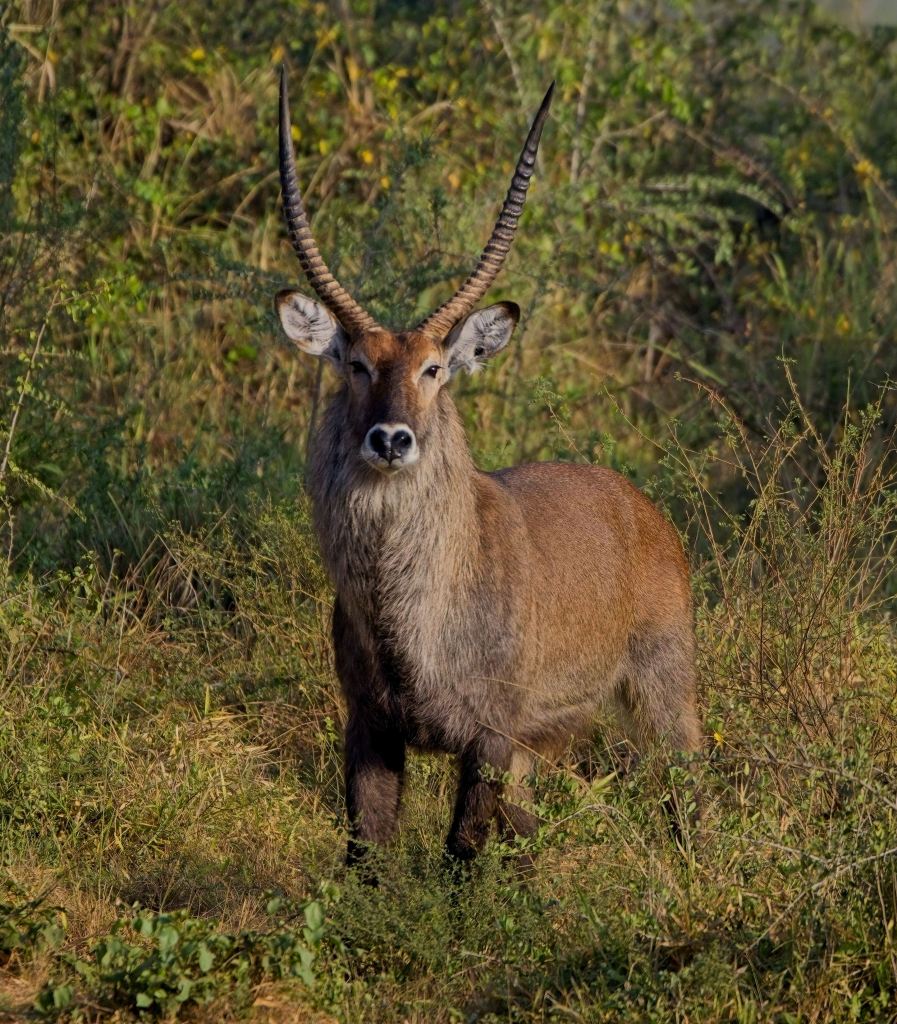
This was the first day when we would see some large mammals which are what most people associate with Africa – albeit just a small taste of what would come later. We saw our first Zebra, Warthogs, and a variety of species of antelope: Topi, Impala, Bushbuck and Defassa Waterbuck, the latter would be the antelope seen most often throughout the trip.

Common Zebra
Defassa Waterbuck Male

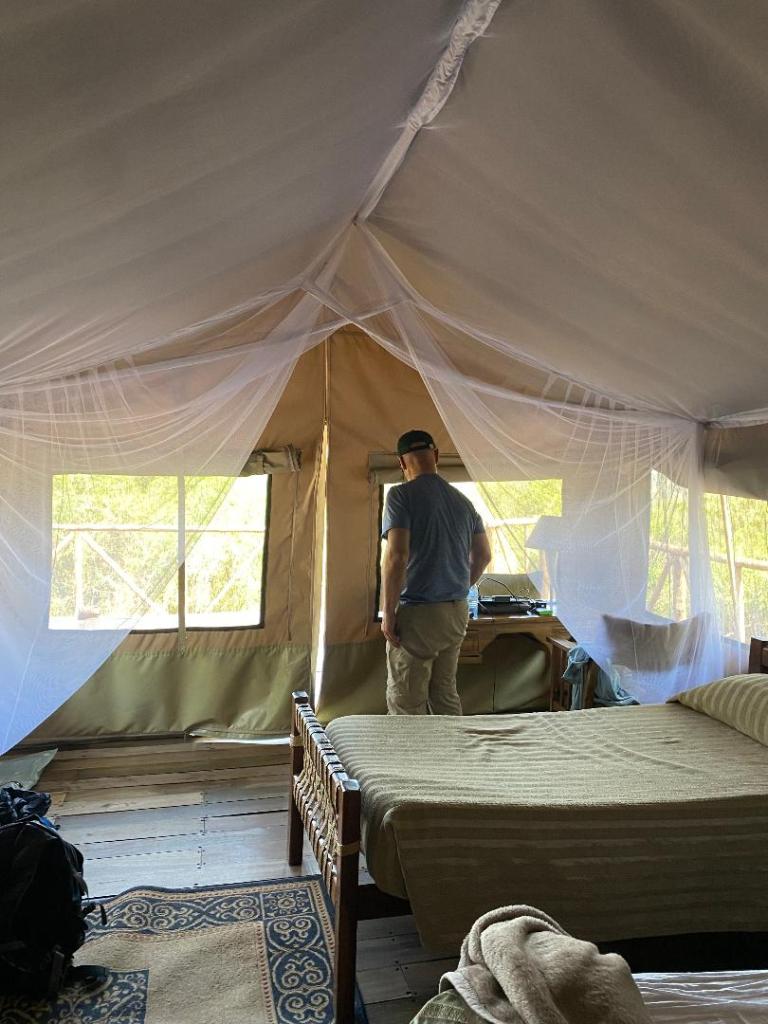
We moved to the Mantana Tented Camp for the night. Very much like the Kubu Kubu Tented Camp in Tanzania, this was not my idea of a tent. It was a significant if somewhat soft walled structure on a wood platform with nettings and zip up doors and a zip up wall dividing the sleeping area from the self contained bathroom with shower and flush toilet. As would turn out to be the case in some other accommodations, the only internet service (wi-fi) was at the main hall/reception/dining room and there was limited if any ability to charge electronic devices except there as well. These were NOT major issues but were another example of a difference between our lodgings in Tanzania and in Uganda. We were the only people at the camp and were treated very well by friendly, competent and gracious staff. Showers were by hot water that was delivered at whatever time was requested. It took a little tinkering to get the mix between hot and cold water right but the water pressure and availability was great. As with everywhere else in Uganda (and in Tanzania as well), bottled water was provided for drinking and tooth brushing etc.

June 18

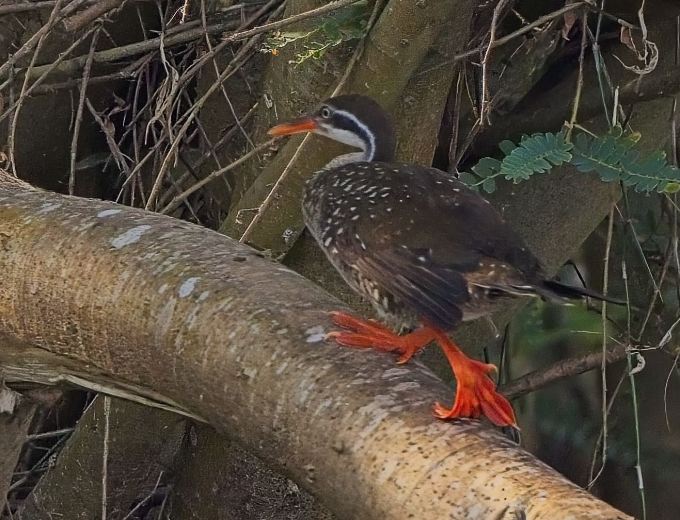
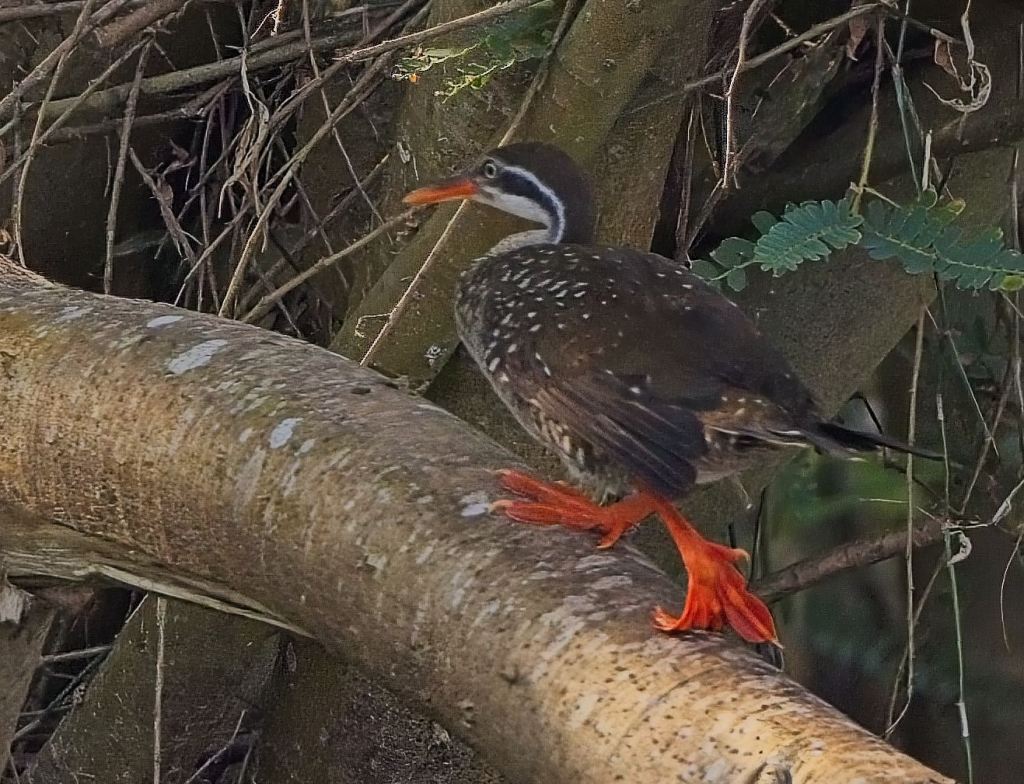
Today would feature another boat ride – this time motorized as we would explore part of Lake Mburo NP, starting at the Nyarutegura River mouth. There were many of what I would call water-oriented birds, but the majority of of the birds seen were on the land adjacent to the lake. Over 4+ hours we had 66 species with photos of almost half. Ten were lifers and 14 were life photos. Without question, the most special of the birds seen, and one on my ten most wanted list for the trip, was the African Finfoot. It took some doing and lots of luck, but I was able to get a decent photo of the Finfoot running on a log showing its huge finned feet.

African Finfoot

Many of the views were distant and of small birds in foliage, so not as many great photos as I would like, but as has been the case with all of my birding boat rides, being able to see the birds from the water was great. Not going to include all the photos – just a sampling.

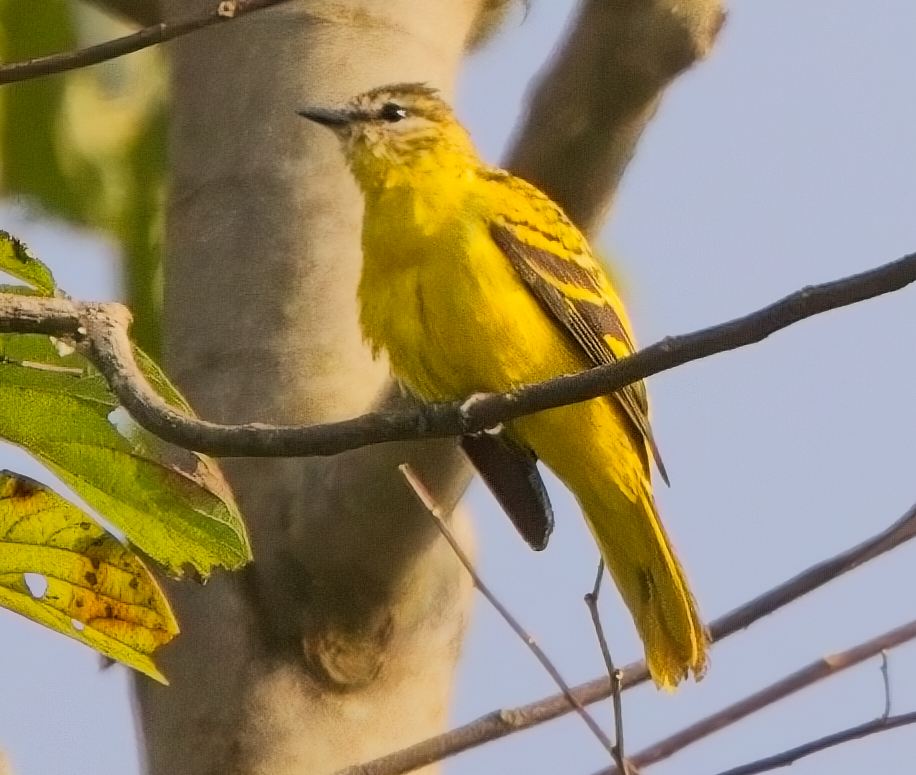
I am including these Barbet pictures not because they are great photos, but because Barbets are one of my favorite groups of birds – found in South America, Africa and Asia – all with something special.

That afternoon birding continued in the National Park and Cindy was finally feeling a bit of jet lag so she sat this trip out. This would hopefully not turn out to be a big mistake as we saw more mammals and had really great close encounters with some giraffes – one of her favorite animals. At first we saw only a couple off in the distance and I was not worried about what she had missed. Later we had giraffes very close and I debated whether I should tell her. Fortunately it was a moot point as we would have excellent intersections with these amazing animals again.

A Magnificent Giraffe

We had good birds as well including lifer Sooty Chat and Tabora Cisticola. Altogether we had 50 species, of which only 8 were new for the trip including Bare-faced Go-Away Bird, African Scops Owl, Common Scimitarbill and Gray-headed Kingfisher, but together with the morning birding in the park our day list was 92 species. We spent another night in our “tents” and then the next morning we would head off to the Gorilla Mist Camp in Ruhija and the promise of Mountain Gorillas.

Tabora Cisticola – Lifer
Bare-faced Go-away Bird
African Scops Owl
Gray-headed Kingfisher

June 19

Our bags were packed and we ready to go with a relatively late (7:30 a.m.) start for more birding in Lake Mburo NP and then our trip to Ruhija and Gorilla-land. In 2 1/2 hours we had 42 species including 8 new species for our tour list, no lifers but one life photo – White-chinned Prinia. My photo of a Red-faced Crombec was not new but any photo of the tiny little tail-less crombecs is appreciated.

White-chinned Prinia
Red-faced Crombec

An Aside: As all birders know, there are rarely guarantees that a species will be seen at a given time or place. Weather, time of day, luck and other factors may produce very different bird lists for the same place comparing one year to another. In their descriptions of their tours, the tour companies generally provide a list in one form or another of birds that might be seen at various stops on the tour. We had seen a lot of birds, good birds at Lake Mburo NP including the prized African Finfoot. It was interesting, however, in retrospect to compare our Lake Mburo list with the birds named in the list of species “recorded in the park” included in VENT”S promotional materials. Not included were any of the three nightjars that we observed, but 17 of the species that were listed (more than 1/3) were not observed – 3 of which would have been lifers. The list of birds from the park had NO impact on my decision to take this trip and the same result would be found from any promotional material for any bird tour. By our nature, we want to see all the birds that are possible, but we know that is rarely if ever the case. If we had spent another day or two or three at the park, I bet we would have seen some if not many of the “missed” birds. The only reason I included this “aside” is because I am planning some future trips and I was thinking about my priorities and expectations. Bottom line here is that as long as we found that Finfoot, I was going to be happy – even a crappy view would have sufficed. We did much better than that with great views of more than one Finfoot and a total of 120 species in the Park – even without those from the “recorded in the park” list that were not found.

It was a long and somewhat torturous drive from Mburo to Ruhija – about 4 hours much of which was on two lane roads, mostly dirt and winding through a number of small villages/towns, some very rough and with many slow going trucks slowing things down. Thus as was as stated in an earlier post, this was a very different experience than Tanzania where we had much less intersection with the towns. Rather than go into details here, there will be a separate post about day to day life in Uganda, at least as seen by us in our transit through these towns. This was definitely not 1st world travel as the towns were very busy, crowded with small shops, markets, and people, lots of people – carrying goods, on motorbikes and bicycles, mostly on foot, basic housing, and then more of the same. Between the towns, there were still many people on foot and often children on the way to or from school or just together with their mothers or each other – almost always waving and smiling as they noted our presence. As I said much more on this later in a blog illustrated mostly with Cindy’s pictures. There were intermittent stops along the way as we saw a bird here or there, on wires, in the brush or trees, on the road, in the papyrus and then on the Bwindi Forest Road approaching our lodging for the nights ahead at the Gorilla Mist Camp. In Bwindi, I added 5 lifers, not especially well seen or heard only – too often the case over the next days as well, but there were some photo ops as well. There were 36 new species for the trip – evidence of how speciation is so related to habitat change.

Black-faced Apalis – Lifer
Stripe-breasted Tit – Lifer
Black Sawwing – Life Photo
Chubb’s Cisticola – Life Photo

We were only a third of the way through the tour itinerary and we had 215 species. I had added 34 lifers and at least as many life photos. As I planned for the trip, my hopes were for at least 100 lifers and maybe as many as 150 as a long shot. I also hoped for at least that many life photos with most being of those life birds and then others species I had seen previously in Africa without a photo. At this point, it wasn’t clear if those goals would be met. The next day we would find out if another goal would be met. Would we see a Mountain Gorilla?

Uganda – Starting the Tour at Entebbe and then our first Shoebill and more at the Mabamba Swamp

The promotional material for the Victor Emanuel Nature Tours trip to Uganda indicated “Uganda is safe and delightfully friendly. As a country it has undergone astonishing changes in recent decades. Infrastructure improvements to the roads, lodges and development programs for the local guides have made wildlife touring in Uganda one of the best experiences possible in the natural history world.” It continued with the note that there would be opportunities in this country where the African savannah meets the African jungle, for lions and elephants, crocodiles and hippos, leopards and giraffes, chimpanzees and mountain gorillas, many other primates and other mammals and lots of birds including the iconic Shoebill, kingfishers, hornbills, turacos, trogons, sunbirds and weavers – maybe 450 species of birds in all.

For better or worse, Cindy and I had had a wonderful trip to Tanzania with up close encounters with the Big Five, cheetahs, thousands of mammals, wonderful places to stay, beautiful scenery and super people – both traveling companions and Tanzanians and wonderful and numerous birds. The Tanzania trip set high expectations, a high bar to meet. We had not appreciated it at the time we signed on for Uganda, but there would be two major differences in the nature of the trip itself. One was that there would be a lot more time spent in the jungle/forest in Uganda with birding more challenging and sometimes frustrating as a result and another was that there would also be a lot more travel through small villages and towns in Uganda compared to travel time spent mostly in and between savannah like National Parks in Tanzania. There were pluses and minuses comparing the two environments. The tourism industry is relatively new in Uganda whereas it is well established in Tanzania, and the associated infrastructure is far more (and better) developed in Tanzania. Roads and lodges in Uganda were a level or two below Tanzania. A real problem? No. Noted? Yes.

That said, our first days and nights at the Boma Hotel Guesthouse in Entebbe were great. Very comfortable room, good food, terrific people, beautiful gardens and a great location in a safe and in some cases, upper class neighborhood with an odd combination of dirt roads and large, elegant, gated homes. We had a full day and a half to acclimatize before the formal trip began, our choice since the travel time from Seattle to Uganda was over 20 hours and there was a ten hour time difference (Uganda being ten hours ahead). It was a good decision as we got some time for a short nap and time to walk around and bird in the neighborhood in addition to some leisure time and birding at the Boma as well.

June 14

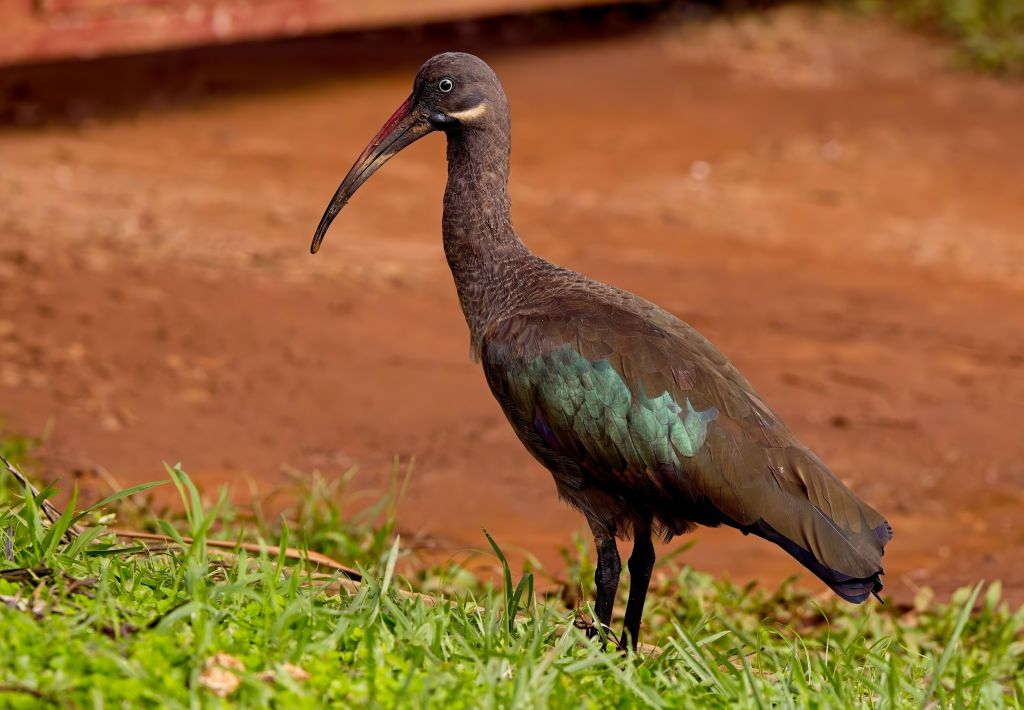
It was the morning of June 14th and the weather was a perfect 75 degrees without a cloud in sight or much humidity. Indeed weather on the trip was consistently great with there being rain on one morning or a couple of nights as we slept. The formal beginning of the trip was dinner on the 15th and it was two early for a nap, so we birded the gardens at the Boma Guesthouse which offered lots of birds and then had a leisurely walk around the neighborhood which added more. Our first finds included a Woodland Kingfisher, Hadada Ibis, two sunbirds (Red and Scarlet Chested), Gray Parrots and a White Browed Coucal.

Hadada Ibis
Scarlet Chested Sunbird

We also met two very interesting people on the walk. The first was an “older bearded gentleman” who started by speaking French to us. I responded with my very limited French and made it clear that we were American so he switched to English – who knows how many languages he spoke. We learned that he had served as a bodyguard to the former Uganda strongman Idi Amin. Not sure of his politics now but he was proud to be a Ugandan. Later on a street with many large homes – all gated – we saw a very fit and handsome man in uniform carrying an automatic rifle. His serious look turned to a smile when I told him he was the most handsome man we had seen (he was). We had a long chat in English and learned that he was hired as private security for the neighborhood and had trained with Navy Seals in Washington State and he was familiar with our hometown of Edmonds – what a surprising coincidence. We returned to the Boma and finally had that catch up snooze.

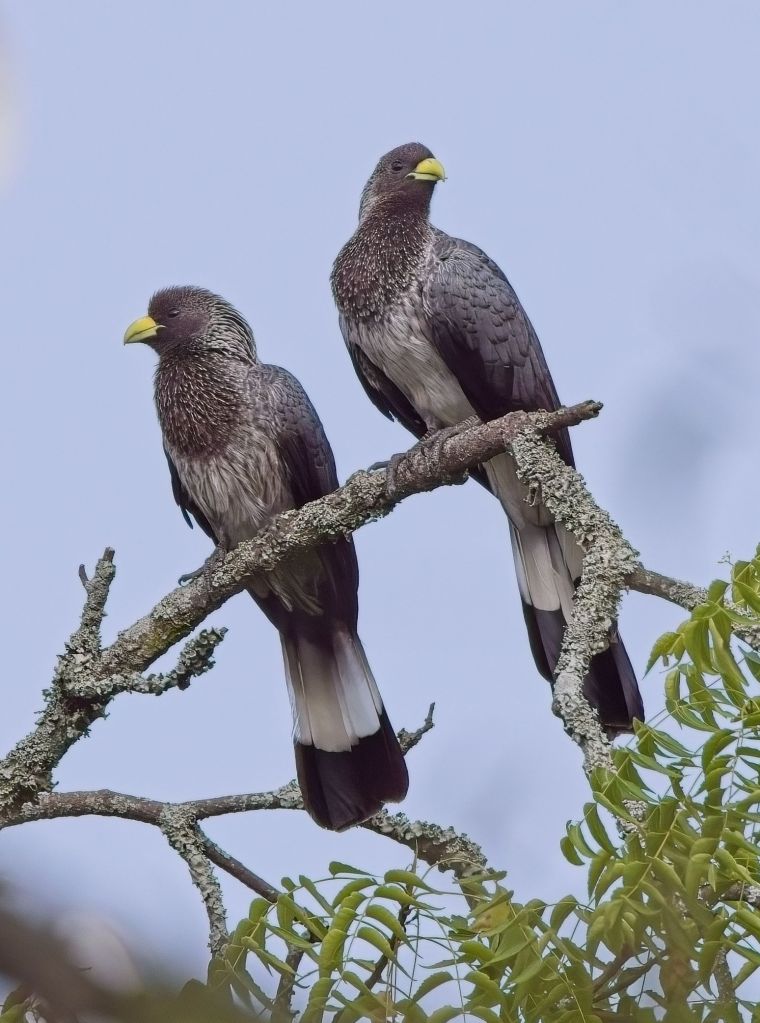
We were back out for another walk in the afternoon and I added the first lifer for the trip – a spectacular Ross’s Turaco – right on the Boma grounds. We also had Eastern Plantain-eaters and our first of many White-browed Robin-chats. All told we had 19 species for the day – a great intro to the Birds of Uganda.

Ross’s Turaco
Eastern Plantain Eaters
White Browed Robin Chat

June 15

After dinner at the Boma Guesthouse, we had a surprisingly easy and good night’s sleep and were up and ready to go at a pretty normal time in the morning. We revisited the neighborhood around the Boma and had another 19 species on our hour long walk. One was a Rameron Pigeon that Ebird said was rare for the area – but I could document it with a photo. The most striking bird was a Black Headed Gonolek and the cutest was a Red-cheeked Cordonbleu. As would be the case for most birds on the trip, due to my previous birding in Kenya, Tanzania and South Africa, none of these birds were lifers, but I was also interested in adding photos to my life photo list. None of the aforementioned birds were new to that list, but I did add a photo of an African Thrush.

That afternoon, we met our tour guide, Dion Hobcroft, who had been my guide on a VENT tour in India in 2011, and the other two members of our group. We spent several hours birding on the grounds of the guesthouse seeing many species we had seen earlier and adding many more including lifers Green White-eye (no photo yet), African Hobby (quick flyover), Splendid Starling and Yellow-fronted Tinkerbird. I also had life photos of Double Toothed Barbet and Brown-throated Wattle-eye.

Splendid Starling – Lifer
Double-toothed Barbet – Life Photo
Brown-throated Wattle-eye – Life Photo

By the end of the day, my Uganda list was at 44 species. Cindy and I both felt good after the long flight and the time adjustment. We were together with the group and had had some good food. We did not know it at the time, but we should probably have made an effort to get to an ATM machine in Entebbe, a major city adjacent to the Ugandan capital of Kampala. There was a commercial area not far from the Boma which would have worked. Too late. The birding had been pretty easy and the birds were mostly in the open and some were even charismatic or even spectacular – the kind most appreciated by Cindy. As is the norm on birding trips, there would be an early start the next day and we would be off to the Mabamba Wetlands and our first boat trip on the tour with our major target being a Shoebill.

June 16

This was the official stat of our tour and there was a major addition as we were now joined by our Ugandan guide who also was the driver of our Land Cruiser for the trip. Veronica Nakafeero would be with us for the first half of the trip. She was proof of the success of the program to develop young bird guides, especially young woman bird guides in Uganda. She would deftly handle the challenging roads ahead and was an excellent spotter and identifier of birds along the way, and also good company – a great addition to the group.

Veronica Nakafeero

We were on the road around 6 a.m. and our first birds were two Great Blue Turacos – spectacular and out in the open. Shortly thereafter, we added another gorgeous bird and another lifer for me – Papyrus Gonolek, a species which was high on my “want list” and then two minutes later another lifer – a Lizard Buzzard. I had the feeling this was going to be a very good day.

Great Blue Turaco
Papyrus Gonolek – Lifer
Lizard Buzzard – Lifer

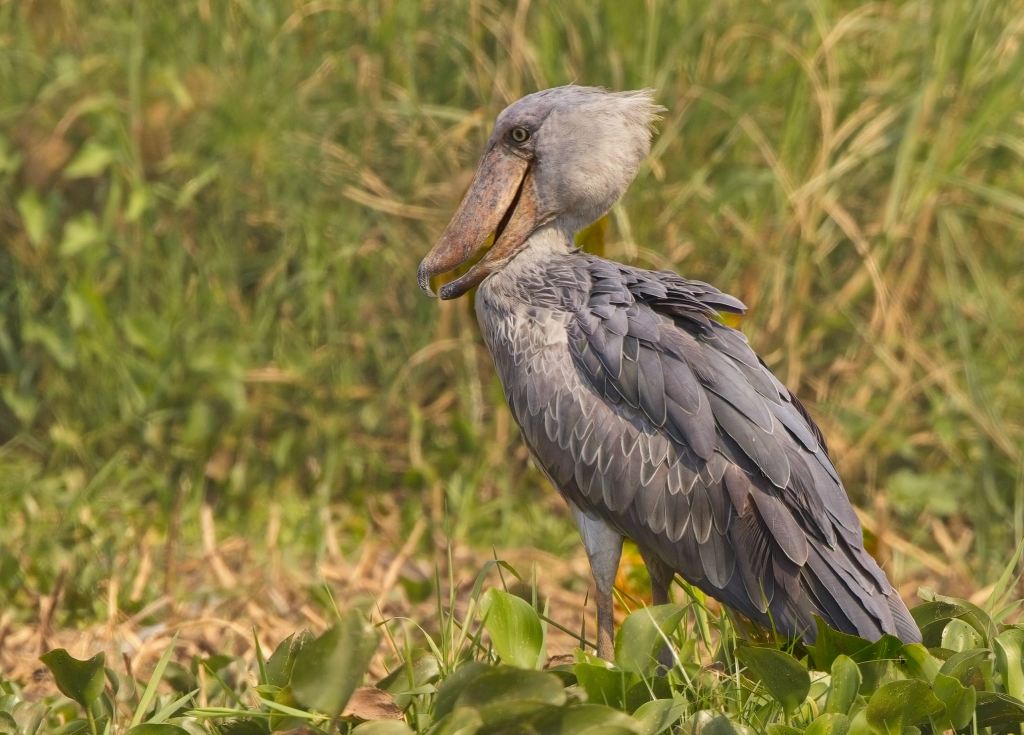
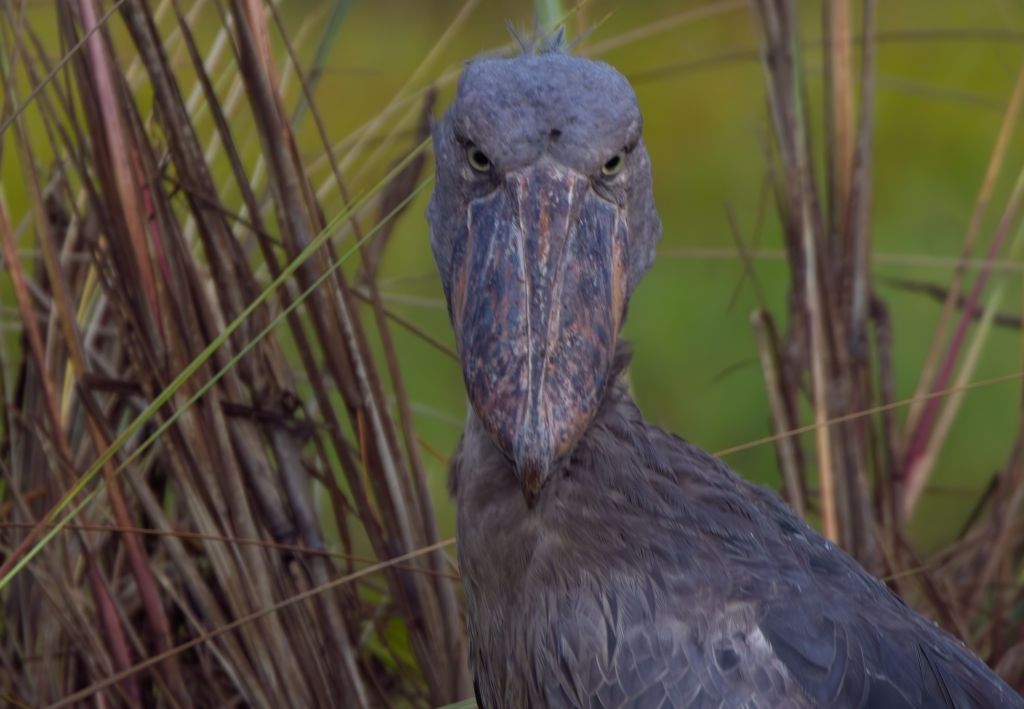
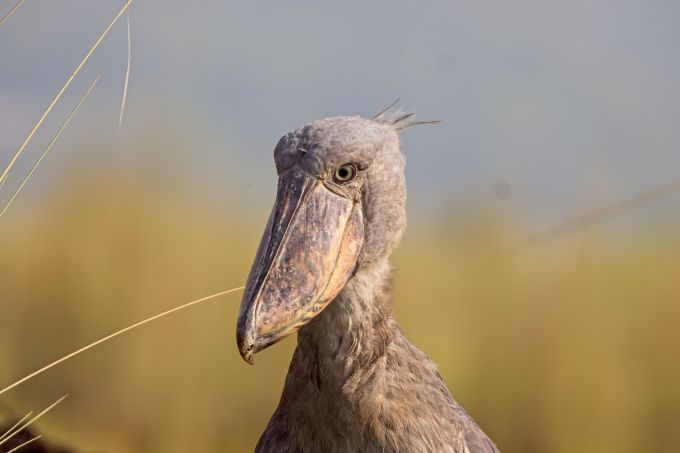
We got to the Mabamba Swamp and Wetlands around 8 a.m. and got on our small boat with our guide at the front and an oarsman at the back. It was the perfect craft to explore the wetlands and to get close to the many birds making it their home. We spent several hours there logging in 50 species and I was able to get photos of more than half of them. This is the best place in Africa, probably in the world, to find a Shoebill, a simply incredible bird. There were several treats along the way, but it did not take too long to find a Shoebill, as there were already several boats stopped along one of the many channels with passengers focused on this magnificent bird. Our guide pointed ahead and she expertly guided us to a good position for views and photos. You can see a photo of a Shoebill and easily acknowledge how unique they are, but seeing one in person is many times better, hard to believe they are real, looking like some prehistoric creature. I took more than 100 photos and could have chosen almost any to include here. Remember that they can be 5 feet tall, weigh 12 pounds (a lot for a bird with flight) and have a wingspan of 7.5 feet. They can remain motionless for long periods of time before grabbing a lungfish, its favorite prey. This lifer was definitely one of the highlights of the trip – and it was only formally day 1.

Shoebill – Is It a Bird or a Prehistoric Monster?

We watched the Shoebill for 30 minutes, and it was very hard to say goodbye, but other birds beckoned. It would take too long to chronicle them all. I have chosen some of the better photos but am leaving out some really nice birds.

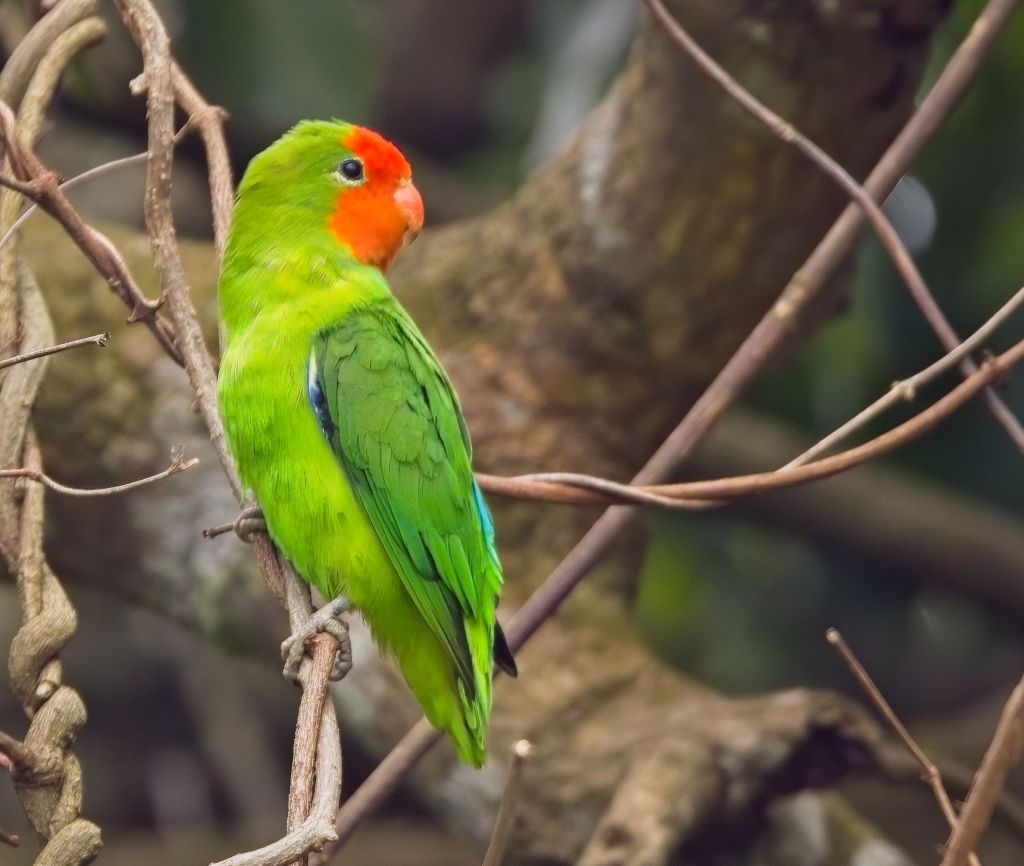
There are 9 species of Lovebirds in the world. I have seen 4 species including the Rosy-faced Lovebird as an introduced species in both Arizona and Hawaii. All 9 are native to Africa or Madagascar. Last year in Tanzania, I added Fischer’s and Yellow-collared Lovebirds to my life list in and this day I added the Red-headed Lovebird. They are small to medium sized parrots with large heads and are definitely “cute”. The only other parrots seen in Uganda were Meyer’s and Gray Parrots both of which I had seen previously.

Red-headed Lovebird – Lifer

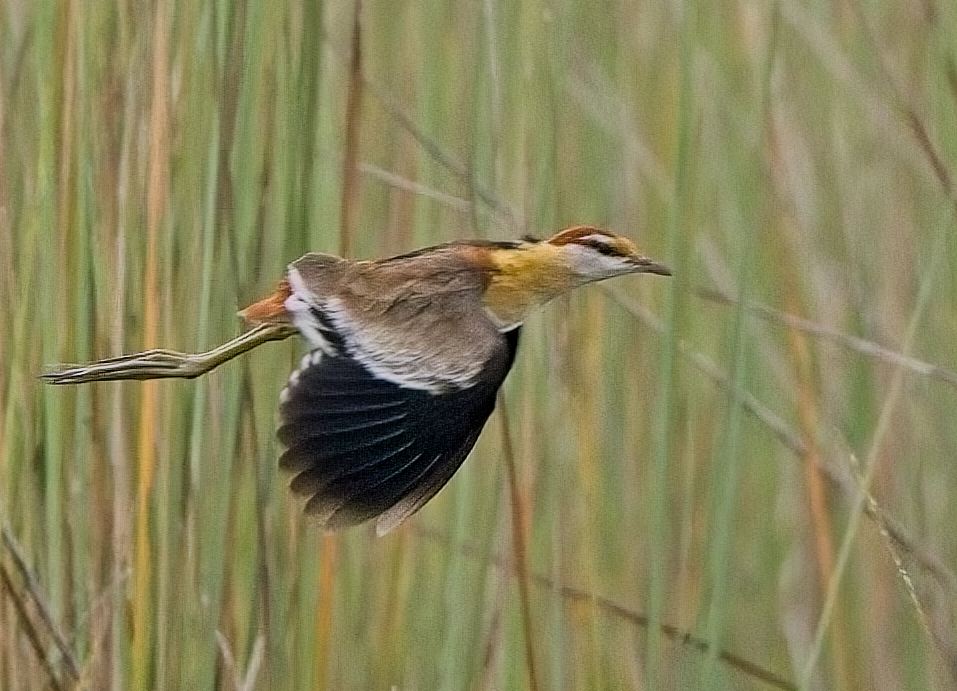
There were two other lifers seen at Mabamba Swamp – Blue-headed Coucal and Lesser Jacana. Missing a photo of the former was just stupid on my part. By the time I realized the coucal that I was watching was Blue-headed and not White-browed, it flew off. Opportunity lost. The Lesser Jacana was a success. It is a difficult bird to find and particularly difficult to photograph as it is very jumpy and does not let you get close. It flies off quickly and disappears in the grass. We found two – neither close and I was lucky to get at least ID quality flight shots – highly enlarged.

Lesser Jacana – Lifer

One last picture and story from the Mabamba Swamp. In Tanzania at Gibb’s Farm I had my lifer African Blue Flycatcher, a very lovely all blue bird. Don’t ask why, but it was just after lunch and I did not have my camera. We never saw another one, so I was sure to get a photo when I saw one at Mabamba Swamp. Unfortunately it took off just as I got onto it, not the greatest but a lifer photo nonetheless.

African Blue Flycatcher

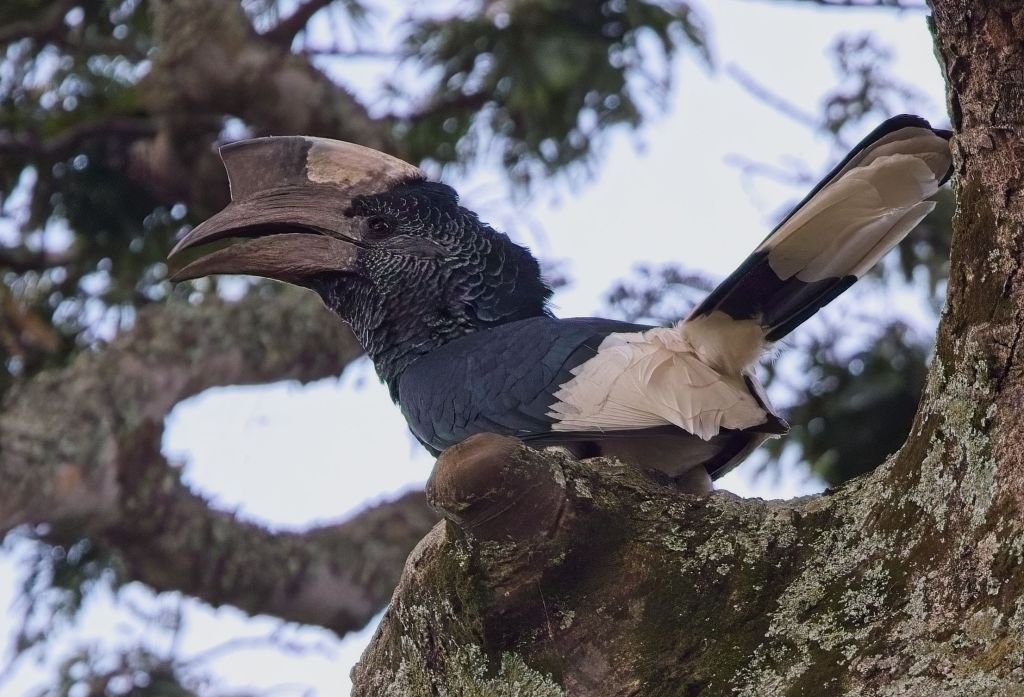
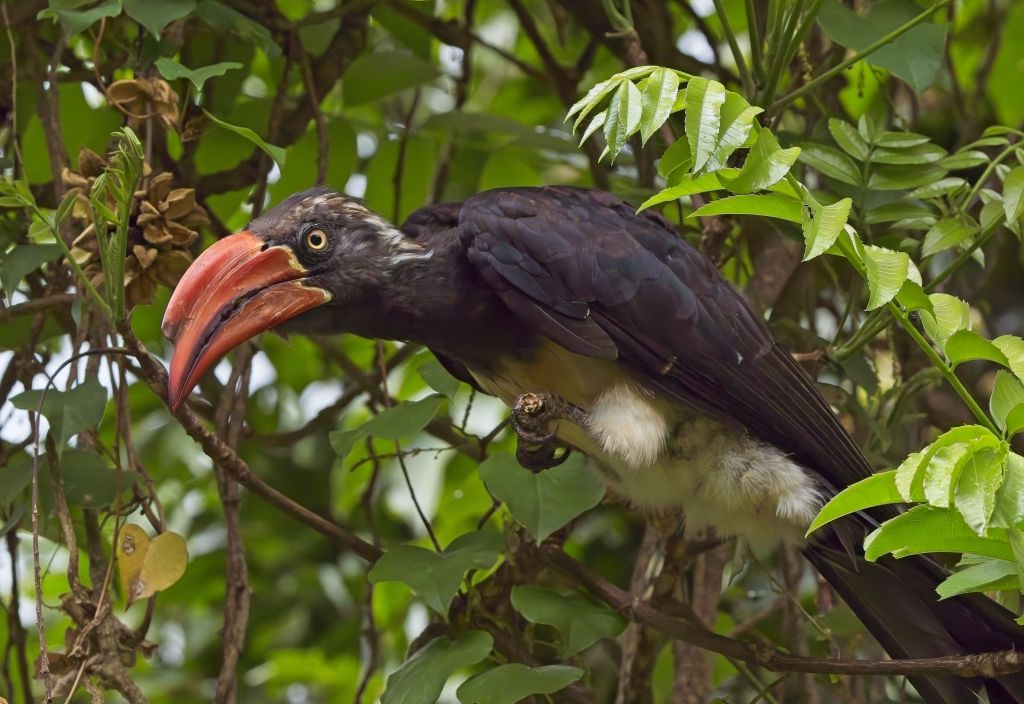
After our great boat ride we would return to the Boma Guesthouse with some stops along the way including at Nkima Forest Lodge where we had lunch and picked up a Crowned Hornbill and White Spotted Flufftail. Neither were lifers and I had photos of both but added the Hornbill to my Uganda photo list. Later we added Long-crested Eagle and White Hooded Vulture on the road and then at the end of the day, we birded the Entebbe Botanical Garden – often a great birding spot and we did have 37 species, but Dion said it was slower than usual. Our best species was a Bat Hawk. I thought I had a photo but cannot find one – a big disappointment. Other lifers for me were an Orange Weaver and an Olive-bellied Sunbird. The former was very distant and I had only a brief scope view. We also had our first Black-and-white-casqued Hornbill.

Olive Bellied Sunbird – Lifer

At the end of the day, my Uganda list stood at 96 species and I had added 16 species to my World Life list and about the same to my world photo list. The Shoebill was the highlight and the boat trip was a complete success – equally enjoyed by Cindy who continued to revel at the Shoebill sighting as well as the Kingfishers. We had grilled tilapia for dinner – tasting better than we remembered it from elsewhere. We were ready for more.

Africa: Where Next? Uganda

When we returned from our trip to Tanzania last year (see my earlier blog posts), Cindy said she wanted to do another Africa trip. I had been to Kenya and South Africa and loved those visits and although I would have enjoyed a reprise, I was more keen on a new country. Accordingly our thoughts turned to Botswana, Namibia etc. and to Uganda. Both options seemed to provide opportunities to see some African bird species that would be new to me in addition to the mammals that had beguiled Cindy in Tanzania. The great appeal of the first option was visiting the Okavango which received universal rave reviews. The special appeal of the second was the unique chance to see Mountain Gorillas and Chimpanzees and also to see a Shoebill, one of the most extraordinary birds anywhere. Based primarily on matters of cost and timing, our focus turned to Uganda, west of Kenya and north of Tanzania and smaller than both.

I am going to start with a retrospective post tour and will return to some challenges, complications and details following the choice later, and then per my usual approach in these blogs will detail the actual tour with stories and photos. The bottom line in retrospect was that there were some fantastic moments on the Uganda tour and we did return sound and safe with new birds, new mammals and yes the Shoebill, those gorillas and chimpanzees; BUT if we had known beforehand how the trip would go, we probably would not have gone on this trip. The positives outweighed the negatives but it was closer than it should have been and far closer than on any other trip we or I have taken.

ShoebillUp to 5 feet tall with a 7.5 foot wingspan

Back to the beginning. Our original plan was to go on a private tour with Greg Homel who had been such a super guide on my visit to Puerto Vallarta and San Blas Mexico in late 2023. Greg had led Uganda tours many times and had what at least had been a great working relationship with a top rate local company and guide in Uganda. Cindy and I talked about the possible trip with two friends (unnamed for now) who we had not traveled with before but were eager to go somewhere with them. Somewhat surprisingly, they were interested and we found a workable time with Greg and started putting together details for a trip for 4 of us. I am not going to belabor the story, but due to some management changes at Greg’s Ugandan partner, their responses and proposals were a combination of slow and far too expensive – even with our expectations that a private small group tour would be more pricey than with a larger group. Greg was as frustrated as we were and as we watched this approach fall apart we looked for alternatives.

To our astonishment we found that there were openings on a Uganda tour offered by Victor Emanuel Nature Tours (VENT) that was scheduled for close to the same time that we were considering and with essentially the same itinerary. VENT was our tour company in Tanzania and we knew the quality would be excellent. Even though there were only two people signed up for the trip, VENT said it would be a go with two more commitments. The price was less than Greg had been able to provide based on the pricing from his Uganda partners. We shared this information with our friends and Greg who shared it with his Uganda partners, who in turn said they just could not meet the price. Our friends were unhappy with the process from Greg’s group – which dragged out over some weeks, and this carried over to a general unease on this trip – which would have been a big first step for them in any event.

Our Itinerary

To end the story, Cindy and I committed to the VENT tour – at which point Greg’s partners came back and said they would match the price. We had had enough and despite a strong desire to go with Greg, we sent funds to VENT and that was that. Our friends decided to wait for another travel opportunity, in part influenced by some changes that had happened to their schedule. Not the best foundation for starting a trip, but the itinerary looked good and there was appeal in having a small group with a reliable company. Stay tuned…

More complications ahead. Not unexpectedly a visa was needed to visit Uganda. Visas have always been easy to get for other trips if needed – easy application, pay the price and done. The online process was extremely frustrating and one requirement was particularly challenging. For some reason a Yellow Fever vaccination was required to enter the country. Given that the exposure to Yellow Fever would be while in the country and thus the traveler’s problem, this requirement seemed to protect the traveler and not Uganda. Why? It turned out that Yellow Fever vaccinations are not easy to come by and are very expensive in addition. We found that Costco had the vaccinations available – after a process of consultation online with a Travel Health Advisor. Ok, we did that only to find that they recommended against yellow fever vaccinations for anyone over 65 as the risk of complications from the vaccine was greater than the risk of the disease itself. So Costco would not provide the vaccination, instead offering an official waiver form. Now another complication. The visa application was very problematic with among other things the need to attach very small sized copies of various photos and documents. Cindy went through the process first with many starts and stops as the online process rejected documents or just gave up. She indicated no vaccination, just a waiver. Finally she got it done and received a confirmation that the application was accepted and being processed. A few days later, she got notice that it was approved.

Now it was my turn and I had similar problems attaching documents and a faltering online process. Finally all the attachments were accepted and it came time to pay. I entered the correct information for the credit card (the same one accepted for Cindy’s application). The system crashed without acknowledging receipt or non-receipt. Worse, now there was an official application, which I could not reopen to modify and/or try again to pay. What next? I tried repeatedly to reopen the process and got the same message that there already was an application filed for that passport, and another could not be filed. After several stressful days including unanswered calls to the number provided for the Ugandan embassy, I found an email address for the director of immigration and explained the problem. I finally got a response with a way to make payment and I did. Another two days later the notice came that it was approved. Would that end the matter? Well maybe. It was not at all clear that when we showed up in Uganda, that our yellow fever vaccination waiver would actually be accepted. And later it came up as we checked in for our flight. We were allowed to board, but there was some skepticism as to whether we would be allowed to enter.

So after the stress of getting the tour commitment, there was the added and really quite great stress with the visas. Not holding you in suspense, when we arrived at the airport in Entebbe, Uganda – at around 4:00 a.m., our documents were approved almost perfunctorily and no attention was paid at all to the waiver. The notice of acceptance from the Directorate of Citizenship and Immigration was all that was needed and our passports were stamped and we were good to go. But there would be more stress ahead – some self inflicted. The tour materials provided by VENT indicated that credit cards were commonly accepted and that there would be opportunities to use ATM’s in the country. Even so, as we had done for our Tanzania trip, we should have gotten some foreign exchange to take with us. We did not, and we made matters worse since we arrived at the airport so early, we did not get Ugandan shillings there either. Our lack of this currency would rear an ugly head throughout the trip. Nothing was uglier than when we finally got to an ATM midway through the tour as they were most definitely NOT commonly available, the ATM not only did not provide funds, but confiscated the card. AAARGH!!! AND many/most places did not accept credit cards and if any American currency was accepted, it had to be crisp and recently printed.

After all the preliminary stress, the trip to Uganda was actually quite good. We gave ourselves a gift by flying business class starting with a long 11 hour non-stop flight from Seattle to Istanbul on Turkish Airlines. The lay-flat seats were great, the ride was comfortable and the service excellent even if offerings of water were rare. The Istanbul Airport is pretty new and very impressive. Finding and getting to our connecting flight to Entebbe (with a short stop in Kigali Rwanda) was easy and quick with a relatively quick layover. If anything, we would have enjoyed a longer layover as we hear that the Turkish Airlines lounge in Istanbul is superb. Our flight to Kigali left on schedule. The seats were not as luxurious as on the first flight, but very comfortable and the entertainment system was good. Six plus hours hardly seemed that long. Then a short stop in Rwanda and then on to Entebbe. There is always that moment of dread as you leave the airport counting on someone with your name on a sign who will get you to your hotel – especially when you arrive so early. He was there and not more than 20 minutes later we were at the Boma Hotel – our tour semi-officially on its way – the formal tour to actually start at dinner the next day.

Business Class on Turkish Airlines

Although at the end we are glad that our friends did not come on this tour due to some of the challenges, it sure would have been nice to have had them with us. From the start when we met the two other members of the group, there were concerns. No reason to go into details as we will never see them again. I will just leave it that we were not fans and there were issues that arose far too frequently. I cannot think of many if any people that Cindy, the always good hearted and good natured person that she is, cannot get along with. But it happened here – not horribly obnoxious as some people I have seen are – but enough chafing to actually make much of the trip unpleasant. Unlike other trips where for example meals with the group are fun with shared stories etc., these were silent – eat and be gone. That’s enough on that – no war stories. Just sad. Blogs to follow will talk about places and animals – birds and mammals and some people – the Ugandans that we met along the way. Mostly positive to great with a couple of not so great. Especially, wonderful Ugandan people who were in many ways the best part of the trip. We thoroughly enjoyed our first accommodation at the Boma Hotel in Entebbe. Our trip would end there as well. Let’s go.